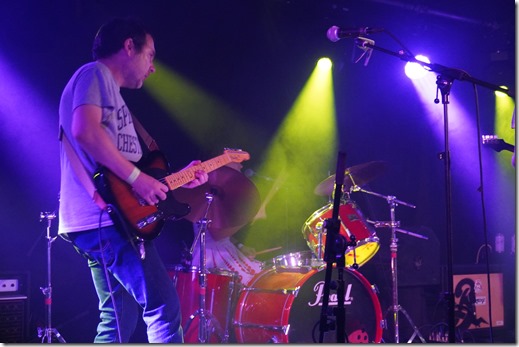
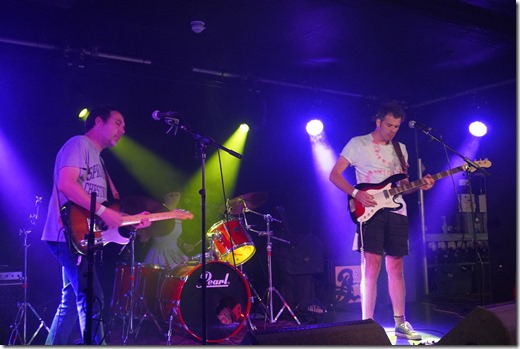
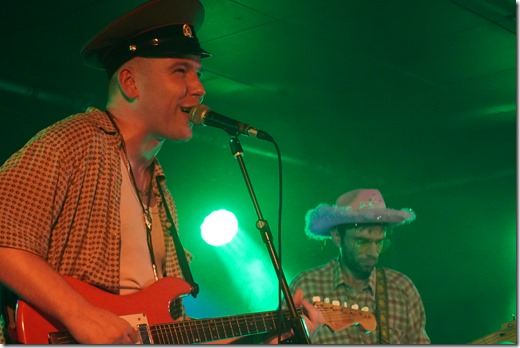
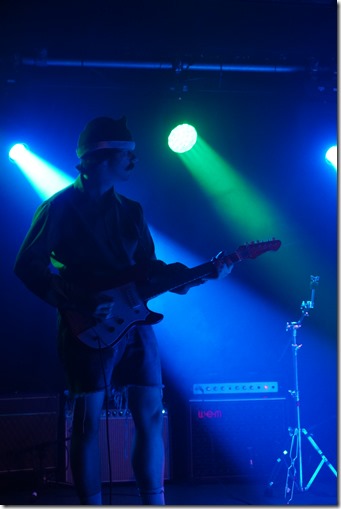
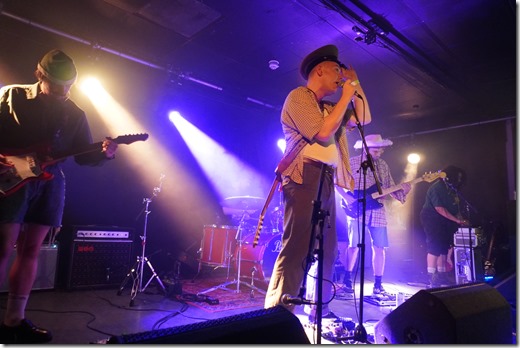
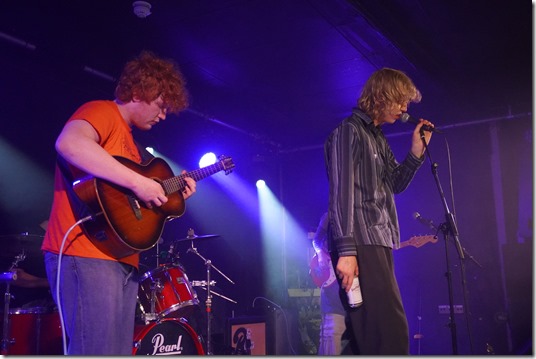
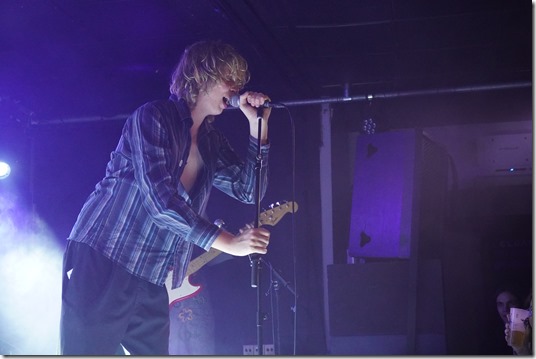
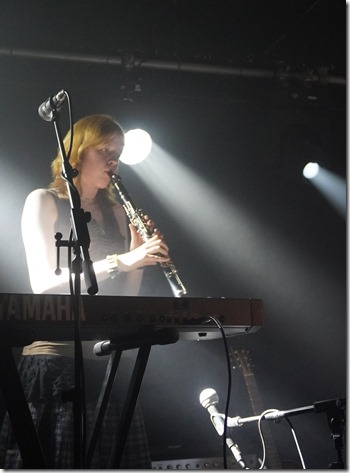
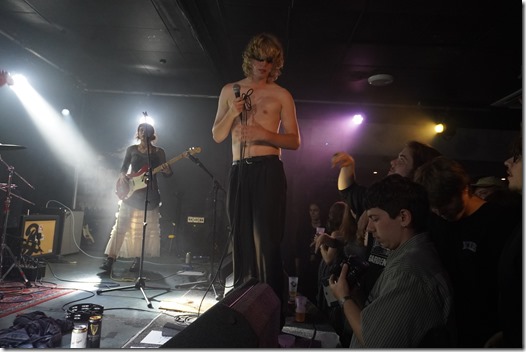
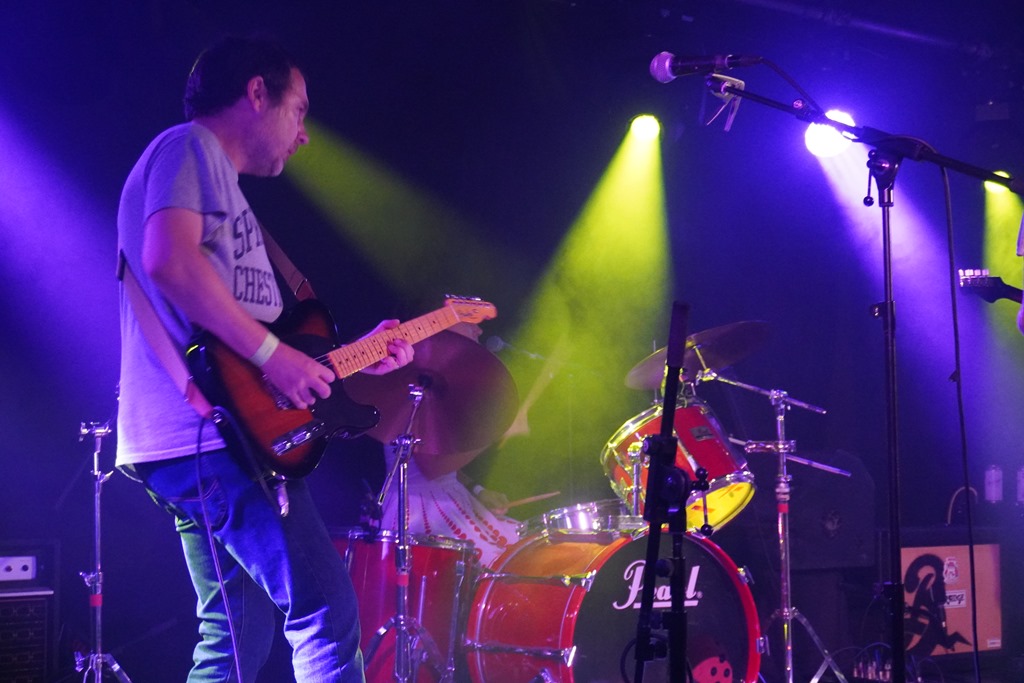
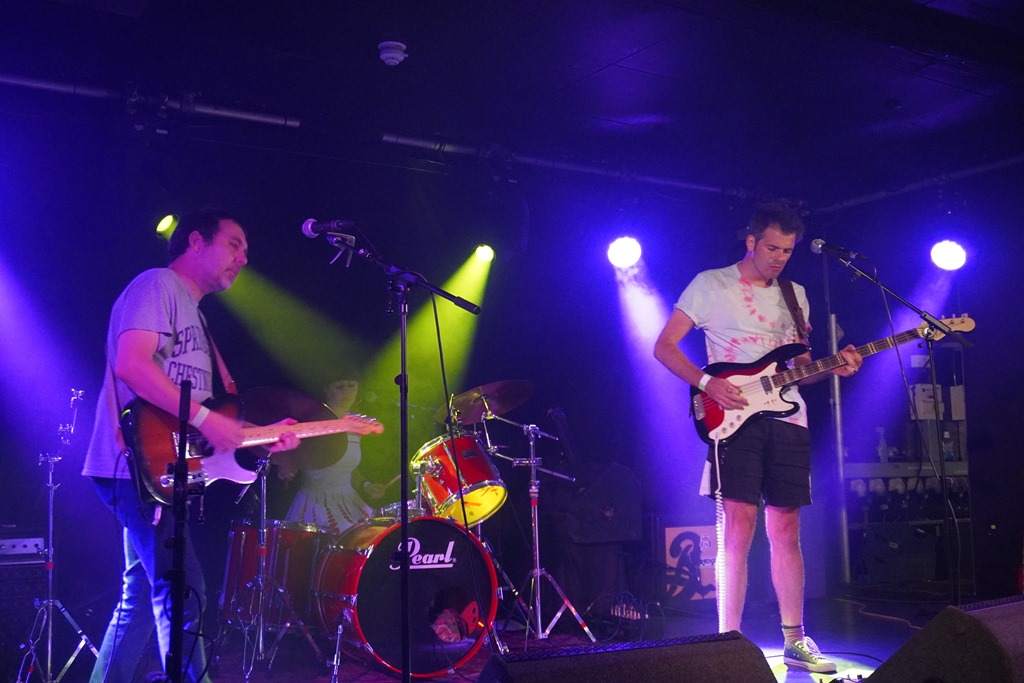
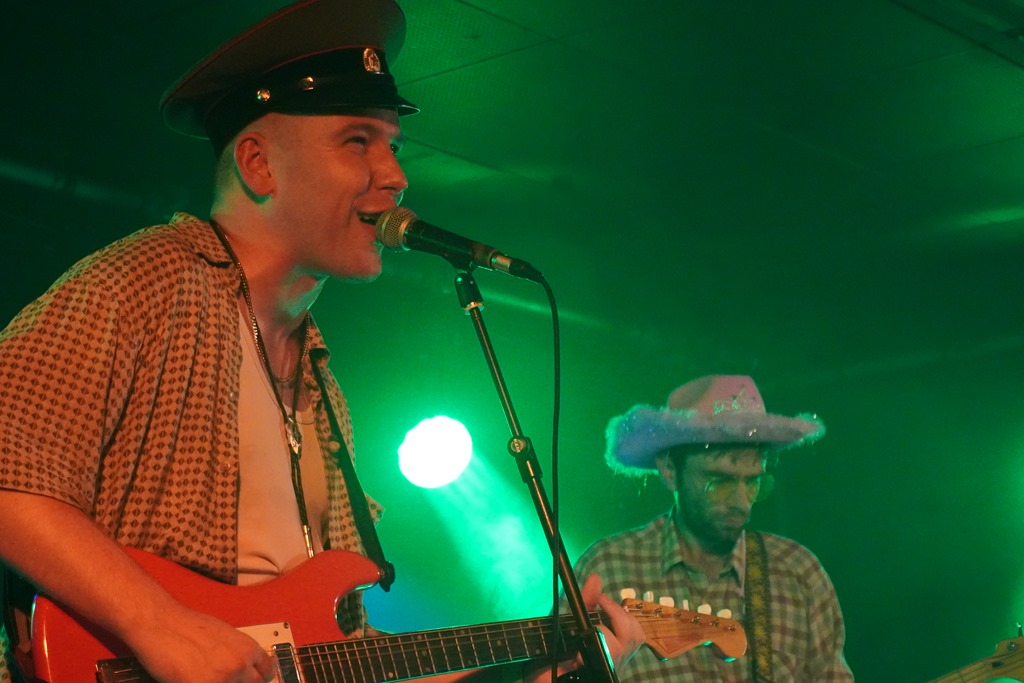
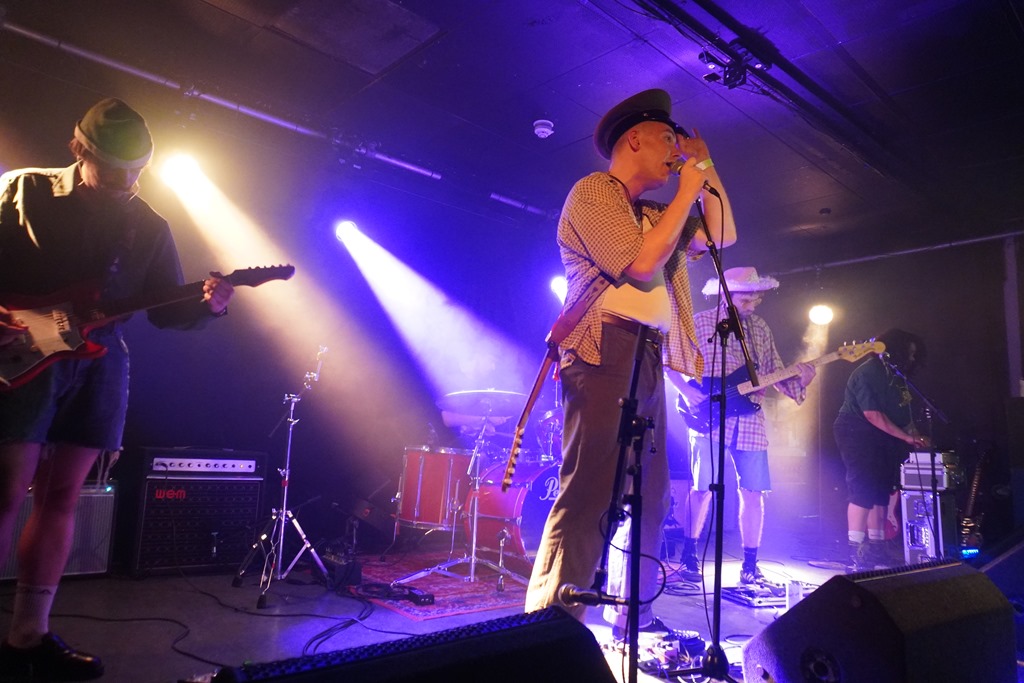
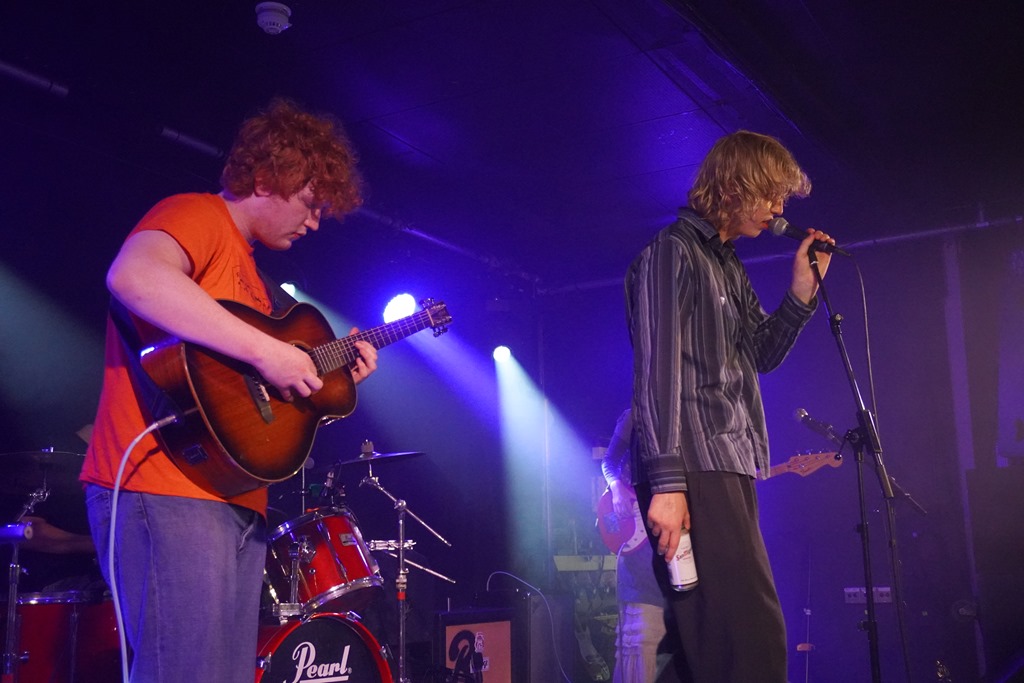
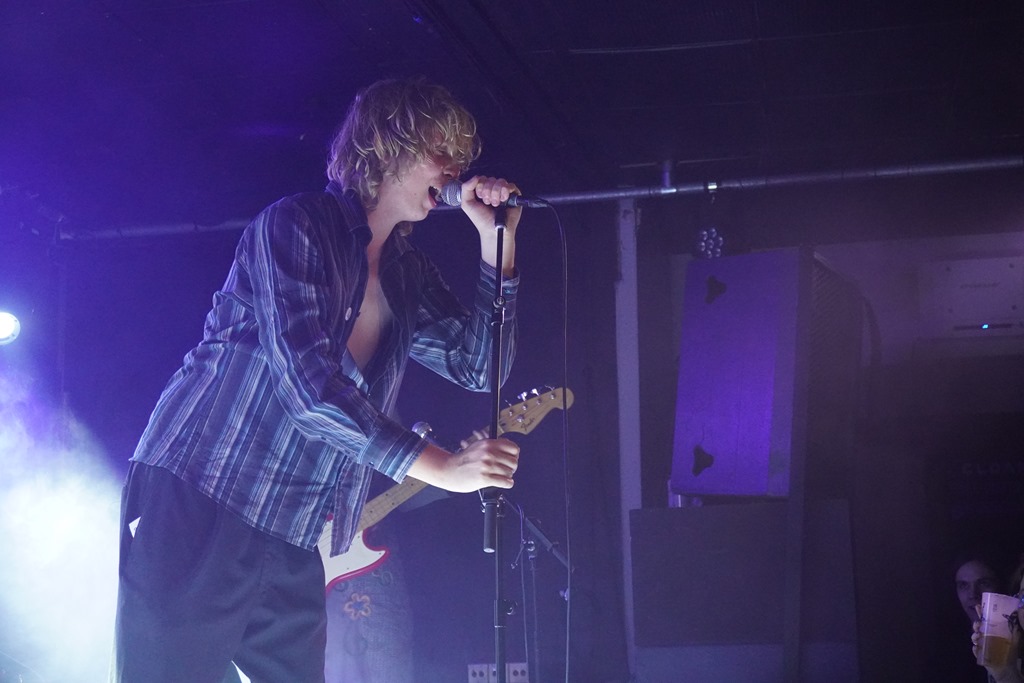
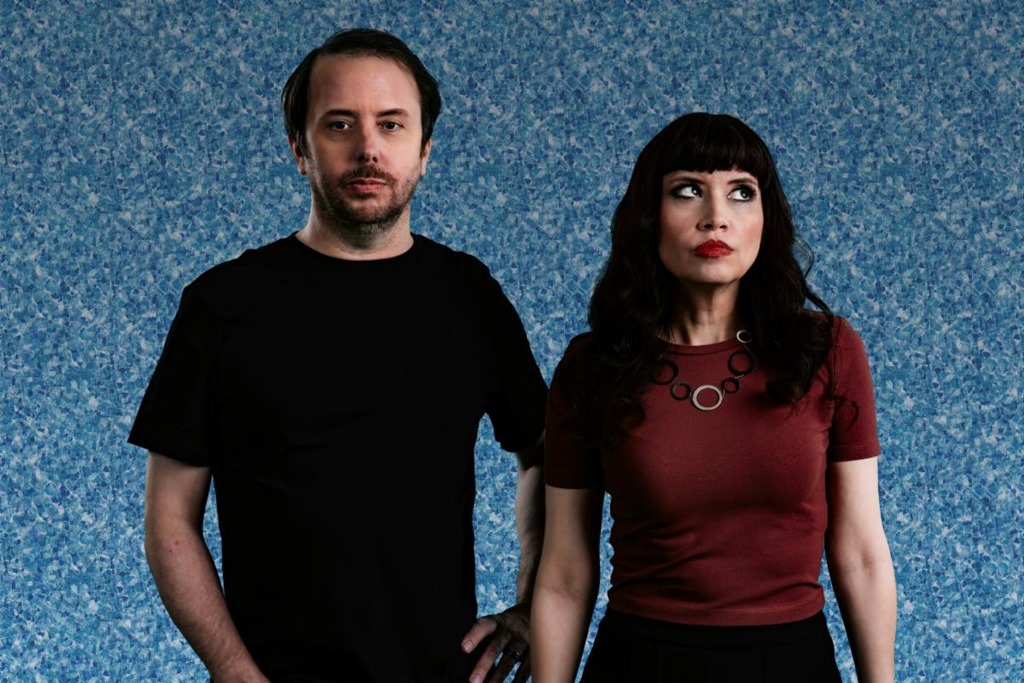
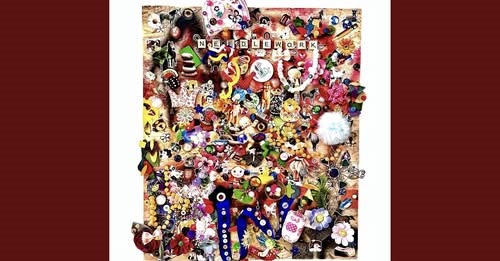
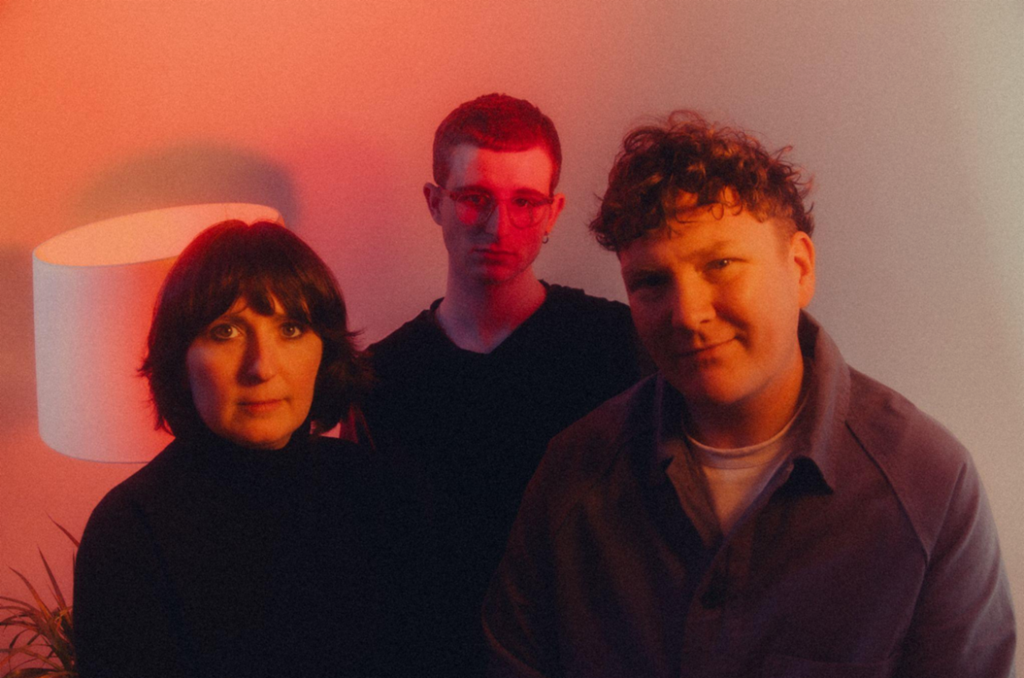
Ah, Shoe York, indeed… I find some amusement in the fact that the original York feel compelled to reference its later tribute city. I’m not sure if Brew York is just a plain pub or born out of a feeling that punning on New York may be in some way beneficial to their profile – but they do make some great beers and are doing well in terms of distribution and expanding their pub outlets, and this can only be a good thing. Shoe York, meanwhile, offers a nigh of shoegaze courtesy of a trio of local acts.
Some MBV lurches from the PA as I find a surface to lodge my pint of porter, and the place is filling up early doors, which is encouraging, and also heartening. Grassroots venues tend to survive on tribute bands and the bigger visiting bands, so to see a local night so well-attended is significant.
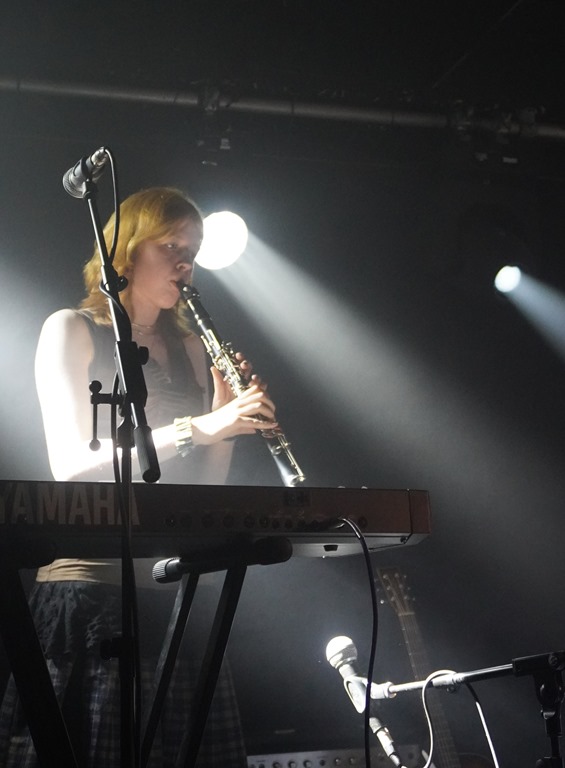
Joseph B Paul does a line in New Order / Joy Division influenced pop that at times sounds more like a darkly spun reimagining of Erasure. The setup is with live guitar, and everything else sequenced, and the drums are way too low in the mix, depriving the songs of the groove that’s clearly integral to their form. In contrast, the vocals are possibly a bit too forward, and devoid of any reverb, they sit on top of, rather than within the arrangements. Joseph does some bouncy dancing and it’s all very 80s, and perhaps there are dreampop elements in the mix, but it doesn’t exactly feel shoesgaze as much as shoehorned.
Joseph B Paul
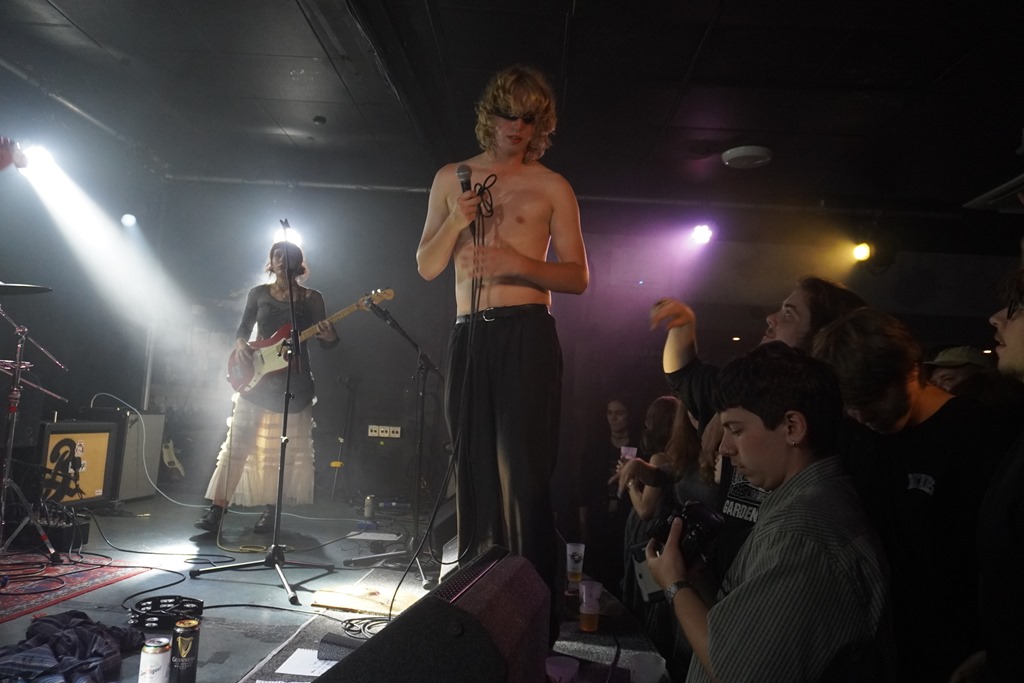
Suddenly, it’s absolutely rammed by the time Moongate take the stage. There is a bar queue, too. I don’t simply mean the bar is busy: there is a queue of individuals snaking back halfway into the rows of people facing the stage. This is wrong. It is not how bars work. I circumnavigate the queue. I don’t get served much quicker, but feel some sense of relief in not perpetuating this dismal wrongness, and I do make it back to the front in time for Moongate.
Moongate do a nice line in dreamy indie that jangles, drifts, and washes gently with a hint of melancholy over the ears, and Joseph has a lot to answer for, being the subject of around 75% of the set, the subject matter of which is predominantly heartbreak, breakups and breakdowns. It’s a nice set, and they’ve got clear potential – and more so when the singer moves on from Joseph.
Moongate
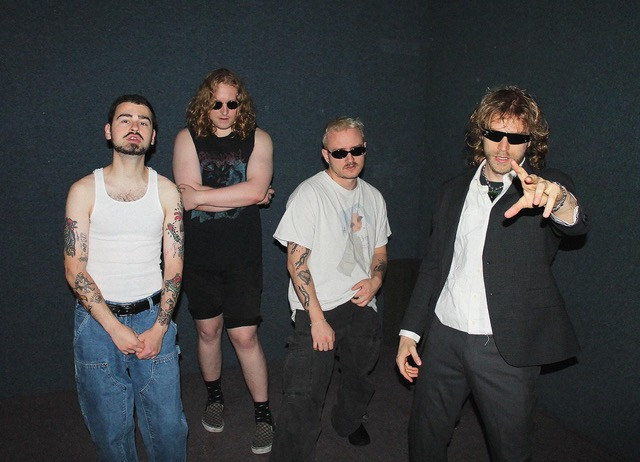
Aiming are three serious, studious, earnest bearded young men. Their drum machine is also low in the mix, but with a crisp, Roland snare sound cutting through the swathes of layering guitar and synths. The live bass has a bouncy groove and is really solid in a 4/4 chuggalong way. In fact, the bassist is excellent, delivering sturdy low-end, and this works: the band have a certain energy and a level of polish that’s slick but nor completely slock or passionless.
The band don’t do chat, but the audience does. This is the most loudly talkative audience I’ve experienced in a while, it’s positively a roar between songs.
Aiming
The song they announce as a new song is perhaps the strongest of the set, which is encouraging, with a delicate melody and solid guitar and bass fusing together. It works well, but there are no real surges or crescendos, and as much as these may be more overtly shoegaze in forms, on this outing… they could do better. But… they’re tight, melodic, captivating, and go down a storm.
It seems quite remarkable that Pink Turns Blue are still going a full forty years on from their formation in Berlin in 1985. Starting out as a duo consisting of Thomas Elbern (vocals and guitars), Mic Jogwer (vocals, bass and keyboards) and a drum machine, they’re considered a part of Germany’s first wave of gothic rock.
The history of goth is certainly a divergent one: the hotbed of dark post-punk that was Leeds in the early 80s spawned a host of bands approximately simultaneous with the emergence of The Cure and Siouxsie and the Banshees, and Germany latched on to them and The Sisters of Mercy early on – so in relative terms 1985 feels like being late to the party. But at the same time, this was a peak year for goth across the continent.
As a personal aside, despite being deep into my goth once I discovered The Sisters and The Mission in 87/88 (late? I was 12/13 and simply too young to be into anything other than Duran Duran and Madness in 84-85) my introduction to Pink Turns Blue was 1994’s Sonic Dust, which was floating around at the second-hand record shop I worked at on weekends. It very much sounded like the indie stuff of the time, but perhaps with a dark edge, but gave no hint of the band’s history.
Since then, they’ve returned to their roots somewhat, and Tainted (2021) was a dark, brooding masterpiece which largely went under the radar, largely like the band’s output as a whole. But while latter-day acts like Editors and Interpol draw the media and commercial attention, Pink Turns Blue just keep on. And Black Swan is a classic addition to their catalogue.
The chiming, picked guitar of ‘Follow Me’, brings an instant pang of melancholy. The rippling synths and crisp drums make everything tight and the sadness begins to permeate. It’s a wistful, reflective sensation: this is where Pink Turns Blue excel. Their songs are drenched with an aching weight.
Jogwer’s clipped vocal delivery sits perfectly with the rolling bass and insistent rhythms, which underpin guitars which wash and chug in neatly-orchestrated duels. And so it is that Pink Turns Blue make music that’s dynamic, exciting, and sad, at the same time.
Single cut ‘Can’t Do Without You’ is simultaneously perfect pop and melancholy indie, and ‘Dancing Wirth Ghosts’, another single, brings the jangle of The Sisters’ First and Last and Always in a style that’s reminiscent of ‘Walk Away’ and ‘No Time to Cry’. Because it’s still possible to be pop and intense and claustrophobic. ‘Fighting for the Right Side’ steps things up and punches hard.
‘Why Can’t We Just Move On’ reminds me more of Slow Readers Club, dark-inflected indie / alternative, with a vibe that balances mellowness and melancholy with a certain tension, and this is really where Pink Turns Blue excel. The title track – by far the album’s longest song, clocking in at nearly six minutes – really taps into emotional undercurrents with its downtempo, reflective styling. There’s no one thing that one can identify as the thing – it’s all about the mood, the delivery. It goes beneath the surface, resonates on a level that’s beyond the articulation of cause and effect: it’s simply achingly sad, but at the same time, utterly beautiful.
Pink Turns Blue have a quite unique take on mid-80s post-punk / goth, and unlike many of the bands which emerged from the class of ‘85-’87, they don’t conform to the clichés to the tropes, the template which became predictable and tedious so quickly, and yet has endured, with every other band doing doomy baritone, aping Craig Adams’ bass pinned to a thumping drum machine. And this is integral to their enduring appeal. They don’t carbon copy The Sisters of Mercy, they’re not another Rose of Avalanche. Yes, they do incorporate certain elements, as ‘Please Don’t Ask Me Why’, with its thumping bass groove and chorus-heavy guitars evidences, but at the same time, they do something different and sound uniquely Pink Turns Blue, and it’s not only the German inflection. Again, it’s not easy to pinpoint the difference: the simple fact is that it’s tangible. Black Swan is a great album: it’s consistent, it’s got mood and feeling, and has something that’s just beyond reach, and that is magic.
Richard Rouska is something of a cult legend in his own lifetime: back in the 80s he was pivotal in the Leeds zine scene, documenting the emerging post-punk movement Leeds remains so renowned for, in real-time, subsequently writing a number of books. Along the way, he’s made some music of his own, recently making Well Martin This is Different his primary focus, with some prolific results. Finding The Ai G-Spot is WMTID’s fifth since their inception in the mid-late eighties, and serves up a set of remixes, with proceeds from any donations going to the Throat Cancer Fund.
And yes, it certainly is different, and that’s clear from the get-go. WMTID’s music is essentially electronica, but draws on a host of elements which have their origins in different decades and different scenes. I will admit that I misread the title as Finding The Ali G-Spot initially. Ai-iit! But while this album draws on a huge array of influences, you won’t find any naff cultural appropriations.
‘The Prince is Dead (Again)’ is a twisted hybrid of lo-fi post-punk, 80s electronic industrial (think Wax Trax! stuff in the late 80s / early 90s), space rock, and Krautrock, a motorik groove stricken through with some wild orchestral strikes and multi-layered vocals – and this is to an extent the template: ‘03:33 Time’s Up’ is exactly the same duration as the original version (‘333’) which appeared on I Know What You Are But Who Am I? in the Autumn of 2024, tweaked to optimise the hypnotic rhythm and detached-sounding vocals. The result is somewhere between DAF and early Human League. ‘Deep Down Low II’ – again reworking a track from I Know What You Are goes full-on techno / cybergoth stomper, with industrial-strength beats pounding away relentlessly. It works so well because it doesn’t take from the original, instead simply rendering it… more. More. MORE! And I want MORE!
There are hints of both KMFDM and very early New Order about ‘It’s (Another) Lovely Day’, but then, it’s as much a work of buoyant lo-fo indie and bedroom pop, while ‘Little Bombshells’ comes on a bit Prodigy, but again, a bit technoindustrial, and a bit kinda oddball, bleepy, bloopy, twitchy, stuttery, the vocals quavering in a wash of reverb as crashes of distortion detonate unexpectedly. Elsewhere, ‘Waiting For The End…’ goes dark and low and robotic, and ‘Three O’Clock Killer’ is hyperactive and warped, and brings menacing lyrics atop a baggy 90s beat.
It really is all going on here, and the end result feels like a wonderfully eclectic celebration of music, articulated through some quite simple compositions, all of which have solid grooves providing the backbone of each.
My general opinion of remix albums is widely documented and not entirely enthusiastic, but Finding The Ai G-Spot is a rare exception, mostly because it doesn’t feel like a remix album an doesn’t offer three or four unnecessary and unrecognisable versions of each song, boring the arse off all but the most obsessive fan. In fact, if you’re not up to speed on WMTID’s output – and there’s a fair chance you may not be, to be fair – Finding The Ai G-Spot offers a neat entry point and summarises the last couple of albums nicely, too.
This split release has a lengthy backstory, which is given in full on the label’s Bandcamp page – but the short version is that when York’s Neon Kittens (how had I not heard (of) them, given that they appear to be from round my way and absolutely my bag? I feel ashamed, and fear I cannot even remotely claim to have the finger on the pulse of my local scene right now – but still, better late than never, right?) approached The Bordellos about a collaboration, the latter, having taken an eternity to only half-finish their current album-in-progress, some ten years after the release of will.i.am, you’re really nothing, offered everything they had for a split release. And lo, this is it.
I suppose the eight songs Neon Kittens have contributed here provide a solid starting point to their rapidly-expanding catalogue, and being paired with The Bordellos works a treat. Both espouse the same lo-fi DIY ethic, with a certain leaning toward indie with a trashy punk aesthetic.
That the cassette edition sold out on advance orders hints at the anticipation for the release: for, as The Bordellos describe themselves as being ‘ignored by millions, loathed by some, loved by a select few’, when you’ve got a small but devoted following, they get pretty excited for new material.
‘Set Your Heart to the Sun’ is perfectly representative of their scratchy, harmony-filled indie – kinda jangly, a tad ramshackle, but direct, immediate. Dee Claw’s airy vocal contributions really lift the sound and raise the melodic aspects of the songs. Not all of the songs have full drum-kit percussion, often favouring tambourine or bongos or seemingly whatever comes to hand, and more than any other acts, I’m reminded of Silver Jews or really, really early Pavement – those EPs that sounded like they were recorded on a condenser mic from the next room with more tape hiss than music, but still undeniably great tunes. And yes, they really do have great tunes – overall, they’re pretty laid-back in their approach to, well, everything: remember when ‘slacker; was a thing? Yeah. In place of polish, they have reverb, and these songs tickle the ears with joy.
Neon Kittens bring a rather denser sound and a greater sense of urgency with the buzzy, scuzzy ‘Better Stronger Faster’. A hyperactive drum machine stutters and flickers away beneath a sonic haze of fuzzy guitar: there are hints of Metal Urbain crossed with The Fall and Flying Lizards in the mix, while ‘All Done by Numbers’ brings Shellac and Trumans Water together in a head-on collision – and one suspects any similarity to Shellac’s ‘New Number Order’ is entirely intentional from a band who recently featured on a Jesus Lizard tribute. ‘Cold Leather’ presents a spoken word narrative over a lurching, lumbering morass of discord, held together by the whip crack of the snare of a vintage-sounding drum machine.
The majority of their songs are around the two-minute mark, and crash in, slap you round the chops, and are done before you really know what’s hit you. ‘Deaf Metal’ is a work of beautiful chaos, constructed around a thick, rumbling bass and rolling drums., while the rather longer ‘White Flag’ is almost a stab at a grunge-pop song, while the discordant clang of ‘Sailing in a Paper Boat’ is absolutely The Fall circa Hex Enduction Hour: lo-fi post-punk racket doesn’t get much better than this.
As they near the end of their UK and European tour, Leatherette are back with their latest single ‘Delusional’, the follow-up to the cathartic breakup anthem ‘Itchy’.
‘Delusional’ is a powerful song that explores the complex emotions of yearning for connection while feeling disconnected from the world around you. A song for those caught between the urge to dance and the desire to leave without saying goodbye. The track encapsulates the struggle of wanting to fit in with someone you love while feeling like an outsider in their world.
Musically, ‘Delusional’ weaves together elements from different eras and genres, fusing the gritty sound of ’90s alternative rock with modern influences drawn from hip-hop and electronic music. The result is a dynamic and engaging sonic experience that reflects the longing for connection and acceptance.
After testing the songs live during their second album Small Talk tour last year, they decided to record them spontaneously at home, in messy rooms and using cheap instruments (including unlikely ones such as mandolin and bouzouki).
“Being eternally dissatisfied, but also tireless explorers, we decided to return to our origins, seeking the expressive freedom that can be found in DIY”. The result was then entrusted for mixing to the usual collaborator Chris Fullard (Idles, Boris), and for mastering to Maurizio Baggio (The Soft Moon, Boy Harsher).
Sister Envy may hail from Wales, but they sound like they’re from way out of the reach of Earth’s gravitational pull.
Their third single, ‘Swallowed By The Ground’ begins gently, but builds in successive waves: the delicate, wistful jangle of the opening bars has something of a classic 90s / 00s alternative / indie vibe to it, with an emotional pull that’s equal parts Placebo and The Twilight Sad – and then the chorus powers in on a tsunami of guitar.
They set the expectation that the song ‘combin[es] elements of the epic gaze sound of early Verve or My Vitriol with echoes of the sound of bands like Smashing Pumpkins and Nirvana’, and yes, this much is true, but so many acts draw on the same touchstones without raising so much as a shrug in the direction of their underwhelming derivative sounding efforts. Yet Sister Envy take those same elements and spin pure alchemy.
The best songs are nigh on impossible to break down to the details of why they work, and it’s here where the famed line about dancing about architecture really makes the most sense. Dissect why ‘Smells Like Teen Spirit’ was an instant timeless classic and you will not only end up empty-handed, but you’ll have stripped out the joy, too. Sure, as is also the case with Radiohead’s ‘Creep’ you have disaffection, alienation, dynamics, and a huge, ripping guitar blasting the chorus, but these elements alone do not in themselves a classic make. It’s in the delivery, for sure, but it’s also in that… je ne sais quoi. ‘Swallowed By The Ground’ has it: passion, power, hook, dynamics, and fuck yeah. This is special.
This album seems to have had a long build-up, as well as being some time in the coming. After all, it’s been six tears since Stairgazing, which yielded the instant perennial classic, ‘Advent Beard’. Glam stomper ‘Mirror Shoes’, the first new material after Stairgazing, arrived in September 2023. Since then, we’ve had a couple more singles, in the form of ‘Idiot’ and ‘Triage’,
The title track provides the album’s opening gambit, and it’s an uptempo, upbeat affair. ‘Things are getting better all the time / You have to crush some grapes to make the wine’, Edible sings encouragingly in the first chorus – and it’s a chorus that’s irrefutably catchy, and this is an unashamedly accessible classic rock tune, with a dash of punk energy to push it along. And when I say ‘classic rock’, my first reaction to the guitar in the opening bars was ‘Summer of ‘69’. The fact I appear to have two copies of Reckless on vinyl, while my wife had a copy on CD for the car says this is not a criticism.
Listening to The Optometrist is rather like going round to someone’s house for some beers and they keep remembering songs from their collection that they simply have to play, making for an eclectic playlist spanning a host of genres and decades: the aforementioned glam monster that is ‘Mirror Shoes’ blams along with a stonking beat propelling a big, fizzy guitar and brings hooks galore, while ‘Idiot’ sounds like Nathan Barley for the 2020s yapping over a rhythm that’s got a strong Adam and the Ants vibe, where The Glitter Band glam meets punk, courtesy of former Kingmaker skin slapper, John Andrew.
Despite having the hallmarks of a sad anthem, ‘Cancelled’ is a snappy post-breakup song that reflects on a relationship that was doomed from the start, while ‘Better than Oasis’ is a factually accurate title for this Beatles-esque indie-pop love song which takes a run through ‘classic’ bands and makes nods to their styles, too. Sure, the ‘Queen’ segment may be a bit novelty, but it works in context.
The CD artwork notably splits the tracks into Side A and Side B, corresponding with the vinyl, and it’s clear that despite its constant style-hopping, The Optometrist is structured as an album in the classic style, with both sides culminating in a big, long statement song: for side A, it’s the eight-minute ‘Cat Piss,’ while side B winds up with the immense, nine-minute ‘The Big Reveal’. The former is a piano-led downer while spirals into Muse-like arena-prog territory about three minutes in that seems to offer something of a companion piece to ‘Cancelled’, while the latter slides into a far darker space.
Elsewhere, ‘Dog Dirt’ – thematically connected to ‘Cat Piss’ by more than just the title – is a quintessential indie cut with fire in its belly, and third single ‘Triage’ takes a slower, more reflective turn.
For all its range, The Optometrist works as an album, thanks to some savvy sequencing, which brings the changes in mood and pace at exactly the right points. Above all, the quality of the songwriting is right there throughout.
As was the case with the previous instalment of Blowing Up the House, an event curated by local legends Percy, the lineup on the night bears almost no resemblance to the one advertised when the event was announced, but the one we got was perhaps even better. Certainly, no-one’s complaining, and plenty of people have turned out despite the early stages of a storm bringing some heavy rain.
Tonight is a night of mixed emotions: it’s the penultimate gig hosted by The York Vaults, a grass roots venue within spitting distance of the train station with a capacity of around 100, which has hosted some great, great gigs, hosting out of town touring acts as well as local bands cutting their teeth and building fanbases. It’s also a magnificent celebration of the quality and range of acts on the York scene, the likes of whom have been mainstay features of the venue’s listings – alongside the inevitable tribute acts, who, love them or loathe them, are major draws and bring essential revenue to this type of venue.
The fact the Vaults is closing is a major blow to live music in York, and is just one more example of the painful collapse of the grassroots circuit.
Relative newcomers and homegrown talents Deathlounge, who pitch themselves as exponents of alt-rock / emo, serve up a grungy alty rocky racket, and there’s a hint of Fugazi, a dash of post-hardcore. As much as they do incorporate elements of contemporary alternative, there are times that they sound like a band you’d hear on John Peel in the early 90s. The mid-set slowie, I’m convinced, had the same chord sequence ‘Two Princes’ by The Spin Doctors. They’re far and away at their best when they’re on the attack, whacking out infectious riffs nailed to a solid rhythm section, and as openers, they’re hard to fault.
Deathlounge
The same can’t be said in all honesty of The Sound of Glass… One man, a guitar and a machine that does the rest. Last time I saw ‘them’, back in 2010, they were a full band going simply by the name of Glass. It’s not clear what happened to the rest of the band, but Alexander King, sporting a vest, delivers some terrible posturing, some terrible lyrics, some terrible American affectations, and a terrible mix with the drums almost completely buried. Unfortunately, his chat between songs isn’t: “We are The Sound of Glass… All of us. This is a song about mad cow disease. Sing along if you know the words….” To make matters worse, some ultra-wanky guitar solos interrupt the flow of some cringe AOR cack and the occasional power ballad. It may be forgivable to an extent, and there is absolutely no questioning his technical proficiency – the guy is clearly an outstanding musician: the main issue remains that as a performer and songwriter, he’s just not nearly as good as he thinks he is.
The Sound of Glass
Fat Spatula sit at the opposite end of the spectrum and are completely devoid of pretension. The start of their set is delayed a few minutes by a pedal malfunction, which turns out to be confusing the input and output. Their brand of US -influenced indie rock is definitely best experienced at high volume, and tonight they deliver a rambunctious set with decibels. Singer / guitarist Neil looks like he has to really concentrate to sing and play simultaneously at a hundred miles an hour, and it’s endearing to see such effort going onto a performance – and his level of effort is matched by the rest of the band, who are sounding their tightest yet. It’s indie played like it’s punk, fast and hard. A song that may or may not be called ‘Jesus in my Bed’ resembles The Vaselines’ ‘Molly’s Lips’ (as popularised by Nirvana). Bassist Presh leaps and bounces and pogos endlessly and Jamie’s drumming is so hard-hitting it takes the top off your head, and the band’s energy is infectious.
Fat Spatula
Knitting Circle have been getting out and about further afield in recent months, and there’s a certain pride in thinking that they’re going nationwide representing York as an act of such outstanding quality. They’re still relatively new, but have everything absolutely together, and they’re straight in with jarring guitar lines and thumping bass and drums. The sparsely-arranged songs are played hard and loud. The guitar is a smash of treble, and they push a single chord to its limit. A lot of their set sounds like The Fall circa This Nation’s Saving Grace, and there’s a strong dose of Gang of Four in there, but a whole lot more besides: they sit comfortably in the milieu of math-tinged noise-rock that’s been emerging from Leeds in recent years – think Thank, perhaps.
Knitting Circle
“Is my guitar too loud? I’ll turn it down”, says Jamie Wilson as he switches instruments. There truly is a first time for everything, and to hear a guitarist volunteering to turn their amp down is proof that Knitting Circle are a bit different. The ‘no guns, no borders’ call for peace is genuinely affecting, while the choppy angularity of ‘I Am the Fox’ brings a rush of dynamism and a tight groove.
Knitting Circle
They really earned the calls for an encore, which they obliged with a tidy instrumental cut to round off a top night, the likes of which only happen in venues like this.
Stuck record be damned, you can pay fifty, sixty, a hundred quid – or, indeed, several hundred quid – to see a major-league artist in a massive, massive venue and watch them from afar, or perhaps on screens, but you simply cannot beat the experience of standing within feet of the band, surrounded by people who are deeply passionate about real live music, who shut up and watch the bands instead of gabbing loudly through performances, and where you’ll probably recognise a number of faces, likely some well enough to chat to between acts, and feel the warmth of community. And you cannot put a price on that.
Anniversary editions and reissues have become a massive part of the music industry in recent years, in keeping with the ever-growing tendency to milk all things nostalgic. Many are shameless cash-ins, designed to compel dewy-eyed fans to purchase an album from their your again at eye-watering expense in order to hear it in a new ‘improved’ remastered form, accompanied by several discs of demos, outtakes, acoustic and alternative versions, and contemporaneous live recordings that no-one ever plays more than once if at all, while cherishing a deluxe booklet of photos and whatnot and reflecting on just how fucking old they are and wondering where the decades have gone.
That doesn’t mean there’s no merit to marking anniversaries, and this release is rather different, being a part of the commemorations of twenty years of Sister 9 Recordings with a comprehensive retrospective of cult Sheffield act Dolium, who first broke onto the city scene around the turn of the millennium, before coming to the attention of John Peel in 2004. The band went on indefinite hiatus in 2010, but during their years of activity, amassed a substantial body of work, including two full-length albums, Kisses Fractures (2005), and Hellhounds On The Prowl (2008). A third album, Brother Transistor, was recorded but never saw the light of day… until now. Add all of their singles and other bits and bobs, including their shelved debut single – which made it to test pressing but no further due to lack of funds – and this four-CD set provides instant access to their complete discography, and more. As such, it’s a boon for fans and an ideal introduction for anyone unfamiliar with an act described by KERRANG! as ‘a less depressing Joy Division mixed with the black horror of Bauhaus and the melodic dynamics of the Pixies’.
I’m not entirely convinced there’s much ‘black horror’ to be found in Bauhaus’ catalogue, but it does capture the punky / goth stylings of a band who espoused the indie / DIY ethic and injected every moment with pure adrenaline. They started out with a drum machine, but progressed to live drums when Simon Himsworth joined. Being a small world, it would appear that this is the same Simon Himsworth who would later play guitar in brief but legendary York band We Could Be Astronauts alongside former Seahorse Stu Fletcher.
There’s an obvious chronology about the first two discs, which contain Kisses Fractures and Hellhounds On The Prowl respectively, with contemporaneous EPs and singles by way of bonuses. As titles like ‘She’s The Pill That Makes Me Want To Stay’, ‘Drug City’, and ‘Whore Whore’, all from Kisses Fractures indicate, this is a band who are fully committed to the trash aesthetic of sex ‘n’ drugs ‘n’ rock ‘n’ roll – with a heap of death and suicide on top – and Kisses Fractures is a low-fi blast of post-punk drama. With hints of The Jesus and Mary Chain and The March Violets in the mix, likening the sound to any specific bands is difficult and rather too specific: what they bring is an assimilation of an era and an aesthetic, and the sound is more that off the mid-80s than the mid-00s. It’s exciting: there’s no let-up, no mid-album lighter-waving anthem, just back-to-back overdriven explosions of raw energy that are every bit as punk as anything released in ’77 or ’78. ‘Driving With The Deathettes’ B-side ‘Daddy’s Swinging in the Attic’ cranks up the sleaze true-crime dirt, against some repetitive lo-fi riffage.
The same themes are present on Hellhounds On The Prowl, which delivers another batch of tightly-packed squalor-filled shock, horror, and filth with titles like ‘“Suicide” Was My First Word’, ‘Coughin’ In The Coffin’, and ‘Junkie Howlin’’, the latter being a swampy, hipshaking fucked-up rockabilly boogie which pretty much sets the level for the album, which does feel more evolved, if not necessarily more mature. ‘We Want Your Blood’ is a lurch into straight-up B-movie horrorcore, and the thunderous ‘She Can’t Steak My Heart’ continues to place the vampire fixation, while ‘Gü the Destroyer’ melds the high-octane explosivity of Dead Kennedys with an Industrial edge. It works, and they get away with it because there’s clearly a dash of pastiche and self-awareness infused with the relentlessly rambunctious rock ‘n’ roll.
As much as they’re about drawing on, and revelling in, cliché, and the work of their precursors, there’s clear common ground with contemporaries like Eighties Matchbox B-Line Disaster. I say ‘like’, but it’s a very short list, to say the least. Then again, the scuzzy garage blitzkrieg of tracks like ‘Godspeed Your Love To Me’ sits comfortably alongside garage revival acts like The Strokes and The Hives. Only this evidences that Dolium were better. As is so often the case, it’s not always the good bands who make it, and perhaps Dolium were just too intense, too wild, too primitive. Among an endless list of contemporaneous vampire-themed ragers, including ‘Holy Water’, ‘Oh Lord, I See No Reflection’, ‘These Fans Have Fucking Fangs!’, ‘You’ve Got Holes!’ comes on like Queens of the Stone Age, and if nothing else, showcases the band’s eclecticism.
I’m sure forums and fans have debated the ins and out of why they decided to call it a day before putting out album number three, but there’s little out in the world on the topic, and hearing the material on its belated arrival gives no clue: it presents the band in ferocious form, evolved to another level, bursting with gritty guitars and showcasing a newfound level of songwriting ability – there are hooks galore, and the production is meaty. It may be more accessible than its predecessors, but it’s by no means mainstream. ‘Get Off on My Machine’ brings the riotous grunge blitzkrieg of Pulled Apart By Horses; ‘(There Goes My) Jellies Girl’ offers unexpected melody and could almost qualify as ‘anthemic’. The gritty uptempo chuggernaut of ‘The Future In Hands’ seems to take not-so-subtle cues from ‘My Sherona’. It’s so tempting to contemplate what might have been… but to do so is futile. The past is past, and Dolium’s peak is certainly past, but Brother Transistor is a belter and that’s an ineffable fact.
AA
The fourth and final disc, which brings together everything else not included on the other discs, namely the first four-track demos and a bunch of offcuts and rarities from the span of their career, is, as one would anticipate, something of a mixed bag, and often raw, rough, and barely ready. The demos provide an insight into the early evolution of the band and their early material, again sounding more like they were recorded in 1983.
With seventy-six tracks, this is not only a monster, but a truly definitive collection which presents the good, band, and the ugly – but mostly it’s either good or ugly. One thing is clear: Dolium were a band out of time: sounding like 1984, they’d likely have gone down a storm now or as part of either the goth revival of the late 90s or a few years ago. They just weren’t the sound of the post-rock dominated mid-noughties. But if there’s any justice, history will recognise Dolium as underground greats.