Posts Tagged ‘electronic’

Metropolis Records – 17th January 2025

Christopher Nosnibor

The arrival of So Lonely in Heaven marks the twenty-fifth anniversary of the existence of The Legendary Pink Dots. And it’s a concept album. Edward Ka-Spel sets it out as follows: ‘Way way back in the early days I used to say a lot about ‘The Terminal Kaleidoscope’, a concept comparing the fragile planet we live on to a drowning human being with life flashing before his or her eyes, the images constantly accelerating. It’s 2024, a little over two decades since the turn of this unbearably turbulent century and the concept appears to have become an unlikely soap opera where we are the cast.’

It’s their second post-pandemic album, and it’s weighted with a sense of impending doom and biblical destruction spun in a suitably grand fashion whereby prog meets avant-garde and electronica.

It can be a bit of a gamble opening an album with a long song – the risk being losing the listener before things have even got going. But it’s a calculated risk, on an album where most of the songs are pretty long.

Some of it’s Ka-Spel’s tone and enunciation, but the title track which is that first long song, carries hints of an electronic reimagining of Suede, circa Dog Man Star. That is to say it also sounds a bit Bowie, and a bit Kraftwek, and with some weirdly bits of glitchy noise and reverby piano, it has echoes of Outside.

Thereafter, there are big sounds and big moods and big concepts in abundance, and it’s by no means an easy album to pigeonhole. Space and environmental issues are woven through the twelve tracks, which, as I fumble for a context, evoke equally the whimsical hippy trippiness of Gong and the inventiveness of The Young Gods. ‘Choose Premium : First Prize’ delves into tense electro territory, and presents a rather harder edge than the preceding songs, and it’s here we really begin to feel the sense of the ‘machine’ which is a central focus of the album’s thematic content:

The machine is everything we are. It sees everything, hears everything, knows everything and feeds, speeds, drinks us down, spits us out – we lost control of it at the instant of its conception. You may cough, curse and die, but the machine will resurrect you without the flaws, at your peak, smiling from a screen, bidding someone in a lonely room to join you. It’s an invitation from Heaven, where anyone can be anything they want to be, but it’s a Nation of One. You’ll be everything we are. You’ll be a shadow of yourself. You’ll repeat yourself – endlessly. You’ll be desperate for some kind of explanation. You’ll be lonely. So very lonely…

This is nowhere more apparent than on the sparse, acoustic-guitar centred neofolk bleakness of ‘Wired High : Too Far To Fall’, which swells and soars and expands to immense proportions, as well as plunging to dark, sonorous depths over the course of its seven minutes. Elsewhere, ‘How Many Fingers In the Fog’ has a more post-punk feel to it, but still spun with a proggy haze, and there’s a lingering wistful melancholy which clings to it.

That there are whimsical, light-hearted moments of plinky-plonky keys and segments of So Lonely in Heaven sound more like wide-eyed stargazing in pure awe shouldn’t trick you into thinking this isn’t a serious album. The medium is the message, and entertainment is a diversion, a distraction, the ultimate lie that it’s ok to sit, sedated, and forget the world. The shit that’s gone down in America is the absolute proof of this: while everyone has been entertained by the circus, a coup has been taking place. This isn’t hyperbole, and this isn’t simply some scuffle in a small third-world republic. Meanwhile, people, especially here in the UK, are largely preoccupied with the current season of Love Island or whatever instead of trembling in fear for the future.

For all the buoyancy and quite enjoyable moments – ‘Blood Money : Transitional’ offers a quite accessible, easy groove beneath its darker surface – ‘business is business’, Ka-Spel sneers over a quite Depeche Mode-like accompaniment.

So Lonely in Heaven is varied, and sometimes sounds as if belongs to another era – but at the same time, it’s unexpectedly and shockingly relevant and now, and is well worth your time – whatever time you have left.

AA

867980

Sound in Silence – 5th December 2024

Christopher Nosnibor

As my final review of the year, what could be more fitting than a work, the title of which, suggests an element of reflection on the recent past. Businesses provide regular reports, people and musical ventures tend not to, with perhaps the notable exception of Throbbing Gristle, but then, they were an exception to more or less everything before or since. Their debut album proper, The Second Annual Report, which followed a brace of cassettes, The Best of Throbbing Gristle Volume I, and The Best of Throbbing Gristle Volume II, set new precedents in so many ways.

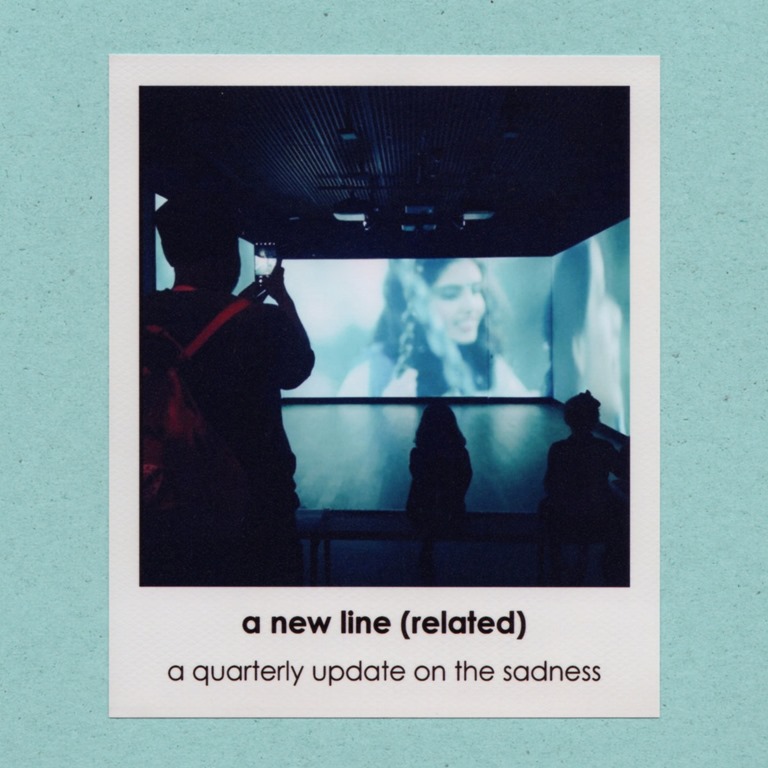
Arriving to the latest release from A New Line (Related) – the solo project of Andrew Johnson, who has previously released music as a member of bands such as Hood, The Remote Viewer, and Famous Boyfriend among others, one feels compelled to wonder ‘just how is The Sadness, and how has it been of late?

This is his third album, which we’re forewarned is an ‘immersive’ work, which ‘balances between minimal techno, dub house and ambient pop.’

‘Calapsis’ drifts in with low-key beats pulsing beneath delicate waves which ebb and flow subtly, gusts of compressed air which build to a hypnotic close. It’s not until the glitchy, disjointed groove of ‘3AM Worry Sessions’ arrives that we begin to get a sense of The Sadness. Stress and anxiety manifest in many ways, and while worry and panic may manifest differently their cousinly relationship It heaves, jittery unsettled and tense, conveying an uncomfortable restlessness.

The globular grumblings of ‘The Ballad of Billy Kee’ emerge from a rumbling undercurrent or mirk to glitch and twitch like a damaged electrical cable sputtering and sparking. Elsewhere, there’s a certain bounce to ‘Only Star Loop’ which gives it a levity, but the scratchy click of cymbals which mark out the percussive measures feels somehow erratic and the time signatures are apart from the bubbling synths and the distant-sounding, barely-audible vocal snippets, which give echoes of New Romanticism. Overall, the track has an elusive air of whispering paranoia.

In many ways, not a lot happens on A Quarterly Update On The Sadness, and the sparse and repetitive yet curiously dynamic title track is exemplary. It leaves you feeling strangely disconsolate, bereft, not only as if you’ve perhaps missed something, but that you’re missing something – not from the music, but from your own life. It seems, in conclusion, that The Sadness is thriving in its own, understated way.

AA

a0970760296_10

Nocturnal Rainbow Recordings – 4th October 2024

Christopher Nosnibor

Where does the time go? It’s a question one hears people ask often, and I often ask myself the same. Time, it seems, evaporates when you’re busy simply existing, keeping going from one day to the next, working, paying bills, shopping, eating, sleeping. All the things you want to do, but simply never get around to, for one reason or another.

Where does the time go? All too often, I’ll receive an album well in advance of release, and, because of life, and an endless inflow of upcoming releases and other diversions and distractions, I will take a long breath of relief on calculating that I have ages, weeks, before the release date, to listen, process, and digest the work, to write and refine my review, and still be ahead of time. The next thing I know, I’ve reordered my review schedule numerous times, perhaps drafted a few preliminary notes, and the album’s been out for almost a month.

It was only a little over six months ago that I covered Slavin’s seventeenth album, Oolong: Ambient Works.

New Dawns, we’re told ‘exemplifies Slavin’s nonconformity, commitment and expansion to his cultural roots of exploratory music, through early clicks and cuts electronica and instrumental ambient, highlighting an immediacy and necessity for musical independence, through which he hopes to reach attentive new audiences… The album is more than a collection of tracks. a cohesive blending of diverse influences and sounds into a unified experience. A beginning of a journey. As with his previous projects, New Dawns invites listeners to immerse in a unique and tropic sonic world, where the boundaries between acoustic traditional instruments, post leftfield electronica, east and west, are blurred.’

New Dawns comprises sixteen tracks, titled ‘Dawn 1’ to ‘Dawn 16’, each representing, I suppose a new dawn. Each composition is distinctive, and distinct: there is separation, rather than segue, and this very much determines how this feels as an album – in that it feels like an album rather than a single composition sliced into tracks. And as such, there is a sense that each piece, appropriately, starts afresh. And while the overall experience is mellow and broadly ambient, there are solid features which mark the territory, and actual, distinct instruments, too, which punctuate, and, indeed, provide form and structure to the wispy ambient soundscapes: strolling, jazzy double bass, haunting, twangy guitars, piano, irregular beats, and splashing cymbals all feature… to say they feature prominently may be something of an overstatement, but their presence is clear, and in context, powerful.

Just as the sun rises in the east, so the twang and drone of sitars colour some of Slavin’s dawns, and across the span of the sixteen pieces, the sense of mood changes every bit as the sense of geography. Oftentimes, the dawning is gradual, a slow emerging of gentle light, but then, for example, the more percussive ‘dawn 7’ arrives abruptly and unexpectedly, and simultaneously brings with it more overtly electronic vibes which bring together Krautrock and minimal techno. ‘dawn 8’ brings swaggering avant-jazz wrapped in a cloak of prog rock leanings, shrouded in a murky fog of obscurity. ‘dawn 11’ has the kind of murky robotic minimalism of late 70s industrial, hinting at the point where Chris and Cosey would go on to spawn trance.

Its total running time may be under seventy minutes, but New Dawns is an immersive work, and I find myself drawn deeper into the details as it progresses. And those details are abundant. There’s simply too much going on for this to be considered a truly ‘background’ work: zone out for a second, and something else will prod its way to the fore, nagging and needling for attention, before sinking below the surface, to be replaced by something else. Having found myself drawn into the scrapes and drones, the subtle – and not to subtle – details, the album slips by, and so does an hour and a bit. And that, I come to realise, is where the time goes.

AA

a2974132267_10

‘Pagan Synth’ band, ESOTERIK has just dropped the latest single from their forthcoming EP, Archetypes.

For their latest single, ESOTERIK brings light to the archetype known as the ‘Shadow.’ The silent observer always watching from behind the scenes, waiting with indifference for what comes to pass. They say you must make peace to move forward, but isolation has always tasted better. Nothing is inherently good or bad and imbalance provides perspective. Without a light to shine the subconscious feeds eternally. However, in absence of light a shadow cannot exist.

On the upcoming EP, Archetypes, ESOTERIK examines the tropes that have weaved a thread across societies for centuries. “It’s such an interesting topic and really highlights the power of language whether written or passed down via word of mouth. The legends hold a commonality that span through time and culture. Before the world was connected by technology, these stories held the experiences and wisdom for generations to come. Whether they are steeped in symbolism or ritual, the lessons are still infused and if sensational that only ensures the survival beyond our limited life spans.”

Watch the video here:

AA

7f2cc02d-d318-e743-2057-c9a6c9ab636f

Kalamine Records – 14th September 2024

Christopher Nosnibor

Whether it be solo works ranging from ambience to classical, or collaborations running the full gamut in the electronic field, Deborah Fialkiewicz’s output in recent years has been nothing short of prodigious, and spanning as many forms as her work does, there is never a dull moment. This latest work, under the POOCH moniker, in collaboration with Dan Dolby (Bassist in Mastiff, Noisemonger in Catafalque and Sulphur Nurse) is no exception. It offers a set of eight dark, stark electronic compositions which owe a considerable debt to early industrial and electronic works, bringing a combination of dark atmospherics and nagging beats. Although entirely instrumental, we’re in the kind of territory occupied by the likes of Cabaret Voltaire, Test Dept, and Chris and Cosey’s Trance.

As an opener, ‘Hades’ is as dark and subterranean as the title would suggest, a bleak, murky pulsation squelching around and leading the listener down, down, down. It serves as something of a primer, a mood-setter, but doesn’t fully prepare one for the altogether steelier, starker, more rhythmic and percussion-driven pieces which follow.

The title track pairs a dense, dirty bass with clattering, metallic percussion which assails the mind like a concerted assault with the contents of a cutlery drawer, and it bashes away relentlessly for four and a half minutes straight. On paper, it might not sound much, but as an experience, it’s pretty hard-hitting. Built around short, clipped repetitions, it creates a suffocatingly claustrophobic aural space. The word ‘pooch’ evokes a cuddly companion, something friendly, but there’s nothing cuddly or friendly about this, a listening experience closer to being whipped with a chain than fussing a canine buddy.

Each composition bears a one-word title (‘GameBoy’ being a forced blend-word (it doesn’t really qualify as a portmanteau) in order to maintain the theme. Funtime bit-tunes are bent with glitches and warping drifts of darkness here, before things begin to slide further into beat-orientated minimal techno.

The steady beat which dominates and defined the spartan ‘Quazar’ is almost soporific: the track assumes something of a background position as it clicks along nonchalantly, with a low, unshifting drone hovering just around the level of register. Nothing happens. It doesn’t need to. And while the thunder which heralds the arrival of ‘Midnite’ might initially serve as an alert, the piece soon melts into abstraction. The final track, ‘Stimpy’ may be missing Ren, but hits hard, built around a strong, thudding beat and looped electronic undulations.

For all of its cuddly connotations, Pooch is a pretty dark album. To my mind – and it could be to my mind alone – music which is heavily beat-orientated and instrumental feels impersonal somehow, and I find it somewhat disorientating, disconnecting, alien. And so it is that the pounding beats of Pooch leave me feeling somewhat dazed, detached, even dizzy. But it’s impossible to deny the detail, the quality of the execution, or the fact that this is an outstanding work.

AA

cover

Bill Leeb is the Vancouver-based musician and mastermind behind electro-industrial scene mainstays Front Line Assembly and ambient-pop duo Delerium, as well as a key member of recording projects that include Noise Unit, Intermix and Cyberaktif.

Model Kollapse marks the first solo venture by this sonic chameleon and creative trailblazer since the mid-80s days of Front Line Assembly, when Leeb began making recordings in his bedroom and released them on limited edition cassette format. Almost four decades on, his new album was recorded and produced in Vancouver, Toronto and Los Angeles with assistance from production duo Dream Bullet and long-term recording cohort Rhys Fulber, plus regular mixing engineer Greg Reely.

The song ‘Demons’ has been released today as the second single from the album, with Leeb stating that the EBM styled track is a comment on “how much darkness and evil exist in the world, some of it created via technology that is here to stay, and how we have to carefully navigate our way through it all on a day-to-day basis.”

‘Demons’ follows the introductory single ‘Terror Forms’, featuring Shannon Hemmett of the group ACTORS, who are also based in Leeb’s home city.

Watch the video here:

AA

a4b332826fb57004f015b07c9799a9237b0fe591

BILL LEEB | 2024 photo by Bobby Talamine

Christopher Nosnibor

Being restricted to live shows within walking distance of one’s house really does change one’s perspective and selections. As much as it also significantly limits my options, I’m fortunate to have no fewer than three venues within this range, and spotting that The Royal Ritual – a band I’ve long been aware of but have never witnessed live – were playing at one of them provided more than enough of a poke to get out.

It’s not exactly heaving. That is to say, come 8:15, it’s still pretty quiet, even for a Wednesday night. But then, I noticed that York was conspicuously quiet all day today: driving almost empty roads to a near-dead Tesco was as welcome as it was strange earlier in the day. The first week of the school summer holidays, and it seems everyone has buggered off – apart from the tourists clogging the town centre, which was far from quiet in the afternoon. But tourists tend not to seek out relatively unknown alternative bands playing a mile or two out of town. They should. Live music is as integral to a city’s nightlife as its pubs and bars and so on. I once ditched a conference dinner in favour of a gig when visiting Stirling, having clocked that maybeshewill were playing, and in the process, discovered And So I Watch You from Afar, who absolutely blew me away, plus I got to explore a new venue. It was a memorable event, and one which has stuck with me. It’s unlikely the alternative would have had quite the same impact – and while I’ll never know, as someone who’s uncomfortable dining with strangers and making small talk, I’m as comfortable with my choice now as then.

Comfortable isn’t really my default, and caving crawled out of my bunker, this is an evening I’m quite content to hide in a dark corner with a pint and observe.

Material Goods are a last-minute replacement for Dramalove. It’s a solid, blank name which suits the duo’s style, which comprises some heavy, complex synth work paired with live percussion – and quite outstanding live percussion at that. The processed vocals are a bit muffled, but overall, the sound is dark and dense and the drums really cut through it with energy and force. Essentially, their palette is 90s alt rock, a bit NIN but with a vague dash of nu metal, and a bit Filter, too. Multitasking and a vast amount of gear affords the singer limited scope for movement on stage, but the sound has a really good, strong energy, despite the songs being pretty downtempo and downbeat.

IMG_20240724_200808IMG_20240724_200818

Material Goods

With Material Goods overrunning and Neon Fields also possessing an immense amount of flash-looking tech which needed setting up, we’re fifteen minutes behind time when they take to the stage. Sonically, they’re astonishing. Playing a hundred-and-twenty-five-capacity pub venue, they sound like half a million quid’s worth of gear in an arena. And the songs match it. They sound like they look: black clad, tattoo bands, neatly-trimmed beards, big, soaring emotional outpourings… And completely lacking in soul. Christ, this guy’s level of emotional trauma is enough to raise the blood pressure to induce a heart attack. Wracked with anguish and all of the pain of the lovelorn, the love-torn… And yet it’s all articulated so blandly, everything is so slick, and so one-level. The theatre soon wears thin, and I start to forget I’m listening to it while I’m listening to it. It doesn’t help that there’s a group of four people bang in front of me gabbing on and pricking around, pulling faces, play-fighting, the guys trying to impress the birds by demonstrating their strength by lifting one another up… they get shushed by a fan but even the absence of their distraction doesn’t really improve the experience. There’s some earnest, meaningful falsetto, and the penultimate song had some cliché tribal drumming, and they wrapped up their bombastic set ten minutes after the headliner was due on.

IMG_20240724_21083420240724_210849

Neon Fields

The Royal Ritual are also a duo who have an extremely ‘produced’ sound. But their approach to production owes more to the methods of Trent Reznor as pioneered in the early 90s on Broken and The Downward Spiral, balancing gritty live guitars with synths and fucked-up distortion and harnessing their tempestuousness in a way that creates a balanced yet abrasive sound. David Lawrie plays live electronic drum pads in addition to the sequenced beats, adding dynamics and live energy to proceedings, and flitting between the drum pads, synths, and mic stand, he’s incredibly busy throughout the set. But something about Lawrie’s delivery highlights everything that was absent on Neon Fields, and just carries so much more weight: the whole package brings a rush of adrenaline propelled by that emotional heft and solid force.

Objectively, the feel is very Stabbing Westward, and goes hard NIN at times in its combination of guitar, synths, and sequenced and live electronic drums. The Royal Ritual are strong on dynamics and atmosphere, and Lawrie is an intense and compelling performer.

IMG_20240724_22045120240724_22154320240724_220550

The Royal Ritual

He does break out of the moody persona to thank other bands and plug merch, but what do you do? In the current climate, bands sadly need to plug the stall. The fact that David steps out of broody tortured soul for two minutes of affable chap may seem hard to reconcile, but then, this perhaps speaks more of the human condition than remaining ‘in character’; people are complex and conflicted, multifaceted and inconsistent. And this is what truly lies as the heart of tonight’s performance by The Royal Ritual. Digging deep into the complexities of the psyche, there’s something about the duo’s performance that gouges into the flesh and demands contemplation.

Dragon’s Eye Recordings – 7th June 2024

Christopher Nosnibor

There isn’t really anything funny about Yorkshire Modular Society, conceptually or otherwise. But one never really fully appreciates one’s own locale, especially not when it’s in the north of England, a region renowned for its pithy, gritty nature rather than its glamour. People will tell you that Yorkshire folk are welcoming and friendly – and tight – and as a non-native whose lived in Yorkshire the majority of my life now, it’s probably a fair summary. The county boasts some of the most magnificent countryside, and I only need to walk ten minutes from my house to be in woodland or fields – not bad considering I live twenty minutes from the centre of a cathedral city, not to mention twenty minutes from the train station, which will land me in Leeds in under half an hour. But for all that, and despite the huge number of outstanding bands to have emerged from Leeds over the years, mention Yorkshire and people will probably think of brass bands, cobbles, and Hovis, flat caps and equally flat brown beer. People tend not to think ‘Yorkshire, the county of experimental electronica’. They’re missing something significant.

There is a thriving modular / electronic scene in Yorkshire, notably with electronic music open mic (EMOM) nights in Leeds, York, and Halifax, all giving platforms to acts who aren’t necessarily on the main gig circuit, although venues like Wharf Chambers in Leeds and The Fulford Arms in York will often feature weird and wonky stuff from across the electronic spectrum.

Like many electronic experimenters, the YMS BandCamp page presents a prodigious self-released output, so if you’re wondering where to start, a release selected by a label seems like a fair point.

Of this continuous hour-long ambient work, Yorkshire Modular Society says, “As the cityscape pulses with electric fervor, oscillations emerge like whispers in the rain-soaked streets. LFOs, like elusive shadows, guide the listener through a maze of sonic intrigue, each modulation a glimpse into a world of mystery. Within the depths of digital tape modules, time unravels and reconstitutes, casting a veil of uncertainty over the sonic landscape. Reverb and delay wash over the senses like urban decay, adding depth to the sonic architecture that surrounds.”

Fiery the Angels Fell is a lot calmer, more soothing, and less apocalyptic than its cover art suggests.

As is often the case with ambient works, I find my mind – like the music – drifting, and my contemplations following divergent trajectories. Here, I found myself wondering what the end would – or will – really look like. Growing up in the 80s, I envisaged the white light of nuclear annihilation, but on recently watching Threads, came to realise that this may not be the spectacular moment of silence prefacing perfect oblivion my younger self had fantasized. But no part of me ever envisaged an globe, or an egg, colliding and splitting in half with molten flames as something I may witness. The cover art, then, harks back to pure 60s / 70s sci-fi vintage. The artwork propagates tension. The sound soothes it.

While there are some billowing clouds along the journey that is Fiery the Angels Fell, this is a delicate, graceful work dominated by organ-like drones and soft sounds which ebb and flow. If this is the soundtrack to the end, I will likely sleep through it, and awake pure nothingness.

AA

de6063_art

Cruel Nature Records – 28th June 2024

Christopher Nosnibor

It’s a perennial complaint around the passage of time, an oft-tossed-out remark with each month that everyone churns out as a space-filler, especially when speaking to someone they haven’t seen in a while – ‘I don’t know where’re the year’s going!’ But 2024: what the fuck?

I recently read Four Thousand Weeks by Oliver Burkeman after a friend kindly sent me a copy after I’d been bleating about how I always had too much to do and too little time to do it in. I almost simultaneously had a heart attack and shat myself reading the opening chapters which explained the book’s premise – namely, that the average human lifespan is around 4,000 weeks. Somehow, I’ve blinked and missed about 20 of them already this year. And whenever I receive an album in advance of its release, I add it to the list, and think ‘Hey, I’ve got a while on this one, I can take my time and still get a nice early review in.’ Because getting in early is satisfying – and, being transparent, brings traffic. I don’t make any money from doing this, so hits don’t equal quids, but there’s a certain pride involved – not to mention a sense of duty.

On learning of there being a new release imminent from The Incidental Crack – longstanding regulars at Aural Aggravation, an occasional collective who’ve managed to maintain a steady flow of releases in recent years, I was immediately enthused, but the end of June was a way off, and life… and here we are at the end of June. In no time, it will be the end of the school year, and once we hit August bank holiday the nights are shorter and it’s time to think about jumpers and central heating and the end of another year and being another year closer to death.

The Incidental Crack have a knack of conveying the pessimism that pervades the futility of the everyday, the way in which those small, mundane disappointments mount up and slowly sap your soul. Look no further than titles like ‘The Kettle Broke’, and ‘There Was No Path At the End of This Field’ on this latest offering for evidence of microcosmic gloom and frustration. The impact of small – almost non-events – can never be underestimated in the context of a stressed and overloaded mind. And people aren’t in that headspace simply don’t get it. Kettle broke? Just get a new one, they’ll say. No, no, that’s not the point. The kettle broke, the cat was sick on the rug, the bread went mouldy, I spilled my drink and it’s an absolute disaster and my life sucks.

The fact is that sometimes, when life feels intense, the smallest details count for a lot: it’s not making a mountain out of a molehill when simply getting through a day feels like an epic battle, and walking to the corner shop feels as daunting as a marathon. And No More Bangers – a title which is equally ironic and carries a tone of sadness, of defeat – is detailed, with infinite nuance proving integral to these five minimal – and lengthy – compositions.

The pieces are constructed around nagging electronic loops, scrapes, drones, hums. There’s nothing dominant, sonically, or structurally. Ten-minute expanses of trickling dark ambience create brooding soundscapes and a tension that sets in the jaw, the shoulders. Insectoid chatters and clicks, stutters and scrapes build the fabric of the sound. Clamouring echoes and rapid repetitions evolve internal rhythms without percussion, with surges and swells driving the second half of the twelve-minute ‘The Springtails Love It.’ But it’s a nagging tension and feels more like being poked repetitively while trying to rest than an inspiration to get up and dance.

‘The Kettle Broke; is largely a hum, a room ambient sound which does next to nothing other than play back the sounds in your head and your kitchen when you’re trying a new recipe and find it requires digging the blender out from the back of the cupboard.

Sometimes, late at night – but also during the day, as I work from home – I find myself acutely aware of the quietness. There will be spells with no traffic, no planes or helicopters overhead, no dogs barking, no pings alerting me of new messages, no meetings. During these often unexpected moments, I will become aware of the whir of the laptop fan, the constant hum of the dehumidifier in the bathroom adjacent to my office, my own circulation.

This is the soundtrack that No More Bangers presents. Low-ley, low-level ambience which sounds like the boiler running through a maintenance cycle, like the throb of the fridge, the fizz of extractor fan. Delivering 100% on its title, this album is absolutely banger-free. But more than that, it feels strangely familiar, and yet familiarly strange.

AA

a0749472000_10

Invada Records – 28th May 2024

Christopher Nosnibor

Well, this one landed out of the blue. A boon for fans, a shock to everyone, necessitating a reshuffle of review diaries for the likes of me.

It’s been six years since the last Beak> album. There are good reasons for this, as they explain: “After playing hundreds of gigs and festivals over the years we felt that touring had started to influence our writing to the point we weren’t sure who we were anymore. So we decided to go back to the origins of where we were at on our first album. With zero expectations and just playing together in a room.”

This is a remarkable slice of honesty about the effects of touring on the creative process, and band relationships. Most bands start at home – in some sense – with writing songs and the aspiration of touring those songs. But the dynamics change with success, and when touring relentlessly, time to write new material is squeezed. Over time, particularly with a pandemic interfering with, well, everything, many bands evolve their methods to operate over distance, and there’s always a risk that some of the dynamic is lost and stuff gets dialled in. It’s true that it’s now possible for bands to operate at distance, intercontinentally, even, but that’s not the Beak> way. They thrive on that instant interplay, the interaction, and without it, there’s simply no Beak>.

When they do come together they work fast. Single ‘Oh Know’ was ‘recorded on the only day the band could physically get together during the winter lockdown’ and released in October 2021. They really do make the most of their time, and their music – particularly this latest effort – froths with the urgency of pressured time. The urgency which has always permeated their music is banged up a couple of gears here, and as a result, >>>> is a frenzied explosion, with perhaps a desperate edge.

This being a Beak> album, it’s brimming with experimentalism, oddness, woozy psychedelia and persistent Krautrock pulsations, relentless beats. This being a Beak> album, it’s bloody great, and a lot of fun.

But that said, much of >>>> actually feels pretty bleak. Yes, Beak> turn bleak. It’s like a band having a blast while staring into the abyss, conscious that the end is near, but carrying on because at some point…

Of the album’s sudden and unexpected release, the band say in their statement, “At its core we always wanted it to be head music (music for the ‘heads’, not headphone music), listened to as an album, not as individual songs. This is why we are releasing this album with no singles or promo tracks.”

‘Oh Know’ isn’t included here, but the album does, however, include flipside ‘Ah Yeh’, and it does slot in nicely with its downtempo, lo-fi Pavement on sedatives vibe. It’s kinda loose, with rattling drums and drags out with a quivering organ drifting over a tense bassline, and it works something of a trance-inducing spell over the course of six minutes. You get the sense that however long and far part these guys are, they share a magical intuition, and whenever they do manage to get into a room together, creative sparks fly.

The band continues, “the recording and writing initially began in a house called Pen Y Bryn in Talsarnau, Wales in the fall out from the weirdness of the Covid days. Remote and with only ourselves and the view of Portmeirion in the distance we got to work.”

“With the opening track, ‘Strawberry Line’ (our tribute to our dear furry friend Alfie Barrow, who appears on the album’s cover) as the metronomic guide for the album, we then resumed recording, as before, at Invada studios in Bristol, whilst still touring around Europe and North/South America.”

‘Strawberry line’ makes for fairly a low-key opener, with a trilling organ and psychedelic reverby-drenched vocals rippling atop a bubbling bass before a shuffling beat enters the scene. But it stands as an eight-minute statement of intent, with that statement being that >>>> packs density to equal its melody. ‘The Seal’ delves into Krautrock, with a relentless groove centred around the rhythm section dominating. It grows dark. It grows tense. It’s sparse, minimal, but it persists, and four and a half minutes in, there’s a taut, jangling Joy Division guitar part.

Chilly synths and a robotic, rolling, repetitive bassline dominate the slow-melting ‘Denim’, a hazy psychedelic downer which delivers delayed gratification with the bursting of a monster riff. ‘Hungry Are We’ is delicate, reflective, post-rocky, with vocal harmonies which again allude to 60s pop and perhaps a bit of prog.

‘Bloody Miles’ marks a stylistic shift towards groovier territory, with a nagging bassline that borders on funk, but the tone remains doggedly downbeat, without getting depressing. With one foot firmly in the early 80s new wave sound, there’s no shortage of weirdness and warpy, brain-bending discord here, not least of all in the shadowy vintage-sounding electropop of ‘Secrets’, that brings together elements of Soft Cell and The Associates with the atmosphere and production of New Order’s Movement.

>>>> is often stark and claustrophobic (and nowhere more so on the eight-minute closer), and it’s always intense and brilliant. Beak> have surpassed themselves – again.

AA

a3178303801_10