Posts Tagged ‘electro’

The opulent darkwave closing song off of VEXILLARY’s latest EP, SurViolence has now received the music video treatment it deserves. Both the song and the video explore the link between science and spirituality and how they influence one another. The dark supernatural theme is embodied by the menacing lyrics of the song :“Chimera awaits at the tip of his hands, a snap of his fingers and the beast is in your land."

The video echoes the same theme visually. It presents us with a sci-fi dream sequence that plays like techno hypnotism.

Watch the video here:

SurViolence adopts the theme of unease in an overly politicized society; using surveillance culture as a metaphor on how technology that was created to serve and protect can serve to exploit. Hence the title, SurViolence.  The sub-plot of tension and lack of trust in the decisions that are being made for us fueled the eerie sounds and direction of the record. 

Voyeurism has been weaponized to give rise to surveillance. Violence has been digitized to replace intelligence.  This is where evolution has led us. It’s time to take back control. If only we could have our eyes back to see. 
Welcome to the surrealist horror of SurViolence.

7156f3f6-7430-41fd-9b43-34fa59ae4182

4th December 2020

Christopher Nosnibor

Woooh, shit, trigger warning! Aggressive electronic music which may trigger feelings of anxiety and n increased heart rate paired with themes of death and suicide! Biomechanimal should be plastered with red flags and probably quarantined. Wait, we’re all quarantined, and it should go without saying there’s some heavy sarcasm there.

Personally, my tigger is the ‘triggers’ crowd: unless either billed as family entertainment or the content is particularly disturbing, art shouldn’t require a warning: the very function of art is to challenge, and to present audiences with real emotions and concepts that are uncomfortable. Art is a window – or a mirror – on the world, and one that provides a conduit to explore the places we don’t necessarily venture in everyday conversation.

‘End Your Life’, which features Nysrok Infernalien is pitched as ‘a brutal, filthy expression of electronic music,’ and an ‘aggressive collaboration [which] brings together elements of industrial, extreme metal’.

If, in combining the crazed attack of the likes of KMFDM with the persistent but gnarly groove of early Ministry and stitching it together with a gauze of heady trancey cybergoth, anyone could possibly expect anything that wasn’t full on and in-your-face intense and designed with absolute precision to punch buttons – while at the same time geared up to make you move – is living on a different planet. Sonically, ‘End Your Life’ is very much rooted within genre context, but it’s actually an uplifting tune, a rush of hi-nrg beats and hyper synths, while lyrically, it’s hard to decipher, and it may be a threat or a promise or neither. But it’s more likely you’ll be too busy bouncing around to want to be slitting your wrists.

The five accompanying mixes mangle the tune to varying degrees, each accentuating a different aspect of this snarling beast of a tune, with the harsh metallic guitars often pitching to the fore, propelled by pounding beats that pump so, so hard. Die Sektor strip it back and slow it down a bit, and get a bit Nine Inch Nails in the process. Overall, there’s more than enough variety in the mixes to keep it interesting, and they compliment the original version well.

AA

a0539954098_10

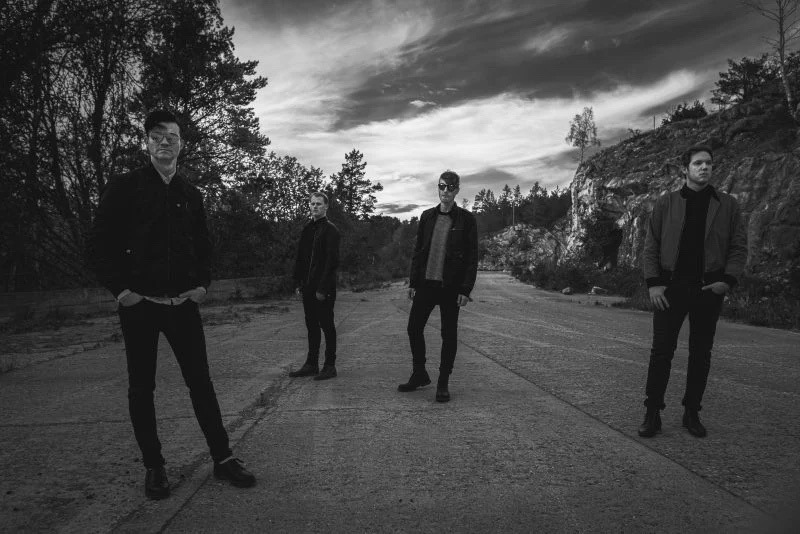
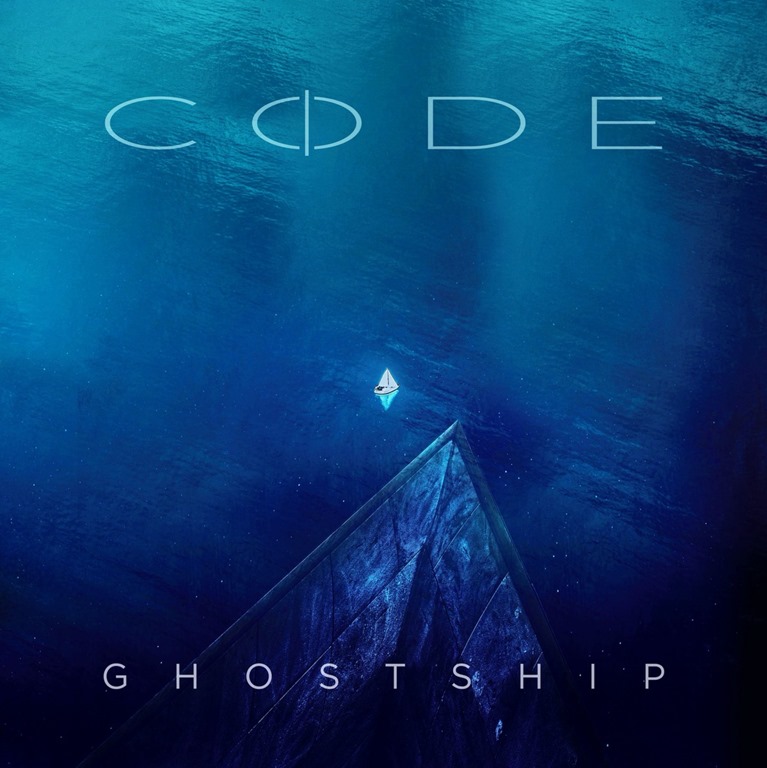
Kent based electronic quartet CODE have released a rebooted version of their 1992 debut single ‘Light Years’, which was available on white label only at that time and remains highly collectable to this day. Attracting support from John Peel at Radio 1 and Colin Faver and Colin Dale at Kiss FM, the original was a cross-genre classic; cosmic and psychedelic yet club-friendly, it pointed towards the future while acknowledging past masters such as Tangerine Dream with its sinuous, mind-bending arpeggiations and minimal melodic motifs. The 2020 upgrade remains true to its industrial techno roots but adds a contemporary dancefloor sheen. Bandcamp orders will also include a remix by Bjika, a musician who melds the spatial elements of progressive and deep house with the rawness of Detroit techno.  
The full length rework of ‘Light Years’ appears on a new album by CODE entitled ‘Ghost Ship’, their first in 25 years.

Watch the video here:

7eaaa5ea05da962bad5d421c72ccbd64ef4e4aaf

7th June 2020

Christopher Nosnibor

I suppose I’m fortunate to move in the circles I do. In both the real and virtual world, I’m surrounded by some remarkably talented creatives, working in all fields. Many seem to have found new outlets for their creative leanings under lockdown, in many cases probably for the sake of their sanity.

The emergence of a brand new act, VVolves, proved as welcome as is was unexpected, because the duo’s debut, a blend of shoegaze and cool synth pop, is a belter.

‘Momentum’ is a brilliantly kinetic, driving tune that kicks in solidly after a gentle, spacious intro. I’m a sucker for a song that locks into a groove and feels like it’s surging forwards because of, not despite, the repetition, and ‘Momentum’ absolutely does that: a repetitive chord motif, overlaid with chilly synth stabs and a propulsive drum track which contrasts with the ethereal vocal delivery. In combination, it’s an exhilarating rush.

We need more of this, please.

AA

a1325238669_10

Wonkystuff – 5th September 2019

This one’s been a long time in coming: the liner notes document that the three pieces that make up Traditional Computer Music were ‘conceived and composed from various SuperCollider recordings over the years 2010 – 2014 [and] edited and compiled in Logic.

Then again, both Ash(ley) Sagar and Wonkystuff label boss John Tuffen have been kind of busy for most of the five years since this was finished, what with their being one half of The Wharf Street Galaxy Band, as well as operating as Orlando Ferguson and contributing to myriad other projects.

The title of this release is clearly a wilful oxymoron on the one hand, but on the other it’s entirely fitting, and a recognition of the tropes which have established themselves around digital musicmaking. Computer Music, once radical, is now a convention with a substantial lineage. And yet there is, somehow, a certain idea of what ‘computer music’ sounds like when presented with ‘computer music’ as a term, and Sagar manages to encapsulate that on this release.

The three numbered pieces – impersonal, inhuman, digital – are lengthy: 1 is 14:21, 2 is 19:24 and 3 is 18:58. And while Sagar doesn’t delve into retro robotix with bleeps and bloops, Traditional Computer Music explores digital soundscapes that have become synonymous with electronica.

Bulbous, warping drones weft and warp in the opening moments of ‘1’, with sounds of indecipherable origin – are they voices? Are they synthesised sounds? Tapering to an undulating mid-range droning hum after a couple or so minutes, coalescing to a throbbing hum around four minutes before dispersing into a vaporous mass after some four minutes, it becmes little more than a drone, before dissolving, fractured, splintered and broken, into painful howls of feedback that continue for a good few minutes before fading to darkness.

‘Part 2’ continues where ‘Part 1’ leaves off, with elongating feedback-filled drones extending outward for centuries and light-years back. It’s simultaneously evocative and sterile, again highlighting and exploring the dichotomies of digital music. Ash is one of those musicians who explores to the core. And yet his technicality is not at the expense of feeling. You can tell by listening to this that he lives and feels the music, wanky as it probably sounds.

The third and final track, ‘3’ moves into microtonal territory, which is crackly, glitchy, bleepy, and finds a slow pulsing beat thumping beneath an array of tweeting twittering R2D2 stutters. It descends into a morass of tweaking laser shots and squelchy pulsations buried under a growling generator hum ad there’s pitch-shifting and slowing drones galore. It becomes increasingly difficult as it progresses, dolorous drones and low pulsations and eternal, deliberate throbs roll on and on, before finally yielding to a climax of retro-futurist wibbles which ascend to a sustained rippling hum that’s not exactly comfortable whatever your preferences for sonic range.

On TCM, Ash shows that he probably knows the boundaries and remains within them, but at the same time tests the listener’s limits in a positive way. And yes, it’s good, and in its field, outstanding.

AA

Ash Sagar - Traditional

Treading that line between elevated art and unnecessarily loftiness and pretension… It’s a challenge. It’s not always easy to differentiate parody and sincerity, not least of all because we exist in a world in which real-life news resembles Brasseye and The Day Today. Irony is dead, and belief is the enemy in a post-truth society.

So when a press release reads half like a sample from a William Burroughs cut-up whereby Lemegeton Party is described as ‘the narcotic and occluded industrial-ambient debut for the Junkie Flamingos,’ it’s difficult to rate its level of seriousness. And, according to the accompanying text, the album is inspired by Friedrich Hölderlin’s Hyperion, [and] is gilded with a neoclassical sheen that alludes to both the divine and the diabolical. Kundalini’s whispered invocations which have so creepily effective in addressing psychosexually abject conditions in She Spread Sorrow are immediately recognizable here. Yet, she shifts the content towards messages of power and strength, even if cast in the shadows of desolation and solitude’.

The chances are – no criticism – that this will go over the heads of many, and returns us to the question of the extent to which understanding the theory behind any work of art should have a bearing on one’s capacity to appreciate it. I don’t believe that it should even one iota. But then again, my own background draws me to note that in their naming, Junkie Flamingos allude to surrealist juxtapositions built on incongruity, something which defined Dada and indicates a strong Surrealist bent.

The detail is that Junkie Flamingos is ‘a project conceived in 2017 by Luca Sigurtà, Alice Kundalini, and Daniele Delogu’, and that ‘Each of these musicians has their distinctive sounds: Sigurtà with his vertiginous electronica, Kundalini best known as the author behind the death industrial project She Spread Sorrow, and Delogu in the bombastic folk of the Barbarian Pipe and. Their collective amalgamation shifts but does not denude each of these aesthetics in the construction of this oblique, sidereal album.’

It’s clear Junkie Flamingos have high artistic ambitions, and ‘Evening of Our Days’, the first of the albums five expansive tracks sounds pretty serious: even a line like ‘you are a small man’ sounds menacing, threatening, dangerous when whispered, serpentine, from the mouth of Alice Kundalini against a rising tide of electronic manging. The backdrop is sparse, but ugly. ‘Shape of Men’, the album’s eight-and-a-half minute centrepiece is dolorous, sparse, and funereal as a single bell chime rings out over a low, thudding bass beat.

‘Restless Youth’ rumbles, grinds and glitches amidst flickering beats, ominous rumbles, hushes, barely audible vocals, and a general radiance of discomfort and disquiet. The lower, slower, and quieter they take it, the more you feel your skin crawl and your nerves jangle. Sitting between ambient and sparse electronica, it’s darkly atmospheric not in the ambient sense, but in the most chilling, semi-human, psychotic sense. ‘The Language of Slaves’ continues on the same path, the semi-robotic, processed vocals creating a distance between event and emotion. There’s no obvious entry point, and this is music of detachment and cognitive dissonance. These are the album’s positives. It isn’t easy to get into, but why should it be? But where Lemegeton Party stands out is in its subtlety, something chronically underrated right now. With Lemegeton Party, Junkie Flamingos steel in by stealth… and then fuck with your psyche. And that’s why I love it.

AA

Junkie Flamingos – Lemegeton Party

Christopher Nosnibor

“Are you a journalist?”

I nod. I don’t like talking when a band is playing. I don’t like other people talking when a band is playing, so why would I do it? It’s rude. And I’m there to watch the band. And so I don’t explain that no, I don’t consider myself to be a journalist or a music journalist, but a writer who happens to write about music often.

She’s already asked me what I’m doing and tried to get a look at my notes – a spidery scrawl barely legible to myself, to which I’d responded by wordlessly waving my A7 pad at her.

Some people just don’t get hints.

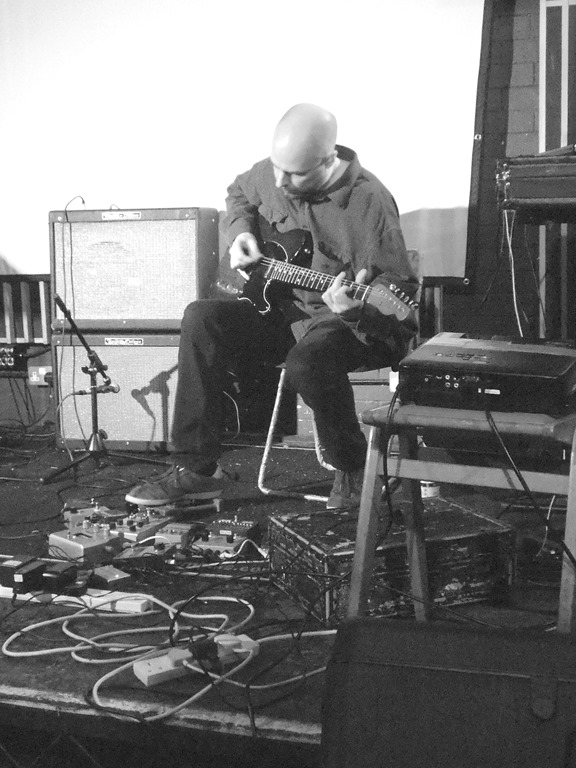
Following on from opening acts Steve Hadfield, who’ delivered a set of proficient but slightly static electronica and Dean McPhee, who performed some ethereal, atmospheric guitar instrumentals with the assistance of a bank of pedals that almost filled the venue’s small stage, worriedaboutsatan built their set nicely. One of their trademarks is intelligent structure, and while they’ve woven segments of their latest album’s more delicate parts into their set, they swiftly transitioned from drifting ambience through subtle rhythmic pulsations to propulsive beats, all the while conjuring rich layers of atmosphere. Gavin Miller’s guitar sounds even less guitar-like than ever, as he conjures rippling waves of sonic abstraction from six strings.

DSCF7638   

Steve Hadfield

DSCF7645                                                                            

Dean McPhee

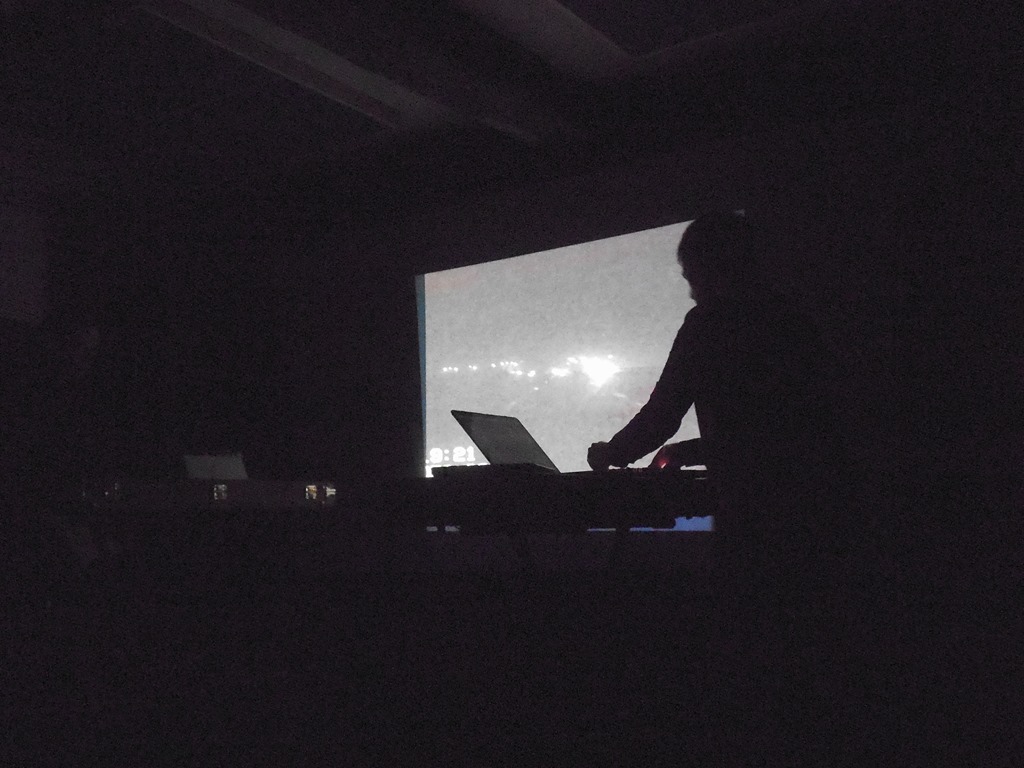
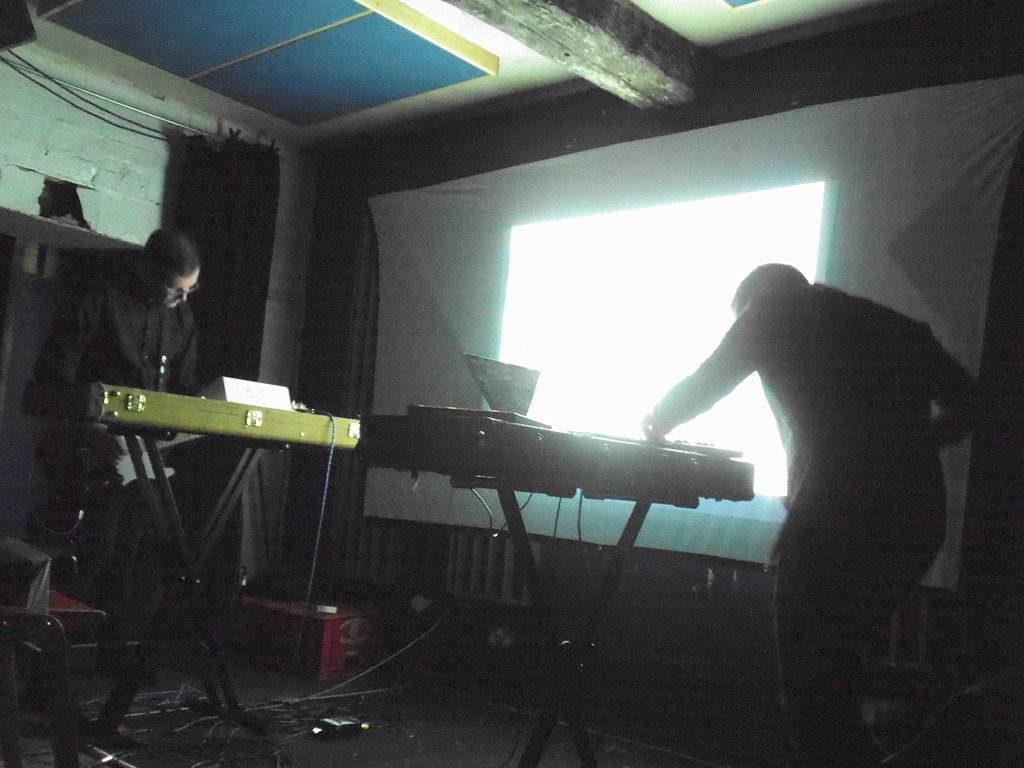
It’s been a long and taxing day, and I’ve consumed more beer than intended, than is wise, I’m switching between tenses, and I’m trying to decipher the narrative of the film projected at the back of the stage. It’s intercut with various black-and-white footage that conveys nothing in itself, but is evocative in its bleakness, and there are flickering light segments, too: beyond this, they play in darkness, visible only in silhouette. Their stage show hasn’t changed dramatically in recent years, but it’s visually striking and effective, and places the immersive music to the fore.

DSCF7691

 DSCF7685                                                                                                         

worriedaboutsatan

Then, halfway through, a couple of women appear at the front and get down to some mum-dancing: fair play, but they don’t need to be exchanging comments about it. I have my earplugs in and am in the zone, perhaps more even than usual in my state of inebriation. It’s the short, chubby one who starts nebbing at my pad – not that I’d have been any happier had t been her taller, slimmer friend.

“Who do you write for?” she shouts in my ear. It’s a shame earplugs only reduce volume and cut top-end rather than muting irritants.

“Me.” I want to tell her to fuck off, but even seven pints in, I’m mindful of manners.

This throws her but she seems to think it’s cool, and she asks yet more questions, and then she starts going on about how she’s worried about my eyesight, writing in the dark and all. I appreciate the concern, but my liver and blood pressure and anxiety are probably more of an issue than my eyes, and besides, I’m wearing tinted glasses at a gig, and if perfect strangers feel the need to worry about anything, I’d say climate change, Brexit, the stranglehold of capitalism, and the simple fact we’re all doomed are more worthy of that worry. Ok, so I don’t appreciate her concern one bit.

Eventually, she leaves me in peace and I’m able to watch the guys bring their set to a triumphant climax to an appreciative response from a home crowd. And deservedly so: the fact they don’t tour often, and when they do, they’re reliably solid, consistently engaging and dynamic in both set formation and performance, and perform with such incredible energy, makes an intimate show like this all the more special.

OUS – OUS017 – 30th November 2018

Christopher Nosnibpr

Juxtapositions… oppositions… rippling waves of abstraction shimmer in broad washes while darker current bubble beneath… but the mood soon turns ugly as the bubbing low end becomes a churning throb and the soft waves harden into sharp-edged shards and extraneous sounds interrupt the smooth edges.

On ‘Feel Safe’ time and sound warp and blur: the time signature is but an illusion, an allusion to time rather than any true marker, and the naturally-occurring rhythms which emerge from the interweaving notes are constantly shifting, at first disorientating but gradually the while weft and warp becomes an aural blanket that softly smothers the senses and envelops the listener.

Nemeček conjures so many layers and with such subtlety it’s often hard to appreciate just how much is happening simultaneously. The soft rolling bass and drifting, cloud-like mid-ranges of ‘Organs’ become subject to crackling interference toward the end of the track, while ‘Incidents I’ is a disorientating oscillation.

The digital release benefits from the inclusion if ‘Incidents II’ which segues into ‘Incidents I’ and is a slow-building beat-backed blast of thunder that swells to epic proportions, and while the mellifluous sonic nebulae are as expansive and kaleidoscopically immersive as they come the dense, deliberate beats an booming detonations of sub-bass provide a sense of structure and form that focuses the attention back in. That isn’t to say the form places Recurrences fully foreground, or that the compositions even hint at linearity: they drift in and drift out again without having an overt direction. And all of this is good.

Recurrences is constructed as an ambient work, and its semi-abstract form and drifting layers of soft-focus vapouresness more than fulfil that criteria: that there’s more besides and beyond doesn’t detract from that ambition, and Recurrences is something of a masterclass in advanced ambient which occupies background, foreground, middleground, and twists the psyche all at once.

AA

Recurrences

CD/DL Fourth Dimension Records/Foolproof Projects FDCD107/PRJ049

7th September 2018

Christopher Nosnibor

The blurbage: Void Axis is Brighton duo Map 71’s fourth album. The previous one, Gloriosa, released on Fourth Dimension as both a limited edition cassette and, later, a CD featuring bonus material, saw them garnering more praise and attention than before. During the interim they have continued to play live regularly and have a few more shows planned around the UK in September and October, including an appearance at the Fourth Dimension Records’ label night at Cafe OTO on 19/10/2018, where they share the bill with Alternative TV, Richard Youngs and EXTNDDNTWRK (Andrew Fearn of Sleaford Mods’ solo endeavour). A 2×7” compilation will appear to coincide with this likewise featuring a track by them. Lisa Jayne (words and voice) and Andy Pyne (drums and electronics) are based in Brighton and became Map 71 in 2013.

The critique: This is glorious. It’s not accessible, easy, light. In fact, it’s anything but either. Atonal vocals and clattering motoric percussion dominate. We’ve moved a long way from The Fall and Kraftwerk, but at the same time, MAP 71 call to mind the sparse simplicity of Young Marble Giants, but synthier and dronier.

Blank, monotone narratives about nothing in particular drift out over repetitive synth oscillations and cyclical synthesised rhythms. For ever.

‘Nuclear Landscapes’ presents a thunderous, murky, barrelling noise by way of a backdrop. The rhythms are messed-up, sound bouncing against sound to build a dark mess of noise like tennis balls in a tumble dryer. Elsewhere, ‘The Future Edge’ goes murky and dips into Suicide territory with its dark, dank, throb which provides the sonic backdrop to Lisa’s expressionless spoken-word narrative.

‘Armour and Ecdysis’ goes spacious and eerie, with fear chords and heavy echo and infinite delay creating an unsettling atmosphere, while ’21:12’ goes dark and robotic in in its plundering of early 80s post-punk electronic works for inspiration. And it works Void Axis is tense and dark, and clinical and difficult in a stark analogue way.

Void Axis isn’t an album to engage with on an emotional level: there’s no engagement or resonance here.

Sonically, I’m reminded in some ways of Dr Mix and the Remix’s Wall Of Sound – the album released by Eric Debris post-Metal Urbain through Rough Trade in 1979 and which provide a blueprint for both The Jesus and Mary Chain and Big Black. Being one of my all-time favourite albums, this is a good thing: Void Axis is spectacularly primitive and claustrophobic and insular. And in its revisiting the technologies and production values of almost 40 years ago, Void Axis is also imbued with a certain sense of authenticity, despite its being spectacularly out of step with, well, pretty much any zeitgeist. Let’s face it, no-one else sounded like Dr Mix back then, and nor has anyone before or since, and the same is true of the drum-machine thump-led treble overload of Big Black.

But ultimately, what sells Void Axis is that is doesn’t sound like any other album. MAP 71 have found their niche.

AA

MAP 71 – Void Axis

London based synth duo, Sex Cells have shared the video for their debut single ‘Hell Is Where The Heart Is’.

The double A-Side release also features ‘Are You Ready’ and will be available digitally and released on limited edition seven inch vinyl on their own Pretty Ugly Records. Under the guidance of Raf.E and produced by Dave M. Allen (The Cure, Yassassin), the two songs will be accompanied by a series of surrealist artworks made by the band – like a love letter to a nightmare.

Taking their inspiration from early synth pioneers such as Wendy Carlos and Delia Derbyshire, Sex Cells perform a kind of ritual dance – a mixture of Suicide, Psychic TV, and Art House sensibilities. The band are Matt Kilda and Willow Vincent, originally hobbyist promoters running monthly nights of live music and visual projections for experimental noise acts. Sex Cells started off life as a purge of shared anger after the pair were ripped off in a house rental scam. Left completely penniless from the fraud, they sought sanctuary in a Peckham rehearsal room where they decided to document their crisis with a synth and house drum kit.

Soon after, early shows in South London for Trashmouth Records introduced the pair to those at the centre of the same scene that The Fat White Family and Shame have risen through. Finding musical allies in bands like Meatraffle and Madonnatron, Sex Cells have become regular fixtures at nights around London, sharing bills with the likes of The Rhythm Method and HMLTD.

Sex Cells  have been navigating London full circle ever since, setting up camp wherever they can, and rarely staying in one place for longer than a few months. Together with a mutual interest in Dadaist values, Surrealist imagery and an obsession with ‘lost London’ and the esoteric, the band’s slum living conditions and precarious existence has provided a fitting thematic universe which both of these tracks draw from.

Watch the video here:

A truly exciting live prospect who reject the modern stereotype of electronic music made by laptops, Sex Cells will play following London shows in August:

LIVE DATES:

AUG 09TH    THE FINSBURY, LONDON N4

AUG 11TH    THE FIVE BELLS, STREATHAM, LONDON SW16