Posts Tagged ‘Drone’

Christopher Nosnibor

Having shown a remarkably consistent rate of output, with three albums in just over three years (four if you include their collaboration with The Body), BIG | BRAVE have also maintained a similarly solid touring schedule, which has for the lucky people of Leeds brought them to the city on each of their last three circuits which have brought them to the UK.

On record, BIG | BRAVE achieve a rare intensity, and while heavily reliant on drone, feedback, slow, heavy percussion – things familiar to fans of numerous bands like Earth, Sunn O)), and Swans, they demonstrate a unique approach to songwriting and structure, and an ability to tap into raw emotion in a way which goes far deeper than mere words. Live, however, they’re simply so much more. All of these elements are amplified – and not just in the literal sense by means of their towering backline. Oftentimes, the first time of seeing an outstanding live act draws you back in the hope of recreating that initial ‘wow’ moment. But anyone who’s seen lots of live music will likely agree that great as subsequent experiences are, they never have quite the same impact. It’s incredibly rare – in fact practically unheard of – for an act to hit that same spot more than once. BIG | BRAVE are that rare thing: despite high expectations, they always seem to pull out something extra and surpass those expectations.

The hype from people I know in real life and virtually for these shows, particularly in context of the new album, A Chaos of Flowers was huge. And, it soon proved, entirely justified.

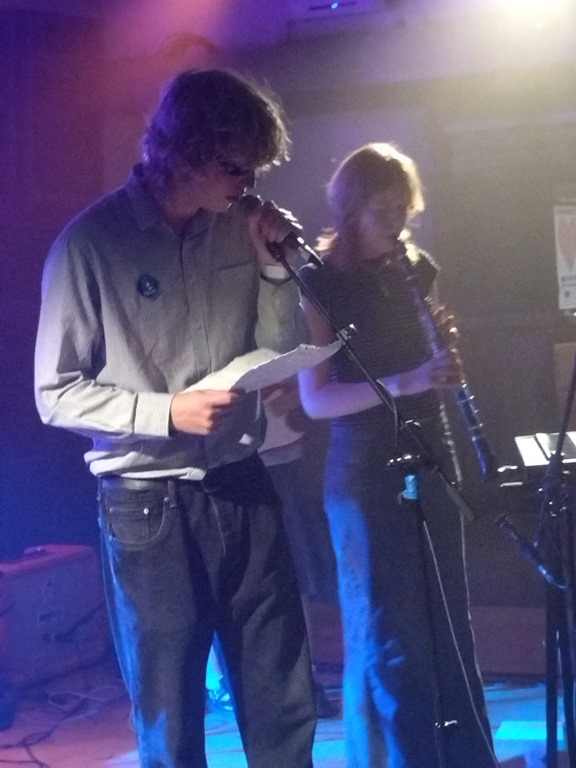
Keeping tour costs to a minimum, Aicher, who provided the main support previously, is the sole support this time around. The solo project of their live bassist, Liam Andrews, he’s joined this time around by BIG | BRAVE guitarist Mathieu Ball, and his presence adds further layers to the deep, rumbling sounds emanating from the PA. Playing in near-darkness, Andrews conjures thunder and heavy drones and explosions, while Ball wrings epic howls of feedback. Much of the sound is derived from the use of open contact with the guitar lead when disconnected from the metal-bodied bass he grinds against his immense rig, and there looks to become modular lead switching going on, too. This set feels darker and more structured than a year ago, and captures – and expands on – the sound of the Russell Haswell mastered ‘Lack’ single.

IMG_20240525_203315

Aicher

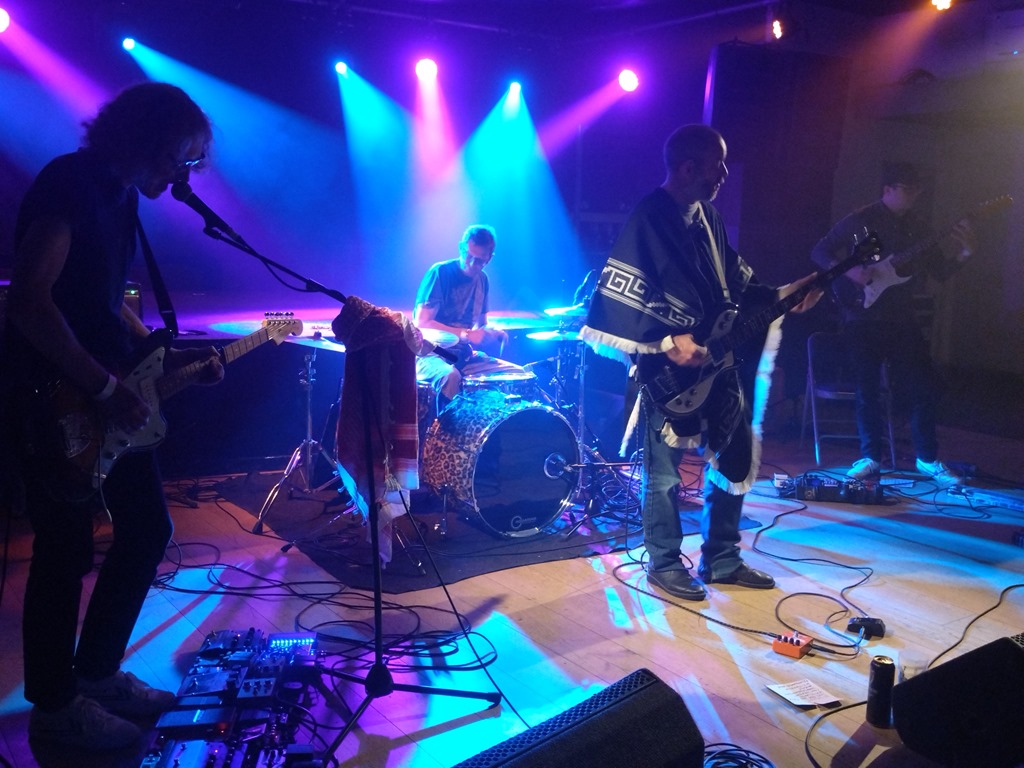
BIG | BRAVE’s ‘quieter’ new record does not translate to a lower volume live, but a balanced, dynamic approach to the sound. From the opening moments of the set, I find myself experiencing the physical sensations of enormous volume and strong lower-end frequencies, powerful vibrations shake my nostrils, my legs, even my scrotum, in a slow build. Frone hereon in, my notes are sparse as I find myself completely immersed in the performance. For an hour, I forget where I am, and the entire room is transfixed: there’s no chat, no-one’s jostling to be here or there, pushing forward, going back and forth to the bar. Time stands still, and so do we, utterly captivated by every moment.

‘The blinding lights facing out,’ I note… ‘A hypnotic, mesmerising, immense wall of shimmering sound. Each strike of the bass yields a shuddering quake. Sparse, subtle percussion’. I recorded very little else, but the rest is etched into my memory with such vividness it’s as is I can watch it all back in my mind’s eye.

IMG_20240525_212406

BIG | BRAVE

Watching the neck of Ball’s guitar flexing under force against the amp one minute, and seeing him move, light-footed around the stage, with the deftness of a point-toed ballet dancer is remarkable, and compelling. And the sustain! Without striking a note, with headstocks pressed against cabs, both his guitar and Andrews’ bass hold notes for near eternities. Robin Wattie is an understated yet immensely powerful presence, with instrumental segments far outweighing the vocal elements, but her guitar, too, is immense, and Tasy Hudson is outstanding – slow, measured, precise, powerful.

 IMG_20240525_215200

BIG | BRAVE

Andrews applies a violin bow to the bass for ‘I Felt a Funeral’, bringing an even weightier, dronier facet to the heavily textured sound. And that sound – and beyond, every molecule of their essence – stems from the contradictory elements of fragility and force, and they pull against one another at every moment. And it’s from the space between that the magical power of BIG | BRAVE emerges.

It’s only at the end, as the rapturous applause fades, that Robin finally speaks. The rest of the band are packing down leads and things around her as she tells us, her voice quiet and choked with emotion, how grateful they are to us for coming, for listening. It’s moving to see an artist so humble, so genuinely touched and amazed to be doing what they’re doing, that they’re playing to full venues who are so engaged. They’re doing steady trade at the merch stall a few minutes later, too, and deservedly so.

I leave, clutching my pink vinyl copy of A Chaos of Flowers after gushing at Mathieu about how they blew me away – again – while he served me, and step into the rainy night completely awed by the intensity of what I had just witnessed.

Karlecords – 12th April 2024

Christopher Nosnibor

This three-way collaboration promises ‘intense, menacing layers of thick drones and alien sounds,’ and comes laced with sadness in the wake of the recent passing of Phill Niblock.

Karlrecords’ statement around this release and how it came to be is simple, direct, and worth quoting here:

In summer 2022, within just a few weeks and by pure coincidence, 2 proposals regarding Phill Niblock albums arrived: one suggesting an overdue vinyl reissue of a CD release (more on that when the time has come for it), the other email was from Anna Clementi saying she and Thomas Stern were working on new pieces that Phill Niblock has written for her … when Zound Delta 2 was complete, Phill sent photographs for the two artworks, we met twice to discuss details, but unfortunately he died unexpectedly early January this year so the album now is, sad as it is, a posthumous release … an intense goodbye from one of 20th century most iconic composers.

While Niblock departure was sudden and unexpected, it’s remarkable that not only had he enjoyed a career spanning five decades and ranging across minimalist and experimental music, film and photography, but that at the age of ninety, he remained prolific until his final days, as Looking for Daniel, released in February, and representing his final compositions, evidences.

Like Looking for Daniel, Zound Delta 2 contains two longform composition, and, again, it’s a monumental drone-orientated work. ‘Zound Delta 2’ is eerie, other-worldly, haunting and atmospheric. Ethereal voices hum and moan, breathy wordless monastic incantations come together and emanate disembodied exhalations as if calling from the other side. No doubt the actual source sounds and the process was quite banal and workaday, but the effect… the effect sends shovers all over and goosebumps pickle in response to this chilling swell of sound. Beneath the moans and cries are slow-turning rumbles and delicate, wisp-like ambience. Everything sounds slowed down and stretched, sound suspended in time and space as they hang in the air. The layers wrap around one another, and while minimal in form, a density of atmosphere builds which makes it hard to catch your breath.

Sometimes, a dream can affect the shape and mood of the entire day which follows, and this has been one of those days for me. More often than not, it’s simply a hangover of anxiety or a sense of doom which looms, but since my wife died early last year, I’ve dreamed of her only rarely, so when I do, the impact is great, and if feels as if she’s speaking to me, even when there’s no obvious message. Invariably, she’s well again in my dreams, or at least looks healthy again, and sometimes, she imparts words or wisdom. But mostly, it feels a if her presenting in my dreams is a reminder, a kind of haunting. The reason I take this diversion isn’t purely a matter of indulgence, but because it’s relevant to the tone of ‘Zound Delta 2’, which creates the sensation of Niblock pre-empting his departure with a recording which sounds as if it’s being projected from beyond. The abstract voices aren’t tortured hellish howls, but the sound of purgatorial lostness, wandering in between worlds, wanting to communicate, to be heard, but without the capacity for articulation.

Perhaps this isn’t the album I should be listening to tonight – but then again, perhaps it is. Culturally, we avoid talk of death, we shield our eyes from it. As the sole inevitability of life, we need to turn and confront it. ‘Zound Delta 2’ is without doubt one of the most powerful, intense, moving and difficult pieces I can recall hearing. It is so, so sad, so far beyond human, so far beyond this realm. It feels like the purest grief, the deepest of sadness, the ultimate release, the sound of being dragged, unsuspectingly, into the spirit realm. Everything collapses and eddies into a disorientating swirl of sound in the tracks final minutes, growing evermore uncomfortable.

‘Zound Delta 2 (Version)’ is fractionally shorter, but no less comfortable. Again, it begins quite gently, almost delicately and emanating an air of tranquillity – but it’s soon disrupted by creeping undertones of distortion. There’s squelching, trudging, sloshing and rumbling discomfort amidst uneasy drones and heavy flutters, and if it’s momentarily lighter than the ‘original’ version, this alternative or second version swiftly evolves to become pure tension. As it progresses, ‘Version’ become more uncomfortable, more distorted, more strangled, tortured, and asphyxiated. I feel my muscles tighten and my head spin. It’s dark, it’s tense, it’s difficult.

Clearly, it would be erroneous to presume that Niblock was aware of his limited time. But something about Zound Delta 2 feels like a planned exchange from a place beyond our experience and understanding. It’s as if he had stepper over some time before, and brought something back and shared it with his collaborators for this work.

Any response to a musical work is personal, subjective. Perhaps my in-the-moment reaction is coloured by timing, by the moment of the now – bad timing. But – BUT… something about Zound Delta 2 is intrinsically hard to manage, touching a subconscious level that really triggers something. As slops and churns wash and eddy around the eternal drones which form the dominant fabric of the album, Zound Delta 2 tugs at our feet and ankles and disturbs the ground beneath our feet. Dark and dank, Zound Delta 2 is not an album to listen to in the dark.

AA

KR115_front

Skoghall Recordings – 5th April 2024

Christopher Nosnibor

I don’t really know too much about this release. It came my way via one inbox or another, with a download, but no cover art, no press release. And for some reason, I had expected it to be longer. But it’s a Skoghall release, and features Dave Procter (Legion of Swine, Dale prudent, Wharf Street Galaxy Band, etc ad infinitum) and some mates.

We’re looking at a couple of tracks, both short of five minutes. Nothing wrong with that – there’s a lot to be said for keeping things simple, and keeping things concise. Do I need the backstory, an essay on the contributors and their backgrounds? No, no I don’t. No-one does, really.

I do feel we’ve become altogether excessively invested in the wrong details in recent years. Time was when an act could release a record, it would be reviewed on its merits, or it’d slip under the radar and all we’d have would be the music. There would often be no mention of who did what on the record., and there would of course be no website, no source by which to obtain details of personnel or a bio. Nowadays, journos – people like me, although I don’t consider myself a music journalist by any means – get picked up on the slightest inaccuracy, we get asked to change spellings and correct who played bass, amend the cover art and the release date… This is not right. The press’ purpose is to independently proffer opinion, to critique, and where facts are missing, perhaps plug the gaps with assumptions, why not? While reviews are a part of the promotional cycle, it’s important – at least for me – to be apart from it all. In short, press is not PR, and should on no way feel obliged to give frothingly enthusiastic reviews simply because they’ve received an advance copy.

I digress, and admit that I tend to provide positive coverage of the releases which come my way which I like, rather than slapping down the releases I’m less keen on. When you get fifty or more submissions a day, you can afford to be selective, and besides, life is short and I’m not going to spend mine squandering energy on stuff I have no interest in.

I have a strong interest in this, though.

What’s on offer are two slices of minimalist electropop with a keen late seventies / early eighties feel. A single droning note hangs throughout the first track and a drum machine clips and clops away recreating the sound of early Young Marble Giants – only here, Procter drones and stutters a blank, low vocal delivery, half-robotic, half crooning, and drifting astray in a swamp of reverb.

The (virtual) flipside is dronier, noisier, a serrated-edged grating drone providing the backdrop to a challenging piece where a clanking percussion saws away and Procter rants -away in the background, again, immersed in reverb and low in the mix – about control and its uses and abuses. Now you’ve got control… what are you going to do with it? He asks, antagonistically.

The answer, well, it depends on who you’re asking. Power is a difficult thing, and – so hark back to an early SWANS track, what we see is power for power’s sake – use and abuse, but more of the latter. Show me – when was power last used for benevolence? I don’t want to be dragged down in this now, and there is plenty of mainstream outrage in circulation, so let’s get back to the release.

It’s succinct, it’s tense, it’s uncomfortable. Bring on ‘Two’.

AA

a4206158382_10

Having written music since she was a kitten, Speculum Bunny enjoys blending words and sound to provoke, enthral and mystify her audience. Inspired by the depraved nature of love in all of its majestic forms, her childhood,  masochism and devotion. Challenging mainstream narratives on motherhood and women’s expression she blends noise, synths, voices and field recordings. She pushes her her edges.

Featuring five tracks – three of which were recorded live at Radiophrenia, Sluagh is Speculum’s first release since Liminal Fluff in October of last year.

Combining abstract sounds and elongated wavering drones with murky noise and disturbing sound as backdrops to uncomfortable spoken word pieces, Sluagh is by no means easy to categorise, and it’s not the easiest of listens either – and that’s precisely why we’re recommending it.

Listen to Sluagh here:

AA

a0456756198_10

Christopher Nosnibor

They’ve been going since 2013. Emerging from various permutations of solo and band-related projects by front man and songwriter Si Micklethwaite – evolving from his solo wall-of-pedals shoegaze work as Muttley, through the Muttley Crew collective to eventually coalesce as Soma Crew with guitarist Steve Kendra and drummer Nick Barker, with a rotating cast of contributors along the way. I’ve probably seen – and written about – most of these incarnations of both the band and their forebears, and they’ve never failed to provide music of interest. While the core trio means they’ve always retained their distinctive identity in ways which extend beyond Micklethwaite’s distinctive approach to songwriting – minimal, repetitive, cyclical, hypnotic – the shifting lineups have meant they’ve spent their career continuously evolving. It’s true that the evolution has been slow – a tectonic crawl, in fact, and if you ever meet the band, especially Si, it’s obvious why. These guys are as laid back in their approach as the music they make – and the music they make is psychedelic, hypnotic, slows-burning, hazy.

This latest offering – and it’s been a while since the last one – feel different. Strangely, it feels more overtly rocky. Bit it’s also different in other ways, while at the same time delivering everything you’d expect from these guys.

Confused OK is a long, droning, shimmery blissed-out exploration of all of the territories that Soma Crew love to ramble around: krautrock, drone, and here they bring a country twist to this weirdy retro grooveout. The country twist is very much a new addition to their relentless grooves and tendency to hammer away at a couple of chords for an eternity. And once again, on Confused OK Soma Crew Are seemingly content to batter away at a single chord for an eternity. More bands need to get on board with this.

With the slide guitar splattered all over the nagging bluesy honkytonk rhythm of the first song, ‘These Careless Lips’, they come on like The Doors circa LA Woman, at least musically. But whereas Morrison sounded like a roaring drunk spoiling for a brawl on that messy album, Micklethwaite sounds like he’s more likely to nod off than kick off, his vocals a low, mumbling drawl weaving loosely around the key of the guitars. The second song, ‘Tranquillizer’ is appropriately titled and is quintessential Soma Crew: seven and a half minutes of reverb-drenched tripped-out motorik drift. The intro hints at some kind of build, but once all the elements are on board, it’s a magically spaced-out kaleidoscopic spin where relentless repetition becomes inescapably hypnotic.

Flamboyant solos, guitar breaks… they’re so unnecessary, so much wanking. There’s none of that crap here: the extended instrumental breaks plumb away forever and a day, the guitars peeling off shards of feedback and tremulous layers of effects while the drums and bass stick tightly to the same locked groove.

The production on Confused OK is murky, hazy, the separation between instruments is, well, it’s all in the mix, which coalesces to create a fuzzy fog which recreates the sound of the late ‘60s, and it works so, so well.

Expanding their style further, ‘Let it Fall’ is a three-and-a-half minute slice of indie pop with a vintage sixties psychedelic feel, and it’s followed by the downtempo mellowness of ‘This Illusion’, before ‘Another Life’ goes all out for the blues rock swagger with a glammy stomp behind it. With the lyrics so difficult to decipher, it’s impossible to unravel the link between ‘The Sheltering Sky’ and Paul Bowles’ novel, although no doubt there is one, and here, they really cut loose with some wild guitar as Si sings up for a change over this hypnotic throbbing boogie.

Sprawling over seven minutes in a mess of reverb and distortion, ‘Propaganda Now’ closes the album off with a pulsating groove and an effervescent energy, fitting with its call to wake up and small the bullshit. Because it’s time. Sure, the Johnson / Trump ‘post-truth’ era may have given rise to the wildest frenzy of right-wing conspiracy theory, but now we know – we KNOW – that we’ve been lied to and fed a conveyor belt of bullshit… the pandemic was real, the fear was real, but our government partied hard while we were all trapped in lockdown, and their cronies made MILLIONS, nay, BILLIONS from backhanders and dodgy contracts for dodgy kit that never reached a soul. And now, the cost of living crisis, attributed to the war in Ukraine, has seen energy companies and supermarkets record record profits – because among it all, profits have been protected at all costs – namely at cost to customers while CEOs and shareholders rake it in.

Confused OK may sound like a mellow droner of an album on the surface, probably because it is. But is has detail, it has texture, and it has depth. It’s also their strongest work to date.

Soma new

‘Propaganda Now’ is the closing track from the upcoming album Confused OK by York band Soma Crew.

‘Propaganda Now’ was lyrically informed by an awareness of the increased discrepancy between fact and its interpretation through social media. Participation in the dispersion of information is unavoidable in contemporary society, and it is virtually impossible to be sure of the veracity of sources. Visual cues are taken from historical posters where images are used to persuade the viewer of a particular point of view. In these circumstances we are presented with a dichotomy, and our innate circumspection is smothered.

Check it here…

AA

Soma new

24th February 2024

Christopher Nosnibor

A change is as good as a rest, so the saying goes. I don’t know if I’m entirely convinced, but as I seem incapable of resting – there’s always something to do, and if there’s nothing that needs doing in any given moment, there’s all the stuff I want to do but don’t have enough time for the majority of the time. The trouble is, oftentimes, when I do get a window, I find I’m unable to focus, and simply jump and jitter and remember that I need to put another load of laundry on or tidy something or other or add something to the shopping list, and before I know it, I’ve not even stopped for a second. It makes reading books and watching TV incredibly difficult. I’m by no means alone: the vast majority of people I speak to – admittedly, mostly by text as we all seem to be too busy to take time out to meet in person – all make the same complaint, that there simply isn’t enough time in the day, and when you’re stuck in a perpetual cyclone of life activity, it’s nigh on impossible to stop and to unwind. And then, of course, there’s not only physical rest, but mental rest, and it can often feel as if your brain is your enemy, or certainly not your friend.

They say of the song that it ‘reaches for a fleeting February feeling before it thaws and fades’, and the lyrics are brimming with briefly sketched but evocative visual lyrics

I open the window

Breathe in the morning air

But ideas are like sunlight

They’re everywhere

And yet, despite the theme of restlessness which runs through the song, the images themselves are soothing, as is the mellow musical accompaniment, which they describe as ‘Seven spiritual minutes of ethereal melody and synthesised drone for deep and peaceful nothingness.’ It’s certainly quite a change from their trademark fizzy punky poppy tunes or the guitar-orientated lo-fi post punk stylings, with the final three minutes simply being a long, slow-turning drone solo, which is calming indeed.

AA

a2121234740_10

Hallow Ground – 7th February 2024

Christopher Nosnibor

Silent movies provide a perfect inspiration for musical scores: unencumbered not only by pre-existing scores, but also dialogue or incidental sound, they offer a completely blank canvas and space for musicians to fully explore – and articulate – the mood of the movie, the moments of drama, to become both immersed in and enhance, even create, atmosphere.

Following the split of Siouxsie and the Banshees in 1996, Steven Severin devoted much time to writing scores for old movies, and performing them as live soundtracks in movie theatres, and I was fortunate to catch him in around 2012 when touring Carl Theodor Dreyer’s 1932 Vampyr. It was a powerful and haunting experience, and one which clearly brought new dimensions to a very old film.

In the same vein, Musique Infinie – the collaborative project of Manuel Oberholzer a.k.a. Feldermelder and Noémi Büchi – present an improvised score for Alexander Dovzhenko’s groundbreaking 1930 silent movie Zemlya (Earth) created for the 24th edition of the VIDEOEX festival for experimental film.

For those unfamiliar – such as myself, the crib notes inform that ‘Frequently cited as a masterpiece of early 20th century filmmaking, the movie deals with the collectivisation of Ukraine’s agriculture.’

Now, the movie clearly holds up on its own to be so revered and still revisited almost a century on, but what of the soundtrack? How does it hold up without the visuals which inspired it?

The soundtrack is divided into two movements of roughly similar duration – ‘Creation’ (14:25) and ‘Destruction’ (12:54). It begins with big, bold, sweeping symphonia, synthesised choral soarings atop majestic, broad-sweeping synth tones. There is a palpable sense of grandeur, and with deep string sounds resonating low beneath big, emphatic surging drones, this feels immense and so strongly cinematic that it’s hard not to be caught up in the tide. A sudden droning downturn marks a temporary change of mood before we’re brought out into calmer waters and begin to regain our breath around the five-minute mark. Robotic, industrial glops and bleeps undulate and oscillate, cresting through the smooth surface. Over time, the piece transitions between organic-sounding orchestral manoeuvres to altogether more space-age sounding synthscapes, before fading rapidly at quite an interesting intersection.

‘Destruction’ – as one might well expect – steps up the drama and the dynamics, but perhaps less expectedly becomes more overtly electronic, with stuttering, glitching disturbances and cold, dark waves blasting in, bending and warping. At times haunting, disconsolate, others foreboding and unsettling, this is certainly the more challenging half of the album. But on the one hand, while it’s more exciting, in some respects, it’s also less fulfilling. Partly, it’s because of the way in which the organic-sounding strings rub against the more overtly electronic sounds, and as much as this juxtaposition and interplay is essential to the compositional form, it sometimes feels like a clash whereby the pair are seeking to achieve two separate ends. Given its improvised nature, this is perhaps to be expected, and the overall flow of the album as a whole is marked by moments of convergence and divergence.

There’s also the nagging sense of just how contemporary this feels in contrast to the visuals the sound is designed to accompany, although without being able to observe the intended setting, it’s difficult to fairly judge the level of success here.

One could – and probably should – see the film, and should also watch it with this accompanying it, as intended – but that isn’t this release, which must be judged on its audio content alone. And taken apart, in isolation, Earth is a stimulating and dynamic work, and one which demonstrates that Musique Infinie aren’t afraid to test themselves and to test boundaries, and to create a powerful and dramatic listening experience.

AA

HG2401_front

26th January 2024

Christopher Nosnibor

New year, new lineup, new project… having wrapped up their ‘open-ended’ album project Songs from the Black Hat and been whittled down to a three-piece, the prodigiously productive Argonaut herald the arrival of 2024 with a song for Dry January. They describe ‘The Hole’ as ‘A ten minute hymn to sobriety, hibernation and transcending the January blues. A lullaby of heartfelt harmonies trailing into ambient drone to aid deep, meditative alcohol free sleep…’

Lyrically, it’s sparse, and self-explanatory:

People say it’s hard

Because there’s a hole

A gap in your heart

A space in your soul

But I say it’s easy

Because the hole is a bin

To throw the self destructive thoughts

And all the alcohol in

I’m not one for dry January myself, although I certainly respect anyone who does, and I certainly get it. A lot of people do very much overdo it in December, stretching festivities out over the entire month. There are work dos, friends and family to catch up with, and more often than not, doing so involves feed and drink. It’s no wonder people feel like shit and feel the need to quit booze, go on a diet, do Veganuary, and take out a gym membership while making a new year’s resolution to lose the stone or so they gained the previous month.

Perhaps what’s every bit as hard as demonstrating brutal discipline in January – the darkest, bleakest month of the year – is maintaining moderation the whole year round. Such asceticism isn’t easy in such grim times: people naturally seek comfort in food and whatever else makes them feel better – and it’s alright if it makes you feel better, to lift a line from Shellac’s ‘Song of the Minerals’.

I digress: ‘The Hole’ does mark a significant shift for Argonaut, who have pushed forth strongly pursuing a trajectory of snappy to the point songs best defined as choppy lo-fi indie / post-punk crossover with lots of fuzz and reverb. This is a dreamy, drifty dronezer, dominated by thick reverb-soaked synths which surge and swell, ebb and flow. It very much does transport s back to the early 90s on so many levels. It’s not quite The Orb, but it is a very spacey effort which is predominantly instrumental and built around the repetitio of a synth wave and looped bass – or xylophone, or something – sequence of a handful of notes. And so it goes (and yes, I’m referencing Vonnegut there). And it goes… and it goes. It is every bit as meditative and ambient as they suggest, and I can feel my blood pressure dropping as the track progresses.

Counterpart release / nominal B-side, the ‘ambient mix’ runs for some twenty-two minutes, and it’s a thrumming buzz, a piece which stings like a swarm of bees frustrated at their confinement. It’s more of a track to let drift over your, rather than one to listen to intently. But this ‘Post-industrial ambience for urban meditation’ is far from soothing, even by candlelight. The tones are serrated around the edges, and possess a certain edge of aggression. Perhaps I need another whisky. Make it a double.

AA

a1544290615_10

25th January 2024

With Band of Susans, active between 1986 and 1996, Robert Poss curved an arc from the New York noise scene towards more of a shoegaze sound. With releases on Blast First and Mute, and featuring a pre-Helmet Page Hamilton on second album, Love Agenda, not to mention a reputation for eardrum-shatteringly loud live performances, the band unquestionably achieved more in terms of influence and cult cred than commercial success (something their final album, Here Comes Success (1995) seemed to acknowledge in its title). But what qualifies as success? Capitalist culture and media tell us that success is a career, promotion, cash, holidays, cruises, bug house big car. But that’s because these are the status symbols capitalism tells us we should aspire to. How about having enough to be ok, a home you like and feel comfortable in, having friends, knowing yourself and being comfortable in your own skin, and having the freedom to do things which give you pleasure? It’s a question of values: what do you value more, time, or money? Status, or the satisfaction of being true to yourself?

There seems to have been a fair bit made of fellow BoS alumni Karen Hagloff’s return to music making in recent years, but not so much about Robert Poss’ sustained output since the band called it a day. But then again, Poss has spent a career being somewhat overlooked and vastly underrated. Both his songwriting and style of playing is quite distinctive and unusual – quirky seems a reasonable adjective, and is certainly not a criticism. The notes on bandcamp note that ‘The release is dedicated to composer/filmmaker/photographer Phill Niblock, a long-time mentor, colleague and friend.’ The timing of this certainly renders this dedication particularly poignant, and also highlights the way in which exponents of avant-gardism feed off one another and evolve one another’s ideas in different directions.

The Niblock connection certainly sheds additional light on Poss’ approach to composition and sound, favouring drones and repetition over rigid verse/chorus structures and progression, and Drones, Songs and Fairy Dust does very much contain, as the title suggests, a miscellany of bits and pieces, ranging from exploratory wanderings to fully-formed songs using conventional ‘rock’ format of guitars, bass, and drums – and on some, there are even vocals, notably the punchy post-punk cut ‘Your Adversary’, which marks a change of style with its murky production and blustery drum machine backing.

The first of these, ‘Secrets, Chapter and Verse’ is a title which could easily be on a Band of Susans release and the song carries that Band of Susans vibe – jangly indie but played loud – and I mean LOUD, with strolling bass running back and forth and up and down beneath the layers of guitar, the vocals low in the mix and serving primarily functional capacity – sonic placeholders.

‘Out of the Fairy Dust’ combines jangling indie and ambient drone and in many respects does carry echoes of ‘Here Comes Success’ – but also Love of Life era Swans – at least until about halfway through where it takes a sudden turn into deeper folk territory. It’s quite a contrast with the deep, ultra-droney sonorous ambience of ‘Foghorn Lullaby’.

Like the epic solo workout that is ‘Hagstrom Fragment’, which comes on like some legs akimbo 90s rock, ‘Skibbereen Drive’ lunges into rock mode, and follows the chord sequence of ‘Flood II’ from The Sister’s of Mercy’s Floodland – and sounds very like it, with its cold synths and crisp drum machine, but without the acoustic guitar detail and lead guitar line. It’s a real contrast to the epic dronescape of ‘Into the Fairy Dust’, on which the drums are a million miles behind the drone as they clatter and roll away, onwards, ever onwards, but also almost entirely submerged in the mix. Elsewhere, with its snarling synth grind, ‘S Romp’ sounds like Suicide doing dirty disco, and ‘Trem 23’ – well, it takes us back to the 23 enigma.

Drones, Songs and Fairy Dust showcases a remarkable diversity of styles, and it’s neither as dry nor as dark as all that, with ‘Imaginary Music On Hold’ presenting a most whimsical feel. As a collection, it never fails to be interesting, or enjoyable, and showcases Poss’ eclecticism and range, and there’s pleasure to be had from listening to a collection of work by an artist who never feels constrained or compelled to confirm to a given genre or mode. It’s something that seems to trouble many people, not least of all labels and critics, that an artist’s creations are based on the pursuit of creative endeavour and interest rather than assigning themselves a category by which they must live. The flipside of this is that it may not feel particularly like an album it its own right, but more like a collection of demos and ideas – and just as the title summarises the contents as three separate elements – Drones, Songs and Fairy Dust – so it feels like it contains the seeds of three separate and distinct projects – a droney one, an indie one, and a dark rock-orientated one. It would be exciting to witness those three projects realised, but what we have here, regardless of future intent, is a document of forward-facing music-making and an artist whose sole priority is doing his own thing. This is, ultimately, the ambition for any artist: to create without concern for commercial matters. And Drones, Songs and Fairy Dust is an exemplary product of creative freedom.

AA

a2882047316_10