Posts Tagged ‘Avant-garde’

Christopher Nosnibor

Live music tends to follow a fairly standard format, namely where artists perform on a stage either in a conventional venue, or outdoors if it’s a festival. Punters traipse in, stand around, talk (sometimes through the performances) and file out again, and judge their enjoyment based on the merits of the performances and the sound and perhaps the company. Music performed in conjunction with art tends to be installation-based in some sense, and the music then finds itself relegated to a secondary position. It was only on arriving at the Leeds Industrial Museum in glorious sunshine that I began to consider the fact that while field recordings are an essential part of a huge array of musical works in the more experimental and avant-garde fields, and that there’s a huge body of musical work which is concerned with responding to and working with specific environments, it’s rare for an audience to experience the music and the environment from which it originated simultaneously.

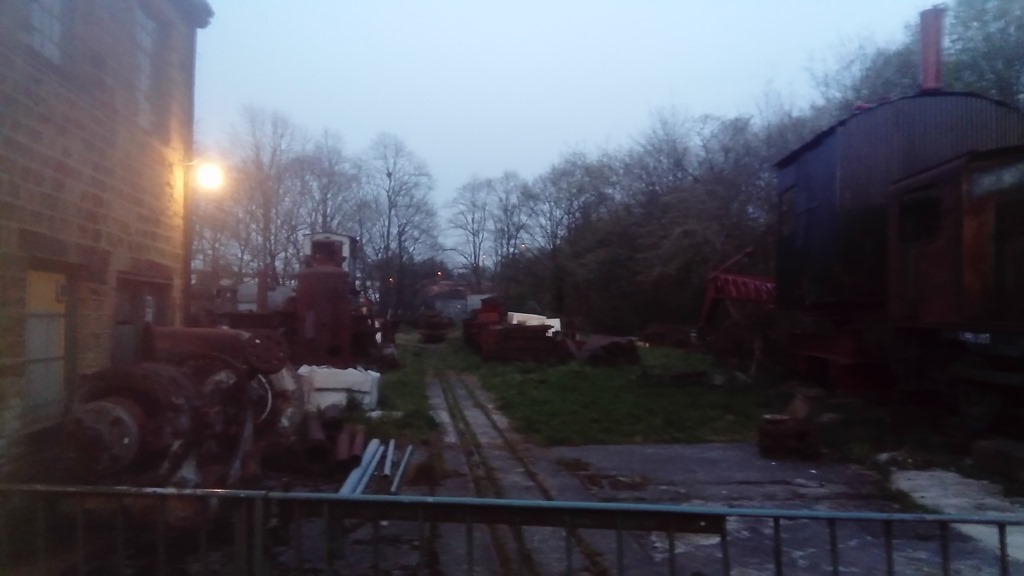
Having seen the event – and it is an event, not a mere gig, not even simply a night of music, but something that, as the evening progresses, I realise is something that will stay with me as an experience, something different and really rather special – was in the museum, I assumed it would simply be in the museum. To arrive at the PA required walking the full length of the labyrinthine factory space, packed with weird machinery and other abstruse-looking contraptions. Some were operating, clanging and banging away. Following the arrows, we arrived at the sewing room, where NikNak is spinning discs and adding some wild flavour to the established tradition of scratching. I assume the bar is just around the corner and that we’ll be assembling in or near here, so move on with a view to returning. Follow the arrows. Follow the arrows. I try not to panic that getting out again is going to add quarter of an hour to my walk back to the station, and instead marvel at the displays. I’m not really digesting: the museum is looking like a full day’s exploration, and I make a note to return before too long.
DSC_0560DSC_0558

Eventually, we stumble into what appears to be some kind of old engine house. Past that, the bar and toilets. A nice array of local beers, bit in cans and kegs. No commercial piss on offer here.

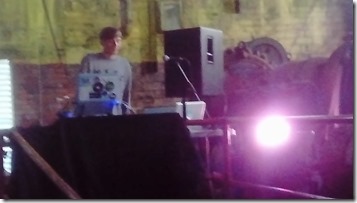
The sun is slowly sinking, but still casting a fair bit of light as Bambooman delivers his ‘site-specific’ set, which is built predominantly around field recordings captured around the museum in the weeks ahead of tonight’s show. He throws some solid beats, and bass loops and samples in abundance. Light, skipping motifs that hint of the orient and extraneous industrial sounds – repetitious mechanical clankings which forge heavy marches dominate, and are overlaid with oddly folky vocals. The incongruity actually works in its favour.
DSC_0556

Bambooman

And it’s here that I begin to really experience – and to appreciate – the synergy of sound and space. It isn’t because the music isn’t engaging that I find myself casting my eyes around the space I’m standing in: it’s because the music compels me to do so. I cast my eyes upwards, and wonder what caused the various punctures and tears in the corrugated roof, through which the fading light seeps, purplish. People begin to pack in with greater density, legs and pelvises moving in time with the rhythms. A woman comes and stands too close to me, and keeps knocking my shoulder as she moves to the music. I let it pass.

My notes thin in density: a trip to the bar results in my missing the front end of Object Blue’s set, but time is already beginning to warp before her altogether more abrasive set assails my senses. Abrasion may be relative, but in any context, Object Blue packs some attack. The bass frequencies register around the pelvis, while the treble hits around the upper reaches of the cranium: the cymbal work is almost sharp enough to slice off the top like cutting open a boiled egg. The sounds are pushing the limits, fraying at the edges, and tug ant the nerve endings, but the PA is supremely crisp and clear and despite the respectable volume, I’m not feeling any need to get the ear plugs out. Object Blue’s approach to ‘industrial’ may be less literal than that of Bambooman, and more conventional in terms of genre, but with contrast comes impact. As a performer, she’s understated and demur, but sonically, her set is combative, aggressive, every frequency tweaked for optimal discomfort. I absolutely love it, and instead of raising the blood pressure, the sheer quality of the compositions and the attention to detail is uplifting. And with any uplifting uplifting experience comes a sense of quiet joy.
DSC_0562

Object Blue

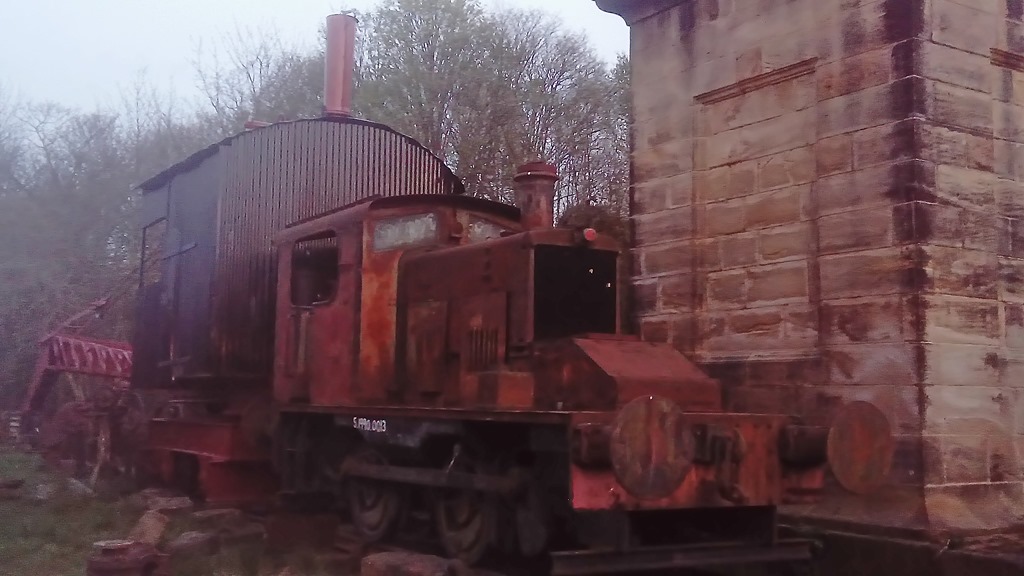
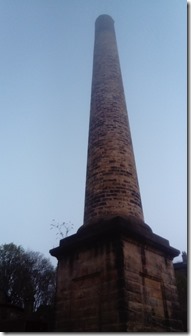
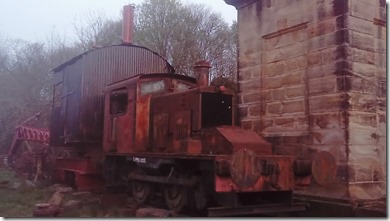
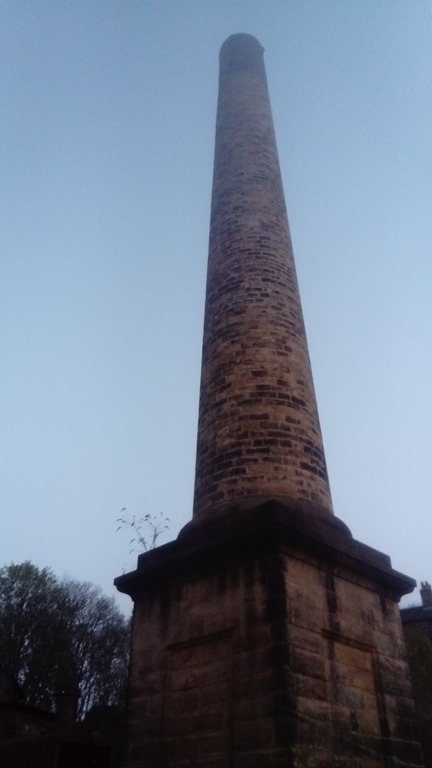
Time really begins to slip now, and it’s not about the alcohol consumed. I’ve actually been pacing myself, for a change against recent outings more immersed in the experience than the quest for obliteration. During the space between acts, and as the beats knocked out by the DJs echo out into the night, I talk to my friend about mental health. It seems oddly comfortable and in come ways appropriate: I’ve spent the last few months operating at a frenetic tempo, which has resulted in wild fluctuations in mood. Tonight, at one with my surroundings, immersed by the music, stepping out of my life and engaged by everything that’s going on and the sense of something different something new, I find I’m reattenuating, becoming once more aware of the details of my environment – the sky, the details of chimney tower, the rusted engine, the imposing hulk of the mill on the hill, the skeletal frame of an engine tunnel or something, rusty and covered in ivy, the inexplicable machinery at every turn. I’m breathing at a slower pace. I’m back in life.
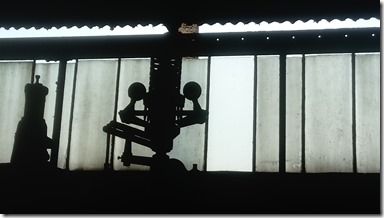
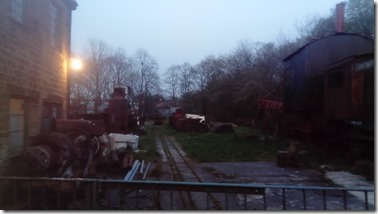
DSC_0557DSC_0561

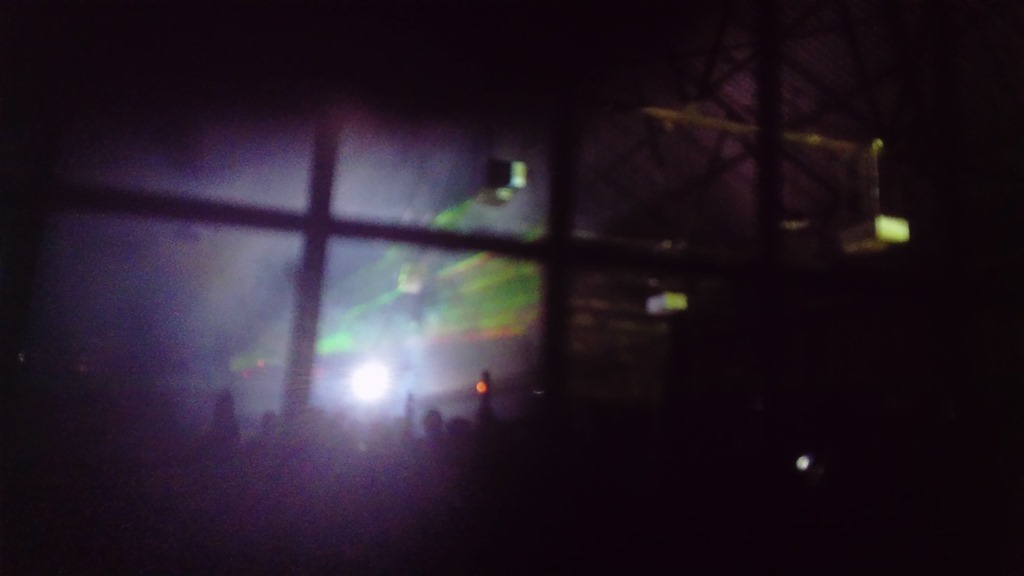
Pye Corner Audio delivers something special. The downtempo focus of the set is key to its hypnotic effect. One moment, I’m engaged, observing the laser lighting and the drift of illuminated smoke across the space where he performer is situated, attuned to every last nuance of the surroundings, from the wire fence to the way the other members of the audience engage. The next, I find I’m swaying on my feet, eyes barely ajar, in something approaching a hypnotic trance. It’s the best I’ve felt in months – zoned out, but not completely out of it – the music becomes a throbbing wash that envelopes my body and every last one of my senses. THIS is what immersion feels like. The moment is all, and nothing else matters.
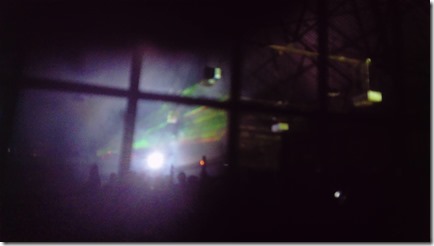
DSC_0567

Pye Corner Audio

I remember, jerking alert between lengthy spells of complete immersion, that this is a life experience. For the first time ever, it’s one I feel comfortable being only semi-present for.
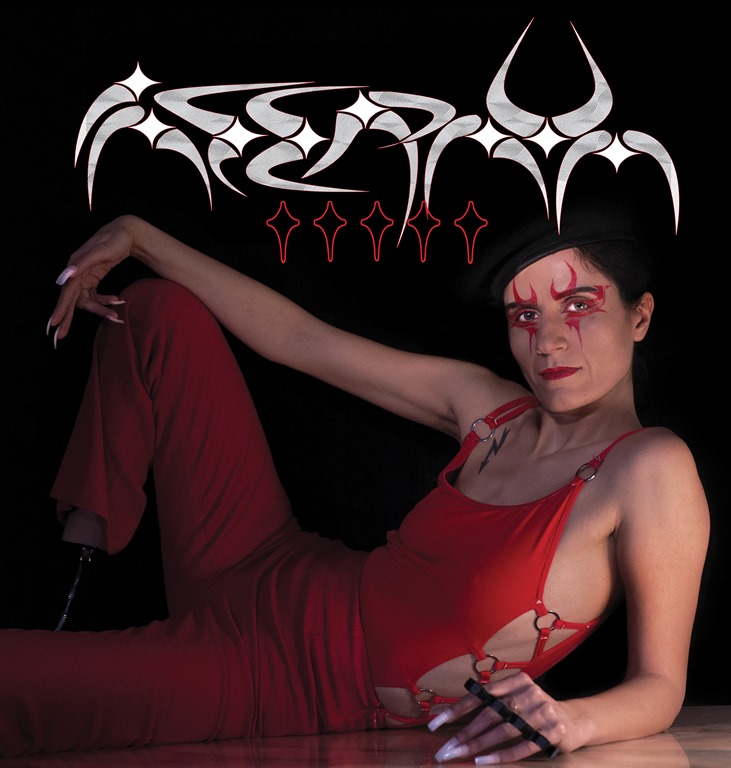
PNL Records – PNL040 – 20th April 2018

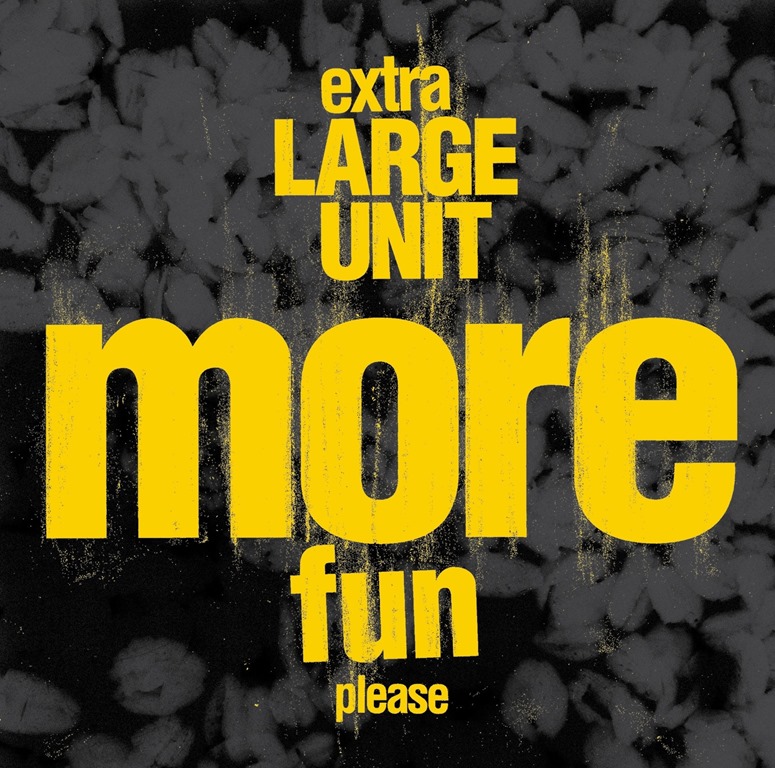
Extra Large Unit is an appropriate collective moniker: More Fun Please! is a live recording of an expanded iteration of Paal Nilssen-Love’s Large Unit ensemble, and features some twenty-seven musicians, in a line-up which features three grand pianos. Yes, three grand pianos. Excessive? Hey, if you’re going to go large, why not go uber-maxi, all-out massive?

The accompanying blurb explains that ‘The challenge of composing for so many musicians, while also maintaining the qualities and identity he had established with Large Unit, pushed Nilssen-Love to new creative levels. This was a monumental task…’ And More Fun, Please! is a monumental album. The question is, how much fun can you handle?

In his liner notes for the album Nilssen-Love writes, ‘When writing music, I search for extremes, pushing boundaries: physical, dynamic, instrumental limitations, if any, how fast and how slow can one play, how loud and how quiet. I search for unusual ways of thinking. I want to give the musicians trust and have them take initiative and to feel the responsibility of what it is to be an individual player in a group context’.

More Fun Please! is a thirty-minute aural rollercoaster, half an hour of highs and lows. At times, it sounds like a classic cartoon soundtrack, parping brass and sudden bursts of percussion; at others, it’s brimming with oriental exploration and eastern promise, and at others still, it’s utter bloody chaos, discord and cacophonous mayhem. In between, there are passages of trilling, tooting, droning and scraping, brought to abrupt halts by immense orchestral strikes – and I mean immense, earth-shaking, and borderline galactic in scale – and plinking, bibbling xylophone breaks.

The brass is beyond wild. Words simply aren’t enough.

The whole thing is an orchestral frenzy, a riotous ruckus of everything all at once, with sustained crescendos that seem to last forever.

It’s a lot of fun… but half an hour is probably about as much of this kind of fun as anyone can handle.

more_fun_please-42547043-

Ex Records – 23rd March 2018

Christopher Nosnibor

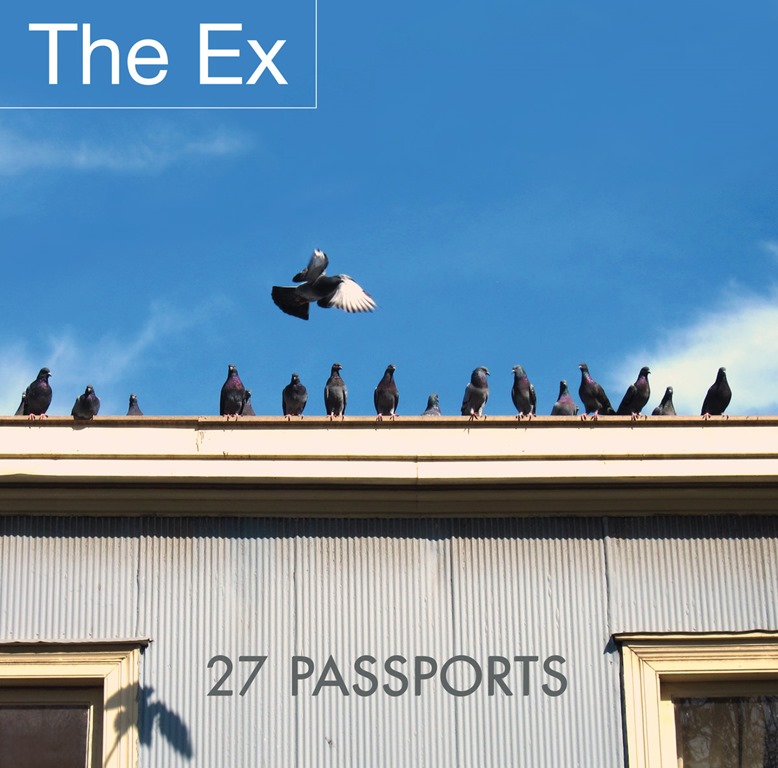
‘We always start from zero when we make a new album,’ the band explain of their creative process. This could well be the essential factor in their enduring nature: in avoiding the trap of becoming predictable to either their audience or themselves, they’ve remained fresh and innovative, continually testing their creative limits. Almost forty years and twenty-odd albums since their formation as an anarcho-punk band, The Ex are noteworthy for their eternal evolution and their refusal to stands still or to retread old ground. Collaborations, side-projects, and shifting lineups have also proven integral to this ethos, and it’s been almost eight years since their last album together as a quartet.

27 Passports sees them return once again reinvigorated, refreshed and ready to reinvent rock once more. And they do, in the way only a band with three guitars (but no bass – Moore’s baritone guitar provides essential tonal range here) and infinite vision likely can.

As the title suggests, this is an album of movement. Or, moreover, perhaps an album that creates the illusion of movement. 27 Passports is accompanied by a 40-page booklet of photos shot by Andy Moor. They’re odd, devoid of context or narrative meaning. Simultaneously eye-catching and mundane, they’re snapshots of life, devoid of perspective or implication: a row of feet on a train; a rusting car; a swan with its head under water; a traffic jam. These images provide an appropriate visual accompaniment to the disjointed, semi-abstract and immensely oblique lyrics and the musical content.

The first track, the six-and-a-half-minute ‘Soon All Cities’ is driven by a loping rhythm and crashing cymbals and builds a hypnotic groove slashed through with angular guitars which clang and scrape and layer up with volume and distortion. More than the choppy guitar work that often strays into the atonal and discordant, as do the vocals, it’s the percussion that really provides the focus of 27 Passports, pinning the loose and purposely obtuse guitar work in place and holding everything together.

If the claim that ‘there are some remnants of their African adventures’ (a reference to their collaborations with Getachew Mekuria) sits at odds with the spiky post-punk schematic, ‘The Sitting Chins’ subtly and strangely weaves ‘world’ music elements into the jolting barrage of chaos. If there was ever an antithesis of Paul Simon or Sting, this is it, and this fact alone makes 27 Passports an essential album.

For the most part, the compositions eschew linearity in favour of locking into a space and pushing away at a single motif for as long as seems reasonable, and sometimes beyond. This is very much a selling point. At to B is overrated: it’s about the journey. And it’s less about the distance than the motion itself. Take a walk: multiple laps of the block will not only achieve the same exercise effect as walking for miles toward a destination, but new details will reveal themselves with each circuit. No two circuits of the same short route will ever be the same. 27 Passports may be transcontinental in intent, but looking the wrong way down the binoculars is what it’s really about.

Barrelling bass scours the lower sonic realms on the robotic, motorik, ‘New Blank Document’; equal parts Gary Numan and early Swans, with heavy hints of The Fall’s ‘Spector vs Rector’ in its messy fabric. Such discord scratches away at the psyche, drills into the cerebellum, and unsettles the equilibrium.

In contrast, ‘Footfall’ deploys the same methodology and the same instrumentation, but against the relentlessly thumping beat, there’s a nagging aspect to the cyclical riff which has an intuitive emotional drag, a certain resonance. There’s something special about a certain descending three-chord sequence… and of course, they almost bury it beneath layers of jagged trebly noise. And that only renders it all the more beautiful and captivating.

There are some wonky pop moments present, too, with the Pavementy ‘The Heart Conductor’ bouncing along nicely, with a catchy vocal melody riding on top of the off-kilter guitars that are reminiscent of early Fall. Of course, when it comes to The Ex, comparisons are vaguely pointless beyond providing guidance for the uninitiated: with such an expansive career, it’s their work which has influenced many of the acts that stand as useful reference points. Of the surviving bands of the period – The Fall being no more and having arguably plateaued a good few years ago and Pere Ubu only offering occasional sparks – it seems like The Ex are the last ones standing who continue to really extend their reach and to challenge themselves and their listeners. 27 Passports is an absolute stormer, and an album which stands up against anything else going – period.

AA

The Ex - 27 Passports

Bearsuit Records – 20th April 2018

Christopher Nosnibor

Try as I might – and I do, I really do – I find it impossible to avoid words like ‘weird’ ‘whacky’, and ‘oddball’ in reviews of anything released on the Edinburgh micro-label Bearsuit Records. This is no reflection of a lack of vocabulary on my part: it’s simply what they do. Every boutique label needs some kind of signature or house style, and a micro-label really needs a niche. Bearsuit specialise in stuff that’s so far out it’s beyond.

Fear of the Horizon is actually pretty conventional by Bearsuit standards – but these things are all relative. ‘Eamon the Destroyer’, the album’s first cut, arrives in a flourish of expansive prog-rock guitar and twittering electronics, all on top of a thumping beat that’s pure dark hip-hop. And then the guitars really takeover and we’re in territory that’s suspiciously close to be being categorizable as ‘rock’. But then ‘The Positive Approach of Talkative Ron’ swings into view in waltz-time and goes all weirdy… and then there’s whistling and another epic guitar solo.

Pancultural influence are infused within the glitching electronic fairground fabric of ‘Woman With the Plastic Hand’, with its stuttering beats and woozy organ sound, while ‘Vandal Schooling’ brings with it a crunch of industrial noise and stabs of bold orchestral brass, taking a sharp turn from abrasive to mellow around the mid-point and locking into a metronomic hard, industrial-disco flavoured groove near the end. For the most part, though, the sounds are soft-edged, mellow, supple, analogue.

‘The Horizon Project’ brings together mellow and woozy, its mellow motifs and nod-along beats cracked with a stylophone break and underlying hiss of distortion. It runs contra to the chilled beats and quite accessible lead melody.

‘Weird’ ‘whacky’, and ‘oddball’… they’re all entirely appropriate adjectives, but fail to account for the depth and range of Fear Of The Horizon. As hard as it may be to take seriously an act going by the name of Bunny & the Invalid Singers, there’s real merit to this work that goes far beyond the superficial quirkiness. ‘Weird’ ‘whacky’, and ‘oddball’ don’t convey the wistfulness, the melancholy, the nostalgia, range of emotions, moods and mindsets.

This is where I should sign off with a suitably witty flourish, or some pun-based punchline, but such flippancy would be to only further undermine the true merits of an album which clearly shows no fear. Fear Of The Horizon is a fun, entertaining, and enjoyable work but don’t let the oddness and goofiness lead you to believe it isn’t serious, or art. Because it’s most definitely both.

AA

Bunny & the Invalid Singers – Fear Of The Horizon

Discrepant – CREP53

Christopher Nosnibor

This double album gathers two previous CD-only releases, both of which focus on Laurent Jeanneau’s love/hate relationship with China.

Soundscape China comprises two side-length sound-collages, with long samples of songs and TV shows, including what sounds like an exercise routine, and street bustle and radio, children’s voices, are overlayed with sounds of the sea and myriad extranea. Jeanneau’s work under the Kink Gong guise is often described as ‘surreal’, as collage works so often are, on account of their tendency to collide incongruence. The effect of displacing objects or text (with sound and moving images included in this category… one could argue that anything and everything is text in some form or another) and relocating it to an unfamiliar setting or alien context has the capacity to instil a sense of the uncanny. ‘Soundscape China Part 1’ doesn’t produce this effect, and feels more like reportage, a work which captures something of the flavour of the county without making any inference or comment, and without affecting any discernible change to the material or what it represents.

The Kink Gong website carries the notice that ‘Under the name KINK GONG you find 2 activities, the 1st one is to record ethnic minority music mostly in south-east Asia, the 2nd is to transform, collage, recompose the original recordings into experimental soundscapes’.

The second piece fulfils these both: it is far more intense, with jarring juxtapositions, crashing percussion. The material is more overtly spliced, the collaging nature of the work more apparent, and the overlaid noise louder, more abrasive. Yet there is still no sense of location in either time nor space. Not that this is a criticism, or something that could be considered a failing of the work: it’s simply its nature, and, more likely than not, my personal reception – Jeanneau’s experience of, and relationship with, China is considerably more deeply engaged than my own virtually non-existent experience beyond television.

Destruction of Chinese Pop Songs, on the other hand, is indeed, surreal. In fact, it’s fucking weird. Recorded (?) between 2000 and 2002, made mostly from skipping CDs of Chinese pop songs and further recomposed in Kunming (China), Vientiane (Laos) and Paris.

Why would anyone do this? And then, why would anyone listen to it? I could defend my choice to stick the album’s full duration – and in a single sitting – as research in the line of duty as a critic, but the truth is, these skipping, jitter, scratched-up, fucked up defacements hold a perverse pleasure, and I listen with bemusement.

‘Car crash’ is a phrase that’s been overused to the point of cliché obsolescence, but it’s appropriate here: not only does it convey the awkward compulsion to continue listening despite the discomfort and the knowledge that it will be impossible to unhear this, but it also reflects the mangled musical wreckage that’s wrapping itself around your ears. That said, having driven past two accidents within a short distance of one another on the A1 on Good Friday, noting my wife’s irritation and snappy frustration at all of the cars slowing as they passed, I made a point of not looking to prove that it is possible to resist. I felt a little cheated at denying myself from observing the Ballardian spectacles, but have no such need for restraint in the face of this exercise in avant-garde appropriation and defacement.

And the collisions keep on coming. ‘Hit Qin Qin’ sounds like R2D2 in the middle of a circuitry meltdown in a sea of distortion and static, while plinky-plonky piano lift music rolls on, despite the notes warping and melting. It’s simultaneously comedic and horrific. Elsewhere, ‘Pingtan’ sounds like a string instrument being slowly pulled apart while a radio plays random stations in the background, and ‘Bai Street Dance’ sounds like it was recorded on a condenser mic and played back through a Walkman speaker with a torn cone.

Everything about these songs is difficult and obtuse. Even when the ‘songs’ aren’t devoured by stutters, glitches, sticks and all other kinds of sonic wobble that’s a variant on the digital stutter, or by distortion and static and fast-forwards – yes, even when the form and sound of the song beneath the fiddling is fundamentally intact and discernible – there’s other shit thrown in to interfere and interrupt it. So yes, it is surreal, and continues the lineage of William Burroughs’ audio cut-ups, while revisiting the questions of context, ownership and defacement raised by Duchamp and the Dadaists before.

It’s obscure, awkward, bizarre, messy. It’s disorientating, destructive and really rather silly, both in terms of concept and execution. But these are all the reasons to appreciate Kink Gong’s commitment to forging his own path.

Dian Long: Soundscape China / Destruction of Chinese Pop Songs present two very different – if closely connected in thematic terms – aspects of the artist’s work, and releasing them together as a single document makes perfect sense, so long as you’re amenable to experiencing a total mindfuck.

AA

Kink Gong - Soundscape

Jahmoni Music – JMM209 – 23rd February 2018

James Wells

Straight into weird shit territory here. Wordless, atonal vocals layer up, ululating and droning and whatever, the tape stretched and slowed and generally fucked about with, while a monotonous bass throb and thumping industrial beat holds an insistent four/four. Think The Fall crossed with Throbbing Gristle. It’s not the full picture, but is a flavour of ‘To Evacuate is Difficult and Infrequent’. It may or may not be a song about bowels. But probably is.

DJ Marcelle is certainly not a DJ in either the conventional or contemporary sense: nor does she present the image of the club DJ throwing down bangin’ tunes for the euphoric masses. Her website uses a kind of Scooby Doo Mystery Machine typeface, and her tour photos all document the soups she’s consumed. This explicit lack of coolness is a cause to celebrate her as an artist. This is not about trends or commercial endeavours: this is about making art with sound.

‘To Reveal the Secret’ is a lo-fi mess of sample loops and clattering drums, and calls to mind the jittery experimentalism of the early 80s avant-garde scene: again, the shadow of TG looms, but equally, the playful oddness of early Foetus and lesser-known acts like Meat Beat Manifesto offshoot Perennial Divide. It pretty much bleeds into ‘Walking Around Aimlessly’, another mash-up of looped samples and old-school tape effects, mining that seem of William Burroughs cut-up inspired audio experimentalism that marked Cabaret Voltaire’s first few albums. Firecracking percussion and wild analogue bleeps provide the fabric of the frenetic finale, which lands in the form of ‘To Sing Along’. The irony is as heavy as the bass, and it rounds of a set that’s noteworthy primarily for its weirdness and apparent celebration of the random.

And random’s where it’s at. Psalm Tree is weird but groovy.

AA

DJ Marcelle

30th January 2018

Christopher Nosnibor

On the strength of the cover, with its sombre-looking black and white image of a fledgling gull (I think – I’m not David Attenborough) perched atop a post with the sea behind it, all the way to the horizon where it meets a brooding sky, you would expect The Earth Swan Sings Again to mark a turn towards serious, introspective and altogether less hectic approach to music-making. And in some respects, it is.

While still incorporating the wildly disparate elements of his recent previous albums – of which there are many, and then some (he’s put out a full dozen in the last decade) – The Earth Swan Sings Again feels less manic, more refined, but no less magpie-like in its amalgamation of a broad range of genres. And on this outing, Reaks has gone even further out on the jazz trip he embarked upon with Track Marks last year. This may seem strange for an artist who doesn’t really like jazz, but Reaks is an artist who doesn’t allow genre prejudice to contaminate his creative process. This is postmodern art at its intertextual best: everything is equal, and it’s all material. What counts is how that material is used, recycled, adapted. Etc.

This all makes for a more accessible set of material, but of course it’s all relative, and songs with titles like ‘I Stroked Her Like a Leper’, ‘Her Body Convulsed’ and ‘Today Hurts More than Mercy’ are never going to have the commercial appeal of the mediocre shit of Ed Sheeran or Bastille or whatever cal R1 is spinning on an endless brainwashing loop these days, and that’s before you even get to the music itself. ‘She stretches open like a parasite’s echo,’ Reaks sings by way of a refrain on ‘She Stretches Open (Like a Parasite’s Echo)’. It’s vaguely disturbing, and entirely surreal, but in keeping with his abstract / cut-up approach to the creation of art.

Bringing a more low-key vibe that’s dominated by a post-punk atmosphere, The Earth Swan Sings Again is darker and challenges in different ways from preceding efforts. The basslines are still dubby but less rampantly wild, and more about driving by stealth. The guitars are still choppy, but veering toward the picked and understated – apart from the immense and brain-meltingly OTT jazz/prog wigouts that splurge all over the place unexpectedly and incongruously – they’re altogether more subtle. Well, the guitars, maybe: the OTT jazz/prog wigouts are maybe less so, but they work, and there’s a sense that Reaks knows all of this. As one of the most singular artist practising at this moment in time, Reaks knows what he’s doing, and also knows that one chooses art of commercial success. And this is art.

The Earth Swan Sings Again is dark and stark, low-key yet eclectic, and at times inexplicable. Of course it is: it’s an Ashley Reaks album, and when it comes to walking the line between genius and madness, Reaks has forged a career by joyously straddling it and raising two fingers to convention of any kind. Outré creative talents like Reaks are few and far between, and while the mainstream grows ever safer, ever more diluted, ever more background and by-numbers, the need to artists who rub hard against the grain grows ever greater.

AA

Ashley Reaks – The Earth Swan Sings Again

5th February 2018

Christopher Nosnibor

Sidestepping any comparison of the title to Chocolate Starfish And The Hot Dog Flavored Water and perhaps clocking a nod to Cinema Cinema’s Manic Children and the Slow Aggression, The Tattooed Aunts and Mice on Speed stands not only as one of the most intriguing juxtaposed item album titles I can think of, but is probaby one of the best you’ll hear all year.

It’s been some time in coming, but Rick Senley’s fourth album under the I Am A Man with a St Tropez Tan guise. He has many, including musicforvoyeurs, alongside his work as a photographer, journalist, writer, teacher, actor and guitarist in a number of bands. I Am A Man With a St Tropez Tan is – according to Senley himself – ‘the sound of aggression borne of death, mental health struggles and addiction. It’s also a project centred around one man and his Dictaphone, a magpie-like approach to lifting and combining snippets of sound to create a nasty, messy and quite abrasive collage.

The biographical context to The Tattooed Aunts and Mice on Speed is genuinely harrowing, and I shall quote without abridgement: ‘After the death of his girlfriend and an accident left Rick housebound for months he channelled his rage and despair though electronic sounds and screams – a Chemical Brother nightmare put to sleep by Apex Twin’s downers, a bed-bath by Depeche Mode with Nine Inch Nails glaring through the keyhole and The Prodigy banging on the door.’

It’s a challenging mess of splintered noise, fragmented and disjointed, with pumping technoindustrial beats and dark club-orientated grooves pounding insistently beneath it all.

The whole thing has a nightmarish quality about it. Warped vocal samples taper in the way for a juddering beat and warping bass groove on the first track, ‘Killing Seals’, and thins become only more challenging from hereon in. the second Senley seems prepared to offer an inroad, an accessible structure centred around a solid rhythm and consistent bassline, he tears it to shreds and throws it all up in the air.

Senley pitches the album with the summary ‘Bursts of Burma, Thai ladyboys, Egyptian dogs and kittiwakes from Iceland join forces in equally disturbing measure.’ It’s perhaps a slanted perspective of the actual contents of The Tattooed Aunts, but it does give some indication of the wide-ranging sourcing of material Senley has engaged in in order to formulate this near-Burroughsian cut-up collage of sound. It’s disruptive, disturbing, a soundtrack of dissonance and dislocation. And it very much captures and conveys a mood of a difficult headspace, making for an album that’s at times tough, but ultimately rewarding.

AA

I Am A Man - Tattooed Aunts

This is it Forever – 28th February 2018

Christopher Nosnibor

Capac are an electronic duo, currently based Athens and Bristol. But geography is a state of mind, and while details about the context and circumstance surrounding Through The Dread Waste are limited, the music stands for itself. Yes, it’s supposed to contain ‘ten interpretations of the coldest traditional winter music in the form of dark drone and atmospheric ambience’, but without a priori knowledge of the original versions, all that is left is drone and ambience.

The ‘dread’ ascribed to the ‘waste’ is entirely redundant: waste is surplus, unnecessary, for disposal. Why dread it? The sense of portent, of impending doom… Yes, in a world where there is no time to waste, no money to waste, we may rightly dread it. And yet. The waste: anything waste is unnecessary, and should be confronted, not dreaded or feared. And without value or purpose, anything is waste.

On the subject of disposal, the order page for the physical edition of the album is most telling, containing as it does the following: ‘The physical form and true embodiment of the concept behind Through The Dread Waste… You receive a fire log with a metal plate hidden deep inside. After burning the log, among the ashes you will find your metal plate revealing instructions to access the original constructions of the traditional pieces of music, prior to their deconstruction. Destruction, after all, is a form of creation.’ This echoes a classic and fundamental tenet of the avant-garde, namely the premise that one must destroy in order to create anew.

Postmodernism’s defeatism and acceptance of the death of originality is either the last gasp of the avant-garde, or the point at which is necessarily destroys itself to re-emerge, the creative equivalent of stubble-burning at the end of the cycle of growth and croppage. It would be easy to deride the ‘fire log with a metal plate’ but this is art, and there’s precious little the production and release of music by and large, especially in the mainstream. And this is art which is more than merely willing to be ephemeral, and actually invites its own destruction.

The album’s ten compositions are by no means indicative of a conventional, square set-up, as longer tracks are separated and segued by fragmental pieces. And over its duration, there is a lot of piano, and a lot of space. A lot of space. Through The Dread Waste is a sparse, ominously atmospheric set. This is music to stare into space to. At times, its presence is so sparse as to be beneath detection. The lilting piano, the endless resonant air between them, is captivating, yet so understated as s drift into the ether.

The overlaid and unintelligible snippets of voice on ‘Winter Morning’ call to mind the scratchy, pre-fade in discord of ‘Disintegration’ by The Cure. But here, there is no swampy tune riding in on oppressive drums to hammer it all home. Instead, it drifts into another space, and we consider valiant spaces and parallels. Elsewhere, monasterial voices hover in fogy darkness and drones crackle, from eternity.

As such as it’s a spiritual, transportative, and eventually an immediately accessible release (and not in the same sense of ‘accessible’ which is at the centre of the divisive and heated debate which is raging in the poetry sphere right now). Through The Dread Waste has infinite inroads, and is not abrasive or overtly difficult. Yet equally, it’s not dull or unchallenging. It has melody, and drifts in a way you can get lost in.

AA

Capac – Through The Dread Waste

Crónica 136 – 9th January 2018

Christopher Nosnibor

There’s something seriously awry with my promo download of the album. The tracks won’t play any audio, and instead flit by as if scrolling, searching through a menu on fast-forward. It’s a disorientating experience, and frustrating. But my curiosity I piqued, and so I feel compelled to piece together a review from the sources I can access, starting with the album’s BandCamp page on the label website.

The genesis and evolution of this collaborate project is described in the most factual of terms in the accompanying blurb.

To start AMT and Tarab exchanged materials and objects. AMT exchanged a single sound sculpture for Tarab’s collection of small objects. This material exchange led to activity. AMT manually manipulated, Tarab also, but more often than not he placed the sculpture in situations and let them work on it. Once again exchanges took place, this time of audio material. Elements where then selected and arranged and further rearranged; some left untouched and some where [sic] transformed.

I know little about either act, beyond the sketchy bios which accompany the release. On the evidence of the contents of this curious split album, Artificial Memory Trace – a project by Slavek Kwi, a sound-artist, composer and researcher interested in the phenomena of perception as the fundamental determinant of relations with reality – create fragments of sound, with seemingly random bumps and scrapes and whistles and near-mic distortions and whatever snippets come to hand tossed together to make bumpy, jumpy sonic rides. Very brief, bumpy, jumpy sonic rides at that: the seven AMT contributions to this release are under the minute mark, but what they lack in duration is countered by their intensity. They don’t make for easy or smooth listening.

Tarab’s seven pieces are lengthier and present a very different approach to composition and arrangement. Scuffling shuffling scrapes and thumps congeal to render soundscapes that couldn’t possibly sit within the ‘ambient’ bracket. It’s altogether too jarring, the intrusions unexpected and sometimes surprising. You can’t settle to this, you can’t mellow out or relax. If fact, this is a sonic experience that provokes twitchy, tetchy reactions. It’s not music to ‘like’ but to appreciate artistically. Its challenge is its strength.

None of this is to pitch one act against the other as being more ‘evolved’: if anything, their contrasting styles and near-duality is integral to the appreciation of this release.

How seriously should it be taken? Probably quite seriously. Nothing about Obex intimates an explicitly light-hearted release, an album geared towards ‘fun’. And yet amidst the dark, ponderous clanks and rumbles, something about Obex suggests an entertaining aspect, and also hints that this is art for the love of art over and above any grander narrative. And, context / no context, this is an interesting, textured work, rich in texture and dynamics.

AAA

OBEX