Archive for the ‘Reviews’ Category

Mortality Tables – 3rd May 2024

Christopher Nosnibor

As much as this is an album it’s an historical document, and one they’ve had to blow the dust off ahead of its release. Kullu was recorded by Carl M Knott, aka Boycalledcrow, as a series of field recordings as he traversed India in 2005 and 2006.

As the accompanying notes explain, ‘The album is an audio travelogue of Knott’s travels through India in 2005 and 2006, just after he’d graduated. That journey was part of Knott’s concerted efforts to overcome the intense feelings of stress and anxiety that had gnawed away at him throughout his adolescence. Along the way, he documented his travels in a blog and accumulated countless memory cards of photos and videos.’

Life has a habit of delaying projects, of getting in the way (I have a number of book-length projects which I embarked upon circa 2010 which are languishing, incomplete, on my hard drive, and have every sympathy). When a project has lain so long, has been placed on a backburner, or whatever else, how viable is it after eighteen years? Is it really worth resurrecting? Yes. Always, and especially if / when it’s personal.

You read and hear often talk of ‘closure’, and usually it’s in relation to a bereavement or a specific trauma. But life is trauma: a path strewn with rocks of trauma to trip you unexpectedly.

Kullu is a road trip, a narrative, and also an exorcism, a sequence of processing, a coming to terms.

More than anything – and any critic’s outlook is limited to their experience – I’m struck by the range of sounds and the way in which Kullu is an album that expands over so much ground. At the outset, the beats are to the fore and Joujouka come to mind initially, as percussion thunders loud and hard, but before long, things start to melt and dissolve into entirely less form-shaped compositions. Twisting between ambience and various shades of dissonance and slow-shifting pulsations, Kullu grates and scrapes its way through a twisted journey of difference, of fresh terrains, ranging from ominous vocal and semi-orchestral compositions like ‘Kanashi’, to clanging, clattering, altered and warping. There’s a lot going on and I sometimes wonder if I’m equipped to cover this. But ultimately there is always room

Kullu presents all the moods, all the vibes, all the breadth of experience. It’s often discordant and difficult, and that’s as it should be.

AA

a2597800960_10

Constellation – 3rd May 2024

Christopher Nosnibor

Ah, that difficult second album. Kee Avil set the bar high for herself with her debut, Crease, two years ago. Crease was a highly experimental, boundary-pushing collection of compositions, which was as challenging as it was entertaining. But the trouble with setting out one’s stall in such a fashion is that you can’t retread the same ground, you can’t do the same thing twice, you can’t repeat the same experiments and expect different results. Not to suggest that Crease was in any way a ‘novelty’ record, but experimentation and avant-gardism has to be ever new, fresh, and novel. Pushing the boundaries requires an artist to continue to push them further, to expand the parameters, or otherwise risk being confined withing the limits set initially, at which point, it becomes prescriptive, a template. Small wonder, then, that Avil found the process for Spine to be quite different from Crease. But, unlike many artists who struggle to regain the creative spark in the wake of their debut, whereby some languish for years in a creative trough only to return with some second-rate slop (there are many articles devoted to examples of the ‘sophomore slump’, and I feel neither need nor inclination to recap on them here), Kee Avil seemingly found herself fizzing with ideas, as her bio details:

Spine was written in Kee Avil’s home studio after a lapse in writing while touring Crease and working on other projects. She is a well-known and respected member of the Montréal experimental scene, and formerly ran Concrete Sound Studio with Zach Scholes, who continues to work with her as a producer on Spine. Compared to the three years that went into making her debut, Spine emerged in a matter of months—a process that may also be a factor in its intensity and sharpness: “This record was much harder, like it was really discovering everything from scratch.” In her desire to not simply replicate or extend the sound of Crease, she felt she had to rip up the rule book, write in a different way, and pare back songs against her usual instincts.’

Touring does seem to have a habit of affecting the creative flow. It seems almost as if the industry model with its cycle of release – tour – write – repeat – serves to doom artists to dealing with unnecessary pressure to deliver, and it’s entirely self-defeating since inspiration simply cannot be forced – it’s something that happens. And it happened for Kee Avil, for sure.

Spine is brimming with discord and dissonance, angularity and oddness. ‘Felt’ fucks things up from the very off with warped, wrangling, jangling guitar that twists and mangles across flickering, stammering beats and extraneous noise that gets in your ears like a hatched moth fluttering against your eardrum. It’s a cringy, unsettling sensation, and it’s not really all that pleasant, and Avil breathes and croaks her way over it.

‘the iris is dry’ is magnificently weird, a close, breathy semi-spoken word muttering about lamps and eyes and angels, and it’s tense and claustrophobic and claws its way into your cranium. ‘It makes no sense,’ she croaks by way of a closing refrain, and it’s hard not to agree.

‘remember me’ continues the form of minimally-arranged alternative / eerie indie with a dark folk vibe crossed with a vocal style that sits in the realm of spoken word with a performance art delivery: Avil doesn’t sing, but whispers and breaths the words in a fashion that creates a palpable tension.

Gelatin’, released ahead of the album is entirely representative: taut, glitchy, the vocals mixed in a way as to be in your ear and at the same time detached: it’s awkward, uncomfortable. This is true of Spine as a whole.

The only real difficulty in Kee Avil’s second album is for the listener: with its shuddering percussion and harsh frequencies, as well as the up-front vocals, this is a challenging work. And this is a good thing: art should be challenging, and the quality is outstanding.

AA

A

a3581782210_10

15th March 2024

Christopher Nosnibor

While releasing a double-A-sided single is one option, in the digital age, releasing two singles simultaneously is also a viable option. It doesn’t coast any more, but does probably double the likelihood of scoring hits, and double hits equals double download potential. It’s the 2024 equivalent of releasing a single on multiple formats, only not nearly the pain in the arse collectors had to suffer in the 90s, heading down to the local record shop to bag the regular release on 7” and 12”, cassette and CD, and then again the following week for a limited edition format. Because back then, these strategies would have an impact on chart placings, and chart placings mattered, receiving airplay on the UK Top 40 on Radio 1on a Sunday evening, and the chance of further exposure on Top of the Pops. Now, if any fucker downloads your release, you’re doing well, because infinite streams may be something to plug but the revenue is not. Yay, fifty thousand streams… we earned 10p.

As usual, I digress.

Reviser are pitched as sitting alongside ‘classic 80’s bands such as Sisters of Mercy, The Cure, and Killing Joke, REVISER sounds complimentary to such contemporaries as Actors, Soft Kill, and Drab Majesty.’

So many contemporary acts align themselves to The Sisters of Mercy while offering but pale ghosts of imitation, and I find myself feeling deflated on a constant basis. Reviser do at least offer something, in the deep, grooves which likely come from baritone guitarist and vocalist Krysztof Nemeth, which shares some commonality without being a lame tribute-style rip-off. The baritone guitar is a rare and underrated instrument, showcased to strong effect by Leeds duo That Fucking Tank. Here, with its thicker tones, it manifests as a foot-to-the-floor low-end groove that clearly takes its cues from ‘Alice’ and choice cuts from First and Last and Always.

‘Burn it Out’ is synthy, but there are flickers of fractal guitar which float across a thunderous drum machine. Krysztof Nemeth – while not remotely ‘gothic’ in his vocal delivery, eschewing melodramatic baritone in favour of singing ‘straight’ brings further layers to the band’s evolving atmosphere. ‘Assassins’ again brings that solid 4/4 groove melded to relentless drum machine, reminiscent of ‘Lucretia, My Reflection’ (I’m thinking this is no accident), combining reverby guitar and wispy synths, finishing it all off with some processed vocals. It’s a bit post-Depeche Mode electrogoth, but the guitars provide texture and the songwriting and the delivery is on point, hitting the balance between that mechanised detachment and a the twitch of human heart.

This takes you back to the spirit of 83/84, when their forbears were knocking out black gold, and a single, at its best, was a tightly-packed statement of dark intent. These singles – taken together – deserve your attention.

AA

AA

255181

Klonosphere Records – 3rd May 2024

Christopher Nosnibor

If there’s one thing you need to learn about Djiin, it’s that they don’t bend or bow to conformity, and they come from a quite different angle in comparison to the majority of bands pedalling riffs and noise.

Their bio describes them as ‘a psychedelic stoner-rock band whose name is inspired by a psychedelic stoner-rock band whose name is inspired by spirits and other beasts of the Semitic beliefs and traditions. Influenced by 70’s progressive rock and krautrock bands, doom scene and heavy rock from the glory days of the early Sabbath era, as well as other modern references based on the diversity between western and traditional eastern sounds, Djiin develops a personal, atypical and captivating universe. Spirits and other beasts of the Semitic beliefs and traditions. Influenced by 70’s progressive rock and krautrock bands, doom scene and heavy rock from the glory days of the early Sabbath era, as well as other modern references based on the diversity between western and traditional eastern sounds, Djiin develops a personal, atypical and captivating universe.’

You may need a moment to step back and digest the depth of this. Djiin are not your average metal act.

‘Blind’ blew us away as a single cut ahead off the album’s release, and while it’s in some ways representative, it’s also the soft end of the band’s sharp wedge.

The title track twiddles and widdles in a way that Bill and Ted would probably flail over, and it’s a textured, detailed post-rock epic reminiscent of the hectic fretwork that dominated the sound of 2004-2006, but doesn’t sound in any way dated – not least of all because this is a pummelling blast of noodlesome guitar noise which transcends the confines of time or genre, lunging and lurching against a host off walls which confine genres within narrow, predetermined confined.

‘In the Aura of My Own Sadness’ is a glorious sprawl of post-rock exploration which ventures into a host of territories which are hard to unpack, not least of all because of some of the way if delves into detailed noodly territory, breaking into hefty tribal tones of the pulverising slow doom of the closer, ‘Iron Monsters’.

Mirrors may only contain five tracks, but in terms of depth and quality of content it offers a considerable amount more via its layered, if brutal, soundscape, which carves deep. It’s heavy album, and that’s for sure, and one which doesn’t conform to the distinctions of genre. But genre distinctions count for nothing: what counts is a that his is a raging apocalyptic blast – and it’s good.

AA

a1658479541_10

Tartarus Records – 26th April 2026

Christopher Nosnibor

The mood which pervades all life right now, feels pretty bleak. It’s not only that turning on the news brings endless darkness, with endless reports of multiple wars and families around the globe, but it feels as if a cloud has descended over all existence for all but the mega-wealthy who are living it large, laughing their way around the globe on cruises and in private jets in the knowledge that they’ll be gone and interred in spectacular mausoleums or at least having secured their notes in history and with extensive entries on Wikipedia. My daughter, who’s twelve, and loves retailing me with facts, told me just last night that based on current consumption, oil supplies will be exhausted when she reaches the age of fifty-six. “I don’t want to live til I’m fifty-six,” she said. It wasn’t spoken with an air of pessimism of gloom, but a statement grounded in an acceptance of the hell that the future holds.

It’s in this context that we arrive at III, by extreme experimental duo All Are to Return, who preface their new album with the commentary that ‘We have entered a new age of extinction – of poisoned lands, habitat destruction and encompassing climate catastrophe. AATR III reflects the harshness of life laid bare to the vagaries of capital, of uncaring generations heaping misery on their successors and the life-forms with which they share a fragile biosphere.’

Something I find bewildering is that in the nineties, environmental issues were pretty niche, as was being vegetarian – you’d be hard-pressed to find vegetarian cheese or yucky TVP on the high street, and would only be able to score some half-edible veggie sausages in Holland and Barrett or some crustie hippie shop down some side-street. Now, this is mainstream, and yet still politicians back big businesses who push fracking and deforestation and place profits ahead of what most refer to as ‘sustainability’, but is, ultimately, in reality, ‘survival’.

Perhaps I digress a little, but feel it’s relevant before returning to the pitch which explains how ‘The album’s unmitigated brutality of sound and expression are mediation of these concurrent events. Colossal noise-scapes are shaped with pulsing synth patterns, shredding percussion and vocals that are screams from the void. As a whole, the many-layered compositions carry massive assaults on the senses and a rage unhuman.’

The first few seconds alone are an all-out sonic assault, a blast of harsh static noise, a howling white noise blizzard which hurts. And from thereon in, it only gets harsher, an obliterative wall of noise that goes full Merzbow in no time. It shivers and trembles, grates and vibrates, everything overloading, eardrum-shredding, abrasive, aggressive, snarling, gnarly.

Not everyone ‘gets’ noise: to many, it is just ‘noise’. But noise is a vehicle which provides a unique catharsis, a means of channelling rage which cannot be conveyed in words alone. There are vocals on III, but they’re the sound of demonic torture in a sea of flame.

Thunderous, speaker crackling distortion overloads, and the vocals are butt demented, demonic shrieks buried amidst a skin-stripping nuclear blast. Every track is harsher and louder and denser than the last – and it’s the perfect soundtrack to the world right now. It would equally be a perfect soundtrack to Threads, being pure white-noise, blinding apocalypse in sound.

‘Drift’ is entirely representative: a solid wall of noise, harder and heavier than a slab of concrete – and it is the perfect encapsulation of the rage of life in the now. I sat down to listen to this as Iran rained missiles down on Israel in retaliation for the bombing of their embassy in Syria… Israel immediately vowed to return fire. Gaza has been levelled. We’ve just endured the wettest – and warmest – February and March on record here in the UK and half the country is under water, and many places received the entire rainfall for April in the first week, since when we’ve had more frosts than in the previous two months. Around the globe, wars rage and famine is rife, and frankly, everything is fucked. To think otherwise is delusional. Legacy? It’s clear what the legacy of the 21st Century will be, and ‘Legacy’ encapsulates that perfectly.

All Are to Return articulate their anguish at this fucked-up state of affairs by the medium of the harshest of noise. And it makes perfect sense. III isn’t quite Harsh Noise Wall, but it is fucking brutal. ‘Archive of the Sky’ is nothing short of devastating.

III hurts. It rakes at your guts, it rains heavy blows from every angle. It rapes your ears and pounds your cranium, it thumps your ribs and slays your sense. Every second is a sonic detonation, a devastation annihilation, a squall, a wall, an explosive blast, the sound of the world caving in, the sound of the absolute end. You want to hear the sound of the apocalypse? Listen to this, and live through the end of the world. It’s coming, and sooner than you care to contemplate.

AA

AATR III Artwork

Fire Records – 26 April 2024

Christopher Nosnibor

Another day, another artist I’m discovering and wondering if I’m increasingly poor at keeping up or of there really is just more music in the world than I could ever keep abreast of even if I devoted every waking minute to trawling every corner of the Internet for news and playlists. Maybe it’s a bit of both. There is, perhaps, something of an expectation that someone who writes about music should have a deep and wide-ranging knowledge of the subject. The trouble is, the more music you’re exposed to, the more avenues it opens up, and suddenly there’s this and this and this… and how is there time for all of it?

If you’re obsessive about a given genre, you may be an expert in your field, but you’re missing out on all of the other fields. Explore the other fields far and wide, and you’re missing something elsewhere. I see people on social media who seem to spend their entire days playing – usually streaming – new albums, and they’ve heard pretty much everything on release, five, six, seven albums a day. I’m rarely able to listen to music while working my dayjob, and when reviewing, I can’t really manage more than an album a night to hear, digest, process, formulate an opinion and sentences to articulate it.

In daily life, I rarely suffer from FOMO, but when it comes to music, I feel – increasingly -that I’m unable to keep up. I’ve not listened to the latest Taylor Swift album, for example. Or any of her albums for that matter. Am I missing out? My daughter would insist that I am. But as much as I listen to music for pleasure – at least when I can – I also listen with a view to providing coverage to artists who aren’t Taylor Swift, who you won’t find covered in every other publication. And so we come to Yosa Peit, who I clearly can’t claim to have discovered at the dawn of her career, but who, while having gained a following and a contract with Fire records, clearly isn’t a household name either.

The pitch for ‘The free-ranging sound of Yosa Peit’ is that her work ‘recalls the intense arrangements of a cyber-era Prince with the surrealist tones of Arthur Russell and the vulnerability of Arca circa 2017.’

I’m a little uncomfortable with Prince. By that I mean, likely somewhat controversially, I think he’s massively overrated, and moreover, I’m not really a fan of anything funk.

Perhaps it’s my relatively superficial knowledge of Prince that’s the reason that Prince is by no means my first point of reference on hearing Gut Buster, an album which is positively brimming exploding with ideas. There are elements of crisp pop and some bust-up, fucked about bluesiness to be found in the mix in this extravaganza of inventiveness, which also sculpts dark electropop shapes with some heavy bass and ethereal synths. At times, skitters and ripples rush by faster than the mind can compute, and there are some pretty slick grooves, even hints of what one might broadly refer to as ‘urban’ shades – as exemplified on ‘Tower Shower’, which also brings some dubby bass and blasting beats.

Gut Buster has soul – bit tosses it in a liquidizer and pulses it to a pulp with skittery bits and pieces of synth and hyper-processed vocals, 80s AOR melted into soporific trip-hop and hyperactive techno tropes. The chipmunk vocals area bit irksome at times, but there’s so much else that’s good that you can forgive it. The minimal gloop of ‘Call Me’ is a slow bump and scrape, and showcases the way in which Peit’s compositions are riven with intricate and fascinating detail.

Gut Buster is odd, quirky, in places dark and in others, less so. Unashamedly other and oddball, there is much to unravel here.

AA

383430

Cruel Nature Records – 26th April 2024

Christopher Nosnibor

Plan Pony – the solo project of Jase Jester, one half of Ombibael / Ombibadger – has been simmering for a while, and we’ve been following his output since the release of the ‘Martyr’ single back in 2020. So I was naturally excited to hear his latest offering.

I felt suddenly uncomfortable, concerned, even, on seeing the accompanying blurbage, which leads with ‘RIYL: Animal Collective, Madlib, Nurse With Wound, Hype Williams, Black Dice’. I mean, I do like a bit of NWW, and don’t mind some Black Dice, but I absolutely abhor Animal Collective. So, so much. Something about Animal Collective radiates muso smugness – something it would be hard to accuse Jase of.

Electric Swampland Home is the first Plan Pony album, and as with previous outings, finds Kester grappling with vintage gear to conjure authentic vintage noise inspired by those early adopters. He’s right when he tells me that emulators simply aren’t the same, and that when technologies were emerging, the sound of the resulting recordings was born of necessity – like when you bounce tracks on a cassette four-track and lose some quality and definition in the process, and the presence of amp hum and tape hiss because amps hum and tape hisses. Adding tape hiss or vinyl crackle digitally is an affectation, and while some may be sold on this kind of nostalgic artifice, it lacks that certain something.

While questions of authenticity provoke heated debate in circles around some genres – punk, obviously, grunge, perhaps to a lesser extent, and right now, indie and alternative as new acts track stellar trajectories seemingly from nowhere while claiming modest grass-roots credentials while obfuscating middle class and public school backgrounds and major label backing, Electric Swampland Home is a truly authentic work. Kester hasn’t amassed a pile of highly-sought-after vintage kit in the way people with hods of cash buy up 808s and Moogs to try to be cool. Electric Swampland Home is the sound of a Boss sampler and an old Tascam digital studio he’s had for yonks, and which by today’s standards are pretty primitive.

From the very start, Electric Swampland Home creates discord and chaos with the woozy, bent, and frankly fucked-up ‘Travelling There’, a loop of atonality that gives way to a rolling rhythm and feedback-squalling bass crunch… and from thereon in, everything goes.

‘The Village’ tosses a salad of tribal beats, twisted Kyoto and a dash of Joujouka. While I’ve never been comfortable with the kind of cultural appropriation that the likes of Paul Simon’s takes on ‘world music’ present, this is something entirely different – a full global exploration which occurs simultaneously. This owes more to the tape experiments of Burroughs and Gysin, Throbbing Gristle and Cabaret Voltaire than anything else, conveying a sense of the way in which everything happens all at once, and linearity is a construct.

Across the album’s eight tracks, Plan Pony meshes some dense sonic textures and layers of difficult dissonance. Notes and tones bend and warp, things twist and melt and bleed into one another: edges blur and fade. The way the juxtaposing and often incongruous elements are brought together isn’t explicitly jarring, it’s not a bewildering collision of noise, but something rather more subtle – although no less impactful and no less disorienting. As with Burroughs’ cut-ups, Electric Swampland Home captures – recreates, distils – the overwhelming experience of modern life, the blizzard of information, the endless intertext, the diminished attention span, the globalisation and the egalitarianism of everything. That isn’t to say we live in an egalitarian world – but that everything equally demands our attention from every corner of everything, to the point that it’s impossible to prioritise or even reasonably assess what’s of more importance than anything else. And so we quiver, frozen in stasis, poised between myriad options and so often spend hours selecting none of them.

This is nowhere more clearly conveyed on the warped, glitchy layerings of ‘Same Cloud’, which brings everything all at once. On the one hand, it’s the most overtly ‘song’ like piece on the album. On the other, it’s like listening to the radio from the next room while reading a book with the TV on in the background, and your phone’s ringing and next door are doing DIY and your mind’s wondering about what’s for dinner – and this continues into the sample-soaked looping stuttering jangle of ‘Amphibian’.

‘8pm Local Time’ combined field recordings, a low-level quivering bass and squelchy laser-blasting electronics together, and not necessarily in the most comfortable of fashions.

Electric Swampland Home revels in incongruity, in awkwardness, in otherness, and in many ways, it’s a magnificent representation of life in all its colours and chaos, its business and unpredictability. It’s not an easy or immediate album, and it’s not for a second intended to be. It is an unashamedly experimental work, and one which succeeds in its explorations.

AA

a3913248541_10

Christopher Nosnibor

However well you plan, things just happen that are beyond your control. It’s how you deal with these problems that present themselves which counts. In pulling off ‘Blowing Up the House II’ a punk and post-punk half-dayer with half a dozen bands for free / donations, Andy Wiles has performed little short of a miracle. Looking at the poster for the event on the venue wall, with a hand-written A4 sheet stuck in the middle with the stage times, it’s apparent that only three of the acts from the original advertised lineup are actually on the bill. Losing one key act due to diary mismanagement on their part must have been frustrating, but to lose the headliners on the day due to the drummer having broken his arm surely felt like a message from the gods, and not a kind one.

Still, the replacements could not have been better; the addition of JUKU on an already solid bill proved to be both inspired and fortunate, and then for Soma Crew to step into the headline slot, hot on the heels of the release of their new album made for a fitting switch.

Among the lower orders, Saliva Birds had some steely post-punk moments that reminded me of later Red Lorry Yellow Lorry with driving bass and solid drumming, and overall, they were pretty decent, and went down well.

As was the case with Saliva Birds, I had zero expectations of Zero Cost, up from Hull. They play some perfectly passable hard, fast three-chord punk marred somewhat by excessive guitar solos. They were at their best when they went even harder and even faster for some back-to-back explosive 30-second blasts. They only half-cleared the room, and they got some old people dancing very vigorously.

It’s getting to the point where Percy are likely in the top three or four bands I’ve seen the most times, partly because they’ve been playing gigs locally since before the dawn of time, but mostly because they’re worth turning out for. It’s fair to say you know what you’re going to get with Percy, in terms of consistency, and the rate they write new material, there’s always something new in the set – namely half of the forthcoming album, with the title track getting a premier tonight.

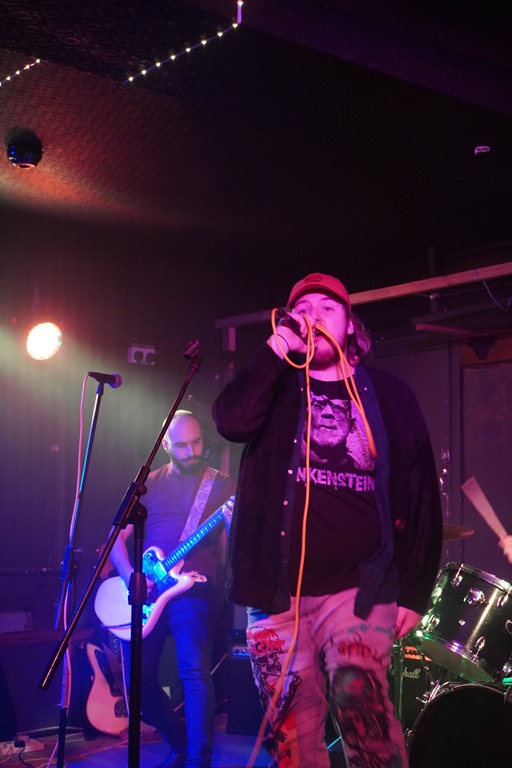
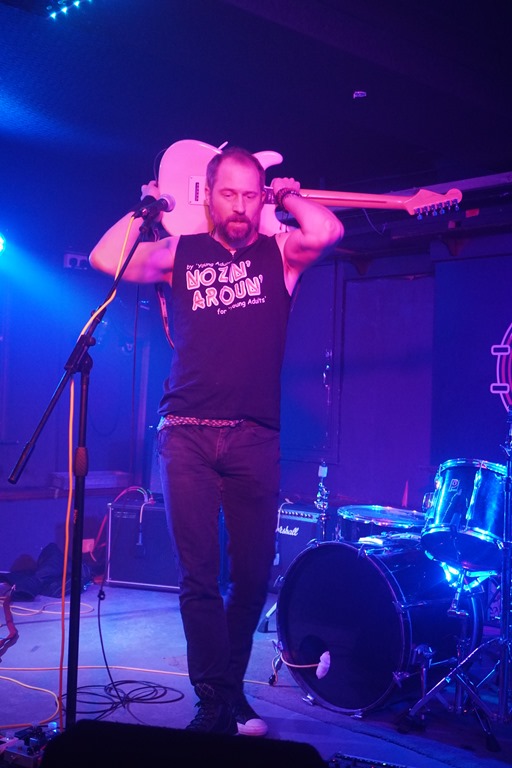
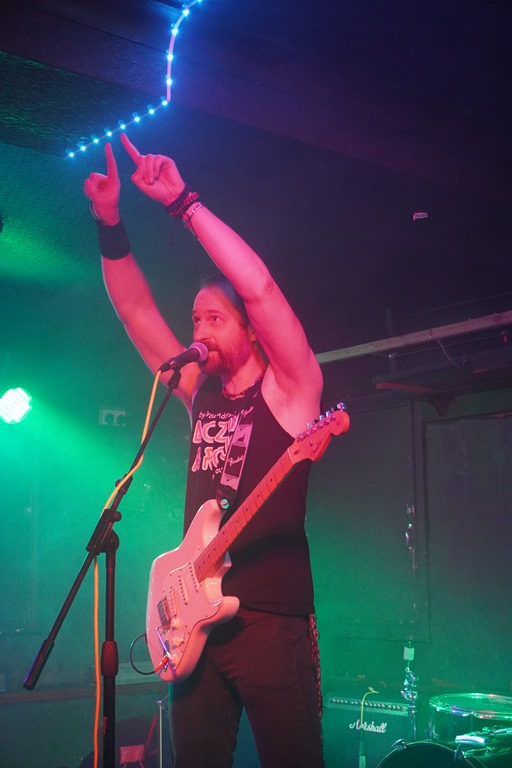
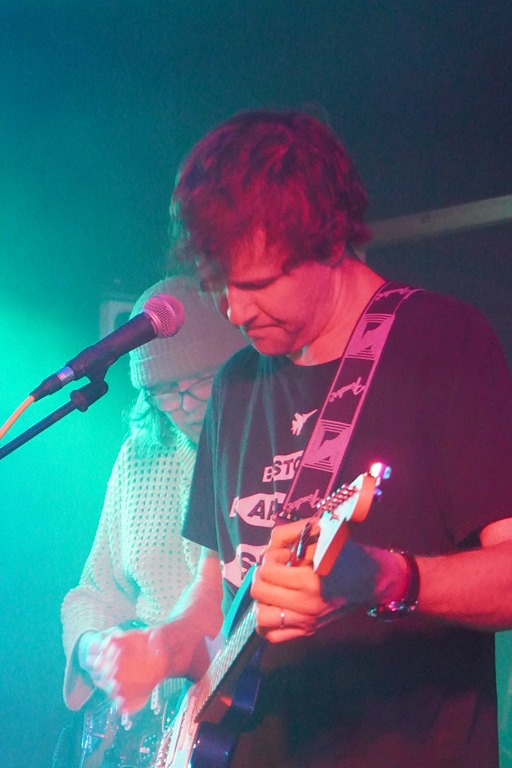
Opening their set with the darkly paranoid ‘I Can Hear Orgies’, Colin’s guitar is a metallic clang amidst screening feedback, contrasting with the eerie synths and insistent rhythm section. The loudness of Bassist Andy’s shirt threatens to drown out the sound from his amp, a big low rumble that defines the band’s sound. The drums are loud and crisp and propel some proper stompers.

“Don’t try the wotsits, they taste like earplugs,” Colin quips, in uncharacteristically jovial form, referring to the jar on the bar.

On the evidence of tonight’s outing, the album will be a dark, jagged collection of post punk songs about alcoholic blackouts and sex parties, and even without older favourites like ‘Chunks’ and ‘Will of the People’ in the setlist, there’s plenty of earworms. The waltz-time Thinking of Jacking it in Again’ sits somewhere between The Stranglers and Slates-era Fall.

20240420_205455

Percy

My review of JUKU’s debut performance last Summer was the fourth most-read article at Aural Aggravation for 2023 (behind the review of Swans’ The Beggar, Spear of Destiny at The Crescent, and my interview with Stewart Home). It was a gig that warranted all the superlatives. And they’re every bit as immense and mind-blowingly good as I remember tonight. It’s full-throttle heads-down stompers from start to finish. With big, ball-busting grungy riffs hammered out hard at high volume, there are hints of the Pixies amidst the magnificent sonic blast… but harder and heavier. And the drummer is fucking incredible. His powerhouse percussion drives the entire unit with ferocity and precision. Naomi’s delivery and demeanour contrasts with the lyrics wracked with turmoil, while Dan plays every chord with the entirety of his being, and to top it all, they have some tidy post-punk pop songs buried like depth charges beneath that blistering wall of noise. It’s a perfect package, and they’re an absolute-must-see band.

20240420_21390120240420_21480520240420_213840

JUKU

With a lot of bands and a lot of kit, with really tight turnaround times, it’s a huge achievement that the headliners are only ten minutes late starting, and credit’s due to venue and bands alike for their no-messing approach to plugging in and playing without any soundcheck beyond checking that there is sound. The sound, in the event, is consistently good all night – well-balanced, clear, and achieving an appropriate volume.

Soma Crew are another band I’ve seen more times than I can now count, and they just go from strength to strength. Many acts would have been daunted by following JUKU, bit they’re seasoned performers who play with a certain nonchalance and slip into their own inward-facing bubble where they just play, and magic happens.

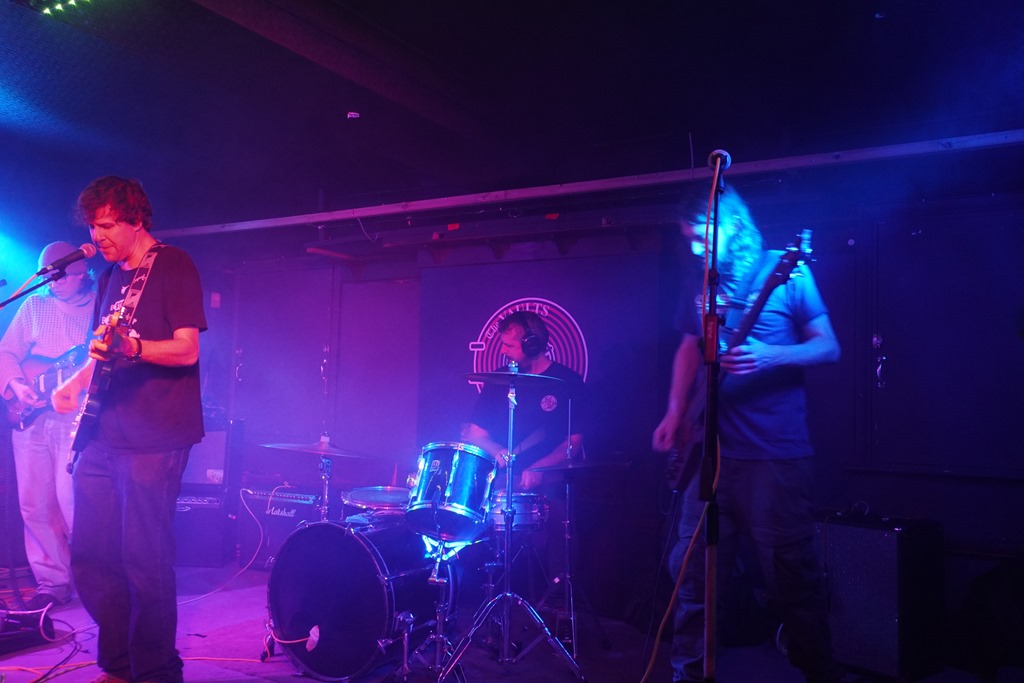
Tonight they’re out as a three-piece (the lineup seems to vary week by week, probably as much dependent on availability as by design), and much respect is due for their starting with a quintessential Soma Crew slow-builder, a crawl with crescendos which plugs away at the same droning chord for a solid six or so minutes. On the face of it, their hippy-trippy space rock is neither punk nor post-punk – but what could be more punk than doing precisely this? As their Bandcamp bio asks, ‘Why play 4 chords, why play 3. Why play 2 when 1 will do…?’ This is a manifesto they truly love by, and I’m on board with that: the joy of their music emerges from the hypnotic nature of the droning repetition, a blissful sonic sedative.

 20240420_22302820240420_224034

Soma Crew

While the rhythm section throbs away on a tight groove, beautiful chaos cascades from Simon’s amp via an array of pedals that occupies half the stage. It’s seven-minute single ‘Propaganda Now’ that solidifies their taking command of the room by virtue of doing their own thing.

Once again, it’s a trip to a grass-roots venue that shows just how much great music there is to be had a million miles from the corporate air hangars which charge £7 a pint and scalp the performers for 30% of their merch takings. It’s not even about the pipeline for the next big names who’ll be on at Glastonbury in a few years: it’s about real music, music that matters.

Coju Recordings – 1st April 2024 (CD & digital)

Cruel Nature Records – 29th April 2024 (Cassette)

Christopher Nosnibor

Letters and things lost have an almost mythical status in the field of literature. So many volumes are dedicated to the reproduction of exchanges between authors of revered status, and are poured over, clawed over, by both fans and academics. Many writers of great novels were also great letter-writers, and the letters often serve to build not only biographical depth and detail but also shed light on the development of the novels, that mystical ‘creative process’. Much of history exists in letters – the rich primary source material from which we piece together the picture and assemble a coherent narrative. It may be a construct, but it’s a necessary one when it comes to understanding the world and how we collectively came to arrive at the present.

The fact no-one writes letters anymore is a great loss. The same thought and effort simply doesn’t go into emails, and they tend to be considerably shorter, too, especially in the last decade or so. In fact, the quality of communication has slumped through the floor in recent years. Emails volumes – at least, ones that aren’t transactional in some way, have plummeted in favour of WhatsApps and messenger missives via FaceBook, Twitter, etc. It’s hard to really articulate just what’s been lost over the last few years, besides simply the art of in-depth, detailed longform communications, but with anything more than five lines long likely to be dismissed as TL;DR, it’s significant. I digress… because there are rare avenues open to expand on these matters.

Benjamin Heal, one of those multi-faceted, polyartistic individuals who is hard to pin down due to the sheer range of his output, has, through the years, pursued an academic career with a focus on William S. Burroughs – a prodigious writer of letters – and performed experimental noisy indie under the guise of Cowman, sharing stages with the likes of Trumans Water and Gum Takes Tooth, as well as his more electro-centric vehicle Coaxial.

Now resident in Taiwan, his latest project seems to bring together these elements of a diverse life. The material on this, the debut release from The Lost Letters – which finds Heal working with Fulia, is a calm and calming collection of delicate songs. The duo offer a quite gentle and melodic set of tunes in which is mostly centres around mellow acoustic-led indie, and slow, sparsely-arranged, soporific shoegaze and it’s not merely projection on my part in detecting a wistful, vaguely nostalgic air permeating the songs. The songs effortlessly drift and weave, Fulya’s vocals adding a layer of sound rather than easily audible lyrics.

The seven-minute ‘Cecille’ has, by its trilling gentility, nothing to do with The Walking Dead: it’s a graceful exploratory work which is mellow, melodic, and carries heavy hints of The Cure circa Disintegration thanks in no small part to its fulsome, airy bass sound and crystalline guitars, and it’s fair to reference Cocteau Twins at this juncture, too.

Things take a turn for the darker and more discordant on the lugubrious, plodding ‘Cut’, which scrapes and scratches for another seven minutes. With its muttered, monotone vocals and insistent sparsity, it offers hints of Shellac and latter day Band of Susans, in contrast to the soft acoustic instrumental work of ‘Route Rute’. These songs are on the longer side by necessity: repetition has greater impact over duration, and if the literary allusions and lifts by means of the deployment of the cut-up technique devised by Burroughs and Gysin are largely lost in the mix, the overall effect of discomfort and disjointedness remains strong throughout the set. ‘Crystal Skies’ is murky, with a drifting ambience spun through with a softly picked guitar, before ‘Sails and Sou’wester’ brings the album full circle to its nautically-themed beginning. While inviting comparisons to Slowdive and Cranes, it cascades dreamily into a mesmerising sea of sound, so richly evocative that you ache as it drifts on toward the horizon, leaving you reaching for something intangible.

Critics often write of craft, but the most moving music often comes from intuition and feeling, and this is moving in the subtlest of ways. Quite simply, The Lost Letters is a beautiful album.

AA

a3976784992_10

Human Worth – 20th May 2024

Christopher Nosnibor

The latest album from Norwich based two-piece Kulk, It Gets Worse, arrives two and a half years after the release of We Spare Nothing, described as ‘thunderous and experimental’, and honing their ‘unique and monolithic brand of heavy doom and sludge’.

The timing – and the title – couldn’t be more apt. Just when you were probably thinking we’d endured the absolute worst of life on this planet – from Brexit and Trump via a global pandemic and insane inflation and everything money-related being utterly screwed and still getting more painful by the day after 14 years of a Conservative government – it continues to get worse – half the world is at war, the other half the world is either flooded or in flames, and there are mass killings practically every other week. It’s not, then, simply a nihilistic strapline to grab the attention, but pretty much a demonstrable fact. Things never get better – only worse.

The band articulate both the circumstances and the mood when they frame the album thus: “This album is about the universal suffocating weight of hoping for more while navigating a climate where the apparatus for seeking it is being consistently undermined. What it feels like to not only struggle keeping your head above water but to try jumping out from the deep end without losing your trunks. It is selfish guilt and misplaced woe, desire is a distraction from the world at our feet”.

Bookended by short instrumental intro and outro tracks, ‘More’ and ‘Less’, It Gets Worse packs back-to-back balls-out riff-fests, where the bottom end sounds like a bulldozer and the beats sound like bombs. Whereas a lot of stuff on the doom and sludge spectrum is simply plain slow, Kulk are masters of the tempo shift. ‘A Heavy Sigh’ comes on at pace and builds a real groove, before hitting the breaks around two thirds in, at which point it becomes reminiscent of Melvins. The reason Melvins have endured is that – perhaps despite the popular perception – they’ve showcased a remarkable versatility and an urge to experiment, and it’s here that the comparison stands strongest with Kulk: they’re not just big, dirty riffs and shouting, although they do a first-class job of putting those things up front and centre. ‘Out of Reach’ is a pounding, raging roar of frustration amped up and overdriven to the max, hitting that perfect pitch at which blasting out a repetitive riff at skull-splitting decibels is the ultimate catharsis and the only practical and sane response to the world in which we find ourselves.

Things take a turn with ‘Mammoth’ showcasing a more hardcore bent initially, before descending into a howl of feedback, a noise-rock quasar delivered with the most brutal force. The vocals are barely audible, and then things get ever harder and harsher on ‘Beyond Gone’ which goes full industrial, hammering away at a simple, repetitive chord sequence with murderous fury. You feel your adrenaline pumping as they thunder away, combining pure precision with absolute chaos as feedback swirls and squalls all around like an ear-shattering cyclone.

The slower ‘Fountain’ shows considerable restraint and makes for an oppressive four minutes: it brings a bleak mood, and the hit lands late but hard when the distortion slams in. Getting Adam Sykes of Pigsx7 to play on ‘Life Will Wait’ is a major coup, and the track is a belter, built around a hypnotic three-chord riff – because all the best riffs have three chords – and really works the quiet/loud dynamic to the max.

Often, when people – particularly people in my demographic – write of the music of the 90s, it’s with a dewy-eyed nostalgia for their lost youth. Sure, I have my moments, but when I say that It Gets Worse takes me back to the 90s, I’m recalling the excitement of discovering endless obscure little bands cranking out major racket in pubs and tiny venues, some of whom managed to either get records or CDs released by shoestring labels, or otherwise scrape together funds to record and release a 7” or CD – and many of whom didn’t, and only exist in hazy recollections. The point is that these were exciting times. The only positive about living in shit times is that shit times make for good music, as people need an outlet to channel their pain, anguish, frustration, and rage. It Gets Worse is saturated with pain, anguish, frustration, and rage. And because of that, it’s very much a product of our times, and it’s absolutely essential.

AA

AA

a2498304630_10