Archive for the ‘Reviews’ Category

11th November 2024

Christopher Nosnibor

13x is reborn – or perhaps reanimated, resurrected, something – as dEddGvRL, and the title of gives a hint as to its tone and themes of this this seven-track release.

As she summarises in the accompanying notes, Anhedonic Succubus is ‘More a collection and recovery from extreme trauma over the past couple of years. Fake friends, S.A, declining mental health, alienation, despair, suicide, revenge….’ As such, this is music that’s issuing forth from a dark and difficult place, and there’s not only no escaping the fact – it’s necessary to take this head-on. There are doubtless many who will find these subjects triggering, but life does not come with trigger warnings, and a key function of art is to get to grips with life in all its complexities, all its pain and ugliness. And in connecting with art which does this, we strive to find ways to navigate life and the traumas it puts us through.

From a creative perspective, many artists channel their own experiences – however painful – into their craft as a channel of catharsis, a release, a way of comprehending or coming to terms with things. All of this is clearly an oversimplification of a complex relationship between an artist and their art, the nature of the creative process, and the way an audience – an infinite array of individuals rather than a collective with a single, fixed perspective – receive and respond to said art, in whatever medium. But I tentatively step towards Anhedonic Succubus with this preface because it’s particularly pertinent.

As has been the case with work as 13x, dEddGvRL channels considerable pain and anguish into these works – something which represents a continuation of the inspiration behind much of the previous work as 13x. But dEddGvRL plunges deeper into those dark places, and the eclectic sample credits feature some illuminating inclusions:

Drums on "Ophelia: Drained" taken from Tool "Die Eire Von Satan"
"Deathbearing Machine: Killng December" contains a segment from Charles Manson’s interview with Dianne Sawyeri
Cock Speech on "Sterben, Kranke Fotze" – "Female Trouble" (John Waters – 1974)
"Scared Of This Place" – Johnny Depp in Court
Catwoman (1968) appears on "Valenbitch"

‘Ghosts of My Body’ starts the set off quite gently, as it happens: dark, atmospheric, yes, but not without a certain levity, with hints of early-80s Cure B-sides and a dash of Disintegration, until the fizzing, distorted spoken-word vocals bring a more unsettling aspect. It creates a sense of detachment, which is likely almost entirely the objective, given the context.

Slow, sparse, murky, ‘Ophelia: Drained’ is reminiscent of Nine Inch Nails circa The Fragile. The tension builds and the percussion tears through the surface of a swirling wind and things start to get darker fast from hereon in.

Based on the context and the content, one may be forgiven for expecting more rage, more abrasion, more visceral noise, more attack. But Anhedonic Succubus is harder and heavier in its absence: instead of exploding outwards with a brutal sonic assault, dEddGvRL keeps things contained, introspective and seething. The effect is disturbing and menacing. Electronics buzz and hum around distorted vocals, and the percussion, too, is restrained, subdued. Things crackle and glitch, stutter and clatter, and the atmosphere is claustrophobic, oppressive.

When things do get noisier, on ‘Fuck What You Kill’, it really hits hard, and that’s before one reflects on the perverse implications of that title and hookline. But even then, the noise is sociopathically restrained, and pinned to a hypnotic repetition. The technoindustrial stomp of ‘Scared of This Place’ is by far the most accessible – and uptempo – track on here, and it works well and is well-placed, providing a late – and unexpected – rush of energy, before ‘Valenbitch’ leads the way to the exit in a relentless churning grind.

Anhedonic Succubus is heavy, but not in overt or conventional ways: instead, as the title threatens from the outset, it slowly sucks the air and energy, dragging the listener into dEddGvRL’s hellscape. It’s a tough listen, but artistically, it’s a success, delivering on its promise.

AA

a1542349256_10

A1M Records – 29th November 2024

Christopher Nosnibor

For most bands, unexpectedly parting company with their record label on the eve of the release of an album, the lead-up to which has involved three well-received single releases on said label, would be a devastating blow. But not so The Battery Farm. Even before A1M Records swooped in to fund the CD release, they’d already announced that the album would be going ahead as planned. That’s resilience defined. It also encapsulates the spirit of this indefatigable, undefeatable band. The Battery Farm embody tenacity, stubbornness, bloody-mindedness, and graft. They’re not making music for fun, or as a hobby, but by compulsion, with dark themes and dark grooves being very much front and centre of their work.

Flies – released two years ago almost to the week of its successor – was a strong debut, one which showcased the work of a band unafraid of experimenting, of embracing a range of stylistic elements, or revealing literary leanings. They’ve gone deeper and darker on the follow-up.

‘Under the Bomb’ whips in with synths buzzing a crackling static electricity before a sparse acoustic guitar comes to the fore, a sonorous bass note sounding out as Benjamin Corry sings – an intimate croon – and paints a bleak scene that calls to mind the grim images of Threads, the revered BBC film marking its fortieth anniversary this year. Considered by many to be the bleakest and most harrowing film ever made, its anniversary is a reminder of just how recently cold war tensions were so high that the fear of nuclear annihilation was both real and justified, as well as of just how quickly things can escalate – and, indeed, have escalated already in recent years. The closing lines ‘Survival makes you wish you’d never been born / Envy the dead after the bomb’ articulate the sheer horror of the fallout and a nuclear winter, and the song creates the context for an album which is dark, tense, and – justifiably – paranoid, scared.

The band fire in hard in jittery, driving post-punk mode on ‘The Next Decade’, Corry roaring full-throated, raw, raging, then shifting to adopt a more theatrical, gothic-sounding tone. It’s an impressive performance, reminiscent of Mike Patten on Faith No More’s ‘Digging the Grave’, and the overall parallel feels appropriate here. It’s a punchy, sub-two-minutes-thirty cut that’s almost schizophrenic and bursting with tension, paving the way for single ‘Hail Mary’, which hits hard. Minimal in arrangement, it’s maximal in volume. It’s gritty and taut, and when the bass blasts in after the two-minute mark, the sheer force is like two feet in the chest.

The singles are packed in tight, with the mathy noise-rock crossover of the manic panic of ‘O God’ coming next. Again, it’s the lumbering bass that dominates the loud chorus, and it’s a strong hook that twitches and spasms its way from the tripwire tension of the verses. ‘O God, which way is hell?’ Corry howls in anguish. The answer, of course, is whichever way you turn. You’re doomed. We’re all doomed.

The title track lands unexpectedly, as a slow-paced rock ‘n’ roll piano ballad which sounds like it’s lifted from a musical, an outtake from Greece or maybe Crybaby. But midway through it springs into life and takes off in a burst of proggy bombast. As was the case with Flies, The Battery Farm are never predictable, never afraid to throw a curveball, and they get the impact of making such switches, meaning that ‘Stevie’s Ices’, which lands somewhere between Muse and Queens of the Stone Age. The squelchy strut of ‘Icicles’ is different again: part Pulp, part Arctic Monkey in the spoken-word verse, more Nirvana in chorus, the essence of the album as a whole comes together here. The songs, in presenting two almost oppositional aspects between verse and chorus reflect a world that’s torn in two, collapsed, pulling in different directions – and while its theme may not have been directly inspired by the most recent events, given that its writing and recording predate the US election, the circumstances which brought us here – via a political backdrop which sees the UK, US, and so many countries split almost 50/50 between hard-right and broadly centre-left, a situation that brought us Brexit, which brought us Reform and fourteen years of Conservatism, which means that speech in support of the Palestinian people is met with hostile calls of antisemitism… Division and polarity defines the age, and debate is dead.

Powering through the raw big-bollocked punk blast of current single ‘John Bull’s Hard Times’ and the moodier, more reflective ‘It’s a Shame, Thanks a Lot’, a song which confronts anguish and misery and the desire to die in the most direct and uncompromising lyrical terms against a backdrop that borders on anthemic, we stagger to the fractured trickling gurgle of the disembodied ‘After the Bomb’ which spirals towards a climax before it slumps into a wasteland of ruin.

As dark as it is, The Dark Web packs some meaty tunes and beefy grooves, which elevate it a long way above Threads bleakness, but by the same token, it’s by no means a lightweight, sugary confection. Once again, The Battery Farm balance dark themes and slugging noise with moments which are that bit lighter, and even sneak in some grabs and hooks. The Dark Web is a dark album for dark times, but steers wide of being outright depressing. This takes some skill, and The Battery Farm have skill to match their guts.

Battery Farm - Dark

Overdrive/SKiN GRAFT – 15th November 2024

Christopher Nosnibor

When it comes to writing about bands who clearly function as a collective unit, it usually feels wrong to focus on any one member. But Eugene S Robinson is someone who stands out, not only in his singularity as a member of any band he plays with but within the alternative scene more broadly. The fact of the matter is that there aren’t many suit-wearing, bespectacled black men in noise rock, and this is a man who has blazed trails and then some. Famously founding Oxbow in 1988 as a means of recording his ‘suicide note’ before departing the band this year due to “the weight of irreconcilable differences, none of them aesthetic or musical.” It’s perhaps an understatement to remark that this is a man who has carved a unique path in music, and Mansuetude marks something of a shift for Buñuel following the trilogy of albums comprising A Resting Place for Strangers, The Easy Way Out and Killers Like Us.

Mansuetude is a whole lot more direct, less experimental, than any of its predecessors.

The album comes in hard: ‘Who Missed Me’ crashes in with an ear-shredding squall of feedback and distortion – that bass! And you’re swimming in noise before the crunching riff slams in… and then there’s the beat and… fuck. It’s too much! It’s brutal, launching between frenetic hardcore and pure mania. By the end, it feels like three songs playing at once and I’ve got heartburn before it collapses into a simmering afterburn. And then the blistering mathy blast of single cut ‘Drug Burn’ roars in with the deranged, lurching intensity of the Jesus Lizard at their fiercest.

There is absolutely no let-up: ‘Class’ is led by a big, dirty bass and hits with a density which hit around the solar plexus.

Just two songs in, you feel punch-drunk, breathless, weak at the knees. And they’re only just getting warmed up.

‘Movement No. 201 broods and skulks in a sea of reverb, and offers brief respite and alludes the kind of spoken word /experimental pieces on previous albums, but the explosions of noise hurt. ‘Bleat’ gets bassier, dirtier, heavier, more suffocating., the warped and twisted layering of the vocals intensifying the experience, the sensation of everything closing in.

It’s the relentlessly thunderous percussion that dominates ‘A Killing on the Beach’, but then the guitars roar in like jet engines and holy shit. Again, the multi-layered vocals raining in from all sides sting like the tasers referred to in the lyrics and everything is fizzling and sizzling in the most intense way. And then they crash in with ‘Leather bar’: it’s s seven-and-a-half-minute monster, a droning colossus and a true megalith of a track. As much as it recalls Sunn O))), I’m reminded of a personal favourite, ‘Guitars of the Oceanic Undergrowth’ by Honolulu Mountain Daffodils. It culminates in a thick wall of distorted guitars, the kind you can simply bask in. It borders on the brutality of Swans circa ’86. It’s harsh, it’s heavy it’s punishing.

The high-paced alt-rock, hardcore-flavoured frenzy that is ‘High. Speed. Chase’ is heavy and puns at a hundred miles an hour, and ‘Fixer’ is a tempest of raw energy, bleeding into the sub-two-minute gut-churner that is he blistering hardcore grind of ‘Trash’. ‘Pimp’ collides punishing repletion with skull-crushing weight, while the last track, the six-minute ‘A Room in Berlin’ finally brings an experimental edge and a spoken-word element to the soundtrack to a nuclear winter, with the most harrowing effect.

Everything about Mansuetude is dense, dark, and raging. It’s relentless in its ferocity, its raging intensity, an album that never lets up and is truly punishing at any pace. It’s an outstanding album, but it hurts.

AA

a1827083267_10

Christopher Nosnibor

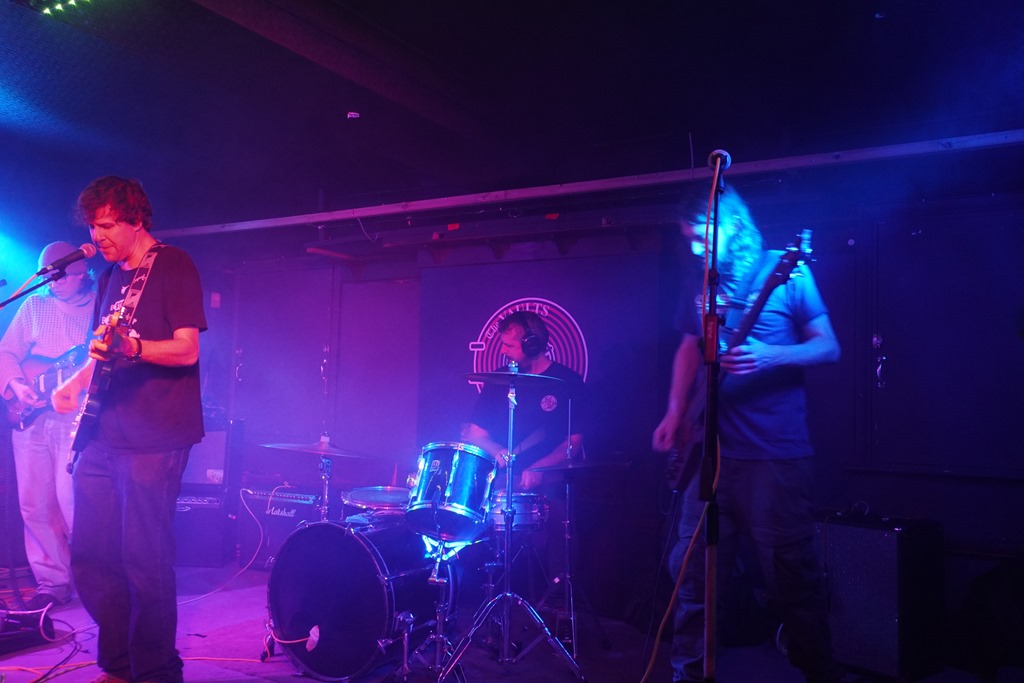
It’s easy to become complacent about the stream of bad news of endless pub and music venue closures, until it happens on your back door, in a way that directly impacts your social life. It’s been a really bad couple of weeks when it comes to establishments in York: first, we learned that the property owners of The Victoria Vaults have decided to close a pub of 130 years standing in order to flog it off, presumably to be converted into flats, and The Maltings, a city centre pub of national renown, is to be converted to an Irish Bar following the retirement of the previous owners who had run it for over thirty years. This follows on the heels of the revelations that The Roman Bath, another city-centre pub popular for live music, is to be rebranded as a sports bar. And on top of all this, there’s the result of the American election to digest. Right now, I can’t really contemplate, let alone dwell on, this.

We all have our ways of dealing with bad news. Me, I like to immerse myself in the experience of live music. For some, uplifting tunes in the form of buoyant pop or something singalong and anthemic is the remedy. Personally, I simply find joy in the experience, immersing myself in the moment and revelling in music that’s good. The Bricks being dependable, as I’ve reported an almost embarrassing number of times in the last couple of years, meets that criteria.

The fact that tonight’s show is being hosted at Lendal Cellars is also encouraging in the face of the aforementioned bad news about venues. It’s an interesting venue – a remarkable space, really, a city centre pub that’s by the river – and prone to issues with the toilets due to the frequent flooding in York – in a series of fairly low-ceilinged vaulted rooms – cellars, as the name suggests. I used to frequent it often in my early office days, back in the late 90s, but haven’t been in over twenty years, and I’ve never once I attended a gig here. There are reasons for this, one being that I don’t recall the place hosting bands, and another one being that in recent years I’ve been avoiding Greene King establishments on account of their business model when it comes to buying up breweries and shutting them down. I’ve also tended to avoid venturing into the city centre on weekend nights – especially racedays – because as a magnet for stag and hen parties and twats in general, not to mention recent reports of gangs of youths harassing and even attacking random strangers, York city centre has become less appealing as a destination for me. But this is a source of optimism, in that there may be potential for another pub venue, albeit of incredibly limited capacity, to step up and plug a gap.

“It’s very Cavern in here,” says the bleach-blonde with sunbed orange skin and sports gear on her lower half and a red crop-top on her upper, who’s celebrating her birthday and inviting random strangers to guess her age, to her mum as they quaff prosecco during the soundcheck. I suppose it is, and it’s also very incongruous – to the extent that I’m reminded of the night I saw Sunn O))) at The Sage in Gateshead, and was queuing to enter the venue, on the same night an X-Factor performer was performing in the lobby.

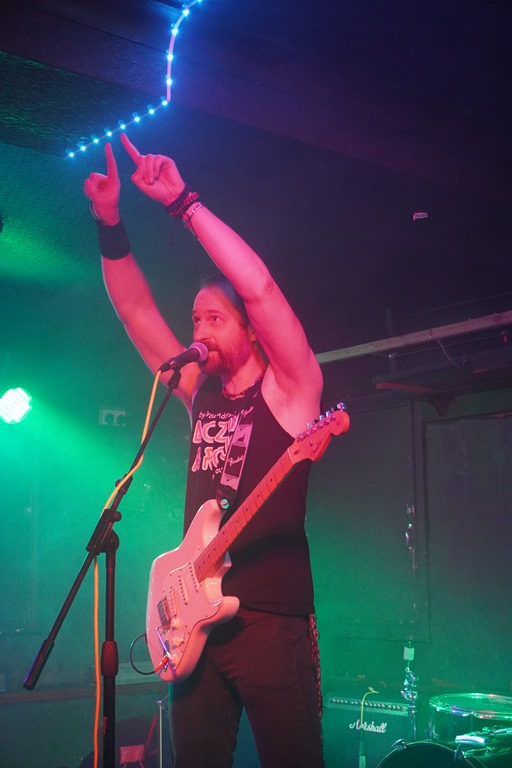
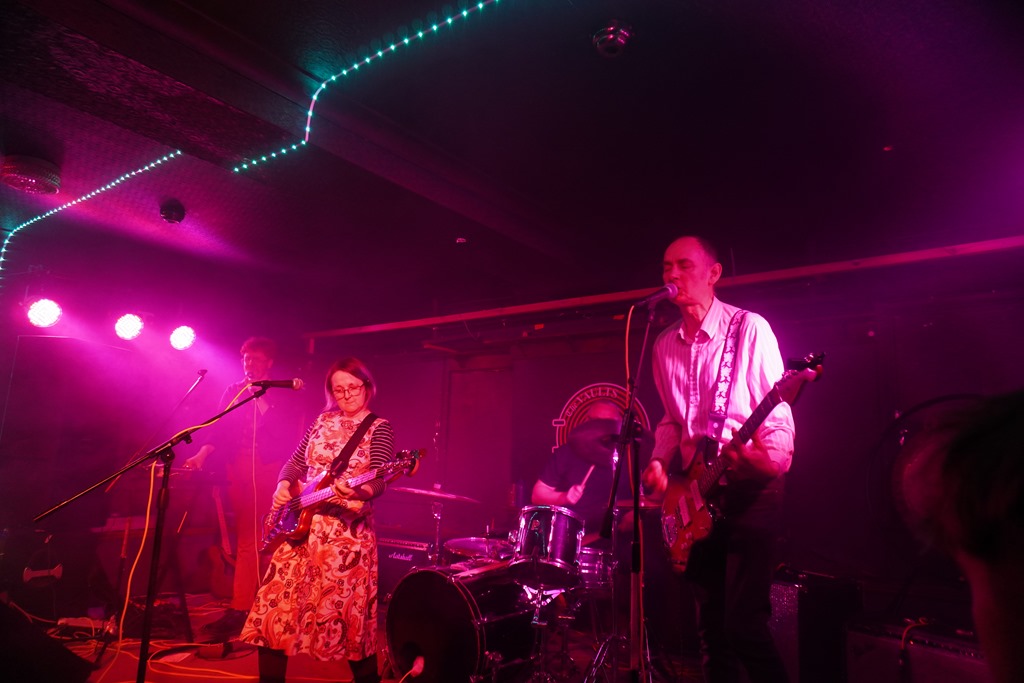
I’m here first and foremost for The Bricks. I’m not ashamed to say I absolutely bloody love this band because they’re absolutely brilliant. Having seen them in gig venues on abundant occasions, it’s a test of their mettle to be placed in this setting, and for those out for a regular Saturday bevvy with their mates, decked out in their nicely-ironed shirts and fancy dresses, hearing them is likely to come as a shock. Perhaps not as loud, or, initially, as assured on some previous outings, they’re still solid and hit like a spiky post-punk punch in the face. The band as a whole, are powerful, but Gemma, when she’s singing, at least, is absolutely fucking terrifying. Between songs and offstage, she’s meek, self-effacing, even apologetic, but when she steps onto the songs there’s a switch that flicks and she blasts out every line like a woman possessed. The slower, bluesy stroll of ‘Snake’ afforded the weekenders the opportunity to scurry for the exit without the full assault of the PA on the way out. There are a few sound issues early on, particularly with the mic feeding back and not being loud enough, but by the last couple of songs they really are firing on all cylinders.

DSC00330.HUE

The Bricks

This leaves me pondering between sets over the crisis facing live music at a grassroots level, startup acts and even those who have been going a while but are very much pub and small-venue circuit acts. As the number of dedicated grassroots venues diminishes, perhaps this is the future: to put live music right there in people’s unsuspecting faces. A lot will shit themselves and leave, but perhaps enough, after a few drinks, will come to appreciate hearing – and seeing – something different.

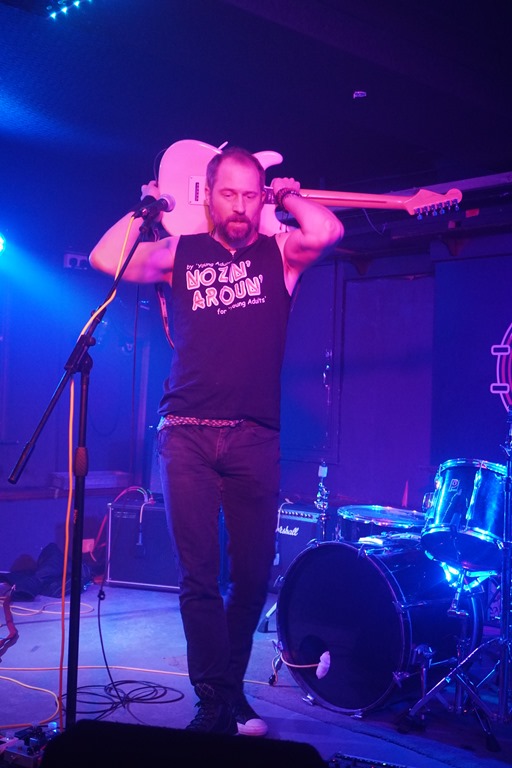
My contemplations are curtailed by the arrival of DDK Soundsystem. If The Bricks revived the spirit of the early 80s, DDK’s take on dance rock is unapologetically rooted in the 90s. They are, ultimately, a covers band, but they’re a lot of fun.

DSC00339

DDK Soundsystem

They kick off with a stomping rendition of ‘Open Your Mind’ by U.S.U.R.A., and in some respects, the treatment isn’t a million miles off Utah Saints, in that they present as much as a rock act as a dance act, and fuse the elements together: there are live vocals and guitar and bass, samples and backing tracks and sequenced drums all firing in synchronicity. Sure, there’s an element of middle-aged men doing rock posturing to dance tunes and some mum-disco 90s dance vibes, but they’re clearly enjoying themselves, and it is all well done.

Mid-set they really rock out, sending more lanky bozos with bumfluff moustaches and fake eyesh-sporting girls scurrying for the door. It’s at this point the gig hits proper volume, too. There’s no chatting idly over this. Overdriven, flanged guitars – and it’s been too long since I heard such epic swirling flange – blast out on a storming cover of Kylie’s ‘Can’t Get You Out of My Head’, before they drop ‘Encore d’un Fois’, a song I’d forgotten about, but an undeniable banger, and ‘Hey Boy, Hey Girl’ also lands near the end of the set. While one could readily contend that it’s corny and cheesier than a bowl of nachos, it’s also massive fun.

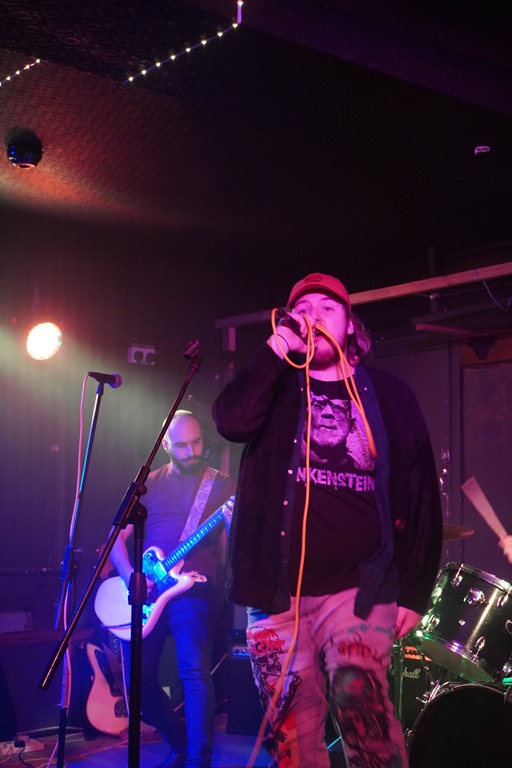
Saliva Birds were solid when I caught them low on the bill at an all-dayer back in April last year, and they’re solid again on this outing, turning out a set of sturdy, kick-ass US-style rock ‘n’ roll. The guitarist, in baseball cap, plaid flannel shirt, and faded blue jeans encapsulates their sound visually. It’s hard to get really excited about them, given that there have been band around sounding like this for at least the last thirty years, and they don’t really bring anything new, but to describe them as ‘workmanlike’ is by no means a criticism. They’re good at what they do, and they didn’t clear the room.

AA

IMG_20241109_223257

Saliva Birds

And if an eclectic lineup like this can keep enough punters unaccustomed to live music that isn’t straight covers or tribute acts, then perhaps there’s some mileage in shows like this. It seems like a back-to-basics approach, like how in the 70s and 80s bands used to play working men’s clubs and club nights to audiences who weren’t fussed at best, and were more into playing pool and getting booze down their necks than anything else. But given the choice between jostling with baffled townies slopping their lager and cocktails to see bands, and not seeing bands because there are no bands playing anywhere, I know what I’d pick every time.

27th September 2024

Christopher Nosnibor

They’re pitched as being for fans of, among others, the Jesus Lizard, QOTSA, Earthless, King Gizzard and Lizard Wizard, Fu Manchu, Daughters, and Beak, and their influences are listed as Dick Dale, Black Sabbath, Queens of the Stone Age, David Bowie, Ennio Morricone, Scott Walker, Pink Floyd, Fear, Erkin Koray, and Minute Men. And for those familiar with the band, the fact that Cigarette is their first album in five years is likely to be a cause of excitement.

Citing Daughters has become somewhat tarnished lately, in the wake of allegations against singer Alexis Marshall, which saw the band halting activity and him dropped by this label., but then, there likely a lot of people who aren’t aware of this, and moreover, it seems that even convictions and out of court settlements are no obstacle to becoming president of the United States, so perhaps a lot of people aren’t especially concerned by such things.

I’m not sure what The Giraffes have been up to for the last five years, or how they’ve managed to avoid my radar for the entirety of their career – after all, they formed back in the 90s, and released their debut album in ’98, with Cigarette being their eighth. But this is something that happens a lot: there are simply so many acts out there, it’s impossible to be aware of all of them. But we’re here now.

Some may say that five years is a long time to cook up just seven songs, but quality beats quantity, and Cigarette is solid and consistent in the quality stakes. There’s an abundance of drawling, stoner swagger. If ‘baby Pictures’ makes for a gentle start, they slam on the gas and go pedal-to-the-metal on the riffarola of ‘Pipes’, before ‘Limping Horse’ goes all out on the blues-driven scuzzy rock ‘n’ roll.

‘Dead Bird’ brings the requisite slow-tempo acoustic mid-album breather, and in doing so brings an almost folksy aspect to proceedings, while also strongly reminiscent of Alice in Chains in the harmonies.

Revisiting politically-charged single cut ‘Million Year Old Song’ in context of the album, and realising grimly how much can change in just a few weeks, it clicks that I’m reminded a little of Rollins Band with its sinewy lead guitar work and rant blasting over a low-slung groove.

It closes off with aa couple of six-minute epic sluggers, with ‘The Shot’ starting out with a delicate slow-burn but builds, snaking, smoking, and spun with a dash of flamenco and a swirl of drama into a writing monster of a track, before ‘Lazarus’ provides a worthy finale, with its atmospheric, almost post-rock epic intro that leads into a sultry strut that underlies a contemplation on death delivered in a gritty, Mark Lanegan-esque growl.

There’s a solid, vintage feel to Cigarette – which is to say it’s by no means ground-breaking, but while bands like this were ubiquitous in the ‘90s, now, they’re not so much. It’s not only nostalgia that means I miss them; there’s a place for this kind of chunky, dependable rock ‘n’ roll with a whiff of attitude and the perspiration of graft, and Cigarette is ultimately satisfying.

AA

a1929281707_10

Mamka Records – 15th November 2015

Christopher Nosnibor

It feels like a while since we heard from Maja Osojnik – and, I suppose it has: her debut solo album, Let Them Grow, comprising work composed and recorded between 2013 and 2015, was released in early 2016: we’re now near the end of 2024, and a lot has happened in the last eight years.

Life… and we’ll spare another retread of the pandemic ‘lost years’. Along the way, Maja has founded her own record label, created and exhibited visual artworks, and produced some collaborative audio works, notably DRUCK with Anthony Pateras.

But the time between Let Them Grow and Doorways is significant in terms of the album’s inspiration and purpose. We learn that ‘Doorways was born from a longing to escape the city and everyday life – and the problematically fast pace thereof, a pace of production that accelerates the erosion of attention. In seeking to arrive in a quiet place, to linger there with an observational unprejudiced eros, to become completely aware of being alive. In line with Pauline Oliveros’ practice of deep listening, Maja Osojnik’s album explores the involuntary nature of hearing and the conscious nature of listening. It raises the question: How attentively do we perceive, recognise and internalise the ever-changing (aural) environment?’

It’s a question few likely ponder, although one that I have found myself contemplating in recent years. It began with the first lockdown. I used to travel to work – a twenty-five minute walk, followed by a further half-hour bus journey – with my earphones firmly wedged in my ears, desperate to ensure the noise of everything and everyone was blocked out by music, and I craved my own space. But then, suddenly, I felt the need on my daily hour’s walk, to hear nature – and it’s true, my paranoia peaked to a level that meant I felt the need to have my eyes and ears open and be aware of anyone in the vicinity, when people were much scarcer in the street. But this reconnecting with the sounds of birds, the wind in the trees became more than simply a lockdown hobby. And while, it seems, ‘The Great Pause’ – something only some got to experience or enjoy – gave way to ‘The Great Return’ and ‘The Great Acceleration’ Maja Osojnik has been motivated to seek peace and space, and instead of yielding to any pressures – real or perceived – to produce endlessly, she has chosen to explore time, and space, and allow herself to draw long, slow breaths, and to absorb the details of her surroundings. And it is this different focus which has informed Doorways.

While essentially consisting of two compositions – ‘Doorways #9’ and ‘Blende #1’ – each with a running time of over twenty minutes, and corresponding with a side of an LP, for digital release purposes, each piece has been segmented into five movements or fragmentary length. This may seem to run contra to the idea of reclaiming headspace from the current climate of the truncated attention span endemic in Westers society, but it does reflect the collaging approach to sound Osojnik has taken in assembling a broad range of field recordings, along with the input of woodwind and strings. As the accompanying notes point out, ‘It’s about active listening – what the artist Maja Osojnik calls cinema for the ears – an interactive game with one’s own self. The compositions invite the listener to hear them deeply; they function like a rotary dial, bringing extremely sensitive changes into focus. By constantly readjusting the focal point, they create new relationships between the electronically generated sounds, instruments and field recordings.’

And yes, it’s a timely and necessary reminder not only about the way we close ourselves off to the world, but how music is often something which simply floats around in the background while you’re doing other stuff, and how listening habits have changed: the majority now listen to an endless shuffle stream on Spotify. Simply typing that sentence plunges me into a state of despair.

In its collaging approach to composition, Doorways has, in a sense, inbuilt the shuffle into its structure – but at the same time, it is best experienced as an album, as intended. Doorways is not a bunch of songs, penned as singles, lobbed together to make an ‘album’: Doorways is very much an album album. It’s also a very good one.

‘Doorways #9’ bring with haunting disquiet and glitches and trips, backward surges and traced of feedback. It’s meant to be skin-crawlingly uncomfortable, and it is, as insectoid scrapes and scuttles.

The first five minutes of ‘Doorways #9’, in its cave-dripping tension, builds anxiety, and it’s only when birdsong develops that there evolves a sense of levity. But the tone grows increasingly dark, and there are increasing obtrusive spikes in jarring organ, and a sense of menace hangs heavy in the atmosphere. ‘Doorways #9’ is in some respects a dark ambient work, in that it’s unsettling, uncomfortable and free of percussion, and as such drifts from one moody, uncomfortable segment to the next. Suddenly, unexpectedly, in the last three minutes, things plunge deeper into darkness, as there’s a churning noise and a sense of falling… down… things take on a nightmarish quality, and the experience is dizzying, gut-churning and it would work well as a piece off a horror soundtrack. Perhaps one day it will be incorporated in one.

‘Blende #1’ grinds, scrapes, and skitters through an array of tones and textures. And it goes on… and one, twisting, turning, droning, scraping, and churning. There’s some avant-jazz in the distance. It’s pleasant, but mournful.

This is not an easy, or immediate, album. We all need time, and to take and make time. Along way, Osojnik leaves us haunted an incurring . It’s a spacious, and low—key but cheering experience.

Maja Osojnik has created an album that’s dark, and difficult, but which creates space for slow contemplation and reflection and it’s no vague criticism to report that Doorways is ‘nice’. It’s much more besides: intriguing, it draws you in, and pulls you in different direction. It’s an album, alright.

AA

MAM08 front

1st November 2024

Christopher Nosnibor

Imagine having your album release scheduled many months in advance only to find the release date crashed by The Cure’s first album in sixteen years. Imagine you’re not only an act likely to appeal to Cure fans, but your act features a former long-serving member of The Cure. This is the true story of Vamberator, the duo consisting of Jem Tayle, formerly of Shelleyan Orphan, and Boris Williams, Cure drummer from 1984 to 1994, and sometime contributor also to Shelleyan Orphan.

The album’s title is telling and possesses a certain resonance. Much has already been written on the contradictory impact of social media, and the idea that while we’ve never been more connected, we’ve never felt more isolated. Scrolling through endless snaps of people’s holidays, parties, nights out is a hollowing experience, and one that’s anything but inclusive. Of course, you want to be pleased and happy for these people sharing their experiences as they live their best lives, as is the parlance, but inside, you’re being eaten away as you’re confronted with your own mundane, grey existence.

If anything, the pandemic heightened the agony for many: half the population was basking in being work-free, spending days baking bread and discovering new hobbies and bingeing on Netflix, while the other half was battling their way into work, or juggling work and home schooling, or simply trapped indoors on their own – or worse. Virtual drinks via webcam and group WhatsApps and streaming gigs were poor substitutes for the real thing.

And now we’re supposedly back to normal, but it feels as if something has been lost, and possibly lost forever. Our lives have become more distant, more disparate. In my own experience, it simply seems harder to co-ordinate meeting with people, and while some people seem to be so busy with their social lives it’s a wonder they can remember what the interiors of their own homes look like, their busyness leaves some off us at home, disconnected for weeks at a time. I am not alone in being alone: for many, the creeping sense if isolation and loneliness weighs heavier than ever before. This is truly The Age of Loneliness.

I’ve begin with the digression in order to contextualise the point at which I arrive at this album, having spent the last few days – like a lot of people – immersed in the melancholia of the new Cure album, having not seen proper daylight for the best part of a week and struggling against the urge to hibernate.

The single release ‘Sleep the Giant of Sleeps’, which came out in the summer, showcased an energetic embracing of myriad firms, and I myself described it as ‘a mega-hybrid of alt-rock, post-punk, and psyche.’ It set a level of expectation for the album and despite being born from a place of comparative darkness, the spark of experimentation and joy of creating illuminates the recesses of Age of Loneliness.

‘I Used to be Lou Reed’ kicks the album off in a flurry of strings and takes flight with a quite poppy flavour. It’s got horns and string and synths bursting all over, and there’s a slick funk groove which emerges after a minute or so… but despite being there, there, and everywhere, from James Bond to crooning 90s indie all in the space of five minutes, nothing feels forced or corny. Wish-era Cure meets Pulp might not sound like the ultimate pitch, but prepare to be pleasantly surprised.

Shades of negativity colour songs with titles like ‘I Need Contact’ and the title track, as well as ‘I Don’t Want to Cut the Grass’, a paean to lethargy which drifts and lilts like a Kraftwerk piece, but with the drollness of late Sparks. ‘Pilgrim’ brings tints of Beatles-esque twanging and some Eastern shades alongside elements of psychedelia. With loping rhythms and layered instrumentation, the title track slips into a groove worthy of late 80s Wax Trax releases then swerves unexpectedly. ‘I Need Contact’ is a sparse piano-led ballad, and its simplicity in itself is affecting. ‘Creature in My House’ begins haunting and ominous, before swinging into an electropop glam stomp which shouldn’t work, but does. This is true of much of Age of Loneliness.

Being predictable is not an accusation one could level at Vamberator: Age of Loneliness is ambitious, and bold. Sometimes it goes over the top, but it’s forgivable, because instead of playing it safe, as musicians of their experience often do, Tayle and Williams have tested their limits here, and they’ve emerged victorious.

AA

AA

a0433341087_10

25th October 2024

Christopher Nosnibor

As is the case with his collage artworks, there is a sense of physicality about Ashley Reaks’ recorded work. His album titles tend to be brief but evocative, visually or otherwise: Compassion Fatigue; Track Marks; Growth Spurts; Winter Crawls… these are titles which evoke a sensory response – a shudder, a shiver, a skin crawl. The Body Blow Of Grief – Reaks’ fourteenth solo album – lands with an impact before you even arrive at the music itself.

I suppose – as is often the case when it comes to any music – there’s a personal element to my response here, and I make no apology for this. As I have touched on elsewhere, art is personal, in that it elicits a response which is unique based on a multitude of factors, ranging from life experience to emotional state and the mood of the moment. But the very phrase, The Body Blow Of Grief, lands like a punch in the stomach, and I’m aware that, while recently bereaved, having lost my partner of twenty-two years and adjusting to life as a single parent to a twelve-year-old, I am acutely sensitive to things which many others wouldn’t be. And yes, grief hits like a body blow. It knocks you, hard, socks the air out of your lungs and leaves you feeling weak, dazed.

Reaks’ music very much sounds like his artwork looks: a collage, a collision of styles, disjointed elements overlayed unapologetically; instead of smoothing over the joints, Reaks revels in the ruptures. Because this is where the vitality of life is found.

‘Home is Where the Hurt is’ may be a fairly obvious piece of wordplay, but the album’s opener digs deep into this seem, one which is a rich source of material in Reeks’ exploitation of trauma and its effects. ‘I can’t really feel what’s real’, he confesses against a backdrop of dubby bass and honking horns, before a shuffling beat settles into a tidy groove. It’s a bit Interpol meets Madness before lurching into post—rock territory and tapering out in a rippling tingle of layered guitar.

While the topics may be heavy, The Body Blow Of Grief is remarkable for its levity, its musicality, it’s easy tunefulness. I don’t mean necessarily that it’s all air and light – because it really isn’t.

There’s some quite tight, choppy, indie guitar on ‘No Place In The Nature Of Things’, a song that squirms and twists its way through almost seven-and-a-quarter minutes.

‘Somewhere To Hide Among The Swarm’ takes the bold step out into the swarm to offer some-full-on progressive rock flavours.

Across the course of the album’s eight tracks, Reaks walks through the familiar territory of previous albums with leaning toward dub and post-punk, but ventures into altogether newer territories with some spaced-out prog-inspired explorations, and ‘Hobbling Like A Refugee’ has an eighties feel that unexpectedly delves into electropop and AOR. It’s not polished to the levels of the 80s rolled-up jacket sleeve bands, but it alludes to the slickness of the era, but the dark lyrics are a stark and uncomfortable contrast. ‘Mongrel Nation’ is a slice of chunky post-punk laced with the bombastic excesses of Muse and a few jazzy twists.

The last track, the eight-minute epic ‘I’m Not a Fossil’ is a multi-faceted, multi-headed monster propelled by some strong technical dtrumming.

As always, Reaks presents us with an album that’s complex and layered, but The Body Blow Of Grief feels like a step up in the ways it opens horizons to new levels of boldness and ambitious sonic vistas.

AA

a1473578772_10

Mortality Tables – 1st November 2024

Christopher Nosnibor

Spoken word is hard. I know. I’ve done it. I’ve been terrible at it. I’ve witnessed countless others be terrible at it, too. Spoken word is even harder as a prose writer. It’s just so difficult to hold an audience’s attention. This is why spoken word events seem to favour poetry: whether they rhyme or not, poems tend to focus on rhythm and to be brief, rarely longer than aa couple of minutes. And a lot of poets manage to memorise their pieces for performance, and poets who ‘read’ tend to be looked down upon in certain circles. It’s rather harder to memorise and recite a three-page slab of prose, and face buries in pages makes performing and engaging altogether harder. But worst of all, people simply don’t seem to possess the attention span.

Reading prose is hard. A segment of a story may not really work outside if its intended context, and a short story that only takes three minutes to read isn’t going to have much substance.

There’s a huge disconnect here: people listen to audiobooks but struggle with spoken word or anything that isn’t a renowned author or a celebrity voicing an accessible, pot-driven narrative.

William Burroughs told Philippe Mikriammos in an interview in 1984 that ‘many poets are simply lazy prose writers.’ He qualified this by explaining, ‘I can take a page of descriptive prose and break it into lines, as I’ve done in Exterminator!, and then you’ve got a poem.’

It’s true.

Chop your sentences down to phrases.

Cut your phrases down,

Down to their component parts,

Capitalise each line

– unless you’re e e cummings –

And lo,

You have a poem.

Burroughs had the advantage of recording his spoken word pieces and performing segments from his books in the 60s, 70s, 80s, when the medium was still comparatively fresh, and people had attention spans greater than goldfish, and had the additional benefits of a remarkable flair for reading and a truly unique voice. Here in the 2020s, it can be hard to attract – and maintain – any kind of attention with an audience. As I say, I know: I’ve done it, and I’ve been terrible at it. I’ve also been alright at it. I’ve driven people from the room, and considered it an achievement, because it’s infinitely better to have an impact of that nature than for audience members to fall asleep, or worse, forget the performance. The challenge for any spoken-word performer, be it in a live setting or in a studio, is how to grab, and maintain, the attention of any audience.

Here, Andrew Brenza reads from his book pod (ghosTTruth, 2023) with accompaniment from sound artist and electronic instrument restorer alka (Vince Clarke’s VeryRecords). Instrumental augmentation is the most obvious and immediate way of grabbing the attention. It transforms a spoken word work into a multimedia project, for a start, and moreover, the moment ‘music’ is involved, a whole new audience – which likely has no interest in spoken word – opens up.

His voice processed with a metallic flanged edge and epic reverb, and against an ominous organ droning ambient hum, Brenza becomes commanding, not to mention eerie in his delivery. This is the fine line all spoken word performers must tread, of course, but here it is felt acutely: The delivery can often overrun the work; style overtakes concept and content.

I find myself drawn into the delivery of pod – the sounds, the delivery. But engrossed in these, the content slips to become secondary, in a way. But perhaps that’s ok. ‘Intermission Meander’ provides a bleapsome interlude, and the narrative segments are vignettes, segmented scenes which are centred around image and concept rather than linear narrative, events, or characters. In this context, this release works. It is not an audiobook, but an audio accompaniment to a book. It’s difficult to absorb, but a successful project.

AA

a0689313884_10

Dret Skivor – 1st November 2024

Christopher Nosnibor

Procter’s been at it again. The only artist I know who can go on tour and play under different guides doing different music – or ‘music’ – depending on the booking. Not that anything he does is commercial or has any kind of mass appeal: it comes down the question of if you’re on the market for harsh noise or something a bit gentler. And how he’s back from one of his excursions, here we have new studio work, which clearly didn’t make the merch table – released in a limited physical edition of just three hand-painted CDs.

One might wonder just how far it might be possible to push the concept of Fibonacci Drone Organ, but since the mathematical Fibonacci sequence is endless, so it would seem are the limits of this project. This particular outing, with a title inspired by Ken Loach, does mark something of a departure for FDO, being less droney and more barrelling bassy murky noise. It’s also more overtly political – nothing new for Dave Procter, but usually something reserved for his other projects.

‘Disenchanted with the state of the fucking world? You’re not alone’ he writes. ‘This is a synthesised reflection of the current state of my brain. I hope it brings you some peace.’

How much peace one can expect from longform tracks entitled ‘war war death death’ and ‘american client state’ it’s hard to really know, but I for one can relate to Proctor finding solace in the cathartic release of creating dense noise. Because there comes a point where words are not enough: indeed, there are no words. In fact, I derive some comfort – small as it is – from this release. It does indicate that the state of Dave’s brain isn’t the best, but with the US election looming and the very real possibility that Trump could become president again, I can’t help but feel a combination of gloom and outright terror. In recent months, as the war in Ukraine has rumbled on, and the hell on earth in Gaza has escalated, and escalated, and escalated, and Israel’s nauseating genocidal mission continues to be funded by the West, it’s felt like a growing weight in the atmosphere. I’ve found myself tense and on edge. Everything is wrong. ‘I find no peace,’ as Thomas Wyatt wrote.

It feels as if the world was waiting for the pandemic to pass, and as if during the successive lockdowns, world leaders were simmering, festering, building their fury to unleash the moment restrictions were listed. Recent years have been painful, and as Procter’s brief notes indicate, there are many of us who are struggling, powerless, as our governments continue to push the line of Israel’s ‘right to defend itself’. No-one would deny that right, but no rational person would agree that a death toll of almost 44,000 – with many tens of thousands of women and children, not to mention other civilians in that figure – is proportional, or merely self-defence. While news outlets do report these figures – which are, it has to be said – beyond nauseating – there is no compassion in the reporting. Deaths are but numbers, the words ‘humanitarian crisis’ but words. The images of smoke and dust and devastation are horrifying, but to actually be in the midst of it, with no safe places to go, as schools and hospitals are targeted, is beyond imagination.

It’s in this context that Procter has created two grey, grating, heaving and ugly tracks, one fifteen minutes in duration, the other over twenty-three.

‘war war death death’ is bleak, and dense. There’s the heavy whip of helicopter blades at the hesitant start of the track, which gradually emerges as a long, wheezing, churning drone, resembling the rumble at the low end of the mechanical grind of the first Suicide album. And this is pretty much all there is. And from this minimal piece emerges a sense of desolation, particularly as the end, which concludes with just rumbling static – and nothing. Devastation. Dust. Annihilation.

‘american client state’ is again, heavy a serrated edged, humming drone that hovers, panning and circulating like a malevolent drone. It’s pitched in the range that really gets under your skin and penetrates the skull, not in an exhilarating way, but instead slowly wears down the spirit, dissolving any sense of motivation. The monotone hum seems to somehow articulate, in ways that words cannot, the sense of powerless I personally feel, and suspect others do, too. There’s something empty in the monotony, not to mention a squirming discomfiture. What can we do?

All digital sales money from this release will go to the Palestinian Medical Relief Society, and while it may be a drop in the ocean, and while what needs to happen is for aid to actually be allowed to be delivered – something which will require an intervention which is long overdue – something, anything, is better than nothing.

Often, there’s a droll humour to Dave Procter’s work, but apart from the title, the higher the monkey climbs, the more you see of his arse is a bleak work, and a depressingly droney as it gets. But it provides an outlet, an expression through which to focus that release, and reminds us that we must hope against hope for better ahead.

AA

a1192190513_10