Archive for the ‘Albums’ Category

Keplar Keplar – 3rd March 2023

Christopher Nosnibor

However much you think you know about music, there is always more to learn. And so it transpired that Holo was first released in 1998 and is ‘one of those rare records that managed to carve out a niche of its own while also building bridges to variety of genres like Chicago-style post-rock, the ambient mysticism of projects like Rapoon or the music made at the intersection of shoegaze, and electronic music in the late 1990s.’

Where have I been? Living in a cultural vacuum? Hardly. And yet this is my first encounter with KILN. And I’ve not heard of Rapoon and have no knowledge of Chicago-style post-rock either. Chicago house, I’m aware of, but… well, I daresay I’m not alone, and so this reissue off Holo may well prove to provide an introduction, and an entry point to the trio’s supposedly niche-carving brand of ambience.

It’s an album that’s rich in detail and texture, from clanking, clattering tin can percussion and big sweeps of amorphous sonic clouds that wash and crash in waves.

It’s hard to decipher precisely what’s what – is that a didgeridoo or just a digital drone? It’s impossible to unravel the layers and determine the individual sources as glugs and gurgles slide in between soft dulcimer-like notes and easy beats that bubble between all kinds of textures and tones which drift and slide and groan and drone in and out of the ever-shifting fabric of this fascinating album. Guitars and extraneous sounds flit and flicker in and out while instant drums nag and boom. At times it’s new age, at times it’s more tribal, and Holo pushes ambience in numerous directions.

There are segments – interludes, breaks, fragments – where this is a catalogue of challenging source materials melted together. At others, it’s altogether less challenging and simply washes of you in a soft breeze.

For an album that’s so chilled, there is much happening on Holo¸ and as much as it is an album to chill to, first and foremost it’s an album to explore.

AA

KeplarRev13LP_front

Southern Lord –10th March 2023

Christopher Nosnibor

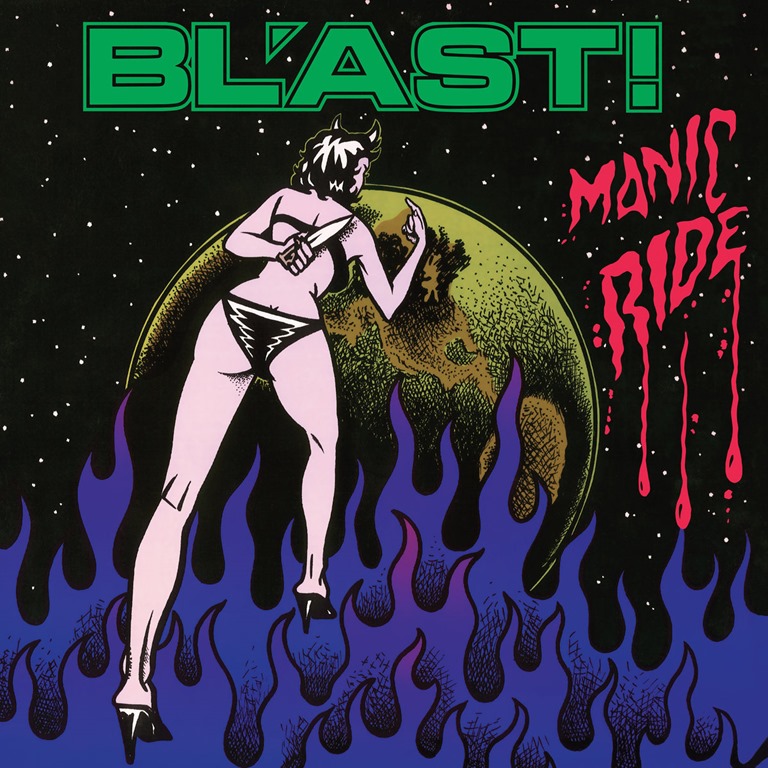
Ask people to name a hardcore band and any money they’ll say Black Flag, but anyone who knows their stuff will likely also mention BL’AST. BL’AST stand as one of the definitive hardcore bands, formed in 1983 and releasing their first album, The Power of Expression in 1986, having recorded it three times.

The story goes – according to the band’s bio – that in June of 1988 BL’AST! went into the studio with Black Flags’ live sound GOAT: Dave Rat (RATSOUND), and the breakneck Take The Manic Ride was recorded. This version was later destroyed after the band was dissatisfied with the original production, with a rerecorded version being presented to the public in 1989.

It perhaps seems ironic that a band as raw and immediate as BL’AST should spend so much time faffing about in search of achieving the ‘perfect’ recording, when the finished article sounds so… unpolished. But of course, that’s the point and the key issue: many bands who are live acts first and foremost find their sound stunted, diminished, compressed and ultimately rendered weak and lacking in bite when attempting to capture the experience in a studio setting. The studio is a sterile environment, clinical, and few producers really get the concept of not actually producing a band. Hardcore is about tearing your guts out with vitriolic rage. The studio is never going to be the best environment for channelling it.

This is the stuff of music legend: the master tapes for that first version were destroyed and were never to be recovered, but as Southern Lord detail, ‘Through some incredibly magical surgery a new heavy as fuck version of the album has been produced.’

Perhaps predictably, Manic Ride is a mess of furious noise and aggression, abrasive and angry. While the Southern Lord reissue isn’t leagues different from the Blast First original, it’s very clearly a different mix. Hardcore (sorry) fans will likely be divided over the mix, whether it’s better or worse or whatever and there’s no right or wrong really. This version is crisper and clearer but also fuller.

What really matters is that this key album is back out there, and if it divides fans, fine. It’s back in the public domain, and will, with any luck, introduce new listeners to the band and their legacy.

AA

a0095993474_10

3rd March 2023

Christopher Nosnibor

Where does the time go? I type this with a rising panic in my chest, the same one which kicks me awake at 5:30 most mornings. I may often panic about the mounting chores and deadlines, the crumbling state of my house and cost for repairs, but mostly I panic about time and its passage. How is it 2023? How is it March already?

However much time you think you have, you always have so much less.

And so the arrival of the new break_fold album is something which both elates and trips me. It’s been six years almost to the month since the first break_fold release, 07_07_15 – 13_04_16 , which in turns reminds me it was thirteen years since Tim Hann’s previous musical venture, I Concur, were an active band. What happened? The simple answer is, of course, life. It happens when you’re not looking. It’s hard not to feel nostalgic for that time: it was a period of discovery. The Brudenell was still emerging as a venue, and putting on lots of local acts, and at the launch of their debut album, I Concur sounded immense, like they could be the next U2 – only not cocks and unencumbered by a Bono, of course. You get the idea. They were just SO good. But then… life. It gets ahead of you.

Tim Hann has been tinkering as break_fold for a while now, because ultimately creatives can’t simply stop creating, even if it’s at night working in the cupboard under the stairs or the shed. You can’t help it. However tired you are from work, life, parenting, there’s an itch that can’t be scratched any other way, and ultimately, it has to be done.

And it’s been done nicely here, a year on from the release of the single ‘Welwala’, which features on This Was Forever and again, I have to pinch myself. Again, a year already?

The title – and perhaps it’s just me – bears an element of melancholy. It was forever, but now…? Well, nothing is forever, and the realisation that something forever has a finite existence is something sad and regrettable. The title track spins together shimmering top synths over stuttering beats and rolling mid-range create a dynamic tension and a certain sense of drama.

This Was Forever is a set of solid instrumental electro with some deep grooves and some dark, jittering moments. It is, overall, easy on the ear, ‘Everything Affects Everything’ mines a dark seem that’s pure 80s movie soundtrack. Indeed, the vibe is strongly eighties for the most part, not least of all with the cracking snare sounds that drive some of the faster pieces – but then again, this type of one-man synth-based style is ultimately contemporary, possible due to the wealth of inexpensive software that has meant that making music is possible for anyone with a laptop. But with such availability, it means you have to be good to stand out. And break_fold’s output showcases Hann’s ear for atmosphere, for range, for texture and form.

‘Welwala’ is one of the album’s standouts, and packs some energy in a track that’s actually danceable, if you’re that way inclined. It’s a solid, meaty groove. Grooves and beats are perhaps the defining feature of This Was Forever, with the murky undercurrents of ‘Did I Say it or Just Think it?’ landing in the space between latter-day Depeche Mode and Ghosts-era Nine Inch Nails. At the lighter end of the scale is the buoyant ‘Mishby’ which bounces along in an overtly synthy-piano way, with the beats backed off a way.

This Was Forever is the kind of album you could pop on while working without getting distracted by it – and sometimes, that’s just the kind of album you need.

AA

11183_JKT

14th February 2023

Christopher Nosnibor

Having first encountered Deborah performing as one half of dark ambient noise duo Spore, I’ve discovered she’s nothing if not prolific, and having hit the classical charts with one recent album and released not one, but two new albums in the last few weeks, it’s hard to keep up, not only with her vast output but the stylistic range. Daughters Of The Industrialists is one of those new albums, and one which again presents a very different musical face.

Daughters Of The Industrialists couldn’t be further from the sound of Spore. The track tiles radiate a glowing warmth which translate in their sound, too. The first of the album’s ten compositions, ‘Sparkle’ does exactly that, a soft a mellow sonic hue rippling in slow waves and gradual washes, and ‘Angel’ is every bit as delicate and skyward-facing as you might expect. The same goes for ‘Dazzle’, a composition which exudes tranquil, calm, and soothing vibes but becomes increasingly busy, hinting at both 80s electronica and the vintage sounds of Kraftwerk and Tangerine Dream.

With no accompanying verbiage, Daughters Of The Industrialists is an album which very must stand to speak for itself. And it’s an album with sonic range and one which stretches out in many directions. A number of the compositions have been released previously as standalone singles via Bandcamp, including the ponderous, reflective ‘Mothtail’ a slow and wistful work built around drones and a swelling digital breeze – but collected here into an album context, everything fits into place with a sense of unity and coherence, with the majority of the pieces being concisely contained between three to four minutes in duration, meaning nothing feels overdone or stretched out to outstay its welcome.

‘Pixel Eye’ possesses space-age qualities despite its having been forged while rooted the spot, and there is much activity here.

‘Orange’ is sparse and contemplative, and while the flickering, misty ambience of ‘Callisto’ and Orb-like bleepery of ‘Waning Moon’ set their sights on the vast expanses of space, what really stands out is their organic feel, a sense of connecting with nature as well as the cosmos. It’s this sense of being attuned to the natural world and its cycles, and of being at one with the earth and in turn the space beyond that feeds through the six-and-a-half-minute closer, ‘Crystal Rain’. Here, slow, turning drones intertwine in a slice of truly classic ambience, and it’s so very soothing, and conveys a sense of vastness, of space. And in doing so, the album concludes by transporting the listener somewhere beyond the confines of four walls and reminds us that there is something outside, and beyond. Go, explore.

AA

a2647674050_10

25th November 2022

Christopher Nosnibor

Two years on from when I covered Open to the Sea’s Another Year Is Over, it transpires that Milan-based Matteo Uggeri and his cohorts are back with Tales from an Underground River. A lot has happened since then – and yet in many ways, not a lot has, and for some of us, it feels as if lockdown never ended.

Governments and employers seem to be content to peddle the idea that with vaccines rolled out and restrictions lifted, the switch had been flicked that restores normality – so much for the endless talk of a new normal not so long ago. This is likely true of some things, primarily retail and public services, but then, many office workers have only returned on a part-time basis, if at all. For me, personal circumstances have meant not at all, which is welcome – much as I miss people, I don’t miss those people.

I digress, but this context is what I bring in terms of my reception to this album, which was, recorded over the course of a couple of years, starting in the Winter of 2019 and spanning the pandemic period – a time that has drifted into near-unreality and feels almost dreamlike, unreal. And this is very much the sensation that Tales from an Underground River creates. Listening to it feels like listening to a dream.

The text which accompanies the release, they’re at pains to point out, is not a press sheet, but a diary, and that makes sense, as it charts the album’s long and convoluted evolution. It certainly isn’t a sales pitch. But then, art shouldn’t be about sales pitches: creatively, the journey to the end result – if indeed it even is the end result – is far more interesting, and of significantly more value.

Beginning life as two long and multi-layered sets of improvisation with piano, guitar and synths recorded by Enrico Coniglio, it was then completely reworked by a process of additions and subtractions by Matteo Uggeri, and over time, incrementally, it was picked apart and broken down into thirteen relatively short pieces, where soft, rolling piano and mournful brass merge with the sounds of thunder and rain and a host off subtle field recordings which add delicate layers to the sound. And they’re segued together in such a way as to render the album one continuous piece in a succession of movements.

The mood transitions incrementally through the segments, and the titles are beautifully descriptive: I found myself forming mental images of scenes while listening, the music providing the soundtrack to a slowly unfurling movie in my mind’s eye – a movie brimming with scenes of nature, as ‘Pebbles Clink, Fluffy Echoes Make the Air Colder’ and ‘Pebbles Clink, Fluffy Echoes Make the Air Colder.’

Indeed, reading the lengthy titles in sequence conjures a semi-narrative in itself. At times ponderous, contemplative, brooding, at others with flickering sun offering hope – sometimes within the space of a single piece, as on ‘Limpid Lights Dig Words in the Rocks’, you feel yourself carried on a current through different terrains and landscapes. ‘Emotions and Thoughts Climb over Years and Years, Always the Same’ brings droning guitar textures and a rather darker hue of ambience with post-rock leanings, and Tales from an Underground River is an album where the movement and changes never cease over the course of its journey. At times eerie and unsettling, at times ominous, and at others – for wont of a better word – cheerful, it’s a magical piece of creativity that shows vision and was very much worth the three years of work.

AA

cover

28th February 2023

Christopher Nosnibor

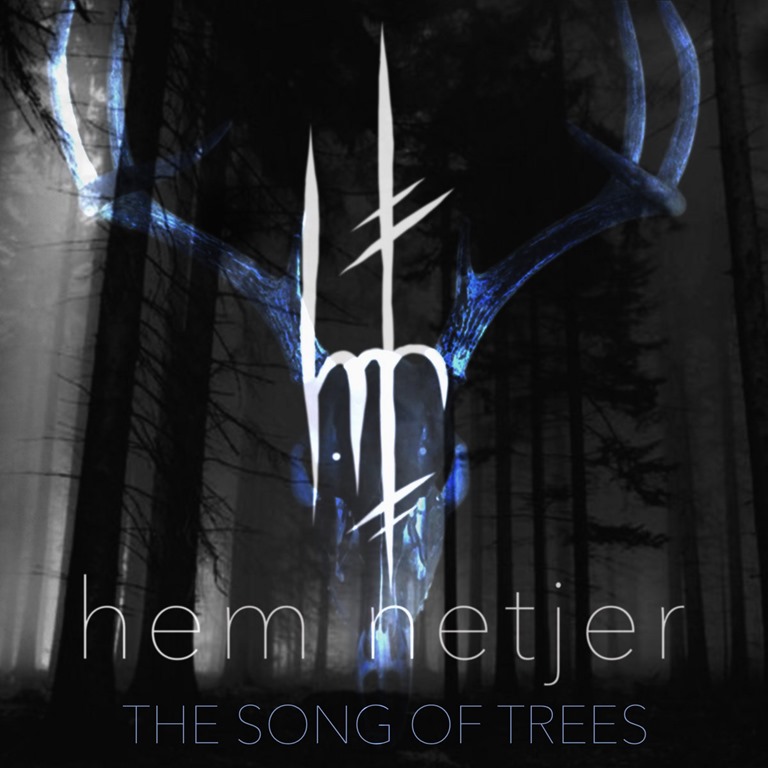
Something about ‘Elemental Cry’, the lead single from Song of the Trees struck a chord and resonated on a subliminal level. It landed with me at a difficult time, personally. Admittedly, most times are difficult, but some are more difficult than others. More often than not, music helps me through those times, and it’s not always the music I’m expecting. Sometimes, old favourites provide the least comfort and are simply too painful. Perhaps I was clawing for something spiritual, music that provided an escape to another realm. Truth is, I’m eternally seeking something. This sweeping, soaring epic channels something that goes beyond notions of derivative Nordic cosplay cal to forge something powerful beyond words.

This is a quite particular and specific thing about music: sometimes it’s not the music itself, but your state on receiving it. I was, and am, in a state, and words aren’t easy. They are a slog. I don’t want to be here, but must power on. And so that transportation, that being lifted to another place, is perfect in terms of needs. Combining heavy synth drone, spacious piano and metallic twangs, The Song Of Trees is tense and atmospheric. It twists at muscles and nerves as drones undulate, hover and hang in the dense air. As the title suggests, it’s rich and earthy, intertwined with nature and the elements, an album that evokes a sense of the vastness of the great outdoors, the space and freedom that instils life into our bodies, and has for as long as we’ve walked the earth. Only now, contemporary living has separated us from nature to the extent that to walk in woods, or to find a place unsullied by human impact feels like some sort of a special treat. This means that while it’s perhaps harder to feel an attunement to the natural world in daily living, experiencing it is something to be cherished all the more dearly. This, then, transports me from the dingy confines of my poky rectangular office space and to somewhere I can feel free.

Given the taster, and the album’s opener, the expansive ‘Void’, ‘Salt and Tears’ lands as an early surprise, being quite beat-driven and overtly electronic with something of a glitchy leaning that’s far from natural or organic. It’s powerful, and it’s all about the dominant percussion, which works well, although it’s not nearly as powerful as third track, ‘Eldur’: the beats are again dance-orientated, but the vocals are positively operatic. It’s a song that registers on a number of levels. In combining the natural, the earthly, the spiritual, and the ultra-modern, with technology-orientated sounds, this could be a clash if not handled with due care and sensitivity, but Hem Netjer create with a sense of balance and equilibrium, which in some way conveys our conflicting, divided existences.

I suppose there are elements of more mainstream artists as well as the likes of Zola Jesus and the wave of Nordic metal acts which seems to be emerging all blended together here, and these imbue The Song Of Trees with a power that’s greater than the sum of the often quite minimal parts. If ‘Freedom’ characterises the album’s more commercial moments, there are plenty more that carve a different space. ‘Elemental Cry’ arrives as the penultimate track with it thunderous drums and steely strings and its power remains undiminished, and it’s the clear highlight of the album.

And elemental is the word: The Song Of Trees has, despite electronic sounds being so integral, a purity that is rare indeed – and that’s both powerful and moving.

The six-minute closer, ‘Otherworld’ is epic in every sense: sparse in instrumentation yet ultimately vast and immersive, it makes for a strong finish to a strong album.

AA

a1911371475_10

Rude Records – 17th February 2023

Christopher Nosnibor

I’m somewhat conflicted here. Broadly speaking, my view is that there is good music and bad music, and it’s not a question of genre: there are good songs in all styles, even if they’re the exceptions to the rule. I’m not a rabid fan of many genres – hip-hop and jazz to name but two – but really rate some songs from each of them. Apart from pop-punk, that is. That’s just the worst kind of music, period. Oh, and folk-punk can fuck off, too. Even worse than the music are the fans, especially at the end of the night at a festival. Anyway. Nu-metal. I can’t say I was ever a fan. I mean, it was a bit shit, right? At its worst, it was juvenile, dumb, and not even that heavy. But then, I was listening to Swans and Godflesh and early Pitch Shifter, bands I still point towards when offering examples of truly heavy music. I even went off Pitch Shifter when they transitioned to nu-metal. But then, I can’t say I hated all of it, and in some respects, I kinda miss it now. Is that simply nostalgia for shit because time? Or is it that there really does feel like there is no specific trend now, and everything is so fragmented there is no real sense of there being any cohesive culture or subculture?

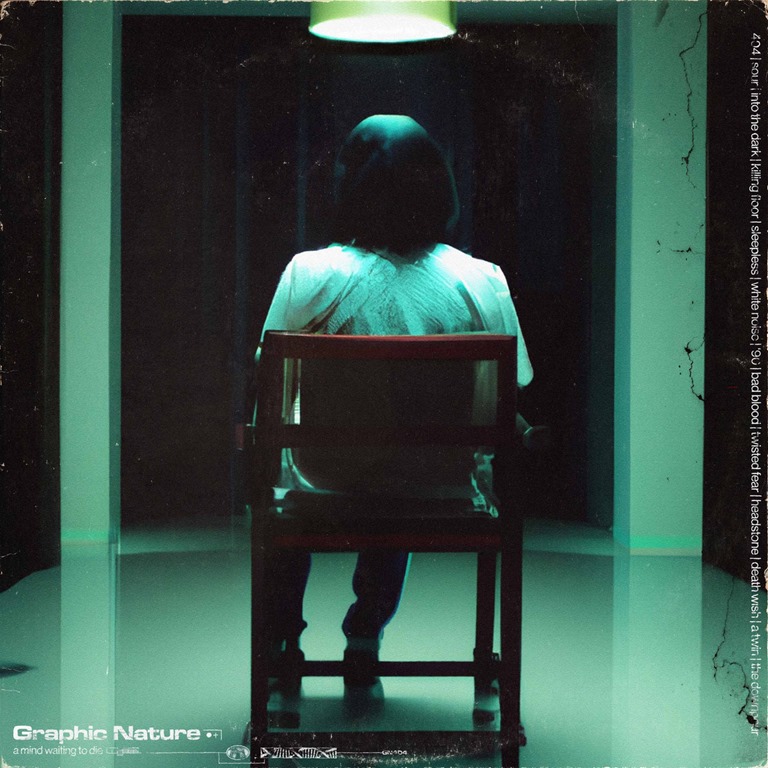
Kent metallers Graphic Nature took their name from a track on Deftones’ Koi No Yokan album and cite Slipknot, but also Nine Inch Nails as key influences on their sound. And having formed in 2019, it’s fair to say that the band represent a new wave of nu-metal (which sounds a bit daft, but not as daft as The New Wave of New Wave that happened briefly in the early 90s, and it wasn’t only shit, but didn’t even really sound especially much like new wave). The point is that while lyrically, the subject matter is pretty obvious – death and decay, but mostly anxiety, people being fucked up, the world being fucked up – the anger and angst is channelled with a focus and force that is rather more sophisticated than some of the turn-of-the-millennium hits. There are no shit rap breaks or scratching, and pitched as an album designed to ‘start a dialogue about the issues that matter’, there’s a seriousness about A Mind Waiting To Die. ‘Rollin’’ or ‘A.D.I.D.A.S’ it is not. Thank fuck.

Halfway through the album, there’s a minute-long drum ‘n’ bass instrumental interlude. I’m not convinced it’s the most comfortable break, but it’s a necessary one, because there’s not much respite for the rest of the album’s thirteen-track duration – although the slower, sparser ‘A Twin’ which pitches the NIN influence to the fore – is a different kind of powerful.

For the most part, they combine their various influences into a dense, murky mess of fast-paced, high-octane racket, and as is the case with a fair bit of metalcore and nu-metal, the song structures tend not to focus too much on the conventions of verse/chorus, instead leaping to and from between tempos and riffs with brutal slabs of guitar, overdriven to the point that chords are compacted and become lumps of noise. There aren’t many easy inroads here, but in terms of an album that relentlessly blasts raging catharsis, well, job done. A Mind Waiting To Die simply isn’t a ‘tunes’ album: it’s gut-spilling nihilism, a mess of entrails and frayed nerves laid bare. It’s not exactly fun, but it’s harsh and heavy and they mean it.

AA

a3556939295_10

Gutter Prince Cabal – 16th February 2023

Christopher Nosnibor

There aren’t many guitar-based genres of music where one-man bands are particularly commonplace. Of course, I’m not talking about folk or acoustic-based music, but the kind of music where, on listening, you’d expect a full band. Industrial is something of an exception because early exponents like JG Thirlwell – aka Foetus – developed through the use of tape loops and studio experimentation, and the same is also true of later exponents like Nine Inch Nails, with Trent Reznor’s studio-based project evolving from being largely synthetic into a live proposition.

But black / death metal are genres unto themselves. One might joke that it’s because most of the people who make this kind of stuff have no mates or are too antisocial to form bands, although it may not be much of a joke. Either way, Melbourne-based Aaron Osborne is one of those one-man operations, handling all aspects of writing and playing to create the sound of several. And what a sound it is. If you want dark, dense, and sludgy, with bowel-loosening guttural vocals, then you’re in luck.

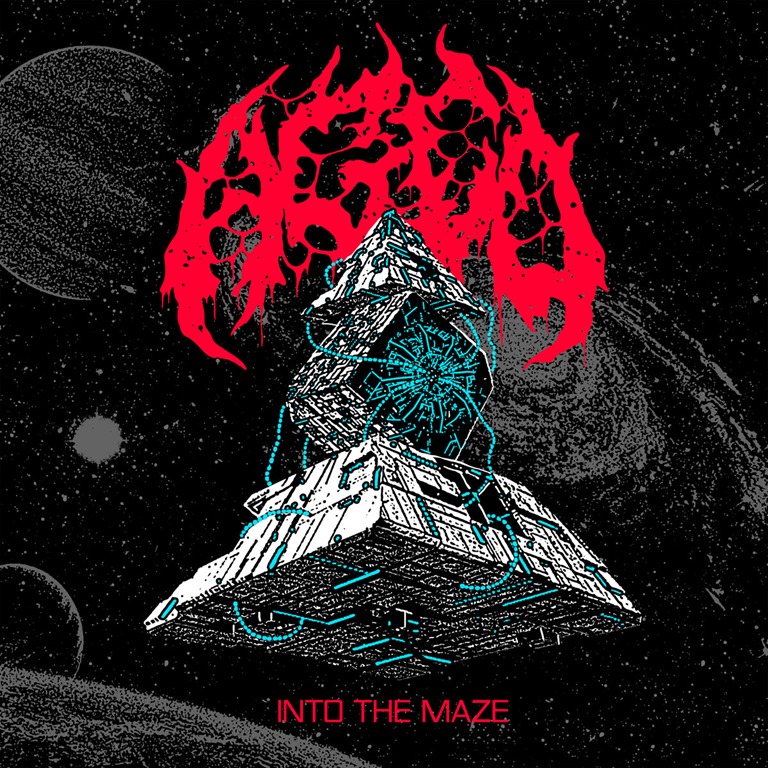
Into the Maze – a twenty-seven minute album – or mini-album – actually comprises two new songs plus four cuts previously released as the Collector EP.

You don’t listen to this stuff to be uplifted – but you do dive into it for escape, and Into the Maze brings that cathartic release.

The title track is monster slab of downtuned darkness. There are some guitar screeches which emerge from the relentless trudge that call to mind Fudge Tunnel, but this is denser, slower, doomier, and somehow less organic-feeling, like early Pitch Shifter but with live drums, and passing a nod to how they take ‘the swagger and groove of Entombed’s Wolverine Blues and infuse it with the tar-thick pull of doom’. But against Wolverine Blues, it’s half the pace and the lyrics are unintelligible grunts, so it’s very much an example of taking an influence and steering it in a different direction. And this is a good thing. The production is perfectly dingy and oppressive, and over the course of just short of half an hour it really grinds you down in just the way it should. In all, it’s pretty bloody brutal. I dig.

Oh, and that’s one hell of a logo.

AA

a3701776308_10

Northern Spy – 24th February 2023

Christopher Nosnibor

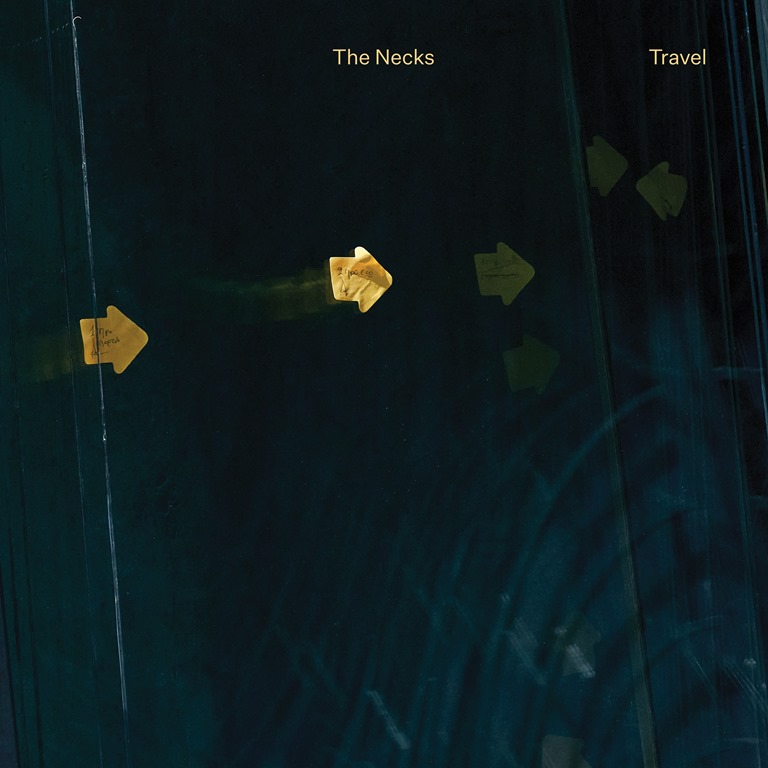
The Necks are never dull: an act that can be depended upon to deliver something different, which is no small feat for a band who’ve been going for more than thirty years. Travel sees them revisit the fundamental methodologies of Unfold, released in 2017 on Stephen O’Malley’s Ideologic Organ label. Admittedly, it’s not an album I’ve revisited all that many times since I wrote about it, but then, that’s true of many records I’ve appreciated. Some of it’s a time thing, but some of it’s an instrumental / jazz thing. I prefer to engage in the moment – and then the moment passes, and I too move on.

Where this album different from the majority of their others is that the format was integral to the form of the content, as the accompanying blurb points out, proving ‘four sub-20-minute pieces – instead of the typical 60+ minute arc for which the band is known – along with an obfuscated track list which leaves play order to the listener’s hand.’

Travel isn’t quite a straight live improv set, but does, they feel, come closest to recreating the live experience, and was recorded – save for some light overdubs and post- production – primarily live. And it’s very much oriented towards slow grooves and rhythmic repetitions. It’s hazy, mellow, almost sultry.

Side one is occupied by the twenty-one-minute ‘Signal’, built around a repetitive bass cycle and some rolling piano that brings with it a classical element, and, propelled by some busy hand drumming which transports the composition some way from what one would ordinarily expect off jazz-orientated works and into the realms of ‘world’ music (a term I try to avoid, with its connotations of western superiority and self-centredness, but sometimes short-cuts are necessary).

On side two, ‘Forming’, which again stretches languorously past the twenty-minute mark, is led by ripping piano, underpinned by some crunching bass stutters and rumbling groans. It’s jazzy in a psychedelic, Doorsy sort of a way. In this sense, it feels more like an extended mid-song workout than a piece in its own right, but it’s both pleasant and tense at the same time as it builds to a crescendo that never fully materialises.

‘Imprinting’, the album’s shortest cut at just over seventeen minutes, brings the multi-layered percussion to a more prominent position, and clanks and trembles along with almost hesitant-sounding keys and twanging strings drift in and out. It’s also perhaps the most overtly ‘jazz’ piece on the album, although it feels stretched out, the pieces pulled apart and as three instruments drift along together on a steady way, the sensation is quite hypnotic.

Organs always create a sense of grand scale and space, and the heavy drone and trill of ‘Bloodstream’ is utterly mesmerising. The piano is soft and ripples along atop the sustained mid-range drone as ethereal notes drift in and out. Part,

The album feels like a moment in time, somehow transient, and yet also something more. Travel may not really go anywhere, but it very much captures a mood – which is, for the most part, whatever mood you project onto it.

AA

Print

Thrill Jockey – 24th February 2023

Christopher Nosnibor

Some albums are so, so hard to review, because listening to them leaves you with no words. They stop you in your tracks and you sit, open-mouthed, speechless – thoughtless, incoherent. Blank. It’s not often this happens to me – unless it’s when presented with an album by BIG|BRAVE.

The Canadian trio made a huge impact with Vital, just under two years ago. They’ve been making waves since their 2014 debut, Feral Verdue, but hit a new seismic peak with this shuddering blast of minimalist rock. I’m used to knocking out a review in an evening, but that one took me an absolute age, because I simply ran out of words.

With nature morte, they’ve done it again. The title, in translation, is not dead nature, but instead refers to still life, or an image depicting inanimate objects. It seems fitting, not because it lacks movement, but instead because the spacious playing, slow and deliberate, creates moments where time stands still, frozen, suspended, and I find myself likewise frozen, my breath caught.

The formula may not be radically different from Vital, but the tone most definitely is. The dense, jarring music – and it’s music in the most minimal sense, shuddering chords crashing in, juddering and halting, simultaneous with pulverising percussion and it’s stark and harsh and heavy and suffocating, reminiscent of Greed-era Swans, and its exemplified nowhere more clearly than on the seven-minute opener ‘carvers, farrriers and knaves’. But then it builds into a truly monumental climax a mere three minutes in, and it’s clear that for all of their building tension, nature morte is an album of truly tempestuous release, and this is nowhere more apparent than in Robin Wattie’s vocal delivery. Here, her desperate, often plaintive, lost voice sounds more desperate, more trapped, more anxietised than ever. We’re accustomed to her sounding scared and but ethereal. Here, she sounds like she’s being buried alive and desperate to be heard and to escape before she suffocates under the weight of the music.

Of the six tracks, three extend well beyond nine minutes: epic is indeed the word, but none of the pieces feel overly long. In fact, the opposite is true: these are compositions not so much to get lost in, but submerged as if buried by a sonic landslide. ‘the one who bornes a weary load’ is a shuddering monolith of sound that thunders so hard it feels like the earth is shattering, and Wattie screeches and howls, ragged, anguished as if she’s clawing to dig herself out of a purgatorial hole and to cling for life with broken nails on fingers scraped to bone.

There are moments of softness, of quietness, delicate guitars ripple hauntingly on ‘my hope renders me a fool’ and ‘the fable of subjugation’, alluding to post-rock and even folk – if via latter-day Earth – and these moments are evocative, moving. But building to crescendos of monumental proportion, they’re the calms before the inevitable storms, making it impossible to settle back and drift along with these more delicate passages. Sure enough, around the four-minute mark, ‘the fable of subjugation’ erupts move violently than Vesuvius. The album may end on a light note with the short (sub-four-minute) acoustic song, ‘the ten of swords’, but one feels as though darkness lies ahead – as is fitting for a song which references the tarot card which indicates painful endings, deep wounds, loss, crisis, major disaster (or recovery and regeneration, depending on which way up it is). If you’ve seen the news in recent months, this seems unlikely, and it’s hard to imagine that nature morte offers light at the end of its long, dark, airless tunnel.

There’s still an aching beauty which permeates every second of the album, but it’s also ribcage-crushingly heavy and imparts a relentless pain and anguish that’s impossible to escape.

It’s hard to breathe listening to this. The weight lies heavy. For any expectations they may have set with Vital – and the bar was set hight to a point it was hard to imagine anything could even come close – nature morte smashes and obliterates them all.

AA
a3747569844_10