Archive for the ‘Albums’ Category

Gizeh Records – 12th February 2016

Christopher Nosnibor

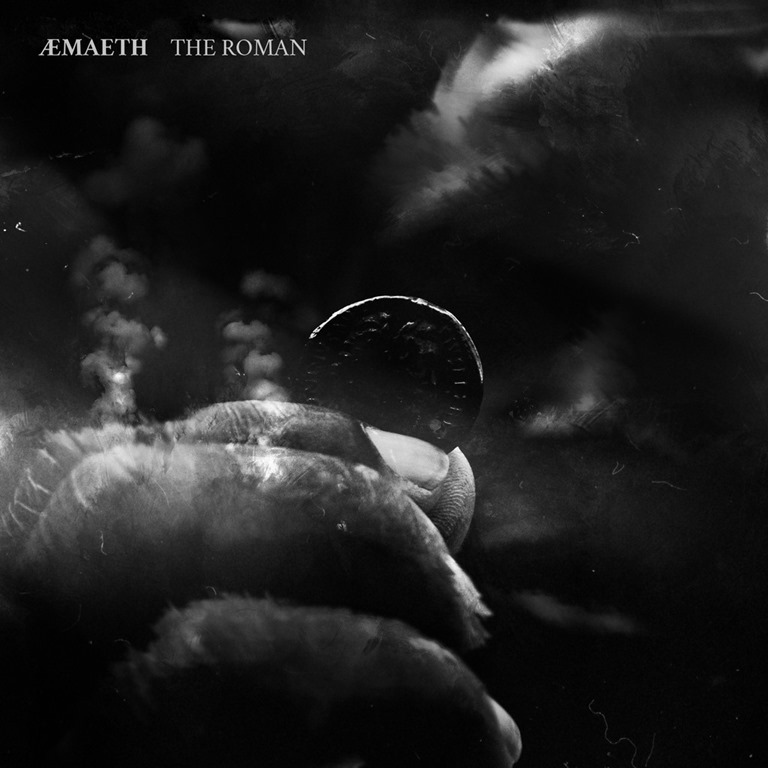
Æmaeth is the project of Owen Pegg (A-Sun Amissa / Hundred Year Old Man), and he’s already scored a number of films. Independent flick The Roman is a silent work which to which ten segments of improvisational drone-based passages played on guitar and piano were composed by way of an accompaniment.

Since the film premiered in May 2014, its soundtrack has been evolving, developing, accruing layers and details, until finally, the ten pieces came together to form a fluid, brooding sequence that stands as a whole, and as a powerful sonic journey. It’s fitting for a film which is no gung-ho Hollywood take on history based on a succession of cast off-thousand battle scenes. Simon Rawson’s movie, shot in Yorkshire, is outlined as a story of two men, lost, who are ‘challenged and tested by nature, each other and the inner most conflicting primordial affiliations with man’s body and mind’.

Pegg’s soundtrack conveys so much, its dark, tense tones resonate as they connote psychological drama. The battles fought within the mind, the conflict and the uncertainty. The barren, unforgiving landscapes, shadowy woodlands and bleak moors. These are the scenes portrayed within the compositions, which are spacious, often sparse. Delicate piano notes drift airily but ponderously, gradually eclipsed by deep, dark, thunderous rolling drones, stormy and threatening. At times, the sheer weight and density of the ominous tones are oppressive, the sounds so large as to create a sensation of a pressure being applied to the skull.

That isn’t to say the soundtrack lacks subtlety: far from it. There are passages of quiet, so hushed as to compel the listener to strain their ears listening for some faint sound – and invariably, there is something, something small, soft, indistinct. Or there are layers of sound, often in the upper frequencies, needling the senses, tugging at the peripheries of the psyche, somewhere in the background or half-hidden, off to one side. These, like the brief moments of light which occasionally present themselves, are integral to the soundtrack’s dynamics, and the power of its effect.

There is torment, there is discomfort. There is also an ever-present sense of danger, sometimes distant, sometimes heart-stoppingly close.

The final passage, the nine-minute ‘Neptune’ is vast, built on a slowly turning vortex of sound. A rumbling rhythm lingers as it pulses just beneath the surface of its soft tonality and offers a hint of redemptive relief at the conclusion of a journey which is most worthy of the term ‘epic’.

Æmaeth - Roman


Æmaeth – The Roman at Gizeh

Speed the Plough – Now

Posted: 4 February 2016 in Albums

29th January 2016

Christopher Nosnibor

New Jersey’s Speed the Plough have been going some 32 years now, and Now marks their eighth album release. You could hardly accuse them of saturating the market with product, but by the same token, they’ve maintained a steady output, and it’s testament to their tenacity and commitment that they’re still going. Still, by pacing themselves with some lengthy breaks – not to mention various lineup changes: their current drummer, John Demeski, is the son of Stanley Demeski who occupied the stool a full two decades previous – they’ve kept things fresh, and Now sounds like an album that’s been honed and crafted and presented to the world out of a genuine desire to write and play rather than mere habit.

That the band-members have shared songwriting duties means there’s a real diverse feel to the album, although it holds together remarkably well. The result is an album that’s balanced, in terms of its temperament and tone, and it’s rich in its emotional depth.

The vocal harmonies are a defining feature as the band explore an array of mindstates. The fiery folk-infused rock of ‘Garden’ picks up the tempo and a switch of lead vocal duties after the languid but aching desperation of ‘Midnight of the World’ proves an effective move.

Rolling percussion and crashing cymbals provides a tension-building backdrop to the lilting duality and roiling tension of the theatrical-sounding ‘Because’, while there are hints of Jefferson Airplane about the rockier ‘More & More’.

It’s a solid album, but in many ways, to describe it as such seems to be selling it short. It’s an overtly folk album, and there’s a lot of bad and obvious folk out there. The lilting melodies and strong dynamics across the album and within the individual songs, coupled with the varied compositions place Now in the ‘good folk’ category.

Speed the Plough - Now

Speed the Plough Online

Driftmachine – Eis Heauton

Posted: 3 February 2016 in Albums

Hallow Ground – HG1601 – 26th February 2016

James Wells

Understanding and appreciating this album benefits from knowledge of the context and methodology of its origins. The title translates – more or less – from the Greek, meaning ‘a conversation with oneself.’

To quote, ‘the album was constructed from self-generating patches, with Florian Zimmer (Saroos) and Andreas Gerth (Tied & Tickled Trio) providing technical parameters and letting their modular system talk in its own musical language. The self-generating patches recorded here can be understood as a transcript of those machine-produced monologues, and as artistic research. By evoking a ghostly presence of modular synthesis, the duo find traces of individuality inside their machines.’

Now, I’m not entirely sure what a self-generating patch is, but it seems to carry a certain connotation of ‘the machines taking over’. Music that evolves by itself. Something created by means of randomised algorithms – somehow simultaneously programmatic and random. Certainly, this is the feel of Eis Heauton. The form of the tracks do not conform to any overt or explicit structure, order or sequence, but instead assail the listener unexpectedly, almost a kind of sonic ambush.

Dark, murky blasts of thick bass thunder in deep caverns while low, stealthy beats pulse. Shrieking metallic and mechanical scrapes and clanks combine to forge shadowy atmospheres. Sonar bleeps probe underwater and dense sonorous drones resonate. ‘Sunlit Reverie’ creeps around ominously, evoking quite the opposite scene in the mind’s eye from the one the title implies.

Driftmachine


Driftmachine on Soundcloud

Ipek Gorgun – Aphelion

Posted: 2 February 2016 in Albums

Self-Released – 16th February 2016

Christopher Nosnibor

With a first degree in Political Science from Bilkent University, a Masters in Philosophy from Galatasaray University and a PhD in Sonic Arts under way at Istanbul Technical University-Center for Advanced Studies in Music, it’s clear that Ipek Gorgun’s interests are diverse and that she possesses a rare intellect.

She’s a published poet, and a photographer, who’s had her pictures featured far and wide, including in National Geographic. Her musical achievements are pretty impressive, too: as a bass player and vocalist for projects such as Bedroomdrunk (avant-garde rock) and Vector Hugo (electro-acoustic), she’s also opened for Jennifer Finch from L7 and Simon Scott from Slowdive, as well as performing live with David Brown from Brazzaville.

While her age is undisclosed, she looks barely old enough to have completed a degree. Most people achieve barely a fraction during a lifetime. It’s both sickening and awe-inspiring, but ultimately, her obvious drive is beyond admirable.

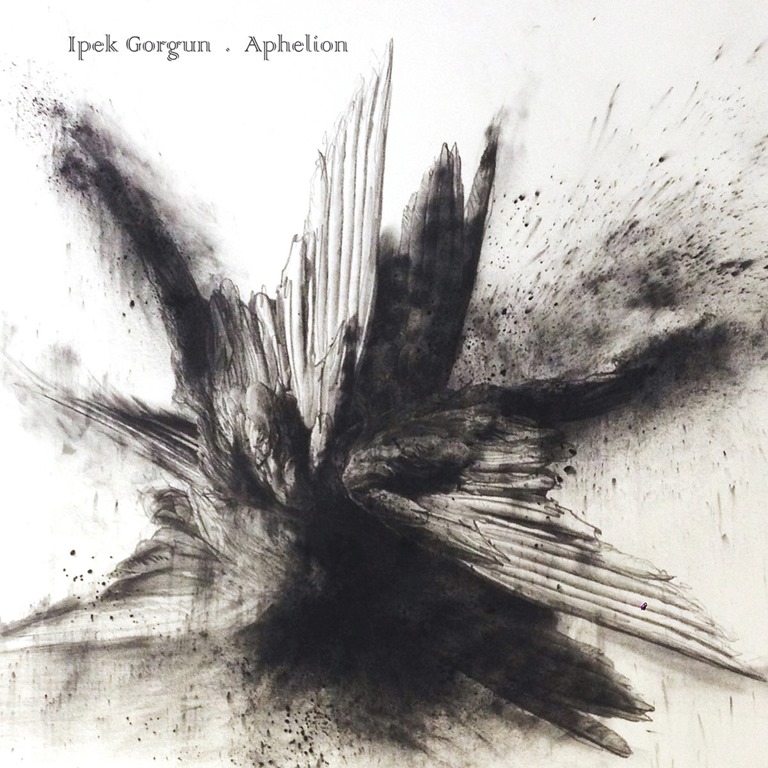
‘Aphelion’ is her debut album, although the fact she is currently working on an electroacoustic solo project and conducting research on how sonic arts can be incorporated with emotional and cognitive alteration, I doubt it will be her last, or that it will be long before subsequent albums follow.

Splintered bleeps phase in and out across funnelling drones make for a delicate introduction, but they’ve very soon obliterated, bulldozed buy a barelling blast of deep, droning, high-volume electronic noise and scraping feedback, fuzzed out at the edges with distortion. On Aphelion, Gorgun exploits the full dynamic range, moving between soft and sometimes ominous quieter passages to louder, harsher tones; sometimes gliding, long notes hover, while at others, sharp, sudden sounds arrive unexpectedly to jolt the listener. In terms of frequencies, too, Gorgun explores the sonic spectrum to powerful and sometimes uncomfortable effect.

The parts are often difficult to pinpoint with specificity, but the sum is challenging, stimulating, and intriguing.


Ipek Gorgun - Aphelion


Ipek Horgun Online

Infernal Machines – Rife

Posted: 1 February 2016 in Albums

Clang Records – Clang034 – 12th February 2015

James Wells

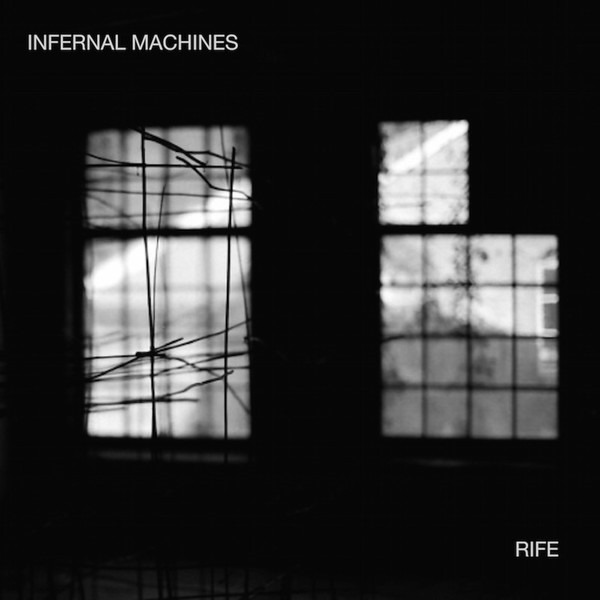
Infernal Machines is Lars Graugaard and Hans Tammen. Both respected composers in their own right, they’re also, independently sonic innovators. While Tammen is perhaps best known for his choking Disklavier, Rife features a guitar./computer hybrid in the form of the ‘endangered guitar’, while Graugaard brings interactive computer work to the table for forge rare patterns and grooves, with some interesting and, in parts, bamboozling and dizzying results.

Yes, this download album may only contain three tracks but it has an overall running time of 28 minutes and is so texturally rich than any more would be to be left beyond gorged.

‘Is That A Light?’ pings and pops, drones and groans over rapid percussion resembling bongos. Building an intense insectoid scratching clamour, it drills its way into the cranium. The album’s centrepiece, the eleven-and-a-half-minute ‘Ashen Lines’ hits as a laser attack. Pulses form hectic and cacophonous polyrhythms that shift and mutate. Scraping and rattling against one another, churning and circling.

‘Steady Jolt’ marks a radical departure, as a strolling bassline – remarkably conventional, by all accounts – wanders hesitantly toward a flickering curtain of electronic light that cascades and iridesces. Pulsing dance beats emerge as the sonic spectrum slides into another realm.

It’s not a work you can readily pin down, its shape in eternal flux. Constantly shifting, no two bars are entirely alike, as layers build and sounds evolve and transform. By the end, you find yourself wondering just how you arrived at the end destination – not that it matters, because it’s very much about the journey.

Infernal Machines - Rife


http://clang.cl/rife/

Sub Rosa

Christopher Nosnibor

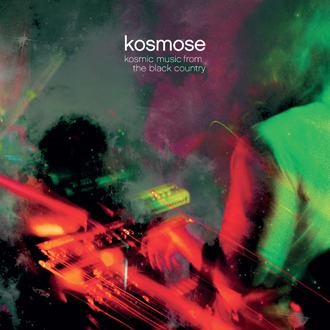
I’ve long been an admirer of Sub Rosa’s releases: the label has a particular knack for uncovering weird and wonderful releases, and while not all of them are necessarily to my taste (the William Burroughs LP Break Through in Grey Room is very much my bag and absolute gold; the Charles Manson one less so: no-one would really care less about Manson’s frankly feeble musical efforts if he hadn’t attained global notoriety as a mass murder who implicated The Beatles in his infamous killing spree), their historical and musical value is undeniable. And so we have ‘Kosmic Music from the Black Country’, an archival retrospective of the little known but nevertheless near-mythical Kosmose spanning the years 1973-1978.

Built around the core nexus of Alain Neffe and Francis Pourcel (of SIC renown), Kosmose (more of a loose collective than an actual band) operated as an occasional live entity, playing exclusively around the Charleroi area of Belgium. They splintered in 1978 without leaving any officially released material to document their existence. It’s the kind of stuff of which legends are indeed made.

As their very name suggests, their music is far-out, spaced-out and experimental, a brain-frying amalgamation of krautrock, progressive rock and jazz. Some 40 years on, how do the recordings hold up? There’s a very real danger that a release like this could completely devastate the mystique and the myth. Perhaps the fact their appeal is niche and their legend very much confined to underground circles, there’s less of a risk of the hype overwhelming the output than, say, an undiscovered album by The Beatles, or Bowie, or even, say, King Crimson or Jethro Tull. Aficionados of wild wig-outs – those aware of the band by reputation – are, one might say, predisposed to appreciate these recordings, and will be ultimately thrilled rather than disappointed.

There are many of the standard elements of freeform prog / jazz improv in evidence; lengthy drum solos, prolonged passages of sparse hums interspersed with groans and shrieks of saxophone. There are no shortage of epic grooves. But there’s a lot more besides: this is inventive, atmospheric and psychotropic stuff. There are moments of subtle beauty. There are moments of explosive crescendos and shattering discord. It’s not always easy to tell what instrument is doing what. Swirling drones provide a shifting, shadowy backdrop to creeping flickers. Everything goes every which way, in all shapes and colours.

The tracks – all untitled – trip, swirl and weave into one another to form an immense, dense, whirling psychedelic trip. The recordings have a hazy quality, and the production values – such as they are – are very much of their time. And that’s integral to their appeal: it’s like unlocking a sonic time capsule that’s stored in someone’s brain.

Kosmose


https://www.youtube.com/embed/pSpadjolmA8

Kosmose online at Sub Rosa

Francis Juno – Tomorrow’s Nostalgia

Posted: 17 January 2016 in Albums

Hula Honeys – 17th November 2015 – hon18

James Wells

I kinda like the idea of future nostalgia. First, because there’s a certain postmodern knowingness about the oxymoronic, paradoxical nature of the concept. It shows a degree of confidence, too, however ironically it’s intended, in the implication that this work has ‘future classic’ potential – unless, of course, it means it’s somehow a soundtrack to future nostalgia, or a comment on what nostalgia may look like. Not that anyone’s looking to the future much right now: nostalgia is big business alright, with people mooning over the most mundane aspects of the past. I yearn for a future in which people reserve their outpourings of nostalgic adulation for things that are actually worthy. Getting misty-eyed over dull as ditchwater bands like Shed 7, or the time when a chocolate bar shared the dimensions of a log and you could buy crisps that tasted of hedgehog. I’m not saying things weren’t better then, but not everything was better, and a lot of the world, from art and culture to consumer goods, was plain cack.

Precisely what this album says about the nostalgia of the future is unclear. Or perhaps it says nothing, and the album’s title is simply an observation of the fact that in time, tomorrow will be nostalgia at some point in the future.

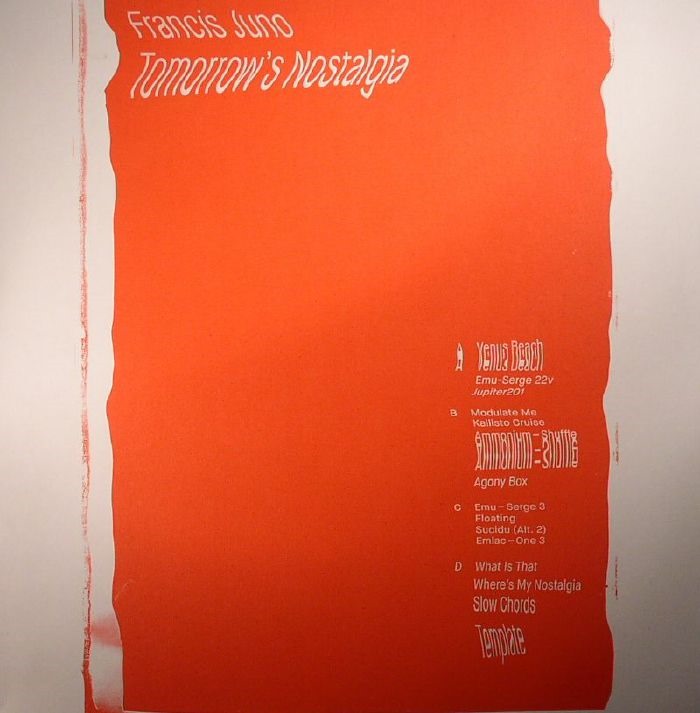
Low-key, minimalist compositions which rely heavily on wibbly, wobbly basslines are perfectly represented in the fonts used on the cover, and sound like the sound of the future 15 or 20 years ago. Juno lays down some chubby, laid-back electro grooves, underpinned by classic retro drum machine beats – whipcrack snare sounds synonymous with machines like the old Roland TR606. It’s a collision of late 70s and early 80s disco and more experimental work with the knowing retro chic and analogue worship of underground dance music the late 90s and, indeed, since the turn of the millennium.

No doubt had this been released in the 80s or 90s to a degree of cult success, people would be excavating it now and hailing it as a masterpiece. Or maybe not? Perhaps it could be interpreted as a satire of sorts. Who can really tell? And ultimately, does it really matter?

Francis Juno Online

Juno

Lärmheim – Cent Soliels

Posted: 5 January 2016 in Albums

Christopher Nosnibor

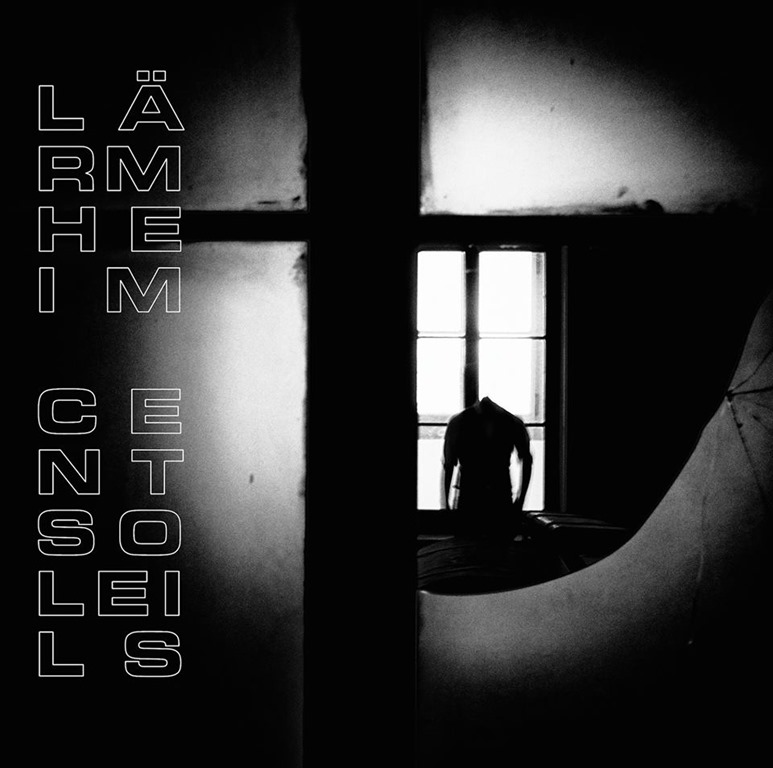
I know virtually nothing of Lärmheim, other than the fact it’s the musical vehicle of Henri de Saussure. Having misplaced the press release, it transpires information on the website and Facebook pages is sparse, and most of the reviews in circulation are in German. The limited details culled from Facebook show the Swiss artist was born in Geneva in 1989, studied drums, piano, tabla, and bass clarinet, and is currently using ‘synths, software, hardware, drum machines, vintage gear and lots of coffee’. But ultimately, knowledge of Lärmheim or its creative force counts for very little in the face of this utterly overwhelming album.

Not so much a collection of musical compositions as an electronic explosion, Cent Soliels is everything, all at once. Looped beats and tapes spooling at five-speed, surging synths warped woozily amidst crackles and static, circuits spinning in overdrive to the point of meltdown. Stuttering, stammering, everything is jammed up to the max.

There are brief moments of calm respite, but there’s interference, fizzing currents sparking in exhaustion. Passages of sweeping euphoric dance, some of which explore dizzying time signatures and synth wizardry which demonstrate almost progressive leanings, are ruptured by barrelling screeds of white noise, while heavy beats blast like detonations, adding to the violent tumult of sound. Brutal barrages of noise worthy of Whitehouse erupt at every turn, and when moments of silence fall, the effects is just as devastating.

Larmheim

http://music.laermheim.ch/

Mind Travels / Ici d’ailleurs – MT05 – 11th December 2015

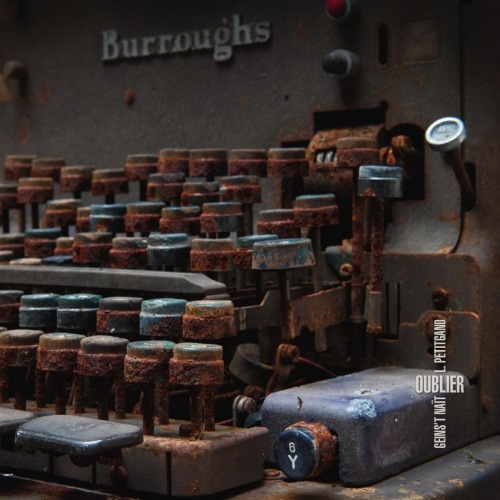
The rusted Burroughs adding machine on the front cover hints at the album’s contents in more than one way: like the crumbling staircase on the back, it’s an image of decline, of decay, a reminder of places, scenes and memories forgotten or fading. And then of course, there is the work of the adding machine’s inventor and head of the Burroughs Corporation, William Seward Burroughs I descendent, William Seward Burroughs II, infamous author of Naked Lunch and literary inventor of the seminal cut-up method. It’s fitting, because Oublier is a work which plays on the mind through dislocation and juxtaposition, an album that plays on the mind in some of the ways Burroughs’ texts do.

I’m not only referring to the way Burroughs’ most radical work create a simultaneous sense of real time and dream time through the formation of jarring narratives, or the way past, present and future to forge a disorientating and endless present though the dislocated anti-narratives formed by means of the cut-up here. Burroughs is renowned for his prescience, his forward-thinking and his dystopian take on science fiction. Closer reading of Burroughs’ works – in particular his final trilogy, but also texts like The Wild Boys, as well as the cut-up trilogy of the 60s – reveal an author capable of deep nostalgia.

In merging the very different styles of Geins’t Naȉt and Laurent Petitgand – renowned respectively for industrial collaging in the vein of Throbbing Gristle or early Neubauten, and film scores, Oublier offers a sonic work which challenges the listener in unusual ways. By unhooking the conventional temporal bearings of composition, they have forged a work which elicits an almost subconscious response.

Delicate, picked acoustic guitar flicker in and out from an ever-shifting terrain in which electronic and acoustic music and sources indistinguishable in origin push, pull and twist against one another. Stealthy basslines, gentle melodies and echoes of grooves are submerged in extraneous sound on sound, pink noise static hiss (‘Kenie’). Dark atmospherics and sonorous booming low tones contrast with surging tides, obscuring enigmatic, haunting vocals (‘Ghost). ‘Je ne Dors Plus’ is hypnotic, unsettling. Clattering industrial mechanoid rhythms rumble around degraded fragments and snippets. Orchestral strikes rupture dingy desert soundscapes on ‘Brass’, half Foetus, half Master Musicians of Joujouka.

The pieces on Oublier are fragmentary and non-linear, and exist as memories, overwritten and partially erased, palimpsests of faded nostalgia. There are moments through which the listener is led through gentle, sweeping melodies, aching with beauty but tinged with sadness at the corners. Rainfall, whispers – sometimes sultry, sometimes threatening – echo in empty rooms, abandoned but adorned with the spirits of lives past. It isn’t an album you interpret in a concrete definitive sense, and certainly, that any response is by no means fixed or preordained: instead, the supple, shifting nature of the pieces offer fleeting insights and evocations which appeal to the listener’s own experiences and the recollections stored in the memory banks. It’s evocative not of anything explicit, but of vague sensations: the listening experience is therefore shaped by what the individual listener brings to the album. As such, it’s a work which offers an intensely personal listening experience.

This is precisely the aim of the Mind Travels series, which has been little short of of inspiring and inspired, and Oublier offers a veritable palace for the mind to wander in. Sit back, listen, and forget…

oublier-500x500


Geins’t Naȉt + L Petitgand – Oublier Online

30th October 2015

Christopher Nosnibor

Explorations of sexuality are certainly nothing new, and while every generation likes to think it’s reinvented sex and sexuality, it is of course, what’s ensured the survival and expansion of the human race since it first evolved into its own species. We know we’re by no means the only primates to enjoy recreational sex, but we are, of course, the only ones capable of making art.

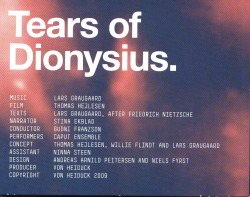
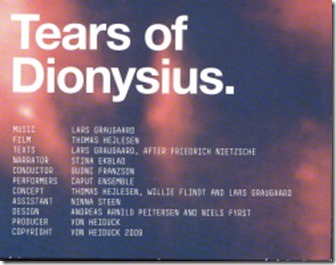
Graugaard’s Tears of Dionysius is an unusual project, an audiovisual work which juxtaposes high art with low. The visuals are a collection of anonymous black and white movies, compiled and sequenced by writer and film-maker Thomas Hjlesen, the texts composed by Graugaard ‘after Friedrich Nietzsche’ (taking ‘Geburt der Tragödie’ – ‘The Birth of Tragedy’ which dissects the dichotomy between the Dionysian and the Apollonian as its basis) and the score composed by Graugaard for 18 players and performed by Caput Ensemble, along with Gudini Franzon and Stina Ekblad. As such, its ambition and scope on a purely technical level is vast, and in terms of its theoretical philosophical context, it’s equally immense. In many ways, the enormity of the project proves to be the audience’s greatest challenge. Quite simply, how does one assimilate a work like this?

Graugaard’s score is magnificent. ‘I ask again and again, why are you so sad’ is a bold neoclassical piece which has the drama of ‘Mars’ from Holst’s Planets suite, which stands in contrast with the blurred, grainy images. Hands grabbing, squeezing, kneeding, flesh, malleable, dough-like, the figures become almost abstracted and cloud-like at times, and it’s often difficult to be certain exactly what you’re watching. The effect is akin to a merging of Henry Moore’s figures with the style of Lucian Freud and the rape scene in A Clockwork Orange.

‘When Your Shadow is All Over Me’ – a jumble of limbs, pumping male buttocks toward the lens, then cut to a torso, a male and female abdomen in rhythmic slow-motion, something more akin to jellyfish floating through the deep than the actuality of copulating bodies – cut to a close-up of a woman’s pubic thatch, rising and falling in a slow rhythm. The music is sparse, creeping, cinematic, eerie. In a way, this corresponds with the strange detachment of the nature of these anonymous films: there are no faces in shot. We hear the voice of Stina Ekblad narrate the relationship between Apollo and Dionysius while a penis fills the screen plunging in and out in a fluid motion.

When we do finally see a face, during ‘No Matter How Hard We Try’, it’s a high-contrast image of a man’s forehead and eyes in close-up, slowed to almost a still. Against a soundtrack of unsettling discordance, how do we read those eyes? Freeze. Saturate to fade.

‘You Are in the Arms of an Angel’ finds scraping strings teeter on the edge of a dark abyss over a stuttering loop of a lesbian kiss. Again, the film quality reduces the features to washed-out whites and shadows, the eyes deep hollows, the mouths vortex-like black holes, expressions of lust transformed to anguish and agony.

The drama and tension rises on ‘Nobody Seems to Know Where We Go’, and I’m reminded of JG Thirlwell’s most ambitiously orchestral works. There is, of course, an element of irony that such an overtly cinematic soundtrack should be aligned with the low-grade, short-focus (as opposed to wide-screen, panning) shots which occupy the screen.

At the 24-minute mark, two women, ghoulish with contrast and oversaturation, sit, smoking: it’s every bit as strange and alien as the flickering hands exploring contours of breasts, large dark nipples and stockinged legs. Strings and piano motifs skip and dance lightly, while the looping of the footage, the repetition of scenes at variant paces lock the performers into some kind of perpetual sexual hell in which there is no release, no climax, no resolution, merely the same endless stroking and grappling. Looking for a distraction, I become fixated on one of the girls’ teeth, but the degraded, blurred image makes them look sharp, ghoulish. Mammoth orchestral strikes build to a thunderous crescendo as her partner kneeds away at her tits, a gentle gesture transformed into an act of brutality through its repetition and the alteration of context.

At times, it’s like watching animated x-rays locked in some brutal final battle, and Graugaard’s soundtrack is no less unsettling. Instead, the juxtapositions and the overt incongruity render the experience jolting, unsettling.

Despite the origin and initial purpose of the footage which features here, Tears of Dionisius is most certainly not an erotic movie: detached and abstracted from its original context, we’re presented with something dark, mechanical, inhuman. Instead of arousing, it unsettles, and implicitly reverses the lens position to cast its gaze on the viewer. Is this desire?

The soundtrack only heightens the effect, its sonic pathos building dramatic peak upon dramatic peak. Surging strings and teetering horns which would be at home in 60s sci-fi movies soundtrack images of pulsating vulvas and slow, deep masturbation. It is unsettling. The soundtrack functions in almost precisely the opposite way a soundtrack conventionally functions, not subtly complimenting the images on screen, but incongruously reminding the viewer that there are essentially two entirely separate projects being presented simultaneously here. And within that dissonant space, the viewer is challenged to consider their own desires, and their own place as observer / voyeur / listener / critic.

Time and space collide as old visuals are overlaid with a contemporary score which in fact recalls a previous time, but not the time in which the images were shot. And those images… for all of the pornography that pervades daily existence now, and forms a desensitizing backdrop to 21st century life in the western world, the footage is powerful, and sears itself onto the retinas. It’s an infinitely complex work which functions and resonates on almost countless different levels, and challenges the viewer without mercy. All of this makes for a true work of art, and one which demands comprehensive and considered engagement.
TearsofDionysius_0001-e1421498473484

http://l–l.dk/


https://player.vimeo.com/video/11760273

Tears of Dionysius, part 2 from Lars Graugaard on Vimeo.