Archive for the ‘Albums’ Category

Humpty Dumpty Records – HMPTY030 – 5th February 2016

James Wells

Sometimes, there is simply no substitute for volume. Marking something of a change of direction from his previous Amute albums, Jérome Deuson has embraced something that could be considered more of a ‘rock’ aesthetic in cranking everything up to 11. But this isn’t a question of indulgence. It’s about the transformative nature of volume. It’s the volume of the sounds which determine the way the notes and tones interact on the pieces on Bending Time in Waves. The dominant instrument is guitar, bathed in reverb and pushed to the max to forge vast cathedrals of sound. You might loosely call it shoegaze, or slacker indie, or simply ‘alternative’, as we did back in the 90s. And there’s very much a 90s feel to Bending Time in Waves, an album capable of the same kind of temporal discoordination as induced by My Bloody Valentine’s Loveless.

Beneath the tumults of guitar, there are some pounding drums, but like everything else, they’re partially obscured, semi-submerged amidst a tidal wave of treble, a screed of overloading sound that fizzes and crackles and fuzzes. Winsome slacker introspections played delicately and ponderously are transformed by the ear-splitting volume, crackles, and pops of cracking transistors and hisses of feedback. Soft swathes of soaring strings cascade in and out again on tsunamis of reverb-soaked guitar. Quiet moments of reflection, hushed and sincere swell outwards exponentially, threatening to obliterate Deuson’s fragile psyche.

It’s disorientating, bewildering, overwhelming. But there are some nice songs to be discovered, underneath it all.

Amute

Amute Online

Ici d’ailleurs – IDA111

Christopher Nosnibor

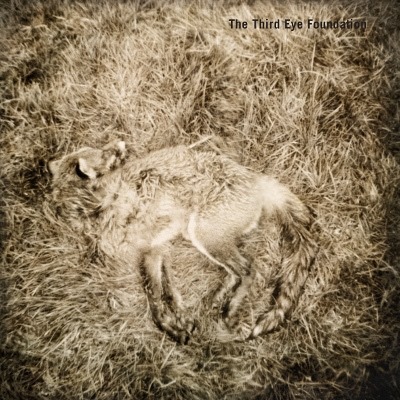
That some hail Semtex as one of the most influential drum & bass albums of its time is entirely understandable – perhaps more so with two decades to reflect on its groundbreaking achievements. 20 years on, it sounds staggeringly intense.

The album is appropriately named: an aural explosion, it still sounds like nothing else. That they don’t make ‘em like they used to may be true, but then, they never made ‘em like this, ever.

There’s a primitive quality to the recordings, in that the tracks are all drenched in a thick sonic smog. But while the dense layering of the sound adds to its appeal, and its enigma, as you lean closer to strain for the hidden details, the nuance, the very soul of the songs, there’s also a sense that the unusual production conveys intense, ear-splitting, tinnitus-inducing volume. This is one of the album’s major assets, and in many ways, it’s perhaps as well, in that it gives some vindication to Matt Elliott’s devotion to a most basic but equally uncompromising approach to the album’s realisation: as the bio notes, Semtex was mixed ‘with headphones way too loud’, which resulted in the artist suffering permanent hearing loss at around 3 khz.

In some respects, it’s a product of its creation: after all, necessity is the mother of invention, and the material was recorded in a squat which Elliott shared with Matt Jones from Crescent, on a-4 track recorder borrowed from Dave Pearce from Flying Saucer Attack. It’s the sound of long hours spent obsessively channelling creativity, and wrestling with the conundrum presented by a vast concept and ambition countered by limited kit and technology.

The press release is on the money when it reminds us that ‘the result is brutal and uncompromising, and features a mix of noisy ripped up guitars and hectic drum machines’, and that ‘Semtex is the antithesis of electronic dancefloor music . It’s head music, and it’s headfuck music. It juxtaposes dreamy soundscapes with violent sonic assaults, and operates on so many levels, conscious and otherwise.

The original album featured six tracks. This staggeringly comprehensive reissue features a bonus disc containing a further eight, and there’s a download code for additional material giving a total of 29 tracks and some three hours of music, including the 28-minute ‘A Silent Longing’ and 34-minute behemoth ‘Voyager’.

‘Sleep’ starts the album with a squalling dissonant noise that’s sharp and shardy enough to keep even the most chronic narcoleptic awake, assaulting the senses with a nightmarish wall of sound that’s very much geared toward the higher frequencies. Even when pulling back on the aggression, as on ‘Still Life’ and the dreamy drift of ‘Next of Kin’, the tracks are driven by a barrage of percussion, mangled, gnarly and hyped-up industrial-strength beats. The cavernous crawl of ‘Once When I Was An Indian’ marks a change of pace and amps up the atmospherics as it detonates outwards into space in slow motion.

The wealth of bonus material displays manifold different facets of TEF: from the looping motifs of ‘Alarm Song’, which, even with its crunching beats, is more overtly accessible, to the ambient abstractions of ‘Shard’, there’s a lot to explore and digest.

Broadly speaking, the idea of an anniversarial reissue smacks heavily of industry and nostalgia, but this release conforms to neither. It’s certainly not a cheap cash-in with a bunch of b-sides and outtakes to bolster the package. What it is, is a retrospective of sorts, which encourages and facilitates a fresh appraisal of the work in a new context. And it needs to be heard.

Third Eye

The Third Eye Foundation Online

PBP

Christopher Nosnibor

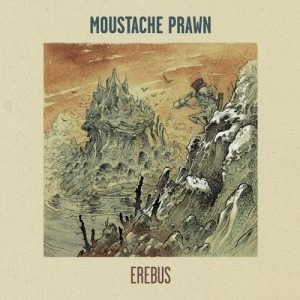
If the band’s name sounds a little odd in a quirky, absurd dada sort of a way, then it’s due in part to the translation. Initially formed as a post-punk band working under the name Dystopia, the bandmembers’ discovery of acts like the Strokes, Arctic Monkeys, Radiohead, Interpol, The Smiths, and Jon Spencer Blues Explosion prompted a radical change of direction and a new name, which, I’m reliably informed (i.e. from the press release, not Google) translates as ‘shrimp whiskers’ in Italian. Ok, so it still doesn’t make much sense, but it’s certainly different.

The same is true of the Italian trio’s second long-player, pitched as ‘a concept album, a fantasy tale that explores environmental issues and animal rights.’ I respect and even admire that. These are big issues, and they’re more than merely political issues. Yet pop culture as a whole seems strangely removed from real culture. It’s very much a measure of the first-world late capitalist society that ‘culture’ can be a separate entity unto itself, and concerned with entertainment and personal emotions instead of things that matter, like, say, the state of the planet or the dominance of global corporations.

Not that much of this is apparent in their wild and often experimental alternative rock, which jolts and jars, lurches, scratches and scrapes. They don’t ape any of the aforementioned influences in any obvious way, and instead head out on a very long limb to create something that slaps the listener round the face with its otherness and a real sense of urgency. Nagging basslines and angular guitars explode in frenzied discord against drums that fire spasmodic rhythms in every direction.

A chunky, elastic bass guitar line worthy of Gang of Four underpins guitars that twitch and jerk every which way on ‘Mountaintop’, and the funk-tinged ‘Breakdown’ makes you want to dance and makes you feel tense at the same time. There are occasional moments of hippy-trippy psychedelia (‘Goodbye Zero’, for example), and jangle-centric indie (‘Something is Growing’), but despite gleaning snippets of lyrics about elephants and breaking the government, this doesn’t feel like an excessively preachy work, and it’s certainly not about gooey, wide-eyed idealism.

It is, however, wildly eclectic, and there’s some superlative drumming, not least of all on the explosive ‘Waterquake’ which combines harmonious melody with immense percussive firepower.

How much of the concept or the message you get is likely to vary, but there’s no missing the universal and utterly exhilarating delivery.

Moustache Prawn

https://www.youtube.com/embed/YORVelOf6Y4?list=PLTd0ejrxraFwNp7GWzSncgMUA_0XuFHlo

Moustache Prawn Online

Rock is Hell / UNrecords – RIP 66 / unrec11 – February 2016

Christopher Nosnibor


Maja Osojnik is an angry woman. A woman on the edge. A woman with inner strength. After 14 band albums, her first solo outing is a highly charged work, heavy with stark emotions and raw catharsis.

‘Tell me, what do you want me to be?’ she asks in an opium monotone on ‘Tell Me’. Slowly, her offers become more desperate and pained, her multiple voices speaking simultaneously before she slams it all down on the table, unable to maintain her decorum any further: ‘Ill become… all the images you want / so you can walk on me / sleep in me / so you can throw all your shit on me / Tell me, what the fuck do you want me to be?’ It’s chilling in its directness, its apparent lack of artistic distance.

‘Let Them Grow’ is one of those albums that hits like a punch to the solar plexus. It’s impossible not to laud the artist for her openness, her ability to convey so many painful emotions – but at the same time, it’s deeply uncomfortable. Listen, people who use terms like ‘TMI’ are, in the main, uncomfortable because they don’t like to face brutal truths, particularly those belonging to other people. On ‘Let Them Grow’, Osojnick pays no regard to these emotionally closed or stunted types and simply lays it all out there, telling it like it is, spilling her guts because she has no other choice. This isn’t simply music, this is pure art and the very definition of catharsis. Let Them Grow is a work of exorcism, of expulsion.

If you hadn’t already figured, this is a challenging work. ‘Condition’ is a full-tilt rant against a backdrop which amalgamates industrial noise and tribal beats. ‘Stick it up your ass… Come out, you rotten cocksucker, here’s your fucking POP SONG’ she hollers bitterly. And she fucking means it: this isn’t mere petulance, but a middle finger to an establishment and a wider world that’s failed and ultimately fucked up- and which doesn’t value the arts and doesn’t recognise the value of art. It’s a shame, because this is art.

It’s not just the music: I received the CD in its gatefold card sleeve enveloped within a four-leaf pamphlet type wrapper, accompanied by a sticker and five postcards of the artist beautifully shot by Rania Moslam in a range of striking poses. The whole package was in turn wrapped in a parchment paper bag. It’s about the artefact, the attention to detail, the building of suspense and expectation while gaining access to the disc itself, which, in turn, does not disappoint. This is not merely an album. It’s a grand gesture.

From the most subtle, delicate pieces, led by softly-fingered piano, she slowly drags out every sinew of anguish, draws on every drop of pain and presents real emotion. Emotion that can’t be faked.

Brooding instrumental passages offer moments of respite, but then there are sections of growling industrial noise, dark and sinister, grinding and crushing, which are nothing short of devastating. Taut, tense and from the heart, Let Them Grow sees Maja Osojnick present an album that is unparalleled in its sincerity and astounding in its emotional and musical power.

Maja Osojnik

Maja Osojnik Online

Silver Snakes – Saboteur

Posted: 21 February 2016 in Albums
Tags: , , , ,

12th February 2016

They come straight on with all guns blazing on this one. A repetitive, driving riff, amped up to eleven dominates the album’s first track, ‘Electricity’. It may be corny an cliché to say it grabs the listener by the throat and gives an instant hook, but the bottom line is that it’s entirely. As a music reviewer who received anywhere up to 50 albums and Eps a week for review, I know as well as anyone the importance of making an impact in the first minute or two. We live in a world that’s time-precious and time-pressured, of instant gratification and low patience thresholds. If whatever you’re pitching don’t grab the attention immediately, then fuggeddaboutit. ‘Saboteur’ is a riffcentric album that blasts off with the claws out, sinks ‘em in deep, and digs right in.

Full-on as it is, it’s got range and dynamics, and they don’t resort to formulaic verse/chorus/loud/ quiet structures by way of a default. Although, then they do tale the more conventional path they end up with ‘Raindance’, a full-on grunger reminiscent of Nirvana and lesser known T&G acts like Tar, and it’s belting – arguably, the most obvious single choice from an album that’s dominated by raging, overdriven guitars and angst-laden vocals, ripped with rage.

They stalk stealthily through the breakdowns and bring it all back with tumultuous overdriven attack. ‘Dresden; hit s a slower, more stoner-rock vibe, with some heavy-duty tom-driven-drumming propelling a slow, grinding riff into oblivion over the course of an expansive nine-minute sprawl. It’s one of three longer tracks (as in over seven minutes), through which they explore more prog territories, but without losing any momentum.

There are elements of Soundgarden and Korn are at play here, not to mention Nine Inch Nails (as exemplified by the full-tilt ‘Charmer’, but it would be wrong to tag them as 90s revivalists. Regardless of decade, the driving guitar riff and thunderous drumming is always king, and the song that conveys sincere emotion and delivers a tangible punch to the gut is god. Silver Snakes are both kings and gods, on the strength of this album.
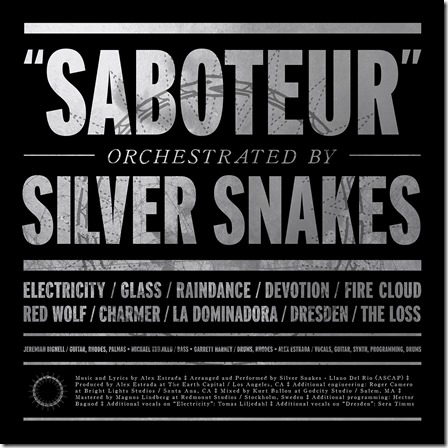
They come straight on with all guns blazing on this one. A repetitive, driving riff, amped up to eleven dominates the album’s first track, ‘Electricity’. It may be corny an cliché to say it grabs the listener by the throat and gives an instant hook, but the bottom line is that it’s entirely. As a music reviewer who received anywhere up to 50 albums and Eps a week for review, I know as well as anyone the importance of making an impact in the first minute or two. We live in a world that’s time-precious and time-pressured, of instant gratification and low patience thresholds. If whatever you’re pitching don’t grab the attention immediately, then fuggeddaboutit. ‘Saboteur’ is a riffcentric album that blasts off with the claws out, sinks ‘em in deep, and digs right in.

Full-on as it is, it’s got range and dynamics, and they don’t resort to formulaic verse/chorus/loud/ quiet structures by way of a default. Although, then they do tale the more conventional path they end up with ‘Raindance’, a full-on grunger reminiscent of Nirvana and lesser known T&G acts like Tar, and it’s belting – arguably, the most obvious single choice from an album that’s dominated by raging, overdriven guitars and angst-laden vocals, ripped with rage.

They stalk stealthily through the breakdowns and bring it all back with tumultuous overdriven attack. ‘Dresden; hit s a slower, more stoner-rock vibe, with some heavy-duty tom-driven-drumming propelling a slow, grinding riff into oblivion over the course of an expansive nine-minute sprawl. It’s one of three longer tracks (as in over seven minutes), through which they explore more prog territories, but without losing any momentum.

There are elements of Soundgarden and Korn art play here, but it would be wrong to tag them as 90s revivalists. Regardless of decade, the driving guitar riff and thunderous drumming is always king, and the song that conveys sincere emotion and delivers a tangible punch to the gut is god. Silver Snakes are both kings and gods, on the strength of this album.


Silver Snakes


Silver Snakes Online

Consouling Sounds – 18th March 2016

Christopher Nosnibor

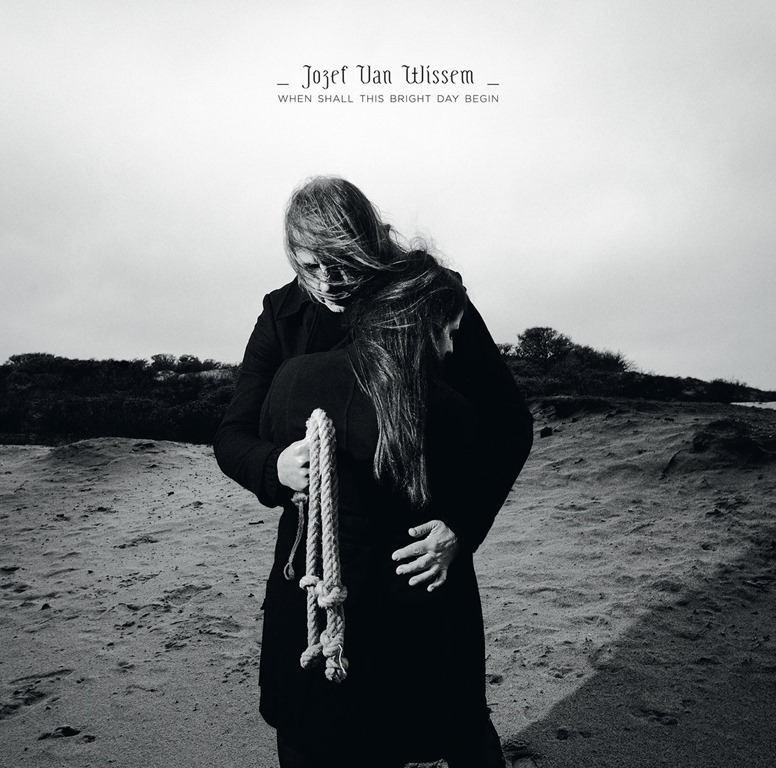
Oftentimes, I’ll set an album to play and, although listening to it, will find myself distracted by other things – email, Facebook, Twitter, whatever. We live in a world of information overload and we find ourselves multitasking – or distracted – constantly. It seemed fair to assume that I’d be able to get a few bits and bobs done while giving a first spin to Jozef Van Wissem’s latest offering. I was mistaken. But then. It’s not often I’m presented with an album that combines both elements of the avant-garde and the baroque, performed on the lute, an instrument I cannot help but associate with Elizabethan court poetry – not least of all Sir Thomas Wyatt, author of lyric verses ‘My Lute, Awake!’ and ‘Blame Not My Lute’.

Van Wiessem’s lute is very much awake, and there is no blame to be apportioned when examining his latest work, When Shall This Bright Day Begin. Am I uncomfortable with the absence of a question mark in the title? Yes, but that’s about all.

The Dutch composer has received no small degree of recognition for his lute compositions – which seems, on the face of it, a little odd. I mean, who plays the lute nowadays, apart from medieval revivalists, the kind of people who are heavily into LARP and all the rest? But listening to When Shall This Bright Day Begin, I find I’m doing nothing but listening. Van Wissem’s compositions and playing are magnificent, and utterly compelling. And it’s hard to imagine anything further removed from ‘Greensleeves’ or the Elizabethan court. The instrument may be ancient in its origins, but the eight tracks here aren’t steeped in historical reverence. Instead, Van Wissem conjured beautiful and timeless music.

If ‘To Lose Yourself is Eternal’ opens the album in what may be considered a fairly conventional, accessible, lutey way, the darkly warped swampy garage drone of ‘You Can’t Remain Here’ completely annihilates any sense of comfort or rapport that’s been established. Coming on like a ‘White Light’ era Swans track covered by Dr Mix and the Remix, it also drags in some fucked-up ketamine-slowed psychobilly leanings and imbue the song with a sense of absolute derangement. It’s genius.

By genius, I mean almost as genius as inviting Zola Jesus to feature on two of the right tracks. Another admirably idiosyncratic and utterly unique performer – not to mention a vocalist in possession of a stunning voice which is dramatic and stunningly powerful – she brings breathtaking dimensions to ‘Ruins’ with a suitably spellbinding performance that’s well-suited to the musical accompaniment.

The stark, dark country twang of scratchy strings, coupled with muffled samples, which make ‘The Purified Eye of the Soul is Placed in the Circle of the Eternal Sun’ and sort-of counterpart ‘On The Incomparable Nobility of Earthy Suffering’, pull hard on the attention.

Van Wissem shows admirable restraint, and contains the album to just eight tracks, with the sparse ‘Death of the Ego’ providing a delicate and understated conclusion which is enough to leave the listener sated. Bask in the glorious elegance, for this is music of the most magical kind.

Jozef Van Wissem

Jozef Van Wissem Online

keitkratzer productions (zkr0020) (CD) / Karlrecords (KR027) (Vinyl) – 26th February 2016

Christopher Nosnibor

Reinhold Friedl’s keeping it in-house with this one, with the Zeitkratzer collective which he helms performing a reworking of one of his own pieces. Kore is a development of his earlier Xanakis [a]live! (2007), which was an homage to French-Greek composer Iannis Xanakis. Originality may be dead, but artistic evolution is not, and here we see Friedel engage fully with the organic processes of influence and appropriation, and the idea that a work is never complete but continually subject to re-evaluation, reinterpretation, reconfiguration.

Pained screeching of tortured strings, form long, agonized screams and wails. On the lower register, cavernous rumblings and ominous echoes. It quakes and trembles and teeters and bucks, crashing and lashing, a sustained and calamitous wall of sound akin to how one may reasonably imagine a galactic storm. And it goes on for what feels like an eternity, light years of shuddering textural depth stretching out and fully enveloping the senses.

While the CD track-listing shows ‘Kore’ as being presented in just two parts, its mastering in fact replicates the vinyl edition’s four sides, with each piece between 11 and 16 minutes in length. As a single entity, it crashes and grates, squalls and shrieks, grunts and groans. And it never lets up, a sustained crescendo of sonic and psychic disturbance, a tempest of clashing noise, a raging storm.

The segmented arrangement works well: for while ‘Kore’ is clearly a single body of work, there are distinguishable differences between the four tracks. The second is comparatively quieter and less intense than the first, but the tones still forge sharp shards which slice into the cerebellum. Trilling and tweeting shrilly in the upper reaches of the spectrum, dark scrapes create perilous undercurrents which build in density.

Vast crashes of sound, immense gongs of violence slice the atmosphere in the third, more percussively-orientated part. It shudders and heaves, before finally screaming onwards through the tumultuous final 11 minutes. A blasting wall of noise which assails the listener with all sounds all at once, it’s an immense sound and an immense sensation that sounds like no orchestral work you’re likely to have heard before, and, quite conceivably, nothing else you may have experienced, period.

Zeitkratzer - Kore

zeitkratzer Online

Britney – Britn3y

Posted: 16 February 2016 in Albums
Tags: , , , , , , ,

Superstar Destroyer – 11th March 2016

James Wells

Not so much a drone as a collective groaning sigh prefaces the thunderous barrage of brutal rage that splits the speaker cones with pummelling drums and bursts of screaming vocal anguish and stop/start guitar judders. ‘Fully Ben’ assails the lugholes like Truman’s Water having been tortured, brutally murdered, butchered and cast forth to crawl around in purgatory. Fuck me. Three minutes in and I’m dizzy, punch-drunk, giddy and utterly bewildered – in the kind of way I like. And that pretty much sets the tone for this most manic, frenzied albums.

Where do you even begin with this white-hot torrent of noise? The tempos, man! The jolting, jarring, spasmodic guitars! What is this? It’s not metal, that’s for sure. Noisy math-rock? Math-rock is about intricacy, and this is intricate in terms of structure and changing tempos and time-signatures, but at the same time, it’s violent, frenetic. The vocals aren’t your regular shouty, screamy effort, either– this is the sound of pure mania, derangement to the power of 10. Not so much psychedelic as psychotic, the songs – the majority of which clock in at under two minutes – melt into one another, a crazed blur of spasmodic noise.

It’s intense, but not conventionally heavy: the guitars are warped, elastic, and don’t rely on hefty distortion. ‘Neon Python’ sounds like a collision of early Pulled Apart by Horses and second-album These Monsters – only with more drugs. Seriously, what are these guys on?

There are occasional breaks – ‘Sleep Now Dogman’ provides two minutes of respite in the form of some woozy percussion-free experimentalism while someone chunders their guts up, presumably a physical reaction to the exertion of the preceding track – but ultimately, this is beyond full-on, Especially after the, er, ‘interlude’.

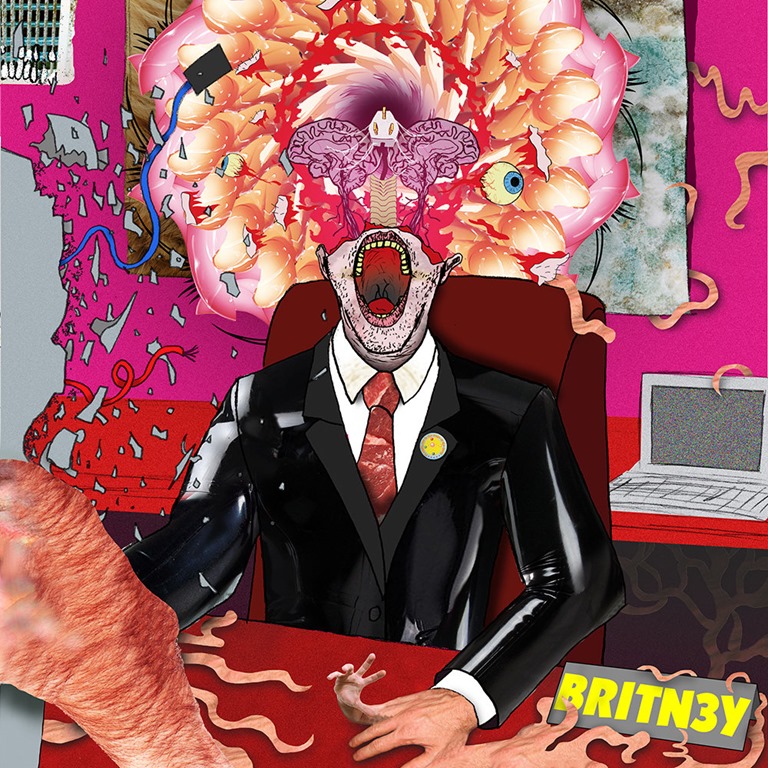
‘Boss Moggy’ goes electro-math-screamo – or something and ‘Gum’ ups the tempo and the racket even further, achieving the effect of a sonic blizzard. You don’t know where you are or what you’re listening to, it’s a total whiteout. Britn3y isn’t an album – it’s a convulsive, abrasive explosion of noise, the aural equivalent of someone’s brains bursting from their skull while they twitch uncontrollably having been connected to an open mains electrical circuit. In short, it sounds exactly the way the cover looks.

If you’re in any doubt, I mean it’s good. Mental, but really, really good.

Britn3y

Britn3y by Britney Online

clang records – clang032

Christopher Nosnibor

Stan Brakhage was an experimental filmmaker who sometimes closely shot glass objects. A huge influence on Frasconi, who sometimes makes music with glass instruments. The album title is a play on words, in reference not only to his artistic forebear but also the cracked quartz crystal bowl which was used to make this 20-minute musical work.

Having previously given the instrument a rather too vigorous workout during a rehearsal, Frasconi decided to explore its absolute limits. As Frasconi himself observes, ‘Glass is fragile. Glass is easily broken. Most glass instruments ignore these fact and instead focus on the material’s delicate beauty’.

Standing Breakage captures the artist’s efforts to complete the job he unintentionally began when the instrument – pictured on the front cover – became fractured. Ironically, despite labouring at the fracture in order to bring about the bowl’s ultimate destruction, he failed to achieve the desired moment of breakage. As such, for all its fragility, the glass held firm against a sustained assault.

An awareness of the circumstances of the album’s creation is, in this instance, integral to its appreciation, first and foremost, because if you didn’t know it was made using only the sounds created with a glass bowl, you would never guess that it was made using only the sounds created with a glass bowl. Because it doesn’t sound like it was made using only the sounds created with a glass bowl. In fact, it doesn’t sound like anything organic, or even of this world.

Standing Breakage finds Frasconi create an intriguing blend of chimes, rings, swirls and twangs, scrapes and chatters. Heavy, bulbous bass tones resonate, twisting and spinning upwards. Percussive thumps and sounds like scraping violin strings all emerge from the single instrument under the musician’s interrogation. Clanging, gong-like sounds crash. Eerie sounds that defy any obvious description, and sound alien and other-worldly in their origin drift. Booming synth-like notes balloon outwards, expanding in the air.

Tension mounts and builds. You sit, teeth on edge, fists clenched. You’ve no idea what will come next. You will twist and squirm. You’ll conjure myriad images in response to the strange sounds. But never once will you think ‘this sounds like someone pissing about with a glass bowl with a crack in it.’

Miguel Frasconi

Miguel Frasconi’s Website

Keitkratzer Productions – 26th February 2016

Christopher Nosnibor

Reinhold Friedl’s Zeitkratzer collective are well established as trailblazers, tackling not only some of the most challenging composers and musical works, but also dismantling the distinction between genres and fields. They may use conventional orchestral instruments, but the sounds they produce are anything but conventional or readily recognisable as orchestral. It’s their unique approach to the creation of sound that has enabled them to not only interpret and perform, but do justice to, works ranging from Metal Machine Music to material by Whitehouse. Here, the nine instrumentalists are joined (for the third time) by Japanese experimental / noise performer Keiji Haino on vocals, and we find them revisiting one of the most difficult, divisive and groundbreaking composers of the 20th century in the work of Karlheinz Stockhausen.

The track-listing is the same as the Aus den Sieben Tagen album, recorded live by Keitkratzer without Haino in 2011. The compositions are the same and the performance similar in essence, but the overall sound achieved on Aus Den Sieben Tagen feels less brutal. But with restraint comes a greater sense of nuance, and a more menacing overtone.

After a silent play-in, ‘Unbegrenzt’ builds a long, low wheezing drone that sustains in perpetuity. Earthmoving bass tones growl in the sub-strata beneath it, while Haino emits droning, guttural incantations, groans and coughs as if attempting to expel his innards through his mouth before the sound once again fades gradually toward silence.

Emerging from the void, ‘Verbindung’ builds on the dark atmospherics which characterise the album, which simmers with, low, slow-building tension, scratches and scrapes, hums and hisses. Dank echoes and alien, animal sounds, snarling, growling, salivating dangerously.

The discordant brass and crashing, non-rhythmic percussion of ‘Intensität’ is a blast of anti-jazz, over which Haino coughs and splutters and heaves, howls and jabbers and screams like a possessed man in the throes of an exorcism.

Final track, the seventeen-minute ‘Zetz Die Segel Zur Sonne’ hangs on an eternal drone, the subterranean croak of the vocal conjuring images of ancient demons performing purgatorial rituals reminiscent of ‘Monoliths’ era Sunn O))). Truly, it’s a monster.

Zeitkratzer - Haino - Stockhausen

Zeitkratzer Online