Posts Tagged ‘Brian Eno’

Karlrecords – 22nd May 2026

Christopher Nosnibor

Flocks is the duo consisting of drone specialist Werner Durand and percussionist Uli Hohmann, and their second album, Lagoon, we’re informed that ‘the duo further explores the aesthetics it has crafted on its selftitled debut (2023, on the now defunct ZEHRA imprint): DURAND and HOHMANN shape drone-y soundscapes based on their self-built wind- & stringed instruments, Persian percussion and subtle electronics, drawing additional inspiration from Krautrock (listen to the irresistible, hypnotique, ever-changing rhythmic pattern of the title track) as well as JON HASSELL’s “fourth world” aesthetics, placing the duo nicely between tradition and experiment!’

For those unfamiliar with the fourth world concept, it can be traced to the 1980 collaborative album Fourth World, Vol. 1: Possible Musics by Hassell and Brian Eno, with the former defining the fourth world as “a unified primitive/futuristic sound combining features of world ethnic styles with advanced electronic techniques.” And it does very much describe the sounds on Lagoon, where electronic drones and quavering digital textures are melded with percussive forms of ancient origin. Indeed, Hohmann’s credits on the album include kanjira, riq, ghatam, Tibetan bells, Venetian shells, and bamboo tube zither. And the result is nothing short of hypnotic.

The three longform tracks share aquatic-themed titles, matched with gloopy tones and fluid forms. Side one contains two ten-minute pieces in the form of ‘Whirls’ and ‘Tidal’, while the twenty-minute title track fills the entirety of side two.

The length of the pieces means they each have time – and space – in which to fully explore the tones and textures of the instruments involved, and to create fully immersive soundscapes. There are breathy stutters amidst the wavering undulations, and sounds which evoke the sound of waves lapping the sides of a small boat. There are gentle ripples, ebbs and flows in these extensive sonic expanses, and it’s not difficult to let go and simply succumb to the drift.

The arrival of some quite smooth sax in the middle of ‘Tidal’ is something of a surprise and feels kind of incongruous at first, but in time it manages to nestle in nicely. ‘Lagoon’ features stronger, busier, percussion and denser, more claustrophobic drones, and is also the most overtly ‘jazz’ of the three compositions due to the more prominent sax work. Over its extended duration, it builds a solid groove, and seems to quicken in pace, although it may only be an increasing density and the tension of eternal repetition. Eleven minutes in, and you really begin to feel it: the relentless rhythm and eternally monotonous drone which underpin all of the additional layers have a cumulative effect. As horns and clients and an array of extraneous sounds from twittering to laser-like bleeps come and go, it becomes increasingly disorientating, and while the experience is by no means unpleasant, it does fully envelop the mind and body.

The combination of sci-fi sounds and weird electronica with urgent polyrhythmic percussion does, indeed, feel other-worldly – of this planet, and not, of the distant past and the equally-distant futures of imagination. And among it all, the listener finds themselves lost, adrift between the two, in time and space unknown.

AA

AA

KR120 front

Houndstooth -15th March 2019

Christopher Nosnibor

And We Are Passing Through Silently is pitched as ‘a collection of songs reworked by Abul Mogard between 2015 – 2018’, with the press blurb describing it as ‘the sublime first survey of reworks by [the] cult synthesist’. It’s also keen to point out that while there may only be five tracks on offer, here, the stature of the artists with whom Mogard has had involvement, noting ‘divine renderings’ of songs by Aïsha Devi, Penelope Trappes (The Golden Filter) and nick nicely (heralded by luminaries of the US underground Ariel Pink & John Maus), with the album culminating with Brian Eno’s collaboration with Irish avant-folk band Fovea Hex.

The 2LP, CD and digital editions also feature Abul’s brand new rework of Becoming Animal’s ‘The Sky Is Ever Falling’ which features vocals from Cinder (This Mortal Coil/Cindytalk) and Massimo Pupillo on bass (Zu/Thurston Moore/Stephen O’ Malley),

The album opens with Mogard’s reworking of Aïsha Devi’s ‘O.M.A.’ The minimalism of the original, as well as its woozy atmospherics are substituted for a mellow sonic wash, and while it’s eminently listenable, there is a certain sense of loss. The darker, more disturbing aspects are stripped out in favour of something less psychologically traumatic, but… I’m torn between the function of a remix bringing something different, and it taking out the essence, and this very much feels like a stylised dilution.

In contrast, his rendition of Penelope Trappes’ ‘Carry Me’ distils that essence and concentrates it, while also drawing out three mellow minutes into twelve and a half of droning organ abstraction, and Mogard’s reworking of nick nicely’s ‘London South’ follows the same trajectory, stretching out four minutes of soft, wistful psychedelia into a fifteen-minute drift, with long, sonorous drones expanding to cinematic proportions. The vocals are preserved, but spaced out, pushed to the back, partially submerged in reverb.

Everything reaches a perfect coalescence on ‘The Sky Is Ever Falling’. Which combines cinematic and operatic, minimalism and maximalism, as the sparse yet full, widescreen instrumentation comes to crate the backdrop for a soaring vocal performance that lifts and soars. The piece warps and wefts on a solar wind for almost a quarter of an hour, before the contrails bleed into an eternal scraping drone that creates a soporific calm that flows from foreground to background in an imperceptible transition.

On the one hand, there isn’t much to it, and Mogard’s method is simple – but it’s not only effective, but has ‘signature’ stamped all over it: his style is distinctive, to the point that his reworkings relegate the original artist and their work to a secondary placing while his own sound and style dominate. On occasion such an approach to remixing may appear ‘insensitive’ or even ‘selfish’, but Mogard seems to have established himself as a re-creator more than a remixer, with artists lining up to submit their work to his reworkings, he’s clearly got some leverage in the musical community, and fair play.

AA

Abul Mogard – And We Are Passing Through Silently

OKTAF – OKTAF #12 – 27th May 2016

Christopher Nosnibor

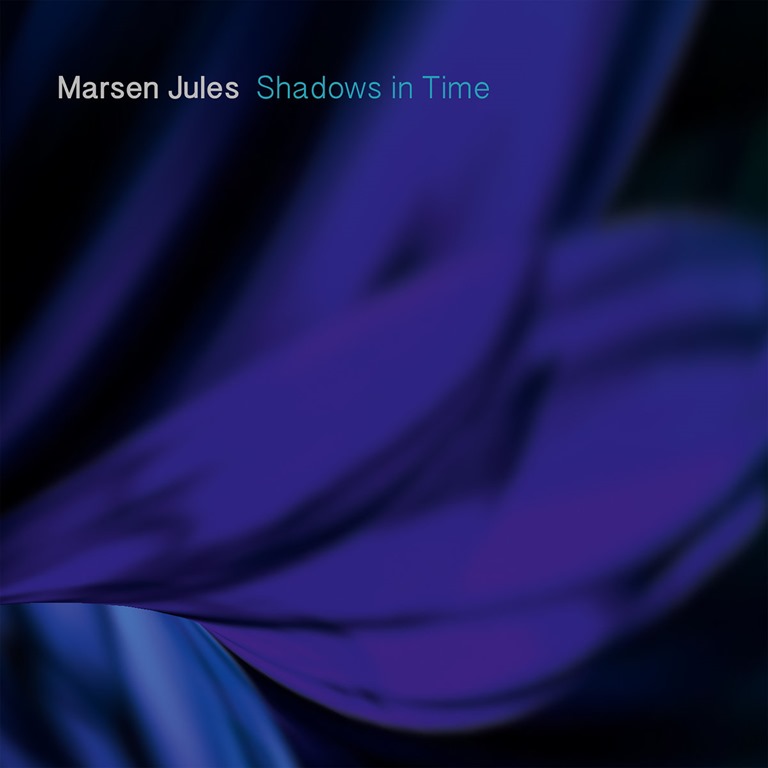
Marsen Jules has long been established as a unique sculptor of sound, redefining ‘sound poetry’ while working within the territory foreshadowed by the likes of Brian Eno and Steve Reich. Shadows in Time marks a huge leap, not so much sonically, but conceptually, as a project, which touches on matters of marketing, consumerism, issues of art and artefact, and the role of the recipient in the artist/audience equation. Shadows in Time is, ostensibly, an ambient work. But ambient carries connotations of background sound, of a given environment. It suggests mood music, but also something that isn’t a focal point as of and in itself.

The soft, supple sounds of Shadows in Time are mood music, in that to immerse yourself in the recording is to create an environment which slows the heart rate and unwinds the mind. But Shadows in Time is more than a mere ambient work. It’s a concept album, the concept of which is only partly about the audio you will hear.

If every individual hears music slightly differently, experiences music on a personal level, coloured by their own senses and experiences, then the fact Shadows in Time exists in some 300 different forms effectively means the already infinite listening experiences are increased to an absolute point.

This review is based on the experience of just one person – me – listening to the CD version. A single track, 49:29 in duration. It begins cinematically, a shimmering expanse of organ-like tones gently sweeping and gliding. The long notes ripple and roll, emanating tranquillity and calm. It also exudes a sense of scale, in a galactic sense. Or perhaps that’s just my mind uncoiling, my tension dissipating. I find myself wondering about the infinite potentials, and what the other versions may sound like. What multiple versions may sound like played simultaneously. Or all of the versions. The vastness is almost beyond comprehension. And from thee calm emerges a sense of infinity. It feels good.

Sit back and enjoy the experience – in whatever form it takes.

Marsen Jules - Shadows

Marsen Jules Online