Posts Tagged ‘vintage’

5th November 2025

Christopher Nosnibor

The early days of goth threw out a host of disparate elements, and there were some quite specific regional variations, too. While Leeds was a hotbed of the emerging scene, what was happening there was stark, bleak, with a certain industrial leaning, likely in part on account of its post-industrial wastelands and the kind of depravation which was rife in the late Seventies and Eighties, but was particularly prevalent in the North. It was quite different from what the more overtly punky Siouxsie and the Banshees were doing, and different again from the art-rock of Bauhaus. And it’s really their 1979 debut single –which was only partially representative of their oeuvre – which is largely responsible for the last forty-five years of the association of goth with bats and vampires and the like. Westenra do very neatly – and legitimately – tie these aspects together, hailing from Yorkshire (Whitby, to be precise) and with a name lifted from Bram Stoker’s Dracula, which famously sees the titular lead character land in Whitby, a place which will forever be synonymous with the macabre, the haunting, the gothic.

Announcing their arrival in 2019, Westenra are relatively new arrivals to a scene that’s creaking with acts who’ve been going for centuries (ok, decades), and in that time they’ve built quite a fanbase, particularly in and around their home county, with a steady flow of releases and an active touring schedule, including some high-profile shows playing alongside The Mission and Theatre of Hate. All of this is well-deserved, as they spin their own blend of – as they pitch it – ‘Goth, Alternative Rock & Metal.’

‘Burn Me Once’ does feel like a progression from their 2021 debut full-length, First Light. The production is fuller, bolder, and while the intro track (Monitus) is a densely atmospheric sample-soaked curtain-raiser, it’s only a primer. The band’s massive riff-slinging progress is nowhere more apparent than on the first song proper, ‘Ghosts in the Machine’. It’s got guts, and hints of the expansive vibes of Fields of the Nephilim’s ‘Psychonaut’, due in no small part to the sweeping synths and chunky, hypnotic bass groove, which explodes into a cyclone of bold metal-tinged riffery, against which Luciferia belts out dominant, full-lunged vocals which draw influence from Siousxie, but which are entirely her own style.

‘Sweet Poison Pill’ steps up the atmosphere and the tension, serving up a blend of vintage goth with a cutting metal edge and a dramatic theatricality, aided by layered vocal tracks. It’s bold, it’s epic. There’s a lot going on here: ‘Time’ opens with skittering electronic energy before crashing into a crunching metal Siouxsie-infused attack – and then there’s a whopping great guitar solo which erupts seemingly from nowhere. ‘For All To See’ is a big, bold, riff-led beast of a track that packs the density.

Westrenra sure know how to slide between modes and moods: Burn Me Once is epic in every sense. It’s an album which radiates immense power, and there isn’t a weak track here. Against a densely-woven musical backdrop, Luciferia delivers consistently strong vocals.

With this album, Westrenra deliver on all their promises, and then some, with a set of songs that’s brimming with energy and brooding introspection. And as much as they’re a goth band, Burn Me Once is an album that sees them pushing out in all directions far beyond genre limitations. Ultimately, Burn Me Once is a high-energy rock album with dark undercurrents which course relentlessly, and the quality of the songwriting is outstanding.

AA

a1821740368_10

Liquid Len Recording Company – 28th January 2025

Christopher Nosnibor

I suppose I lost track of ‘new goth’ bands at the end of the 90s, and am still a way behind even now I’m a bit more back on it, and so History Of Guns, described by Mick Mercer – the authority on all things goth, who’s Gothic Rock Black Book was a bible for be when I was 13 and discovering the scene, as “By far, the most inventive UK band to have got their hands caught in the Industrial threshing machine” – bypassed me.

As the parenthetical numerals in the title suggests, this is a remixed version of their debut single, released twenty-five years ago, and it’s accompanied by a brace of new songs by way of B-sides, in the way things used to be done back then, when you had 12” and CD singles – and while I don’t get nostalgic for much, there was something special about these formats. Then there’s the fact a 12” single used to cost about £3.50 and a CD single a couple of quid – which probably sounds as incredible as a £1 pint or 3p tin of beans (Kwik-Save, No-Frills, c1995) to anyone under 35 – meant they were affordable, accessible.

But while we’re talking nostalgia and the passage of time, the accompanying video uses footage, originally filmed by Danni Cutmore on a VHS camera, of the band writing and performing the song at Earthworks studio in Barnet in 1998. It’s grainy, fuzzy, saturated, and looks like it could just have easily have bene shot in 1988, or even 1978. On the one hand, digital technology means the quality of video footage, even when shot on a cheapy mobile phone, is usually crisper, and isn’t prone to deterioration – but on the other, it’s so commonplace, it has less currency and less buzz about it, somehow.

The music itself… yes, it’s got that vintage post-punk feel to it, spun with an industrial edge, and pitching the band alongside Alien Sex Fiend, Cabaret Voltaire, Nitzer Ebb, Coil, Nine Inch Nails, Deathboy, The Prodigy, and LCD Soundsystem is all quite fair enough.

The classic spindly goth guitar sound spins spidery webs across a thumping drum machine, and there’s that quintessential low-slung bass groove… not to mention Del Gilbert’s theatrical baritone which looms powerfully over all of it. But then there are shuddering laser synth blasts which bubble up from nowhere, fizzes and whizzing and bleeps create the sensation of listening to two songs at the same time. Perversely, it somehow works, not least of all because there are strong hooks and the beat hits just right.

First B-side, ‘i am defective’ shows how they’ve evolved: it’s a dubby instrumental which leans far more into the electronic territory which only coloured their debut single. It’s also harder-edged and more overtly industrial, too, not just with the electronics, but the crunching, serrated guitars which cut in and threaten speaker damage. ‘LMS (Deep Mix)’ – a radical reworking of ‘Little Miss Suicide’ is in the vein of Rosetta Stone circa The Tyranny of Inaction – at least to begin with, but then swerves hard into the kind of electronica that qualified as technogoth or even cybergoth and reminding me why I drifted from the goth scene at the time. Now, I’m a bit more open to these things, and as an example of hard-edged industrial goth, it’s solid.

This release presents a neat straddling of the band’s formative years and their current sound: a clear win for fans, and a neat introduction for the unfamiliar.

AA

AA

a1503917006_10

Cruel Nature Records – 26th April 2024

Christopher Nosnibor

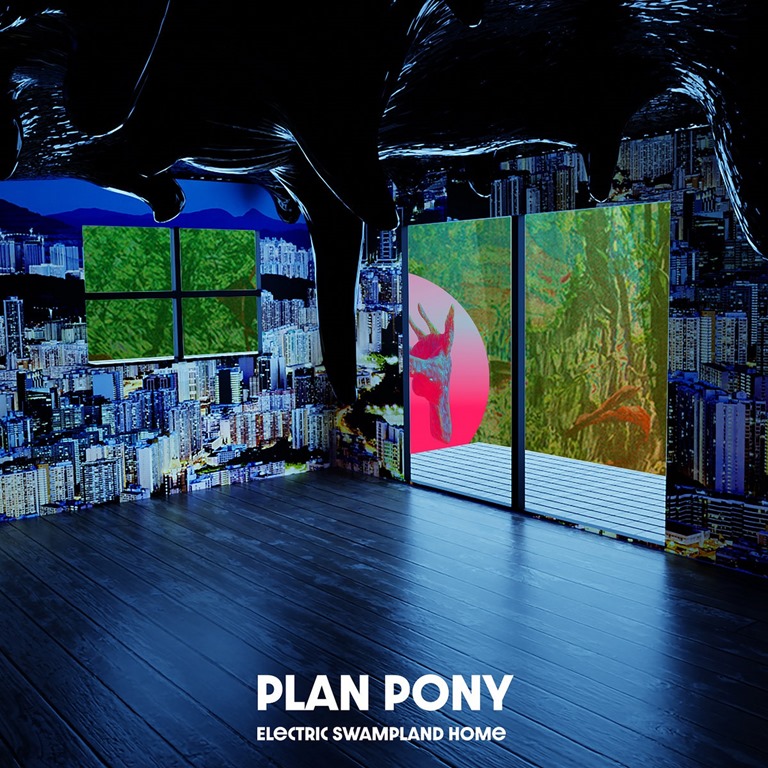
Plan Pony – the solo project of Jase Jester, one half of Ombibael / Ombibadger – has been simmering for a while, and we’ve been following his output since the release of the ‘Martyr’ single back in 2020. So I was naturally excited to hear his latest offering.

I felt suddenly uncomfortable, concerned, even, on seeing the accompanying blurbage, which leads with ‘RIYL: Animal Collective, Madlib, Nurse With Wound, Hype Williams, Black Dice’. I mean, I do like a bit of NWW, and don’t mind some Black Dice, but I absolutely abhor Animal Collective. So, so much. Something about Animal Collective radiates muso smugness – something it would be hard to accuse Jase of.

Electric Swampland Home is the first Plan Pony album, and as with previous outings, finds Kester grappling with vintage gear to conjure authentic vintage noise inspired by those early adopters. He’s right when he tells me that emulators simply aren’t the same, and that when technologies were emerging, the sound of the resulting recordings was born of necessity – like when you bounce tracks on a cassette four-track and lose some quality and definition in the process, and the presence of amp hum and tape hiss because amps hum and tape hisses. Adding tape hiss or vinyl crackle digitally is an affectation, and while some may be sold on this kind of nostalgic artifice, it lacks that certain something.

While questions of authenticity provoke heated debate in circles around some genres – punk, obviously, grunge, perhaps to a lesser extent, and right now, indie and alternative as new acts track stellar trajectories seemingly from nowhere while claiming modest grass-roots credentials while obfuscating middle class and public school backgrounds and major label backing, Electric Swampland Home is a truly authentic work. Kester hasn’t amassed a pile of highly-sought-after vintage kit in the way people with hods of cash buy up 808s and Moogs to try to be cool. Electric Swampland Home is the sound of a Boss sampler and an old Tascam digital studio he’s had for yonks, and which by today’s standards are pretty primitive.

From the very start, Electric Swampland Home creates discord and chaos with the woozy, bent, and frankly fucked-up ‘Travelling There’, a loop of atonality that gives way to a rolling rhythm and feedback-squalling bass crunch… and from thereon in, everything goes.

‘The Village’ tosses a salad of tribal beats, twisted Kyoto and a dash of Joujouka. While I’ve never been comfortable with the kind of cultural appropriation that the likes of Paul Simon’s takes on ‘world music’ present, this is something entirely different – a full global exploration which occurs simultaneously. This owes more to the tape experiments of Burroughs and Gysin, Throbbing Gristle and Cabaret Voltaire than anything else, conveying a sense of the way in which everything happens all at once, and linearity is a construct.

Across the album’s eight tracks, Plan Pony meshes some dense sonic textures and layers of difficult dissonance. Notes and tones bend and warp, things twist and melt and bleed into one another: edges blur and fade. The way the juxtaposing and often incongruous elements are brought together isn’t explicitly jarring, it’s not a bewildering collision of noise, but something rather more subtle – although no less impactful and no less disorienting. As with Burroughs’ cut-ups, Electric Swampland Home captures – recreates, distils – the overwhelming experience of modern life, the blizzard of information, the endless intertext, the diminished attention span, the globalisation and the egalitarianism of everything. That isn’t to say we live in an egalitarian world – but that everything equally demands our attention from every corner of everything, to the point that it’s impossible to prioritise or even reasonably assess what’s of more importance than anything else. And so we quiver, frozen in stasis, poised between myriad options and so often spend hours selecting none of them.

This is nowhere more clearly conveyed on the warped, glitchy layerings of ‘Same Cloud’, which brings everything all at once. On the one hand, it’s the most overtly ‘song’ like piece on the album. On the other, it’s like listening to the radio from the next room while reading a book with the TV on in the background, and your phone’s ringing and next door are doing DIY and your mind’s wondering about what’s for dinner – and this continues into the sample-soaked looping stuttering jangle of ‘Amphibian’.

‘8pm Local Time’ combined field recordings, a low-level quivering bass and squelchy laser-blasting electronics together, and not necessarily in the most comfortable of fashions.

Electric Swampland Home revels in incongruity, in awkwardness, in otherness, and in many ways, it’s a magnificent representation of life in all its colours and chaos, its business and unpredictability. It’s not an easy or immediate album, and it’s not for a second intended to be. It is an unashamedly experimental work, and one which succeeds in its explorations.

AA

a3913248541_10

Dret Skivor – 2nd February 2024

Christopher Nosnibor

Nostalgia sucks. On so many levels, nostalgia sucks. It’s something which looms a longer, darker shadow over life with ever years that passes, as every memory recedes further into the past until eventually it tips over the horizon, beyond sight, to a distance whereby its very happening takes on a dream-like quality and you begin to question if the even was real or imaginary, a myth which has grown from the creeping spores of hazy recollection.

I was probably ahead of the curve when I began feeling pangs of nostalgia on moving to secondary school in 1987. Nostalgia wasn’t big business then, and didn’t even strike me as something that so many people felt deep pangs of back then, although perhaps shows like The Golden Oldie Picture Show which I would often watch with my parents after coming home from Cubs should have given me a clue as to how adults mire themselves in their past. It was on reaching my thirties when I began to separate from my peers who constantly bemoaned the state of music, now there was no good new music, how it had all turned to shit since they left school.

Today, I took myself for a quiet pint, only to find myself eavesdropping inadvertently on a couple of old bastards complaining how there’s no proper music anymore, how it’s all 70s and 80s bands which headline Glastonbury and it’s all rap like 10-bit and one began spouting on how he saw Dave Grohl’s band, Metallica, on TV and wasn’t into it. Then they raved about Pink Floyd and The Eagles and now awesome they are, and how their songs are ‘minutes, minutes long… And then there’s a guitar solo. And Dire Straits… and how Blondie’s career ended with Parallel Lines, but they did this comeback song, like Duran Duran. I wished I was deaf, and congratulated myself for not being so painfully moored to the past – or so ill-informed.

But for all of this, I feel a pang of sadness on the arrival of a new Legion of Swine release. I miss Dave Procter’s presence in the UK for a start, surely one of Brexit’s biggest losses, at least on the underground music scene. I miss his crazy noise shows, particularly back when he would don a latex pig’s head and lab coat to crank out harsh noise. I have a particularly fond memory of our two collaborations, but especially the room-clearing effort where I yelled like a maniac as he ambulated the venue with a portable speaker emitting screeds of feedback in the middle of the afternoon.

Beyond this particularly personal context, of course, the latest offering from Legion of Swine is by no means a nostalgic work, although it does explore wibbly analogue synth and lasery sounds which hark back to the early 80s, when primitive synths were becoming widely available. But then, it equally passes nods to early Tangerine Dream, and to the bubbling pink noise and synthy waves of Throbbing Gristle early Whitehouse. But, on balance, the listening experience alone does not evoke nostalgia. What the hovering hums do evoke is a sense of awkwardness, if difficulty.

Legion of Swine’s output has never been about commercial success, but noise for the sake of simply making. Art as it should be. It it’s for the benefit of Legion of Swine first and foremost, for whom it’s entertainment. It’s for the benefit of an audience as a secondary concern, and the number of people who are likely to be entertained by this is few. But it’s a storming album, which really explores tones and texture. Consisting of a tow longform tracks each with a running time around twenty minutes, it’s an evolutionary piece, and within each continuous composition, the various segments flow from one to the next.

It reminds us of the fundamental difference between albums made up of ‘songs’ and shorter pieces and longform works, in that the former can contain ideas and concepts in a compartmentalised way, with no necessary correspondence between them, while the latter is a journey, and requires an altogether different level of focus and concentration in order for it to work as such. Gloopy alien soundscapes and long, low, ominous drones are rent with laser blasts and trickling ominous electronics worthy of some vintage sci-fi works, and ‘jag hör röster’ is a lot less overtly noise-orientated than previous Legion of Swine releases and live outings, sitting very much within the domain of dark ambience rather than abrasive noise. But it’s well-executed and with occasional blasts of overloading, needles-into-the-red distorting drone, it’s not as mellow as all that, with skronking feedback and earwax-vibrating buzzing and an array of organ-vibrating oscillations pouring their way into your ears. ‘hör du röster?’ is absolutely head-melting thick, buzzing noise abrasion all the way, a monstrous wall of distorted drone amped up to the absolute max, with surging, sloshing swells of dense analogue noise, and a relentless barrage at that.

Uncomfortable as always, under ytan ligger nåt is one hell of a racket. All hail the Swine!

AA

a3325660179_10

1st December 2023

Christopher Nosnibor

I may have mentioned before that I’m a sucker for the sound of vintage drum machines – partly by association with so many of the innovative acts which emerged in the late 70s and early 80s, which used them in a host of different contexts, exploring the near-infinite avenues these little bits of kit afforded. For a start – and perhaps most significantly – it was possible to make solid percussion without the need for a drummer or drum kit, meaning furthermore, thanks also to the advent of the portastudio, there was no need for a proper rehearsal space or studio to rehearse and record music. In fact, with relatively cheap synths, you could record as a band without even having a band. The other thing was that, if amped up right, these things could be immensely powerful. And so it was that we saw the emergence of acts as diverse as The Sisters of Mercy and Metal Urbain, Young Marble Giants, and The Human League.

Poly Ghost are a German synthpop trio, and ‘Ananas Ring’ is a quirky, fairly minimal tune that brings together the primitive sound of the aforementioned Young Marble Giants with the retro-chic of Stereolab, delivered with a humourous twist that could only come from a German act. Anyone who says the Germans lack humour is simply missing it. Absurdist wordplay might not be everyone’s bag, but from Die Toten Hosen to the deliberately clunky lyrics on St Michael Front’s first album, there’s no denying that there’s a thread of quirky amusement that’s uniquely German.

And so we arrive at Poly Ghost’s ‘Ananas Ring’, and while the twisted punning of the band’s name is one thing, the inter-language incongruity of ‘ananas’ – French for pineapple – with the English ‘ring’ (the French word for ‘ring’ is ‘bague’) from a German band takes messing around with language to another level. Despite the lyrics seemingly being in English, I have absolutely no idea what the song is actually about. But, I do have functional ears, which are totally sold on this quirky sound. The accompanying video is daft, and ‘Ananas Ring’ is a nifty tune that brings all the analogue, and the squeaky, inflected vocals just make it all the more wonderous.

AA

su80615-AnanasRing-Thumb01m

Southern Lord – 28th July 2023

Christopher Nosnibor

Southern Lord are at it again, with an archival release of a cult hardcore act whose legacy is larger than its output, following the BL’AST and Neon Christ releases. It’s truly a joy to see the label move beyond its immediate back garden of drone and doom to use the platform its created to showcase the bands without which it likely wouldn’t exist. Originally released for Record Store Day, this second issue comes on vinyl and digital formats, it’s a comprehensive retrospective, which contains ‘all of the out of print 7”s and 12”s, compilation tracks, as well as the session the band recorded at the infamous Inner Ear Studios in Washington, DC, and never heard before unreleased songs.’

Existing for only four years, releasing just eighteen songs in that time, they’d called it a day before most people even heard of them. Like so many short-lived bands, their impact and influence only began to spread posthumously. There’s something genuinely cool about this, with bonus point for not having reformed, staying true to the original hardcore ethos.

As the accompanying notes observe, ‘the fact that the band’s entire output plus unreleased material, numbering thirty songs in all, fits – quite comfortably – on a double LP speaks for itself in many ways. Yes, this is hardcore, and you know the score: fast, furious, faster, more furious.’

Listening to Discography, it’s not pretty, and some of the recordings are pretty ropey. And ropey isn’t just ok, it’s good. It’s raw, it’s real. If it’s clean and polished, it ain’t hardcore.

This is indeed fast and furious, and utterly brutal, and triumph of bass and raging guitar-driven noise, The thing that’s hard to assimilate for me, being the age I am, is that 1993 was thirty years ago. Hardcore exploded in the mid-80s and was still in its heyday early 90s, parallel with the emerging grunge scene. Nirvana’s Bleach espoused the same values. And listening to Discography, what’s remarkable is the sound. It’s no-fi, it’s dirty, it’s gnarly. With the exception of perhaps black metal and crust punk, there aren’t really any other genres that hold such low production values in such high esteem. The gnarlier, the more authentic. And this is gnarly alight. Some of the tracks are barely above four-track portastudio tape quality. But too look at the context: four-track cassette portastudios were still hugely popular until the mi-late 90s. The world has changed beyond recognition in the last thirty years, meaning that recordings from the late 80s and early 90s feel like they’re nor not so much a lifetime, but another world.

Of the thirty tracks here, only three extend beyond three minutes. And yet, within these concise packaged of noise and fury, they somehow find room for some gentle, even borderline experimental passages. Heroin had range, and texture. But of course, first and foremost, they had fury and they had fire, and they had rage and volume. And Discography is essential listening.

AA

a1212115206_10

Another month, another new song from Argonaut, as they continue to expand their open-ended album Songs from the Black Hat.

This time around, ‘We Burn Bright’ is a nifty little tune that brings some indie jangle and a dash of 60s-inspired pop to the band’s quintessential DIY sound. Hear it here:

AA

a4099463747_10

James Wells

It’s either fight or flight, right? It’s clear what this foursome choose, although they may need to square up for the other if some disagree with their claims: their website home page is certain bold and confident, welcoming the surfer with the invitation to ‘Discover a new name to send you back to 1973, outrageously overlooked and under-appreciated – until now.’

Looking at the hits of 1973 makes me glad I wasn’t there. It’s bad enough that Glen Campbell’s ‘Rhinestone Cowboy’ was at number one when I was born, but the thing with any new movement that’s remembered as defining a period is that it was rarely a cultural dominant. People harp on about punk in 77 and 78, but it was Boney M, 10cc, Leo Sayer, ABBA and Rod Stewart who dominated the charts and the radio in 77, and 73 is more accurately represented by Elton John, Stevie Wonder, Paull Simon, and Wings than anything glam.

So when Flight suggest that now is the time for a glam revival, rekindling the sound of 1973, remember how much history distorts things.

Fair play to these guys, ‘Don’t Ask’ has the swagger off T-Rex propelled by the thumping insistent drumming of The Glitter Band and a well-realised retro vibe, with a hazy, shimmery production and a neat tube-crunching guitar sound. It’s catchy as, and clocking in at a super-succinct two minutes and forty-seven seconds, it’s punchy, too, and very much in keeping with that vintage vibe.

AA

thumbnail_Flight

12th August 2022

Christopher Nosnibor

It’s 30֠C in the shade up and down the country right now, and everyone is melting. It’s oddly quiet in the office at the back of my house, and had been for a while: some people have gone away on holiday, but most still seem to be at home – because most can’t afford to travel and are still working from home at least half the week – but hardly anyone’s sitting out in their back yards, It’s simply too hot.

You want to know what else is hot? Thins new single by Voodoo Radio. It’s a sizzling serving of primitive pop-flavoured punk that grabs you instantly. To unpack that, pop-punk or punk pop as we’ve come to know it in the contemporary sense is limp, bouncy and lame, but to trace the point where pop and punk converge to the late 70s, we’ve got Buzzcocks, X-Ray Spex, The Adverts , knocking out belting tunes that are bristling with the spiky attitude and gritty guitars of punk as it was emerging, but still packing strong melodies and hooks galore, and it’s in this bracket that Voodoo Radio sit.

There’s no pretence or hidden depth here, no subtext: this is a straight up and direct song that’s pure nostalgia, a fond reminiscence about buying ice creams from ice cream vans, delivered with a sing-song tune with a high sugar content that’s guaranteed to make you bounce off the walls. The video, too, plays on that retro vibe, shot in that 70s solarized colour tone with a proper ice-cream van as the main prop.

But what’s special about the Cumbrian duo is their unashamed exposure of their northern roots, which have never been more celebrated than on ‘Ice Cream Man’, where Paige’s pronunciation is proper gritty with flat vowels and glottal stops galore, and this only accentuates the vibrancy and directness that simply makes this song so much fun. It’s old school, but this comes with added sprinkles, and you won’t hear anything cooler, more fresh, and more exhilarating all heatwave long.

AA

thumbnail_Voodoo Radio

MFZ Records – 24th June 2022

Christopher Nosnibor

Conceived and recorded between the end of 2021 and the beginning of 2022, this set reflects ‘the everyday troubles Davide [Nicosia, aka Acid Youth], deals with as an individual but also as part of a community’.

The title refers to his ‘desire to get out of the gloom and seek for a reassuring light’, and explores this theme by the vehicle of dance music exploiting the vintage Roland TB-303, produced only for a short time between 1981 and 84. It was supposed to sound like a bass guitar. It didn’t. Of course, it would later come to be appreciated, and Reverse Darkness is a concise encapsulation of the appeal of these vintage analogue machines.

Against shuffling drums – heavy echoed with some thudding bass beats – there are simmering synths that drift and wash, and a flock of fluttering tweets, all underpinned by a thick, bouncing bass groove, ‘Vibrato Brilliance’ is simultaneously sparse yet dense, and Nicosia really starts to warp things up on the dislocated retro-futurist title track.

Acid Youth very much captures not only the sound but also the feel of those early 80s dance cuts, the kind of meandering, gloopy synth works that appeared on soundtracks of movies where computers had green text on little monitors and neon lights were synonymous with the future. Being nine or ten in 1985, it felt exciting; with hindsight, it feels like the future we ended up with is a whole lot less of a rush, but hearing this inspires a kind of nostalgia, not for anything specific, but for a feeling, a sense of a near future, thanks to rapidly evolving technologies, that held near-infinite potential. Setting aside any gloom over the disappointment that those potentials now feel chronically unfulfilled as we stumble through every dystopia ever envisioned rolled into one colossal morass of shit on shit, Reverse Darkness tugs me back to the crackle of excitement that once coursed through culture.

He goes really deep on the uptempo ‘Modded Dub’, full-on bass squelch wobbling and rippling atop an insistent kick drum – but it’s toppy, and really packs a punch towards the chest rather than the gut, and in context creates a different kind of tension by way of the contrast with the thick, bassy bass, and it’s true – they don’t make ‘em like they used to.

MFZ23_art