Posts Tagged ‘Spoken Word’

skoghall rekordings – 10th January 2025

Christopher Nosnibor

The notes which accompany this release are more of an anti-pitch than a promotion: ‘depression, dourness, gloom, sex, drinking, drugs and male anxiety – some of it true, some made up.’ I had been warned. Should this maybe even come with a trigger warning?

Hell no. Art is life., and life doesn’t come with a rigger warning. If you truly want to avoid anything that’s a potential trigger, you probably just need to die right now, because there is no other way to avoid everything.

But my misery is your reward is pretty fucking bleak. It’s not Dave Procter’s first foray into acoustic-based musical work, and by no means the first release to feature his first spoken word works, although it is perhaps his first to present both these and an array of other styles with the purpose of exploring a core theme, namely of being fucking miserable.

I should make the up-front presentation of the fact that I am absolutely by no means being critical of the album’s miserabilism. For years, the theme of much dialogue has been ‘we need to talk more about mental health! We need to destigmatise mental health! We need to talk about mental health more openly!’ And I agree without reservation… but… It seems that the limit of most conversations – and this is perpetuated, sadly, by sufferers, and by artists, and by bosses (especially bosses) and by social media –remains at ‘I’m having trouble with my mental health’/ ‘Oh dear’. That is not talking about mental health. But people are not comfortable discussing the details, the way those troubles manifest, what it really means. Tell someone what that really means and oftentimes it will likely be a very brief and one-sided conversation. Male anxiety: are we even close to a place where blokes can sit and talk about their disturbed sleep and panic attacks down the pub with their mates? Are we hell.

The spoken-word pieces – succinct and pithy – are impactful partly because they say so much with so little verbiage, but equally because of the monotone delivery recorded close to the mic, with no studio slickness, no compression or reverb, but dry, as if Procter is leaning forward to confess in low tones the unutterable darkness. ‘no sleep no peace’ is exemplary:

I get no sleep at night

No peace in the day

There’s shit in the kitchen

There’s shit on the floor

There’s shit all on my life

Since you walked through the door.

So many of us will have lived with some squalid fucker at some point, and what may on paper appear trivial can in fact become a living hell.

The majority of the songs are sparse acoustic guitar and vocal works which sit between bedroom gloom and neofolk, with similarly direct and downcast lyrics: ‘the choices are stark enough / between dope / and a rope / it doesn’t take much these days’, he sings on ‘not much’. They’re simple and super lo-fi, and wouldn’t work any other way, because the nature of the recordings imbues them with an intimacy which brings a lump to the throat on many occasions. Even the bits that are made up, because it’s all interwoven and ultimately inseparable.

Elsewhere, ‘the visitor’ has the haunting reverb-drenched melancholy of Leonard Cohen, while ‘his face, my place’ is like a demo for a goth take on the kitchen sink non-drama of The Wedding Present, and ‘when you want her back’ sounds like David Gedge in collaboration with Stereolab.

As the label’s Bandcamp page states, Skoghall exists to present ‘a collection of past and present work involving Dave Procter’, and my misery is your reward is very much a work mines from the archives, ‘originally recorded during several periods of the above in Leeds and Stockholm in 2007 and 2008, although the ideas have been around since late 2005…’ Procter adds, ‘I think they call it catharsis. This LP is meant to be listened to in one sitting.’

Almost twenty years since conception and seventeen or so years since its recording, some may consider it curious that an (extremely) active artist would serve up these somewhat primitive and one might even say juvenile recordings now. But there does come a point in life when, perhaps we make peace with our discomfort and awkwardness and with the distance of time, can appreciate the merits of those works which were necessary in the evolutionary journey to the artists we become. To finally release it… yes, there must be an element of catharsis in casting out those thorny thoughts, the kind of twisty, churny recollections that insist on needling away, years after the fact.

my misery is your reward is a world away from Procter’s work as Legion of Swine or Fibonacci Drone Organ, and even the no-nonsense spoken word of Dale Prudent, and there’s a touching humanity, and the lack of sophistication is an asset when it comes to conveying difficult emotional states in a relatable fashion. Yes, we need to talk about mental health, and what we also need is for documents of unflinching honesty and for artists to take the lead. This is what we need.

AA

AA

a2113781565_10

Ideologic Organ – 10th January 2025

Christopher Nosnibor

It’s already looking like 10th January is going to be an intense date in terms of the sheer volume of releases. Time was when January was something of a quiet spell for new music, as everyone recovered from the Christmas glut, and labels tended not to release much since people were skint. It also used to be the case that unexpected releases would sneak unexpectedly high in the charts, especially the UK singles top 40, with remarkably low sales figures, usually with cult acts with savvy labels whacking out a release that would have barely scraped the charts any other month – White Town’s ‘Your Woman’, released 13th January 1997 and hitting number one in the UK and going top ten globally – however briefly – is a classic example.

There’s no danger of Nate Wooley registering on any charts with Henry House, released on the Ideologic Organ label, curated by Stephen O’Malley of Sunn O))) legend, and home to a long line of truly magnificent avant-garde and otherwise most unusual musical works, of which this is very much one. That’s not because it’s not good, it’s just that the nature of charts has changes beyond recognition over the last thirty years. There is also the statistic which recently came to light that there was more music released on any single given day of 2024 than during the entirety of 1989. It’s a pretty staggering statistic, and one of many factors when considering just how difficult it is for artists to make a living from making music. Something I have touched on previously is the fact that simultaneous with this explosion of output, culture has become both more homogenised and more fragmented. In terms of the mainstream, this homogenisation has facilitated the advent of multimillionaire and even billionaire ultra-megastars like Taylor Swift – but at the other end of the spectrum, there are tens of thousands of artists releasing music on Bandcamp and Spotify with no backing or publicity whatsoever, to be heard by maybe five people.

But we need music that’s unpopular, that isn’t created with any commercial intent, and we very much need labels like Ideologic Organ to provide a platform and to point us toward the cream of those artists who may not otherwise reach the audience they so richly deserve.

And as an album containing a single composition split into five parts, described as ‘a recurring dream song’ with a running time of some eighty minutes, this is a work which is very much non-commercial in every way.

As the accompanying notes detail, this is a work which combines ‘closely tuned instruments and sinetones, tape-music editing techniques, field recordings, and voice,’ providing the context that ‘this eighty-minute, five-part song cycle is an evolutionary step away from the spontaneity of the free jazz/noise aesthetic usually found in the music of Nate Wooley. Henry House expands on the ecstatic, durational work found in Wooley’s Seven Storey Mountain, a six-part composition that has been premiered over the last ten years by an ensemble that now includes multiple drummers, guitarists, a twenty-one-person choir, and the composer on amplified trumpet. But its ritual is more serene, more natural, slower.

Henry House is the first long-form piece that doesn’t feature Wooley’s trumpet. It is also the first to be constructed around his poetic writing. Wooley weaves a strange funeral mass for a fictional everyman from isolated phrases culled from essays, poems, and non-fiction written by Wendell Berry, John Berryman, Joseph Mitchell, and Reiner Stach. After organizing the fragments into a dream narrative, Wooley rewrote the text dozens of times, manipulating the stitched-together story until only glimpses of its sources remained.’

It’s ten minutes into the twenty-minute opener, ‘Acacia Burnt Myrrh’ that the poetical oration begins, with the words spoken by Mat Maneri. He speaks in a calm, not entirely flat, but level tone, of geometry, of space, of time. The words conjure abstractions, images, moods, against backdrops of elongated hovering hums, oscillator-driven quivering drones. The words are audible, but comparatively low in the mix, and it’s not always easy to stay focused on the narrative, such as it is: instead, the mind focuses on absorbing the atmosphere. There’s a lot of that, and Henry House is an immense project with near-infinite dimensions. Megan Schubert’s faster-paced, more driven-sounding delivery is quite a contrast to Maneri’s, and from these counterpoints, the album grows in terms of dynamics and depth.

So much happens: listening to Henry House is like reading a book which contains stories within the story, and illustrations in a range of styles. No two tracks are really alike, and the arrangements change across the course of each piece. It draws you into a dark fairytale, a unique world which isn’t exactly scary, but unsettling because it feels unfamiliar, dissonant. The fact that two of the pieces bear the same title only add to the bewilderment. Horns and drones radiate between the narrative segments, and the final piece, ‘Aleatory Half Sentences’ is led by some flighty piano work, which trills and flickers against a heavy, nagging, low-level hum. It’s one that really takes some time to process, but it’s very much worth the effort.

AA

a3180996504_10

It’s been another incredible year for Benefits, and one which has seen them evolve – and drop a single with Pete Doherty ahead of their second album, Constant Noise, due on 21 March 2025 via Invada Records.

And what a treat for Christmas eve – a new tune which is, again, more ambient than noisy, but which pitches a low-key and quite menacing-sounding spoken-word assessment of the state of things as war rages around the world and death tolls continue to increase as do tensions as the West bankrolls mass destruction and civilian slaughter.

New Benefits may not be quite as in-yer-face sonically, but don’t think for a second that they’ve gone soft.

Check ‘Missiles’ here:

AA

471339238_897662605683873_8615911540289970348_n

10th December 2024

Christopher Nosnibor

Less than a fortnight after Yorkshire-based collective Papillon de Nuit unveiled their first track, ‘Scarlet’, they present to the world the second fruits of their recent recording sessions, mastered by none other than Tom Woodhead, formerly of ¡Forward Russia! at Hippocratic Mastering. While ‘Amber’ continues the colour-themed song titles, they promised something different, and, indeed, that’s precisely what they’ve given us.

‘Scarlet’ was a somewhat folk-infused tune with a rolling rhythm: in contrast, ‘Amber’ sits more in neoclassical territory, in terms of composition and arrangement, with a lone piano providing the primary instrumentation; around the sung segments are spoken-word poetical passages. Again, Stephen Kennedy leads, but there is a counterpoint in words composed and spoken by Edinburgh-based polyartist Monica Wolfe, and the interaction between the voices and modes of delivery is engaging. This is not rock, or pop, or folk, but unashamedly music as art, and as compelling as it is beautiful.

AA

a1612744261_10

Mortality Tables – 1st November 2024

Christopher Nosnibor

Spoken word is hard. I know. I’ve done it. I’ve been terrible at it. I’ve witnessed countless others be terrible at it, too. Spoken word is even harder as a prose writer. It’s just so difficult to hold an audience’s attention. This is why spoken word events seem to favour poetry: whether they rhyme or not, poems tend to focus on rhythm and to be brief, rarely longer than aa couple of minutes. And a lot of poets manage to memorise their pieces for performance, and poets who ‘read’ tend to be looked down upon in certain circles. It’s rather harder to memorise and recite a three-page slab of prose, and face buries in pages makes performing and engaging altogether harder. But worst of all, people simply don’t seem to possess the attention span.

Reading prose is hard. A segment of a story may not really work outside if its intended context, and a short story that only takes three minutes to read isn’t going to have much substance.

There’s a huge disconnect here: people listen to audiobooks but struggle with spoken word or anything that isn’t a renowned author or a celebrity voicing an accessible, pot-driven narrative.

William Burroughs told Philippe Mikriammos in an interview in 1984 that ‘many poets are simply lazy prose writers.’ He qualified this by explaining, ‘I can take a page of descriptive prose and break it into lines, as I’ve done in Exterminator!, and then you’ve got a poem.’

It’s true.

Chop your sentences down to phrases.

Cut your phrases down,

Down to their component parts,

Capitalise each line

– unless you’re e e cummings –

And lo,

You have a poem.

Burroughs had the advantage of recording his spoken word pieces and performing segments from his books in the 60s, 70s, 80s, when the medium was still comparatively fresh, and people had attention spans greater than goldfish, and had the additional benefits of a remarkable flair for reading and a truly unique voice. Here in the 2020s, it can be hard to attract – and maintain – any kind of attention with an audience. As I say, I know: I’ve done it, and I’ve been terrible at it. I’ve also been alright at it. I’ve driven people from the room, and considered it an achievement, because it’s infinitely better to have an impact of that nature than for audience members to fall asleep, or worse, forget the performance. The challenge for any spoken-word performer, be it in a live setting or in a studio, is how to grab, and maintain, the attention of any audience.

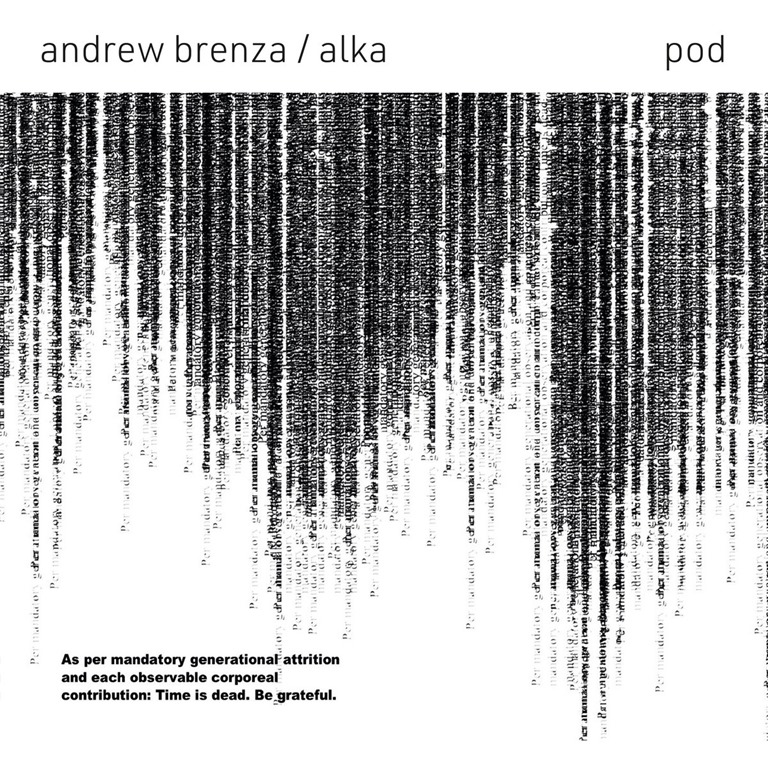
Here, Andrew Brenza reads from his book pod (ghosTTruth, 2023) with accompaniment from sound artist and electronic instrument restorer alka (Vince Clarke’s VeryRecords). Instrumental augmentation is the most obvious and immediate way of grabbing the attention. It transforms a spoken word work into a multimedia project, for a start, and moreover, the moment ‘music’ is involved, a whole new audience – which likely has no interest in spoken word – opens up.

His voice processed with a metallic flanged edge and epic reverb, and against an ominous organ droning ambient hum, Brenza becomes commanding, not to mention eerie in his delivery. This is the fine line all spoken word performers must tread, of course, but here it is felt acutely: The delivery can often overrun the work; style overtakes concept and content.

I find myself drawn into the delivery of pod – the sounds, the delivery. But engrossed in these, the content slips to become secondary, in a way. But perhaps that’s ok. ‘Intermission Meander’ provides a bleapsome interlude, and the narrative segments are vignettes, segmented scenes which are centred around image and concept rather than linear narrative, events, or characters. In this context, this release works. It is not an audiobook, but an audio accompaniment to a book. It’s difficult to absorb, but a successful project.

AA

a0689313884_10

Christopher Nosnibor

The Lovely Eggs really are the best advert for the DIY ethos going. Here we are, in the 300-capacity Crescent in York, just over two years since their last visit, and whereas then – again, on a Sunday night – there were twenty-eight tickets left on the door, they’ve sold out well in advance this time. This is likely due in no small part to the release of the absolutely cracking Eggsistentialism earlier in the year, but equally their ever-growing reputation as a truly outstanding live act.

Track back to 2015, the first time I saw them: it was a part of the sadly gone and fondly-remembered Long Division festival in Wakefield. They weren’t a new band even then, and while they drew a respectable crowd, were just one of many punky indie bands on the circuit. Seven albums in, and having stood up to gouging from arena venues on merch from support acts and done quite literally everything themselves these intervening years, they’ve risen to prominence not only as a super band, but the definitive outsider band. And, as with last time around, we have a curated lineup with a fellow Lancashire band opening, a poetry / spoken word performer by way of an interlude, before their own set. Previously, we got Arch Femmesis and Thick Richard: this time, it’s British Birds opening, and Violet Malice providing the off-kilter spoken word.

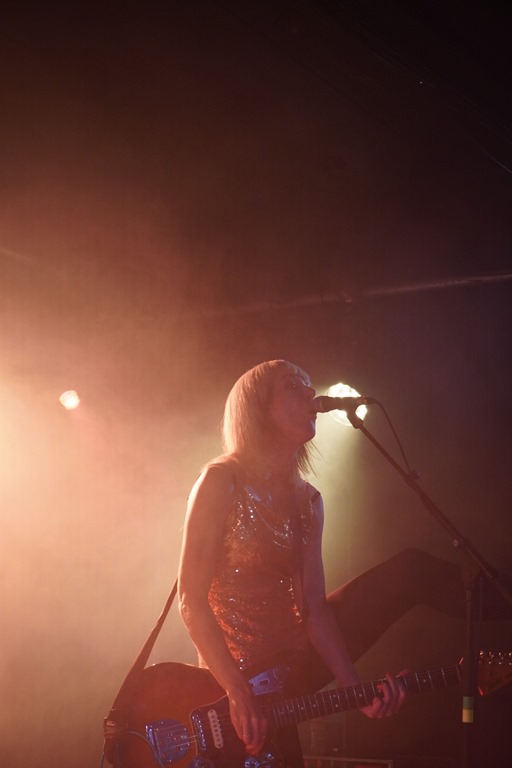
Both are excellent. I was hugely enthused by the return of British Birds to York, having first seen them in this very venue supporting Pale Blue Eyes, and they did not disappoint. Their set is packed solid with hooks, harmonies, jangle… and tunes. A solid rhythm section and some twiddly vintage synth tones provide the base for two- and three-way vocal interplay. In the five months since their last visit, their sound seems to have grown meatier, more solid, and they’re tighter, more focused, and Emma Townson, centre stage on vocals, keyboard, tambourine, and cowbell is more nonchalant and less six bags of Skittles exuberant in her performance, but there’s a really great vibe about them on stage, and they feel like a cohesive unit, and one with great prospects if they maintain this trajectory.

DSC00173DSC00167

British Birds

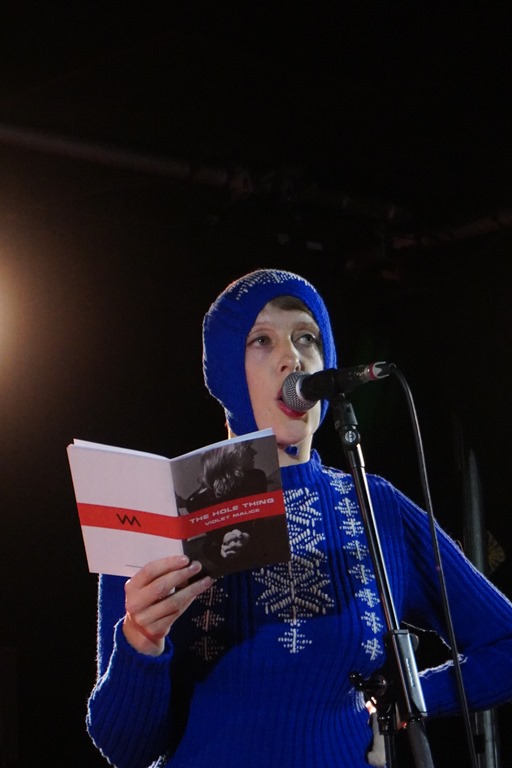
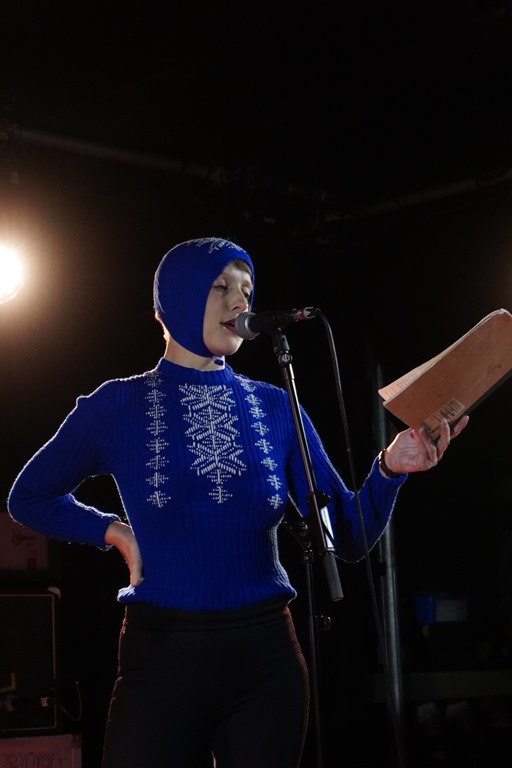
Violet Malice is not from Lancashire, but Kent. It’s appropriate. It could almost be a typo or a mispronunciation. She belongs to the glorious lineage of snappy poets who are likely to go down better at a rock gig than your average spoken-word night which clearly has an arc from John Coopeer Clark forwards. She tells it like it is: and how it is is hilarious, but uncomfortable. I’m reminded of Manchester writer and spoken word performer Sue Fox, and the way an audience will lap up her visceral monologues about cocks and cunts, howling with mirth but breathless as they ask themselves ‘did she really just say that?’

‘Stop eating your own food and jizzing on about how good it is’, Violet intones in a blank monotone. Her best line comes in ‘Posh Cunt’ where she drop ‘enough cum to make 24 meringue nests’. It’s fair to say that if a guy had delivered the line, it would not have had the same impact, and this is but one measure of the ground which still needs to be made up. But Violet Malice is leading the charge – as, indeed, are The Lovely Eggs. What they’ve achieved with this lineup is strong female representation without being male-exclusionary: they’ve not gone on a Dream Nails kind of anti-male campaign (which is simply inverse sexism) and there’s no adopted policy of hauling single men off for interrogation by security, a la The Last Dinner Party in Lincoln. It’s as strongly feminist as it gets: no-one is alienated, and the demographic across both genders and ages is well-balanced.

DSC00186DSC00184

Violet Malice

My notes pretty much run out during The Lovely Eggs’ set, and I make no apology for this. When this happens, it means I’ve either overimbibed or am just so in the moment I forget, and tonight, it’s very much a case of the latter.

They’re straight in with ‘Death Grip Kids’, with the killer opening line ‘Shove your funding up your arse!’, of which I wrote elsewhere, ‘the song is a proper middle finger to the industry and the establishment, a manifesto which encapsulates the way they’ve rejected the mechanisms and payola of labels’. More than a song, it’s a manifesto, which sets the tone for their bursting-with-energy hour-long set.

DSC00224DSC00216DSC00239

The Lovely Eggs

‘Magic Onion’ is a standout; ‘I am Gaia’ brings the obligatory mid-set slower tempo tune, ahead of leading a big old singalong with ‘Fuck It’, and the second half of the set is just incendiary. The packed room is united and uplifted and collectively uplifted. There’s no encore, no artifice, just pure, life-affirming entertainment: everything you could want from a gig. The Lovely Eggs really are the best.

Having written music since she was a kitten, Speculum Bunny enjoys blending words and sound to provoke, enthral and mystify her audience. Inspired by the depraved nature of love in all of its majestic forms, her childhood,  masochism and devotion. Challenging mainstream narratives on motherhood and women’s expression she blends noise, synths, voices and field recordings. She pushes her her edges.

Featuring five tracks – three of which were recorded live at Radiophrenia, Sluagh is Speculum’s first release since Liminal Fluff in October of last year.

Combining abstract sounds and elongated wavering drones with murky noise and disturbing sound as backdrops to uncomfortable spoken word pieces, Sluagh is by no means easy to categorise, and it’s not the easiest of listens either – and that’s precisely why we’re recommending it.

Listen to Sluagh here:

AA

a0456756198_10

26th February 2024

Christopher Nosnibor

Having recently had his early punk rock recordings reissues, Stewart Home makes a new foray into the recorded medium, this time with a rather more experimental collaboration with JIz. Delivering a spoken word list of ‘problematic memorials’ (as the title suggests) with some additional commentary, in a fashion not dissimilar from The Justified Ancients of Mu Mu’s ‘It’s Grim Up North’, across three variants with backing that ranges from swampy experimental noise to minimal avant-jazz, Home leads us on a tour of London taking in sights that most people don’t realise have unsavoury connotations and commemorate people and events which probably ought to be damned rather than celebrated.

The long history of slavery throughout the British Empire has – belatedly – become subject to more open discourse in recent years, but our current government, who seem determined to resurrect the spirit of the empire through jingoism and xenophobia and a completely false reimagining of history as a way of selling Brexit as a win, are averse to such discourse, branding anything and everything from the Army to the National Trust as ‘woke’ – as if being woke is a bad thing.

For the most part, the sense of ‘Britishness’ which is increasingly only a sense of ‘Englishness’ in our ever-more isolated and impoverished part of a small island on the edge of Europe – geographically, and sinking off the coast of Europe politically – is born of ignorance. Stubborn, belligerent ignorance, but ignorance nonetheless. And out of such ignorance arise pathetic, futile culture wars.

Home has so far managed to slide his antagonistic sociopolitical position under the radar in recent years – in contrast to his controversy-piquing earlier years when he was churning out pastiche works about skinheads and riots and anarchy. What happened? Perhaps in developing his approach to be more subtle, Home achieved even greater subversion by being able to continue his mission without interference. Whatever the reason, here we have Problematic Memorials. Call it woke, call it what you like, but it needs to be heard. And beyond the message, it’s a top-notch spoken word / experimental music crossover collaboration, so go get your lugs round it.

AA

a2330344121_10

New Reality Records – 17 October 2023

Christopher Nosnibor

Speculum Bunny’s been doing the rounds on the live circuit with New Reality Records labelmate Stewart Home of late, and while in terms of presentation they’re leagues apart, her modus operandi bears strong parallels with Home’s, not least of all the audacious piss-takery of his earlier career, which is – quite unexpectedly – experiencing something of a renaissance – she’s also a completely different animal.

Her bio outlines how ‘Having written music since she was a kitten, Speculum Bunny enjoys blending words and sound to provoke, enthral and mystify her audience. Inspired by the depraved nature of love in all of its majestic forms, her childhood, masochism and devotion. Challenging mainstream narratives on motherhood and women’s expression she blends noise, synths, voices and field recordings. She pushes her edges.’

Female voices in music – strong ones, not sonic wallpaper popmakers dollied up by record labels – may be growing in number, but they’re still few and far between in the scheme of things. It’s a sad reflection on society and the music industry, but it does mean that when someone comes along and says ‘fuck the norms’, it’s powerful, and stands out, and Speculum Bunny – an overtly challenging moniker, uses a profile pic on her Bandcamp bearing the slogan ‘I’m not cute, I’m disgusting’ (it’s the cover art from her first release in May 2023: this is her fourth). It’s clear that her objective is to provoke a real sense of discomfort, and if both her choice of name and the EP’s title work through incongruous juxtapositions of hard / soft or similar, then the four tracks contained therein are the sonic manifestations of this oppositionality.

‘Demon Boyfriend’ is built around a chubby bass groove that’s reminiscent of the early years of The Cure, and it provides the backdrop to a dark spoken word piece. ‘he’s quite old… and he’s quite hairy… and he’s got horns…’ Much of the impact / appeal lies in the delivery, of course. Flat, monotone.. and unashamedly Scottish. There’s a tinkly fairytale tone to the keyboard sounds on the lo-fi ‘Dragon of Lure and Dread’. The vocals are sung, but mumbled so as to render the words almost inaudible, and the drums are distant, a thumping heartbeat below the surface.

You can probably consider this a spoiler alert. Pretty much the last thing I expected was for ‘House of the Rising Sun’ to be a fairly straight acoustic cover, delivered in what one might – for wont of a better description – an intimate, witchy tone. As the song plays out, a double-tracked vocal gives a slightly disorientated twist. The final song, ‘There is No Ash Without Fire’ is again minimal in its arrangement, and while a bulbous Curesque bassline provides the main element of the backdrop to her haunting vocal, which soars and swoops, the atmosphere is more akin to Young Marble Giants.

Liminal Fluff doesn’t sit within any single genre pigeonhole: in fact, none of the songs really conform to any style or genre, and ultimately, it seems a fair summary of Speculum Bunny as an artist. It’s truly refreshing to discover an artist who really doesn’t sound like anyone else – and even more of a deal when what they’re doing is good. And this is good.

AA

a3042142564_10

Panurus Productions – 6th October 2023

Christopher Nosnibor

Heavy music doesn’t have to be po-faced or excessively serious, and there have been a few comedy metal and noise bands through the years. Lawnmower Deth are one which swiftly spring to mind, but the likes of Municipal Waste, and lesser-known acts like Grindcore Cakemakers also make hard noise while being a far cry from the existential rage more commonly associated with their genres. And that’s good. The world needs variety, and there’s more than one way to alleviate the grimness of life on this sorry planet.

This album from Black Shape is perhaps the absolute antithesis of Godflesh’s seminal Streetcleaner. With the lumbering weight of a runaway bin lorry, Black Shape rumble their way through eleven tracks of bin themed absurdity, utilising their knack for writing material that is as colossally heavy as it is varied and comedic. Most of the tracks are around the two-minute mark, with just a couple of four-minute outliers. On the surface it’s a whole mess of noisy shit, but closer listening soon reveals a wildly varied album which incorporates jazz, spoken word, nu-metal, rap and thrash.

‘The Beast from the North East’ is a dirty, shouty punk effort – more Anti-Nowhere League than The Pistols. Dense, muscular, with filthy sludge guitars, pant-soiling bass, and a wild solo which occupies half the song’s duration. The production is rough and raw, and this works in its favour: the guitar on ‘I Wanna be a Binman’ positively tears from the speakers, and it’s like being at a gig and standing so close to the PA that your nostrils vibrate. If you’ve never done it, you need to at least once, although earplugs are recommended. You still feel the force without fucking your hearing for the rest of your life. It’s a throbbing stomper reminiscent of Ministry circa Psalm 69. Only instead of burning for the needle, it’s a hard craving for lugging refuse. They pillage every style going here: ‘Dogshit Bin Juice’ takes a turn for the choral in the verses between ball-busting glam stomp riff breaks. It’s hilarious, but also makes you think. You sometimes hear that binmen are pretty well-paid. But would you do this, for any money?

If ‘Put Me in the Bin’ is the most overtly old-school punk cut, the recording is again more industrial, which couldn’t be more at odds with the offbeat, off-the-cuff lyrics, while ‘Once a Binman, Always a Binman’ throws a curveball with a gentle intro and unlikely lift of ‘Love Lift us Up Where We Belong’ before going full-slugging nu-metal / grunge crossover, with the meaty heft of Tad bringing the blue collar grit to proceedings. There are some moments of astute observation and social critique which land quite unexpectedly, but it just goes to show that it’s a mistake to write of a so-called ‘comedy’ album – or indeed any comedy – as shallow, lacking in content, or emotional depth. ‘The Story of How I Died’ brings lilting harp and Pam Ayres style narrative.

Beyond bin-related themes, this is not an album that’s predictable in anyway, lyrically or stylistically, with piano ballads pressed against squalling hardcore assaults. And because of the punk / thrash / metal leanings, and the overall daftness of many of the lyrics and the overall concept, Black Shape’s musicianship is likely to be overlooked. But the range is a measure of immense versatility and competence. Black Shape are the Bill Bailey of dustbins, and BINS is a work of sheer brilliance.

AA

a2313098061_10