Posts Tagged ‘Review’

Jess Robinson

So, Camden Rocks was good this year wasn’t it?! After almost thirteen hours on my feet, I have blistered soles, a tight back, and by the Goddess I swear my eye-bags could double up as a freakin’ Deliveroo tandem. Totally worth it though.

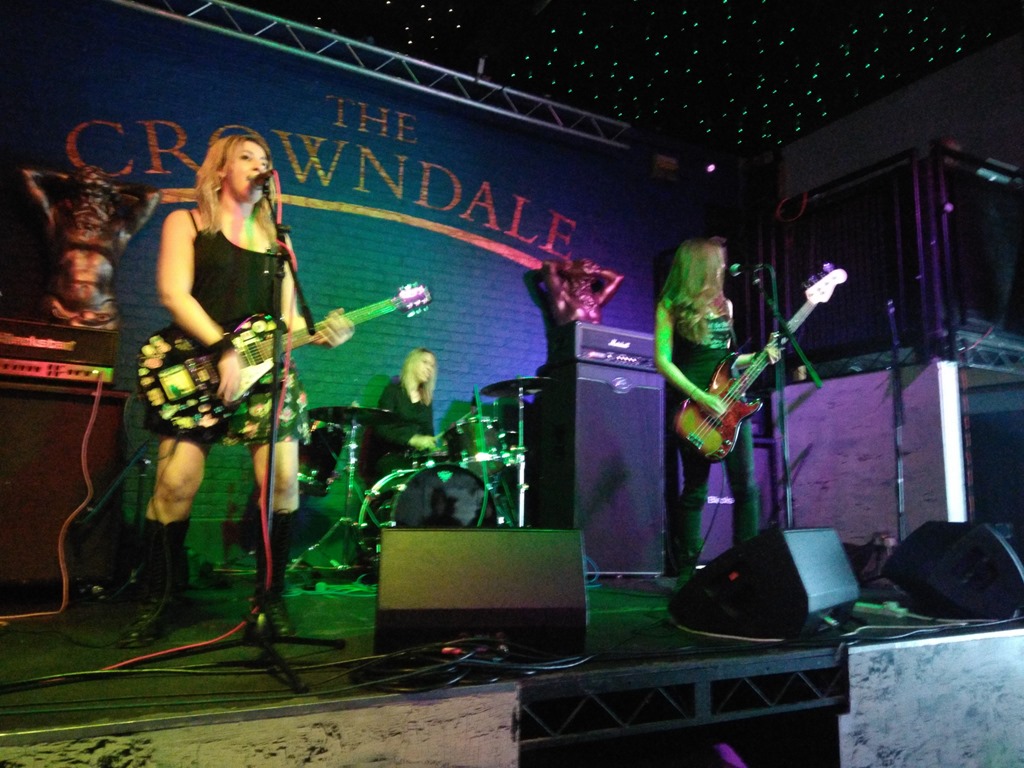
My musical day-trip started with The Kut at The Crowndale at noon, I feel like I should describe them as shouty and feisty and grrrr, but they really weren’t. In the best way, they were actually genuinely lovely. Personable, proficient, and clearly over the freakin’ moon to be able to play two extra tracks as part of the soundcheck – a soundcheck so damned good it swelled the crowd from a piddly eight people (understandable, given the time of day) to something nearer 50. The Crowndale itself felt something like an abandoned funeral parlour, complete with huge floral tribute on the corner of the bar, but sonically it worked nicely, and it was great to see that the bar staff (definitely not undertakers) were enjoying the music, taking phone pictures of the band at work.

The Kut’s songs are a mix of punky-punkrock-grunge-rock. Yeah that’s a mishmash, but it’s a good one, tunes are raw, unpolished yet without flaws. The punkier elemns of ‘I Don’t Need Therapy’ fed brilliantly into ‘Bad Man’, a track that’s a sublime blend of everything I loved about both Nirvana and Hole – the guitars and sneering Cobainesque vocals work so well with the Courtney Love based lyrics. Vocalist Maha was determined to get us dancing, kicking up the beat with ‘Hollywood Rock ‘n Roll’. Bouncy! Great fun.
IMG_20160604_121104

The Kut

My next mission was to find my way into Dingwalls (having basically formed an infinity symbol in footsteps the previous day I decided to start my mission afresh on Saturday). Surely with the music in full flow, and with festival punters making their way into the venue, it wouldn’t be hard to work it out… oh how wrong I was. See, the name “Dingwalls” is marked out in an arc above the doors on the canal-side. So you walk down there, aaaand the doors are locked. You continue alongside the building, drawn to the music audible at the far end. You see the band through the windows, but you can’t get in. You walk around the building, nope, still no doors evident, unless you fancy trying to barge into the back area of the stage mid-set. No. Walk up to Lock 17 (directly above Dingwalls), where there are stairs pointing down to ‘Club’ (i.e. Dingwalls). Lovely bar staff explain we’re not supposed to go down there, and to use the door outside. I remained confused, all the doors are locked! So I take my chances and go down the forbidden stairs… Lovely security guy (who later explained that the name wouldn’t be above the door any more, if only they could physically remove the lettering) told me how to – correctly – enter the venue. So off I trot, to find that the letters above that magical entranceway in actual fact proclaim “The Comedy Loft”. Of course! I mean, it’s so obvious when you think about it….

Once I made it inside Dingwalls, I discovered two stages, and I managed to catch the end of Heels’ set on the larger of the two – thrashy, shouty, femme-fronted, male-backed metal, are Heels. Not really my taste, but they seemed to be on form. When they finished I nipped to the ladies, and it was like that cringey moment in that IT Crowd episode, the one where Roy and Moss crash Jen’s theatre ‘date’ with the gay man, go to the gents during the interval and there’s a toilet attendant man there, who puts them off their stride so badly that they can’t even piss yet they each pay him a tip anyway. Yeh? This.was.worse. The lady, surrounded by myriad bottles of dubious looking perfume, bellows a cheerful “Hello!!” to me and the grrls following behind, so I say “Hi”, but evidently I’m too quiet, for as I my feet carry me to a toilet cubicle while my mind screams “no, run away, remember the IT Crowd episode!!” she glares right at me and booms “When a lady says ‘hello’, you say ‘hello’ back!”. That’s me told then. Except I did say ‘Hi’… does that not count? Does it have to be ‘Hello’? Please don’t hurt me/hate me toilet attendant lady….

I escaped Dingwalls, and after a chippy lunch on the hoof, I landed at The Cuban for the first of Ginger’s three sets. Expecting it to be busy, I got there early but it was still rammed. And I mean rammed. Somehow I tagged on to a quad of hardcore fans and wound my way between jam-packed bodies, following them as far as the sound desk. My view of the stage… was non-existent. Bugger. What to do? Well, I decided to make the best of it and just listen. It was still live music, right?! I was in the building, woohaaaaa! Then… HERO…! the guy doing the lighting took pity on me and let me stand on the bench behind him. Well, I am tiny, so thankfully I don’t take up much room! In return, I fanned him now and again with a Camden Rocks Fest postcard. Oh yes, things were going well.

Ginger and his guys had a few technical difficulties at first, something up with a guitar… It was cool though, he bantered his way through it jovially (no prima-donna stropping) and refused to cut the set short because of the delay. Bet that pleased the organisers… We were melting but we all clapped in time and ‘oooooh’d’ (off key) when Ginger asked us to ‘ooooooh’. “That was definitely the best sing along I’ve ever heard. Not technically brilliant…” ~cheeky grin and wink~ “…for sure, but definitely the best” The highlight had to be ‘I Wanna Go Where The People Go’, of course it was. We all loved it.

Peckham Cowboys followed. They were rockin’, like, well, like cowboys who double up as a rock band. A solid performance, much enjoyed by the remaining crowd.

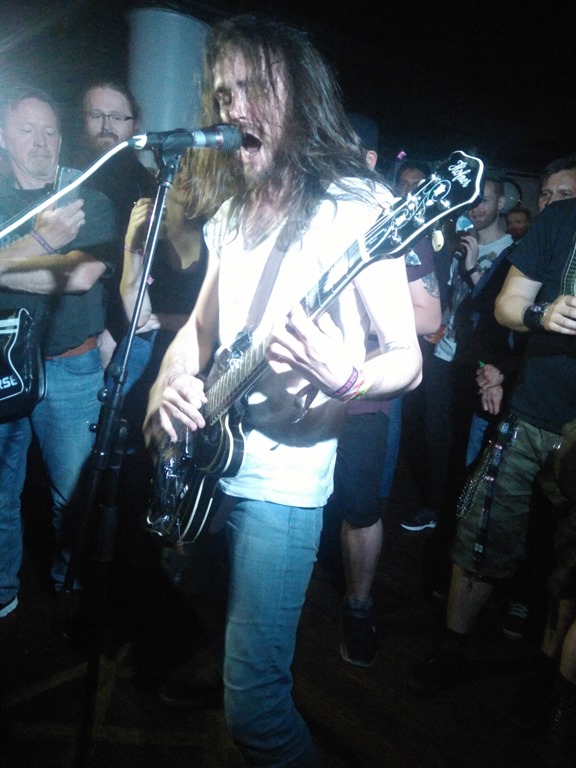
So then. Onwards. To The Underworld. To Heck. Umm, intense doesn’t quite cut it as a description… It was intense, it was also insane, and it was utterly perfect. Invigorating and terrifying almost alternately, Heck are fuckin nuts, man. Perfect choice of venue, kudos to whoever placed Heck there. It was dark, it was cavelike, it was deliciously claustrophobia-inducing WALL-TO-WALL NOISE AND CHAOS. I’m glad I’d been forewarned of likely antics. Although there was no escape (guitarist stomped on my foot at one point, singer plonked his mic stand down right in front of me, proceeding to sing and play guitar whilst deluged by photographers), I did select a location where I was largely safe. Basically, if you don’t wanna be involved, don’t go see Heck live. Stay at home, listen to the records, watch them on YouTube to see what you’re missing. But naaah, you should probably go anyway, at least once; absorb the wonderful screaming vitality of them.
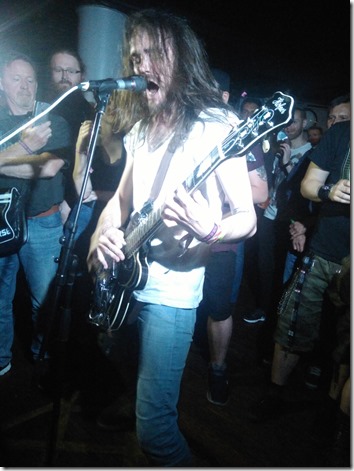
IMG_20160604_172349

Heck

I was so spaced after Heck, I decided to abandon my plan of Vukovi at the Bloc Bar (I know, I know, I’m slightly ashamed!) – I just needed a little time, outside, getting some air, resting my beaten senses!

Popped back up to The Cuban where Starsha Lee gave strong rock vibes; blasting guitars and sci-fi tinged cartoony vocals, boy they were good and crazy. Crazy good. I overheard someone say “I liked the music, but I just couldn’t get on board with that voice…”. Slightly harsh, but each to their own!

Deadcuts was the last band I saw at The Cuban, gothy layers mixed with New Wave. A little Joy Division-y with their music. None of that is my bag, but Deadcuts were clearly on their game and crowd pleasers nonetheless.

A return to Dingwalls, for LA act Queen Kwong. I absolutely love these guys, and the fact that the overall lineup switches around and morphs between tours does nothing to diminish the power and sheer brilliance their songs, I urge you to see them next time they are in your area. Tonight’s set was marred only slightly by the dim lighting, which I suspect was set at low level on instruction from Carré herself, but it did mean that she couldn’t be seen too well, and I think sadly, those that didn’t already know the music struggled to engage with the show. Having said that, for those of us familiar with the luminosity of tracks like ‘Cold Daggers’, ‘Bells On’, and ‘Purrfiction’, it was awesome.

I’ll admit I was flagging when I left Dingwalls, and, knowing I likely wouldn’t physically be able to see (yep; the short-arse problem again!) much of Black Spiders at Proud, I rejected all headliners and made my way to Camden’s Cavern at Belushi’s bar, where I stayed the rest of the night. To be honest, at a festival where there are over 200 acts to choose from, why stand crushed seeing two or three bands that you could see on numerous tours, when you could find something fresh and exciting, up close in a smaller venue?

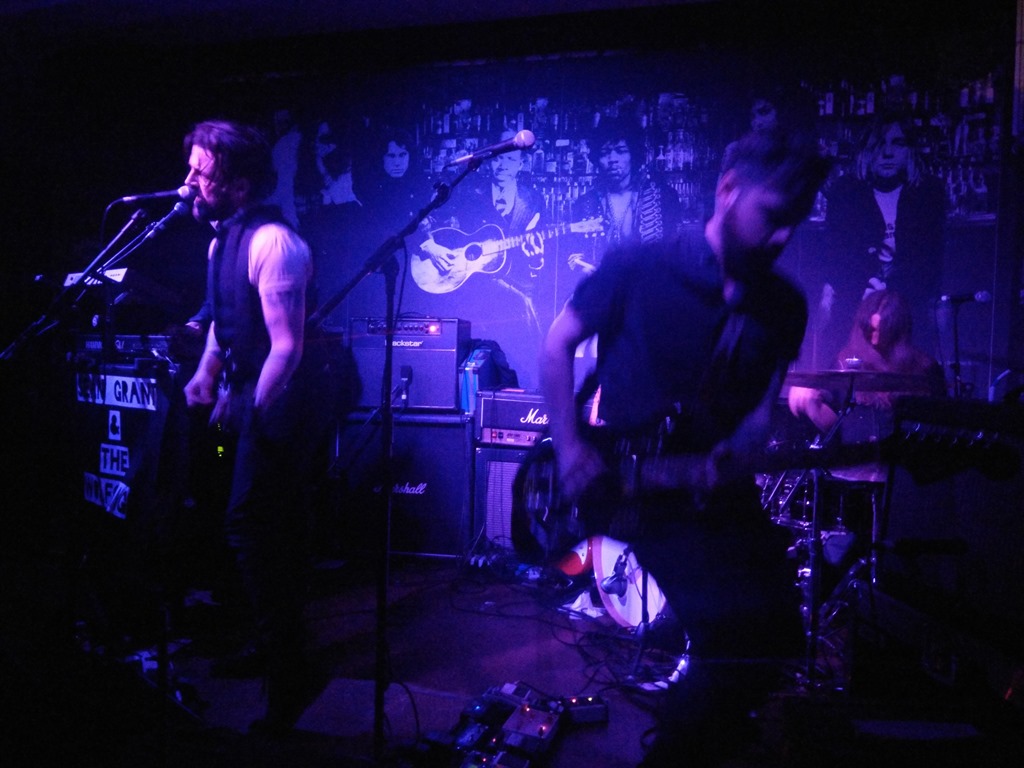
What’d you seeeee!?! I hear you cry, ha, well, let’s think back… I just about missed Wars but caught Making Monsters (hooks and riffs, baby, hooks and riffs), As December Falls (polished and young), and lastly Seán Grant & The Wolfgang who made their way to the stage area for a midnight display. And wow! They were so worth waiting for. Seán and his (wolf)gang served up a full-on juicy slab of a set that included ‘Curtains’, ‘Best Of Men’, ‘Brother’ (dedicated to one overjoyed pal in the crowd), and the most excellent ‘Take A Man’s Body’. Meaty, pounding, brilliantly executed music combined with gorgeously bittersweet lyrics that draw.you.in! A superb end to my Camden Rocks experience.
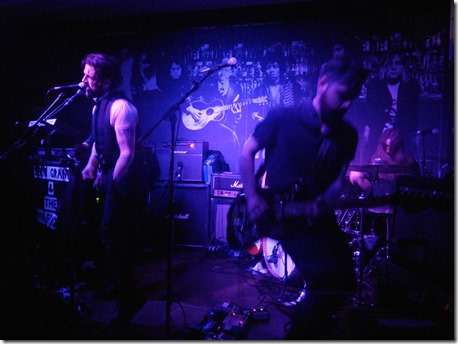
IMG_20160605_000237

Seán Grant & The Wolfgang

Huge, huge thanks to all those that brought the music and the vibe, and to those that kept us safe and happy, right down to the not-so-scary-really, toilet attendant lady.
clang records – clang040 – 20th May 2016

Christopher Nosnibor

The formation of this four-track album emerged from something quite spontaneous. As Takeishi explains, ‘it was developed as a live percussion and electronics performance piece in Nov, 2015. The recordings from the actual performance and sound-check run-through were edited together to finalize the first three tracks of this release. I am very much fascinated by real time electronic processing of acoustic sounds. The fact that something simple and small, like a tap on a bell can be turned into a dense and intricate texture excites me with creative inspirations.’

As such, the recordings – at least the first three tracks here – are not only about process rather than composition, but are process, captured in real-time. And while the acoustic instruments are very much in evident, the way they very swiftly morph beyond recognition is, indeed, enthralling, because nothing is as it seems.

‘Primus’ twangs, detuned, retuned, out of tune, the notes bending and overlapping seemingly in a state of disorder, and soon the album’s trajectory reveals itself as fleeting moments of grace emerge from an ever-shifting away of tinkling chimes and funnelling drones. Strings scrape and scratch atop a woozy buzz on the lower frequencies and ominous hums hover and eddy.

The fourth track, ‘Quattour Elementa’ is essentially what the title suggests: four pieces put together to form one extended piece. Each segment offers a different sonic vista, formed as they are using different instruments – and only ever one or two on any one track. Again, it’s an exploratory piece that is concerned with, and captures, the process. Fortunately, rather than sounding like someone’s soundcheck or studio fiddling, or the musical equivalent of someone’s scrappy workings out for a new story or a difficult mathematical calculation, Dew Drops actually holds up as a work in its own right, and something worth listening to.

Dew-Drops-Cover-400px-312x312


Satoshi Takeishi – Dew Drops at clang Online

Christopher Nosnibor

Temple of Boom is the epitome of the underground venue. Not in geographical terms, but in that it puts on way cool gigs you have to be in the know to find out about. And you have to find the place. Even on my third visit, I found myself wondering if I was in the right place, as I wandered barren streets lined by warehouse units and esoteric businesses with reinforced steel roller covers festooned with graffiti over their doors and windows, and had to double-check the so-inconspicuous-as-to-be-almost-secret entrance. And stuff happens when it happens. 8pm start means there’ll be someone behind the bar. The first band may be on at 9, perhaps half past or whenever. But that’s the thing with the underground. It’s not mainstream, it’s not out there in the public domain, and you have to seek it out and invest some effort to reap the rewards. Arrows of Love are a band who justify any such efforts.

I’ve seen Arrows of Love on three previous occasions. And I can’t get enough of them. From the moment I heard the dirty, low-slung bass thud of ‘Honey’ I was hooked. And as a live act, they’re something else. Their shows are wildly unpredictable, cathartic celebrations of beautiful chaos during which anything could happen, and often does. So very predictable, they aren’t. They’re as likely to set the place on fire as to crash and burn. And that is every reason why they’re the ultimate rock ‘n’ roll band going right now. They really do exist on the edge.

The Franceens (predictably) kick ass when they finally take to the stage shortly after 10pm. Their energetic, choppy, punky indie is infectious in its own right, but live is where they really kill it. Guitarist / singer Dan Oliver Gott races into the crowd on a number of occasions, exuberant, larger than life. They’ve got songs, and hooks, too. Delivering high–octane rock action from beginning to end, it really is hard to fault ‘em.

Franceens

The Franceens

Scrawny leather jacket wearing skanks Ming City Rockers look like a rock band. By which I mean, if you were to gather together every stereotype of the last 40 years and distil it into a single act, it would be Ming City Rockers. The singer sports wildly backcombed hair and looks like he’s stepped out of a Chris Morris sketch, while the lead guitarist looks like she’s wandered in from an 80s fancy dress party where she’s gone as Strawberry Switchblade, but in Ian MacCulloch’s coat. If they were half as good as they think they are, they’d be awesome. Revelling in rock ‘n’ roll cliché only works with a heavy dose of irony, and if you’ve got some really strong songs. The red-lipsticked bassist has nice teeth though.

Ming City Rockers

Ming City Rockers


Arrows of Love are close to unveiling their second Bob Weston mastered long player, Product, mooted as being quite a progression from the squalling grunge racket of their debut, Everything’s Fucked. On the evidence of ‘Toad’, which they’ve recently put up for streaming, they’re venturing into even murkier, noisier, more angular, territory. They’re also showcasing a (relatively) new lineup: in replacing drummer Mike Frank and singer / guitarist Lyndsey Critchley, Craig Doporto and Alex Brown have got a major task in prospect. I did briefly meet them before they played, and like the rest of the band, they’re lovely people. It turns out they’re also bloody good on stage and possess the energy and charisma that’s so essential to the band’s style.

Arrows 1

Arrows of Love

It’s gone midnight when they take to the stage, and Nima Teranchi is rocking the Jaz Coleman look with untamed dark hair and utilitarian boiler suit (which makes a dazzling contrast with bassist Nuha’s electric blue locks and rather more slinky stagewear). He’s not low on intensity when in front of the mic, either, and the second they strike the first chord, everything about the band crackles with manic energy, and exude an ineffable magnetism. They’re beyond – and above – mere ‘cool’. Yes, they put on a show, but it’s not merely performance: there’s something almost transcendental about an Arrows of Love show, with five people completely immersed in the music and the moment.

Arrows 3

Arrows of Love

I soon realise that while trains between Leeds and York are good, there’s nothing between 00:45 and 02:15, and with a 6am start looming, I’m going to have to bail early. But then ‘early’ is relative…

Arrows 2

Arrows of Love

I manage to squeeze four songs before having to peg it, and while I’m itching to know what they’re going to do next, I’ve already seen enough to get a handle on the fact they’re on blistering form, and seriously loud. They’re already bigger outside their homeland, and may yet to really crack the Leeds scene and the north more generally, but shows like this can’t fail to build their reputation, and it’s hard to believe that Product won’t see them explode. If ever a band deserved global cult status, Arrows of Love do.

Cronica – CRONICA 111

James Wells

The sixteenth album from @C, like its predecessor Ab Ovo, began as a soundtrack for puppet theatre play Agapornis, inspired by the life and works of Anais Nin, and as such, has nothing to do with the kind of Three-Body Problem Elton John has. It also isn’t a soundtrack album per se: the soundtrack was rewritten after the play’s premiere, and as such, Three-Body Problem is a satellite work which evolved from the original concept.

So, what is the problem around the three bodies? It transpires there are in fact two distinct but related problems: the first descends directly from the production of the play itself, which is centred around two main characters, played by puppets, and a third character with several spoken lines, played by an actor. The challenge of representing the characters in sound was core to the development of the album, the actor being replaced by musicians.

And then there was the process of developing the album itself, from the initial soundtrack, through the album, to a third, ongoing process, of creating video pieces to accompany the album’s tracks. As such, the problem is concerned with both physical bodies and with body of work.

The nine pieces are sparse, static crackles, hisses and fizzing sounds spin in co-ordinates around dank, gloopy bass rumbles. Creating a spooky kind of ambience, it’s darkly atmospheric, ominous and unsettling. Toward the end, trumpet squawks and honks add additional texture and discord, and introduce further contrast to the squeaks and scrapes which flitter and twitter. The final track marks a change of direction, drifting toward the horizon on a wash of delicately strummed harp chords which ultimately evaporates in a wash of noise, far removed from the original starting point.

It’s this gradual, subtle progression that proves to be the album’s ultimate success, because it’s a work that confounds the expectations it sets. Intriguing and quietly compelling, the problem is solved.

https://player.vimeo.com/video/161043546

TRANSCENDENCE 115 from Lia on Vimeo.


Three Body

Christopher Nosnibor

Are Three Trapped Tigers really a £10 band? Are they a band who can justify playing 300-400 capacity venues on a UK tour with some 15 dates? The people of York clearly don’t think so, and it’s telling that the majority of those who’ve turned out purchased discount tickets from the main support, Stereoscope. And yes, they’re the primary reason I’m here, too.

And so it is that being on just 15 minutes after doors, Soma Crew, playing as a three-piece, perform to an almost empty room. As a venue space, Fibbers is good. But when it’s quiet, it’s a vast, cavernous barn of a place. It’s also a huge space to fill, sonically. The twin guitars melt together in a mass of infinite reverb, and the metronomic drums – an integral part of their sound – are all in place, but something, more than the bassist, is missing. It’s not until toward the end of the set when Simon turns to his amp and whacks it up by 30% that it all comes together. Yes, their swirling, FX-laden psychedelic shoegaze dronescapes need to be heard at volume to achieve the optimal effect. The music needs to form a big, fuzzy sonic blanket, a sound large enough to get lost in. and when they achieve that, as they did at the end, they’re ace. Still, you can hardly blame the band for the sound out front when they’ve barely been given a soundcheck.

DSCF3454

Soma Crew

Also denied a detailed soundcheck, Stereoscope have less kit and so manage to achieve a fuller sound. Playing in near darkness, the trio pump out a set of slow-burning electronic behemoths. The live drumming would have benefited from being up in the mix for maximum punch on his outing, but even so, it brings an essential dynamic to the band’s industrial-edged mechanised sound. Front man Andy Johnson gives some amusing and self-deprecating patter between songs, but his lyrics are as dark as the grinding basslines Tim Wright churns out from his laptop, and as the stage itself. Announcing the last song as a cheery number about depression, he contorts his spindly frame into agonised postures and he pleads to stop the world.

DSCF3473

Stereoscope

So, why did the two support acts only have 20 minutes to soundcheck between them? Well, the headliners needing two hours to prepare for a set just over an hour in duration, in short. Ok, so it is their show. So where are their fans? To be clear, I didn’t turn out to gripe about the headliners. True, I did catch them live as a support act some years ago and was largely unimpressed. I wasn’t able to find my write-up of that show, but listening to their stuff on-line in the run-up to tonight gave me an indication of why I might not have been loving their work. But I was still willing to give them another go, and wondered if live they were more palatable.

And lo, the first track of the set made me think I’d perhaps been too harsh. With some strong, energetic and extremely dynamic drumming driving a relentless succession of twists and turns, but marked by some solid riffage, it suggested a powerful statement of intent and that maybe the lengthy soundcheck was justified – after all, the sound was incredible: the clarity! The crispness! But then the wanking began.

I’m by no means antagonistic toward musicianship. But as much as good musicianship requires technical ability, it equally demands the performer has a sense of listenability. Is it really music when the compositions are and endless succession of noodly snippets, disjointed and disconnected, the sole purpose of which seem to be to show the players’ technical prowess? I’ve long maintained that being a good musician does not necessarily correspond with being a good songwriter, and thee London trio reinforce this with every bar. Musicianship should at some point translate to the creation of music, beyond a showcase of technical ability.

And then there’s the presentation. With bearded hipsters Matt Calvert and Tom Robertson standing behind a bank of synths and looking rather self-satisfied (the former flailing at a guitar and paying less attention to his keyboard and laptop), I can’t help but be reminded of the line in hipster-bashing anthem ‘Being a Dickhead is Cool’ by Reuben Dangoor: ‘I play synth / we all play synths’. Granted, the drummer doesn’t play synth, and I can’t tell if he’s wearing loafers with no socks, but he’s a bearded hipster too.

DSCF3493

Three Trapped Tigers

Watching these guys rapidly disappear up their own anuses, my issues are twofold, and do extend beyond grousing about trendy tossbags making music for trendy tossbags: there really is nothing to get a handle on here. There’s no emotional heft, there’s no sense of trajectory or evolution to the songs. It isn’t that I demand emotional depth from every band: that would be unreasonable. Variety is the spice of life, and fun is important. Only this isn’t fun. They don’t conjure a mood, because no one section last long enough to conjure anything other than dizziness. Three Trapped Tigers communicate nothing, beyond a sense of their own self-importance, which hinges exclusively on the fact they can play their instruments extremely well. And I’m not going to deny that they can, because to do so would be patently absurd. But how do you connect with that, what is there to relate to?

The second is the sense of superiority: if you don’t get this and love it, you’re just not smart enough, maaan. But people respond to tunes, and they respond to art that speaks to them in some way. Three Trapped Tigers don’t speak on any level, and seem to think they’re above tunes. They’re wrong, and being a dickhead is not cool.

Gizeh Records – GZH67 – 1st April 2016

Christopher Nosnibor

Last Harbour aren’t exactly renowned for their prolific output. They may have released six albums, but it’s taken the best part of 17 years, and the gap between the last two albums was a full four years. So, for Paler Cities to follow less than a year after their last long player, the immense Caul, feels like a real step-up in terms of momentum. The 7” single is accompanied by a brace of digital-only tracks, and the quality of the material is both consistent and superlative.

They’ve struck a rich seam of gloomy post-punk folk music, and ‘Paler Cities’ indicates a further evolution, showcasing a new-found stripped back approach to the compositions. A tense, chorus-heavy guitar provides a suitably stark backdrop to K Craig’s intonations of mournful longing delivered in his signature cavernous baritone.

Flipside ‘The Curved Road’ is a brooding, introspective effort which goes deep inside while evoking dark late-night imagery and conjuring psychological drama. The stealthy, almost subterranean, wandering bassline really makes it.

The digital tracks are of an equal calibre: ‘A Better Man’ is beautifully lugubrious and understated, dripping with minor-key violin, and with its chiming guitars and sad-sounding string arrangements, the darkly dreamy ‘Witness’, with its sweeping vistas, displays post-rock tendencies (or, more specifically, it echoes I Like Trains at their most melancholy).

There’s an overarching theatricality to the four tracks on offer here, and while they’re downtempo and downbeat, the aching beauty that lies in their shadowy depths is utterly compelling.


Last Harbour - Paler

https://w.soundcloud.com/player/?url=https%3A//api.soundcloud.com/tracks/244857832&auto_play=false&hide_related=false&show_comments=true&show_user=true&show_reposts=false&visual=true

Last Harbour Online

Bronze Rat Records – BR5 – 26th February 2016

Christopher Nosnibor

I’m late to the party here. Lauren Laverne’s already been bigging up this collaboration between Michael J Sheehy and former Dream City Film Club bandmate Alex Vald. I guess that’s the price you pay for having a full-time job that isn’t listening to and playing music, and you don’t have a production team to sift through your promos. I don’t begrudge Lauren getting in first, because I’m pleased to see the latest work by musicians who, in their former incarnation, recorded not one, but two Peel sessions.

Dream City Film Club were band out of time, and the same may be true of United Sounds Of Joy. However, the way in which music is disseminated and received now as opposed to 20 years ago means that outside the mainstream at least, music is more likely to be accepted on its own merits rather than on the basis of prevailing fashions.

There’s a strange polarity at play here: it’s harder than ever to break into the major league to achieve top-flight status and all that comes with that, in the form of international success, wealth and recognition. But the infinite fragmentation of everything beyond the mainstream means that bands can connect with niche-level audiences globally, and aren’t reliant on radio play or support at home to attain a degree of recognition. If there’s any justice, the channels now available will enable United Sounds of Joy to connect with the audience they merit.

Yes, they are an acquired taste. For those unfamiliar with his previous work, Sheehy’s soft, haunted croon comes of a surprise at first, and in this musical context, it’s particularly unusual. It’s simply so rare to hear vocals on what is, in effect, an ambient audio work. Yet with hints of Scott Walker, minus the arch theatrical side, Sheehy’s voice is perfectly suited to the

The music is wispy, vague, hauntingly intangible. Shimmering guitars tremolo in ‘The Sun That Hides a Darker Star, and the monotone spoken word of ‘Dust Veil’ cracks dryly over the sparse bassline and dark, pulsating industrial wasteland conjured by the crunching, mechanical rhythm. ‘Wounded Moon’ has something of a Michael Gira / Angels of Light quality to it, calling to mind the sparse, folkier later works, infused with a slow-burning drone.

It’s a greatly understated work, at times it’s almost sonically subliminal – yet it still succeeds in achieving a most hypnotic effect. And that’s precisely why it warrants exposure, exploration, consideration. By no means an immediate album United Sounds Of Joy is most definitely an intriguing album, built on many layers. It’s not one to hurry, but one to explore.

United Sounds of Joy

United Sounds Of Joy Online

Reveal Records – 11th March 2016

Christopher Nosnibor

Vigils comprises a suite of 11 sparse piano-led compositions. As a unit of work, its pace is predominantly sedate; the strings are subtle, graceful, and the mood is thoughtful, reflective. This is very much Birkin’s objective here, and he describes the album as ‘a soundtrack to the idea of looking back at our present from somewhere in the future’. But Vigils is not an album that cries nostalgia. It does not evoke a sense of longing for a future past. But equally, nor does it soundtrack a sense of guilt or a desire to separate from the part. It evokes the passage of time, of retrospection, of ageing, but without resorting to Instagram filters. Vigils is about time, but doesn’t set out to evoke a specific time as such, and in doing so, transcends time.

In context, ‘Accretions’ is surprisingly spirited and uptempo – that isn’t to go so far as to say it’s pop, but the rippling chords and hooky repeated motifs are accentuated with big chords that imbue the piece with a boldness that romps along in a way which is overtly accessible.

‘Moonbathing’ introduces picked acoustic guitar and harmonious vocals while a violin weaves shades of pastoral folk, while the orchestral chamber music of ‘Atomhog’ is sweet, crisp, and uncluttered in its arrangement.

Birkin explains the concept behind the album its artwork by observing that “Significant human evolution is not fast and loud but slow and quiet. So slow that you almost don’t notice it happening. Except when you look back and see changes after they’ve happened…that’s when you see the giant leaps.” Based in Derbyshire, Birkin formulated the album secluded in his isolated residence in an old mill, itself an artefact from a bygone era repurposed for contemporary living.

And while we – that of course is me speaking on behalf of an assumed section of the population right now – often speak of the unbridled pace of change, in real terms it’s all relative. Mobile phone models and laptops may change faster than you can blink, but that’s only superficial change. Lifestyles, attitudes, the big things, change much more gradually, almost imperceptibly. And indeed, it’s during those imperceptible, gradual changes, that the leaps occur.

I daresay that no-one living in the Industrial Revolution felt as though they were living in a period which would come to mark a pivotal period in human history, just as those living in the inter-war or post-war years we likely too busy simply living to consider the present as a period. Similarly, growing up in the 80s never felt like the dawn of the digital age or late capitalism, and there’s very little obvious difference between pre- and post-millennial life as it goes. But in the present, the eighties feel like another life, the sixties and seventies like historical fictions.

Time is but a construct measured in lived experience, and subtly, subliminally, by implication and by simply side-stepping stylistic trappings of past, present or imagined future, Richard J. Birkin captures all of this in a beautiful, poised and soothing collection of work.


Richard-J-Birkin-Vigils

Richard J. Birkin Online

Christopher Nosnibor

Mark E Smith has oft claimed that everyone rips off The Fall. Mark Wynn even has a song about it, which does precisely that, entitled, appropriately, ‘Rip off The Fall’. While Smith’s claims are unquestionably exaggerated, the band’s influence is undeniably vast, and far exceeds the reach of their commercial success. One band who are unashamed in their ripping off of The Fall is Leeds / York-based combo The Wharf Street Galaxy band. But then, they only rip off The Fall inasmuch as they belong to the lineage of Can, Kraftwerk and The Fall, with a hefty dose of Public Image’s angular post-punk underpinned by dense, dubby basslines. Originally released as a three-track cassette (what else?), this expanded reissue features a brace of demos and a rehearsal recording.

A particularly Wobble-esque bass run kicks off the first track, ‘No Puffins for YOU Lad’, which finds northern churl Dave Proctor spilling a semi-abstract narrative that lurches on myriad detours in an increasingly tense and intense style that calls to mind the ranty racket of tracks like The Fall’s ‘Neighbourhood of Infinity’ and the vibe of earlier works like Perverted by Language. Angular and challenging, this is s what it’s all about, and even in 2016, this kind of stuff sounds every bit as antagonistic and uncomfortable as it did 30 years go.

The wandering spaghetti Western vibe of ‘Sergio Leone Comes to Keighly’ is suitably surreal, but grounded by a gritty Yorkshire sensibility, which essentially defines the WSGB. ‘Organised Freedom is Compulsory’ forges a monotonous groove, a long drone sustaining for some eight minutes over murky drumming and a chanted lyrical refrain of ‘Freedom is compulsory’. (I’m reminded of both The Fall and Scumbag Philosopher, another band who both rip off The Fall and have supported them, as well as Bauhaus, by the way in which the guitar serves to provide texture against the bass, instead of any kind of melody).

Of the additional tracks here – a brace of demos and a rehearsal recording – ‘Selfie Stick’ is sonically dark and lyrically savage and marks it as one of the band’s standout tracks.

But The Wharf Street Galaxy Band aren’t really about standout tracks, and as this debut EP demonstrates, they’re all about nagging away, bludgeoning the listener into submission with a blend of ragged guitar, urgent bass and hectic drumming while the vocals hector and harass.

Needless to say, I totally dig their scene. You know what you’re going to get, so go listen or bugger off back to your mundane mainstream shit.

WSGB

The Wharf Street Galaxy Band Online