With Billy Blacklister’s recent relocation to Germany, there were likely to be questions over the future of Leeds’ masters of abrasive angular noise. The arrival a new three-tracker as part of Too Pure’s singles club series answers them: their first new material to be released since their second album, Adult, in October 2015, is absolutely fucking blistering.
It may be hard to believe, but they’ve actually gone one louder, one heavier, one more ferocious than the previous release here. A tangle over overdriven guitar wails over drumming that’s up front and pure Shellac leads the assault on Dart. The bass is brutal and Billy’s vocals are sharp and full-lunged. They’ve not gone for hooks, instead going all out for battering ram brutality, all with their trademark hint of mania.
‘Disco’ and ‘Drag’ both clock in at under three minutes (the latter only just breaking two). On the former, sinewy guitars skew angles across a nagging bass groove. Funky it isn’t. On the latter, chords stab like daggers as the whole thing lurches at pace to an abrupt halt.
Lyrically, the songs are largely impenetrable, but this isn’t music to muse to: Dart is a violent, visceral experience – and one of the best things I’ve heard all year.
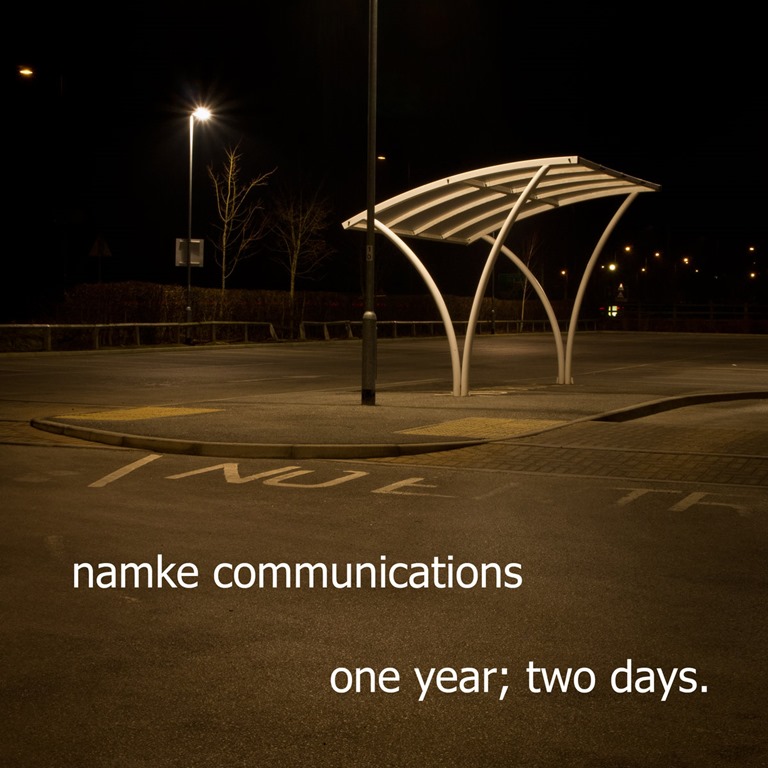
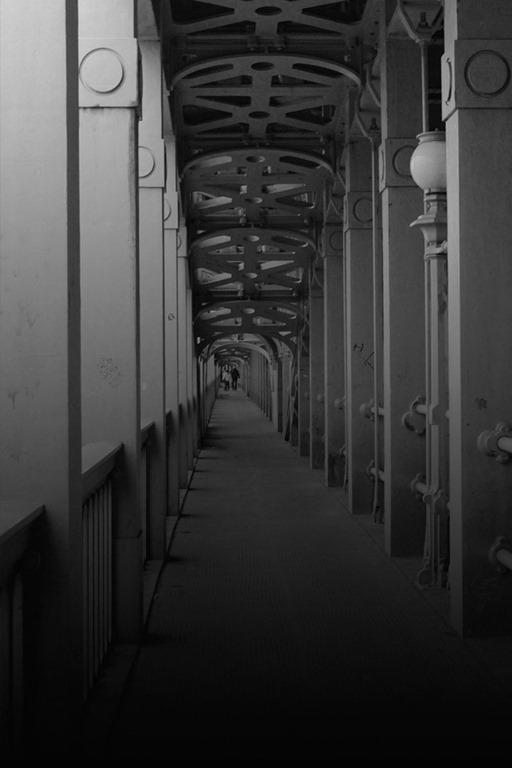
I know very little about this release, at least in terms of specifics. I do know that it’s the work of the prodigious John Tuffen, who also performs as part of Neuschlaufen and Wharf Street Galaxy Band amongst others. I know its physical edition is in a hand-numbered run of 50 CD-R, housed in a paper foldover sleeve in a PVC wallet, with an appropriately blank image by way of cover art. There’s a bleak, quasi-modernist feel to the night-shot photograph of a structure constructed as some kind of shelter. But a shelter without people and a car-park without car is simply dead space. One Year, Two Days is a night-time work. Recorded at night (we’ll return to that shortly), it’s the soundtrack to empty spaces and time without people. And abstract as the sound sequence are on One Year; Two Days, it’s reasonable to summarise the project as a work about time and space and a certain absence.
I do know that John likes his kit, and to fiddle with it, and that a lot of his works are ‘project’ based, centred around either a piece of equipment (e.g. 808 // Whammy (2016) and Field Memory Recorder (2017) recorded exclusively with a novation circuit) or specific times / locations. I also know that John has been working under the Namke Communications moniker for some seventeen years now, and has built quite a body of experimental work in this guise.
The track titles are simply dates and times, and show that the four pieces were recorded over two days in 2016 – as the EP’s title suggests. In some ways, it marks a continuation of the 365/2015 project, which saw Tuffen record – and release – a track a day for the entirety of 2015.
This project and its predecessor provide a considerable insight into Tuffen’s creative modus operandi, which could equally be described as a work ethic. It’s one I can personally relate to, as I strive to produce and publish at least one review a day. This does, of course, raise the inevitable question about quality control, but there are two very different positions on creativity: the first suggests creativity is something which cannot be controlled, is spontaneous. It says you have to wait or the moment, the idea, the impulse. To wait and to go with the flow. The second says that creativity is like a muscle: the more you do, the more you’re able. In time, quantity begets quality as a committed, systematic approach to making art.
‘2016-08-08-2202’ sets the tone, a distorting oscillation provides the backdrop to creeping notes which gradually rise majestically before bleeding into ‘2016-08-08-2318’. It may be growing later, but the mood grows marginally lighter. The sequencing of the tracks is a major factor in the listening experience here, as there is an overall arc from beginning to end. The mid-section, as represented by ‘2016-08-10-1909’ transitions into hushed ambience, before fragmenting into darker territory with fractured distortion and dislocation taking hold. Eventually, it spins into hovering metallic drones, the frequencies touching on the teeth-jangling.
The final track, ‘2016-08-08-2256’ forges a cloud of amorphous sonic drift, a sonic cloud without tangible form. It’s immersive, but at the same time entirely engaging, as the oscillations and quavering notes which fade in and out of the rumbling thunder slowly dissipate in a drifting mist.
While locked in time and space in terms of their creation, in terms of reception, the four tracks on One Year; Two Days transport the listener beyond both time and space. And herein lies the power of this release, in that it both freezes time, and stretches it out over a frame which has no fixed limits.
Since their initial (slight) return with the EP produced in collaboration with Cubanate’s Marc Heal on his guise as MC Lord of the Flies in the spring of 2015, PIG have been on a real (sausage) roll.
Hot on the heels of the remix album Swine and Punishment lands the Prey & Obey EP, which features three new tracks spawned from the same swirling cesspit of sleaze which gave birth to The Gospel, the first PIG album in a decade. Bringing extra meat to the lineup for this outing is Sisters of Mercy guitarist Ben Christo, who also receives co-writing credit for ‘The Revelation’. Meanwhile, the eternal PIG / KMFDM overlap is maintained courtesy of the En Esch, who contributes a remix version of the lead (prime) cut.
‘Prey & Obey’ positively explodes with heavy-duty guitar-led grunt and chug. It’s vintage PIG, drawing all of the elements that define the band’s sound from the span of their career: Watts spits and snarls over overdriven guitars melded to a thumping industrial disco beat while a swirl of strings whip up the layers of drama. It’s all delivered with a knowing bombast and, and as such, sits up there with anything in the substantial PIG oeuvre.
‘The Revelation’ references PIG classic ‘Serial Killer Thriller’ in the sinewy lead guitar part, while Watts, snarling menacingly, juxtaposes bodily fluids and biblical references like only he can (and get away with). The third of the new tracks, ‘The Cult of Chaos’ is also of premium PIG standard; slower, grinding, it twists a goth-tinged lead guitar over a throbbing groove that’s equal parts guitar and electronic, while a brooding piano strolls around in the background
Of the remixes, the Leæther Strip remix of ‘Prey & Obey’ fits the predicable technoindustrial groove version requirement, while the aforementioned En Esch reworking is darker, murkier, grimier, and more atmospheric. Collectively, they make for a rounded representation of what PIG are about. There’s snout wrong with that, and Prey & Obey is not only a rip-snorting effort, but up there with the best PIG releases.
Stop me if you’ve heard this one before: because neither music reviewing nor cranking out postmodern novels no-one reads doesn’t pay the bills, like most writers and people slugging along in the lowest reaches of the music industry – personally, I like to pretty it up by describing it as ‘operating at a grass roots level’ – I’m compelled to endure the drudge of corporate life to survive. After a bad day at the office – which is every day – I like the fact I can either escape into discovering brilliant new music. Equally, it’s immensely satisfying to savage a release just because I can’t get away with calling my boss a cunt and the rage has to find some outlet.
So here I am, unwinding with a pint of homebrew and among the email stack that’s perhaps even more terrifying than my inbox at work, and Plastic Baricades present themselves. I really shouldn’t like this: the band cite an incongruous list of influences including Radiohead, Oasis, The Shins, Biffy Clyro, Coldplay, Muse, Razorlight, and Nirvana.
They’re pitches as being ‘romantic and honest, gloomy and curious, melodic and melancholic’, a band who ‘chronicle life in the troubled yet fascinating XXI century with painstaking sincerity.’ No question: these are troubled and fascinating times. If we entered the new millennium with a sense of trepidation, there was no way anyone could have predicted the shitstorm that is Trump and Brexit and… well, the list goes on.
‘How Goldfish Grow’ is a supremely summery tune with a feelgood vibe. It’s built around a nagging guitar line and buoyant bass groove, and with a huge, hooky, singalong chorus, infectious may be a cliché but the most appropriate word going to describe ‘How Goldfish Grow’.
Just because I’ve spent the last decade whittling down my cassette collction from over 500 to fewer than 50 doesn’t mean that I don’t think the tape renaissance isn’t cool. It represents a return to the appreciation of tactile, physical media, as well as a format that has a certain fragility which adds to its appeal: the idea that the cassette was cheap, convenient but also potentially damageable and disposable means that it’s possible to enjoy something of an ambivalent or even conflicted relationship with cassettes, often on a tape-by-tape basis. The return of the cassette suggests bands are haring back to a bygone age when acts – before the advent of the CD-R – would sell tapes at their gigs. These were often bands too new or too skint or too unsigned to have any vinyl releases.
The title of the debut release by Newcastle post-punk band Lost on Me also reminds us of the pre-internet era when bands would cut a demo and send it around gig promoters and record labels the like in the hope of getting gigs and more exposure, or even a recording contract and the chance to record in a proper studio rather than on a beaten-up four-track borrowed from a mate.
‘Protection’ bursts from the speakers in a blizzard of fractal, interlooping guitars, a mass f chorus and delay, and one might be forgiven for an initial thought which incudes Editors by way of a reference point – I’m thinking forst album era, I’m thinking ‘Munich’ in particular. But then Martin Downing’s dense, dark baritone enters the mix, and its heavy timbre has far more ‘gothy’ connotations, calling to mind Chris Reed from Red Lorry Yellow Lorry.
‘Landslide’ is a chiming pop tune at heart with a nagging guitar line, but the throbbing bass and deep, growling vocal casts heavy shade across its sunny surface. Third track ‘Balance’ brings a sinewy tension and a density that, again, is reminiscent of the Lorries.
The stuttering bursts of drums propel the wistful, emotive closer, ‘New Beginnings’ into territories which bring together contrasting dynamics to good effect, and once more indicate that these guys have studied the darker (and often more drum machine driven) side of the early 80s alternative scene. The production also contributes to the effect in a major way, with deep, deep reverb all over everything and a slightly hazy, murky analogue veil hanging over the guitars, in particular the thick bass tones. It’s all in the details, and they’re certainly not lost on me.
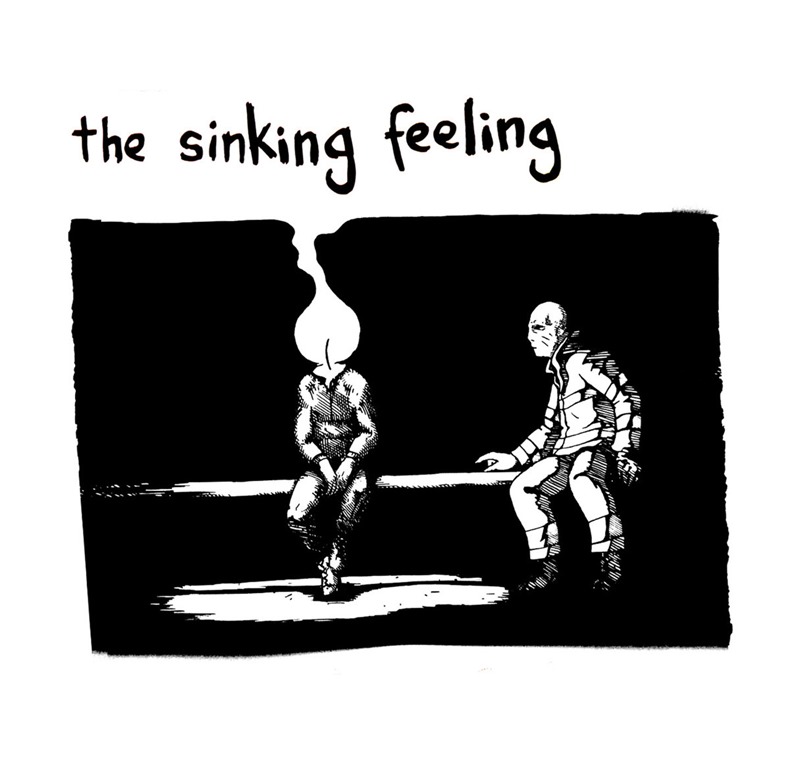
‘The Sinking Feeling is testament to the fact that you can take crushing self-doubts and turn them into something else. With three totally unique personalities and backgrounds, the band converge on subjects of depression and loss. Each with their own trials, each member contributing to the unique dynamic that is proof that there is beauty and worth in every tribulation.’ So says the press release. Who would have known they’d have been from Glasgow? Not that all bands from Glasgow are depressed, miserable fucks,
Even without the blurb, the vocals are a dead giveaway, however murky the production. And the production is seriously murky. It sounds like a sock was stuck over the condenser mic they recorded the songs into while packed into one of their parents’ bedrooms. But beneath the mud is gold: the three songs which comprise the ‘One’ EP are magnificent slices of punky grunge alt-rock with some neat hooks buried like depth charges
There’s the bluster of Bug era Dinosur Jr about the three songs on this EP, particularly opening track ‘Standard’. Closer ‘Mary’ goes a bit more post-hardcore with some angry, throaty vocals contrasting with the slacker drawl that runs alongside.
Would it benefit from better production? No. This is music that’s real, raw, emotionally charged and played from the heart. And no multitracking and crisp EQing can supercede that.
The great Swans back catalogue reappraisal and re-release continues with a brace of albums from near the end of the band’s initial incarnation. The latest pairs Swans’ 1995 album The Great Annihilator with Gira’s simultaneous solo release, Drainland. 1995 was a fertile year: Jarboe also released Sacrificial Cake through Alternative Tentacles in the same year, in some respects mirroring the period eight years previous, when two different Skin albums – effectively Gia and Jarboe solo releases – appeared in 1987 and 1988 in near synchronicity with Swans’ pivotal Children of God. Indeed, while the ‘definitive’ reissue programme is both extremely welcome and is a genuine boon for Swans fans both new and old, it does highlight the complexity of the band’s back catalogue. Precisely which album sits with which is a question which will never find an easy resolution, but on balance, Gira and Young God have made a decent fist of presenting a cohesive and linear recataloguing of the band’s initial history.
The Swans album The Great Annihilator arrived some three years after the epic twin salvoes of Love of Life and White Light from the Mouth of Infinity, which had represented both an evolution and a return to form following The Burning World in 1989. And while The Great Annihilator clearly belonged to the same broad phase as its immediate predecessors, it also felt more focused and more intense. It also stands as a transitionary album, the last studio release before the immense, everything-through-the-wringer churning mash of Soundtracks for the Blind, at which point the first phase of Swans collapsed and terminated.
Soundtracks perhaps hinted at the direction the reincarnated Swans would take on their return, but lacks the immensity of the sound they would produce on their post-millennial return, and equally lacks the focus of The Great Annihilator, and in this context, it’s this album which stands as such a significant document of the band in the later years of their first phase. The 2002 reissue saw the album augmented with a six-minutelive recording of ‘I Am the Sun’, which is also included here. However, this version is more about presenting a ‘restored’ version, returning to the recently-excavated original tapes to deliver the album as intended.
By this point Gira had perfected the cavernous, monotone drone which is now his signature: emerging on Children of God and honed over the course of White Light and Love of Life, on The Great Annihilator and Drainland the dark, bleak detachment conveyed in that vocal is as terrifying as any of the growling, barking threats of violence contained on Filth and Cop. He may have sounded brutal in his rage on those releases, but here Gira affects a demeanour which is altogether calmer, and consequently all the more dangerous in its psychopathy. He no longer sounds like a tortured, tormented human soul: he sounds like he’s detached himself from humanity.
What makes The Great Annihilator such a strong album is its range, which is equalled by its force and its cinematic production, balancing slow, repetitive, hypnotic tracks with explosive, percussion driven compositions. As such, it’s a perfect encapsulation of the ugly / beautiful juxtaposition which characterises the Swans ethos. The raw, visceral Jarboe-led ‘Mother/Father’ is gruelling in its intensity and contrasts with the mesmeric ‘Killing for Company’ and the expansive, uplifting ‘Where Does a Body End?’ (which stand among some of my all-time favourite songs by Swans – although, if truth be told, in the scheme of their vast output, it would be easy to fill a double album with my favourite songs by Swans).
‘I Am the Sun’ shares common ground with previous percussion-led tracks like ‘Power and Sacrifice’ (which stand a world away from earlier percussion-led tracks as featured on their albums prior to Children of God, which very much marked a turning point for the band), but at the same time, offers the first hints of what the band would evolve to produce during their second, post-millennium phase. Elsewhere, ‘Mind/Body/Sound/Light’ and ‘Celebrity Lifestyle’ display a certain newfound commercialism (beyond the folk leanings of The Burning World), magnificently counterpointed by Gira’s monotone baritone drone. And who else could succeed with a line like ‘she’ just a drug addiction, a self-reflecting image of a narcotized mind’? ‘Alcohol the Seed’, meanwhile, is sparse, stark and harrowing, the direct, declarative lyrics standing at the point where art and life intersect to deliver maximum discomfort to the receiver. ‘Killing for Company’ is delicate yet beyond dark, a song which reflects Gira’s interest in serial killers and takes its title from Brian Masters’ 1993 biography of Dennis Nielsen.
Gira’s solo debut, Drainland, has always stood as a singular release, both stylistically and in overall terms of the Swans / Gira oeuvre. It also seems to be one of those releases which has been somewhat overlooked.
The first track, ‘You See Through Me’, which features a serrated, grating, oscillating drone and haunting piano provide the musical backdrop to a recording of Gira, drunk, nasty, arguing with his then-partner Jarboe over money and his alcohol problem. It’s one of those works which crosses a line that will never be readily acceptable, where art transgresses the boundaries of the personal and the public. This, of course, is art of the highest order, that demands the receiver face uncomfortable and painful realities. Simultaneously, Gira, in his capacity or artist, dismantles all sense of persona and lay himself bare in the most unfiltered way imaginable.
It paves the way for what is a difficult album on every level, as he trawls the darkest recesses of his psyche: the lyrics may not be as visceral as those contained on early Swans releases, but they’re every bit as gut-wrenching in their impact, not least of all because they’re so intensely personal.
It’s a dark, stark album, which makes for uncomfortable listening on many occasions: even the more overtly post-Children of God tracks, where Gira spins hypnotic, opiate-hazed acoustic strums, as on ‘Unreal’, it’s more nightmarish than dream-like. And then there are jarring, nauseatingly difficult loop-led nightmare dirges like ‘Fan Letter’. And yet, the album contains moments of true beauty. Songs like ‘Why I Ate My Wife’ (which again alludes to Gira’s serial killer fascination and also draws on, and shares its title with, a piece from 1993 which appeared in Gira’s book of collected prose, The Consumer (1994)), dark as they may be lyrically, are also truly magnificent, and as touching – and well-crafted – as anything Gira has done during his long career.
The mastering seems comparatively quiet, but that’s largely on account of the fact everything tends to be mastered so damn loud and so damn bright these days that much of the dynamic range is lost. The very purpose of this remaster is about audio fidelity and unravelling knots in the original processing. Sonically, this remaster feels richer, denser than the original releases, although it would take obsessive comparison and a lot of time to draw out all of the detail. Most importantly, this release makes two classic Swans / related albums (one being something of a lost or unsung classic at that) readily available once more, and on vinyl, too – The Great Annihilator has been commanding obscene prices on the second-hand market for a long time now, while Drainland was only released in the US packaged with Jarboe’s Sacrificial Cake and is again expensive and hard to come by: as such, it all adds up to an essential release.
It’s been almost two whole years since dreampop duo Lunar Twin released a remixed version of their debut EP ‘Champagne’. ‘Night Tides’ offers more mellow, drifting soundscapes over the course of six tracks, which finds supple, rolling synths wash around the grizzled vocals of Bryce Boudreau, which have heavy echoes of Mark Lanegan and Duke Garwood.
If the wooden tones of the percussion which holds the first track, ‘Waves’ in places suggest Jools Holland world music smugness, the heavy patina of Boudreau’s blues tones bring a resonant, resinous counterpoint. ‘Coral Sea’ brings the glacial synths of New Order’s Movement and the coldwave aesthetic and pairs it with a shuffling, understated beat, and again it’s the contrast of the warm, well-worn Cohenesque croon which makes it stand apart from the myriad laid-back electro acts in circulation right now.
‘Birds of Paradise’ pivots on an undulating synthetic 80s disco groove, while ‘Prayers of Smoke’ introduces a more Krautrock element to its spacious, synthy, dub-tinged verses, before breaking into a straight, slow and low, late-night blues chorus.
The title track provides the finale, and despite the absence of beats, it’s a magnificently-realised summary of the EP as a whole: hunting, sparse, yet rich and resonant. Drifting swirls intertwine subtly to create a delicate atmosphere, while Boudreau’s voice drips like treacle. And darkly pleasurable it is, too.
There’s a perverse irony in my presence at this show in my capacity as correspondent for Aural Aggravation, a site devoted explicitly to music that’s underground and obscure. This is not least of all because I’m old enough to remember when the NME was a key publication for giving coverage to bands who were not only unknown and obscure, but often likely to remain so. In moving with the times, the NME has metamorphasised into a free, glossy, picture-rich publication that’s far more likely to feature Beyoncé than Bell Monks or break_fold. In fact, Bell Monks and break_fold won’t get a look in, and it’s not because they’re not artistically interesting or of merit. And as for feature-length reviews, forget it. All of which is partly the reason for my doing what I do.
Any show which sells out a series of 1,800 or so capacity venues is not underground by definition, and likewise any event sponsored by VO5. Still, it’s as much an indication of the nature of the music industry now that for tours to be feasible for even moderate-sized acts, they need corporate backing and to shift a shedload of merch. And of course, the corporate backers need to break into large markets. In other words, it’s economic, and it goes both ways.
So why am I here? In a word: Cabbage. It’s fair to say they’re a fairly unlikely breakthrough act. Manchester’s answer to Fat White Family, the band, who’ve been unequivocal in their opinions on The Sun, nationalism and Brexit, pithily describe themselves as ‘neo post-punk’ (most certainly not to be confused with the New Wave of New Wave) and are as far from the kind of aural chewing gum that’s sadly become synonymous with indie in the second decade of the second millennium.
I’m not about to pretend to be down with the kids: the venue is rammed with teens and student types, with older folk – and by the looks of things, some parents of the student types – hanging back. Because I’m not down with the kids, I can safely say I’m sure there was never as much cleavage on display when I used to go to gigs in my university days. But then, that’s perhaps because I never went to trendy gigs like this, who knows? Anyway, my knowledge of Rory Wynne prior to my arrival extends to a cursory Google search which tells me he’s an up-and-coming teenage indie rocker. Rory plays with a full backing band. Who knew? They’re conspicuously absent from his press shots. As a band, hey have a good energy, and Wynne looks to be enjoying himself up there. Musically, his up-tempo guitar-led alt-rock is perfectly passable, but does essentially sound like every early 90s US alt-rock act boiled down to its most generic form, and his cliché guitar-lofting poses get tired quickly. The set also has a rather strange ending: he thanks the crowd – who have been pretty tepid in their response – before launching into an instrumental number. A minute or so in, he carefully putts his guitar down and tosses his pick into the rows. Moments later, the rest of the band follow suite, toss their pics and wander off looking a bit confused.
Cabbage, as one would expect are by far the most challenging, and exhilarating, act on the bill, and on account of that, all the more surprising for their inclusion. Is this what the kids are into? I’d like to think so: it gives me hope that songs like ‘Uber Capitalist Death Trade’ could be anthems for a generation. But I rather suspect that more of the oldies present have turned up for them, their enthusiasm for new music reignited by a band who combine the angular, jarring guitar lines of early Fall albums with a snotty punk thrash, while also evoking the spirit of The Stooges. The bass is nostril-vibratingly booming, and there’s an attacking edge to the sound even in this aircraft hangar of a venue. Many of their songs are brash, juvenile, perverse in a puerile way, but there’s a strong sense that they’re fully aware of this and are revelling in the awkward shock value of singing about necrophilia and masturbation. They’re shambolic / not shambolic – which is to say, they play like they don’t give a fuck, but are still tight, and can nail a motorik rockabilly groove with the best of then: Babyshambles they’re not. A week or so back, Lee Broadbent was in a wheelchair having fractured his pubic rami in a bizarre wall-leaping accident. Tonight, he manages to limped onto the stage and limp about a reasonable amount, but performs most of the set seated, sneering and snarling atonally from a slouchy, reclining position. But even this is an inverse type of showmanship, and contrasts with Joe Martin’s spasmodic flailings. Shirtless and scrawny, he comes on like Iggy Pop. They deserve a way more visible show of appreciation from the crowd: one girl is up on someone’s shoulders and a few people are bouncing around, but most are static and either filming or texting on their phones.
Cabbage
There’s a rush toward the front of the stage immediately after their set, but what I witness next is truly horrific: the audience finally start getting animated. There are people dancing and singing along – to the Courteeners, whose ’19 Forever’ is playing over the PA. People are snapping and filming the stage and grabbing selfies – while the crew set the stage for the headliners. There are whoops as each vocal mic is checked. And then the band walk on, half-hidden behind smoke and… well, the crowd mostly get back to standing around, snapping photos and WhatsApping with their mates.
Live, Blossoms are quite a different proposition from their recorded output. If their studio presents them as dark-hued indie, then live it’s the darkness that comes to the fore. The enter to a pulsating synth throb by way of an intro to ‘At Most a Kiss’.
The thunderous, steely electro groove is swiftly dampened by a so-so vocal and a bouncier pop tone. I don’t want to be too harsh in my critique of Blossoms, and will admit to having a soft spot for them, with a greater appreciation in light of their live show. They do have dynamic range and some solid, insistent basslines. They do convey a certain broodiness. The jiggish guitar line on ‘Blow’ has hints of The Sisters of Mercy’s ‘First and Last and Always’ about it, and there are three girls, about a third of the way back, up on people’s shoulders, arms waving arabesques: it’s starting to resemble a Mission gig. And the reference isn’t entirely out of place: with their accessible, anthemic sensibilities, Blossoms live call to mind the lighter end of the mid-80s goth spectrum, the point at which it had transitioned from post-punk to indie-goth.
Blossoms
I glance around the venue from the front row to witness an ocean of lofted phones. In fairness, they are visually striking and snap well. With dense smoke and dazzling spots and strobes casting the band in silhouette, they’ve got the Sisters’ visual stylings nailed: musically, however, they’re more Rose of Avalanche than Doktor Avalanche. On balance, it would be churlish to begrudge them: Blossoms’ music may be steeped in the music of thirty years ago, but it’s distinctive in the scheme of the commercial musical landscape of 2017.
It’s a cold, wet, February night in York. The wind is howling and the air is bitter. It’s not much warmer in The Crescent, despite a respectable turnout for this incredibly good value five-band extravaganza hosted by Leeds promoters and label Come Play With Me (and while I’ve never asked or otherwise bothered to research, I’ve always assumed the name is taken from the 1992 Single by Leeds indie stalwarts The Wedding Present, rather than the 1977 sex-comedy movie).
Perhaps it’s because they play so frequently in and around York that I often pass up on seeing Bull play. As a consequence, I tend to forget just how good they are, and often feel as if I’m, discovering them anew when I do see them. Their breezy US alternative sound, which hints at Dinosaur Jr and Pavement is laced with a distinctly Northern attitude, and they’ve got a real knack for a nifty pop song. They make for an uplifting start to proceedings.
The ubiquitous and multi-talented local stalwart Danny Barton features among the lineup of three-piece Sewage Farm, in capacity of bassist. Their post-grunge style is a sort of hybrid of US alt rock and 60s pop: more New York than Old York. With nods to Sonic Youth, but equally, Weezer, they’re good fun and make a dense noise for just three people.
Looking around the venue, I observe a number of long coats and above-the-ankle trousers. It’s starting to look like 1984, while on stage it sounds like it’s 1994. Time is warping, history is bending in on itself. Clearly, I need more beer. While I’m at the bar, The Jesus and Mary Chain and Slowdive pour from the PA, setting the tone nicely for the next act.
While they’re setting up, I chat briefly to Adam Weikert, drummer with Her Name is Calla. I waffle a load of bollocks, and as he heads off to get warm and grab a beverage, I realise just how unbelievably fucking tired I am. Maybe if I drink enough beer I’ll perk up, or otherwise fall asleep at the table I’m sitting at to make notes between bands. Perhaps I’ll simply care less, and also develop a much-needed beer-coat.
Team Picture describe themselves as ‘One part post-punk, two parts fuzz’, and having been impressed by their single cut released by CPWM the night before, I was keen to check them live. Biographical details about the Leeds act is scant, and despite the positioning of old-school cathode ray tube television sets around the stage and the female singer being one of the hyper-retro bods I’d clocked, giving an air of hypermodernism of a vintage circa 1979, they’re really not an image band. They are, however, an exceptionally strong live act. The six-piece forge a layered sound that oozes tension: the monotone dual vocals and fractal guitars trickle brittle over strolling basslines and taut drums. The songs are magnificently composed and executed. Atmospheric segments blow out into expansive passages propelled by motoric rhythms. I’m totally sold: it’s a cert that this is going to be a band who are on an upward trajectory and 2017 could be a big year for them.
Team Picture
I’m still freezing my tits off, tired, and feeling disconnected and out of sorts, so I buy a third beer: surely an Old Peculier will unthaw my toes at least. The barmaid throws a friendly smile as she hands me my change. Inexplicably, I feel hopeless and empty, and now, I’m without a seat, as the girl who stood right at my elbow during Team Picture’s set, despite the venue being only a third full is now sitting with her mate at the table I was at previously. She looks vaguely familiar, but I’m not about to embarrass myself by attempting conversation. Perhaps it’s the chilly post-punk vibes lingering in the air spurring my existentialism; perhaps not. Regardless, I don’t go to gigs to socialise.
It’s a relief when Halo Blind begin their set. Another York band featuring another ubiquitous face on bass, this time in the form of former Seahorse Stuart Fletcher (currently rocking a look that says he wants to be Tom Hardy), they’re classic exemplars of post-millennium neo-prog, and they’re seriously good at it. Having just released their second album, Occupying Forces, they showcase an evolving, expansive sound. Layered, dynamic, melodic and harmony-soaked songs, rich in atmosphere and calling to mind the likes of Oceansize and Anathema, define their set. They explore dynamics fearlessly, building some sustained crescendos and executing them with admirable precision. During ‘Downpour’, I find myself drawing parallels with ‘Pictures of a Bleeding Boy’ by The God Machine. But if a band’s worst crime is betraying echoes of The God Machine, then you know they’re a band worth hearing.
Halo Blind
Her Name is Calla: another tour, another lineup. Sophie Green is out (a shame, as she’s an awesome presence), making way for a return for Anja Madhvani (which is cool, because she’s a superb player). And that bearded guy at the back, manning a bank of electronics and hoisting a trombone: is that really departed fonder Thom Corah? Yes, yes it is, and they open up a tempestuous set with the rarely-aired single-only track ‘A Moment of Clarity’. I may be in a minority, but it’s one of my favourite Her Name is Calla songs, and as Tom Morris pushes his voice to the limit with the cry of ‘the crunch / is the sound / of a human spirit breaking’ as the band erupt around him, it’s a powerful and emotive moment.
Her Name is Calla
The band play a varied set with intensity and vigour. Quiet and melancholy, ‘Pour More Oil’ is delicate and moving; ‘Meridian Arc’ brings an insistent throb, vlume and tension in spades. Tiernan Welsh’s bass coms to the fore and his complete immersion in the songs is compelling.
They close the set with ‘New England’. I stopped taking notes, beyond scribbling ‘fucking yes’ in a barely decipherable scrawl. One of the highlights of The Heritage¸ this is precisely the kind of slow-building, explosive epic that made the band their name, and to see them thrash wildly, with Tom gnawing his guitar strings with his teeth amidst a tumult of ever-swelling noise, is an experience that’s something special. There is no encore: there doesn’t need to be. There is nowhere to go from here: an awesome finale to an awesome night.