Posts Tagged ‘Noise’

Too Pure – 29th September 2017

Christopher Nosnibor

With Billy Blacklister’s recent relocation to Germany, there were likely to be questions over the future of Leeds’ masters of abrasive angular noise. The arrival a new three-tracker as part of Too Pure’s singles club series answers them: their first new material to be released since their second album, Adult, in October 2015, is absolutely fucking blistering.

It may be hard to believe, but they’ve actually gone one louder, one heavier, one more ferocious than the previous release here. A tangle over overdriven guitar wails over drumming that’s up front and pure Shellac leads the assault on Dart. The bass is brutal and Billy’s vocals are sharp and full-lunged. They’ve not gone for hooks, instead going all out for battering ram brutality, all with their trademark hint of mania.

‘Disco’ and ‘Drag’ both clock in at under three minutes (the latter only just breaking two). On the former, sinewy guitars skew angles across a nagging bass groove. Funky it isn’t. On the latter, chords stab like daggers as the whole thing lurches at pace to an abrupt halt.

Lyrically, the songs are largely impenetrable, but this isn’t music to muse to: Dart is a violent, visceral experience – and one of the best things I’ve heard all year.

AAA

Blacklisters - Dart

MC/CD/DL – Nakama Records –NKM012 – 22nd September 2017

Christopher Nosnibor

I’m not entirely sure what a no-input mixer is, and I’m not sure I have the energy or motivation to find out. But it’s one of the ‘instruments’ Utku Tavil ‘plays’ on this album, in addition to snare drum and sampler.

What I do know is that Juxtaposition is a studio work of four Oslo based improvisers (and not the indie mongs who went by the same name who came round to my flat in Glasgow in 2000 to be photographed by my achingly hip flatmate) recorded in the spring of 2016. Various timbres of opposite extreme, as a result of each musicians’ different approach and background, coexist without hierarchical restrictions. Having that in mind during playing, the mixing process played a crucial role to deliver a concrete body of equalitarian sonic output. Without compromise, moments of joy and pain, screams, feedback and bird sounds are layered on top of each other.

This is not music that’s easy to listen to, let alone love. Scraping, distorted clanks and clatters echo atop growling, prowling, near subsonic bass intrusions and an elongated howl of sustain. And that’s just the first thirty seconds. An overloading mass of shuddering, screeding extranea rapidly builds to skull-crushing intensity, as shrieks of treble erupt like solar flares from amidst the tempestuous racket.

‘Pakistansk Mango’ is a fiendish mash of vocals – Natali Abrahamsen Garner does not sound of this world, and it’s hard to compute that the sounds emanating from her being are untreated, unprocessed – shudder and judder to a babble of stuttering repetition, against a backdrop of bubbling synths, ear-shredding bursts of pink and white noise, and nail-scraping feedback reminiscent of Total Sex era Whitehouse. Pleasant it is not. In fact, as distorted metallic bangs and hammers batter through a sonic riot of indeterminate origin, I’m feeling pretty fucking tense.

A yammering percussion that sounds like a cross between a locomotive and a nailgun provides the spine behind a whirling aural assault for ‘Revolver’.

Natali Abrahamsen Garner and Agnes Hvizdalek’s voices exist outside the realm of the human, and serve to add a disturbing, unheimlich aspect to the already hellish, grating sonic torture. Screams, shrieks howls and growls are all integral to the traumatic experience. ‘1000 Poeng’ features a host of primal screams over growling synth bass and brutal, waspish feedback. On ‘Enkle I’, a deranged bleating entwines with a surging skitter of overloading electronics and a swirling vortex of nastiness, and a mess of brown noise buzz blasts in around five minutes into the final track, ‘Trost’.

Juxtaposition is a cruel and punishing work, which exploits the full sonic spectrum and every texture, from grainy abrasion to the razor-sharp to inflict maximum pain.

AAA

- dsn - JUXTAPOSITION - VIDEO titles

LP/DL Editions Mego eMEGO238

8th September 2017

Christopher Nosnibor

The album’s blurbage tells us that ‘Shit & Shine’s sidestep from percussion led bunny rabbit rock ensemble performance based glee to ultimate heavy fools of the sticky dancefloor remains one of the more inspiring turn around’s in recent years’. They’ve certainly come a long way from the percussion-dominated noise rock racket of their formative years, but Craig Clouse continues to demonstrate a tireless appetite for pushing both himself and the listener.

Some People Really Know How To Live picks up where the 2015 album Everybody’s a Fuckin Expert (also on Editions Mego) left off, and the cover art even serves as a companion piece of sorts. Musically, it combines elements of disco, electro, old-school industrial and classic experimentalism to forge a sound that’s murky, dense, vaguely nauseating and still strangely danceable.

Warping, woozy drones taper in and out against bumping bass and a whip-crack vintage Roland snare sound on opener ‘Behind You Back’, before ‘Dish 2 Dish’ brings the groove. Dark and vaguely dubby, it’s also angular an abrasive, hectic and blustery, with some big bass tones. Its lack of sophistication is somehow a virtue, in that there’s a directness and spontaneity that gives it real punch.

Samples are lobbed in here and there, adding to the dislocation of shivering synths and engine-like growls, atonal incidentals and the fractured, warped grooves which abound. ‘Notified’ brings heavy clattering percussion and low-down grindy bass. With a time signature that’s unpredictable to say the least, it’s disorientating and head-pummelling. Elsewhere, the fucked-up funk of ‘Girl Close Your Eyes’ bumps and grinds its way through the stomach to make you shake. With beats that are propulsive providing the power behind a twisted sonic attack that’s more repulsive, Some People Really Know How To Live is some good shit.

AA

eMEGO238_front

Southern Lord – 29th September 2017

Christopher Nosnibor

It’s been five years since Wreck appeared on Alternative Tentacles. So what have Unsane been doing in the intervening period? Gazing at their navels, taking up yoga and discovering a serene spirituality as a means of dealing with the anguish of life in the modern world? As if. They’ve been distilling their brutal rage into even more intensely bleak slabs of sonic nihilism. And, naturally, it’s housed in appropriately unsubtle, gore-soaked artwork. Unsane’s album covers are nothing if not distinct: while so many metal album covers which display hematomaniac tendencies are highly stylised and revel in the intended shock value, Unsane’s covers are all the more shocking by view of their clinicality, resembling crime scene photos than works of art. This is in many ways true of the music itself: there’s a functionality, a bluntness about it, and no sense of there being any indulgence or show.

Everything about Sterilize is stark, uncompromising, and connotes post-industrial, post-everything society, the dehumanising effects of merely trying to exist in the capitalist world where everyone gets pushed further and further down for the benefit of the few. It’s the soundtrack to life being sucked from the soul, the sonic encapsulation of desolate fury.

The grey steel assault of ‘Factory’ sets the tone and tempo: screeching feedback whistles through the grey, grain of the guitars and sludgy bass. From thereon in, the ferocious howls of anguish and packed in tight, back-to-back.

The song titles are also functional, direct, descriptive. Again, there’s no fluff, and little joy, to be found around ‘We’re Fucked’, ‘A Slow Reaction’ or ‘Distance’. Everything is paired back to the bare essentials and compacted for maximum impact. This includes the blues-based sound that defines Unsane: it’s crunched up, compressed, stomped into submission, meaning that while there is a certain swing to it, it’s limited to the most concise and precise form.

‘The Grind’ is aptly titled and brings a thunderous deluge of guitar; ‘Aberration’ is built around a simple four-chord trudge; and ‘No Reprieve’ sums up the album as a whole. You don’t listen to Unsane for variety, either across a given album, or their output overall. You listen to Unsane to vent, to experience a relentless viscerality. There’s something almost self-flagellatory about listening to an Unsane album in its entirety. At a certain point, the initial sense of catharsis is replaced by a crushing claustrophobia. This isn’t to say it’s an unpleasant experience, but is indicative of the effect of such sustained intensity. It’s as exhausting, mentally and physically, as the exertions of daily life on the treadmill, a punishment as reward.

When they slow the pace a shade, the weight is turned up, and when they hit a groove, it’s explosive and blistering. The tripwire guitar that stretches its sinews over the sludgy trudge of ‘Lung’ only raises the tension, and closer ‘Avail’ draws a heavy curtain of screaming anguish on proceedings with distorted vocals tearing across a rumbling bassline and savage guitars.

There’s a desperation and urgency about Sterilize which ensures that it crackles from beginning to end. Everything seethes, spits and scrapes and there’s not a moment’s relief. It’s this intensity which makes Sterilize as strong as any Unsane release. It’s mercilessly harrowing, but is ultimately satisfying in a perverse, sadistic sense.

AAA

hi3000x3000RGB

Following their recent exclusive on Pure Grain Audio, York-based hardcore punk four-piece, Seep Away, have their released new single ‘Matchstick Man’. The new single is taken from the band’s forthcoming EP, The Blackened Carnival Of Societal Ineptitude, due in the Autumn.

Taking influence from thrash legends Municipal Waste, alongside hardcore standouts Expire and Incendiary, the track is a vitriolic stab at those individuals we all know who drain the life out of those around them.

Vocalist Jay Sillence comments, “This song is quite personal to me – we all know that special type of asshole who sucks the life out of people with their actions – they just want to fight, and fucK, and they have nothing else in their life of any value, so they have to take from others. This song is a dedication to that special person in my life, and I hope other people can relate to the venom that I feel.”

Listen to ‘Matchstick Man’ here:

https://open.spotify.com/embed/track/4xOmiqM5XTLZgGAh6SfG7Q

The band’s new EP, ‘The Blackened Carnival Of Societal Ineptitude’ will be released in Autumn.

IMG_6767

Catch the band live at the following dates…

AUGUST

18 – Percy’s, Whitchurch (with Saltwater Injection)

SEPTEMBER

7 – Fibbers, York (with SHINING)

OCTOBER

2 – The Station, Ashton-Under-Lyne (with 2 Sick Monkeys)

21 – Hoersfest at Fulford Arms, York (with Petrol Hoers)

NOVEMBER

4 – MNDA Fundraiser at Fulford Arms, York (with Segregates)

DECEMBER

16 – BGB Christmas Piss-Up – Fulford Arms, York (with The Restarts)

Christopher Nosnibor

The soundcheck in progress while I’m ordering my first pint suggests we’re in for a loud night. Well, the Facebook event page did give fair warning. It’s a good job I’ve brought earplugs: the guy behind the bar points out that he’s already wearing his.

It’s 6:40pm on a Sunday evening in August. Outside, it’s still warm and the sun is out. Inside, it’s seriously dark, even with the curtains open and daylight filtering in. The THING – whose ‘Nightmares for Children’ streamed exclusively on Aural Aggravation back in April, begin their set with a dolorous bell chime and ominous, droning synths. The fear notes give way to a massage deluge of gut-grinding sludge: the guitar sounds like a bass, the bass sounds the bowels of Beelzebub after a phal. As they thunder through a continuous half-hour set, I’m reminded of Sleep, but the samples and synths which emerge through the murk gives an industrial edge to the doomy dronescape which reaches its climax by building through a single chord and floor to being battered at increasing speed before breaking into a tsunami of sludge.

The THING

The THING

Rotting Monarchs win band name of the night, no question. But starting fifteen minutes late in a tightly-packed schedule is not so cool, and they seem a bit disorganised and lacking in finesse. Still, their shouty, grindy punky racket brought together bits of NOFX with hints of Bomb Disneyland, which is no bad thing.

The place is suddenly a lot busier: Shrieking Violet have brought their mates. And they’re young. Many of them have short skirts and shiny new DMs. I’m here in my cracked £20 steel-toed Chelsea boots and beer-stained jacket. I’m not expecting much. Yes, they’re pure 80s, as if the singer’s hair and shirt didn’t give it away. The first track has hints of early Ultravox. But equally as the set progresses, I’m reminded of This Et Al minus the falsetto. They benefit from some hooky tunes propelled by some phenomenal, powerhouse percussion. ‘Avalanche’ is built around a steely, cyclical riff worthy of Killing Joke, and overall, it’s a strong set.

Shrieking Violet

Shrieking Violet

They may be playing as a three-piece sans bassist Dani, but SEEP AWAY still manage to bring eye-popping intensity and ear-shredding volume to proceedings. The eight-string guitar ensures the sound’s got density, and when paired with Dom Smith’s fierce drumming – his second set of the night having already pounded through The THING’s set – there’s plenty of sonic backdrop for Jay to do his manic thing. He’s a hell of a showman: that he’s wild and unpredictable and relentlessly in the crowd’s faces means you can’t take your eye off him for a second.

DSCF0622

SEEP AWAY

My opinions on novelty bands are no secret, and in the main, I think they suck. Petrol Hoers are a novelty bad so perverse, so fucked-up and plain wrong, that they’re an exception. Two blokes – two fat blokes – one wearing dungarees with no shirt, but a comedy horse’s head, the other wearing red Y-fronts, a fine mesh vest and a Mexican wrestling mask, stomp around hollering over backing tracks of blistering, uptempo industrial-strength bangin’ techno. In paper, it sounds both weird and shit in equal measure, but the audacity of these guys is as sheer as the pants guy’s top. The half dozen people who last the duration of their set absolutely fucking love it.

DSCF0661

Petrol Hoers

Little Death Machine take the stage ten minutes after their set was supposed to finish. Are they worth the wait? Absolutely. The London trio play in near-darkness, adding to the taut atmosphere which emanates from their technically precise and detailed compositions. On account of being scribbled in the dark (and not on account of the pints consumed over the course of the evening), my notes are a shade difficult to decipher, but in the moment I was taken by their rock / post-rock / hop-hop / soul rock hybrid. I also note by way of reference points Placebo, Oceansize, Nine Inch Nails, TesseracT, and some stuff I can’t make out from the scrawl.

DSCF0736

Little Death Machine

Did I really write ‘soul rock’? Yes, it appears so, and if that reads like an insult or criticism, it’s not: the moods that are deeply entwined within the songs, which are complex and progressive in their structures, are played with a sincerity and soulfulness that you feel. And that’s something no amount of technical ability or compositional dexterity can fake. It’s emotive, textured and resonant. And the perfect finish to an intense and varied night of live music.

ChristopherNosnibor

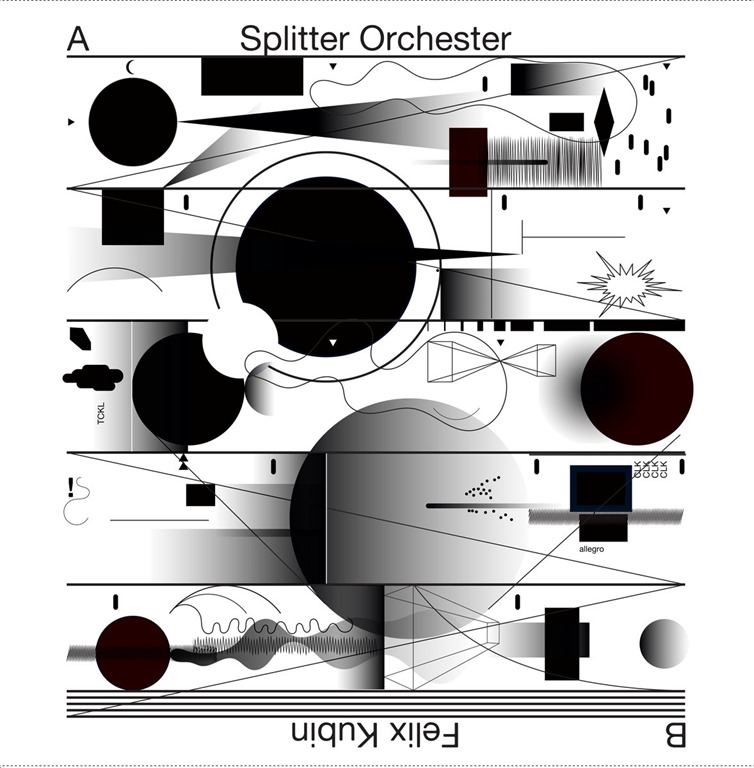
The split album seems to be in vogue again, and it’s a format which perhaps offers more scope for artists who don’t trade in punchy little tunes than the split single or EP. Shine on you Crazy Diagram may only contain four tracks and have a running time of just over thirty minutes, but it allows both contributing acts to showcase the range of their sound by presenting expanded, developed musical works.

The two tracks by Splitter Orchestra explore and examine weird digital percussion: the ever-shifting pitch creates the illusion of ever-shifting tempo (or does it? Perhaps the tempo does shift albeit subtly) beneath whistling contrails of feedback. They sputter and scrape and drone and hum. ‘Diagram 1’, at under four and a half minutes, is but a prelude to its counterpart, ‘Diagram 2’ which hums and wheezes for almost eleven minutes. There are rhythms in the mix, but they’re pinned back in the mix and bounce around against a shimmering backdrop of feedback and extraneous noise.

Kubin’s compositions are altogether less overtly structured, or at least rhythmic, as swampy swashes and thumps rumble and eddy before – from seemingly out of nowhere – faceripping blasts of distortion roar and blast. ‘Lückenschere’ is constructed around a clattering, shifting rhythm.

‘Lichtsplitter’ clatters and moans and hums and drones for an eternity, before stepping up about ten gars. By the end, one has a fair idea of what it just be like to stand within two feet of a Boeing 474 taking off.

This is, without doubt, one of those releases which lends itself perfectly to vinyl: it is, after all, an album of two halves. They compliment and contrast, and showcase two quite different sides of the experimental digital coin.

There’s a digital bonus track from the Splitter Orchester. ‘Diagram 3’ is a ten-minute extravaganza of thick, impenetrable hums and drones. It might not exactly change the complexion of the release, but it does unquestionably fill out and round off the intangible, non-physical format nicely.

Splitter Orchestra   Felix Kubin

Crónica – CRÓNICA 126-2017

Christopher Nosnibor

The title of the latest album by the super-prolific experimental composer and student of film and musique concrete, Emmanuel Mieville, comes from the Japanese translation of the Sanskrit word and alludes to a chapter of the Lotus Sutra, a renowned text from Māhāyana Buddhism. Apparently. It’s hardly my field of expertise. And so the inevitable question arises: what’s my point of entry?

Juryo is by no means an accessible album and its four longform tracks, which span between nine and eighteen minutes don’t readily lend themselves to lengthy debates about Buddhism and the path to enlightenment. Similarly, that the album consists of four compositions shows no obvious correlation with the twenty-eight chapters of the Lotus Sutra. As such, it’s fair to surmise that the allusion which connects the title to the contents is in largely an oblique one, beyond the fact that the album features field recordings captured in Asia.

This is swampy, abstract, murky noise. On the surface, it’s a formless conglomeration of noise, grating, grinding scrapes and bumps. Woozy rippling bubbles flit and floom over tidal waves of surging extranea, which may or may not be the swash of actual water rippling over rocks: it could equally be an aural illusion, or an intentional simulacrum.

Top-end whistles sustain for an eternity and aggravate not only the aural receptors but the mind on ‘Nyorai’, although in the mix are recordings of Tibetan nuns and FM radio from Hong Kong. These manifests as chants and clattering chimes and finger cymbals which emerge around the midpoint of the seventeen-minute sonic journey. According to the liner notes, ‘Murasaki’ means ‘purple’ in Japanese, but the spinning, swirling sonic discombobulations which eddy and swirl present a kaleidoscopic vista.

In the sleeve notes, Mieville explains that ‘Taisi Funeral’ (the fourth and final track) is a ‘recording of Buddhist chanting for a deceased person recorded in a small village in Taiwan, mingled with my own synthetic sounds. Tanit Astarté is a quotation from Antonin Artaud’s book Héliogabale and refers to the moon goddess, as described in Phoenician myths’. It’s certainly the most overtly musical and rhythmic of the four compositions, but as a rising surge of amorphous sound rises to wash away the voices and the rhythm peters out, it transforms to an altogether more ambient soundscape. Morever, while still linking back to the overarching theme of the Lotus Sutra, we can see that Meiville’s sphere of reference is considerably broader than may first appear.

Juryo is subtly complex and had both range and depth. It doesn’t readily conform to any one genre, but to lazily slot it into the broad space occupied by ‘experimental / avant-garde’ is to fail to recognise the spectrum of stylistic elements it incorporates.

Emmanuel Mieville – Juryo

Christopher Nosnibor

For those who aren’t fans of extreme music, it’s often hard to see the appeal. ‘How can you listen to that, let alone enjoy it?’ is a common line of questioning. Often, the response can be boiled down to a single word: catharsis.

The one thing that always strikes me about events like these is just how friendly the atmosphere is. The fans are friendly and many, like me, seem shy and reserved – until they completely go mental in the moshpit. And it’s in this context that extreme music makes perfect sense. I may be nursing bruised ribs today after my quest for photos landed me in the line of danger but never once did I feel in any way threatened: it’s all freaks, outcasts and oddballs together in a safe environment.

What had initially been booked as a standard date on the UK leg of Full of Hell’s tour metamorphasised into an eleven-band extravaganza when circumstances dictated a change of promoter. And there wasn’t a weak act on the bill, and the first couple, Cheap Surgery and Hoof Glove both stood at the punkier end of the musical spectrum than the screaming metal end. It’s not so much that it was welcome to be eased in gently as a positive thing to be treated to some musical range: it’s not as if either was light or poppy, with Cheap Surgery evoking the spirit of bands like Penetration. Hoof Glove, meanwhile, are a band of two halves with a metal rhythm section onstage and an electronic noise duo at a table in front of it. Processed-to-fuck female vocals add a different shade of intensity to a grainy noise reminiscent in places of the abrasive angst of Xmal Deutchschland.

DSCF0289DSCF0301

Cheap Surgery                                               Hoof Glove

A close-cropped screamer in a Crass T-shirt leads the full-throttle attack of Hex, and it was midway through their confrontational, fiery set that the slam-dancing commenced, hinting at the shape of things to come.

Led by the Throat may look like four ordinary guys, but they’re the first band to bring the full-on snarling metal assault to proceedings, and they bring it from the first bar of their tight, powerful set. As he paces the stage, the singer emanates a malevolent energy that’s as powerful as his patterned shirt is tasteless.

I can’t remember when or where I last saw Groak, but I remember them being good, and this evening’s performance confirms my memory is correct. Singer / guitarist Ben Southern is wearing a Rudimentary Peni t-shirt and the band’s sludgy, dirgy churn is propelled – slowly – by Steve Myles’ crushing percussion (how many bands is this guy in?). This is music dredged from the pits of the lower regions of hell, and pretty much as intense as it gets. Or so you’d think. But it’s only 6:30 in the evening by the time they leave the stage, and we’re not even halfway through the lineup.

DSCF0375

Groak

Masters of Powerviolence Lugubrious Children, who released a spit EP with Groak last year are up next, and they’re punishing too. The trio bring the power and the pace, and the result is carnage.
DSCF0384

Lugubrious Children

It only gets better, and more intense, with Gets Worse. Very much a beards and long shorts band, they’re bristling additional strings, with a massively overdriven five-string bass bringing the low-end that grinds below a pair of seven-string guitars. And all of those stings are downtuned and sludged to the max. A single power chord sustains for a full minute before the juggernaut chug slams in. This is a full-on, balls-out racket that draws together the slow trudge of Godflesh and the tearing frenzy of Napalm Death to devastating effect.

Famine are one of those bands who just get better with every outing. Having seen them grow from a snotty two-piece into a thunderous, ferocious gut-ripping threesome who are tighter and more ferocious with every show. My notes from their set are sparse and only semi-legible, but in front of a home crowd, they’re assured and received the violently rapturous reception they deserved.

I’d been recommended Unyielding Love by a friend whose opinion I very much respect, and they didn’t disappoint, taking the snarling gnarliness to a whole other level. The seven-string guitar and five-string bass congeal into a thick glutinous sonic slime with optimum low-end. It’s driven by rapid-fire drumming that’s hard enough to crack any skull, and overlaid with brain-shredding electronic noise. Their relentlessly savage set can be perhaps defined as the sound of a goat’s skull being dragged underfoot about the stage echoing amidst a heavy organ drone, before processed reverby vocals erupt into a howling vortex of noise. And tat all actually happened, in real life.
DSCF0448

Unyielding Love

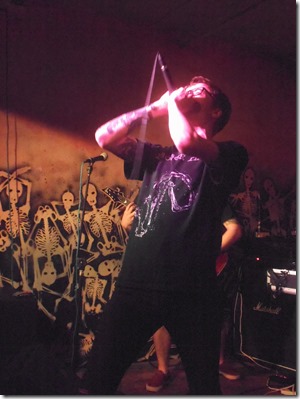
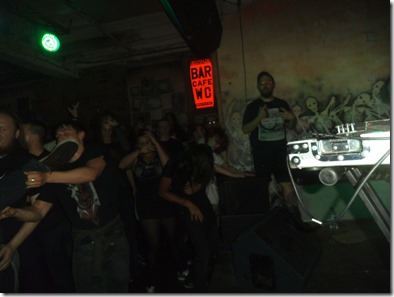
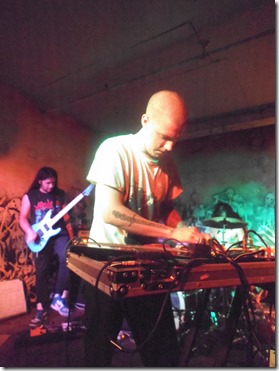
I’ve no idea who I saw performing a ‘secret set’ in the Meatlocker (the venue’s second stage, still draped with original plastic curtains because it was absolutely fucking heaving and I’d had a few beers by this point but they were intense and loud and brutal. But Full of Hell… Fucking hell. I’d run into Dylan Walker shortly before the set and was struck by just what an affable guy he was. On stage, of course, it’s another story: blasting ear-bleeding electronics and brutal vocals with a violent energy amidst a raging tempest of the harshest grindcore around, live shows don’t come more intensely visceral than this. How much of the set was lifted from the latest long-player, Trumpeting Ecstasy, I couldn’t say: I was too busy avoiding flailing feet and flying bodies, and clearly, the pain in my left side tells me I failed somewhere during the mayhem. But this…. THIS is catharsis.
DSCF0534DSCF0484DSCF0505

Full of Hell

I stopped to have my photo taken with some random strangers on my way out: they liked my hat. I may have drunk too much beer, but in the main, I was hitting the cool night air elated and exhilarated, and on a different plane from the one I had arrived on.


Hallow Ground – HG1703 – June 2017

Christopher Nosnibor

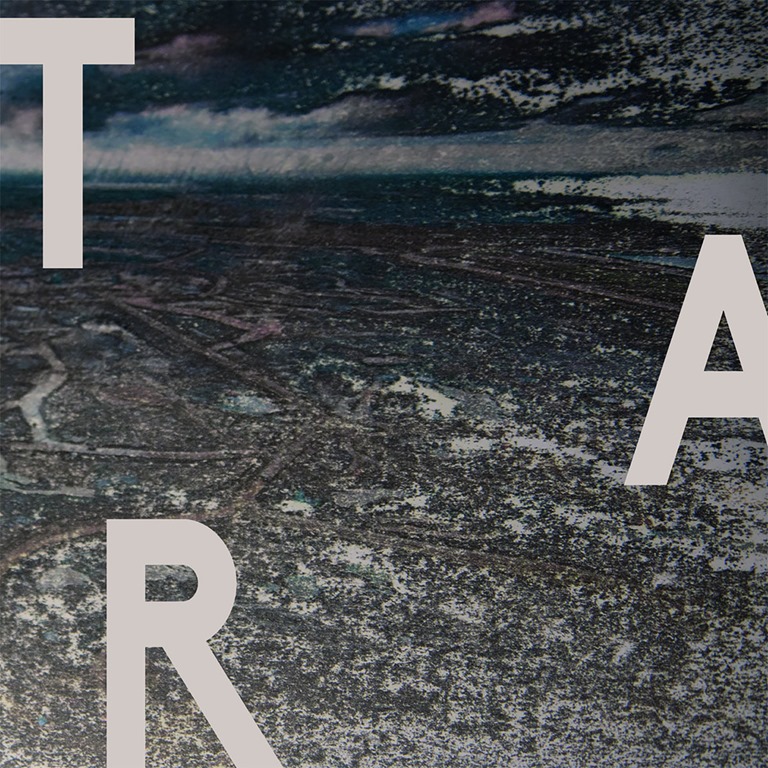
TAR is the fourth solo album by Tehran-based composer Siavash Amini, although he’s joined by Pouya Pour-Amin on electric double bass and Nima Aghiani on violin. Not that the individual instruments are readily recognisable in the thick sonic swirls which combine to forge the ever-shifting soundscapes of TAR at least in the main. But when Aghiani’s violin weeps and bleeds emotive from amidst the amorphous aural clouds which turn and taper, billowing and rolling, throbbing and pulsating.

‘A Dream’s Frozen Reflection’ begins droney but gentle, but inside the first two minutes breaks into a serrated sonic tempest. Music that sounds for all the world like a circular saw accompanied by a saw played more conventionally (does anyone play the saw any more? Or has it more or less gone the way of the comb and the washboard?) isn’t an easy sell, but Amini creates an intense aural experience that immerses the senses. But for all the harsh tones, there are contrasts in abundance, and through forging a shifting soundscape, the atmosphere changes, sometimes almost subliminally over the course of the piece.

‘Rivers of Tar’ plunges into murky, dark territory, but crystalline glissandos cascade through the eddying clouds of sulphur, while graceful strings rise and sweep expansively. It’s hard to determine whether or not it really carries an emotional resonance, but as a listening experience, it’s got more than enough range and features some passages which do have that vital drag.

At times, ‘The Dust We Breathe’ is barely there, delicate contrails of soft ambience washing in and out. There are periods dominated high-volume undulations of grating, snarling noise early on, but over the course of its fourteen-minute duration, the track drifts quietly and softly into the background.

It’s Amini’s ability to manoeuvre, effortlessly and almost untraceably, the trajectory of the four compositions from head-crushing abrasion to lulling calmness which is the greatest achievement of TAR. It’s an ambient album which carries a sting in the tail sharp enough to hurt, while equally massaging the mental receptors with its delicate tones.

The extent to which TAR translates Amini’s desire to explore ‘the fragile tensions between and individual and collective subconscious’ is largely irrelevant: TAR is an unexpectedly dynamic work, brimming with texture and contrast.

Siavash Amini – TAR