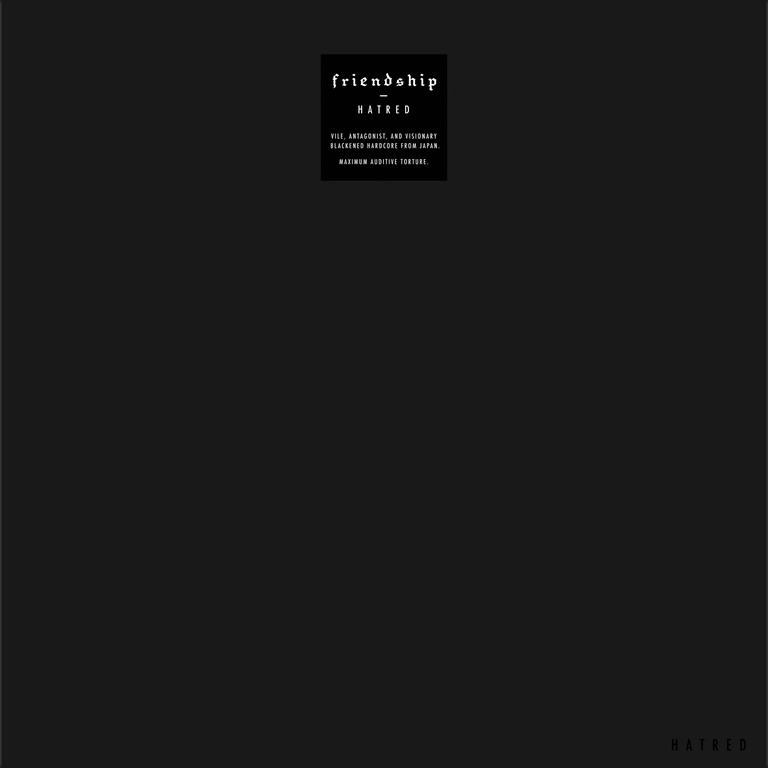
Fast and furious isn’t in it. But the enigmatic and secretive Friendship are from Japan, and when it comes to extreme music, Japan really leads the field. And if Hatred seems an odd title for an album by a band called Friendship, then the equation really should be turned on its head: for a band this brutal, abrasive and gnarly to be called Friendship is simply perverse. There’s nothing friendly about them, and song titles like ‘Rejected’, ‘Regicide’, Corrupt’, ‘Tortures’, ‘Grief’, and ‘Execution’ don’t exactly send hugs in abundance either.
Of the album’s twelve tracks, only two extend beyond the three-minute mark, and half are sub two minutes. Holy fuck, this is fast and hard and nasty. It begins with feedback and immediately plunges into the dingiest, gnarliest, darkest metal noise going. The drums are pounded so fast it sounds like a pneumatic drill. Everything else is just a blurred barrage of insane, intense noise. There are riffs, but they’re brief, and churningly cyclical. The rest is all squall. And it’s a furious, punishing grind.
If friendship it is, it’s an abusive one which shows no regard for the wellbeing or mental health of those concerned. But as far as hatred is concerned, this album is all aspects of pure loathing distilled to the most potent concentrate.
Listening to Hatred is like having your soul torn from the heart of your being and ground to a pulp before your eyes, while your eyes are being pricked with hot pins. Aurally, it’s torture in its own right.
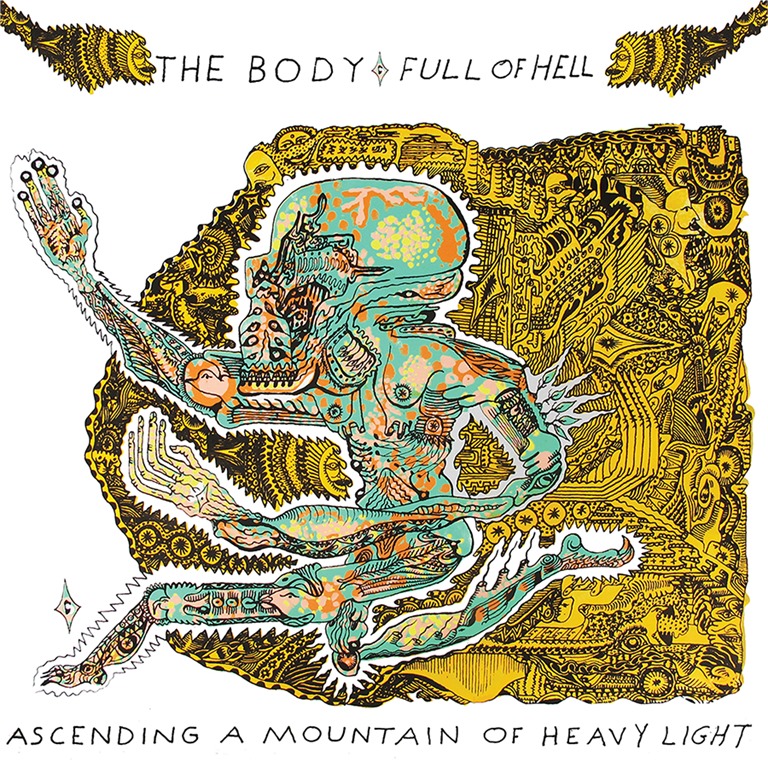
The second collaborative album between The Body and Full of Hell, which collides with the earth like a meteor, and a mere 18 months after its predecessor, and just six months after Full of Hell’s full-tilt annihilation that was Trumpeting Ecstasy, it’s every bit as unremitting and remorselessly heavy as anything previous. It’s the sound of two uncompromising bands finding compromise by amplifying one another to the nth degree, meaning that Ascending a Mountain of Heavy Light is fucking intense, fucking heavy, and yes, even more fucking intense.
The accompanying blurb forewarns that ‘samples, synth, saxophone, and a drum orchestra all throb, and sputter, coagulating under the weight of the two bands. Programmed drum patterns and loops taking cues from hip hop are bent and twisted throughout, flawlessly emboldening the distortion drenched guitars and howling vocals.’ And did I mention that it’s intense?
Beyond the first few seconds of skittering synth oscillations, there is no light on the opening track, ‘Light Penetrates’. The crushing power chords land at tectonic pace, while the vocals – an impenetrable scream of anguish – are nothing more than a primal scream of pain. And then the jazz shit beaks loose, with horns squealing like tortured pigs bleeding in all directions.
There’s nothing pretty about this, but occasionally, from amidst the screeding walls of amorphous racket emerge full-throttle stoppers, like the pounding ‘Earth is a Cage’. Elsewhere, ‘Didn’t the Night End’ is a snarling, grinding, bowel-shaking racket of surging waves of noise that simply hurt. It’s the kind of snarling, grinding, bowel-shaking racket that makes you want to lie on the floor and curl up into a foetal position. It makes you want to die, and it certainly makes you long for the night – and the noise – to end, as it assails the senses from every angle.
The drum intro is nabbed from oh, so many tracks – a simple four-four thump of a drum machine bass – before everything explodes in a tempest of screaming industrial-metal fury. Early Pitchshifter come to mind, at least in the drum programming, but this is something altogether more psychotic in its unbridled fury, and in its amalgamation of paired-back hip-hop and industrial metal, all crackling with overloading distortion, ‘Master’s Story’ invited comparisons to the innovations of Godflesh – at least until it goes all crushing doom halfway through.
As with anything produced by either band, either independently or collaboratively, Ascending a Mountain of Heavy Light is not music for pleasure, and large chunks are little short of anti-music, blistering walls of sonic brutality built on discord with the most challenging of tones and frequencies explored to the max.
It’s a fucking miracle Arrows of Love are still here, let alone that they’ve managed to nail a second album. But then, to watch them play live, it often seems like a fucking miracle that they can make it to the end of a set. Everything about Arrows of Love, from day one, had had an air of precarity, teetering on the brink of implosion. Every song carries that same sense of danger. It’s their wild volatility that sets them as one of the most exciting bands of the last decade, but ultimately, it’s the songs that matter. They’ve always had songs: sprawling, messy, noisy, fucked up and perversely challenging songs, underpinned with some lean grooves.
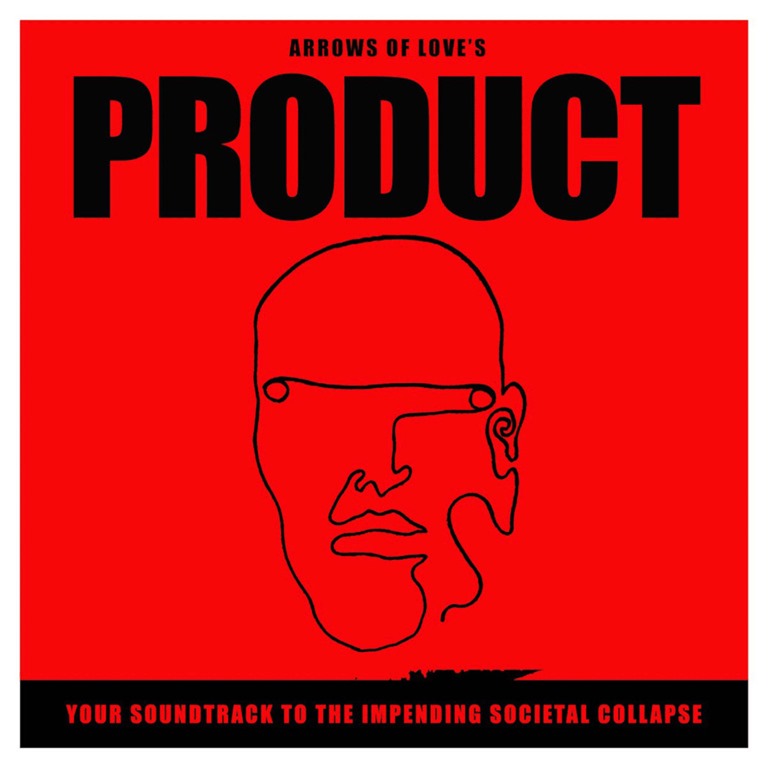
Product has been a long time in coming and the line-up on this, their second album, is quite different from the one which recorded their debut. In the period between the delivery of aforementioned debut the nihilism-in-a-nutshell noisefest that was Everything’s Fucked (May 2014) Arrows of Love have evolved, and perhaps some of it’s a natural progression and some of its… not so much an increasing maturity as a refocusing of energy, and some if it’s a result of the personnel changes. One obvious shift is the absence of shared vocals: Lyndsey Critchley’s departure has certainly altered the dynamic of the band in that sense (bassist Nuha Ruby Ra’s vocal contributions are a lot less prominent, and she only leads on one track, the surprisingly sultry and almost tender ‘Come With Me’), and Product is a lot less direct and attacking than its overtly grunge-orientated predecessor.
That doesn’t mean that Product is any less confrontational or antagonistic, and the nihilism which drove Everything’s Fucked is apparent in the subtitle ‘Your Soundtrack To The Impending Societal Collapse.’ Moreover, the use of the definite article shows an absolute confidence in what lies ahead – Arrows of Love are certain we’re past the tipping point and freewheeling toward the end of the world as we know it. Product is certainly a darker, more claustrophobic affair than its predecessor, and finds Arrows exploring wider, deeper territory in the process.
‘Signal’ is dark, dense, disturbing, and desperate, and is heavily hung with a curtain of goth which drapes over the violent (post)punk energy. ‘Did you ever see this coming?’ Nemah challenges through a fuzz of distortion ‘Let the lunatics run the asylum,’ he spits, and we know that this isn’t the future he’s predicting, but a plain observation on the present. The tension builds into a squalling racket and the vocals reach fever pitch as the track reaches its explosive climax.
It feels like an eternity since ‘Predictable’ first aired on-line – and while the band articulate their ennui at the daily shit that is life in the 21st century, as a musical work it’s anything but predictable. The vocals transition from drawling boredom in the verse to screaming mania in the chorus, while the guitars lurch and swerve every which way.
Marking a change of pace and direction, ‘Desire’ is dark, brooding, stripped back, introspective. At near the six-minute mark, it’s a seething mess of emotions: Arrows of Love are a band who’ve always emanated a gritty sexuality, but this channels it in a very different way, and it’s not comfortable or snuggly.
‘Tidal’ is perhaps the most overtly ‘art-rock’ song on the album, as well as being the most classically ‘grunge’ composition, with its quiet / loud verse / chorus juxtaposition. At the same time it encapsulates the dual character of Product, and album that swings – quite effortlessly, and thus with maximum impact – between classic post-punk trappings and raging noise, with exploratory experimentalism informing the process.
‘Beast’, which premiered some months ago now, is a swampy, squalid mess of seething abrasion a throbbing mess of bass that sonically calls to mid Melvins in places but ultimately stands as the soundtrack to a riot. The shrieking ‘Toad’ is equally uncompromising, and ‘The Parts That Make the (W)hole’ comes on like a hybrid of The Fall, Shellac and The Cooper Temple Clause. ‘Restless Feeling’ captures the dark, dirgy doom of Swans circa 1984 and makes for one hell of a low ending to the album: if anything, it’s the sound of society after the collapse as its low-end swell builds to an all-consuming tsunami of noise.
Product bridges the gap between Bauhaus and Nirvana, but ultimately, any comparisons are but signposts to an album which is unique in its standing. Product avoids pretence and overblown portentousness: it doesn’t make lofty statement about the future, but instead stands as a painfully intense document of the present. If any album of the last five years articulates the dizzying, anxietised state of contemporary life, it’s Product.
Now, I’ve been digging Nasty Little Lonely for a while. Clearly, this is because I’m a music reviewer who gets to hear about everything in advance and I’m infinitely cool because of it.
But seriously, I was introduced to these noisemongerous mofos three years ago, by means of their Bad Jack & Other Stories EP. And they’ve only continued to get better – by which I mean more intense and visceral – ever since.
‘Ugly Vitamin’ is a seething, squalid eruption of-guitar-driven derangement that calls to mind not only Hole at their best, but also the sneering ferocity of Lydia Lunch the rather more psychotic Queen Adreena. It writhes into the skull and penetrates hard. A choppy, chunky bass and hammering rhythm drives through squalling, treble-smash guitar and Charlie Beddoes does sweet but dangerous on the vocal front. You don’t want to fuck with NLL, that’s for sure: but you do need them in your life.
With Billy Blacklister’s recent relocation to Germany, there were likely to be questions over the future of Leeds’ masters of abrasive angular noise. The arrival a new three-tracker as part of Too Pure’s singles club series answers them: their first new material to be released since their second album, Adult, in October 2015, is absolutely fucking blistering.
It may be hard to believe, but they’ve actually gone one louder, one heavier, one more ferocious than the previous release here. A tangle over overdriven guitar wails over drumming that’s up front and pure Shellac leads the assault on Dart. The bass is brutal and Billy’s vocals are sharp and full-lunged. They’ve not gone for hooks, instead going all out for battering ram brutality, all with their trademark hint of mania.
‘Disco’ and ‘Drag’ both clock in at under three minutes (the latter only just breaking two). On the former, sinewy guitars skew angles across a nagging bass groove. Funky it isn’t. On the latter, chords stab like daggers as the whole thing lurches at pace to an abrupt halt.
Lyrically, the songs are largely impenetrable, but this isn’t music to muse to: Dart is a violent, visceral experience – and one of the best things I’ve heard all year.
MC/CD/DL – Nakama Records –NKM012 – 22nd September 2017
Christopher Nosnibor
I’m not entirely sure what a no-input mixer is, and I’m not sure I have the energy or motivation to find out. But it’s one of the ‘instruments’ Utku Tavil ‘plays’ on this album, in addition to snare drum and sampler.
What I do know is that Juxtaposition is a studio work of four Oslo based improvisers (and not the indie mongs who went by the same name who came round to my flat in Glasgow in 2000 to be photographed by my achingly hip flatmate) recorded in the spring of 2016. Various timbres of opposite extreme, as a result of each musicians’ different approach and background, coexist without hierarchical restrictions. Having that in mind during playing, the mixing process played a crucial role to deliver a concrete body of equalitarian sonic output. Without compromise, moments of joy and pain, screams, feedback and bird sounds are layered on top of each other.
This is not music that’s easy to listen to, let alone love. Scraping, distorted clanks and clatters echo atop growling, prowling, near subsonic bass intrusions and an elongated howl of sustain. And that’s just the first thirty seconds. An overloading mass of shuddering, screeding extranea rapidly builds to skull-crushing intensity, as shrieks of treble erupt like solar flares from amidst the tempestuous racket.
‘Pakistansk Mango’ is a fiendish mash of vocals – Natali Abrahamsen Garner does not sound of this world, and it’s hard to compute that the sounds emanating from her being are untreated, unprocessed – shudder and judder to a babble of stuttering repetition, against a backdrop of bubbling synths, ear-shredding bursts of pink and white noise, and nail-scraping feedback reminiscent of Total Sex era Whitehouse. Pleasant it is not. In fact, as distorted metallic bangs and hammers batter through a sonic riot of indeterminate origin, I’m feeling pretty fucking tense.
A yammering percussion that sounds like a cross between a locomotive and a nailgun provides the spine behind a whirling aural assault for ‘Revolver’.
Natali Abrahamsen Garner and Agnes Hvizdalek’s voices exist outside the realm of the human, and serve to add a disturbing, unheimlich aspect to the already hellish, grating sonic torture. Screams, shrieks howls and growls are all integral to the traumatic experience. ‘1000 Poeng’ features a host of primal screams over growling synth bass and brutal, waspish feedback. On ‘Enkle I’, a deranged bleating entwines with a surging skitter of overloading electronics and a swirling vortex of nastiness, and a mess of brown noise buzz blasts in around five minutes into the final track, ‘Trost’.
Juxtaposition is a cruel and punishing work, which exploits the full sonic spectrum and every texture, from grainy abrasion to the razor-sharp to inflict maximum pain.
The album’s blurbage tells us that ‘Shit & Shine’s sidestep from percussion led bunny rabbit rock ensemble performance based glee to ultimate heavy fools of the sticky dancefloor remains one of the more inspiring turn around’s in recent years’. They’ve certainly come a long way from the percussion-dominated noise rock racket of their formative years, but Craig Clouse continues to demonstrate a tireless appetite for pushing both himself and the listener.
Some People Really Know How To Live picks up where the 2015 album Everybody’s a Fuckin Expert (also on Editions Mego) left off, and the cover art even serves as a companion piece of sorts. Musically, it combines elements of disco, electro, old-school industrial and classic experimentalism to forge a sound that’s murky, dense, vaguely nauseating and still strangely danceable.
Warping, woozy drones taper in and out against bumping bass and a whip-crack vintage Roland snare sound on opener ‘Behind You Back’, before ‘Dish 2 Dish’ brings the groove. Dark and vaguely dubby, it’s also angular an abrasive, hectic and blustery, with some big bass tones. Its lack of sophistication is somehow a virtue, in that there’s a directness and spontaneity that gives it real punch.
Samples are lobbed in here and there, adding to the dislocation of shivering synths and engine-like growls, atonal incidentals and the fractured, warped grooves which abound. ‘Notified’ brings heavy clattering percussion and low-down grindy bass. With a time signature that’s unpredictable to say the least, it’s disorientating and head-pummelling. Elsewhere, the fucked-up funk of ‘Girl Close Your Eyes’ bumps and grinds its way through the stomach to make you shake. With beats that are propulsive providing the power behind a twisted sonic attack that’s more repulsive, Some People Really Know How To Live is some good shit.
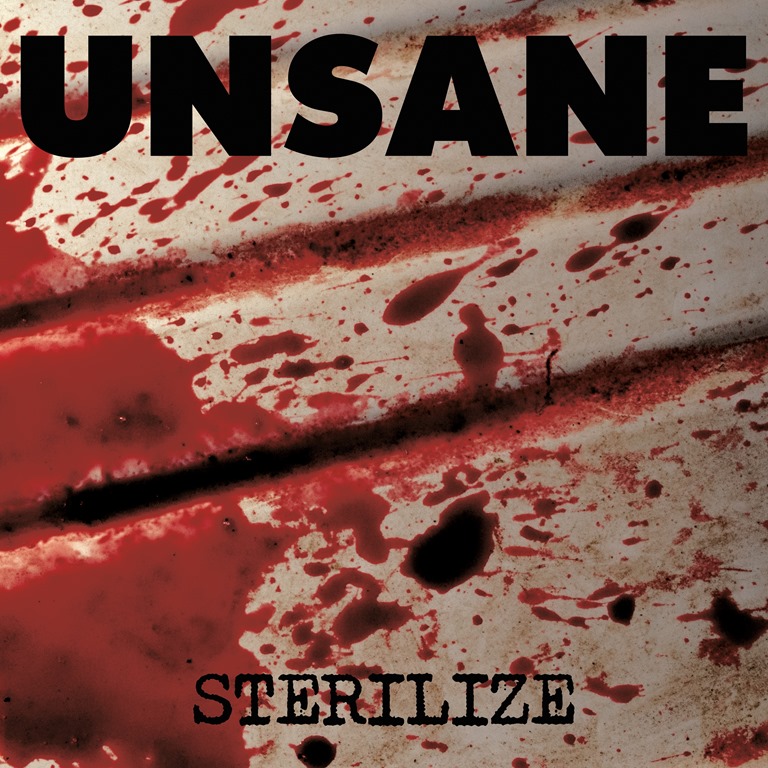
It’s been five years since Wreck appeared on Alternative Tentacles. So what have Unsane been doing in the intervening period? Gazing at their navels, taking up yoga and discovering a serene spirituality as a means of dealing with the anguish of life in the modern world? As if. They’ve been distilling their brutal rage into even more intensely bleak slabs of sonic nihilism. And, naturally, it’s housed in appropriately unsubtle, gore-soaked artwork. Unsane’s album covers are nothing if not distinct: while so many metal album covers which display hematomaniac tendencies are highly stylised and revel in the intended shock value, Unsane’s covers are all the more shocking by view of their clinicality, resembling crime scene photos than works of art. This is in many ways true of the music itself: there’s a functionality, a bluntness about it, and no sense of there being any indulgence or show.
Everything about Sterilize is stark, uncompromising, and connotes post-industrial, post-everything society, the dehumanising effects of merely trying to exist in the capitalist world where everyone gets pushed further and further down for the benefit of the few. It’s the soundtrack to life being sucked from the soul, the sonic encapsulation of desolate fury.
The grey steel assault of ‘Factory’ sets the tone and tempo: screeching feedback whistles through the grey, grain of the guitars and sludgy bass. From thereon in, the ferocious howls of anguish and packed in tight, back-to-back.
The song titles are also functional, direct, descriptive. Again, there’s no fluff, and little joy, to be found around ‘We’re Fucked’, ‘A Slow Reaction’ or ‘Distance’. Everything is paired back to the bare essentials and compacted for maximum impact. This includes the blues-based sound that defines Unsane: it’s crunched up, compressed, stomped into submission, meaning that while there is a certain swing to it, it’s limited to the most concise and precise form.
‘The Grind’ is aptly titled and brings a thunderous deluge of guitar; ‘Aberration’ is built around a simple four-chord trudge; and ‘No Reprieve’ sums up the album as a whole. You don’t listen to Unsane for variety, either across a given album, or their output overall. You listen to Unsane to vent, to experience a relentless viscerality. There’s something almost self-flagellatory about listening to an Unsane album in its entirety. At a certain point, the initial sense of catharsis is replaced by a crushing claustrophobia. This isn’t to say it’s an unpleasant experience, but is indicative of the effect of such sustained intensity. It’s as exhausting, mentally and physically, as the exertions of daily life on the treadmill, a punishment as reward.
When they slow the pace a shade, the weight is turned up, and when they hit a groove, it’s explosive and blistering. The tripwire guitar that stretches its sinews over the sludgy trudge of ‘Lung’ only raises the tension, and closer ‘Avail’ draws a heavy curtain of screaming anguish on proceedings with distorted vocals tearing across a rumbling bassline and savage guitars.
There’s a desperation and urgency about Sterilize which ensures that it crackles from beginning to end. Everything seethes, spits and scrapes and there’s not a moment’s relief. It’s this intensity which makes Sterilize as strong as any Unsane release. It’s mercilessly harrowing, but is ultimately satisfying in a perverse, sadistic sense.
Following their recent exclusive on Pure Grain Audio, York-based hardcore punk four-piece, Seep Away, have their released new single ‘Matchstick Man’. The new single is taken from the band’s forthcoming EP, The Blackened Carnival Of Societal Ineptitude, due in the Autumn.
Taking influence from thrash legends Municipal Waste, alongside hardcore standouts Expire and Incendiary, the track is a vitriolic stab at those individuals we all know who drain the life out of those around them.
Vocalist Jay Sillence comments, “This song is quite personal to me – we all know that special type of asshole who sucks the life out of people with their actions – they just want to fight, and fucK, and they have nothing else in their life of any value, so they have to take from others. This song is a dedication to that special person in my life, and I hope other people can relate to the venom that I feel.”
The soundcheck in progress while I’m ordering my first pint suggests we’re in for a loud night. Well, the Facebook event page did give fair warning. It’s a good job I’ve brought earplugs: the guy behind the bar points out that he’s already wearing his.
It’s 6:40pm on a Sunday evening in August. Outside, it’s still warm and the sun is out. Inside, it’s seriously dark, even with the curtains open and daylight filtering in. The THING – whose ‘Nightmares for Children’ streamed exclusively on Aural Aggravation back in April, begin their set with a dolorous bell chime and ominous, droning synths. The fear notes give way to a massage deluge of gut-grinding sludge: the guitar sounds like a bass, the bass sounds the bowels of Beelzebub after a phal. As they thunder through a continuous half-hour set, I’m reminded of Sleep, but the samples and synths which emerge through the murk gives an industrial edge to the doomy dronescape which reaches its climax by building through a single chord and floor to being battered at increasing speed before breaking into a tsunami of sludge.
The THING
Rotting Monarchs win band name of the night, no question. But starting fifteen minutes late in a tightly-packed schedule is not so cool, and they seem a bit disorganised and lacking in finesse. Still, their shouty, grindy punky racket brought together bits of NOFX with hints of Bomb Disneyland, which is no bad thing.
The place is suddenly a lot busier: Shrieking Violet have brought their mates. And they’re young. Many of them have short skirts and shiny new DMs. I’m here in my cracked £20 steel-toed Chelsea boots and beer-stained jacket. I’m not expecting much. Yes, they’re pure 80s, as if the singer’s hair and shirt didn’t give it away. The first track has hints of early Ultravox. But equally as the set progresses, I’m reminded of This Et Al minus the falsetto. They benefit from some hooky tunes propelled by some phenomenal, powerhouse percussion. ‘Avalanche’ is built around a steely, cyclical riff worthy of Killing Joke, and overall, it’s a strong set.
Shrieking Violet
They may be playing as a three-piece sans bassist Dani, but SEEP AWAY still manage to bring eye-popping intensity and ear-shredding volume to proceedings. The eight-string guitar ensures the sound’s got density, and when paired with Dom Smith’s fierce drumming – his second set of the night having already pounded through The THING’s set – there’s plenty of sonic backdrop for Jay to do his manic thing. He’s a hell of a showman: that he’s wild and unpredictable and relentlessly in the crowd’s faces means you can’t take your eye off him for a second.
SEEP AWAY
My opinions on novelty bands are no secret, and in the main, I think they suck. Petrol Hoers are a novelty bad so perverse, so fucked-up and plain wrong, that they’re an exception. Two blokes – two fat blokes – one wearing dungarees with no shirt, but a comedy horse’s head, the other wearing red Y-fronts, a fine mesh vest and a Mexican wrestling mask, stomp around hollering over backing tracks of blistering, uptempo industrial-strength bangin’ techno. In paper, it sounds both weird and shit in equal measure, but the audacity of these guys is as sheer as the pants guy’s top. The half dozen people who last the duration of their set absolutely fucking love it.
Petrol Hoers
Little Death Machine take the stage ten minutes after their set was supposed to finish. Are they worth the wait? Absolutely. The London trio play in near-darkness, adding to the taut atmosphere which emanates from their technically precise and detailed compositions. On account of being scribbled in the dark (and not on account of the pints consumed over the course of the evening), my notes are a shade difficult to decipher, but in the moment I was taken by their rock / post-rock / hop-hop / soul rock hybrid. I also note by way of reference points Placebo, Oceansize, Nine Inch Nails, TesseracT, and some stuff I can’t make out from the scrawl.
Little Death Machine
Did I really write ‘soul rock’? Yes, it appears so, and if that reads like an insult or criticism, it’s not: the moods that are deeply entwined within the songs, which are complex and progressive in their structures, are played with a sincerity and soulfulness that you feel. And that’s something no amount of technical ability or compositional dexterity can fake. It’s emotive, textured and resonant. And the perfect finish to an intense and varied night of live music.





 Aural Aggravation