Posts Tagged ‘Musetta’

Christopher Nosnibor

Stephen Kennedy has an outstanding sense of occasion. Having put on grand candlelight shows under the Gothic Moth banner in the Cemetery Chapel in York, there was no way the album launch for his latest project, Papillon De Nuit, was going to be some pub gig with a couple of local rock bands supporting. And so here we are in The National Centre for Early Music, a converted church with a high, twin-vaulted ceiling. It’s an appropriate setting in which to mark the release of Musetta, an ambitious album a year in the making involving a considerable number of collaborators. This also marks their first live performance, and features a necessarily expansive lineup, featuring ‘cello, piano, guitars, drums and percussion, soprano, orators and vocalist’.

It also happens to coincide with the hottest June day in history – the third consecutive record-breaker, no less, so it’s a relief to be seated and in an old church rather than standing in a sweaty bar – much as I love sweaty bars, the humidity of later has been such that we’d have had people passing out left, right, and centre in such a setting. It’s still plenty warm enough, thank you.

The doors open later than advertised, and seeing the amount of gear on stage – and the sheer size of those drums – it’s hardly surprising. Most bands travel by transit van, or even car. The Tengu Taiko Drummers have a removal van parked outside. Once we’re all in, the lights go down, and there is a hush of expectation. And we wait. It’s a good three suspenseful minutes before the ominous drone and trilling pipes begin to creep from the PA and finally, the drummers begin to appear. No wonder they’re starting behind time: the setup for The Tengu Taiko Drummers is mind-blowing. They filter onto the stage in masks and present a piece which offers a narrative alongside the striking visuals and the sonic impact of the barrage of percussion. The logistics of some eight musicians packed onto the stage, bounding and leaping and switching positions, plus changing the configuration of the numerous and large drums between pieces would be challenging any night, but with the heat and humidity it’s little short of an heroic feat. It’s an extremely physical performance, and the players aren’t so much glowing as aflame only halfway through. It’s clearly a battle for breath, but they power through to deliver a spectacular show.

DSC01846DSC01869DSC01857

The Tengu Taiko Drummers

Thank dog there’s a bar with some refrigerated beers: the interval affords a vital opportunity to replenish some fluids before Papillon Du Nuit make their highly anticipated stage debut. And they don’t disappoint. The plan, on paper, is simple: to play the album. But to bring a studio-based project to a live setting is a huge leap, and often, what works on tape doesn’t work so well live. But here, it all works spectacularly, and they sound as if they’ve been rehearsing for months – although the fact of the matter is quite different. Indeed, the fact is they’ve only rehearsed a couple of times, so it’s testament to the musical intuition and the high level of skill of the players that they come together so well. The sound, too, is fantastic. Clearly, the venue is set up for musical performances, but the sound engineer achieves magnificent clarity and separation between the instruments.

They open the set as the album begins, with the brooding ‘Jude’, Kennedy whispering ‘Is it dark or am I blind?’ ‘The Pilgrim’s Arc’ sees the drums leading the mix for the first time, paired chunky five-string bass break from Dominique, and showcasing them at their most expansive and ambitious, with its dual vocals, whereby Karen Amanda O’Brien’s voice provides a counterpoint to Shephen’s on this this sweeping epic of a song.

DSC01876DSC01890DSC01877

Pappilon du Nuit

Images of tombstones and lyrical themes of mortality and loss abound, and these are songs rich in poeticism and steeped in the most beautiful melancholy. ‘I’m in your head / so I’m not dead,’ Kennedy sings on ‘Sister, dear’, and it’s as if he’s speaking from the other side in the future tense. The effect is intensely moving, balancing the darkness of the inevitable with a rare positivity, without ever being cliché. In contrast with the reflective atmosphere, Kennedy is sporting – in addition to his trademark hat – some pretty bold trews, the black and white striped spandex giving more glam metal vibes than soul-bearing introspective gothic drama.

‘Amber’ is sparse and atmospheric, and with its marching boots introduction, its dark, gothy bass and snaking guitar, ‘Frozen Charlotte’ is a real highlight of the set, as it is on the album. It’s sweeping, majestic, grand, the sound crisp and clear and nailed tightly to some tense, metronomic drumming. Mika Rudawska’s brooding cello stands out in shaping its haunting atmosphere.

DSC01885DSC01913DSC01918

Bringing the The Tengu Taiko Drummers back for a collaborative rendition of ‘Ariadne’ makes for an incredible finale: Kennedy vacates the stage to stand in front as soprano vocalist Megan Richardson takes centre position, and he enthusiastically conducts this monumental performance.

Combining an album launch with a debut live outing was an ambitious project, to say the least – but it befits such an ambitious musical project – and not only did it not disappoint, but exceeded even the highest expectations. Nothing short of stunning.
26th June 2026

Christopher Nosnibor

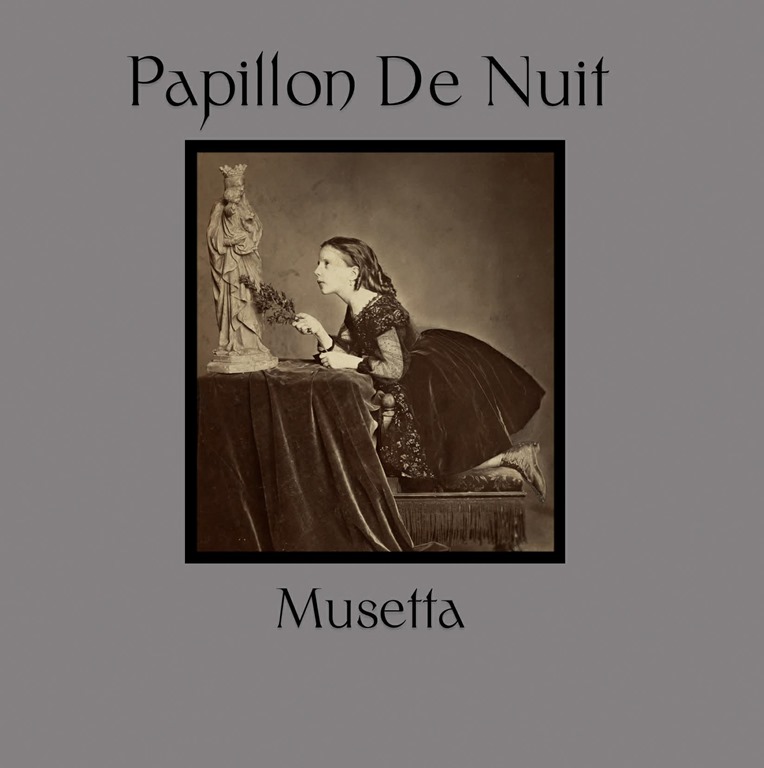
Although they may have seemingly risen out of nowhere a couple of years or so ago, Papillon du Nuit, the ever evolving, ever-expanding musical project revolving around Stephen Kennedy, alongside Mika, Steve, and Karen (who between them cover vocals, cello, grand piano, guitars, keyboards, and percussion) is a coming together of individuals who have been on and around the ‘goth’ and adjacent scene in the north for some considerable time, to form a loose collective. Having debuted in October 2024 with ‘Scarlet’, they’ve built a body of work through a succession of singles – eight in all. Most acts would have simply compiled said singles to assemble an album – but not Papillon du Nuit, and certainly not Stephen Kennedy – because he likes to do things the hard way. The proper way. And because his roots lie in that 80s goth era where bands like The Sisters of Mercy grew their fanbase through a series of ever-evolving single releases but saw the album as a different medium, a means of creating a specific, thematically unified document. As it happens, Musetta sits somewhere between the compilation and standalone document, plucking a selection of those previous singles and placing them amidst the new songs, meaning that of the album’s nine tracks, five have been previously released, although sitting in the context of an album they feel different somehow. And as much as Papillon du Nuit embrace some elements of goth – or perhaps, more accurately, the gothic (think brooding atmosphere, haunting imagery, a sense of drama) – this is a project which goes far beyond genre, with strong leanings towards neoclassical, chamber pop, the theatrical, even the operatic.

As they explain, ‘The album is named after Musetta, one of the major characters in the opera La Boheme, who is enshrined with all the qualities, and all the follies, that make us who we are. Many of the songs here explore a mythical, almost mystical journey, with life displayed more as an inevitably straight path, rather than something circular. The songs are not about death, but many of them lead there’. Some may mock with a ‘pretentious, moi?’, but Musetta is a work which is fully committed to art, and therefore sweeps pretence aside in being the real deal. That Steve Whitfield (The Cure / The Mission) produced, and co-wrote some of the tracks is nothing if not proof of pedigree, as well as their commitment to delivering an album which goes to great lengths to realise strong intent.

Heavy breathing, a panting even. Tension. Suspense. Then comes the panicked whisper: ‘is it dark, or am I blind?’ It has a decidedly Beckettean feel to it. A piano begins to reverberate. This is ‘Jude.’ As a single, it arrived as a stark and curious hybrid of poetry, theatre, and folk with a prog-rock leaning and a sense of the epic. In a revised context as an album opener, it feels very much like an introduction, a passage into a vast musical world. ‘Pilgrim’s Arc’, the most recent single, released in October, is driving, dynamic, tempest of a composition, and makes for a stark contrast arriving immediately after. Immediately, it’s apparent that there’s no small consideration been given to the album’s flow and shifts in mood and pace, and even this early, themes of time and mortality emerge.

AA

The first of the unreleased, album-specific songs, ‘Natalie’, follows, and it’s cinematic, widescreen-even, with its string-soaked chorus, again building to a spectacular finale. It’s no criticism to say it sounds like an album track: it’s magnificently executed, and offers some respite from the experimental intensity of the songs which precede it, and the cello-forward ‘A Sea Within An Ocean’ is the work of a band spreading out and settling, stretching their limbs and simply composing to make music, free from the (self-made) pressure to record a single in a day, or whatever their previous process was. It feels looser, more relaxed, and the result is a rolling, hypnotic wave of a song.

‘Cello Poem’ – at a mere two and three-quarter minutes – feels like more of a narrative bridge than a song in its own right, and the spoken word segue links single cuts ‘Amber’ and ‘Ariadne’ – and does so quite effectively, in truth. It does, however, keep death as its focus. And I suppose this is the core of the matter. As they say, ‘The songs are not about death, but many of them lead there’. How many of the great plays, novels, or poems aren’t about death, at least in some way? Death is, after all, the only certainty in life.

AA

Where Musetta differs from other albums where death is a preoccupation or a focus is that this is an album which carries a weight. It’s in no way frivolous or posturing, it doesn’t take death simply as a motif: it’s a soul-felt meditation on the end of life. No glorification, no stylisation, but a philosophical contemplation. It’s this which makes Musetta so impactful. Not only is youth wasted on the young, but life is wasted on the living, by and large. That is to say, it’s hard to appreciate what you have until it’s gone, or slipping away, and while so much goth – and metal, and so much music of many styles, for that matter – is preoccupied with death in a conceptual way, there comes a point where it comes all to near, all too real, and here it gets scary – rather than a game of lofting skulls and a flamboyant delivery. Shit does get real, and we all have to face the reality of mortality. And at this point, it’s not cool, it’s not dramatic, it simply becomes a heavy reality. We start by losing grandparents, and parents, and often, in between, friends and peers. And when it’s your peers, you start to worry. And if you don’t, you probably should.

Musetta is packed with heavy moments – not so much sonically, but emotionally, philosophically – and it’s woven with a fabric rich in literary allusions and diverse stylistic influences. ‘Visionary’ is a word I’m cautious in applying to anything, particularly anything contemporary – but ambitious and accomplished, wide-ranging, powerful, and moving… Musetta is all of these things, and more.

AA

Album Cover