Christopher Nosnibor
Chameleons might be considered as being among the ‘also-rans’ of the early days of goth, along with the likes of, say, Rose of Avalanche and The March Violets. Despite gaining a solid cult fanbase early on, due in no small part to a stunning debut album, subsequently signing to Geffen in the mid-80s, as well as receiving substantial critical acclaim, they somehow failed to take off. Calling it a day after the release of their third album, Strange Times in 1987, they reconvened briefly at the turn of the millennium. Their latest reunion, now five years in, is approaching their longest continuous run, and has also yielded a new album and EP. And so here they are, arguably as popular now as they’ve ever been, and not as a nostalgia act but a going concern. The number of younger people in the audience tonight is also testament to this.
The doors are early – 7pm – and Kahula are on early doors – 7:10 – so play to a mere smattering of an audience. The five-piece from Manchester are like many of the new, younger emerging bands who are taking the post-punky / goth sound of circa 1984 as their template. They’re a bit early U2, with vocals which evoke Lloyd Cole and Ian MacCulloch. They’re competent, but uninspiring, and they’re met with polite applause.
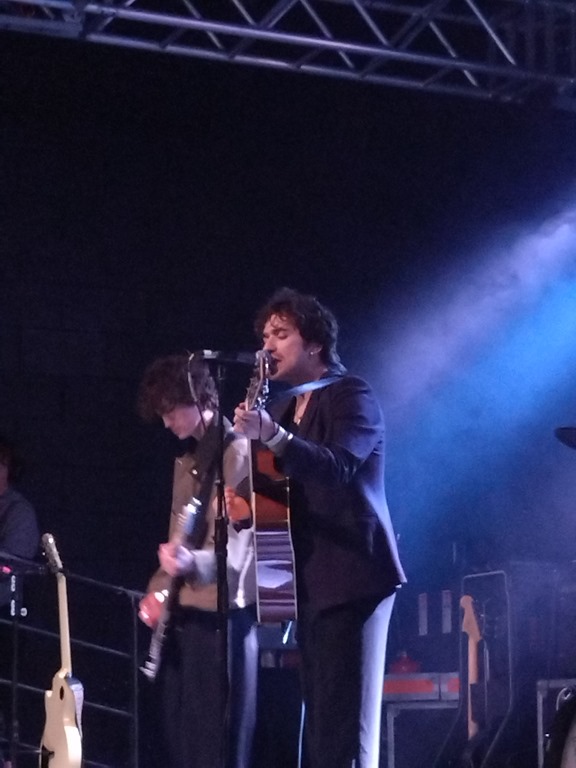
Kahula
Lol Tolhurst by way of a support act is quite something, and a definite draw here. In the wake of his two books, the most recent being Goth, which has been well-received, the co-founder of The Cure has been enjoying something of a career revival after the wilderness years which followed his expulsion from the band circa Disintegration.
Of course, his set of early Cure songs – from the period where was an active co-writer – isn’t a solo set, and he has a bassist and guitarist (who covers the vocal duties) accompanying his drums, and they open with a super-slow and supremely dolorous ‘The Holy Hour’. The bassist throws Peter Hook lunges. And then they’re straight into ‘A Forest’, which would have been more expected as a closer. ‘Siamese Twins’ is next after an intro from Lol which references the closing line and Sylvia Plath. Of course it’s bleak.
Tolhurst’s drumming is simple / sparse / motorik depending on your perspective, but hearing these early Cure songs live and in a – comparatively – intimate setting (Stylus has a capacity of 1,000) is, almost inevitably, moving, even in the absence of Robert Smith’s unique vocal. You can see from the body language that they’re feeling it onstage, too, inhabiting these oppressive sonic spaces.
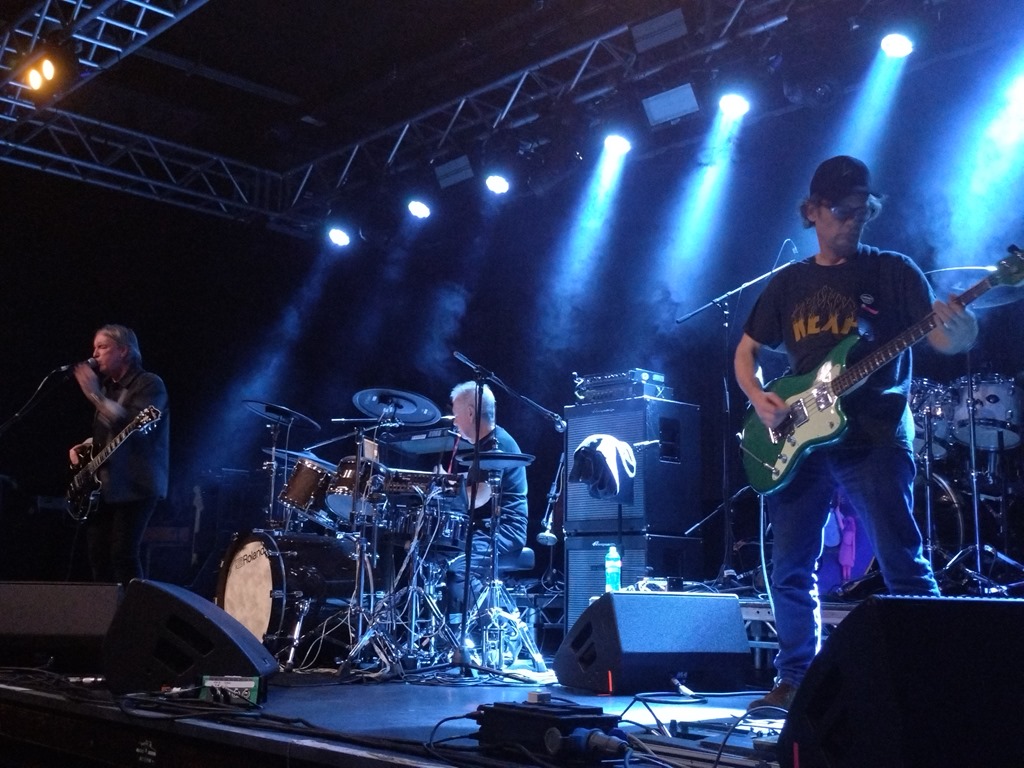
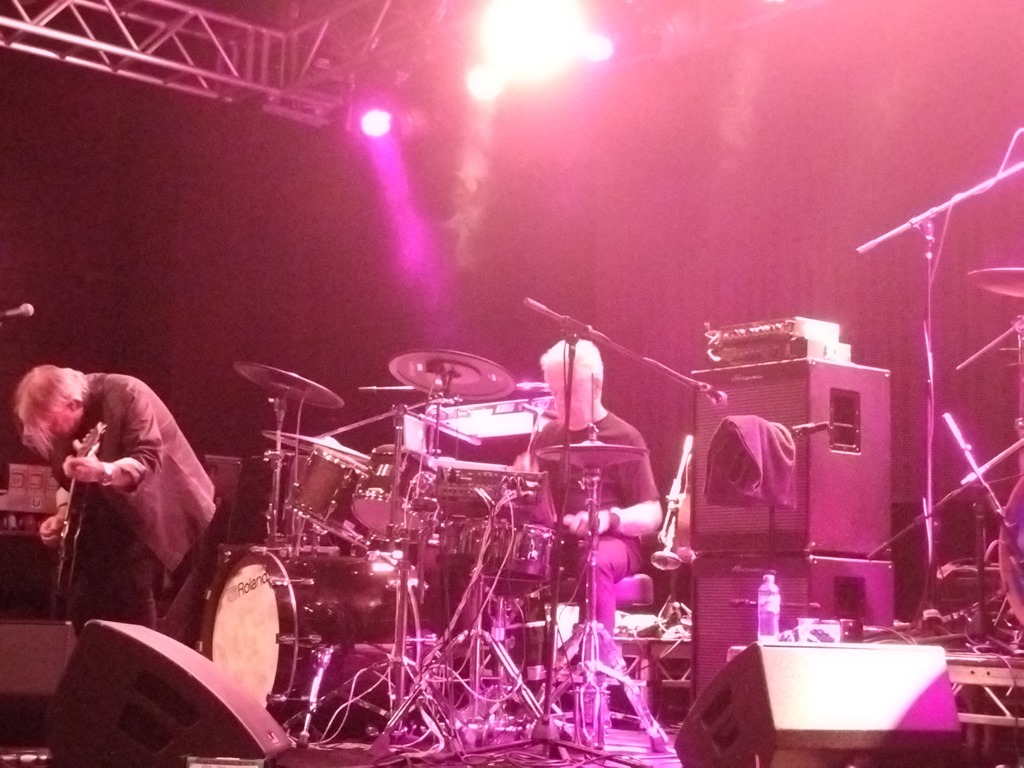
Lol Tolhurst
Their rendition of ‘A Strange Day’ isn’t instantly recognisable, and it doesn’t quite gel, mangling that essential lead guitar part. ‘M’, however, sounds perfectly crisp and brittle. The singer seems to struggle with some of the notes on ‘The Hanging Garden’, where the other two seem at their most comfortable. Lol introduces ‘All Cats are Grey’ as a ‘slightly different version’, and reminds us that they’re his songs too. He seems to have revisited a demo version or something for it, and it does provide an interesting insight into his contribution to the writing process for those early albums. It’s drummier than the studio version. Again, it’s the vocals which are the weakest element, and it’s perhaps worth noting that the guy onstage isn’t the one featured on the tour promo. Or perhaps not. ‘Three Imaginary Boys’ prefaces a band intro, before they give us ‘Boys Don’t Cry’, and at their scheduled end time, launch into ‘10:15 Saturday Night’ by way of a finale. And having promised a set of Lol-era Cure songs, that’s what they gave us.
Chameleons open a set loaded with newer material (five of the seven songs from Arctic Moon feature in the seventeen-song set) with ‘Where Are You?’, and they sound fantastic. Their LED backdrop is like a movie through the set., and I suspect some of it – at least – is AI generated, and I find a certain discomfort in this. Still, there’s nothing remotely artificial about the musicianship or the enthusiasm with which they play the songs.
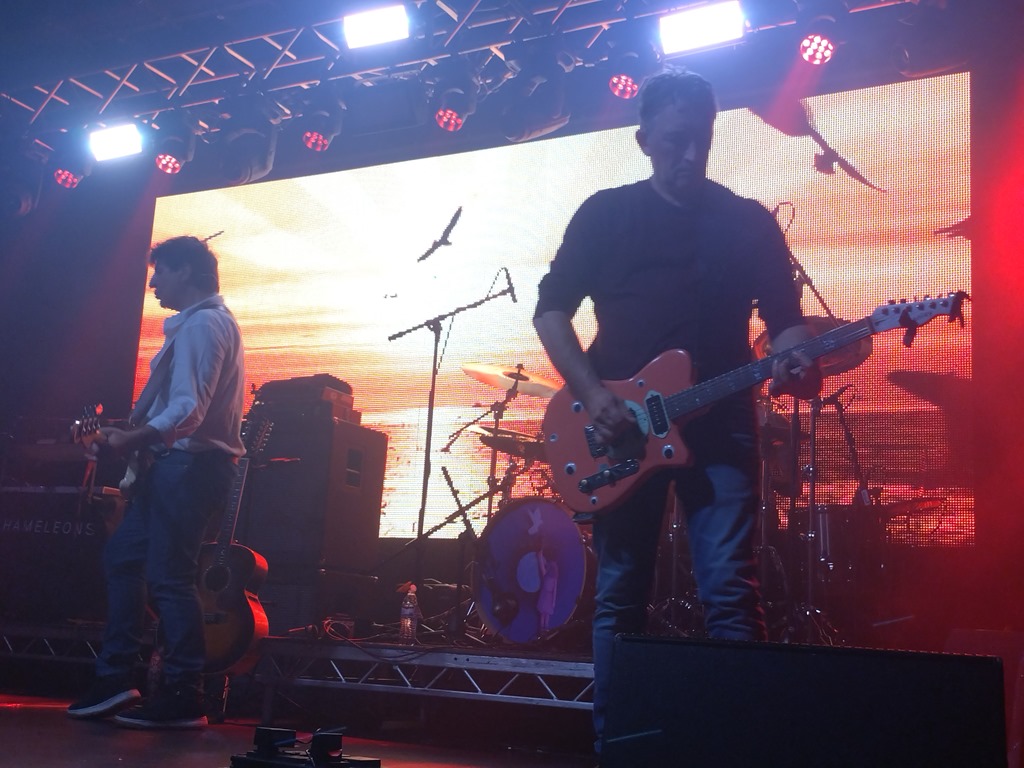
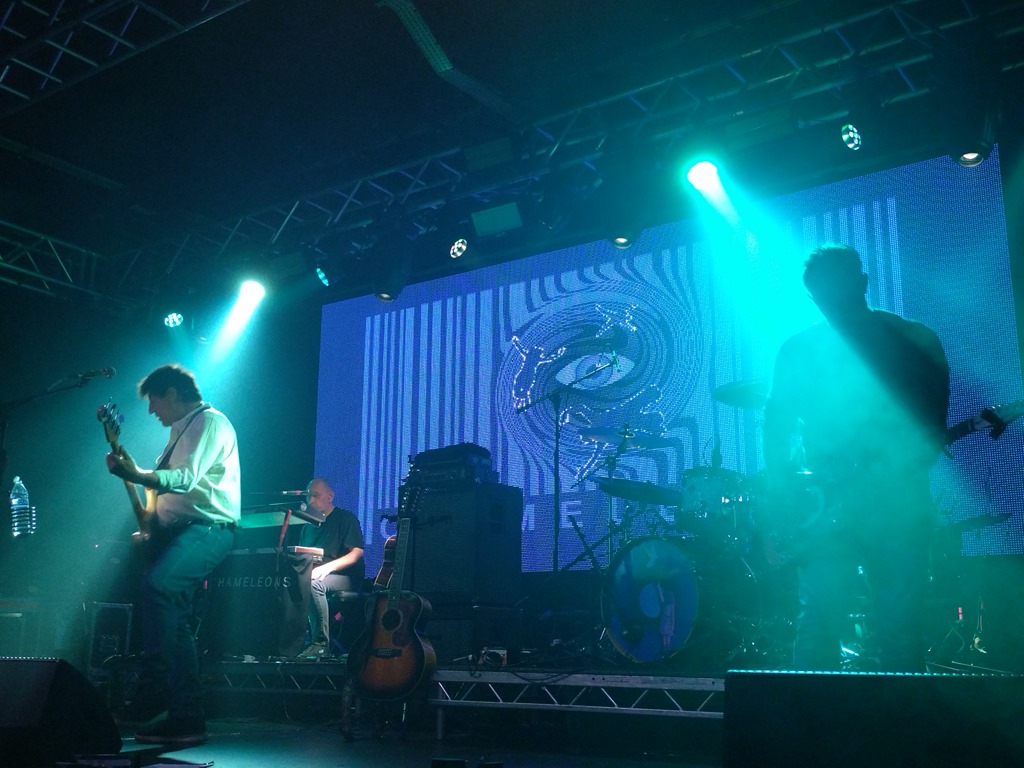
Chameleons
The jangling indie of ‘Lady Strange’ lands third, and sits comfortably alongside the older tunes.
‘I wish these songs weren’t still relevant,’ Mark Burgess opines before they drop the first truly vintage track of the night in the form of ‘Up the Down Escalator’ from Script of the Bridge.
Burgess’ voice is remarkably strong, and with two guitars, they sound muscular. Burgess looks office casual, and pretty limber, too. He swaps his bass for a 12-string acoustic for the epic ‘David Bowie Takes Me by the Hand,’ another one from the new album.
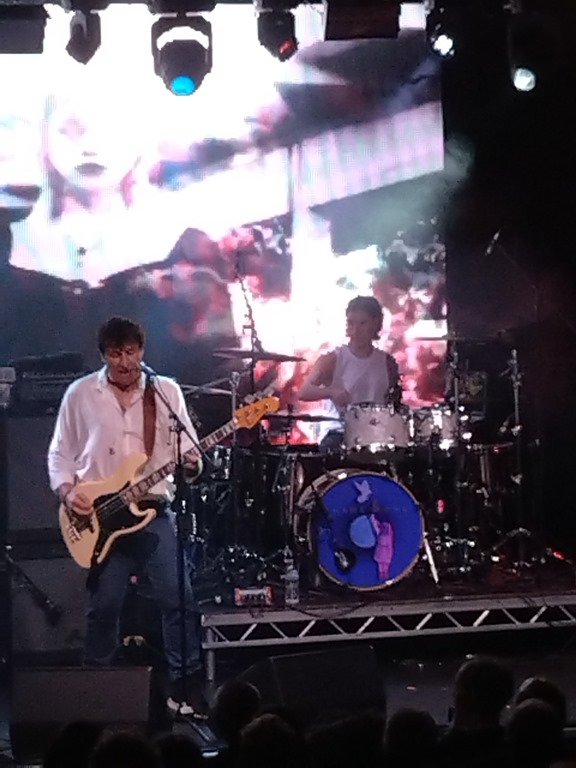
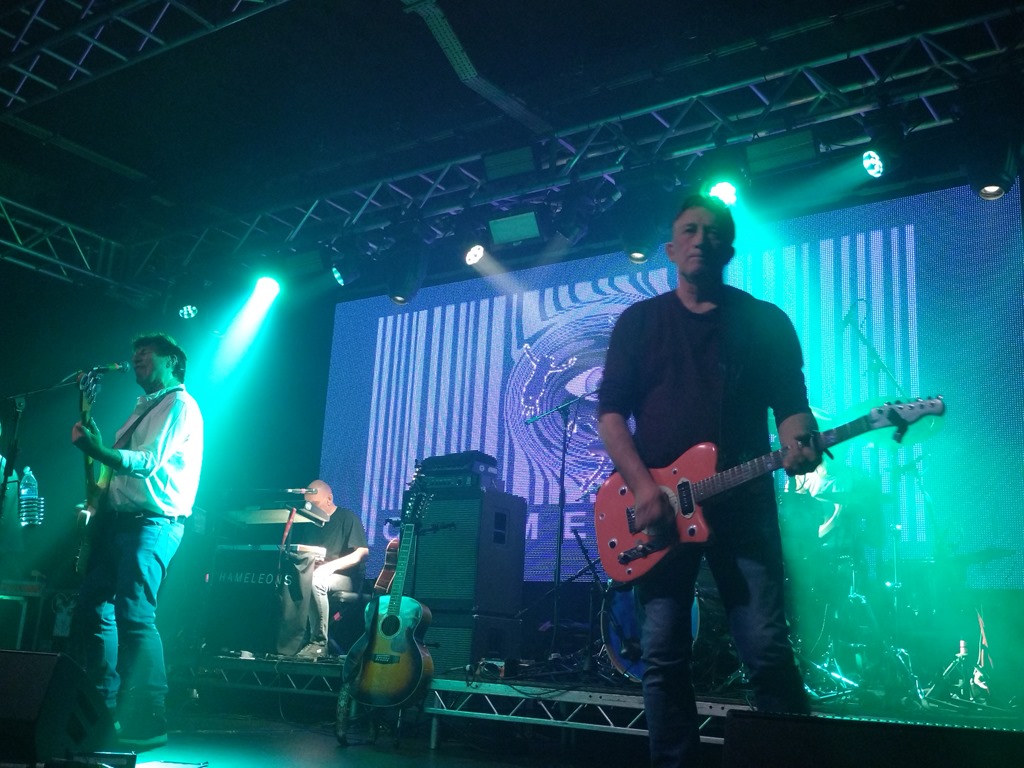
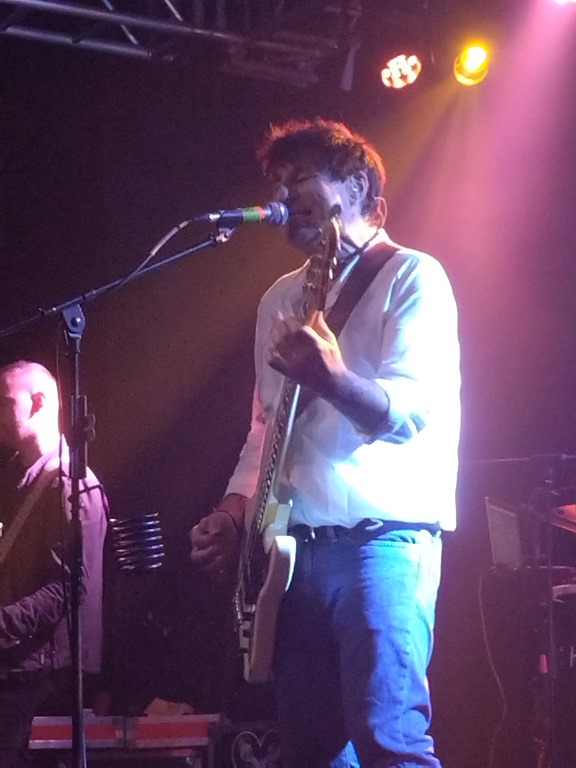
Chameleons
He warns that Trump is just the prelude of worse to come before ‘Saviours Are a Dangerous Thing’, and they land ‘Soul in Isolation’ at the hour mark – and if my ears don’t deceive me, there are nods to The Beatles’ ‘Eleanor Rigby’ and ‘There is a Light that Never Goes Out’ by The Smiths’ slipped in along the way, giving something of a medley feel to this already huge tune.
Hearing ‘Swamp Thing’ with fresh ears and in a live setting, it’s easy to understand why they were hailed as they next U2. Meanwhile, the epic ‘Feels Like the End of the World’ is one of the standouts on Arctic Moon, and so it proves to be in tonight’s set, too. They wrap up a colossal set with the killer brace of oldies, ‘Second Skin’ and ‘Don’t Fall’. It’s incredible that songs of this vintage can still sound fresh, but then, it’s incredible that Chameleons are this good after all this time.