Posts Tagged ‘Intense’

Room40 – 18th July 2025

Christopher Nosnibor

Norman Westberg seems to be a man of few words. Through all of his years with Swans, I can only recall interviews with Gira and Jarboe, although I have for many a decade now admired Westberg’s stoic approach to playing: no showmanship, no seeking of attention, instead channelling the sound, often with infinite patience, screeding feedback and a single chord for an eternity. His solo material is considerably softer than Swans in tone, but no less brimming with tension and atmosphere, and this is nowhere more apparent than in his solo live sets, as I recall in particular from seeing him open for Swans in Leeds two years ago. Onstage, he was unassuming: in contrast, the sound he made, was powerful.

And so it is that the words which accompany Milan are not those of the artist, but Room40 label head Lawrence English, who recounts:

In 2016, I invited Norman Westberg to Australia for his first solo tour.

He’d been in Australia a few years before that, touring The Seer with Swans, and it was during this tour that I’d had the fortune to meet him. Since that time Norman and I have worked on a number of projects together. He very kindly played some of the central themes on my Cruel Optimism album and I had the pleasure to produced his After Vacation album.

Last year Norman shared a multichannel live recording with me from a tour where he was supporting Swans. The recording instantly transported me back to the first time I heard Norman perform.

Whilst many people know his more dynamic and tectonic playing associated with his band practice, Norman’s solo work is far more fluid. Often, when I hear him live, I imagine a vast ocean moving with a shimmer, as wind and light play across its surface.

Norman’s concerts are expeditions into just such a place. They are porous, but connected, a kind of living organism that is him, his instrument and his effects. He finds ways to create moments of connection which are at times surprising, and at others slippery, but always rewarding.

There’s a deeply performative way to his approach of live performance. There’s a core of the song that guides the way, a map of sound, but there’s also an extended sense of curiosity that allows unexpected discoveries to emerge.

Milan, which I had the pleasure to work on for Norman, captures this sense perfectly. It is a record that exists in its own right, but is of course tethered to his other works. It’s an expansive lens which reveals new perspectives on familiar vistas.

This almost perfectly encapsulates my own personal experience of witnessing Westberg performing. And Milan replicates that same experience magnificently. Admittedly, despite having listened to – and written about – a number of his solo releases, including After Vacation, I was unable to identify any of the individual pieces during or after the set. Such is the nature of ambient work, generally. Compositions delineate, merge, and while the composer will likely have given effects settings and so on, which are essential to their rendering, to most ears, it’s simply about the overall effect, the experience, the way movements – even if separable – transition from one to another.

This forty-minute set is dark, disturbing, immersive, somewhat suffocating in its density, from the very offset with disorientating oscillations of ‘An Introduction’. It flows into the next piece, ‘A Particular Tuesday’, where tinkling, cascading guitar notes begin to trickle down over that woozy undulation which rumbles and bubbles on from the previous track. And over time, it grows more warped, more distorted. Something about it is reminiscent of the instrumental passages between tracks on Swans’ Love of Life and White Light from the Mouth of Infinity, and for all the swirling abstraction, there are trilling trickles of optimism which filter through here.

Amidst a swell of bass-booming, whorling sound on sound, gentle, picked notes just – just – ring clear and give form to an amorphous sonic mass, but this too gradually achingly, passes to the next phase, and then the next again. ‘Once Before the Next’ is the sound of a struggle, like trying to land a small wooden rowing boat in a gale. And it’s in context of this realisation that there are many depths and layers to Milian, but none which make for an easy route in, and there is no easy ‘check this snippet’ segment. Instead, it’s the soundtrack which prefaced the ugly one w know is coming.

While Milan is obviously a live set – and at times, the overloading boom of the lower frequencies hit that level of distortion which only ever happens in a live setting, and the sheer warts-and-all, unedited, unmixed approach to this release is as remarkable as it is incredible in listening terms. This isn’t a tidied-up ‘studiofied’ reworking of a live show. Milan is a document of what happened, as it happened. You can feel the volume. The density and intensity are only amplified by the volume, and you really do feel as if you’re in the room. Let it carry you away.

AA

AA

a1125531819_10

Negative Gain Productions – 25th July 2025

Christopher Nosnibor

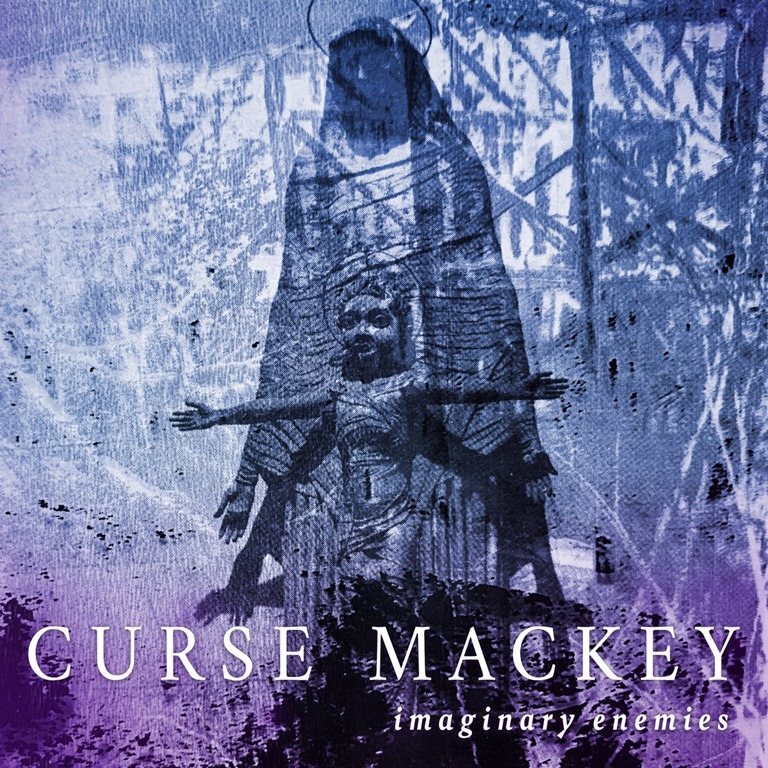
It’s been three years since Curse Mackey delivered Immoral Emporium. Three years may not be a long time, but a lot can happen in three years – and it has. And very little of it has been good. There has always something about industrial music – something I’ll unpick in a moment – which has displayed a sense of the apocalyptic, to the extent that at times it seems to almost bask in it. And that is not a criticism. The end is nigh, and while it’s always a question of ‘when’ rather than ‘if’, we seem to be ever closer to the brink of total annihilation. These are dark times, which call for dark music.

Industrial has come to mean many things, in terms of musical forms over the years, while Throbbing Gristle were the progenitors of all things industrial, technological advances saw acts more interested in pursuing more structured works with tape loops and drum machines, eventually giving us the more electro-orientated strain of industrial that became synonymous with Wax Trax!, and, subsequently, industrial metal, not least of all due to Ministry’s evolution from one to the other. Curse Mackey’s work very much belongs to that late 89s / early 90s Wax Trax! domain.

Concluding the trilogy which began with 2019’s Instant Exorcism, Imaginary Enemies promises to be ‘his most intense and intimate album to date… A bleak, beautiful meditation on paranoia, grief, and the ghosts we conjure from within’.

And so it is that the listener is lead into the album by route of looped samples, layering across one another, before a pounding beat crashes in, and Mackey, accompanied by a low, thumping synth bass groove, sets out his stall with ‘pressure points’, ‘psychosis’, and ‘decay’ delivered with a processed growl. There are many layers to the arrangements, creating simultaneously an expansive and claustrophobic feel. Single cut ‘Vertigo Ego’ swiftly plunges into darker, denser territories: brooding and ominous, Mackey’s vocals are a barely audible whisper. It sounds tormented, stressed, anguished.

AA

If ‘Discoccult’ and ‘Time Comes Clean’ (which calls to mind early (electropop) Ministry and Trudge era Controlled Bleeding) find us in fairly familiar industrial territory, something about the production imbues the material with a suffocating intensity. More often than not, there’s a brightness, a crispness, something of a ‘digital’ cleanness about the genre. In contrast, the sound here is murkier, more ‘analogue’ in feel, alluding to eighties synth music – something I’ve never been quite able to pinpoint as a listener and critic rather than a producer.

One can reasonably assume that album centrepoint ‘Blood Like Love’ makes a reference to Killing Joke’s ‘Love Like Blood’, even if only in title, but sees Curse lean towards gothier territories, stark, brooding, yet ultimately layered, graceful, with synth melodies and dramatic piano weaving around the samples and mechanised beats.

AA

The second half of the album locks into an atmosphere that’s less aggressive and attacking, and more brooding, moody, and introspective, and as such, marks a clear departure from its predecessors. What’s more, it works well, with the more uptempo title track marking a high point in the album, sitting comfortably alongside some of the more contemporary goth classics with its nagging, reverb-heavy guitar line and pulsating bass all held together by that classic, relentless, drum machine sound.

For my money, it’s Curse Mackey’s best release to date.

AA

a1263141378_10

Christopher Nosnibor

Having shown a remarkably consistent rate of output, with three albums in just over three years (four if you include their collaboration with The Body), BIG | BRAVE have also maintained a similarly solid touring schedule, which has for the lucky people of Leeds brought them to the city on each of their last three circuits which have brought them to the UK.

On record, BIG | BRAVE achieve a rare intensity, and while heavily reliant on drone, feedback, slow, heavy percussion – things familiar to fans of numerous bands like Earth, Sunn O)), and Swans, they demonstrate a unique approach to songwriting and structure, and an ability to tap into raw emotion in a way which goes far deeper than mere words. Live, however, they’re simply so much more. All of these elements are amplified – and not just in the literal sense by means of their towering backline. Oftentimes, the first time of seeing an outstanding live act draws you back in the hope of recreating that initial ‘wow’ moment. But anyone who’s seen lots of live music will likely agree that great as subsequent experiences are, they never have quite the same impact. It’s incredibly rare – in fact practically unheard of – for an act to hit that same spot more than once. BIG | BRAVE are that rare thing: despite high expectations, they always seem to pull out something extra and surpass those expectations.

The hype from people I know in real life and virtually for these shows, particularly in context of the new album, A Chaos of Flowers was huge. And, it soon proved, entirely justified.

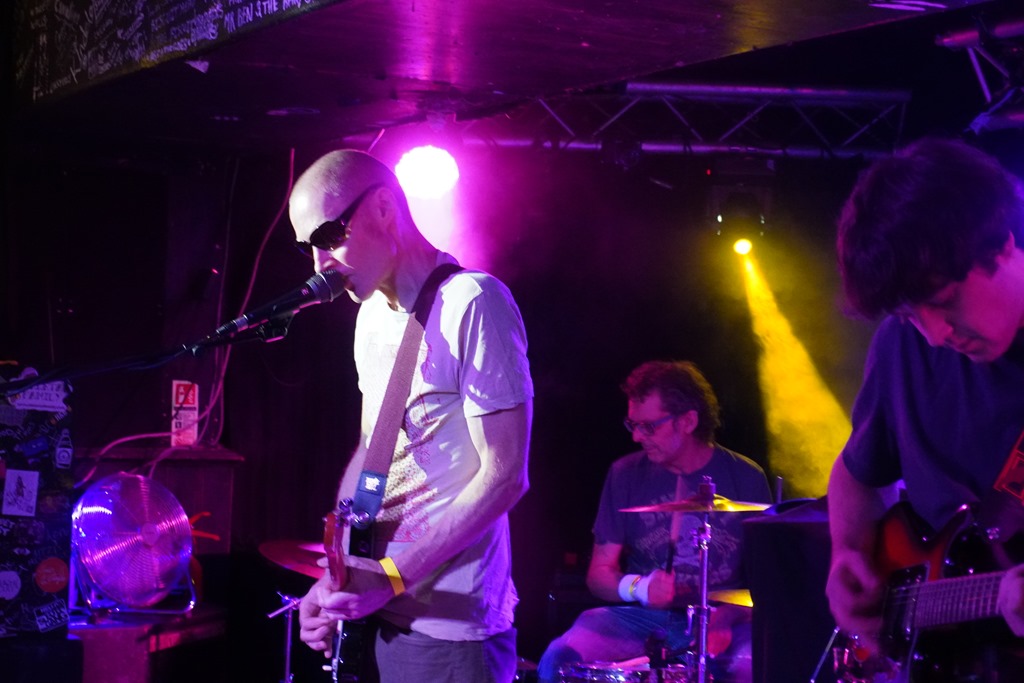
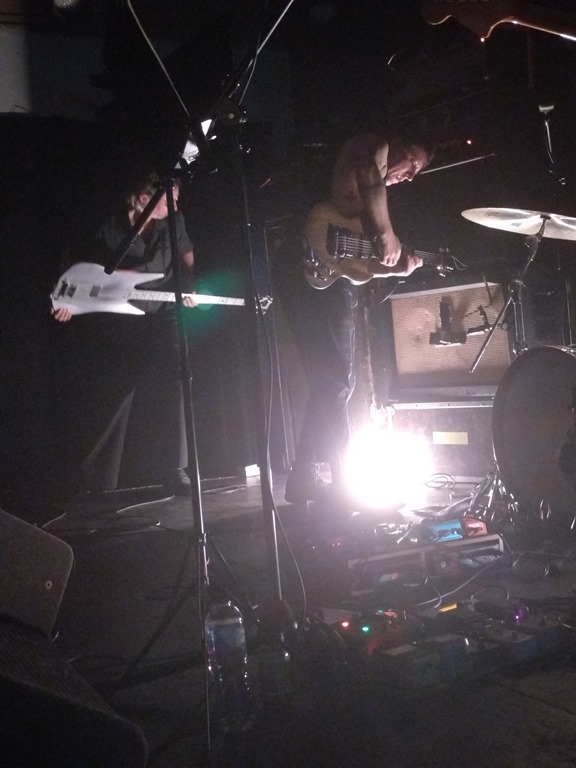
Keeping tour costs to a minimum, Aicher, who provided the main support previously, is the sole support this time around. The solo project of their live bassist, Liam Andrews, he’s joined this time around by BIG | BRAVE guitarist Mathieu Ball, and his presence adds further layers to the deep, rumbling sounds emanating from the PA. Playing in near-darkness, Andrews conjures thunder and heavy drones and explosions, while Ball wrings epic howls of feedback. Much of the sound is derived from the use of open contact with the guitar lead when disconnected from the metal-bodied bass he grinds against his immense rig, and there looks to become modular lead switching going on, too. This set feels darker and more structured than a year ago, and captures – and expands on – the sound of the Russell Haswell mastered ‘Lack’ single.

IMG_20240525_203315

Aicher

BIG | BRAVE’s ‘quieter’ new record does not translate to a lower volume live, but a balanced, dynamic approach to the sound. From the opening moments of the set, I find myself experiencing the physical sensations of enormous volume and strong lower-end frequencies, powerful vibrations shake my nostrils, my legs, even my scrotum, in a slow build. Frone hereon in, my notes are sparse as I find myself completely immersed in the performance. For an hour, I forget where I am, and the entire room is transfixed: there’s no chat, no-one’s jostling to be here or there, pushing forward, going back and forth to the bar. Time stands still, and so do we, utterly captivated by every moment.

‘The blinding lights facing out,’ I note… ‘A hypnotic, mesmerising, immense wall of shimmering sound. Each strike of the bass yields a shuddering quake. Sparse, subtle percussion’. I recorded very little else, but the rest is etched into my memory with such vividness it’s as is I can watch it all back in my mind’s eye.

IMG_20240525_212406

BIG | BRAVE

Watching the neck of Ball’s guitar flexing under force against the amp one minute, and seeing him move, light-footed around the stage, with the deftness of a point-toed ballet dancer is remarkable, and compelling. And the sustain! Without striking a note, with headstocks pressed against cabs, both his guitar and Andrews’ bass hold notes for near eternities. Robin Wattie is an understated yet immensely powerful presence, with instrumental segments far outweighing the vocal elements, but her guitar, too, is immense, and Tasy Hudson is outstanding – slow, measured, precise, powerful.

 IMG_20240525_215200

BIG | BRAVE

Andrews applies a violin bow to the bass for ‘I Felt a Funeral’, bringing an even weightier, dronier facet to the heavily textured sound. And that sound – and beyond, every molecule of their essence – stems from the contradictory elements of fragility and force, and they pull against one another at every moment. And it’s from the space between that the magical power of BIG | BRAVE emerges.

It’s only at the end, as the rapturous applause fades, that Robin finally speaks. The rest of the band are packing down leads and things around her as she tells us, her voice quiet and choked with emotion, how grateful they are to us for coming, for listening. It’s moving to see an artist so humble, so genuinely touched and amazed to be doing what they’re doing, that they’re playing to full venues who are so engaged. They’re doing steady trade at the merch stall a few minutes later, too, and deservedly so.

I leave, clutching my pink vinyl copy of A Chaos of Flowers after gushing at Mathieu about how they blew me away – again – while he served me, and step into the rainy night completely awed by the intensity of what I had just witnessed.

Thrill Jockey – 19th April 2024

Christopher Nosnibor

There’s been a quite staggering trajectory to the work of BIG|BRAVE: with each release they achieve an even greater level of intensity, which seems to be unsurpassable – until the next album. They’ve come a long way from their minimal ambient / folk beginnings. The instrumentation has remained minimal, but cranked out ear-splitting decibels, they’ve developed a way of creating a lot from comparatively little, and unlike many guitar bands, they’re not afraid of space. There is starkness, there is silence, there is separation between the instruments, and much room to breathe between slow, thunderous beats and crushing chords which collide at the pace of tectonic plates.

Vital was aptly titled, and marked a new peak in the articulation of raw emotional turmoil. It seemed improbable that nature morte could equal it, and yet it did, and went beyond, a desperate, feral edge pushing its emotive force to a higher level.

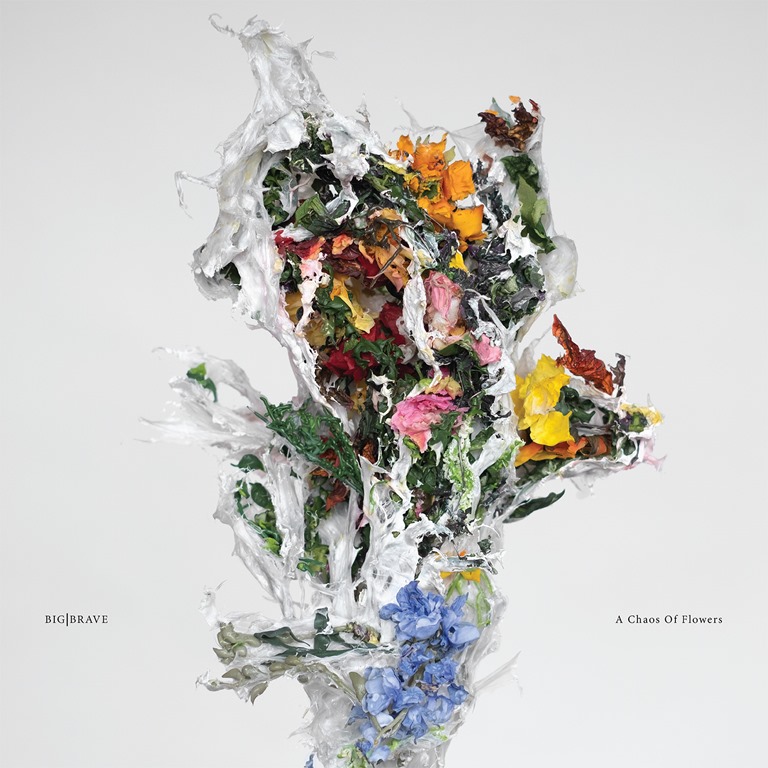
Coming a mere fourteen months after nature morte, and some substantial touring, how could they possibly sustain that kind of intensity? It seems improbable, but it’s happened. A Chaos Of Flowers is graceful, delicate, even folksy – but also eye-poppingly intense, cranium-splittingly loud, and utterly devastating.

The tracks released ahead of A Chaos Of Flowers hinted that this new album, beyond what seems human, would once again match its predecessor. ‘I Felt a Funeral’, which is also the album’s opening track, has strong folksy vibes… until the sonorous guitar tones enter. There are hints of late Earth about his, the way the resonant tones of pure sustain simply hang in the air. But dissonance builds, and there’s an awkwardness to this scratchy, imperfect beauty. The way Mathieu Ball’s guitar scratches and scrapes and builds to a blustering squall of dense, twisted noise is remarkable, building from nothing to an all-consuming howl. Yet at the same time, there’s restraint: it’s as if he’s pulling on a least to restrain this ferocious monster in his hands.

Currents – and volume – build. You’ve never heard guitar like this before. It brings the crushing weight of the drone of Sunn O))). And the thunderous relentless repetition of early Swans, but delivered with a breathy ethereal sparseness that’s difficult to place. And then there are the vocals. Not since first hearing Cranes in the early 90s have I heard a vocal so otherworldly.

The guitar feedback yearns heavy and hard in the final minutes of ‘not speaking of the ways’, a track which starts heavy and only grows in both weight and intensity. Robin Wattie’s voice is half adrift in a sea of reverb and drifting, almost drowning, in a tidal flow of guitar noise, for which you’d be hard-pressed to find a comparison. I’ve fried, struggled, failed. You can toss Sunn O))), Earth, MWWB around in the bag of references, but none really come especially close to conveying the experience of A Chaos Of Flowers.

The songs are shorter than on recent predecessors, and overall, the mood of A Chaos Of Flowers is different – dare I even say prettier than the last couple of albums. There’s a musicality and gentility about this album which marks something of a shift, and single ‘canon: in canon’ is the perfect evidence of this. One may say that ‘heavy’ is relative in terms of distortion and volume, but there is more to it than that. Many of the songs on A Chaos Of Flowers are delicate, graceful, sparse, with acoustic guitar and slow-twisting feedback dominating the sound of each track. There’s a levity, an accessibility, which is at the heart of every song here. Much of it isn’t overtly heavy… but this is an album which will crush your soul.

If A Chaos Of Flowers is intentionally less noisy than its predecessors, it’s no less big on impact. Raging, ragged chords nag away, until ‘chanson pour mon ombe (song for marie part iii)’ brings bleak, tones which cut to the core and explodes in to the most obliterative noise close to the end: this is the absolute definition of climactic finale.

There’s a rawness, a primitive, elemental quality to their music which has defined their previous albums, and this remains in A Chaos Of Flowers. You arrive at the end feeling weakened, short on breath, emotionally drained. I ask myself, how did I get here, so sapped-feeling? The answer lies in the force of this immense album. A Chaos Of Flowers is devastating in its power, and BIG|BRAVE reached a new summit – once again. The deeper and darker they go, the better they get.

AA

AA

641805

New Heavy Sounds – 26th January 2024

Christopher Nosnibor

It begins with a yawning, wailing drone, before thunderous bass, drums, and a rolling piano crash in tempestuously. But if you think this is just another heavy doom-leaning record with a dash of theatre, the arrival of Amber Gardner’s vocals changes everything. She brings an antagonistic, nihilistic punk vibe at first, but then, as the song transitions into a grand, sweeping expanse, reveals a softer side. And so it is that ‘White Noise’, the album’s eight-and-a-half-minute opener is a real shape-shifter, sliding back and forth between crushing weight and spellbinding atmosphere. But when it goes heavy, it’s utterly pulverising, and the sustained crescendo which occupies the last three minutes is gut-wrenching, annihilative, a rare exhibit of raw, chest-tightening emotional heft combining with the most punishingly brutal instrumentation, which leaves the listener feeling wracked, drained, ruined.

It may sound strange, but it’s often more difficult to write about albums which really hit you, which have the most impact. To scrabble for an analogy, it’s like being kicked in the chest and left lying breathless on the ground then being asked to describe the experience while still barely able to draw oxygen. It’s like… like… It leaves you stunned, numb, dazed, and at a loss. Regeneration is one such album. It’s all well and good clutching and comparisons and scratching for similes, but no words can really come close to articulating the spectrum of sensations which engulf your very being when faced with something so intense, so close to overwhelming. Yes, it’s dancing about architecture. What you want to do, more than anything, is to forcibly sit people down and say “listen to this! No, really, listen! Feel that!”

New York-based GUHTS (pronounced ‘guts’) declare themselves to be an ‘avant-garde post-metal project, delivering larger than life sounds through, deeply emotional music’. It’s the emotional aspect that hits harder than the punishing power chords, but it’s the combination of the two which really is the killer here.

The album’s seven tracks are incredibly ambitious in scope and scale, and in terms of balancing emotional depth and sheer brutal force. For the most part, the compositions extend beyond the five-minute mark, but are confined to under eight, and are effectively doom/goth epyllia – expansive, dense, cinematic. The prominence of piano – particularly notable on the slower, intensely wrought and dynamically varied ‘The Mirror’. One of those songs which sustains a surging sensation from the very beginning, it’s truly worthy of the ‘epic’ descriptor.

‘Till Death’ has hints of Cranes about it in Amber’s ethereal vocal delivery, but it’s paired with megalithic guitars of absolutely crushing weight, while the shortest song on the album, ‘Handless Maiden’ is monstrous in its unyielding heaviness. Gardner brings another surprise with her rabid howl, which is utterly petrifying.

There isn’t a weak track here, nor a single second that doesn’t feel utterly vital and doesn’t crackle with intensity, and Regeneration is an immense and powerful album. ‘Generate’ rolls into graceful shoegaze territory, with rolling drums and chiming guitars which wash and ripple mesmerically, gradually building to a sonic tsunami.

There’s something inevitable and completely perfect about the way it all leads the way to the ten-minute ‘The Wounded Healer’, which comes as a truly monumental finale. And what a finale! It begins delicately, ringing xylophone or glockenspiel chiming out mellow tones, before a grinding low-end grinds in and from here, the build is slow and inexorable. Gardner traverses the sonic space, shifting mood and tone in a flicker. The guitar twists and spins, tense and serpentine against the ever-swelling wall of booming bass and by only halfway through, you’re drowning, the air pressed form your lungs… and then… then… Christ. Gardner is possessed, and the guitars pulverise and you feel your skull beginning to compress. Finally, around the seven-minute mark, there is levity. Clawing for aa comparison, I arrive at Amenra, although it’s less than half the story of a song, and an album, which is utterly peerless and completely beyond spheres of comparison.

Regeneration is special, hard-hitting, unique. Really. Listen! Feel that!

AA

a3406377299_10

Fysisk Format Records – 26th January 2024

Christopher Nosnibor

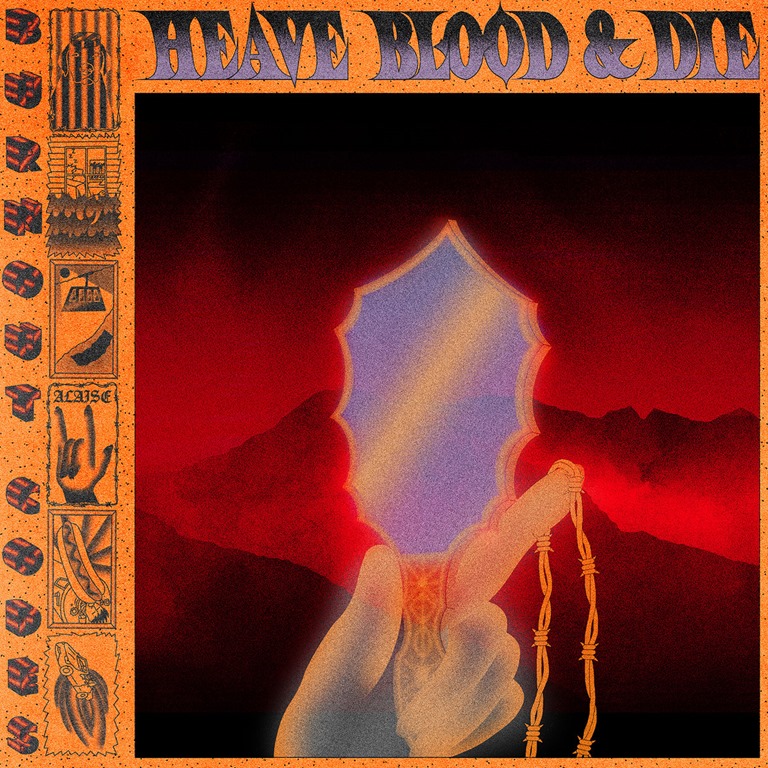
The arrival of single ‘Mjelle’ just the other day provided a strong alert to the imminent arrival of Heave Blood & Die’s Burnout Codes. The band’s name may have a certain comic-book flippancy about it, but their fourth album comes with altogether less cartoony connotations: as the accompanying text explains, ‘Dedicated to bassist Eivind Imingen, who decided to end his life just following the recordings of the album, Burnout Codes is shrouded in sadness and tragedy, and shows the Norwegian collective offering their most textured and innovative album to date.’

It’s not even a mater of English as a second-language: the phrase ‘decided to end his life’ is a difficult one to digest, and one which reminds us that there is no comfortable way to articulate death, and particularly premature death by suicide. Words simply don’t work, they don’t fit, they don’t sound right, they don’t read right. There are no words. But of course, the job of the artist it to find words, and to articulate these essentially unspeakable, incomprehensible things, by various media, be it words alone music, visuals, a combination of any or all of these.

Some albums stand out, at least to me, as being weighted by the perspective of events which would follow soon after: Nirvana’s In Utero and One Last Laugh In a Place of Dying by The God Machine, and, of course, Joy Division’s Closer all resonate with the echoes of foreshadowing deep tragedy, and would also add the altogether lesser known album Nails Through Bird Feet by Chris Tenz – one of the first albums I reviewed on here (positively), to learn some time later that Chris had not only taken his own life just a few weeks later, but did so after visiting York in his final days.

I struggle with the dichotomy between the contemporary dialogue around these things: while there is a huge drive to encourage open discussions about mental health, some feel that anything mentioning anxiety, depression, and suicide should come with a trigger warning and that people should be able to be excused from being confronted with these topics. I do understand that they’re difficult and upsetting, but how does one navigate life by avoiding anything difficult, upsetting, even traumatic? Being recently bereaved myself, I feel I need to front up to one of life’s only certainties, namely that it will end.

Like all of the albums mentioned previously, Burnout Codes is not an album which is about suicide, or grief, but a dark album which explores these challenging themes, and has taken on further dimensions on release due to the addition of unforeseen context. We shouldn’t judge the album within these contexts alone, though.

Sonically, Burnout Codes is a fiery blast of fury out of the traps with the buzzing throb of ‘Dog Days’, a furious collision of grunge and raging hardcore punk which leaves you dazed and breathless, and it’s immediately followed by the sub-three-minute assault that is ‘Men Like You’, which slams in, drums to the fore before locking into a scuzzy wall of guitar and synth, like Girls vs Boys produced by Steve Albini.

‘Hits’ is built around a nagging, throbbing pairing of guitar and synth and a shouty vocal that evokes all the fist pumping. But no, there’s more detail than that. The synths are stark, chilly, droning, the sound of Closer­ era Joy Division, early New Order, The Cure even, but the guitar is positively grungy, and these contrasts create a dynamic tension that serves to sonically articulate a mood of internal conflict, of the experience of feeling jittery, adrenalized, and it’s ramped up threefold on ‘Stress City’, a crackling soundtrack to that sense of feeling overwhelmed, overloaded, overstimulated. If you’ve ever been there, it will resonate deep and hard – and if you haven’t, it’s still a rush of a tune.

Single cut ‘Mjelle’ sits in the middle of the album and marks a shift in placing the synths to the fore and pulling back the guitars, and it’s an obvious single choice with its more clearly-defined chorus and hints of Gary Numan. A slower song, and the album’s longest, extending beyond five minutes, it stands out in the set, but make no mistake that the atmosphere is pretty fucking bleak.

‘Things That Hurt’ races back in with a fierce post-punk darkness, a serpentine synth intertwining with a slippery guitar lead and pounding drums which bring an explosion of energy.

The contrasts and shifts in pace and mood are integral to Burnout Codes, and for this reason, ‘HEATWAVE 3000’ packs a late surprise with its rawness and 80s synth oscillations and strolling bass: it comes on like Killing Joke, with a full, bass-led production.

‘Seen it All’ brings a harrowing conclusion, and bringing the album to a heavy conclusion, Desolate (Keepin) repeats the phrase ‘everything burns’, a crunch of distortion and a rasp of desperation accentuating the pained, ragged appraisal of the mess of life. The statement can be taken metaphorically and literally as we recall how wildfires ripped through Greece last summer in the world’s hottest year on record. The worlds is on fire. Wars rage around the globe. Everything does, indeed, burn… and eventually, burns out.

AA

945712

Human Worth – 15th September 2023

Christopher Nosnibor

It may not be apparent from my review output, bur I am uncomfortably familiar with experiencing torpor. That weight that descends like a cloak and simply loving is as much as you can manage, and in no time, half an hour, an hour has elapsed, and… what? Where does the time go? Where does your life go? For many of us, work eats our lives, as does just doing whatever it takes to keep afloat and on top of things. I will admit to being less familiar with abscission, which I had to look up to find that it’s ‘the shedding of various parts of an organism, such as a plant dropping a leaf, fruit, flower, or seed. In zoology, abscission is the intentional shedding of a body part, such as the shedding of a claw, husk, or the autotomy of a tail to evade a predator,’ according to Wikipedia.

I get the sense from listening to Abscission that this shedding is rather more metaphorical, and that the album is more of a work of catharsis, shedding skins and layers of shit, of unwanted emotions, to feel lighter, to emerge somehow freer, less encumbered by emotional baggage. But this is also something else. More than merely a shedding of dead skin, the experience of listening to Abscission is closer to tearing the skin from your body, the flesh from your bones to escape your corporeal being. Bloody, brutal, unspeakable pain.

On Abscission, Torpor bring the weight, the crushing weight that drags you down at every limb, your spine, your guts, your heart. The first track, ‘Interior Gestures’ is pure leaden punishment. It starts with megalithic raging, guitars like slabs of basalt, the guttural vocals growling and snarling beneath it all, before shifting into a dark yet graceful expanse, and for a moment, you can breathe, and feel a radiant energy. There’s something about slow, heavy music which is, in some instances, uplifting, and Torpor’s gentler passages are truly magnificent, delicate, elegant, even.

‘As Shadows Follow Body’ has a few delicate moments, but for the most part, it’s simply devastating. If the likes of Neurosis and Amenra are perhaps obvious touchstones, where Torpor stand apart is that they make both bands sound like PWL era Kylie. This goes beyond heavy. When everything is churning low and slow, you feel your muscles wilt and body sag. It’s how you perhaps imagine being hit by a truck, or the implosion of a submarine where the intense pressure simply collapses your body. I may be alone or in a very small minority in imagining these things, but sometimes, articulating the experience of particularly intense music requires something of a stretch when it comes to articulation, and most similes and metaphors simply fall a long way short.

I can’t decide – perhaps because my brain is melting – if it’s appropriate or ironic that listening to Torpor should induce torpor. I’m feeling numb, weary, my back and libs ache, likely from spending hours observing bad posture practices during my dayjob before returning to the same position to sift take care of life admin and review submissions. And listening to Abscission only seems to accentuate my aches, because listening to it feels like carrying a heavy load, for miles, in intense heat.

‘Accidei’ locks into a grinding repetition that’s reminiscent of early Swans or Godflesh, and crawls sluggish and sludgishly, before the album’s shortest song, ‘carbon’ ploughs into the depths and tears the ground apart.

‘Island of Abandonment doesn’t so much plunge new depths of heavy, as sound like the real-time death of an underworld god. It does pick up the pace around the midpoint, building to a sustained crescendo that feels like a typhoon. By the end of its enormous eleven-minute assault, I find myself at a loss. I’ve been covering heavy music for a long time, and have spent it developing my descriptive vocabulary. But words fall short, so short, in the face of this. This is another world. Enter it at your peril.

AA

a1160466171_10

Ipecac Recordings – 21st July 2023

Christopher Nosnibor

Thirty-five years is a long time. Not jus in cat or dog years, but in human years, too. For many, it’s half a lifespan. Perhaps it’s not so long in the scheme of the existence of the planet or cosmos, but that’s a timespan incomprehensible to most people, for whom the time from lunch till dinner feels like an eternity. But here Oxbow are, marking thirty-five years of existence.

A defining feature of their work has always been its diversity, and Love’s Holiday showcases that in abundance. The three songs released ahead of the album couldn’t have been much more different from one another, from the grainy, pained, and soulful ‘1000 Hours’ to the brooding, contemplative ‘Lovely Murk’ (both concerned with death and dying) via the full-throttle energised grunge-driven poke of ‘Icy White & Crystalline’.

How representative are they of the album? Entirely. Love’s Holiday has range, both sonic and emotional, and Robinson’s lyrics are dense and multi-facteted, and read like poetry. At first you’re struck between the eyes, but them you chew on them, because there’s more than mere impact, with smart wordplay running throughout, and they’ve visual, evocative, charged.

It screeches in with the sinewy discordant noise rock of ‘Dead Aherad’, Eugene S. Robinson hollering hard against scratchy guitar and tetchy drumming – and then, seemingly out of nowhere, everything locks together and brings a melodic chorus that’s somewhere between grunge and prog, landing in what you might call 90s alt-rock territory. Or you might not, but I’d challenge anyone to define it more specifically.

The raw, seething ‘Icy White and Crystalline’ drives in before ‘Lovely Murk’ and ‘1000 Hours’ follow one another in succession, changing the mood, pace, and dynamic of things. This piece of sequencing works well, as the intensity of the opening brace is enough to leave you gasping for breath and experiencing palpitation. Kristine Hayter’s Lingua Ignota choir vocals on the former fill the song with a white light, with something of a Gospel feel, in keeping with the song’s theme of death and ascension, after which ‘1000 Hours’ balances darkness with light.

A choral surge and rolling piano provide the backdrop to ‘All Gone’, and Robinson showcases his vocal versatility to stunning effect; first, a cracked, Bukowski-like drawl, before breaking into barrelling delivery more akin to Tom waits, and then switching to a hushed, intimate croon. The song bristles with tension and oozes soul.

There’s another switch of instrumental arrangement on ‘The Night the Room Started Burning’, with acoustic guitar entering the mix, and things taking a tense post-punk, almost gothy twist. But again, the choral backing adds a haunting dimension to the song, and it’s incredibly powerful. Pushing on with the stylistic collisions that they absolutely own and utilise to optimal effect, ‘The Second Talk’ melds no-wave noise with country-coloured slide guitar, before ‘Gunwhale’ takes leave by the grandest, most theatrical means possible, before slowing to a grinding drone.

If the overall mood of Love’s Holiday is reflective, introspective, there’s so much detail among it all that it’s hard to unpack even after several listens. Herein lies its greatest strength: it’s not an album which conforms to a genre, but an album which serves as a vehicle to convey, not one thing, but a whole spectrum of complexities. Love’s Holiday is not easy to process, but it’s an eye-opening artistic achievement that thirty-five years in, Oxbow are absolutely at the top of their game.

AA

OBLH_cover_final

Seismic Wave Entertainment – 3rd April 2023

Christopher Nosnibor

Now That We Are All Ghosts is the second album from Milwaukee’s Resurrectionists. It was self-engineered, recorded and produced; and mastered by Bob Weston at Chicago Mastering Service. The blurbage describes the album as featuring ‘nine songs of Doom Chamber-Americana, all powerfully cinematic and ripe for video treatments, leading the group to take the unusual and ambitious step of commissioning videos for every one of them.’ And we were privileged to premier the clip that accompanies ‘Let Me Talk You Through This One’ at the start of this week. Privileged because it’s really something special, not to mention unique.

It’s a crazy project for a crazy album. Returning with a different lineup and different approach to songwriting from their 2019 debut What Comes In, Now That We Are All Ghosts is, on the one hand, a set of accessible and somewhat folksy Americana songs. On the other…it’s dementedly intense and anything but the accessible Americana it presents as.

It’s noisy, and it’s intense, and the first song, ‘A Classic Dictionary of the Vulgar Tongue’ (also my first encounter with the band) is a magnificent work, an example of songwriting that gets the slow-build, the power of transition, evolving from a sparse and gloomy to a rip-roaring soul-purging in no time, and it paves the way for a tempestuous, tumultuous album that drags the listener through some tough and unexpected twists and turns. ‘Hobnobbing With High Value Targets’ is superficially docile but channels darker undercurrents, both sonically and lyrically.

Whatever this album seems to be, it’s always so much more. The songs always end up in a very different place from there they begin: ‘The Ghost This Time’ is a slow blues-crooner, but it’s bruised and raw and there are some tendrils of post-rock tendencies which tickle their way around the wandering bassline. Joe Cannon sounds fraught, wracked, caught in a turmoil, and to draw an obscure reference, it brings together the most fucked-up evangelism with the psychological spasms of Mark Eitzel’s sole turn at fronting Toiling Midgets on the album Son.

‘The New Winter’ starts out with some vintage 70s US rock swagger, but rapidly shifts somewhere else and winds up coming on like Dinosaur Jr, while ‘Blue Henry’ begins softly, before erupting in a tide of anguished emotion, Cannon practically choking on his words as he wrenches them from his throat. Thew downtempo ‘Let me talk You Through This One’ is two minutes of wistful, reflective slackerist Americana, with hints of The Silver Jews.

The album’s final – and finale – track ‘(hotel with pool)’ may sit in parenthesis, but it encapsulates all aspects of the album and amplifies them further in a monumental six-minute monster, that grows and grows, from a somewhat tentative and soulful start to climax as a raging tempest, where instruments and vocals alike are pushed to the limit.

Now That We Are All Ghosts is one of those albums that really does take you by surprise, curving in first from one way and then the other, sliding in gently before tearing shreds in its own very fabric. Understated yet intensely potent, this is a powerful and accomplished album.

AA

a2706103974_10

Divide and Dissolve’s new and fourth album Systemic examines the systems that intrinsically bind us and calls for a system that facilitates life for everyone. It’s a message that fits with the band’s core intention: to make music that honours their ancestors and Indigenous land, to oppose white supremacy, and to work towards a future of Black and Indigenous liberation.

Saxophonist and guitarist Takiaya Reed comments, “This music is an acknowledgement of the dispossession that occurs due to colonial violence,”  She continues, “The goal of the colonial project is to separate Indigenous people from their culture, their life force, their community and their traditions. The album is in direct opposition to this.”

Like its predecessor Gas Lit, Systemic was produced by Ruban Neilson of Unknown Mortal Orchestra and arrives on all formats through Invada on 30th June and is preceded by the lead single/video ‘Blood Quantum’ which calls into question the violent process of verification of Identity.

Watch the video here:

AA

kcbiZXbM

Photo: Yatri Niehaus