Posts Tagged ‘Heavy’

Miasmah Recordings – 16th April 2021

Christopher Nosnibor

It was the heavyweight score of his debut album, Hold, that provided my introduction to the work of James Welburn, and very much piqued my interest – because in some way, sonically at least, it seems I like to be published. Almost six years to the year on, Welburn delivers another immensely heavy set with Sleeper in the Void.

According to the accompanying blurb, the album ‘feels like a story in two parts, rising lethargically, but with gargantuan power. The second begins with the momentous In and out of Blue, where Juliana Venter’s disembodied, spectral dirge takes center stage among the furious drums and bassy riffs, reaching a full crescendo with seconds to go. Parallel marks a release – Hilde Marie Holsen’s nostalgic soundscapes, pristine as glass, meeting the distant thunder of Welburn’s strings on the horizon. And finally, Fast Moon ends the record in a most surprising way – a tribal industrialized banger, complete with vile distorted beats and every other spice in demand on a blackened dancefloor.’

It’s intense from the outset, and ‘Raze’ is anything but lethargic. It begins with a modestly middling dark ambient drone, but before long, pattering drums are hammering like machine-gun fire and whipping up a frenzy while all around the drones increase in volume and intensity until there’s a veritable cyclone of sound raging all about. The experience is dizzying, suffocating.

The percussion is again punishing on ‘Falling from Time’, but while the sound is still dense and murky, the thundering rhythm, is far more mechanised, more industrial, thudding in a furious frenzy amidst an impenetrable smog of sound. The tempo is fast, and it’s relentless: you could perhaps even dance to it, although that’s not so much my thing: instead, I found my pulse accelerating and a glow of perspiration as the tension grows. Finally, the synths break into a softer swirl, although there are ominous tones eddying around as the drums finally peter out and it’s finally possible to catch your breath and compose yourself. It’s but a brief respite before crushing percussion crashes in on the doomy dirge of the title track: stuttering, stop-start detonations cut through the shoegaze on ketamine crawl of the blurred blizzard of extraneous noise.

Julia Ventner’s vocal on ‘In and Out of Blue’ and ‘Fast Moon’ (the latter of which is a grating, bulbous bass-driven beast of a cut that loops and lunged in a trill of treble and a crackle of fizzing distortion) are haunting, ghostly, and pitched against the lurching cacophony of drums and juddering blasts of noise that hit like a taser to the abdomen, it’s not only a contrast and a change of atmosphere her presence brings, but a new level of trembling intensity.

Sleeper in the Void unquestionably makes an evolution for Welburn: while incorporating many of the same elements fundamentally, their application is quite different on Sleeper in the Void in comparison to its predecessor. The basslines are less overtly structured, and Sleeper in the Void sees Welburn move further from any loose conventions of ‘rock’ toward something more abstract. It may be less direct, less bludgeoning, less reminiscent of early Swans, but it’s certainly no less intense or powerful, and it’s still dense and percussion-driven. If anything, the greater sense of nuance and Welburn’s expanded palette only amplify its menacing resonance, making Sleeper in the Void an album that may be challenging, but achieves optimum impact.

AA

MIA050_front

Magnetic Eye Records

Christopher Nosnibor

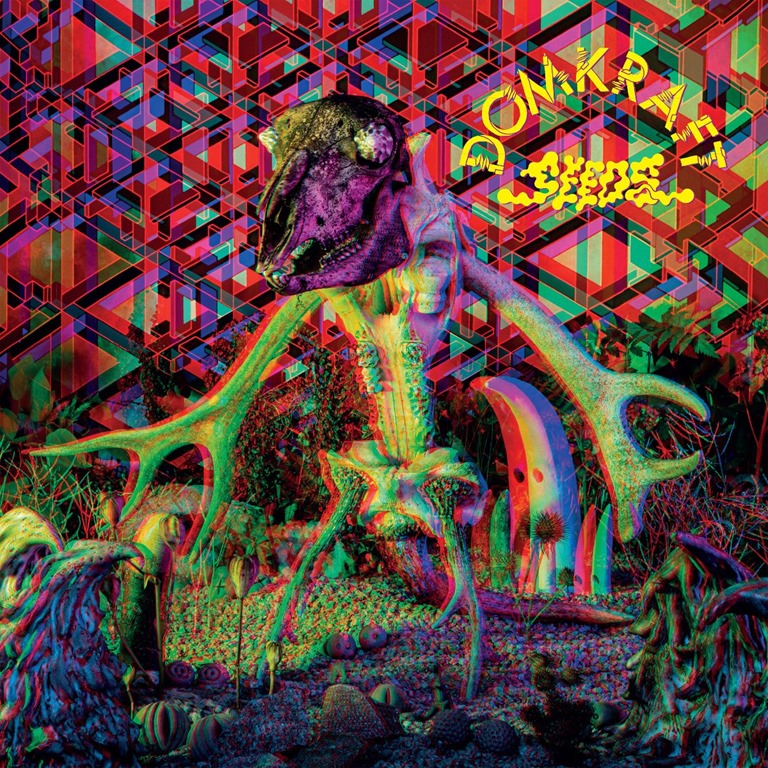
This is my first encounter with Swedish psychedelic doom-riffers Domkraft, and it must be something to do with the power of three, given that this is the third single from the forthcoming third single by the trio.

And when a band puts out a nine-minute track as a single, you get a sense of where they’re coming from. This clearly isn’t a band going for radio play here, the no-compromise approach of a lack of an edit demonstrating a solid anti-commercial aesthetic. But then, how would you do justice to an absolute epic like this by cutting it down to three, four, or even five minutes?

No, you need to hear – and feel – the full thing, from end to end. Build? Yeah, you, might say it builds. After a couple of minutes or so that are a welter of guitars and a monster wall of riffage, it really takes off, before it simmers down into a lumbering, soaring expansiveness that’s even vaguely proggy. No criticism, but a sense that certain parts don’t quite deliver on the threat of the band’s bio or commentary on the single. If anything, this is very much for the better, because ‘Audiodome’ is so much more, and transitions between passages of varying tempo and weight to outstanding effect. Around the right-minute mark, they really slam in with some eight, and it thunders hard.

It feels less like a single than an album condensed into a single track. Epic is indeed the word.

AA

1bd2fbe4-490a-4b80-8d2f-32e80da32ce7

Tartarus Records – 28th May 2021

Christopher Nosnibor

Then a release comes pitched as ‘FFO Gnaw their Tongues, Lustmord, Haxan Cloak, etc’, you know it’s going to be pretty fucking gnarly and pretty fucking heavy, not to mention dark. The band describe themselves as ‘a vessel of auditory violence whose sole purpose is to exist in this place and moment in time. It is an overwhelming form of aural terror conveyed through primal and mechanical means, conjoining visceral matter of an organic origin with that of an abiotic one. These together fabricate an entity focused on the seething aspects of interminable dread and the humiliation of flesh’. Holy fuck. I’m simultaneously quaking and on the edge of my seat for this.

I’m not entirely sure what ‘larynge’ is, and even the Internet has been of minimal assistance, and the connotations of ‘golden dirges’ in my mind says probably more about me than a band whose name in the current climate makes me think of blood clots. In other words, none of the prefatory encounter is anything but bleak in the way it sets expectations for the album, and Golden Dirges, Molten Larynges is, indeed, a challenging work.

It’s harsh, it’s noisy, it’s hellish, a purgatorial racket that combines extraneous noise, guttural snarls, and ritual beats. It’s fucking nasty, the soundtrack to the most torturous horror imaginable. Imagine being skinned alive and flayed with torches as flames rise all around, and you’re being watched by razor-toothed beasts, pale, emaciated, and brutal, s pat of the most gruesome ritual you can conceive. Your eyes are stretched open and you’re forced to watch your own chest being torn open and your ribcage prised apart as your exposed heart quivers and pulsates in its cavity. Your halfway to experiencing Golden Dirges, Molten Larynges.

Harsh blasts of noise surge like a tide at the start of ‘Devour their Bodies Saturated with Brine’, before an explosion of demonic noise simply shreds everything as the ritual ceremony builds to its most brutal climax as chthonic entities revel in the bloodshed.

And there is absolutely no respite, no retreat, no light. Most of the tracks are under five minutes, but they each feel like an eternity. ‘Our Torches Soaked in Oil’ conjures a descent into an abyss both in title and sonically, but the clunking percussion, cutting through a dank morass of swirling noise is disconcerting, before the vortex of dark noise yields to a spitting demon spewing venom from an unexpectedly gentle piano. It’s but a brief respite before the industrial churn of ‘Rattling Mutter’ brings a wall of noise and anguish that redefined punishing.

Golden Dirges, Molten Larynges is a different kind of heavy: it’s certainly not metal, and nor is it industrial or power electronics. It’s also blacker than black. This is beyond. It’s

the sound of the earth being pulled apart – not by horses, but by Satan’s slaves. It’s like being dragged by barbed hooks buried into the chest and back over rough terrain if burning coals. It is all the torture, all the pain, the soundtrack to the catalogue listing of atrocities that make up the second half of 120 Days of Sodom. As the gut-hammering percussion resonates against a grumble of anguished muttering and screaming agonies on ‘A Thicket of Abrasions and Broken Wounds’, it becomes fully apparent the sheer extent of this album’s relentless abrasion and its capacity to plunder previously unseen depths. There is no preparation for this: it redefines torture.

AA

a2071770922_10

Southern Lord – 23rd April 2021

Christopher Nosnibor

Canadian trio BIG | BRAVE return bolder, heavier, and more intense than ever on Vital. But when to start?

I seem to recall an essay by William Burroughs which contained the advice for writers that narrative had to be visual in order to work – meaning that writing about a ‘indescribable monster’ just wouldn’t cut it: readers need to be able to visualise the monster in order for it to be scary. Writing about music may be a slightly different discipline, but the challenge is always to convey not only what the music sounds like – the objective bit – but how and why it makes you feel the way it does – the subjective, critical bit. After all, you’re not a music critic without providing any critique. And yet the first – and for some time, only – word that comes to mind to ‘describe’ the experience of listening to Vital is ‘overwhelming’.

The crushing power chords crash in after just a matter of seconds on the first mammoth track, ‘Abating the Incarnation of Matter’. But it’s the jolting, juddering stop / start percussion that hits so hard that really dominates. There’s so much space – and time – between each beat, that it feels as if time is hanging in suspension, and you catch your breath and hold it, waiting, on tenterhooks. And it’s this, the sound of a tectonic collision, juxtaposed with Robin Wattie’s commanding yet incredibly delicate, fragile vocal that makes it such an intriguing and powerful experience. As the song progresses, the anguished calling becomes a ragged, hoarse-throated holler and you feel the emotion tearing at her vocal chords, ‘dissolving each layer until there is little matter left’.

The yawning throb of feedback that fills the first minute and a half of single ‘Half Life’ sounds like a jet preparing for takeoff. And when it stops, it’s the hush that’s deafening and uncomfortable. The lyrics are actually an excerpt from the 2018 essay collection How to Write an Autobiographical Novel, by Alexander Chee. And when the music ends, leaving nothing but Watties’s acapella vocal, they’ve never sounded more stark and intense. Once you become adjusted to noise, there is little more shocking to the system than its absence. And so it is in life: we’ve become accustomed to traffic, to bustle, to busy shops and offices, to streaming media – and when it stops, we struggle to know what to do.

And so it is that the dynamics of Vital are so integral to its impact. ‘Wilted, Still and All…’ is different again. The album’s shortest track is still of a dense tonality and substantial volume but manifests as a billowing cloud of grumbling ambience, and it provides a certain respite ahead of the punishing ‘Of This Ilk’ – nine and a half minutes of slow, deliberate, and absolutely brutal punishment, a bludgeoning assault on a part with Cop-­era Swans. The drums and bass operate as one, a skull-crushing slab of abrasion that hits like battering ram, while the guitars provide texture as strains of feedback howl and whine. The false ending halfway through only accentuates the force ahead of the extended crescendo which follows. It’s the repetition that really batters the brain, though: bludgeoning away at the same chord for what feels like an eternity is somehow both torturous and comforting. The third and final movement is rather more tranquil, but nevertheless always carries the threat of another wave of noise, which doesn’t arrive until the title track, a nine-minute finale that grinds out a dolorous drone, a crawling dirge where a single chord and crashing beat rings out, echoes and decays for what feels like an eternity.

‘Timeless’ is a word that’s so often used and misused in describing music, but with Vital, I mean it to be understood rather more literally, in that time stalls and everything – time, perception, and the world itself – hangs, frozen in suspension. While listening to Vital, nothing exists outside this moment, and everything is sucked into the vacuum of its making. You can barely breathe or swallow, and for the time it’s playing, there is nothing else but this.

AA

LORD287_12inch Standard LP Jacket

Christopher Nosnibor

Originally released in 1999, Music from the Empty Quarter was Photographed by Lightning’s fifth album. The band described it as ‘their Troutmask Replica, their Tago Mago’, forewarning the listener that it’s ‘a monstrous slice of avant jazz, musique concrete Lovecraftian horror and should under no circumstances be listened to while under the influence of ‘substances’, and it’s immediately clear why. Like Trout Mask, it seems to be an album intended to be as difficult and challenging as possible, the sound of four musicians playing four different tunes in different keys and time signatures at the same time.

A strolling bassline stops and starts, runs and halts against a thunking beat. Everything’s up to the max, resulting in a slightly fuzzed-out sound, murky with the edges frayed by distortion. And over all of it, horns honk and parp, weaving weird patterns. This is the first of the four parts of ‘Al Azif’, scattered at strategic points across the album, with the same nagging bass motif recurring on each, as if in some attempt to give some sense of structure or cogency to the deranged, sprawling mass of weirdy noise. While three of the four parts are comparatively short, ‘Al Azif 4’ is a colossal twenty-one minutes in duration, but there’s a hell of a lot to wade through before – namely the whole of disc one.

‘Reptiles Invent The Amniotic Egg’ is a slow-trudging grind, somewhere between Justin Broadrick and Kevin Martin’s GOD, and SWANS, and ‘Foehn’ occupies similarly dark, weighty territory. Meanwhile, ‘Pop Song’ stands out as the most accessible track here, a snappy number with an actual semblance of a tune that’s reminiscent of early Public Image – but after a minute and a bit, they’re done, and back to making the most chaotic racket going with the frenzied discord of ‘The Assembly of Membranes’, and taking things up a notch on ‘Timing of Cellularisation’ which sounds like The Fall playing next door to Merzbow, and they’ve both left the door open and you’re standing in the corridor between the two.

By the time you’ve been battered by the murky wasteland that is the noodling delirium of ‘Mosses Invade the land’, with its impenetrable vocals, and the unexpectedly folksy lo-fi indie of Sugar Fist – part Silver Jews, part Syd Barrett, you arrive dizzied and dazed at ‘Al Azif 3’ with a strange sense of déjà-vu, before disc two arrives with more of the same – literally. That sensation of being on an endlessly recurring loop is a headfuck almost on a par with Rudimentary Peni’s Pope Adrian 37th Psychristiatric, but perhaps more realistically an approximation of The Fall’s ‘Bremen Nacht’ repetitions on The Frenz Experiment and accompanying 7”.

The demented, snarling vocals, that gibber and gnash away into the drifting fade of horns is most unsettling as disc two gets dubby and deranged on the fourth instalment, and after the brief interlude that is ‘Hypoxia’, the fifteen-minute title track is a yawning, droning swirl of somnambulance, a ritualistic swell and groan with laser rockets arcing over its bubbling, swampy expanse.

This is fucking heavy stuff: not heavy in the metal sense, but in the sense that’s it’s relentlessly oppressive and lasts an eternity. It’s absolutely bloody great, but it’s also probably the soundtrack to life in purgatory. You have been warned.

AA

a1100566683_10

Bloodshed666

Christopher Nosnibor

This Viennese collective describe themselves as purveyors of ‘heavy stuff (crust, sludgemetal, noise rock’ but ‘rooted in diy-anarcho-punk’, and they follow the subtly-titled Shareholder of Shit 10” EP with a 12” picture disc mini album containing five gloriously gnarly blasts of dirty guitar-driven noise.

Much of the appeal of anything that’s crust-orientated is just how grimy and raw it is, and while a few samples cut through with clarity on several tracks here, for the most part, Desolat deliver a set that is little short of a wall of incendiary rage, a snarling, spitting, guttural roar coughing blood and venom against guitars so dingy they positively drip gunge.

If opener ‘Nuclear Extinction to Human Civilisation’ doesn’t exactly sound like a love song, it does probably intimate the band’s perfect misanthropic fantasy, while the title track is the sound of Satan’s innards after a phall. Make no mistake, this is intense, and there’s not a second’s respite at any point: ‘The Bureaucrat’ is a full-throttle sonic inferno that blasts through its three-minute duration at a hundred miles an hour ravaging everything in its path: the guitars a whiplash-inducing blur or fury.

The lumbering closer, ‘Dreams of Slaughtered Yuppies under Starlit Night Skies’, is a six-minute slow-riffing sludgefest that batters away brutally at a simple four-chord trudge. It’s heavy, it’s nasty, and its glorious – which pretty much sums up the record as a whole as it raises a stinking, shit-coated middle finger to all things capitalist and mainstream.

AA

a2246575036_10

Opa Loka Records – 5th March 2021

Christopher Nosnibor

Breath Mule is the third album for Dutch multi media artist Richard van Kruysdijk under the moniker Cut Worms, and after a gap of over three years, completes a trilogy along with Lumbar Fist (2016) and Cable Mounds (2017).

As the accompanying blurb outlines, ‘Cut Worms’ sound palette is firmly rooted in the lower frequencies’, detailing how ‘As the droney, cinematic tracks evolve, their slowly unravelling, gritty sounds evoke the audio equivalent of brutalist architecture: Concrete walls of sound that are as majestic as they are elementary, yet intrinsically detailed when examined with a magnifying glass.’

The majority of the tracks are long, and not a lot really happens, meaning that there is time given for each composition to breathe and explore the tones and textures in full detail. The low-booming opener, ‘Slug Sirup’ sounds like a ship’s horn sounding out over the miles through a dense and played back at half speed. First distant, it grows in volume, but little else happens for a very long time. And then, somehow, more than nine minutes has evaporated, and drifted into the slow-booming drone of ‘Come Lightly’. There isn’t much light about it: it’s dank and ominous.

There are crackling creaks enveloped in the dense, crawling fog of ‘Cinder Locks’. The sound is thick, heavy, immersive, and yes, it is ominous but at the same time, I find a certain comfort in such vast expanses of thunderous ambience. The more condensed the sound, the more it billows like smoke, the more impenetrable and more solid it becomes, the more it feels somehow like something that’s a source of a certain warmth and security. The same is true of the throbbing ‘Denmark Spiral’, but the thin, trilling wisps of Girly Totem’, while more overtly and quintessentially ‘ambient’ are somehow more difficult to settle in with – particularly in context.

The darkness really comes to the fore on the final track, the eleven-and-a-half-minute ‘Slashed Hostage’. The title provides a fair indication of its weight, and it begins with a low, slow, oscillating throbbing hum, one of those drones that nags at the senses like a far-off helicopter that you scan the sky for but can’t see. Again, it’s a slow-builder: the sound expands, louder, denser, but no different, and this is where it really starts to get into your head and burrow into your skull. It’s along this journey that the slow-moving drone expands to a different level of immersion, and when the swell tapers down, hushed vocals echo menacingly, too low in the mix to decipher the actual words, a poem by the enigmatic Italian composer Giacinto Scelsi (1905-1988), who wrote surrealist works in French. Because. That said, Scelsi is an interesting choice, as a composer who, according to his Wikipedia entry, ‘composed music based around only one pitch, altered in all manners through microtonal oscillations, harmonic allusions, and changes in timbre and dynamics, as paradigmatically exemplified in his Quattro pezzi su una nota sola (‘Four Pieces on a single note’, 1959)’.

On Breath Mule, Cut Worms offers more than a single note, but then again, there are no notes: only thick, swirling billows of sound and layers of drone on drone. It grips you, immerses you, hold you… and it’s not unpleasant, as long as you don’t struggle.

AA

CW-M013-digipack-3P_1CD-6-x-8mm-z-kieszonka V7

Human Worth – 5th March 2021

Christopher Nosnibor

I am, unashamedly, a massive fan of Modern Technology, and have been from day 1. And their DOIY label, Human Worth, too. Not only do they make and release amazing music of immense weight, but they have real principles, donating a cut of the proceeds of every release to charity, and being thoroughly nice guys on top is just a huge bonus.

The label’s latest release – their first 7” single – is absolute gold (despite actually being marbled silver and black) And that’s another thing: the quality of the label’s product is magnificent, from the design to the finish. With vinyl’s resurgence, we’ve witnessed a greater attention to the physical product as an artefact to behold and to cherish, for all the reasons fans of vinyl spent about 20 years going on about at every opportunity while people moved away, first towards CDs and then towards streaming. I suppose aficionados of the ‘physical product’ proffer the same kind of case for vinyl as books, but when Kindle fans counter that ‘it’s just like a book’, the common retort is that what’s even more like a book is a book, and there is simply no substitute. Streaming fans don’t even have that: all they have is ‘convenience’, but they simply don’t grasp how much is missing from the experience when interacting with a physical format.

I may digress, but it’s relevant: when presented with a gut-punching welter of noise, it always hits harder when blasting from a fat chunk of wax through some speakers with a bit of poke. And shit, is this a gut-punching welter of noise.

Modern Tech and 72% crossed paths just days before life was placed on pause in March 2020. Sharing a bill for Baba Yaga’s Hut in London, no-one foresaw the year that was to come. With the prospect of live shows remaining tentative at best, this single feels like a necessary release of energy.

It’s 72%’s ‘Drowning in a Sea of Bastards’ that’s the (nominal) A-side, and it’s a squalling, full-throttle noise attack. It’s actually the drumming that dominates, while everything else collapses in on itself to create a volcanic sonic explosion of frenzies guitars that are played in such a way as to not really sound like guitars as much as a wild cacophony. There’s screeding feedback and all kinds of chaos flying every whichway, and somewhere, buried low in the mix, are some anguished vocals. You can’t make out a word of it, but the sentiment transcends language.

Meanwhile, Modern Technology continue to go from strength to strength. The first new material since their debut album, Service Provider in September, ‘Lorn’ is a six-minute monster. The droning feedback that howls from Chris Clarke’s bass is more mid-rangey than usual, bringing a sharp, brittle edge to their dark, dingy abrasion that’s pushes forward slow and heavy, propelled by Owen Gildersleeve’s crushing percussion. When the chords hit, they hit hard, and – as is now well-established as integral to their distinctive sound, Clarke’s vocals, distorted and buried in a wash or reverb, snarl and growl all the rage, landing somewhere between Lemmy and Al Jourgensen circa Filth Pig. It’s a trudging slow-burner that builds with a cumulative effect.

Oh, and there’s more: a brace of bonus tracks, starting with a head-shredding remix of ‘Drowning in a Sea of Bastards’ by Wayne Adams (Ladyscraper / Big Lad / Petbrick). Unrecognisable against the original, it’s a pulversing mangled mess of clanging metal and industrial-strength overloading distortion. Gnarly as fuck, it’s bloody brilliant. And as a double bonus, the additional cut from Modern Technology is another new track, ‘Ctrl’. In something of a departure, it finds Clarke deliver a spoken-word piece against a backdrop of thick, booming bass and slow, slow drums. As the murky layers build, so does the crushing weight of a track that’s reminiscent of Swans circa 1984: it’s claustrophobic and suffocating, and makes you feel tense.

It may only be fifteen minutes in total for all four tracks, but to describe the experience as intense would be an understatement, and I find myself simply too blown away to conjure a pithy one-liner to wrap up. Yes, it’s absolute dynamite.

AA

72%xMT_A_DrowningInASeaOfBastards

72%xMT_B_DrowningInASeaOfBastards

Minimalism and instinct, structure/freedom and meticulous timing form the cornerstones of BIG | BRAVE’s precise, rhythmical sound.

Lyrically, the new album VITAL explores the weight of race and gender, endurance and navigating other people’s behaviours, observation and protest. The band further commented “this album involves what it means navigating the outside world in a racialized body and what it does to the psyche as a whole while exploring individual worth within this reality.”

Our first glimpse of the album arrives today in the form of a video for the track "Half Breed", consisting of a single shot of a single performative action that can be read as the representation of the damage an external force can have on someone or something without ever having to bear any responsibility and consequence.  BIG | BRAVE adds "The action of shovelling dirt onto the person, also acts a way to discredit, shame and discriminate the individual. With the victim (on screen), being painfully covered with dirt by the perpetrator (off screen), all we have to witness is the damage done and left behind. We are aware of what is happening, what has happened, but the source is kept anonymous and can easily be missed and overlooked."

VITAL features the core trio Robin Wattie, Mathieu Ball and Tasy Hudson, for their most collaborative record they’ve made so far. The band say “having cut our teeth in very different musical backgrounds respectively, our intuitions vary, which has an interesting effect on our individual approaches and ears.”
For this record, BIG | BRAVE once again made the trek down to Rhode Island to record with Seth Manchester at Machines with Magnets. They remark “we fully trust his instinct as an engineer and his creative output, getting to experiment with textures, concepts, layers, and with pretty much every single recorded sound, the process of making records with Seth is an absolute journey in sonic exploration".

Watch the video here:

AA

BB

Photo by Mathieu Ball

Releasing their most recent album ‘Canyons’ in 2019, Slomatics have solidified their status as veterans of the underground heavy scene since forming in 2004 with 6 albums and a number of split releases alongside Conan, Mammoth Weed Wizard Bastard and Holly Hunt. Now as part of their upcoming split LP with Ungraven they have shared new track, ‘Kaān’.

The band state, ‘Sometimes the joy of music is the contrast between light and shade, the subtle textures and the space between notes. Other times it’s just about turning the amps to eleven, loading as much fuzz into the signal as possible, putting everything in the red, cranking out the same neanderthal riff relentlessly and screaming into the void. ‘Kaän’ is most definitely the latter.’

Listen to ‘Kaān’ here:

AA

a1116993675_10