Posts Tagged ‘goth’

Projekt Records – 9th December 2025

Christopher Nosnibor

Woah, wait. 1999 is more than 25 years ago? Logically, I can grasp this. But the fact that lowsunday have existed for some thirty years and have been dormant since 1999 meaning this is their first material in over twenty-five years is still difficult to comprehend. It does very much seem to be a more common occurrence in recent years that bands who existed comparatively briefly in the 80s or 90s are reuniting and returning with not only new material, but strong new material. It may be a rather different league, but the last thing I expected last year was a new album by the Jesus Lizard, and that my first gig of 2025 would involve David Yow flopping off the stage and directly onto my face in the opening thirty seconds of the set. Lowsunday formed in 1994: the year Kurt Cobain died, the year I started university, the year of my first job as a reviewer. It feels like another lifetime. It probably does for them, too.

It may be pitched as a blurring post-punk, shoegaze, dreampop, and darkwave, and also as being for fan of The Chameleons, ACTORS, The Cure, Modern English, Clan of Xymox, Then Comes Silence, TRAITRS, but that thumping bass groove and pumping mechanoid drum beat on the EP’s opener, ‘Nevver’ is as trad goth as it comes. But the squalling noise that envelops the vocals – swathed in echo and low in the mix and taking direct cues from The Cure circa Faith and Pornography – is something else, a melding of My Bloody Valentine and The Jesus and Mary Chain with a dose of early New Order, Danse Society, and The Chameleons swirling around in there. And out of this swampy post-punk soup cocktail emerges a song of quality which really recreates that early eighties dark groove.

‘Call Silence’ goes straight for the sound of The Cure circa ’83, the singles on Japanese Whispers. And that’s cool: if you’re going to lift from early 80s gothy pop, you could certainly do far worse than ‘Let’s Go to Bed’ and early New Order as an inspiration – the bassline is pure Peter Hook. The production – and the strolling high-fretted bass work – really hits the spot, although it should be perhaps noted that they really do sound like a band born in 1982 rather than 1994. I guess they were retro before their time.

Paired with chiming guitars, it’s the monster snare smash that really leads – and grabs the attention on ‘Soft Capture’, a song that unashamedly draws on Ride and My Bloody Valentine, and pairs that wash of sound and monotone vocals with a drum sound straight from 1984. The fall from favour of the dominant snare feels like a loss, but there’s no time for lamentations as they pile in with another claustrophobic read goth groover in the shape of ‘You Lost Yourself’. Here., I can’t help but feel the vibes of late 90s goth acts like Suspiria and the scene around that time. It’s well-executed, with fractal guitars tripping over pumping drum machines and throbbing bass.

Closing with single cut ‘Love language’ sees the band strive for low-key anthemic with dreamiest and most overtly shoegaze song of the set. With the vocals drowning in a sea of reverb amidst a swirl of guitars, its detachment is its emotional power, perversely enough. And then, unexpectedly, it stops.

Everything about the White EP is simply magnificent – the way the songs are composed and played, the production, the overall feel. And while retro is all the rage – and has been for a while now, since postmodernism has eaten itself and the entire world has collapsed into endless recycling and nostalgia for ersatz reimaginings of golden bygone times. But sometimes a release will appear, seemingly from nowhere, that radiates a rare authenticity, and reaches the part others don’t. Lowsunday’s White EP is one of those.

AA

756671

Christopher Nosnibor

13th September 2025

It is impossible to escape AI now, and its ubiquity has arrived at a shocking pace, its acceleration seemingly exponential. You can avoid social media, but can you avoid computers or mobile phones for even more than a few hours? The news – beyond the main headlines, at least – is abrim with reports on how it’s affecting us as individuals, as a species, and the environmental impact. I watch a training video at work: it’s presented by AI actors who move their arms in strange ways and occasionally mispronounce a word in the worst way. Meanwhile, management want us to save time on report-writing by using Copilot. Drained by all of this, I go to the pub for soe decompression time, and the talk is of how jobs are being undermined by AI, and some guy’s got a video AI made using just a photograph. Why? Why do we need this? We don’t, of course, but it’s novel, mindless entertainment that can be created in seconds. Increasingly, it feels like we’re volunteering ourselves for virtual lobotomies. Despite the fact that the current technoscape is every sci-fi dystopia playing out exactly as told in real-time, it seems the majority of people are more than happy to embrace AI. Even writers, artists, and the like, present themselves as ‘curious’ and will engage with AI for prompts or to brush up something they’ve done. But the fact it that it’s a slippery slope, which gets steeper and steeper and further down is an abyss that plunges straight to hell. The worst of it is that it’d becoming increasingly difficult to separate real life.

One of the issues I have personally is that just as every significant technological advancement since the Industrial Revolution brought the promise of more leisure time by making work lighter, the opposite is true – unless you consider unemployment and life on the breadline to be leisure. AI isn’t saving time by vacuum cleaning the house, hanging up the laundry, putting the bins out or doing the school run: it’s simply devaluing creative skills. Anyone who has read an AI-generated article, heard an AI-assisted song, or seen some AI-created art will know that there’s something ‘off’ about it, that it’s soulless and vaguely alien. Meanwhile, the world seems to be spiralling into a cesspit of animosity, hatred, and division. Something happened during the pandemic which meant that when we all emerged from lockdown, war and rage and unspeakable cuntiness exploded on a scale beyond articulation. It’s no wonder people are struggling with life right now.

Now After Nothing is, in some respects, a therapeutic escape from all the shit. Multi-instrumentalist Matt Spatial paired with Michael Allen after what he describes as ‘a relatively difficult time in my life [where] I had become lost and depressed without a creative outlet with which to express myself’. There’s much to say that creativity – and exercise, both physical and mental – are the best self-maintenance. Listening to this EP, it’s clear that Spatial is really pouting everything into this.

His comments on the EP are worth quoting: “Artificial Ambivalence, as a concept, to me represents the state of feeling lost and/or the ‘shutting down’ from the negativity and toxicity around each of us,” Spatial explains. “They say ‘ignorance is bliss’, but in the (mis-)information age we seem to have reached a point of being pummeled into exhaustion from the constant barrage of negativity. For some, while the desire is stronger than ever to make positive change in the world, we might get derailed by feelings of helplessness, hopelessness, and being powerless in a society that seems to increasingly favor only one set of values. For others, it’s the choice to conveniently ignore the inhumane atrocities happening in our society when those atrocities don’t directly impact that individual.”

Of the music, there are references to ‘goth-glam grooves slick with sweat, raw enough to leave a mark’ and a nod to the fact that ‘fans have called it “S&M disco,” a sinister shimmer of punk, industrial grind, and nocturnal new wave.’

The first thing that strikes on the first listen of this EP is the energy. Everything is up-front and it lands like a proper punch in the face. Big, gutsy riffs underpin some sinewy lead guitar parts, driven by some explosive percussion and sturdy, throbbing bass. Straight out the traps, ‘Sick Fix’ blends post-punk and grunge to create a hard-hitting blast, and one that’s got hooks and melody in spades, too, with hints of Big Black in the background. It sets the bar high, but ‘Criminal Feature’ hurdles it effortlessly.

Slowing the pace and changing not only the tempo but the mood, the piano-led ‘Holly’ broods hard and is unashamedly mid-80d goth in its vibe, but also incorporates more post-millennial post-punk and goth in its genetics. The result is – to wheel out a cliché – anthemic. And it is, of course, the perfect mid-set slowie, which sets things up for the chugging, bass-driven beast that is ‘Fixation Fantasy’, a track that’s more 90s alt-rock than post punk or goth. More than anything, I’m reminded of psychedelic grunge also-rans Eight Storey Window in the ear for melody and the emotional heft delivered by some achesome riffs delivered at an intense volume.

‘Dare’ brings some dark pop intimations paired with some searing guitar work which lands like a post-rock Placebo crossed with Salvation – that is to say, it’s richly immersed in that mid-80s Leeds sound. It’s inspired stuff, and then some. Closing off, single release ‘Entangled’ offers glorious shoegaze gentility before breaking into a magnificent slice of synthy post-punk with some massive guitar. Artificial Ambivalence is better than ‘all killer’ (which it is) – it’s next-level solid quality and absolute gold.

AA

a3532593873_10

25th October 2025

Christopher Nosnibor

As the blurbage explains, ‘The Third Side Of The Coin is a split, 2 part album which includes 2 sides of one coin, Anima and Animus. They are separate entities but together they create a bridge between dark and light, outer identity to inner truth and form a union of opposites that gives birth to universal truth. They are the gatekeepers of transformation.’

Well that’s two sides, but what about the third? Of course, this is where the truly conceptual aspect of the work comes in – the part which goes beyond the recordings themselves – and which only really makes sense in context of the following explication:

The Third Side Of The Coin is about the natural but paradoxical dualistic state of the universe. This split album explores both sides of a polarized world by peering over the precipice of the coin only to see a reflection staring back from the other side. It is a surreal mirror showing that what you fear and what you hate is living within the unconscious parts of yourself, both sides being parts of a whole. As you look into the familiar and uncomfortable reflection the coin spins, dissolving duality and revealing a clear image of the third side.
Dissolve the duality! The magic is in the middle!’

Taken literally, this suggests that the magic resides in the space between track five and track six, but I don’t think that’s what they’re meaning. Similarly, although I’m reminded of how William Burroughs and Brion Gysion expounded the concept of ‘the third mind’ as how two minds in collaboration can create a work greater than the sum of the parts, as if there’s a ‘third mind’ at work between them, I don’t feel that this quite first with the concept Moons in Retrograde are offering here.

To delve into the album itself is to venture into a world of thumping beats and deep emotional exorcism: single cut ‘Mirror Obscura’ launches the set in classic style, forging a dark, industrial-infused, goth-hued slice of dark electropop – mid-tempo, atmospheric, anthemic, and completely enthralling. The tracks which follow feel rather more generic, particularly ‘Eternalgia’: it’s a solid electrogoth stomper, and while the synths are sweeping, layered, rich in texture, everything is centred around the hard kick drum, which cuts through it all and really slams. The final song on the ‘Anima’ side is a supple exercise in dreampop, with the emphasis on the pop, a quintessential anthemic mid-tempo ballad.

While the atmosphere is overtly darker during the second half of the album – the ‘Animus’ side – it doesn’t seem so radically different at first. ‘The Edge of Entropy’ very much employs the same instrumentation and approach to composition, and ‘The Rotten Tree’ is a classic, processed dark pop cut. But closer listening reveals more twangy guitar in the mix, and a more claustrophobic and subdued style of songwriting. ‘Taxidermy Mouse’ may sound like a rather humorous title, but it’s a slow, deliberate pulsating piece which goes full aggrotech stomper at the mid-point, drawing on elements of metal while pumping out technogoth grooves. And by the time we arrive at the heaving churn of ‘Biological’, with its rampant, frenetic nu-metal percussion and gargling noise, it’s clear that this is very much an album of two halves, and at times the second half feels like a goth Prodigy.

For the most part, The Third Side Of The Coin feels a shade too clinical to really hit the mark on the emotional scale. It packs some bangers, for sure, but there’s some distance between pumping beats and emotional intensity which has a resonant, moving impact. And perhaps, stripping away the concept and taking the album as it is is the best way to approach this…

AA

a1338474138_10

27th November 2025

Christopher Nosnibor

Richard Rouka is… an unusual man. He’s existed around the Leeds scene since the emergence of the goth scene, and he documented it back in the day, in real time, but to describe his own musical output as ‘adjacent’ would be generous, to say the least. The mid-to-late eighties saw his label, Rouska, release a stack of stuff, predominantly by The Cassanda Complex and Dustdevils, bands with strong Leed connections.

His own works, released under the guise of WMTID aka Well Martin This Is Different! draws on the post-punk vibe of that period, but is predominantly primitive electropop with a distinctly bedroom / four-track vibe. WMTID has been a thing for over forty years, but Rouska’s output has skyrocketed in recent year.

One way of pitching it would be early Depeche Mode as performed by Young Marble Giants, but this wouldn’t really convey the ways in which these elements – played and tossed together in the most ramshackle of ways coalesce. But what it hopefully would convey was the fact that this is steeped in early eighties analogue experimentalism, the time when synths were breaking through as emerging technology and the Musician’s Union was shitting itself about how this would herald the death of ‘real’ music – particularly on account of the increasing popularity of drum machines, which they feared would end the need for drummers. Just as home taping didn’t kill music – and if anything it meant that music sharing exposed more people to new acts (I know I discovered countless new bands because people gave me mix tapes), so synths and drum machines broadened musical horizons instead.

Silica Bombs revels in the primitive: ‘Fool Moon’ is simple, sparse, in its arrangement, synths quavering around a persistent piston-pushing drum machine beat. With its stark, minimal production, paired with a fairly flat, monotone vocal delivery, ‘If It Happened Anywhere Else’ very much channels the spirit of Joy Division. The bleak, synth-led ‘Walk With Me (Into the Sea) sounds like a demo for New Order’s Movement. And yes, the recording quality is pretty rough, and it very much captures the spirit and sound of the late 70s and early 80s.

It’s different, alright, but above all, it feels like a magnificent anachronism. The eighties revival had been ongoing for at least a decade now, and so many acts have sought to replicate the sound and feel they’ve largely failed. Maybe you needed to there. Maybe you need the right kit.

But the weird, trilling organ sound of ‘Good Mourning’ brings a dark weight and fizzed-put production which are incompatible with contemporised production values. ‘Crushing Bore; brings a certain humous to proceedings, while coming on like Cabaret Voltaire. ‘Opposites Attract’ brings some heavy drone which contrasts with the sing-song vocal melody, and in may ways this is typical of the way in which WMTID explore polarities with a shameless eighties naiveté. By this, I mean that the 80s was really the last decade of real innovation. The 90s were exciting, and that’s a fact – I was there – but the 80s witnessed the arrival of synths, of electronica, and marked a real turning point in the trajectory of music. And Silica Bombs doesn’t replicate that era so much as live there. With its thumping beats and swirling synth sound, ‘Rouge Planet’ has a strong club vibe. That vibe gets stronger and harder, with the pulsating groove of ‘Sweet Jesus’, which Rouska tells us ‘I’ve got a friend in Jesus’. Yeah. The Jesus and Mary Chain, perhaps. ‘Personal Jesus’ maybe. It drives hard fir a relentless five and a half minutes.

This is an album which wears its influences on its sleeve and shows no signs of shame in that. And why should it? Rouska is very much of that era and played a part. The fact that his musical output over the last few years is indicative of a person who doesn’t go for meetups with former colleagues. More than its predecessor, Finding the A.I. G-Spot, Silica Bombs feels significantly beat-orientated, and more hard-hitting. It’s retro, and its catchy. It’s retro and it’s weird in that it has no specific identity… it’s just what it is. And it’s a groove.

AA

AA

AA

a2195822840_10

zeitkratzer productions – 21st November 2025

Christopher Nosnibor

This is by no means the first time these legends of the experimental world have come together, and one would hope it won’t be the last either. Reinhold Friedl, leader of the Zeitkratzer collective and master of the prepared piano, as pioneered by John Cage, has built a staggering body of work through the years, taking into account Zeitkratzer releases, solo works, and almost countless collaborations. Of those many collaborations, this latest one is indeed strong and ambitious.

There’s something unsettling about the sound of laboured breathing and strangled whispers – and not just because they’re the domain of horror movies. Something in the human mindset makes us fearful of these sounds. Perhaps there’s the notion that a certain type of breathing is the sound of panic, and hearing it triggers a panic response. And so it is that against jangles and creaks and wispy, wraith-like drones and hovering hums, conjured by Friedl, Haino gasps and chokes and hums mystically through the thirteen-minute abstract journey that is the appropriately-titled ‘strange fruits’.

‘wild harvest’ eighteen minutes of exploratory dark ambience and abstraction. It starts quietly, a soft haze of static – and then very swiftly gets weird. Haino’s vocals rapidly transition from a plaintive mewling to satanic snarlings, while Friedl tinkles and scrapes like he’s tinkering away on an egg-slicer. But then there’s a slam of keys like psychotic demanding attention, and Haino violently switches between gasps and rasps like he’s being strangled by a poltergeist, chthonic grumbles, and tortured howls like he’s having his fingernails torn out while on the rack. The eerie metallic scrapes which set the teeth on edge are one thing, and Friedl masterfully builds a wall of discomfort, the sound of post-industrial collapse. It’s the sound of rust, of degeneration, rain-sodden sci-fi dystopia, and in itself it’s bleak, harrowing. But Haino’s contribution amplifies the discomfort, gargling and gurgling like nothing recognisable as human. It’s hard to place and hard to describe as anything but the sound of suffering. And we reel at such sounds: something biological, instinctive, primal, kicks from the inside and tells us this is not good. How we react is varied – some rush to aid, others cringe and curl – but ultimately, it’s something which affects us, it’s something we feel in a way which isn’t readily articulable. But however we react, the paint of others, it hurts us (and if it doesn’t, you’re clearly defective as a human being). As much to the point, however, is that this is challenging listening: discordant tinklings and guttural retchings are not pleasant or easy on the ear, and later, it trips into wailing psychosis and derangement. Again, we struggle when confronted with psychotic gibbering and incomprehensible raving, because we simply don’t understand, and many look upon those experiencing metal disturbance with distain, but this is, in truth – an often unspoken truth – born from a fear that they’re only a slide away from being there.

But regardless of and individual prejudices and fears, the fact remains that this is disturbing, weird, and does not correspond with out normal way of interacting with the world.

‘true, sightly fly’, the track which provides at least half of the album’s title, is a twenty-three-minute monster of a track. It’s on the CD and digital edition, and included as a digital download by way of a bonus with the vinyl edition, which feels like a shame, but then the cost of adding a second disc would likely be prohibitive both in terms of productions costs and sales. How times have changed from the late 80s and early 90s when vinyl was a budget option compared to a CD, when an album cost £7:50 against the cost of a CD being £11.99 or so. But it does feel like vinyl afficionados are being somewhat short-changed with only two of the three tracks, particularly given the fact that ‘true, sightly fly’ is arguably the belt of the set.

On ‘true, sightly fly’, Haino and Friedl plunge into the deepest, darkest, most unsettling depths, gasping, throat wrenching, slithering, churning noise unsettling the stomach writhing and churning, unsettled with beastly gasps rushing onto your nervous, trepidatious face.

This… is not fun and it’s certainly not entertainment. truly, slightly, overflowing, whereabout of good will is not fun: it’s uncomfortable, unsettling, and at times deranged, demented. Inarticulable is, sadly, a reasonable description; I am out of words, and this is weird – but good.

AA

a0384773058_10

Christopher Nosnibor

Live music should carry a warning over its addictive properties. Witnessing a band playing a set so good that you’re buzzing for hours, even days afterwards is a unique high, and one that sets a seed of a desperate need to replicate that experience.

I’ve seen a lot of live music since I started going to gigs over thirty years ago, but the number of acts who have ignited that sense of fervent excitement is limited. I’ve seen many, many amazing shows, but few have blown me away to the extent they’ve felt in some way transformative. Dead Space Chamber Music are one of those few, and I left the Cemetery Chapel in York a few months back feeling dazed and exhilarated, my ears whistling despite having worn earplugs. I simply had to see them again, in the hope to experience that same sense of rapture.

Eldermother – consisting of Clare de Lune on harp and vocals and Michalina Rudawska on cello – have no shortage of musical pedigree, and a superabundance of talent which they showcase with their minimal neoclassical works, a mix of covers and original material. They open with Radiohead’s ‘Street Spirit (Fade Out)’ led by harp and with Clare’s soaring vocals, and it’s one of those performances that make the hair stand up on back of your neck with its haunting atmosphere. There’s a rendition of WB Yeats’ poem ‘The Stolen Child’, a work rich with imagery inspired by wild nature and imbued with emotion and drama. The execution is magnificent, and the originals are similarly graceful and majestic. ‘Hurt’ may not be by any stretch representative of Trent Reznor’s career, but it certainly showcases his capacity for powerfully emotive songwriting, and if it’s the song which forms his legacy, it’s all to the good. Yes, Eldermother play a semi-operatic version of ‘Hurt’ with harp and dark, brooding cello, and… woah. It’s almost too much, especially this early in the evening. I find myself dabbing a tear and grateful for the low lighting.

DSC04790DSC04787DSC04785

Eldermother

Lunar Cult Club – featuring Doug Gordon, aka Futures We Lost – as the provider of the instrumental machinations, take the theatricality up several notches to deliver a set of otherworldly cold, cold, darkest electro with glacial synths and funereal forms. The bank of synths swirl and grind, muddy beats thud and pop from amidst a dense sonic fog. Sonically, they’re impressive – in the main, the arrangements are sparse, and overtly analogue in form – but visually, they’re something else. Theirs is a highly theatrical stage show, and this significantly heightens the impact of the songs. The two singers, dressed all in black and with faces obscured by long, black lace veils – Corpse Bride chic, as my notes say – sway and move their arms in an unnerving fashion, as if reanimated, exhumed. I’m reminded of Zola Jesus and of Ladytron, and I’m mesmerised by their facsimile of a Pet Sematary Human League with its spellbinding marionette choreography. The final song, ‘No-Ones Here to Save Her’ is as dark as it gets: the vocals merge and take us to another realm entirely.

DSC04800DSC04804

Lunar Cult Club

I’m still floating in a state of mild delirium when Dead Space Chamber Music take to the stage. The atmosphere is thick, tense, hushed… awed. Something about the trio’s presence alone makes you sit up, lean in, eyes wide, ears pricked. There’s a lot of detail here. Their focus is gripping by way of spectacle, and their set is designed as a linear work which evolves and transitions over its duration, in a way which calls to mind when Sunn O))) toured Monoliths and Dimensions, whereby, over the course of the set, Attila Csihar transformed into a tree. There are props and costume embellishments, mostly on the part of Ellen Southern, who performs vocals and various percussion elements and a strange stringed instrument: she brings much drama and theatricality, delivered with a sense of self-possession and deep spirituality which is utterly entrancing.

DSC04839DSC04852

Dead Space Music Orchestra

They’re so quiet you can hear matchsticks dropping into a tray. But the fact that these things are audible, amidst cavernous reverb and sepulchral echoes, is a measure of the clarity of the sound and the band’s attention to detail. Ekaterina Samarkina is impressive in the sheer versatility and nuanced approach she takes to the percussion which is truly pivotal to the performance. Her work is so detailed, subtle, the sound so bright and crisp, as she slowly scrapes the edges of her cymbals with a bow. Lurking in the background, Tom Bush – on guitar – plays with restraint, sculpting shapes and textures rather than playing conventional chords and melodies. In combination, they conjure a rarefied atmosphere.

DSC04867DSC04886DSC04906

Dead Space Chamber Music

But towards the end of the set, as if from nowhere, emerge huge cathedrals of sound. The last time around, I compared their climactic crescendos to Swans, and having seen Swans just over a week ago, I very much stand by the parallel called then. And this is not volume for volume’s sake: this is about catharsis, about escape. Dead Space Chamber Music make music which is immense, transcendental. And when they go all-out for the sustained crescendo of the finale, it’s not because of a bank of pedals or a host of gear: they simply play harder, throwing themselves behind their instruments, and full-throttle intensity. It may not be as loud as on that previous outing, or perhaps it’s simply because I’m expecting it, but they nevertheless raise the roof, and fill the space with expansive layers of sound on sound.

The three acts very much compliment one another, making for an event which is more than merely a gig, more than three bands playing some songs: this is an occasion, steeped in theatre and art, performed with a sense of ritual. The experience is all-encompassing, immersive, enveloping; it takes you out of life and suspends time for its duration. It will take some time to return to reality.

New Heavy Sounds – 7th November 2025

Christopher Nosnibor

Cold in Berlin have come a long way over the course of fifteen years and now – after a six-year wait – five albums. Give Me Walls was sharp, defined by an angular post-punk sound which crackled with nihilistic fury. You wouldn’t exactly say they’ve mellowed over time, but they’ve become heavier, darker, and have evolved the ways in which they articulate themselves, musically, and lyrically.

January 2024 saw the release of the EP The Body is the Wound, which introduced the thematics of a new and significant project, and indicated where they were heading, and came with references to an album to follow later in the year. The year came and went, and here we are, at the dark end of 2025. But as lead single ‘Hangman’s Daughter’ and follow-up ‘The Stranger’ foreshadowed, Wounds was worth the wait. Perfection takes time, and that’s what Cold in Berlin have delivered here.

But more than that, this is an album which wrestles with difficult stuff. As the band explain, “Wounds is a series of songs about the different ways people live with and process ‘the wounds’ of their lives… A strange celebration of that formative pain we have all experienced in some way. The loss and joy of survival – the celebration of finding others like us, the gift of knowing life comes after fire.” For all the noise of how we need to talk more about mental health, the fact of the matter is that it’s really just that. There is still real stigmatisation surrounding the subject in real terms, with reactions to attempts at open dialogue tending to range from diminishment, to dismissal, to awkwardness and paralysis before moving on with an embarrassed cough. And yes, I’ve learned this from painful experience. Raise the subject of mental health, anxiety, and dealing with bereavement while adjusting to life as a single parent with a teenage daughter… it’s amazing how many people go quiet, how many friends seemingly vaporize. The simple fact is that the majority of people are afraid to touch on dark topics, to venture to dark places. They can’t handle it, and so… these are my personal wounds, and why this album reaches parts other albums don’t get close to.

It’s ‘Hangman’s Daughter’ that raises the curtain on the dark drama which will infold over the course of nine songs. The big riffery that’s become their signature – and nowhere more apparent on predecessor, 2019’s Rituals of Surrender – is very much present, but there’s a lot happening here, in terms of detail and dynamics and arrangement, with pulsating electronics which owe considerably more to Krautrock than glacial gothy / post punk traditions prominent in the mix, and some thunderous drumming (which does belong more to the post-punk lineage) and some spindly lead guitar work that’s classic trad goth – and at the same time, the song’s imagery leans more toward folk-horror. It’s a potent mix which sets the tone – and standard – for a phenomenally powerful album.

Piling straight in hard and rather faster, ’12 Crosses’ is another showcase of stylistic eclecticism: the tense, cyclical guitar straddles post-punk and noise rock, and creates a claustrophobic, airless atmosphere – then, seemingly from nowhere, there’s brass, which, in context, introduces something of a post-rock feel, which is a sharp contrast with the spiky, Siouxsie-like stylings of the song’s second half. It’s fierce, but there’s more than straight attack.

A mere two songs and ten minutes in, and I find myself reeling by just how much they’ve packed in, in terms of range and depth, and the attention to detail is superlative.

‘Messiah Crawling’ provides… not respite as such, but some headspace to be carried along by a thick, doomy, Sabbathesque riff. ‘They Reign’ marks a change of pace, bringing down the tempo and volume, leading by a more narrative lyrical form. After a slow-build, rolling drums and swathes of synth conjure a cinematic sonic expanse which is transportative. It makes you feel, on a spiritual, perhaps even primal level. Landing mid-album, ‘The Stranger’ is rather sparser and it’s the synths which take the lead on this shimmering prog-pop cut, which grows and twists as it progresses towards a surging climax. Final song, ‘Wicked Wounds’ is nagging, and somehow antagonistic and more overtly punk in its delivery

Throughout, Maya’s vocals are powerful, commanding, but equally, rich and emotive. Not only has she never sounded better, but never more suited to the music her vocals are paired with, running the gamut of emotions from anguish and torment to reflective and vulnerable.

With Wounds, Cold in Berlin have stepped up to another level – and in every aspect. It didn’t seem possible they could keep getting better… but here, they’ve surpassed expectations, and once again exploded beyond the walls of genre to deliver an album which is something else.

AA

Wounds_Cover_3000x3000

Seattle-based industrial/goth/post-punk artist MORTAL REALM is proud to release the new single ‘With A Heavy Heart’ via Negative Gain Productions, following the album Stab In The Dark released last year with the same label.

‘With A Heavy Heart’ is accompanied by a visualizer video that you can stream here:


AA

MORTAL REALM is the multi-genre, industrial-driven project of Adam V. Jones, known for his work in Haex and Sterling Silicon. Following the debut album Stab In The Dark, the project expands on Jones’s blend of heavy electronics, melodic textures, and esoteric atmospheres.

AA

Mortal Realm Photo by Motornerve Photography

Christopher Nosnibor

Last time The Birthday Massacre played York, three years ago, it was at the 150-capacity Fulford Arms. It was sold out. This time around, they’re at the 350-capacity Crescent. They’ve sold that out, too. Despite having been around since just before the turn of the millennium, The Birthday Massacre are very much a band on the up. It’s an unusual trajectory: more often than not, acts explode early on, perhaps building over the course of the second and third album, or the first five years, and then plateau, having established their fanbase. It’s true that they’re a great live act, and that their latest long-player, Pathways, is a cracker, but something has clearly happened here that goes beyond the surface of these raw facts.

One thing that’s apparent is that there are people here for all of the acts – people who are keen, too: within five minutes of the doors opening, the front two rows are packed solid and people aren’t budging. From experience, this does seem to be something of a goth gig thing: the level of dedication and devotion is way up there. But the demographic is a broad mix, and it does seem that for all the hardcore fans, there are a lot of casuals in tonight. Quite how they’ve come by The Birthday Massacre is hard to tell, but given how crisp and poppy Pathways sounds in contrast to the full-throttle industrial drive of the live show, the chances are a fair few of them will be in for a shock.

I’ve seen Ben Christo play many times… But this is my first time seeing Diamond Black. Although Diamond Black are his band, the heavy touring schedule of his dayjob work as lead guitarist with The Sisters of Mercy mean they don’t get out quite as much. They’re on ridiculously early – tickets and some event posting suggest it’s doors at 7:30 rather than the first band, but they play to a pretty packed house. I’m dubious about the platform centre stage which serves the purpose of providing ben a place to stand and throw poses, but he’s not particularly tall. More significantly, for all the 80-s rock stylings (think Mr Mister but with bigger guitars and thunderous bass) all the calls of ‘Hello York!’ and so on, it’s hard not to like them. Ben is clearly a straight-up nice guy and he loves doing what he does, and they’re big on positive messaging and facing up to mental health issues in an uplifting way. ‘Dark Anthems’ from the new EP is gothiest cut of the set, the verse’s guitar line worthy of the Sisters, before breaking into a chorus that’s pure anthemic pop. They’re likeable and fun, and sound great… what more do you need, really?

DSC04402DSC04418

Diamond Black

Lesbian Bed Death win for attention-grabbing name. They go all out on the stage set, too, with banners, mannequins, and a mic stand that’s composed of a strange animal skull atop a curved spine. In contrast with Diamond Black – and The Birthday Massacre – they’re darker, heavier, more metal, and they bring a more theatrical and punk style to the night. The name is a strong one, and works with a collective of predominantly female musicians… but it wasn’t always thus, and the band’s mastermind is the stumpy bearded guy in a Misfits T, and with a hat and a beer belly who goes by the name of Mr Peach. For reasons I’m unable to fully articulate, I’m always suspicious of men with beards trimmed so neatly at the neck. And having whipped out ‘the coolest’ guitar for the last song, it sounds like ass, and he switches back to his other guitar after just a few bars. But, objectively, with a set bursting with churning, slicing riffs, and gutsy, full-lunged vocals, their performance is solid quality and great entertainment.

DSC04440DSC04493

Lesbian Bed Death

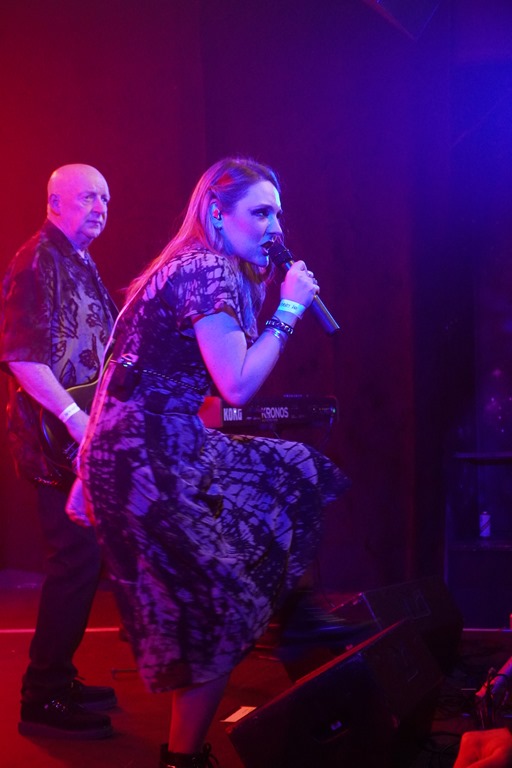
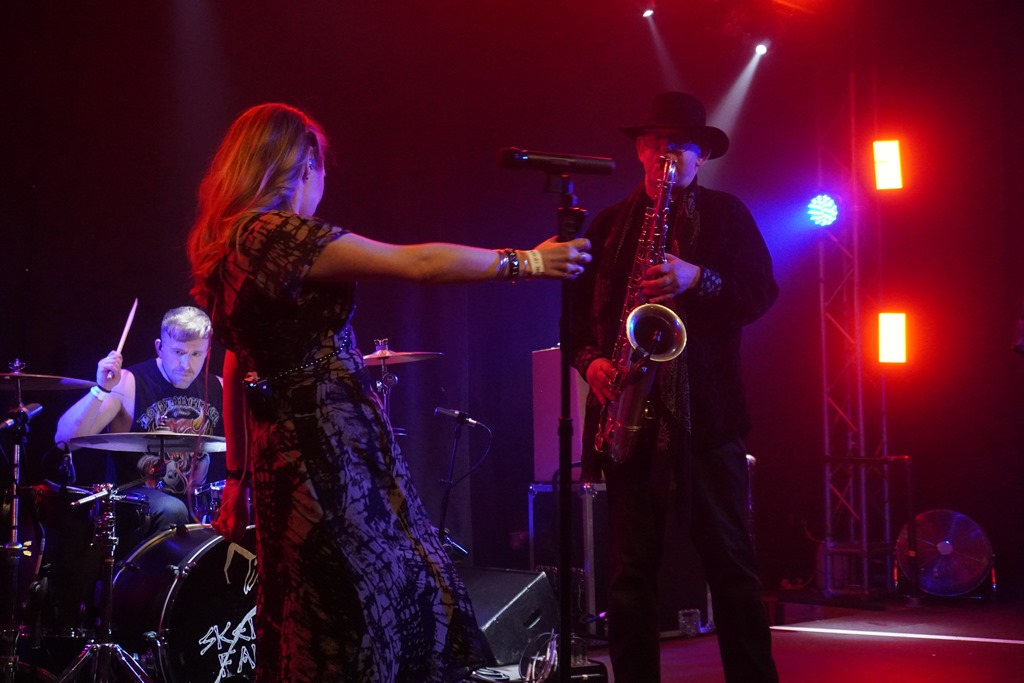
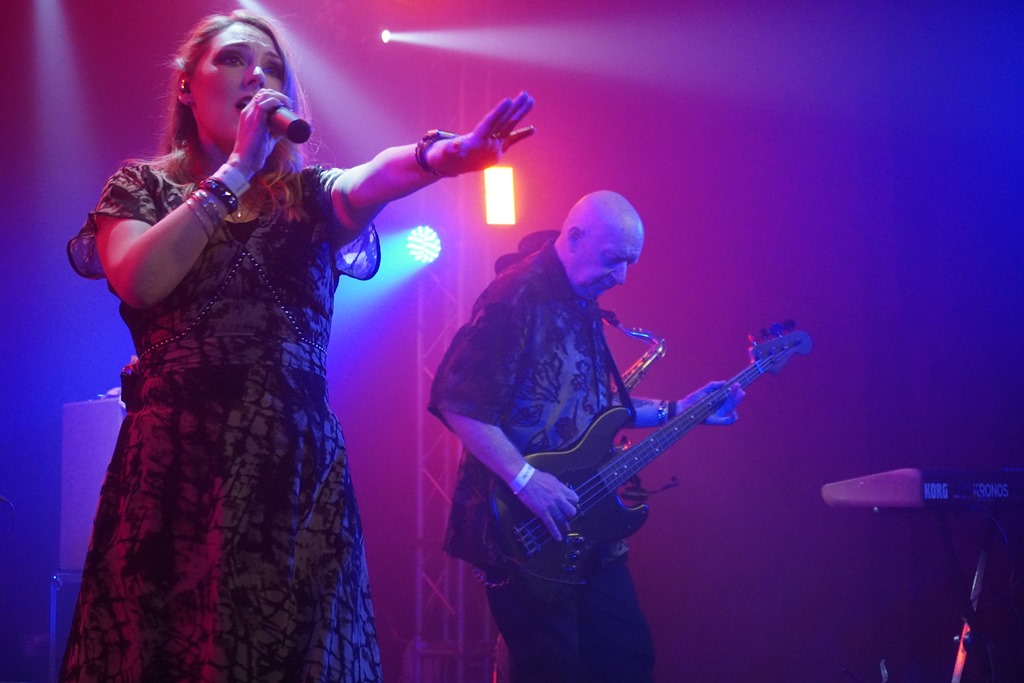
As for The Birthday Massacre… Woah. They sound phenomenal. Studio quality. But real at the same time. With six bodies packed on stage they need to be co-ordinated, and they are – tight beyond tight. If the energy was electric on their last visit, they’ve unlocked a whole new level of intensity now. Midway through the set, they’re all dripping, hair lank and stringy, but they don’t let up for a second. There are no ballads for a breather, and the audience feed off the band’s energy who feed off the crowd who feed off the band… you get the idea.

Sara ‘Chibi’ Taylor may be compact, but she’s one hell of a presence, but at the same time, a friendly one: she hands out water after fanning a distressed fan on the front row and beams throughout the set like she’s won the lottery. And it’s clear that it’s not just her who’s enjoying herself: the whole band radiates an aura of pleasure as they crank out a dense industrial chug. Sweeping synths fill out the sound, as Owen Mackinder lurches around his keyboards and wields his keytar with an infectious exuberance. Amidst the strobes, this is a band with bounce. They start a clap-along with ‘Destroyer’, and it’s a powerhouse blast from beginning to end.

DSC04604DSC04638

The Birthday Massacre

It’s true that in the scheme of things, and by the marks of the genre, The Birthday Massacre are something of a NIN-lite pop band, but they’ve created their niche and nail it, and what’s more, it’s clear they’re enjoying themselves as mush as we are. The drumming on ‘Crush’ is immense, and the song builds to a euphoric climax.

DSC04584

The Birthday Massacre

This time, they do play an encore, and keep the fans baying for more. But when did ‘one more song’ become a chant? If you want more, surely you really want MORE! (this doesn’t work so well at gigs by The Sister of Mercy, who never play anything on demand), but fortunately for us, The Birthday Massacre deliver not one, but three more songs. The reaction is incendiary and completely deserved. By the time they depart the stage, having dispatched twenty songs with explosive energy, it’s clear we’ve witnessed something special, a band at the very top of their game.

5th November 2025

Christopher Nosnibor

The early days of goth threw out a host of disparate elements, and there were some quite specific regional variations, too. While Leeds was a hotbed of the emerging scene, what was happening there was stark, bleak, with a certain industrial leaning, likely in part on account of its post-industrial wastelands and the kind of depravation which was rife in the late Seventies and Eighties, but was particularly prevalent in the North. It was quite different from what the more overtly punky Siouxsie and the Banshees were doing, and different again from the art-rock of Bauhaus. And it’s really their 1979 debut single –which was only partially representative of their oeuvre – which is largely responsible for the last forty-five years of the association of goth with bats and vampires and the like. Westenra do very neatly – and legitimately – tie these aspects together, hailing from Yorkshire (Whitby, to be precise) and with a name lifted from Bram Stoker’s Dracula, which famously sees the titular lead character land in Whitby, a place which will forever be synonymous with the macabre, the haunting, the gothic.

Announcing their arrival in 2019, Westenra are relatively new arrivals to a scene that’s creaking with acts who’ve been going for centuries (ok, decades), and in that time they’ve built quite a fanbase, particularly in and around their home county, with a steady flow of releases and an active touring schedule, including some high-profile shows playing alongside The Mission and Theatre of Hate. All of this is well-deserved, as they spin their own blend of – as they pitch it – ‘Goth, Alternative Rock & Metal.’

‘Burn Me Once’ does feel like a progression from their 2021 debut full-length, First Light. The production is fuller, bolder, and while the intro track (Monitus) is a densely atmospheric sample-soaked curtain-raiser, it’s only a primer. The band’s massive riff-slinging progress is nowhere more apparent than on the first song proper, ‘Ghosts in the Machine’. It’s got guts, and hints of the expansive vibes of Fields of the Nephilim’s ‘Psychonaut’, due in no small part to the sweeping synths and chunky, hypnotic bass groove, which explodes into a cyclone of bold metal-tinged riffery, against which Luciferia belts out dominant, full-lunged vocals which draw influence from Siousxie, but which are entirely her own style.

‘Sweet Poison Pill’ steps up the atmosphere and the tension, serving up a blend of vintage goth with a cutting metal edge and a dramatic theatricality, aided by layered vocal tracks. It’s bold, it’s epic. There’s a lot going on here: ‘Time’ opens with skittering electronic energy before crashing into a crunching metal Siouxsie-infused attack – and then there’s a whopping great guitar solo which erupts seemingly from nowhere. ‘For All To See’ is a big, bold, riff-led beast of a track that packs the density.

Westrenra sure know how to slide between modes and moods: Burn Me Once is epic in every sense. It’s an album which radiates immense power, and there isn’t a weak track here. Against a densely-woven musical backdrop, Luciferia delivers consistently strong vocals.

With this album, Westrenra deliver on all their promises, and then some, with a set of songs that’s brimming with energy and brooding introspection. And as much as they’re a goth band, Burn Me Once is an album that sees them pushing out in all directions far beyond genre limitations. Ultimately, Burn Me Once is a high-energy rock album with dark undercurrents which course relentlessly, and the quality of the songwriting is outstanding.

AA

a1821740368_10