Posts Tagged ‘gloom’

Gizeh Records – 4th April 2025

Christopher Nosnibor

Returning for their eighth album, A-Sun Amissa, purveyors of drone-centric ambience centred around founder Richard Knox pull back from the rather larger avant-rock sound of 2024’s Ruins Era to concentrate once more on ‘unsettling drones and claustrophobic atmospheres’. Knox is joined for the third successive release by Luke Bhatia and Claire Knox, indicating that this is a fairly stable lineup, and perhaps this has been a factor in the album’s exploratory, evolutionary approach.

The promise is that the record’s ‘washed out and ethereal sound drags electric guitar, clarinet, voice and piano through pillows of reverb and distortion to build heaving, desolate dronescapes. Moving through dense, oppressive passages of sound and diffusing into sections of gloomy, haunting restraint. We Are Not Our Dread is filled with majestic, textural detail. It envelops and, at times, smothers you before releasing just at the right moment, resolving in a billowing, melancholic, distorted reverie.’

The first thing that strikes me – as is often the case with any project centred around Knox – is the evocative nature of the title. Perhaps I’m feeling uncommonly sensitive right now, but this one in particular lands with an unexpected impact, and as much as the implication is one of positivity – no, we are not our dread, our dread does not define us or dictate our lives – there is equally the emphasis on the fact that we have that dread. And not you, or I, but us, together, collectively. And so it is that dread become the focus, that thing which looms large over not only the title or the album, but our lives. Why do we have this dread? It would not be an overstatement that the pandemic changed everything: the world that we knew lurched on its axis and no-one knew how to handle it. And since then, insanity has run free. 9/11 may have rattled the rhythm of life for a time, but not it seems that the entire world spent the pandemic years just waiting to wage war, and now nothing is safe or predictable – not your job, your home, your ability to post stuff online. You don’t need to be a prominent protestor or social agitator to attract the wrong kind of attention. The dread hangs over every moment now. We thought we had seen the worst when COVID swept the globe and lockdowns dominated our lives, and began to breathe a collective sight od relief when things began to retract, as we looked with optimism toward the ‘new normal’. But who ever anticipated this today as the new normal the future held?

We Are Not Our Dread consists of four fairly lengthy instrumental compositions, and ‘Electric Tremble’ arrives in a dense cloud of ominous noise which immediately builds tension, and if the rolling piano which drifts in shortly afterwards is gentle, even soothing, the undercurrents of rumbling discord and distant thunder which persist maintain a sense of discomfort which is impossible to ignore.

Ever since his early days with Glissando, melding post-rock with ambient tropes, Knox has had an ear for the unsettling, deftly manoeuvring elements of the soft and gentle with the spine-tingling. And while the eleven-minute ‘All The Sky Was Empty’ is a quintessential work of epic post-rock abstract ambience, rich in texture as it turns like a heavy cloud billowing and building but without an actual storm breaking, instead dispersing to offer breaking light and a sense of hope, the wandering clarinet brings a vaguely jazz element to the sound.

‘Sings Death or Petals’ arrives on trails of feedback and rumbling guitar noise, and is immediately darker, and those dark undercurrents continue with crackles and rumbles and elongated drones which persist beneath the ghostly, ethereal voices and reverb-heavy piano and picked guitar notes. At times, this bears the hallmarks of latter-day Earth, but at the same time there’s a less structured, less motif-oriented approach to the composition, which leaves much open space. I still can’t choose between death or petals here. It builds to a churning whorl, before the final track, ‘Our Hearts Bent As Crooked Lightning’ stirs from a rippling array of simmering noise and evolves into a colossus of rumbling drones, and, over the course of ten-and-a-half minutes, grows supple with softer waves of expansive synth which remind you to breathe again. For all the fuzz and broad swells of abstract, buzzing noise that’s equal parts gripping and soothing, the overall effect is sedative, and welcome.

We Are Not Our Dread leads the listener through some challenging moments, and as each listener experiences works differently, as I hear the final soaring strains of ‘Our Hearts Bent As Crooked Lightning’ this strikes me personally as dark and challenging. The intentions may be quite different, but this is undeniably a work which is sonically ambitious, spacious, resonant. Even as the tension lifts, the mood remains, like a dream you can’t shake, like the paranoia that persists even when you’ve dome nothing wrong.

That We Are Not Our Dread is true, and so is the fact that, to quote from Fight Club, you are ‘not your job. You’re not how much money you have in the bank. You’re not the car you drive. You’re not the contents of your wallet. You’re not your fucking khakis.’ And you are not your dread. It may at times possess you, but this, this is not it. This, however, is a great album.

AA
a1068739543_10

Crónica – 5th November 2024

Christopher Nosnibor

Simon Whetham’s latest work is a fascinating hybrid which incorporates found sounds and elements of layering in order to create a whole other world, a different dimension. The album itself is part of a larger project, which is more readily explained through quotation than a stumbling stab at paraphrase:

Successive Actions is an iteration of the larger kinetic sound performance project series Channelling in which various motor devices, salvaged from obsolete and discarded consumer technology, are activated by playing sound recordings through them. In turn, this produces new sounds from the devices, which are amplified using various microphones and techniques. The title comes from Dirk Raaijmakers’s "The Art of Reading Machines" as a term for mass production processes. As such, the recordings played through the devices are recordings of other devices used in previous versions of Channelling, in which the sounds used were seemingly mundane sound phenomena that occur unpredictably and irregularly in everyday life, as passing traffic, wind, doors closing. So now the sounds of devices malfunctioning and breaking from their programming are causing further action and disruption.

Successive Actions contains sixteen pieces, although only four extend beyond four minutes in duration, with the majority sitting only a short way over the two-minute mark, giving the album a fragmentary feel. But there’s a strong sense of cohesion, too: the title of each of the pieces ends in ‘action’, from ‘Action’ to ‘Protraction’, via ‘Inaction’, ‘Impaction’, and ‘Abstraction’.

While much of the album takes the form of abstract ambience and general murk, there are moments which stand out with levels of heightened discomfort: ‘Reaction’ conjures the bleak whistling wind of a nuclear winter. ‘Inaction’ scrapes and buzzes; it’s unsettling, but it’s not uncomfortable to the point that it’s unbearable: it just makes you feel tense, awkward. You want to seem a less stressful environment. But there s no less stressful environment, and life is stress: to escape that is to deny the reality of the everyday, for the majority. Under capitalism, we are all stressed, and on Successive Actions, Simon Whetham gives us a soundtrack to that stress and anxiety.

Mass production is, arguably, a fundamental source of our woes in the modern age. The Industrial Revolution brought so much promise, but as capitalism has accelerated and expanded at a pace which exceeds our capacity to assimilate, so it has become an ever-greater source of alienation. And here we are, overwhelmed by the road of the big machine as it continually whirrs and grinds. Sometimes its but a crunch and a gurgle, a hum and a thump. A buzz of electricity, a mains hum, as dominates both ‘Retroaction’ and ‘Counteraction’. It’s a cranial buzz and pushes frequencies which are uncomfortable, and as the album progresses it plaiters, and turns dark.

For myself, I feel a certain sense of release while immersing myself in the textures and layers of Successive Actions. There are moments when the album really achieves a heightened sense of – and in panic, of anxiety, of intensified reality. Other moments are altogether more sparse, steering the listener inside themselves into a the depths of an interior world.

Successive Actions is deep, dark, difficult. And so is life. On Successive Actions, Simon Whetham captures it, all elements of life that is. It crackles and fizzes with tension, and tension is high.

AA

a0457389705_10

Decline and Fall, a new Dark Wave project from Portugal formed by Armando Teixeira, Hugo Santos and Ricardo S. Amorim, is thrilled to announce the release of the music video for ‘Gloom,’ the haunting title track from their debut EP.

The ‘Gloom’ EP features four evocative tracks, each creating a dense and disturbing atmosphere with glimpses into the darkest corners of the human psyche.
Armando Teixeira, a pioneer of EBM and Industrial in Portugal, brings his vast and award-winning experience to the project. Known for his influential work with Ik Mux, Bizarra Locomotiva, and Balla, among others, Teixeira’s return to his roots in post-punk, new wave, and industrial is marked by a matured artistic vision and evolved technical expertise.

Joining him is Ricardo S. Amorim, author of Culto Eléctrico and Wolves Who Were Men – The History of Moonspell, and Hugo Santos from Process of Guilt, whose exploration of heaviness and rhythmic intensity adds a unique dimension to the project.

Watch the video here:

AA

929cb85e-60c6-2c61-9d15-dd816615c138

Decline and Fall, a new Dark Wave project from Portugal formed by Armando Teixeira, Hugo Santos and Ricardo S. Amorim, today share a new track off their forthcoming debut EP Gloom, which is set to be released on May 3rd via Bleak Recordings.

Armando Teixeira has a long and multifaceted career and is considered one of the pioneers of EBM and Industrial in Portugal, through projects such as Ik Mux, which began in 1986, and Bizarra Locomotiva, which he founded in 1993 and remained the main creative force until he left a decade later. With a vast and award-winning body of work as a composer, whether in Boris Ex-Machina, Knok Knok, Da Weasel, Bullet or Balla, which has been the artistic incarnation he has nurtured for the longest time, he also has a prolific career as a record producer.

Ricardo S. Amorim is the author of the books Culto Eléctrico and Wolves Who Were Men-The History of Moonspell, and met Armando Teixeira in 2015 for an article about Bestiário, the second full-length by Bizarra Locomotiva, released in 1998. When they met again years later, in conversations about music and records that influenced them, Armando Teixeira’s desire to return to his roots was awakened, composing in a way that brought to the surface what would be his primary influences, from post-punk to new wave, through industrial, but with a necessarily more evolved experience and artistic maturity, as well as access to completely different tools from those he had when he started out in the 80s, and a technical and theoretical knowledge that has never stopped growing.

Wanting to surround himself with people who shared this vision, Hugo Santos, from Process of Guilt, which, over the last 20 years, has explored heaviness and rhythmic intensity, punishingly repetitive and cathartic, as a privileged form of expression. Common tastes and influences are discovered, records are shared that have influenced all three or that are new discoveries for one or the other, inspiration grows and the seed that gives rise to Decline and Fall germinates.

Listen to ‘Undone’ here:

AA

a3013843323_10

Icons Creating Evil Art – 4th August 2023

Christopher Nosnibor

The third single from Swedish act Darkplace is their first to feature vocals, and is not a cover of the Gary Numan hit.

The band are described as ‘a mysterious new Swedish dark dream pop/post-punk group whose forthcoming debut album, About The End Of The World, is a conceptual work inspired by the bleak landscape of the Stockholm suburbs that birthed them.’ They go on to say ‘for the members of this highly secretive group, it is not just about the music. They perceive themselves as more an art project that happens to be exploring and commenting on the state of the world through their chosen mediums of music and video.’

Is a band mysterious if they tell you they are, or does that undermine the mystery? Surely a lack of disclosure is mysterious in itself? If I’m overthinking, it’s almost certainly a consequence of their overexplaining, although I am entirely on board with the idea of an act taking their art seriously to the point of fully inhabiting that space. When it comes to concept-based creations, you have to fully believe in it, otherwise, how can you expect anyone else to?

When it comes to Darkplace, context counts for a great deal, and to provide this, I shall quote liberally here: ‘Centred around an alternative reality – or is it just a grim present and future? – the album is being unveiled gradually via a series of videos based on animated digital paintings for each of its tracks… Their new single, ‘Cars’ […] sees the story move on to a man who travels north following cryptic messages written on highway signs that only show up in the blast of his headlights. Is he the only person who can see them and follow the trail? Darkplace cryptically state that “trying to escape this psychotic, slow burning apocalypse is not easy. Nowhere is safe. These weird structures and phenomena seem to occur everywhere, all over the world. Nowhere is safe!”

Perhaps somewhat ironically, the slow-burning apocalypse of which they write is accelerating at a pace no-one can keep up with, and half the planet is on fire now, quite literally, although this afternoon I read of hailstorms of biblical proportions in Germany and Italy, smashing car windscreen and requiring snow ploughs to clear the streets. It really does feel like the end of the world, and there’s a strong chance that is truly is.

Detached from the narrative of the album, ‘Cars’ stands well as a standalone single. It’s a taut, dark (of course) slice of post-punk inspired tunage, and while its lineage is clearly one that can be traced to the early 80s, it’s equally indebted to the school of the early 00s, which brought us Interpol and White Lies. What goes around comes around, and here in 2023, times are the bleakest they’ve been since the early 80s, with the added bonus of climate change threatening the collapse of civilisation and life as we know it. It’s dreamy but driven by an insistent beat and nagging guitar lines, and if the vocals, floating in reverb, evoke The Charlatans or Slowdive, and there’s perhaps a hint of Doves in the mix, the energy is more reminiscent of early Editors. Lyrically, it’s anything but uplifting, but the musical counterpoint really sweeps you along, making for an exhilarating three minutes.

AA

fc7f46444f143114c333beafb3be754b3b51910f

Prophecy Productions – 3rd February 2023

Christopher Nosnibor

When I decided to strike out and create Aural Aggravation, the premise – at least in my head – was that I would write whatever I liked about whatever I liked, although the more detailed version of that was that I would pen essay-length reviews instead of the usual sub-three-hundred-word summaries that were, I suppose, about volume rather than depth. Equally, the idea at the time, back in 2016, was that it would be a vehicle by which to explore my relationship with music as much as the music itself. I haven’t always maintained this approach since: sometimes I’ve kicked out pieces simply chasing hits as the site has grown in its readership; others I’ve simply not felt like going deeper. And ultimately, I’ve thought ‘fuck it, my site, my platform’, and I have to say I’m comfortable with that. The quality of my writing is variable, and my typing and proofing even more so, but that’s part and parcel of keeping it real and with a view to the bigger picture that reviewing has to be – for me – about how I feel about the music I’m writing about. Because music isn’t something to simply be dissected clinically, assessed on technical merit. People listen to music because of the way it affects them, not because they’re on a battle of the bands panel critiquing like they’re judging Strictly.

You’d think that when things are unspeakably bleak and I’m facing struggles of a magnitude I find almost impossible to face, let alone articulate, the last thing I would want to do is wrap myself in a blanket of suffocatingly dark music, and that the last thing I could bear to listen to while in the process of arranging a funeral is anything by a band called FVNERALS.

But then psychology is complex.

I write to neutralise, to create distance. If it’s on the page, it’s not me, or my experience, it’s simply words. When I fell and broke my ribs some years back, I tore open the palm of my hand on landing. In shock, the first thing I did on arrival home wasn’t to clean the grit out and sterilize the bloody mess, but to photograph it. My wife asked why the hell I did that. It was a fair question. I hate blood, it makes me feel queasy, dizzy, faint. If it’s my own. A photograph of blood doesn’t bother me. So the photograph created separation. It was a hand, not my hand. If it had been my hand, I’d have probably passed out. A hand is just a picture, it’s just TV, like a movie.

I do not feel as if I am living in my own life right now. It doesn’t seem real. Having suffered a bereavement – expected, but at the same time unexpected – solace emerges from unexpected places. I’m not seeking comfort, and have no interest in exploring where I am on the journey of the five stages of bereavement. I am stepping back, and assessing the scene. It is not my life. And this is the soundtrack to my surveillance.

‘Darkness. FVNERALS have created an album that turns the emptiness of the void and the depth of the abyss into sound with their third full-length "Let the Earth Be Silent". The duo gives sonic shape to the silence of extinction that humankind brings to all life on earth and itself. Depression, isolation, and the despair that this existence brings ooze out of every note’.

Lead single and the album’s opening track, ‘Ashen Era’ sets the tone and is representative of the heavy, harrowing furrow the album ploughs, with warping, disorientating noise and disembodied vocals circulating in a mist around thunderous but muffled percussion. It’s all-immersive, dark, dense, and listening to it feels like being buried alive, but at the same time transcendental.

A crashing gong heralds the opening of the scene that is ‘Horror Eats the Light’, released back in November as a single. It’s a bass-dominated exercise in heavy, droning doom and ethereality.

The album’s song titles really do speak for the album as a whole: ‘Annihilation’, Yearning’, ‘Barren’. This is bleak and harrowing stuff. ‘Yearning’ begins brittle, before exploding into a landslide of crushing guitars bearing down. The beats – crashing a light year apar, paired with bass notes landing like detonations event minute or so, this is heavy, but a different kind of heavy.

‘Yearning’ pitches that kind of Swand circa ‘86 crawling dirginess with crushing weight paired with a sepulchral glooming ambience, while the album’s last track, ‘Barren,’ lives up to its title, presenting eight-and-a-half minutes of crushing gloom with ethereal vocals which ascend heavenwards like angels on a zephyr.

Let the Earth Be Silent feels like the final shudders of a dying planet, the collapsing death throes of eternity. It’s a vast and at times quite overwhelming experience. The sound is immense and there’s something of a ceremonial feel about parts of it, but elsewhere it simply feels like the outpourings of grief and is hard to listen to under any circumstances. It chokes you up. There’s something final and ultimately funereal about the droning organ that hovers out to the end, and it leaves you to reflect on the idea – the end. It’s beyond comprehension. But on Let the Earth Be Silent, FVNERALS have created an album that paves the way towards acceptance.

AA

a1345175263_10

Cardiff electronic producer Conformist and gloom wave duo H O R S E S. ‘Heddiw’ ( ‘Today’ in English) collaborate for a collision of electronica and ominous post punk,  on a inventive framework of crunching beats and blips, haunted synth samples  and infused with the ominous vocals of duo H O R S E S, that bare more than a passing resemblance to Joy Division. A collaboration forged in the depths of lockdown, this haunting and bracing release is just a teaser of what’s to come in 2023.

Conformist says of the collaboration, it’s “a project that began by exchanging audio files between myself and H O R S E S on WhatsApp during the depths of Covid lockdown; I’m really pleased we can finally get this track out.  Vocals are by H O R S E S and production is by myself.  Hopefully this is just the beginning; we’re looking to follow up Heddiw in 2023 with a bunch of new ideas.”

Listen to ‘Heddiw’  here:

Conformist is one of the most respected names on the Electronic music scene in Wales, with early demos immediately catching the attention of Steve Lamacq, Huw Stephens, John Kennedy and Eddy Temple Morris.

Subsequent Conformist albums "Paid To Fake It" (2013) and "Lifestyle Bible" (2016) earned lavish praise:

"Paid To Fake It" is the sort of record that will take your breath away…bloody brilliant" The 405

"A musically kaleidoscopic head f***…brilliant" Louder Than War

"a head-spinning deluge of audacious beats and samples…staggering" Wales Online

Conformists’ production work is distinguished and full of unique character; staying leftfield but fresh and ahead of others; meticulous, dense and layered, revealing hidden detail with every listen – taking inspiration from Public Enemy’s Bomb Squad and cut n’ paste pioneers Coldcut, Steinski and The Dust Brothers to name a few.

Purveyors of dark hearted electronic music and inventors of the Gloom Wave genre, H O R S E S are formed by two gentlemen from a southeasterly part of Wales.

Casting a longing gaze on early 70s German electronica, mournful vocals escorted gently by cold beats and balmy synths evoke a brutalist image of Berlin, as the melodies wash between the brash concrete structures of your mind.

735276

The Helen Scarsdale Agency – HMS064 – 6th May 2022

Christopher Nosnibor

As William Burroughs said of his collaboration with Brion Gysin, The Third Mind, ‘No two minds ever come together without, thereby, creating a third, invisible force which may be likened to a third mind’. This wasn’t an entirely original concept, as he was referencing Napoleon Hill’s self-help book Think and Grow Rich, published in the 1930s. Self-help books are notorious for dispensing band advice and convincing the incapable that they’re capable of anything, but there’s a powerful shred of truth in this nugget: collaboration can – although there are absolutely no guarantees – throw open portal and new horizons and unlock unexpected avenues and whole worlds of potential. That more or less all of my attempts at collaboration have swiftly ended in failure – or, more accurately, fallen apart without producing anything more than a few paragraphs at best – probably says more about me than collaboration or my collaborators, but then when things have worked out… Yes, they’ve delivered. When it happens, it really happens. You can’t force or predict ‘gelling’: it simply happens, or it doesn’t, and when it does, alchemy ensues. You tend to find that strengths and weaknesses interlock, and all bases are covered, to use a poor assemblage of cliches.

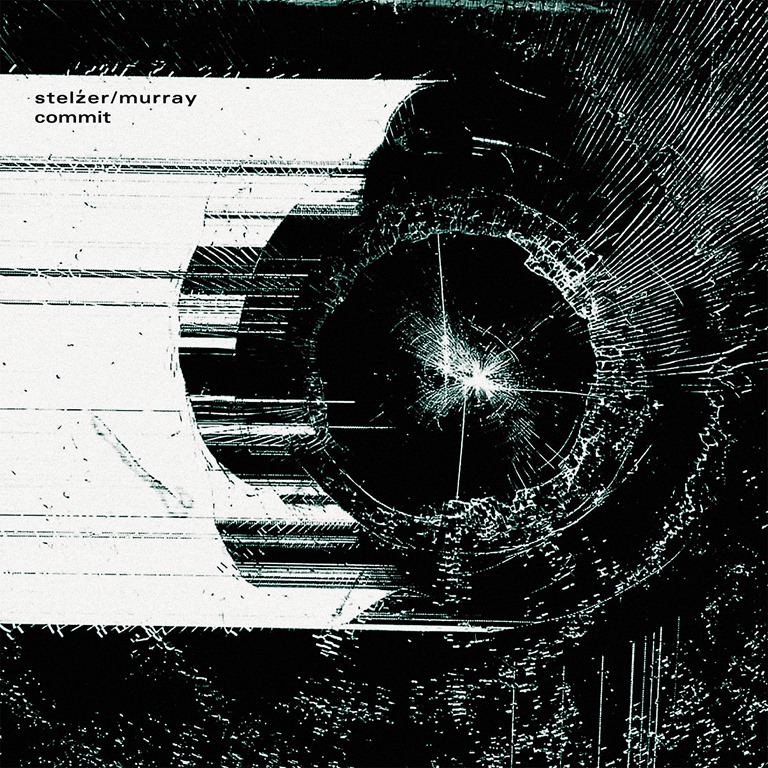
The accompanying text for the third production from the Stelzer/Murray project says that it ‘hits a sweet spot of slippery, industrial occultation that harkens back to an almost forgotten period of music from the late ‘80s and early ‘90s. Think Cranioclast, Arcane Device, Phauss, Small Cruel Party, Organum, and pretty much everything from the Quiet Artworks label… Exquisitely composed and overtly nocturnal without ever falling into the tropes of dark ambient and with plenty of gestures, signals, and threats that allude to any number of allegorically inclined processes (i.e. tape manipulation, time-delay accumulation, electro-acoustic minimalism, etc.).’

No question, despite their apparent absence of recollection of the actual process, Stelzer and Murray are the perfect foils for one another. Alchemy clearly has ensued – but make no mistake, this is some seriously dark alchemy, conjuring thick, black clouds of lung-clogging smoke that drifts, chokes, and suffocates.

On Commit, the atmosphere is dark, dank, doomy. The album is structured over two sides with the two parts of the title track, clocking in at around nine minutes apiece occupying side one before the nineteen-minute gloomfest that is ‘The House is Coming from Inside the Call’ smogging blurrily all over side two. The two parts of ‘Commit’ are darkly intense. They rumble and drone, groan and grind. There ae slow swells of cymbal, and a distant clicking, glitching that pulses time on ‘Commit 2’

is ‘The House is Coming from Inside the Call’ is sparse yet intense, and manifests as a series of movements over its duration. The atmosphere is heavy and oppressive, and the noise builds – and it is indeed noise that builds: it starts off as light drone and evolves into a thundering blast of grinding noise, clattering clanks of machinery and a howling siren that warns of danger, of imminent doom. You want to run for cover, to tale refuge, but there’s no escape and no shelter: thirteen minutes in and it’s built to a gut-churning, punishing churn of industrial noise, with clattering spanners and metal grating against metal.

In the dingy realms of dark ambient, Commit is a strong piece of work. It is dark, and dense, and intense. It possesses an unforgiving density, and it only gets darker and denser as it progresses. It’s an immersive and well-realised work, but Christ, is it bleak.

AA

HMS064_front

Darkness treads light as a feather. The voice of despair gently wafts through the air. Delicate pain wrapped in radiant beauty pierces the heart slowly yet without hesitation. The sinister yet beguiling images that DARKHER aka Jayn Maiven paints with her ethereal vocals, guitars, and added strings conjure iridescent cinematic scenes in which it becomes hard to tell whether there lies beauty in darkness or if it is the other way around.

With her sophomore full-length "The Buried Storm", the guitarist, composer, lyricist, and producer has clearly succeeded to even improve the beloved alchemic musical formula that was firmly established on DARKHER’s debut album "Realms" in 2016. Her mostly eerie and at times even outright sinister sonic storytelling comes refined on every level and with sharpened contrasts that reflect the ongoing learning-process of their creator. 

DARKHER were conceived as the sole brainchild and solo-project of Northern English singer and guitarist Jayn Maiven in 2012. The dark and melancholic yet also massively heavy sound on the self-titled debut EP "Darkher" (2013) combined with the distinct vocals of the shy pre-Raphaelite beauty caused an audible buzz – particularly in the doom scene and brought DARKHER a quick record deal, which led to the following EP "The Kingdom Field" (2014) appearing via Prophecy Productions.

Despite not even having an album out, DARKHER were invited to prestigious festivals such as Roadburn in Tilburg, The Netherlands and Prophecy Fest in the Cave of Balve, where the English delivered widely celebrated performances. In 2016, the highly anticipated debut full-length "Realms" was finally released to much praise from critics and fans alike. Press compared DARKHER’s music with a wide range of highly individual acts such as CHELSEA WOLFE, ESBEN AND THE WITCH, SÓLSTAFIR, LOREENA MCKENNITT, and PORTISHEAD.

In the meantime, Jayn’s long-time drummer Christopher Smith, who already contributed to earlier releases, live shows, and again on "The Buried Storm" has been added as permanent member to the line-up of DARKHER.

"The Buried Storm" gives shape to the darkness lurking at the edge of consciousness, hidden from plain sight but patiently biding its time to strike out at the heart. DARKHER have delivered another frightening masterpiece that easily transcends musical boundaries with its broad appeal to friends of dark sounds regardless of genre. "The Buried Storm" captivates its listeners with deceptive sweetness – only to bind them tightly within a thorn-spiked nocturnal beauty forevermore.

Watch ‘Lowly Weep’ here:

AA

Darkher_001_by_ Kathryn_Pogue

Image: Kathryn Pogue

21st June 2021

Black Angel emerged four years ago, and released Kiss of Death in July of last year – an album that brought together Matt Vowles’ years of experience from being in and around the goth scene to recreate the spirit of 1985.

This time, Vowles and co have come out with a concept album for their third outing, which is ‘inspired by cinematic classics such as ‘Dracula’ (Gary Oldman-1992) and ‘Interview with a Vampire’ with contemporary inspiration on tracks like "Alive" and "Give It To Me’" from the modern aristocratic sophisticated vampires in ‘Underworld’.

The album’s concept, the blurbage explains, is ‘to take you on a journey. The record starts out with an introduction to set the tone and to put you in 10th century England. As our protagonist embarks on his pillage through the town, we hear screams from the villagers as they run for their lives. He’s the Prince Of Darkness and causes chaos and mischief wherever he goes’.

There’s a fine line between artistry and pretence, theatre and corn, and despite the concept that veers towards an amalgamation of all the clichés of goth distilled into a dozen tracks, Prince of Darkness once again nails that vintage goth sound, with ‘Alive’ melding the energy of early Mission with the mechanised drumming of The Sisters to create a swirling cyclone of tripwire guitars and gloom with a glint of joy.

The energy is sustained across the bulk of the album, and the vibe is very much a muscle-flexing dominance, delivered with a big, ballsy swagger: there’s a hefty whiff of testosterone and a barrel load of rock god posturing going down here, but it’s delivered with a knowing nod ‘Live to Love’ is a proper old-school rock ‘n’ roll stomper with a smoky vocal growling and grizzled over a piston-pumping beat and a wonderfully insistent bassline that nags away at a repetitive motif. It’s got that level of grab that immediately makes you want to stick the whole album on repeat, especially after ‘Turn Around’, which pushes the quiet / loud dynamic with a searing guitar line that’s right in the vein of The March Violets – it’s that flangey reverby chorus thing.

Vowles has some depth, and range, too – on some tracks, like ’Call the Night Part II’ he showcases a grainy croon reminiscent of Mark Lanegan, and it’s heavy timbre is well-suited to such expansive epics, and then again, on ‘Secretly’ we see a more soulful, even tender side, and ‘My Love’ goes all out for the heart on sleeve grand gesture. It’s theatrical, but at the same times feels emotionally sincere, and while the melody bears similarities to ‘The Scientist’ by Coldplay, it sounds like it’s being sung by James Ray, and it’s quite moving in a brooding, gothy way.

Throughout, the songwriting is solid, with guitar hooks galore and a taut rhythm section that forges that classic goth groove. There’s a clear lineage from its predecessor in that Prince of Darkness is very much old-school goth delivered with a subtly contemporary twist, but it sounds and feels more confident, more ambitious, and not just on account of its embracing an overarching concept. Prince of Darkness is the sound of a band really hitting their stride, and achieves the perfect marriage of concept and execution.

AA

368330