Posts Tagged ‘Experimental’

Bam Balam Records –12th June 2021

Christopher Nosnibor

Two names to conjure with collided live in Tokyo on 14th March 2019, with sprawling psychedelic masters Acid Mothers Temple coming together once more, a full decade after the release of the live album Underdogg Express in 2009, with the founder of the legendary Krautrock band Guru Guru. ‘A fiery psychedelic collaboration recorded in the spirit of early Guru Guru’ ensued.

Edited neatly into four tracks – two per side of vinyl – it’s being released on limited edition vinyl for the French ‘Disquaire Day’ June 2021 (French Record Store Day 2021).

In recent years, I’ve come to despise Record Store day: after all, a record store is for life, not just for RSD, and the whole thing reeks of exploitation, from the retail prices being set as a level that means stores themselves make next to nothing from any sales, many fans are priced out – assuming they aren’t geographically advantaged – and then they’re shafted once more when those who had both the benefit of cash and location resell at even more exorbitant prices. Yes, one could discus free markets and supply and demand and how buyers choose to pay those prices – and I personally choose not to – but ultimately, a lot of the fun has gone out of it since the early years.

It doesn’t help that RSD has been swamped by reissues by major labels, meaning completists and hardcore collectors of some very popular acts are climbing over to buy new editions of old records, and none of them really give a fuck about independent stores, labels, or artists.

In this context, this release is a welcome one. It’s also a good one, and finds the collaborators veering from wildly chaotic and discordant free-jazz to muted, atmospheric ambience, with the fifteen-minute ‘Electric Junk’ spanning both, and beyond, exploding as it does into a searing proggy / post-rock crescendo in the closing couple of minutes.

‘The Next Time You See the Dalai Llama’ is built around a cyclical motif that whirls like a kaleidoscope over a throbbing reception of pounding drums and bass that lock into a relentless groove for the first four of is nine minutes. The title track closes with a mash-up of classic rock and wild desert psych, with some wild guitar work going fret crazy over an insistent, monotonous bass groove and thumping percussion that pounds and crashes relentlessly, and it even get on quite a swagger and swings into a full strolling jazz workout in the second half.

Tokugoya doesn’t bring any real surprises, and is, really, exactly what you’d expect – but then it doesn’t disappoint… although its limited availability might (but there is still a CD version).

BBLP085_front

5th June 2021

Christopher Nosnibor

The only way to remain sane through all of this madness is to embrace it, or at least some of it. Then again, ( kröter ) have been ahead of the curve in the madness stakes for some time, as the conveyor-belt of releases over the last couple of years have shown, since they were all culled from some epic sessions around 2018.

*f is their third album of 2021, and the sixth album to be culled from these sessions. Remarkably, rather than a random collection of offcuts and flow-sweepings, it contains some of the most outstanding material yet, and one has to wonder how much did they actually record?

They’ve spent a lot of time sifting through the material and chopping it into tracks and sequencing them into albums – with varying degrees of cohesion – but as they note, ‘as usual, there are no second takes in this pond. All is nutritious, spiraling and slowly growing legs.’ These legs are long and hairy, and the sprawling eleven-minute ‘Trajectory’ is a dingy, dirgy grind dominated by a crunchy, dirty bass groove and plodding beat. It’s kinda post-punk, kinda no-wave, kinda noise-rock, and if there are moments when Mr Vast’s vocals hint at a Jim Morrison-esque swagger, the whole thing reminds me most of Terminal Cheesecake, for those who can handle an obscure reference point.

‘The Letter’ is swampy, minimal, meandering, while ‘The Rock’, another low-oscillating slab of dark industrial-leaning synth is propelled by clattering percussion and features snarling, growling manic vocals. Vast is a versatile vocalist, even if on this set his delivery isn’t particularly angled towards melody, as he drones and yelps and drawls and yowls all kinds of atonality over repetitive electronic grooves.

It all comes together on the eighteen-minute ‘casper hauser in the mirror’, a thumping, humping, ketamine-paced motoric industrial jazz odyssey. Vast sounds utterly deranged as his voice wanders lost, aimless, as he half speaks, shouts, raps and yawns out abstract lyrics that drift out in a drift of reverb. Again, around the six minute mark, it sounds like Kraftwerk fronted by Jim Morrison circa LA Woman, and yes, it’s a pretty fucked-up experience, and the atmosphere is not only intense, but also dizzying, bewildering in its hypnotic pull. It transports the listener to another place, out of mind if not out of body, conjuring an almost trance-like experience. It may be some kind of woozy, weirdy, hippy shit, but it’s also affecting. There’s much to be said for the power of repetition, and this just goes on, and on… and on. It’s not nightmarish as such, but it is trippy and disorientating.

This is a fair summary of the album as a whole: *f really does pack in the weird shit, and if the initial tone is one of quirky, oddball fun, the overarching experience is rather darker. The disorientation it creates is less kaleidoscopic joy and more the nausea of excess, and a kind of unsettled bewilderment. ( kröter ) depart from Hunter S. Thompson’s adage that when the going gets weird, the weird turn pro, and instead forge their own path, whereby when the going gets weird, the weird gets even weirder, and a few shades darker, too. Which is cool, because who wants their weirdness to be predictable, after all?

AA

a2240317846_10

Empty Quarter – 1st June 2021

Christopher Nosnibor

The latest instalment in the reissue series of albums by oddballs Photographed by Lightning is something of a departure from its predecessors – but then, each album marks a different departure, and if one thing this contemporary appraisal of their back catalogue highlights is that they never stated still or retrod ground, which each release existing in a completely different realm from those which came before.

Recorded in 2002 and released in 2004 and considered by the band to perhaps be their strangest offering (and it’s got some tough competition), it lists as its inspirations the works of Kenji Siratori, Friedrich Nietzsche, Suehiro Mauro, Georges Bataille, J G Ballard. I’m often particularly intrigued when a band’s citations are literary, or otherwise non-musical, perhaps because in some respects, while there is naturally much crossover between all creative disciplines, literary influences tend to be more cerebral, ideas or concept-based over sonic. When a bands say they’re influenced by Led Zeppelin, you can probably hear certain stylistic elements in the composition: but you’re not going to hear elements of Ballard in the guitar technique of any band – although with a substantial catalogue of releases to his credit, Kenji Siratori is a notable exception to the rule, particularly as the experimental Japanese polyartist’s forays into extreme electronica and harsh noise in the vein of Merzbow actually do very much resemble his literary works also as a brain—shredding sensory overload.

This is certainly a fair summary of the experience of this album: the title track, a mere intro at under two minutes, is a blend of scratchy, synthy noise with extraneous elements collaged here and there.

‘The Embryo Hunts in Secret’ and ‘Putrid Night’ are both a sort of psychedelic new wave collision, and with the wandering basslines that veer up, down, and everywhere amidst treble-soaked chaos, the effect is disorientating dissonant, as if everything is slowly melting or collapsing in on itself. Everything is murky, dingy, kinda distant-sounding and discordant. Take ‘Kundalini Butterly’ – a spiralling kaleidoscopic mess or scrawling feedback and a bass that sounds like an angry bee bouncing around inside an upturned glass, coming on like Dr Mix covering Cabaret Voltaire’s ‘Nag Nag Nag’.

Blood Music is noisy, but it’s not straight-ahead guitars noisy: instead, it’s a mangled menage of bits and bobs hurled together – not clumsily, but then, not delicately, either, with pulsing washes of rhythm throbbing and crashing all around. It gets weirder and darker as they plunge into ‘My Hole’, where the bass bubbles and throbs beneath a continuous stream of trilling distortion, synth whistles and wails, and there’s a lot of overloading, whupping distortion that derails the helicotoptoring synths and froth and foam that sloshes around at the lower end of the sonic spectrum. ‘Dark Sun’ goes kind of industrial with a hefty, thunking beat, with a relentless, distorted snare, low-slung, booming bass and heavily treated vocals, and there’s chaotic piano all over the place: the emphasis is very much on the dark here.

Dave Mitchell’s lyrics are, we’re led to believe, to have been inspired by whatever he was reading, but buried low in the mix, bathed in reverb and given a grating metallic edge, he sounds like a malfunctioning Dalek chanting incantations. To be clear, that’s by no means a criticism.

Final track, ‘Frame’ is more overtly ambient, but dark, with a certain industrial hue as it shifts to pound out a relentless beat against braying sax and a whirlpool of aural chaos: I’m not about to suggest that PBL were going through any kind of NIN phase, but there are hints of parallels with The Fragile in places here.

Everything about Blood Music is seemingly designed to challenge, to present the music in the least accessible way possible – and it’s far from accessible to begin with, for the most part. The dark density of the sound is heavy, and there’s something quite deranged about the album as a whole, in a way that’s hard to define… but deranged it is. Which seems a pretty fitting summary of the band’s catalogue as a whole: the only thing you can really predict is their unpredictability.

AA

a3521472505_16

Stone Giants – the new alias of electronic musician Amon Tobin – shares the third and final single "A Year To The Day" from the debut album West Coast Love Stories, arriving 2nd July on his Nomark label.

“Your phone cheerfully recalls where you were this time last year. What executive committee decided it would be a good idea to have moments from your past randomly intrude on your present day? Memories you’ve either, carefully compartmentalized or buried so safe and deep you daren’t scroll through your photo history. Now at any moment you can be ambushed by an algorithmically generated montage of your most fragile memories set to music. It’s like an AI Psy-Op designed to send us into some kind of spiralling despair.” – Amon Tobin

Listen to ‘A Year to the Day’ here:

AA

a3167959992_16

Mongkong Music – mkng-01

Digital release date: 4th June 2021 / Physical release date: 4th July 2021

Christopher Nosnibor

Having been introduced to the world of microtonal experimentation around a decade ago, I’ve found a certain fascination in those close lenses on the most minute of details – the musical equivalent of peering through a microscope and seeing objects and life forms on a granular, even cellular level. I’ve also learned that anything that can be rendered or viewed from a micro level, it’s probably been done, or otherwise is within someone’s sites to do, or I simply haven’t found it yet. Take, for example, the ensemble Microtub – not a small bath, but a trio of microtonal tubas.

Mycrotom is not a microtonal tom drum, nor a microtonal extension of the work of the Vegetable Orchestra (a ten-piece collective based in Vienna who make music using instruments crafted from actual fresh vegetables). In fact, the moniker is somewhat misleading, for as the press release notes, ‘Tom Simonetti alias mycrotom has created rather large-format sound carpets in the Bertolt Brecht mechanical engineering city of Augsburg. He now presents the same: soundscapes on which you can go out of work and walk away.’

So, it’s actually about sound carpets. I have to confess that I chuckled a little on reading that, before reminding myself of my own habit of describing works as ‘sonic tapestries’ and going into detail about the ‘fabric’ of numerous compositions – and that was before I listened to the album.

The pieces are built on interesting juxtapositions – sparse motoric beats click metronomically through gloopy synth basslines that could have been lifted off early 80s electro cuts on Wax Trax! while xylophone-type chimes ring out lilting motifs. Extraneous sounds are looped to forge unusual rhythms, and there’s a muddy, murky aspect to the sound that makes it difficult to separate the different elements.

Many of the synth sounds are vintage in style, squelchy, thick, fuzzy-edged, and while the arrangements are sparse, the effect is far from minimalist: there’s quite some density to the sound, and what’s more, a lot of Ratoratiyo pursues quite danceable grooves, and with a hybrid of 90s minimalism and 80s robotix, it feels completely removed from anything human.

‘Logic by Machine’ contains human voices – sampled, distanced, detached – against a sparse, rhythmic loop. It’s anything but comforting, and leaves one feeling even further adrift, alienated. It’s a strange experience that twists at the cognitive filters in unexpected ways. After all, none of the elements are new or particularly unusual – but their assemblage is, and in ways that are difficult to place a finger on. And it’s that difficulty of placement that lies at the heart of the challenge for a listener. You ask yourself ‘how does this fit with my experience?’ and ‘where do I belong in all of this?’ There are no handholds or footholds in terms of emotional resonance, in terms of experience. And precisely what does this convey? The sounds may be warm, but the experience is somehow cold, with a sense of separation.

It’s from this place of distance, a position of removal, isolation, that we begin to explore the spaces of Ratoratiyo, and the exploratory adventure begins.

AA

mkng-01_front

CD Epicentre Editions EPI-2101

Christopher Nosnibor

It’s testament to his degree of innovation and influence that John Cage’s works remain a source of fascination for so many almost 30 years after his death. Few composers have reached across so many fields, let alone a composer as radical and overtly experimental. But Cage singlehandedly broke all the ground, especially when it came to exploring elements of the random, of the relationship between the performance and the audience, and of incorporating strands of philosophy into the creative process.

This recording of Variations VII is very much an unadulterated document of a specific event, best detailed in the liner notes:

Variations VII was created by John Cage to be performed at a special event, 9 Evenings, Theatre & Engineering, held from 13th to 23rd October 1966 in New York and in which a team of engineers, led by Billy Klüver, worked with ten artists from the American “avant-garde”, with the aim of enabling them to extend their exploration of the possibilities of electronics in their own art. Here is how John Cage described this piece in the programme for the event:

« It is a piece of music, Variations VII, indeterminate in form and detail, making use of the sound system which has been devised collectively for this festival, further making use of modulation means organized by David Tudor, using as sound sources only those sounds which are in the air at the moment of performance, picked up via the communication bands, telephone lines, microphones together with, instead of musical instruments, a variety of household appliances, and frequency generators. »

And so ‘Intro’ is four minutes of audience chatter, a throng of conversations, all in French, over and across one another. It may feel superfluous to some, but in so many ways, it’s integral to the experience. It not only captures the moments before the performance as it happened, but also transports the listener there, and reminds us that this is not a studio work, designed to capture some kind of perfect realisation of the piece for all time. There is no trickery or manipulation after the fact: this is a live performance, in front of a live audience, something that happened in the moment, and the moment is all there is, and the life of the piece is tied to that specific moment. And then, there is the fact that Variations VII is, effectively, about chatter.

Crackles of static, whistles and whines rent the air as the performance begins; the sound of radio dials turning, tuning in, finding – or failing to find – the right wavelength. Hums, hisses, and snippets of conversations, fragments of music. Whups and whirs, shill shards of feedback and blizzards of white noise emerge from a myriad pieces of sound, booming yawns of interference all criss-crossing over one another in a disorienting real-time sonic collage. Machines grind, babies cry, there are explosive, thunderous blasts of distortion, It’s like walking down a busy street, hearing pieces of conversation, radios blaring from cars, engines revving, and the parallels with William Burroughs’ cut-up technique, for those familiar, are clear. This replicates the experience of life in real-time, and real-time experience is not linear, but simultaneous: a plane flies overhead and you catch sight of an advertisement, and a reflection of a face in a shop window while conducting a conversation, and all around, other people conduct their own conversations…

The mechanics of it are complex and ambitious, but also typical of Cage’s approach to composition:

‘Ten telephone lines connected to the sounds of ten different locations in New York City. History has taught us that one of the first uses of the telephone at the end of the 19th century was, besides transporting voices, the live re-transmission of concert performances of opera. A few privileged listeners could therefore listen to the music in their own homes. Several decades later, John Cage reversed this, so to speak, by inviting the sounds of several distant environments into the concert venue!’

And so it is that the 1966 piece was performed live once more on August 15th, 2020 at the festival Le Bruit de la Musique. The performance lasts for an hour and eight minutes, during which time we’re subjected to a bewildering array of sounds, unconnected, disparate, all completely independent of one another, uncoordinated, random, haphazard and hither and thither. It’s a bewildering experience: not a lot happens, but at the same time, everything happens, a lot of it simultaneously. For the duration of the performance, the spell remains unbroken. For some reason that I really can’t explain, I find myself sitting, ears pricked, on tenterhooks, listening out for details. Towards the end, a blitzkrieg of overlapping extranea build to a tempestuous tumult of harsh noise that sounds like Throbbing Gristle a whole decade before their conception. And as it gradually tapers down, a cough from the audience cuts through the quiet – but it’s not quite finished. We wait, on edge.

Suddenly, there is silence.

Only when the performance ends is the tension broken.

There is a pause, a few seconds of uncertainty, before the applause breaks. There are a few whoops, but mostly, it’s polite. Enthusiastic, but polite. There is no chatter now. One suspects that having witnessed this – bearing in mind that it’s 1966 – many would have been simply stunned of vocabulary. The era may have been accustomed to all kinds of newness, all kinds of shocking, taboo-breaking art, but this…?

Variations VII hasn’t dated, and not lonely does it still sound contemporary, it remains incredibly relevant: if anything, its relevance is greater in 2021 than it was in 1966, perfectly recreating the experience of total media and sensory overload. Never mind The Beatles, here’s John Cage.

Kranky Records – 28th May 2021

Christopher Nosnibor

Over the course of two decades and fourteen albums, Scott Morgan, under his Loscil moniker, has created a body of work which has probed myriad different directions within the electronic / ambient field. While his previous works have explored minimal arrangements and the application of difference source materials such as field recordings, none has been so intently focused on rendering a limited range of course materials in the most varied ways possible – which is precisely what Clara does, taking the same source material and seeing just how far it can be taken in different directions.

The accompanying text explains the process in detail, describing the album as ‘a stunning meditation on light, shade, and decay, sourced from a single three-minute composition performed by a 22-piece string orchestra in Budapest. The subsequent recording was lathe-cut on to a 7-inch, then “scratched and abused to add texture and colour,” from which the entirety of Clara was sampled, shape-shifted, and sculpted. Despite their limited palette, the compositions summon a sense of the infinite, swelling and swimming through luminous depths. Certain tracks percolate over narcoleptic metronomes while others slowdive in shimmering shadowplay, sounding at times like some noir music of the spheres’.

In some respects, then, Clara is a remix album, in the sense that some remix albums stretch and deviate so far from the original material that the song being remixes becomes unrecognisable, and one begins to question the extent to which the track is the work of the original artist and the extent to which the credit for its creation belongs more to the remixer. This may all be Morgan’s ‘own’ work but at what point does the source material become buries beneath the reworking? Perhaps what’s most remarkable about the album, considering its origins, is just how…. Normal, how smooth it sounds, as opposed to being a fucked-up mess of crackle and pop, hiss and static. I had anticipated scratches, abrasion, mangled noise, clicks, pops, something approximating the sound of a Brillo pad being applied directly to the microphone. But no.

‘Lux’ introduces the album in what feels like familiar territory: long, slow swells of strings flattened out into partial abstraction, smudging the definitions that stand between orchestral and ambience to forge sounds that have become almost the standard form in contemporary ambient. And this indeed the form for the album as a whole.

It’s no criticism to observe that Clara sounds like Loscil: Morgan is a master in the field of contemporary ambient, and has a supreme ability to sculpt slow-shifting soundscapes that are eternally intangible, unreachable, yet immersive in their soft clouds and vaporous drifts. ‘Lumina’ has some softly bouncing bubbles rising and eddying around in a soothing sonic foam that’s slow and gentle, while the ten-minute ‘Stella’ floats past almost imperceptibly.

Nothing about Clara is going to raise the blood pressure.

The track titles all refer to light and luminosity, and instead of scouring the ears and the soul, Clara recreates the warm glow of a log fire burning down to embers, or a dimmed bulb late on a summer’s evening after the sun has faded from the sky, leaving a purple-hued sky in its wake. ‘Sol’ slows and dissolves down to a low, pulped-down pulsation, from which in its mist emerges a rippling loop of rippling mellowness that hints at the abstracted ambience of Tangerine Dream.

Even in the face of the most broken, damaged of source sounds, Loscil smooths the edges and renders them something else, and something other, by a process of softening, of melting into abstraction. Clara is a magnificent work of transformation, of distancing, whereby the end product emerges in an entirely different sphere from that which begat it.

AA

457773

Ahead of the release of the first compilation on the NIM label – the snappily-titled Deprived of Occupation and Pleasure We Feast Aural Aggravation are immensely honoured to premiere ‘1010’ by Obviate Parade, the exploratory guitar vehicle for Paul McArthur of Damn Teeth.

With lyrics centred around Emily Dickinson’s 1010th poem, it’s a largely spontaneous cut, with all instruments and vocals recorded in a single take (albeit subsequently edited), it’s a magnificent balance of immediacy and controlled manipulation.

Don’t just take our word for it: get your lugs round it here:

AA

a2705195024_16

Demo Records / Crossness Records – 30th April 2021

Christopher Nosnibor

While I’m no fan of remix albums as a rule, the last year or so has clearly made it difficult for artists to create new material, and since touring’s been off the table, options for maintaining profiles – or making sales – have be limited to say the least. And with time to reflect and review, revisiting and revising previous output through fresh eyes seems more than reasonable.

It’s also refreshing to see ‘Could Divine, Remembered’, the release from anrimeal (the recording project of Ana Rita de Melo Alves), described not as a remix album, but a ‘meditative companion piece to her debut album ‘Could Divine’’. As the blurbage explains, ‘‘Could Divine, Remembered’ refuses the limits of the traditional ‘remix album’ – sure, there are remixes here, but amongst them you’ll find demos, reflections, confessions, rituals, and the artist’s own heartbeat. The sum of these parts is an immersive audio documentary about the making of Ana’s debut. For those familiar with ‘Could Divine’, this is a chance to look behind the scenes and magnify its meticulous detail; for those unfamiliar, it allows a first visit to an abundant internal world.’

I fall into the latter camp, although drawing lines across between the tracks on this new reworking and the original proves an informative exercise, and the reworked titles provide some insight into the inspirations or ideas behind these alternative renditions of each song (notably ‘Encaustic Witches’ returns here as ‘Encaustic Witches as an Ambient Track to Help Me Sleep’ and ‘Headrest’ appears as ‘Headrest, A Story About Feeling’. Elsewhere, explanatory or embellishing details appear, as ‘Death’ becomes ‘Death is a Burning Ritual’.

“When I think of nature, nothing happens,” she says at the very start of the album on ‘Hello and a Half’: it’s quite a contrast to the twitter of birdsong and lo-fi acoustic guitar that heralds the arrival of ‘Marching Parades’, the opener on ‘Could Divine’, and immediately we’re parachuted into the documentary aspect of this fascinatingly multi-fascinated work, which lays Ana’s workings out bare. Cars pass as the speech takes on an almost spoken word narrative form – but even that’s not straightforward as delays double-up her voice and as she explains how the album is about her ‘going into the wild’, it seems that some of that wild is more psychological than literal, an exploration of internal territories hitherto uncharted. At times, it ventures into the kind of disorientating cut-up tape works of William Burroughs and Brion Gysin in the late 50s and early 60s, and elsewhere, her monotone voice, against a sift, dappled backdrop is soporific and sedative.

This is an album of ideas and of origins, of snippets and sketches, as well as of reworkings and revisions. It’s bitty, but somehow hangs together remarkably well as an insight into Ana’s creative process. At the same time, in straddling the before and after that sit either side of Could Divine, it questions the notion of the ‘end product’, the idea that there is ever a ‘finished article’.

The demo of ‘Could Flower’ reveals the early shoots of the idea that would become the album’s title track. It’s a haunting acoustic folk piece, which would subsequently metamorphosise into a fragmentary, multi-segmented work that transitions as if through a dream sequence. There’s an ethereal, evasive quality to Could Divine, Remembered, and it places the album in a realm all of its own.

As an aside, all profits from the release will be donated to Plataforma de Apoio aos Refugiados, a Portuguese refugee support organisation. In bleak times, we once again see art being used as a conduit for good – and this, it has to be said, is good art.

AA

a3633893503_10

Christopher Nosnibor

No two ways about it: coinciding with the NIM compilation album Deprived of Occupation and Pleasure We Feast, FEAST 4 offers the most jam-packed and solid quality lineup they’ve put on yet, with sets from a number of acts featured on the album and a stack more besides.

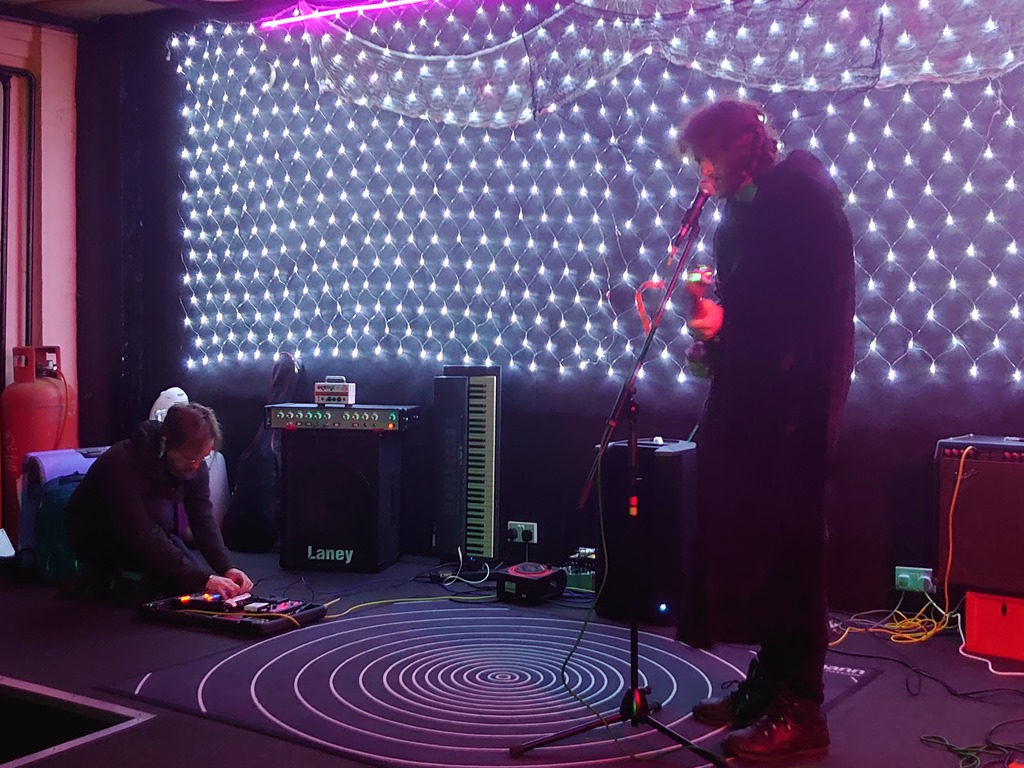
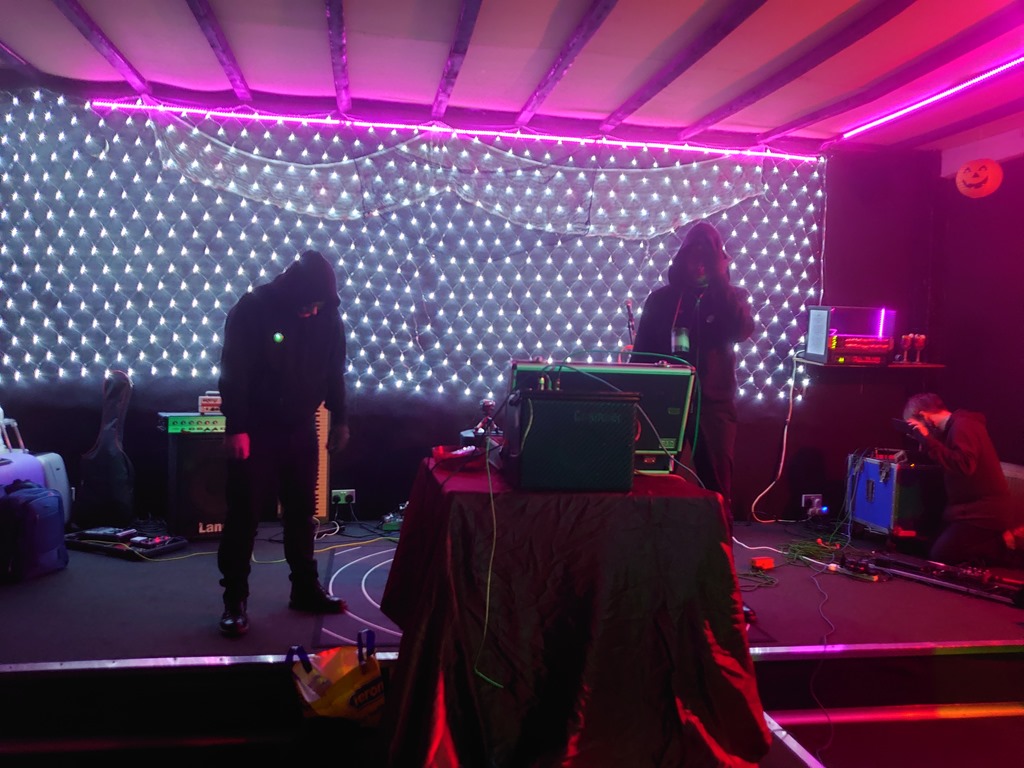
After some weird woozy shit off Territorial Gobbings’ recent Automatic for Nobody album release (which we covered and coveted here), where Theo Gowans hoarsely whispers corruptions of lines from REM, Rejections Ops kick things off early doors with a blitzkrieg of stuttering beats, squalling bass feedback and squealing, crackling synths: the guitarist’s wearing a veil and there are strobes galore. The noise is complete overload, a devastating mass of distortion, and while it would perhaps benefit from a little more contrast – it’s absolutely fucking full-on from beginning to end – it would just be amazing to witness in a small, sweaty room at proper ear-bleeding volume. I could happily go home now – but of course, I’m already home, and am thirsty for what’s to come.

DSC_7128

Rejections Ops

Hubble’s cover of Swans’ ‘No Cure for the Lonely’ from the aforementioned compilation provides a mellow interlude before Omnibael’s set. It’s another intense work, and probably their best yet. Stark, black and white footage accompany the duo’s low-down, dubby industrial scrapings. There are some mangled vocals low in the mix, while the crashing metallic snare is pitched up high, and driven by a relentless sequenced synth bass groove overlaid with explosive noise, the atmosphere is dark and oppressive.

DSCPDC_0003_BURST20210523204013324_COVER

Omnibael

Blackcloudsummoner brings more overloading electronica, dark, dense, story, tense, crunching electrodes crackling distortion, occasionally rent by trills of feedback. And it all sounds as if it’s coming from an immense cavern, about a quarter of a mile underground. The bass sounds like a nuclear experiment, and it’s all going off at once, making for an intense and disorientating experience.

AGED’s sound is rather more ambient, and considerably less abrasive, and it’s well-timed. That isn’t to say that this is in any way soft: there’s a crackling decay at the edge of the sound, and distant samples, barely audible, create a disorientating effect. And it’s over in the blink of an eye.

Making a return for …(something) ruined, the full-tilt, all-out noise abrasion with shouting seemed to hit the spot, and the altogether mellower sounds of Pigsticks and the Wonderbra, making droning harmonica noises in some woods arrives just in time to prevent any aneurysms. This is wonderfully weird, with leaves dropping and being raked creating a ‘field recording’ element to this curious experimental concoction. Birds tweet. A helicopter flies over. Atonal woodwind. Random words. What is it all about? The epitome of avant-garde oddity.

DSC_7133

…(something) ruined

Paired with Pressure Cooker Release valve for a collaborative set, Territorial Gobbing bring all the oddball experimentalism you’d expect. For TG, anything and everything is source material, and on this outing we witness some effervescent vitamin tablets fizzing in bowls, the sound contained by a folded IKEA box. And then they bring on the squeezy sauce bottles, which puff and sigh and gasp in their varying degrees of emptiness. Drainpipe and walkie-talkie, toast, toasters, lighters, phone ring tones, egg slicers, books, paint tube, polystyrene packaging, and kitchen sink also provide sound sources in this bizarre object-led experimental set. It almost feels like we’re watching an album being recorded in real-time. Maybe – and even hopefully – we are. With a track per object, it would work well.

DSC_7134

Territorial Gobbing / Pressure Cooker Release Valve

Gintas K’s set is a brain-bending bleepfest, a tangle of jangling synths and collapsing synapses that fray the nerve-endings. Everything squelches and zaps every which way, and we get to watch it all happen in real-time as the notes twitched away on his keyboard are run through software on a dusty Lenovo Thinkpad to create a crazy sonic foam that bubbles and froths all over. But deep, resonant bass tones boom out over the stuttering bleepage and groaning, croaking drones emerge. It all squelches down to a mere drip before finally fizzling out in a patter of rain, and it’s well-received, And rightly so.

DSC_7136

Gintas K

Hubble’s headlining set is accompanied by some eye-opening PoV visuals of a parachute jump and clips of people leaping off mountains, and the footage is so terrifying I actually hope it’s CGI even though it looks like it’s actually real. The freefalling blue sky space is the ideal accompaniment to the disorientating fretwork of the musical accompaniment which sounds like multiple guitars and keys playing interloping lines together and across one another. The rapid ebbs and flows are immersive, hypnotic, and a long, mid-range drone builds and hangs against the dizzying blanket of fretwork that weaves the rich and sense sonic tapestry of this bewildering sound on sound. It couldn’t be more different in sound from Ben’s regular gig as guitarist in NY noise act Uniform, but everyone needs a break, and this is wonderfully, if dizzyingly, realised. It makes for a top ending to a top night packed with all the weird and all the wonderful from the full noise spectrum.