Posts Tagged ‘Experimental’

Dret Skivor – DRET 009 – 3rd September, 2021

Christopher Nosnibor

On the face of it, it’s a straightforward question. But chewing on it a little longer than is probably advisable, like a lump of gristle you can’t quite find an opportune moment to spit out discreetly at a family meal, it presents a range of different potential inflections, from the casual ‘how do you like your noise?’ delivered with the same intonation as ‘how do you like your steak / coffee / eggs?’ through to the rather more personal but interrogative ‘how do you like your noise?’

So while listening to the ten pieces on this short release, available digitally and as a C20 cassette, I gave this some consideration. It wasn’t necessary, but then, not a lot is, beyond the basic functions of eating, drinking, breathing, and sleeping. Then again, art has existed longer than civilisation, and perhaps it’s not so wild to think that giving an outlet to one’s thoughts and feelings which transcend verbalisation is also necessary in the most fundamental sense. Perhaps we need art to live. This act of consideration in itself made me realise that a lot of noise is something that’s possible to think alongside listening to. It isn’t that it’s necessarily undemanding: it’s often far from it. It’s just that noise has the capacity to free the mind in ways that more structured genres, and modes of music more geared towards beats and lyrics can often pull the brain waves into their structures instead of encouraging that certain mental drift. Of course, ‘noise’ can be subject to a host of interpretations, sometimes with an interchangeability with ‘sound’. Specifically, here, though, I’m talking about noise.

And ultimately, I can only conclude that I do like my noise harsh. For some reason, noise that makes me grit my teeth and chew the inside of my mouth while I’m listening is the noise that meets the needs of my inner workings. It excites me and sets me on edge. I suppose it’s because ultimately, when it comes to this shade of noise, all you can do is submit to it, and it’s a cathartic release to allow the sound to draw the stress from the mind and body.

How do you like your noise? is pitched as ‘a bunch of noises recorded live 2020 and gems from the archives’, and while it’s not always clear which represents which, there’s no shortage of nasty abrasion on offer here, and it’s clear that Pulsen ‘get’s noise – by which I mean, he has a handle on the effects of varying textures and frequencies, and how shifts between different ranges can trigger both physical and cerebral responses. The grating ‘metal massage’ and squalling electronic blitzkrieg of ‘urbanoise’ are exemplary of the kind of circuit-melting experimentation that many will find painful and torturous, and be grateful for their merciful brevity.

There’s range here: ‘dead man’ is a sparse and spacious guitar piece that borders on post rock, while ‘ringu’ does some glitchy warpy bendy note electronics tricks and teeters on the brink of some kind of electrojazz odyssey. There’s also some whimsical faffery, clattering and clanking around that’s more throwaway interlude than composition, with sub-minute snippets like ‘still haven’t found what i was looking for’.

And so, I changed my mind: I like my noise varied. On this release, Poulsen shows the full spectrum of his versatility, and the range of his noise. I like my noise, and I like this a lot.

AA

a3069066462_10

Cruel Nature Records – 27th August 2021

Christopher Nosnibor

Zero Gap is a truly international collaboration between Ryosuke Kiyasu (SETE STAR SEPT, Fushitsusha, Shrimp, etc, aka ‘the Japanese guy with a snare drum’ and WATTS (Lump Hammer, Plague Rider, Lovely Wife, aka that beardy growly bloke) that proves that location is a state of mind. Recorded oceans and continents apart, there is zero gap between the two artists as they hammer out half an hour of sonic abrasion, created, as the accompanying notes explain, ‘entirely from one snare and one delay drenched throat’.

If on the surface the snare drum seems to have only limited potential, then Kiyasu doesn’t exactly disprove that, in that it sounds like snare drum throughout. But the guy finds every conceivable way of rendering that snare sound, from rapidfire hits and rolls and crashes through clattering blasts and builds, and the still finds ways beyond conception to conjure yet more dynamic range from the simplest of instruments.

Against this clattering, clanking, thunderous barrage of percussion, Watts delivers a vocal performance that quite simply doesn’t sound like a vocal performance for the majority of the time. From a whispering moan like a distant solar wind, to a gurgling drain to a chthonic babble, he’s got immense range. It might not quite be Mike Patton’s Adult Themes for Voice, but it’s still impressive – and I mean eye-poppingly wide-ranging and weird. Best of all, Watts grasps when less is more, at times uttering little more than barely audible grunts and burps at long intervals. Snarling and snapping like a zombie in The Walking Dead, one moment, to barking like a rabid dog the next, Watts is wildly unpredictable, and often quite simply doesn’t sound human. Perhaps he isn’t. At times unsettling, unnerving, others plein scary, he snarls, growl and gargles his way through the creation of some quite strange soundscapes.

Everything works well in context, too: at times, Kiyasu pulls back on the battery of beats to taper down to some barely-there hints of sound, and the two not only are incredibly egalitarian in the distribution of the prominence of their contributions, but they seems to intuitively grasp the need for ebbs and flows, crescendos and decrescendos, making Zero Gap a work that feels like a journey, and even if it’s a journey without a clear end point, it’s a journey punctuated by events and variations.

Zero Gap isn’t abstract as such, but it does, most definitely stretch the boundaries of music. It is ultra-niche, but in the global village it’s the kind of thing that has the potential for significant cult reach. The pair deserve it: Zero Gap is far out in the best way. Crazy, inventive, innovative, not giving a fuck for convention, it’s an album that carves its own niche.

Captured as a single track spanning thirty-two minutes, it’s unusually a release that works best digitally (and dare I even say it, it, could make a nice CD), but then this is an unusual release. My advice? Dive into the dark stuff.

AA

cover

Live music is back. People are rejoicing. Coming together and feeling the togetherness, the community, the connection has been so sorely missed by many, and for reasons far beyond the industry itself. It’s a way of life and an integral social agent. But it’s clear that coming out of lockdown and navigating the lifting of restrictions is not going to be a quick or easy process: whereas lockdown hit hard and fast, coming out – or, indeed, going out – feels like venturing into unknown territory. Anyone who talks of this being society ‘getting back to normal’ has either forgotten what normal was like before, or is simply trying to convince themselves that we’re anywhere near because it’s preferable to facing the reality. Is this the ‘new normal’ that was mooted back in the strong and summer of 2020?

It’s clear upon arrival that many of us are varying shades of apprehension and social and musical rustiness, and I will admit here a heightened anxiety over making my first journey by train in over a year, ahead of my first outing as a solo performer. Arriving at a familiar venue comes as a relief, but there are numerous elements of unfamiliarity: signs about the venue about the wearing of masks, the bar behind Perspex, and having to show proof of a negative test within the last 48 hours on arrival all combine to present a scene straight out of a movie or series set in a dystopian future – only, it’s not the future, it’s now, and this is real. Plenty find comfort and security ion these measures, but as the messaging has shifted from ‘beating’ the ‘invisible enemy’ to ‘living with covid’, then the question of this being the forever future is a difficult one, as it certainly feels as if something has been lost in the eighteen months since we last had ‘proper’ gigs.

Tonight’s event was also operating on a reduced capacity, but as it transpired, it was far from packed making social distancing no issue, and one suspects that while so many have lamented the absence of live music for so long, fear continues to keep them away.

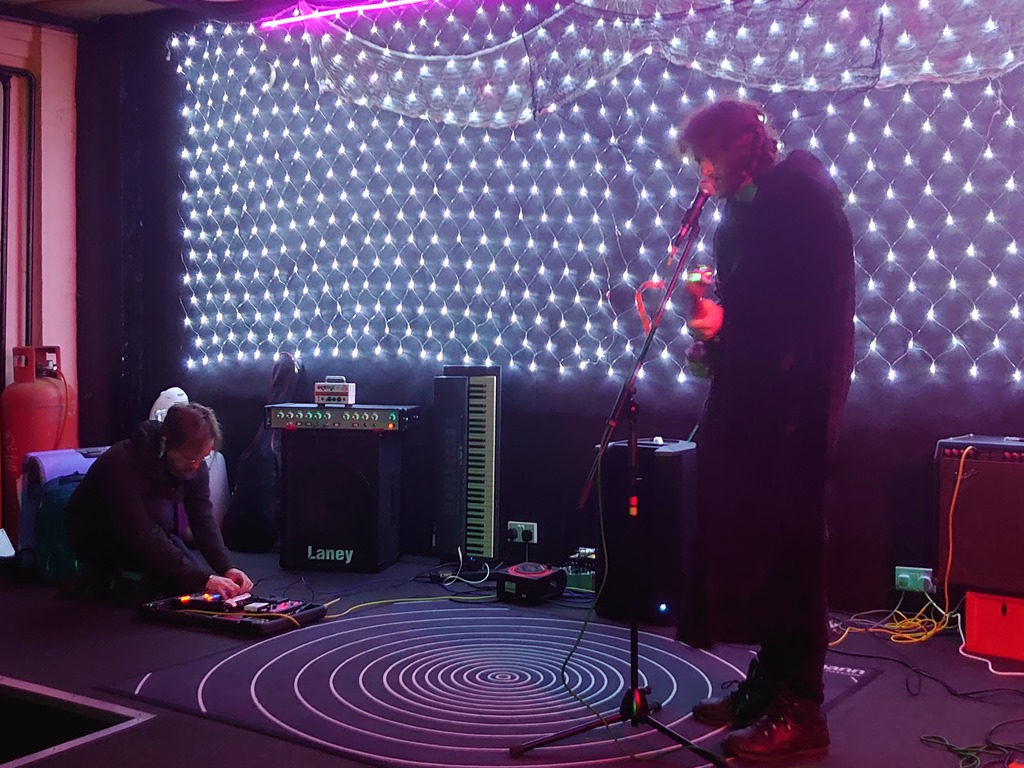
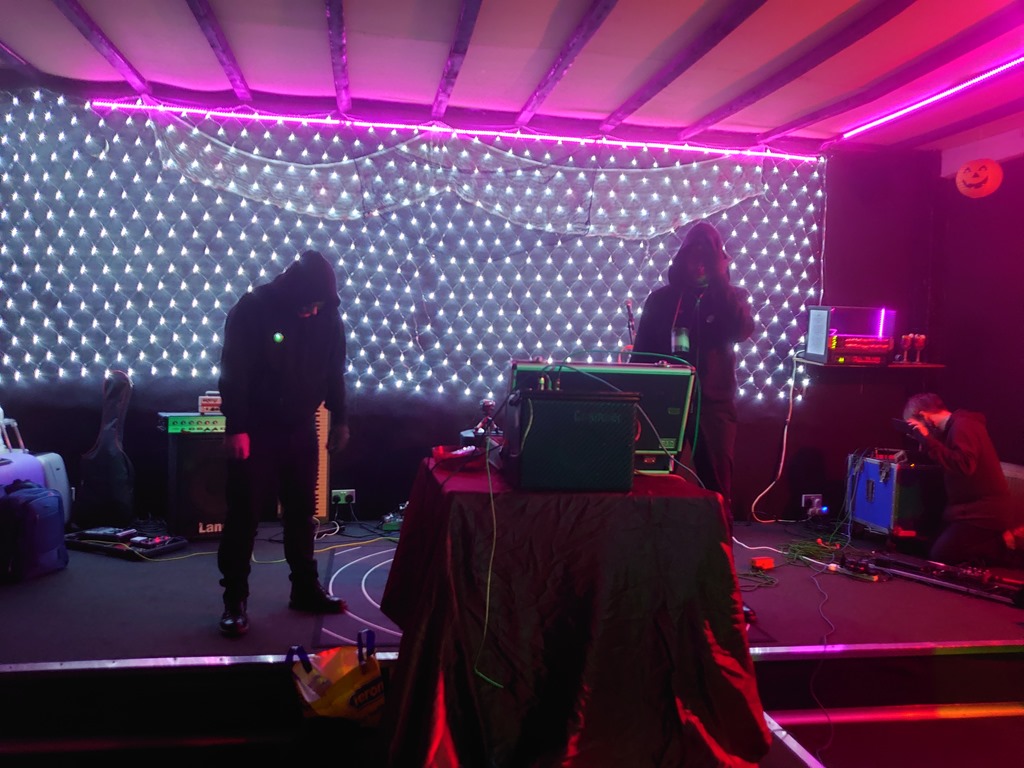
The joy of EMOM night anywhere in the country is their sense of inclusivity, a broad church for outsiders from a vast array of genres, and the premise is straightforward – short slots, one act setting up while the one before plays, keeping the music going more or less continuously through the evening, and tonight’s brought the eclecticism in spades.

How to Use this Manual was up first. The style is gentle, textured instrumental with nice beats, by turns easy and sturdy, with a dash of funk in the mix. It’s easy on the ear, and deftly executed, and there really isn’t anything to fault here. These nights never fail to amaze with the sheer quality of music and clear talent of the performers.

DSC_0082

How to Use this Manual

There’s always one who has to be difficult, of course, someone who disrupts the flow and uses the tools and forces for dark ends. I think my set went well enough. It was short and harsh, as intended. My head was swimming, I couldn’t see the screen of my notebook clearly and I may have fluffed few lines of lyrics, but no-one died, not even me. I think there was even some applause at the end, which may have been appreciation or relief. Certainly, the latter for me was immense.

The spectrum of electronic-based music never fails to yield new and unexpected permutations, and Chaos Lol spans an immense spectrum, and is rare in the way vocals are such a prominent feature of the set – a set that starts out black metal then gets symphonic and beyond. It’s an unusual hybrid of sounds. Heavily echoed vocals are enmeshed in a swathe of sound and are paired with some bulbous beats that venture into drum ‘n’ bass territory in places. It’s hard to form an opinion or decide whether one actually likes it or not, because it’s like being slapped around the face repeatedly and in quick succession, and you simply have no time to compute. But there are no two ways about it: this is technically accomplished, ambitious, audacious, and gutsy. Kudos.

DSC_0085

Chaos lol

Quiet Fire, aka organiser Joe Kemp, who’s up next, treated us to more mellow, more conventional instrumental with electro vibes, pleasant but undemanding – which is probably what everyone was ready for after the last couple of acts. His sound is softer, leaning toward the accessible, bouncier side of electronica – not quite dance, but danceable, and unquestionably with mass-market potential.

Flaves proves to be the evening’s greatest revelation. This guy has got some serious chops, and brings freeform dubby hip-hop using the most minimal setup of the night – literally an iPad. And it’s sparse but seriously banging. There’s a lot of detail and depth to the arrangements, and a lot of seriously heavy bass. The final track of the set is dark and noisy, borderline industrial, and it’s an absolute killer.

DSC_0089

Flaves

I’d chatted to Matt Wilson earlier in the evening as he’d lugged his suitcase of children’s toys and assorted random kit into the venue, and is so often the case, the nicest, most down to earth people make some of the weirdest, most demented music. Using a sackful of educational toys and the like, he gets down to whacking out some mental circuit bending noise was utterly brain-bending. Circle! Square! Yap! Yap! A primitive drum machine thumps out a simple beat, and it all harks back to the sound of early 80s samplism and tape looping. What it lacks in sophistication, it makes up in impact.

DSC_0090

Matt Wilson

It was around this point I came to realise I can only take so much impact, and having performed myself I was fully out of steam and hit my limit, mentally. While hearing music is usually my priority at the exclusion of all else, I caught up in the bar with a friend I’d not seen since February 2020. Ordinarily, I’d feel guilty or even skip posting a half review, but then I remember – since it’s impossible to represent everyone’s experience, the job it to ultimately document mine. I can aim to be objective, but criticism can only be so balanced, and perhaps my job is to more document what I see as I see it in the moment. So here we are. And if live music is about music, it’s also about connecting with friends. Maybe this, then, is how we will find our way back to normal. Meanwhile, we all just continue to fumble our own individual ways.

Room40 – 3rd September 2021

Christopher Nosnibor

This is a work that connects the event with the memory of the event, and exists in the space in between the actual and the recollection – and specifically, those things forgotten .

The material was recorded when David Toop and Akio Suzuki visited Australia, where Lawrence English resides, back in 2013. The pair engaged in creating a site-specific work during a residency on Tamborine Mountain, and were joined by Lawrence during the project. The release is accompanied by a book containing text written by Toop at the time documenting the visit.

And English writers, ‘Going back to listen again to these recordings of which I was a part with David and Akio, I was surprised by what elements had stayed with me and what others had slipped into the eternal greying of my mind. I have vivid recollections of listening to a Lyre bird before recording the pieces together at Witches Falls. I remember both Akio and David finding musicality in decaying palm fronds. I remember Akio’s voice, amplified through his Analpos, bouncing off the stones and trees. I remember David’s flute, so quiet in the pitch black of the night forest as to appear like a hushed tone of wind or a distant animal calling. I also remember trying to match my modest hand held electronics with the pulsing and pitching of the insects around me.’

Memory fades and distorts over time; but then again, is Toop’s contemporaneous document entirely factual and without bias? Nothing here now but the recordings… surely we can at least trust the recordings to be pure in their capturing of the event? Of course not: there are no facts, only representations, fragments. Everything is subject to some form of filter, and eyewitness accounts to crimes are notoriously unreliable, even immediately after the fact.

The album contains six tracks, each one a collage of sounds captured in and extracted from their environment to exist in distilled detachment in recording. Context counts, and while the drips and trickles, gurgles and chirps all sound familiar in a ‘natural’ setting, when set apart, things become less clear. You see, with the sounds of othjer / unidentifianblee origin blended in, it’s difficult to determine the origins of any of the individual sounds and they twist and blur together.

It sounds like running rivers and splashing waterfalls, merged with extraneous sounds doused in heavy echo. It sounds like finger-drums. It sounds like chattering primates, agitated parakeets. It sounds like barks and grunts and yammers, reverberating into the humidity. Amidst the drift of the breeze on ‘Night Drive’ a springing sound arrives as if from nowhere. It’s one of those cartoonish, novelty spring sounds. Surely it wasn’t in the original recording? There are strains of awkward, infiltered feedback, notes of a flute trilling and warbling without musical focus, as the notes yodel and wobble, or otherwise simply waver as quavering notes trailing in the air.

Ominous drones hover and hum, tweets hover and howl out into the air. There are extensive passages where there is little of note – that is to say, not lonely little remarkable, but few notes to speak of – and sparse sounds buzz and drawl seemingly endlessly, like the agitated bee sound that vibrates hard during ‘Small Holes in the Sky’. ‘Leaving No Trace’ again sounds like running water and returns to the sounds of wildlife and the jungle.

Set adrift, and with only the sounds to interact with, the listener finds their own memory triggered, perhaps first and foremost by sound association, having no likely connection with the location where the recordings took place. Just as distance in time leads to a slow decay, so layering if interpretation and association also diminish the link to the actual event, leaving only thoughts on thoughts.

A handful or sharp, trilling noises penetrate the bibbling babble, and then there is a stillness, and having awoken in Autumn, as night has fallen, it is indeed Winter already. Breathing Spirit Forms is a quite remarkable document – not of the actual event, but of something approximating it.

AA

a0762176011_10

6th August 2021

Christopher Nosnibor

For many, Leeds will be forever synonymous with goth, as the spawning ground of The Sisters of Mercy, as well as The Mission, The March Violets, Red Lorry Yellow Lorry, The Rose of Avalanche. But then, Leeds has always been so much more, and anyone who’s spent any time around the city in the last decade and a half will be aware that the only thing that defines the city’s sound is a complete eclecticism. There may be a leaning towards noisier stuff in recent years – well, the last ten or so – but the fact is that truly anything goes, and that’s the absolute joy of the melting pot that is such a diverse and thriving city. Bands like iLiKETRAiNS and Blacklisters, for example, couldn’t be more different, and the same is true of breakthrough acts Kaiser Chiefs and Pulled Apart by Horses.

And so here we land on Terra Incognita by Leeds-based electronic music collective Urban Exploration, which is either their third or fourth album depending on how you view their catalogue, and if you consider Utopic, Heterotopic and Dystopic as separate albums (and I probably would, but this doesn’t really carry much relevance to the task at hand, namely of discussing the new album).

The first track, ‘Beacon’, is a voyage unto itself, beginning a semi-ambient track with some subtle beats before mutating into a full-on beat-driven banger. It’s nothing short of full-on club music, and in the span of six minutes, they’ve spanned multiple genres and landed themselves squarely in the ‘eclectic’ category. ‘Virtual Light’ – presumably referencing William Gibson’s dystopian cyberpunk novel, places a looping synth motif to the fore, and it’s stark and detached. They’re big on references: ‘Kepler-186f’ is the name of the first Earth-size planet in the so-called ‘Habitable Zone’, and orbits the red dwarf Kepler-186, about 500 light-years from Earth. As such, the bands interests and influences are clearly apparent and very much on display here.

The pieces are long – the majority extending well beyond the five-minute mark – and exploratory. Terra Incognita definitely feels like it’s venturing forward and breaking new ground, tiptoeing around the space between tangerine Dream and The Orb. It’s a lot of space, and Urban Exploration seem keen to traverse it.

The full twelve-track set is a dense and dark, semi-ambient affair, which, in balancing ambience with defined beats, invites comparisons to another act who emerged from Leeds, who’ve gone on to do great things, worriedaboutsatan. The press release gives the warning / threat / promise that ‘Terra Incognita transports you to alien lands that are strangely familiar…’ and indeed it does. There is a lot of space, a lot of oddness, a lot of dissonance, and a lot of otherness circulating around Terra Incognita. It’s ain intriguing and well-realised work that is truly worthy of being described as ‘eclectic’, its experimental span leading the listener on a voyage into unknown territories, both earthly and far, far beyond.

AA

a1631477200_10

Fabrique Records – 18th June 2021

Christopher Nosnibor

Berlin-based composer and sound artist Jana Irmert has approached her third album for Fabrique with a view to exploring the way in which sounds have a certain sensory aspect. There’s a way in which music touches us, not just aurally, nor emotionally: some music you really do feel. Beyond music at the louder, harsher end of the spectrum – be it electronic or more conventional in its instrumentation, this is something that is perhaps more common to experimental forms, where contrasting sounds and the shapes and textures of those sounds are more the focus than the unity of a collection of instruments for create ‘songs’.

Articulating how music makes you feel is one challenge, but articulating how music itself feels – or moreover, how the sounds themselves feel – is an immense challenge. Because writing, like any other art, can often reveal its authors limitations, however well they’re working. Every artist has their own personal limitation. Francis Bacon was unable to paint feet, for example. The greatest limitation is invariably the disparity between concept and execution, and often, for musicians, it’s articulating the sound in their head using actual instruments – or, if not articulating the sound, conveying complex emotions through the medium of sound.

Jana Irmert’s challenge here was to render one sensation through another. “I felt I wanted to get closer to the sounds, feel their structure and surface and how they contrast each other,” she says. And, during the process, her recordings yielded some quite unexpected results: “It turned out the processed sounds resulting from hard materials would often have soft and tonal qualities whereas those made from ‘soft’ materials like water or air would ultimately be of percussive or harsh and noisy character.”

The opening bars of the first piece, ‘Lament’, are unexpectedly dense and heavy, a rugged, grainy tone that grinds from the speakers before slowly tapering down to something rather more tranquil, yet draped with the weight of melancholy. Moving into ‘Against Light’, Irmert creates a much more upbeat ambience, a shimmering, shuffling stuttering of sound, and it’s gentle, but not entirely calming or comforting, like being stuck in a tractor beam, a glitching loop that affords no forward trajectory.

With the sounds of the sea, the title track initially seems like it will fulfil the description, offering something soft, soothing, immersive. But as layers build, darker sounds clunk and rumble and loom and lurk in thickening shadows.

There is a certain sense of progression over the course of the eight compositions, with more percussive sounds coming increasingly to the fore. In doing so, the album gradually moves from intangible to something altogether more substantial, its physicality developing an almost corporeal tangibility.

Listening to The Soft Bit, one feel as though one is somehow in nature, and surrounded by nature, from the clouds, and the air – invisible, yet capable of substantial force when moving as a wind – to solid objects – stones, trees, the ground beneath the feet. Listen, inhale it all in, and feel it flow.

AA

FAB088_front

Nefarious Industries

Christopher Nosnibor

Less than two years after the release of the ambient avant-jazz oddity that was CCXMD (that’s not some random Roman numeralisation, but Cinema Cinema X Matt Darriau (The Klezmatics), the New York duo return for round two of their collaboration with the astutely-titled CCXMDII.

Let’s get the spoiler out of the way up front and early: they couldn’t have shifted further from their noise roots, and there really isn’t an overloading guitar riff in the whole album. If CCXMD was avant-jazzy and ambient, CCXMDII is avant-jazzier and more ambient. Having laid the foundations previously, it’s not so much of a shock, but anyone hoping for a return to their riffier roots will be disappointed by this weirdy, spaced-out experimental work.

It contains but seven tracks, although three of them are over ten minutes in duration, including the eighteen-minute opener ‘A Life of its Own’, which was unveiled as the album’s lead single a couple of weeks ago. And here, Cinema Cinema push further still than on their previous album, with those seven tracks bleeding together to forge one, vast continuous piece.

It begins tentatively, with tremulous, trilling woodwind and some scratchy strumming. Sounds echo and reverberate and voices mumble in a blurred, slowed, hallucinated state that’s most unsettling, and slowly transitions from some shilled, chiming new-age desert vibe into an increasingly bad trip as unintelligible jabbering spits and slurs angrily against the warping backdrop and swelling percussion – and that’s before the crazed jazz horns begin to bray and parp.

There are definite ebbs and flows, but not necessarily correspondent with the transitions between the tracks, and ponderous guitar and trepidatious woodwind teeter precariously through ‘Continued’, which is less of a piece in its own right than a bridge toward the nine-minute ‘Bratislava’. Guitars scrape and the drums stutter and test the waters and levels, and it actually sounds like a band checking their levels between songs during a live show than anything. There are some exploratory post-rock moments, but they’re fleeting, and even when the rhythm section finds a groove, it’s but for a short time and ultimately frustrating and unsatisfying, chopping and changing in a mathy fashion – which is fine in itself, but for the lack of a resolution, a crescendo, a finish. Instead, it peters out and squeaks and toots into the next piece.

The trilling woodwind – pan-pipes or similar – are all over the meandering piece and while the percussion rolls, the guitar is pegged back to providing mere texture, and there is no question that the band have shunned pretty much all ‘rock’ trappings here. The raspy, chthonic vocal whispering and manic hollering returns, before it trickles down into ‘Crack of Dawn’ with its stop / start arrhythmic percussion, hovering drones and eerie formlessness.

It’s not until the penultimate track that we get power chords. There is silence, briefly, before ‘Trigger’, which is unexpectedly led by a stop/start drum and hesitant bass groove that eventually emerges as a core motif. Imagine Shellac with brass instead of vocals, and you probably get the idea. It locks into a motoric krautrock groove – but that freewheeling wild horn action is something else. It brings chaos, it brings discord, riding wild all over some wild improv.

CCXMDII isn’t an easy album, and it’s not the punk or guitar-led set some may have expected. But it is a bold, daring work, one that sees a band who don’t give a fuck about conventions or expectations demonstrating that lack of fucks musically. Every band says they’re making music for themselves, but hardly any mean it. These guys do. CCXMDII is also a wonderfully odd abstract soundscapes that drifts and meanders and entertains and perplexes. CCXMDII is the work of a band in continual evolution, and long may that evolution continue.

AAAAA

CCXMDII_album_art_final_cropped_cover

Pilgrimage of the Soul is the 11th studio album in the 22-year career of Japanese experimental rock legends, MONO set for release on 17th September (Pelagic Records)

Recorded and mixed – cautiously, anxiously, yet optimistically – during the height of the COVID- 19 pandemic in the summer of 2020, with one of the band’s longtime partners, Steve Albini, Pilgrimage of the Soul is aptly named as it not only represents the peaks and valleys where MONO are now as they enter their third decade, but also charts their long, steady journey to this time and place.

Continuing the subtle but profound creative progression in the MONO canon that began with Nowhere Now Here (2019), Pilgrimage of the Soul is the most dynamic MONO album to date (and that’s saying a lot). But where MONO’s foundation was built on the well-established interplay of whisper quiet and devastatingly loud, Pilgrimage of the Soul crafts its magic with mesmerising new electronic instrumentation and textures, and – perhaps most notably – faster tempos that are clearly influenced by disco and techno. It all galvanizes as the most unexpected MONO album to date – replete with surprises and as awash in splendor as anything this band has ever done.

MONO began in Japan at the end of the 20th Century as a young band equally inspired by the pioneers of moody experimental rock (My Bloody Valentine, Mogwai) and iconic Classical composers (Beethoven, Morricone) who came before them. They have evolved into one of the most inspiring and influential experimental rock bands in their own right. It is only fitting that their evolution has come at the glacial, methodical pace that their patient music demands. MONO is a band who puts serious value in nuance, and offers significant rewards for the wait.

Watch the music video for first single ‘Riptide’, a film by Alison Group now:

AA

MONO

Bearsuit Records – 25th June 2021

Christopher Nosnibor

Home of all things odd from Edinburgh and Japan, Bearsuit Records, has a new signing, in the form of Edinburgh-based singer/songwriter Eamon the Destroyer. Eamon also records as Annie & The Station Orchestra, and is one half of Edinburgh purveyors of noise Ageing Children, both of whom have received mentions here. If his name has the hallmarks of a mythical war deity or some evil comic book character, his music is altogether less megalomaniacally threatening. The press blub describes it as ‘lo-fi miserablism with a side order of noise / mumbling & whispering – or something’ – and on hearing these two tracks, which serve as a lead-in to Eamon’s debut album, A Small Blue Car – this vagueness makes perfect sense. And, of course, like most Bearsuit releases, it’s about the only thing that does.

It’s rather welcome to see a release that resembles a conventional A-side / B-side single release in 2021, and what’s noteworthy about this one is that the two tracks are actually quite similar, sonically and stylistically, leaving no confusion as to what the Destroyer’s sound is.

Against a minimalist backdrop of quite country guitars, the Destroyer croaks flatly about, well, what, I’m not entirely sure – every line seems to turn on a contradiction or some bathetic construction, like ‘Nobody knows it / well nobody ought to’. Instrumentally, it’s sparse and scratchy, and the vocals sound like they’re coming from a CB radio that’s only just tuned to the edge of the channel. But in the mix there’s a scrape and chatter of extraneous background noise and some cronky feedback, and around the mid-point of ‘My Drive’ it takes a massive left turn into altogether louder territory.

The whole vibe is downbeat and melancholy, and driving emerges as a theme in ‘Silver Shadow’, alongside some vague but wistful images that drift around in a wash of sad, Cure-esque synth and a crashing tide of distortion. It’s more mood-affecting than you would likely expect, and while very much appreciating the unusual mix, it left me feeling downcast and slightly sad, which is a clear indication that either I’m heading for a mood slump, or there’s more craftsmanship to Eamon’s songs than the surface suggests.

AA

a2426643261_16

CD Unsounds 68U – 15th June 2021

Christopher Nosnibor

No-one plays guitar quite like Andy Moor. Renowned for his work with purveyors of expansive and exploratory avant-jazz The Ex, Moor’s solo work takes that guitar work from a collectivist, band setting, where it’s a part of a conglomeration of instruments, and places it directly under the spotlight.

As the liner notes explain, Safe Piece is an exploration of the question of parenting while maintaining an artistic practice. Choreographer Valentina Campora, who initiated the project, began testing the possibility of dancing onstage with her baby as an experiment. The project became a series of 8 performances where Campora performed with the baby for a small public. Andy Moor, father of the child and Campora’s partner, accompanied and gave a sonic context to this experiment. Each performance was filmed by visual artist Isabelle Vigier for the video Safe Piece (a film).

Tye tracks sequencing is segmented in a way that perhaps make more sense in context of the filmed pieces. There are three themed chapters, if you will, pieced together in chunks – but identifying any specific thematic unity that connects them is difficult. Moor moves between single-string pings and frenetic fretwork. But for the most part, this is sparse and lugubrious downturned fret buzzing notes slumping down like a machine winding down as the batteries run down or clockwork unwinds to a crawl. There’s some growling, gut-churning low-end that provides substantial contrast with the nagging of the picked top notes. There’s fret-buzz and warped, slashing chord chanking, stuttering stop/start shudders and jarring , jolting unmusic, that’s uncomfortable at times – not just a bit awkward, but fully squirm-inducing, setting the nerve-endings of the teeth on edge.

Across the album’s thirteen pieces, Moor’s minimal style that centres around scratching and scraping and all other kinds of angular guitar abrasions are front and centre. Discord and atonality are his signatures – but at the same time, he conjures myriad moments of fractured musicality. Hums and thrums and crunches crash through picked chord sequences and segments that sound like tuning up and down in frantic search of the note and not quite finding it.

Safety is paramount, but Music For Safe Piece brings a cognitive dissonance that’s difficult to process in places. But we know that comfort is overrated, and that art should proffer challenges, and Music For Safe Piece brings plenty.

AA

68U_front