Posts Tagged ‘EP Review’

Inverted Grim-Mill Recordings – 4th December 2025

Christopher Nosnibor

Before we arrive at the present, let’s rewind a bit. Everyone likes some backstory, a hint of prequel, right? So we’re going back to 2018, and the arrival of the Crusts EP by Pak40, a band named after a German 75 millimetre anti-tank gun, and a review which I started by saying that ‘I practically creamed my pants over Pak40’s live show in York, just up the road from my house, a few months back. I didn’t exactly know what to make of them, which was part of the appeal – they didn’t conform to any one style, but they were bloody good.’ 2021 brought the arrival of debut album Bunker, a heavy slugger by any standards.

They’ve always been a band devoted to sonic impact, and since guitarist Leo Hancill paired up with Cat Redfern to form Teleost and then relocated to Glasgow, Pak40 have been resting – but not giving up or growing tame. And more than anything, that time out has been spent in contemplation over intensifying their sound.

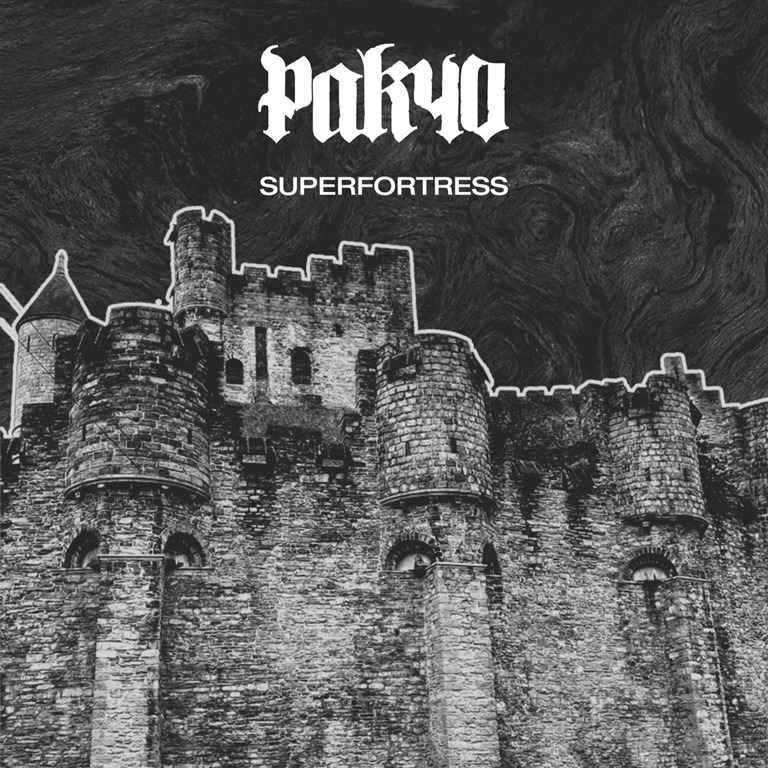
It may be that production plays a part, but Superfortress goes far beyond anything previous in terms of density and intensity. This is not to diminish the potent stoner riffery of Bunker, which contained some mammoth tracks with some mammoth riffs, but Superfortress is a major step up. Sure, Bunker was all the bass, but here, they elevate the volume and intensity in a way which replicates the thunderous, ribcage-blasting, ear-flapping force of the live show.

Four years on from Bunker, Superfortress very much solidifies the Sabbath-influenced aspect of their hefty doom / drone sound with the reverb-laden vocals, but also ratchets up the monstrous weight of previous releases by some way.

The first track, the ten-minute megalith that is ‘Old Nomad’ is as heavy as it gets. The drumming is relentless in its weight and thunderous force, but the bass… Hell, the bass. It lands like a double-footed kick to the chest, even through comparatively small speakers, replicating the impact of the live sound on the current tour. ‘Crushing’ may be a cliché but Pak40 deliver a density of sound that just may smash your ribs and smash your lungs. The title track begins tentatively, the riff only forming at first, before the drums and distortion kick in and from then on it’s massive, even before the vocals, bathed in a cavernous reverb arrive. Its low and it’s slow and it’s doomy, but it’s also earthy and rich in that vintage folk horror doom vibe, and it’s the slowed-down Black Sabbath inspired riffing that dominates the third and final cut, the feedback-squalling instrumental ‘Ascend’.

There’s something wonderfully old-school about this – but at the same time, it pushes things further in terms of weight and volume. And in those terms, Superfortress sees Pak40 push those things to an extreme. This is a monster.

AA

AA

a4105998785_10

Christopher Nosnibor

13th September 2025

It is impossible to escape AI now, and its ubiquity has arrived at a shocking pace, its acceleration seemingly exponential. You can avoid social media, but can you avoid computers or mobile phones for even more than a few hours? The news – beyond the main headlines, at least – is abrim with reports on how it’s affecting us as individuals, as a species, and the environmental impact. I watch a training video at work: it’s presented by AI actors who move their arms in strange ways and occasionally mispronounce a word in the worst way. Meanwhile, management want us to save time on report-writing by using Copilot. Drained by all of this, I go to the pub for soe decompression time, and the talk is of how jobs are being undermined by AI, and some guy’s got a video AI made using just a photograph. Why? Why do we need this? We don’t, of course, but it’s novel, mindless entertainment that can be created in seconds. Increasingly, it feels like we’re volunteering ourselves for virtual lobotomies. Despite the fact that the current technoscape is every sci-fi dystopia playing out exactly as told in real-time, it seems the majority of people are more than happy to embrace AI. Even writers, artists, and the like, present themselves as ‘curious’ and will engage with AI for prompts or to brush up something they’ve done. But the fact it that it’s a slippery slope, which gets steeper and steeper and further down is an abyss that plunges straight to hell. The worst of it is that it’d becoming increasingly difficult to separate real life.

One of the issues I have personally is that just as every significant technological advancement since the Industrial Revolution brought the promise of more leisure time by making work lighter, the opposite is true – unless you consider unemployment and life on the breadline to be leisure. AI isn’t saving time by vacuum cleaning the house, hanging up the laundry, putting the bins out or doing the school run: it’s simply devaluing creative skills. Anyone who has read an AI-generated article, heard an AI-assisted song, or seen some AI-created art will know that there’s something ‘off’ about it, that it’s soulless and vaguely alien. Meanwhile, the world seems to be spiralling into a cesspit of animosity, hatred, and division. Something happened during the pandemic which meant that when we all emerged from lockdown, war and rage and unspeakable cuntiness exploded on a scale beyond articulation. It’s no wonder people are struggling with life right now.

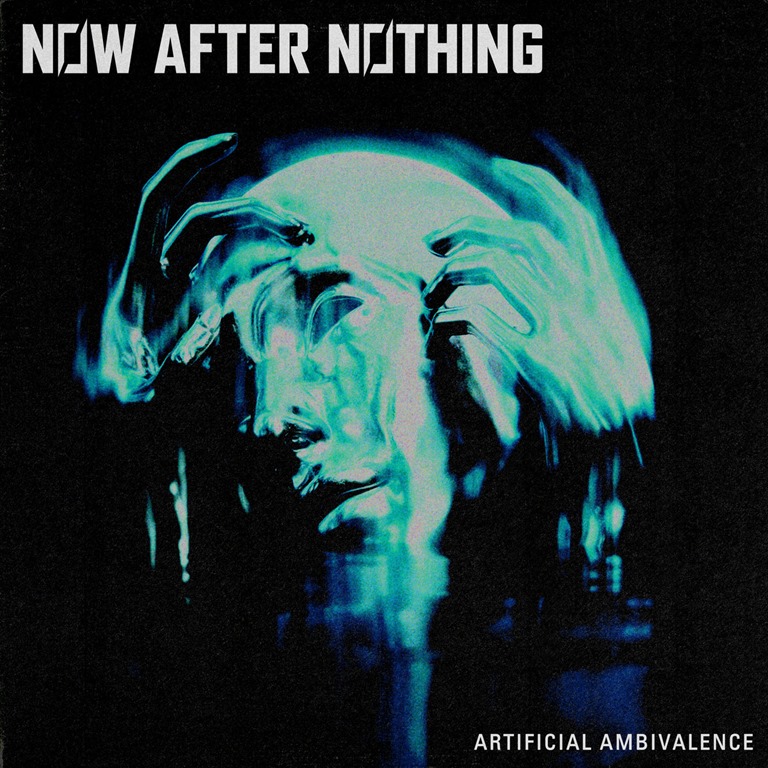
Now After Nothing is, in some respects, a therapeutic escape from all the shit. Multi-instrumentalist Matt Spatial paired with Michael Allen after what he describes as ‘a relatively difficult time in my life [where] I had become lost and depressed without a creative outlet with which to express myself’. There’s much to say that creativity – and exercise, both physical and mental – are the best self-maintenance. Listening to this EP, it’s clear that Spatial is really pouting everything into this.

His comments on the EP are worth quoting: “Artificial Ambivalence, as a concept, to me represents the state of feeling lost and/or the ‘shutting down’ from the negativity and toxicity around each of us,” Spatial explains. “They say ‘ignorance is bliss’, but in the (mis-)information age we seem to have reached a point of being pummeled into exhaustion from the constant barrage of negativity. For some, while the desire is stronger than ever to make positive change in the world, we might get derailed by feelings of helplessness, hopelessness, and being powerless in a society that seems to increasingly favor only one set of values. For others, it’s the choice to conveniently ignore the inhumane atrocities happening in our society when those atrocities don’t directly impact that individual.”

Of the music, there are references to ‘goth-glam grooves slick with sweat, raw enough to leave a mark’ and a nod to the fact that ‘fans have called it “S&M disco,” a sinister shimmer of punk, industrial grind, and nocturnal new wave.’

The first thing that strikes on the first listen of this EP is the energy. Everything is up-front and it lands like a proper punch in the face. Big, gutsy riffs underpin some sinewy lead guitar parts, driven by some explosive percussion and sturdy, throbbing bass. Straight out the traps, ‘Sick Fix’ blends post-punk and grunge to create a hard-hitting blast, and one that’s got hooks and melody in spades, too, with hints of Big Black in the background. It sets the bar high, but ‘Criminal Feature’ hurdles it effortlessly.

Slowing the pace and changing not only the tempo but the mood, the piano-led ‘Holly’ broods hard and is unashamedly mid-80d goth in its vibe, but also incorporates more post-millennial post-punk and goth in its genetics. The result is – to wheel out a cliché – anthemic. And it is, of course, the perfect mid-set slowie, which sets things up for the chugging, bass-driven beast that is ‘Fixation Fantasy’, a track that’s more 90s alt-rock than post punk or goth. More than anything, I’m reminded of psychedelic grunge also-rans Eight Storey Window in the ear for melody and the emotional heft delivered by some achesome riffs delivered at an intense volume.

‘Dare’ brings some dark pop intimations paired with some searing guitar work which lands like a post-rock Placebo crossed with Salvation – that is to say, it’s richly immersed in that mid-80s Leeds sound. It’s inspired stuff, and then some. Closing off, single release ‘Entangled’ offers glorious shoegaze gentility before breaking into a magnificent slice of synthy post-punk with some massive guitar. Artificial Ambivalence is better than ‘all killer’ (which it is) – it’s next-level solid quality and absolute gold.

AA

a3532593873_10

Mortality Tables – 17th October 2025

Christopher Nosnibor

Among their ever-expanding catalogue, Mortality Tables have put out a number of releases which are essentially singles or EPs, with this being one of them: with a running time of just over eleven and a half minutes, this single longform composition is only marginally longer than its title, but its creator, Michael Evill, has condensed a considerable amount of material and experience into this space.

As he writes, ‘I have created a movement which includes the last breaths of my beloved dog Watson. It also includes the last time I recorded with my most talented and wonderful best friend Gustaf in 2001, which I have slowed down so I (and you) can spend more time with him. There are the sounds of new stars being born – my own interpretation and ones ripped off from NASA through this modern internet connection we all have. Surely we own the stars still?

‘We have Aztecs having fun with drums. These were recorded live in Mexico, sadly not from the 14th century before we invaded. We have the hourglass from our kitchen, which Mat inspired me to sample. This was the first idea of this piece and everything else fell in to place very quickly as it’s been swimming in the back of my mind for a while.’

Clearly, some of these elements have deep emotional significance for Michael, but this isn’t conveyed – at least not overtly or explicitly – in the work itself. It’s a collage-type sonic stew, where all of the myriad elements bubble and roil together to form a dense soup, in which none of the flavours are distinct, but in combination, what he serves up is unique, and provided much to chew on. That this protracted food-orientated metaphor may not be entirely coherent is apposite, but should by no means be considered a criticism.

As Evill goes on to write, ‘this was the beginning, and I didn’t spend much time thinking about it and just coalesced those ideas.’ Sometimes, when seeking to articulate life experience, it doesn’t serve to overthink it. Life rarely happens that way: life is what happens when you’re busy thinking and planning. And just as our experiences aren’t strictly linear, neither are our thoughts and recollections. Indeed, our thoughts and memories trip over one another in an endless jumble of perpetual confusion, and the more life we live, the more time we spend accumulating experience – and absorbing books, films, TV, online media, overheard conversations and dreams, the more everything becomes intertwined, overlayed, building to a constant mental babble.

William Burrroughs utilised the cut-up technique specifically to bring writing closer to real life, contending that ‘life is a cut-up… every time you walk down the street, your stream of consciousness is cut by random factors… take a walk down a city street… you have seen half a person cut in two by a car, bits and pieces of street signs and advertisements, reflections from shop windows – a montage of fragments.’

This encapsulates the artist’s quest: to create something which conveys the thoughts in one’s head, to recreate in some tangible form the intangible nebulous inner life, if only to help to make sense of it for oneself.

‘Even Though It Was The Blink Of An Eye’ is a woozy, disorientating churn of noise, which is, at times, dizzying, unsettling, nausea-inducing. But then again, at other times, it’s gentle, even melodic, reflective, contemplative. There are some passages where it’s all of these things all at once. It very much does feel like a scan of the artist’s memory banks, the human brain equivalent of skipping through the RAM files and pulling items seemingly at random. It does feel somewhat strange, even awkward, being granted access in such a way, but at the same time, it feels like ‘Even Though It Was The Blink Of An Eye’ is more than an insight into the mind of one individual, but an exploration of the human psyche.

AA

a0518044244_10

4th July 2025

Christopher Nosnibor

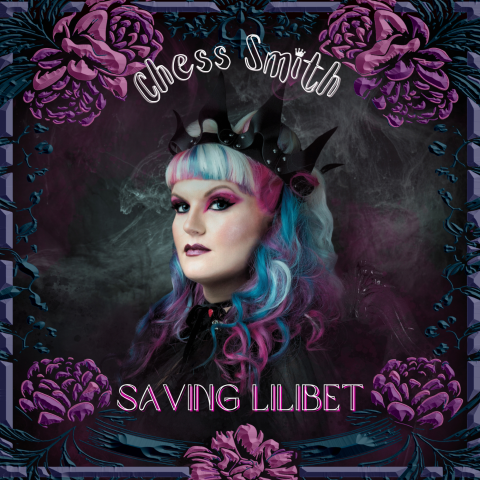
It may be coincidental that Chess Smith threw down Saving Lilibet on 4th July, but it’s certainly appropriate. This is a release that is all about fighting spirit, taking things back, and claiming a state of independence.

Her bio for this release is nothing if not direct:

Chess Smith has been a commanding presence on the Kent music scene for over a decade, both as a solo artist and a frontwoman, most recently as critically acclaimed power vocalist for Salvation Jayne… until 2020, when an abuser tried to take her power, dull her shine, and break her spirit. But they didn’t succeed.

Despite enduring a devastating nervous breakdown at the time, Chess has come back fighting in spectacular style with Saving Lilibet, her most personal, and relatable, work to date. She has made it her mission to provide a voice for those who have experienced abuse and toxicity, and to show the world that you can not only heal after these experiences – you can thrive.

As the saying goes, what doesn’t kill you makes you stronger, and simply telling her story, getting up and putting this out there, with no holds barred, demonstrates phenomenal strength. And for all that, Saving Lilibet is not remotely sad or self-pitying, but a set of songs which is uplifting, and very much focused on empowerment and positivity.

The intro, ‘Saving Lilibet’ is a weirdy, atmospheric little piece, on which Smith’s voice echoes from left and right, ‘save, save’. One gets the impression that this is the voice in her head, her internal monologue speaking to her, pulling her out of her torpor. And that’s exactly what she does, with some pristine pop tunes.

Lead single, ‘Bounce Back’ in many ways speaks for itself. When I covered it back in February, I noted how it was both ‘slick and soulful’, but I don’t think I fully appreciated just how strong the production was: it’s got the groove of Thriller-era Michael Jackson backing up a really crisp pop song, propelled by a thumping retro beat and showcasing a bold vocal performance, which, paired with her heartfelt lyrics hollers ‘taking no shit’.

Second single, ‘Drama King’ is up next, and once again, it’s tight, and light, but by no means flimsy in content or delivery’, and it so happens that the singles are entirely representative of the collection as a whole. The vibe is very much 80s pop played through a post-millennium filter – something which is nowhere more apparent than on the slower ‘Alexa’, while ‘Dissociate’ blends hints of Madonna with some Hi-NRG dance pop and moments of introspection.

‘All My Love’ is a big, anthemic slower song, and clocking in at almost six and a half minutes, it’s epic in every way. And once again, it’s realised with absolute precision and try dynamic is remarkable.

Saving Lilibet is a triumph on every level, and Chess Smith proves she’s not just a survivor, but an artist – and human being – who is determined to thrive. It’s inspiring stuff.


Chess Smith Artwork

3rd October 2025

Christopher Nosnibor

Foldhead has been quiet on the output front of late, after something of a purple patch around lockdown, there was a lull, broken by Mirfield Pads in 2022, with only the ‘Single’ release with …(something) ruined since, and a live outing or two. This is the only kind of quiet you’ll get from Foldhead, mind you: the Yorkshire maker of mangled noise likes to turn it up and blast the frequencies – and tones.

If Mirfield Pads ventured towards mellower, more Tangerine Dream-like electronica, Paris Braille sees a return to the harsher territories more frequently wandered by Foldhead.

Paris Braille – the title likely a reference to two cut-up novels by the late Carl Weissner (who not only appeared in some collaborative / split works with Burroughs, including the seminal pamphlet So Who Owns Death TV?, but translated many of his novels for the German market), namely The Braille Film and Death in Paris – is a typically abrasive affair, with the title track being a nine-minute loop of noise which captures of the essence of the ‘derangement of the senses’ Brion Gysin strove to achieve with his multi-sensory performance pieces which extended the concept of the cut-ups to its logical extreme. The thunderous beat, when surrounded by and endless loop, becomes almost trance-like and strangely euphoric. It’s difficult to discern precisely what’s in the mix here: there may be voices, or it may simply be a tricky of the human ear – my human ear – in its quest to seek recognisable forms amidst the formless sonic churn, in the same way one finds the shapes of animals and faces in clouds. In the right context, say, as a remix on a Cabaret Voltaire EP (where it would be right at home, and the William Burroughs / cut-up connection is again relevant here), this would be hailed as an industrial dancefloor stomper – largely because that’s what it is. Intense, hypnotic, relentless, it’s a pulsating, shifting noise beast that slowly spins off its axis and out of control in a swelling surge of sound.

‘CW Loop’ unashamedly harks back to the tape experiments of Burroughs and Gysin from the late 50s and early 60s, which in turn were a huge influence in Throbbing Gristle, and in particular Genesis P-Orridge, who released a selection of archival recordings on the Nothing Here Now But the Recordings LP on Industrial Records in 1980. It is, quite simply, short vocal sample, heavily bathed in echo, looped, and overlayed with a churn of undulating noise.

The third and final track, ‘Film Death’ – the title echoing and mirroring that of the first – round the set off with a return to the thunderous, beat-driven sound of ‘Paris Braille’, this time with a squall of shrill feedback and full-spectrum static. The result is akin to Throbbing Gristle covering Matal Machine Music. In the world of Foldhead, this is absolutely mission accomplished.

AA

a3884873763_10

Saccharine Underground – 1st July 2025

Christopher Nosnibor

This one hell of a hybrid. Just when you think post-punk has been explored to the point at which it has been hollowed out, exhausted, and has only well-worn and instantly recognisable tropes to offer, along come Washington DC’s Zabus, purveyors of avant-garde post-punk with an EP which is something of a ‘best of’ with tracks from their two recent albums, Automatic Writhing (September 2024) and Floodplain Canticles (January 2025), plus a new track which paves the way for their next offering Whores of Holyrood (due in August).

With its immense, reverb-laden sound and expansive, drifting desert-like soundscape ‘Grafhysi Fyrir Alla’ makes four and a quarter minutes feel like a hypnotic span of double that duration. The shuffling bass and big, booming bass are pure dub. The guitar chimes and floats into the ether as everything swashes around in a huge echoic pool.

Of ‘Grafhysi Fyrir Alla’, lifted from last year’s Automatic Writhing, project founder and focal member Jeremy Moore says it’s about “the societal imposition of unobtainable standards of beauty, and our obsession with physical perfection at the expense of true happiness”. This is certainly not a case of style over substance, but a coming together of musical inventiveness with a level of intellect which is rare. “Psychopathologies like body dysmorphic disorder, at the extreme, can lead to a path of ruin, if most of your life is spent chasing a ghost—what you believe the world wants you to be. Death doesn’t discriminate. The end is always the same.”

This is some pretty heavy – and dark – philosophy on offer here, and it’s welcome: as much as there is much to be said for the benefits of the escapism music can offer, there’s equal solace to be found in art which articulates one’s own world view. And so it that that Zabus portray contemporary dystopia from a range of camera angles.

‘Orphalese’ is more uptempo and is decidedly cinematic with its broad-sweeping layers of synths driven by propulsive, rolling drums. There’s no verse / chorus structure, but instead a hypnotic expanse of sound, the aural equivalent of standing on a summit and looking out at a three-sixty horizon through a heat haze. It’s immersive, utterly absorbing, and transportative.

The first of the tracks lifted from Floodplain Canticles is the six-minute ‘Tearful Symmetries’, which is low and slow, Jeremy Moore’s reverb-drenched baritone croon approximating the late, great, Mark Lanegan against a dubby backdrop punctuated the clangs and scrapes of guitar drones and sculpted feedback. ‘This is the end….’ He reflects, but not with sadness or panic, but a sense of inevitability.

‘Golden-rot’ goes all out for the theatrically gothic experience: it’s as big on drama as it is on sound, as an insistent mechanised drum beat pounds away, cutting through a smog of murky guitar and thick, booming bass, and if I wasn’t already perspiring hard from the humidity and thirty-degree heat, this would make me sweat, with its tension and crackling energy.

And so we come to the title track, the first taste of Whores of Holyrood. It’s different again, although the cavernous reverb is a constant. This cut is a brooding piece that borders on country, once more evoking the spirit of Lanegan. It’s spacious, but its intensity brings an almost suffocating weight.

Shadow Genesis provides a perfect introduction to Zabus, and at the same time whets the appetite for what’s to come. And let me tell you, it’s something to get excited about.

Zabus - Shadow Genesis cover art

11th April 2025

Christopher Nosnibor

It’s still early days for London alternative / progressive metal quartet DAVAAR, formed in the summer of 2024 and with just five shows behind them, but they’ve wasted no time in venturing beyond London in their quest to build a fan-base, or in committing a chunk of their repertoire to tape (so to speak) for the release of this, their debut EP.

Although State of Feeling features four tracks, the title track is an instrumental introduction which is barely a minute long. This is a practice within metal circles that’s become so common as to be predictable and formulaic. It seemed to rise to prominence with the explosion of metalcore’s popularity in the 2010s, and often seemed to be an attempt to cover all bases for the purpose of a wider audience, as if to say ‘listen, we can play, we can do atmospheric and moody and gentle as well as WAAAAUUUGHHHHHH!’. But in doing so, it would often undermine the power of the attacking rage parts.

In fairness, it’s a little different in context of this EP, in that as much as DAVAAR trade in big riffs, their sound is cinematic, melodic, expansive, with clean vocals all the way. And so it is that this opening cut is softly atmospheric, bordering on ambient. A distant beat echoes through the drifting sonic mist. ‘Impulse’ arrives, not on a tidal wave of slugging riffery, but a ripple of picked, reverby guitar, and it’s only after some carefully-crafted build-up does the distortion kick in and the first of the big riffs hits. Even then, everything stays balanced, and the melody remains the focal point, and it’s easy to observe the parallels in their sound with those of their influences and acts they suggest sharing common ground with, including Sleep Token, Tesseract, Leprous, and Deftones.

There’s a lot of attention to detail in the song structures and the overall composition, with high levels of technical adeptness on display. There’s also a lot of polish here, with the end result being that State of Feeling feels fully formed, and DAVAAR’s potential to attain a substantial following is clear.

AA

AA

Davaar Band shot 1

8th April 2025

Christopher Nosnibor

It’s both an understatement and perhaps a needlessly obvious thing to remark that there is an overwhelming amount of new music around right now. And so it’s aggravating, not to mention disappointing, to hear people of a certain age – and I’m talking the over 35s here, but it becomes considerably more pronounced as the demographic slides up the scale – bemoaning that there’s no decent music being released anymore. No, that is not the problem. In fact, it’s simply not true, on any level. The problem is that there is so much new music that, depending on your tastes and preferences, finding the wheat among the chaff can be like finding a needle in a haystack, if we’re going to push some cliches. The cliches are relevant, because even among the ‘good’ music, stylistically, at least, a lot of what’s out there is a rehashing of other stuff, and finding anything that feels new or different is rare.

Bellhead are doing something different. Sure, there are elements of post-punk, goth, noise-rock, but there’s nothing ‘template’ or ‘by numbers’ on display here. The fact they don’t have a conventional musical lineup is a key factor, of course: two basses, a drum machine, and no guitar.

The title track is sparse at first, there’s reverb lead bass played high on the neck ringing out and taking the job of a lead guitar, over a grimy, low-slung low-end bass, with some menacing, distorted vocals snarling low and dark. It’s more atmospheric than industrial, at least in the verses – twisty, grindy, reminiscent of PIG with its breaking out into a roaring anthemic chorus – but that chorus sounds like UK goth circa ’86 when it collided with hard rock. It’s huge, it’s hooky, and it’s strong.

‘Heart Shaped Hole’ is hard and heavy, aggressive but with some well-conceived texture and a production that brings everything to the fore simultaneously, amplifying the intensity. The sound is dense, and having bemoaned how a few bands have suffered from their drum machines being too low in the mix during live performances of late, Bellhead utilize theirs to full effect, pitching the beats well up in the mix. It smacks you right in the face and lends the songs an essential muscularity, providing a relentless driving force to which the bass welds itself. The rhythm section is the pulsating heart of any band: with Bellhead, with everything being the rhythm section, more or less, the pulsations aren’t just strong – this is a relentless blast of bass and beats. And there is not much let-up, either. ‘Shutters + Stutters’ is gritty and dark but with a serrated pop edge.

The piano intro to ‘No Dead Horses’ is something of a false lull, because it soon twists and snarls and sneers, emanating menace and sleaze while crunching overdrive grinds over a loping rhythm.

The brace of remixes tacked into the end may be nice bonuses on one hand, but feel perhaps superfluous on the other, with a Stabbing Westward remix of ‘Bad Taste’ from their previous release, and a remix of ‘Heart Shaped Hole’ wrapping it up. The remixes are solid, the former being a super-high-octane dancefloor stomping smasher. But the EP’s five tracks alone are an outstanding document that feels complete in itself., balancing fire and force and heavy atmosphere. But from whatever angle you view it, Threats is all killer, and finds Bellhead taking things to another level.

AA

AA

Atomic Disc eco-pack Horizontal

3rd January 2025

Christopher Nosnibor

Only the middle of March and I’m running behind on releases, so my apologies to Teleost for letting this one slip down the pile, especially as I’d been looking forward to it for some time. Even their earliest live shows, Before rebranding as Teleost, the duo, consisting of Leo Hancill and Cat Redfern, showed a rare musical chemistry, resulting in music of huge, immersive power. Recent shows, such as their recent York homecoming show with Cwfen, demonstrated that they have reached a whole other level of almost transcendental drone, a place where sound becomes a physical force.

But the challenge for any band who are so strong as a live unit, is how successfully can that be translated via the record medium. To commit the sound to tape – or digital recording – is in some way to compress and contain it, to reduce it to two – or even one – dimension. A recording is essentially a listening experience, without the visual element, without the klick drum or the low frequences vibrating your ribs, and all of the other stuff. So how have Teleost faced up to that challenge? Remarkably well. No doubt recording the guitar and drums live has helped retain the huge sound of the live experience. No slickening, studio polishing, just that huge sound caught in real-time, and Pedro at The Audio Lounge in Glasgow has done a remarkable job, clearly understanding what the band are about.

Three Originals opens with the ponderous grind of ‘Forget’, where a sustained whistle of reverby feedback is rapidly consumed by the first thick, sludgy chord: the distortion is speaker-decimatingly dense, and there’s so much low-end you feel it in the lower colon. It’s pure Sunn O))), of course, but then the ultra-heavy drums crash in and the vocals start… Hancill’s approach to singing is very much about rendering his voice an additional instrument rather than the focal point, and the elongated enunciations convey an almost abstractly spiritual sensation.

The first time I saw Earth was following their return with Angels of Darkness, Demons of Light I, and I spent the entire show completely hypnotised by Adrienne Davies’ slow drumming. It was an experience I shall never forget: it was if time slowed down, and empires could rise and fall between each beat. I haven’t experienced anything similar since, until Teleost. And once you’ve had such a powerful visual experience in a musical context, it’s not only impossible to forget it, but it becomes integrated with hearing the band. And so it is that on listening to Three Originals, I find myself reliving that experience. It’s clear where Teleost draw their influences, but in amalgamating that low, slow drone of Sunn O))) with the more nuanced, tectonic crawling groove of latter-day Earth, they offer something that is distinct and different.

The seven-and-a-half-minute ‘Ether’ blasts in and the sheer density of that guitar is pulverizing. It simply does not sound like two people, let alone that it’s one guitar and no bass. There’s a delicate mid-section consisting of a clean guitar break before the landslide of distortion hits once more. Final track, ‘Throwaway’ is anything but, another sprawling, seven-minute monster dominated by gut-churning sludge and yawning yelps of feedback, while the vocals drift plaintively in the background.

Three Originals is without doubt their strongest work to date, my only complaint being that it simply isn’t long enough. But then, if each track was fifteen minutes long, it still wouldn’t be. In the field of doomy droney heaviosity, Three Originals is in a league of its own.

AA

a1823302603_10

Metropolis Records – 21st February 2025

Christopher Nosnibor

If one nation really loves its rock and it’s goth stuff, it’s Germany, and there are a fair few UK bands who, while they fair ok at home, are absolutely massive in Germany: the fact The Sisters of Mercy have continued to headline major festivals there well into the 00s, while at home, apart from Reading in ’91, they’ve never really featured in festival lineups gives a fair indication of the difference. So it should be of no surprise that it’s in Germany that Swedish post-punk/goth act Then Comes Silence grew their fanbase first in Germany, before expanding across mainland Europe after sharing stages with artists such as A Place To Bury Strangers, Chameleons and Fields Of The Nephilim.

Boxed should probably have been retitled Unboxed for this edition, being a digital reissue of tracks included in a limited and long-sold-out box set edition of their 2022 album Hunger, Consisting of two songs in Spanish, two instrumentals, two remixes and one outtake from that album, its reissue lands coincidental with the completion of a US tour in support of their seventh album, Trickery, released last year.

As one may expect from the summary, it’s more of a mixed bag of novel odds and ends than a serious or coherent EP release, and the presence of the songs sung in Spanish remind me of when The Wedding Present released ‘Pourquoi Es Tu Devenue Si Raisonnable?’, a French-language recording of ‘Why Are You Being So Reasonable Now?’ Sung in Gedge’s flat, Leeds accent, it sounds like… The Wedding Present, of course, and I’m sceptical about the translation given just how nearly the lyrics fit the melody.

Anyway. Boxed. The Spanish language versions of ‘Dias y Años’ and ‘Cebo’ are solid, but obviously don’t really bring much to the table, especially for the non-Spanish speakers – beyond a novel spin, that is. But make no mistake the ultra-percussive, stony goth groove of ‘Cebo’ (or ‘Worm’, as it is titled in English) is a killer cut in any language.

The first instrumental, ‘Spökenas Intåg (Walk-In)’, which in fact lifts the curtain on the release, is a somewhat spooky, atmospheric composition, imbued with filmic qualities, and it would sit comfortably on the soundtrack of a movie or maybe even a docudrama about a serial killer or something.

‘We Only Have So Long’ is a thrusting, energetic, guitar-driven song, packing groove and force into two and a half minutes, and while its offcut status is because of how it doesn’t really sit in the framework of the album, it might have made a standalone single, because, why not? It’s certainly not weak.

Although remixes rarely mark an improvement on the original – although there are notable exceptions – the H Zombie Remix of ‘Blood Runs Cold’ does at least bring something different.

The final track – amd second of the instrumentals – ‘Skuggornas Intåg’ bookends the EP and strives to give it some kind of cohesion, some kind of shape, being a clear counterpart to ‘Spökenas Intåg’. It’s atmospheric but inconsequential, and does feel rather like a space-filler or odd-end outro.

Ultimately, this release is simply what it is: a reissue of some bonus cuts for the benefit of the fans who missed out on the limited version of the album. It’ll no doubt make for a tidy addition for the new fans they accumulated on the tour, too, and it’s decent – but by no means their most essential offering.

AA

629423