Posts Tagged ‘Dense’

Lamour Records – 16th December 2024

Christopher Nosnibor

When you read that someone is exploring metal, the likely response is to think it’s a metal album in terms of genre. But not Tomas Järmyr: his explorations into ‘the deep frequencies of metal’ are quite literal. ‘Using only cymbals’, the notes accompanying the release explain, ‘Järmyr creates a slowly rotating musical sphere that holds beauty, deep emotion, and fierce heaviness… Entrails is an album that shows the core of his artistic expression and serves as the perfect introduction to Tomas Järmyr as a solo artist.’

As titles go, Entrails is unquestionably visceral in its connotations – another thing which would, for many, suggest a ‘metal’ album rather than a ‘metal’ album. But here we have an album containing a single track, which runs for thirty-eight minutes, consisting of nothing but cymbal work.

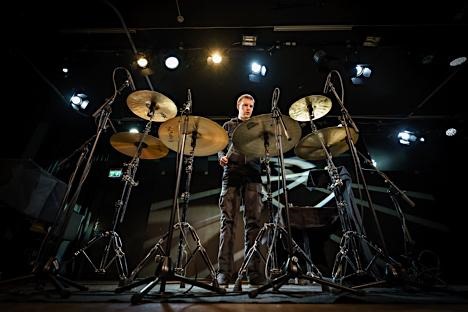
Thomas J

Photo: Thor Egil Leirtrø

In the context of a full drum kit, cymbals provide expression, and also an amount of ‘fill’ to the overall sound, not only of the kit, but the band, creating a wash of resonance in between the notes of the instruments and the beats of bass drum, snare, toms, etc. How do cymbals stand up when separated from everything else?

In the hands of Tomas Järmyr, we come to appreciate the range and versatility of the cymbal. Size certainly matters, and Järmyr’s setup which spans small, light crashes to huge, resonant, bell-like peels, against a backdrop which builds from a delicate clatter to a clashing, splashing tempest, is educational.

There are passages where the clatters and chimes diminish, and make way for dank, atmospheric reverberations which evoke the gloom of subterranean caverns, dark ambience which bears no discernible resemblance to anything remotely percussive, at least to the average ear – or mine.

Sometimes, with experimental music, the mystery is an integral part of the appeal: I prefer not to know which instruments have been used to create which sounds, and similarly, knowing how certain synths or laptop-based programmes have been used to conjure alien sounds feels like something of a spoiler, because I find myself scrutinising the sound and seeking to pick apart its construction. On Entrails, the opposite is true, because most of the sounds simply do not correspond to the source. So on the one hand, Entrails does lay bare the guts of the instrumentation: on the other, as I sit in the swirling drone which fills the room around the eighteen-minute mark, I find myself perplexed and in absolute awe at the creativity of the musicianship. How does anyone come to discover that cymbals have the capacity to be this versatile, to create sounds like these? Who has both ready access to this many cymbals and the time to explore their sounds and the way they interact with one another in such detail?

Sometimes the crescendos are delicate, slow-building: others, they explode unexpectedly. At others still, the sensation is more like an outflow of molten lava from a volcano.

Järmyr’s metal album may be devoid of guitars and guttural vocals – or, indeed, any vocals – bit it is still, for the most part, a heavy album, issuing forth an immensely dense, dark atmosphere, not to mention some quite challenging frequencies, spiking at the top end while rumbling heavily around the lower sonic regions. Ominous, oppressive, Entrails is not a fist-forward punch to the guts, but instead prods and pokes. The effect is no less potent.

AA

a3439715063_10

COP International – 6th December 2024

Christopher Nosnibor

What a year this is proving to be for bands who have lain dormant, at least on the studio front, for quite literally decades. And when it comes to Red Lorry Yellow Lorry, it really has been a long time. The last Lorries release was an ultra-limited gig-only affair back in 2015, with just 50 copies pressed for Leeds in the August and 100 for Valencia the following month. Said EP featured two new songs, ‘Safe as Houses’ and ‘Piece of my Mind’, which were listed as being from the ‘forthcoming album Strange Kind of Paradise’. Time passed, and it really didn’t look like the album would ever see the light of day. But now, this official EP presages its arrival in February 2025, some thirty-three years since they called it a day with Blasting Off (1992).

The Lorries always stood apart from their contemporaries: whereas the Leeds post-punk scene of the early 80s clearly favoured black in every possible way, the band’s guitar sound was steely grey and like scraping metal, and paired with murky bass and relentless percussion, they forged an industrial clang that, was the perfect mirror to both the landscape and the times. Chris Reed’s baritone was less theatrical and more gnarly and angry-sounding than your archetypal goths which would follow. Fans will already know and appreciate all of this, but with so much history – and so much time having passed – some context is worthwhile, especially for those unfamiliar.

During their 80s heyday, they built a catalogue of outstanding 12” releases, with some of their best cuts not on the albums, and with Driving Black, they’ve added another. It contains six tracks, with two mixes of the title track – I gather the original will feature on the album – long with a mix of the as-yet-unreleased ‘Chickenfeed’. ‘Safe as Houses’ and ‘Piece of my Mind’ finally get to be heard – and owned – by more than 150 people, and hearing them again in this context reminds me of the buzz I got when first heard them almost a decade ago: they’re unmistakably RLYL, and if they’re more in the vein of the material on Blow and Blasting Off, the one thing that’s remained consistent throughout the band’s entire career is their sonic density, that claustrophobic, concrete-heavy heft, with ‘Piece of Mind’ being a solid mid-tempo chugger and a grower at the same time. It seems that the two tracks from the 2015 EP didn’t make the album cut – but this can be seen as good news, if they have material of this quality going spare. The same is true of ‘Living With Spiders’, a frenzied track which has spindly guitars crawling and scratching all over it. It would be a standout, but the consistency of quality across the EP means it’s one more cracking tune.

The strangest thing is how time – or our perception of time – seems to become evermore distorted. Perhaps some of it’s an age thing, but… I remember at the time, The Sisters of Mercy’s release of Floodland was hailed not only as the rebirth it was – stylistically and in terms of commercial success – but as a huge comeback after a great absence. But Floodland arrived only just over two years after First and Last and Always. Even more remarkably, I seem to recall the release of Crawling Mantra under the name The Lorries that same year was considered something of a comeback and a departure, even though Paint Your Wagon was released only the year before. The world seemingly lost the plot when The Stone Roses delivered The Second Coming after a five-year gap (and they really needn’t have bothered). And now, while Daniel Ek is advocating the production of ‘content’ on a constant basis, we have bands putting out their first new material in an eternity, and rather than having forgotten about them, fans are fervent – and rightly so.

Chris Reed’s reuniting with David ‘Wolfie’ Wolfenden – Leeds alumni who first appeared with Expelaires in 1979 along with one Craig Adams, who would do a stint as a member of The Mission’s touring lineup – is most welcome, because they’re simply a great pairing, and this is nowhere more apparent than on lead track ‘Driving Black’, which is vintage Lorries, kicking off with urgent, driving drums, before the throb of bass and rhythm guitar and a sinewy lead guitar, sharp and taut as a tripwire cut in and casts a thread right back to their earliest work in terms of style and structure.

The parallels between now and the 80s are uncomfortable; we may have ditched a Conservative government, but workers are still feeling the pinch, and global tensions are off the scale. That the BBC’s apocalyptic movie Threads is getting only its fourth screening – to mark its fortieth anniversary – feels worryingly relevant. And so it is that Red Lorry Yellow Lorry still sound essential and contemporary is equally testament to their songwriting and delivery, and the bleak times in which we find ourselves. Putting the social and political backdrop to one side, the Driving Black EP is an absolute triumph. There are no half-measures, nothing is weak or half-arsed, and it’s – remarkably – as if they’ve never been away.

AA

Red-Lorry-Yellow-Lorry-_Driving-Black_-EP-3000-Cover

Thrill Jockey – 19th April 2024

Christopher Nosnibor

There’s been a quite staggering trajectory to the work of BIG|BRAVE: with each release they achieve an even greater level of intensity, which seems to be unsurpassable – until the next album. They’ve come a long way from their minimal ambient / folk beginnings. The instrumentation has remained minimal, but cranked out ear-splitting decibels, they’ve developed a way of creating a lot from comparatively little, and unlike many guitar bands, they’re not afraid of space. There is starkness, there is silence, there is separation between the instruments, and much room to breathe between slow, thunderous beats and crushing chords which collide at the pace of tectonic plates.

Vital was aptly titled, and marked a new peak in the articulation of raw emotional turmoil. It seemed improbable that nature morte could equal it, and yet it did, and went beyond, a desperate, feral edge pushing its emotive force to a higher level.

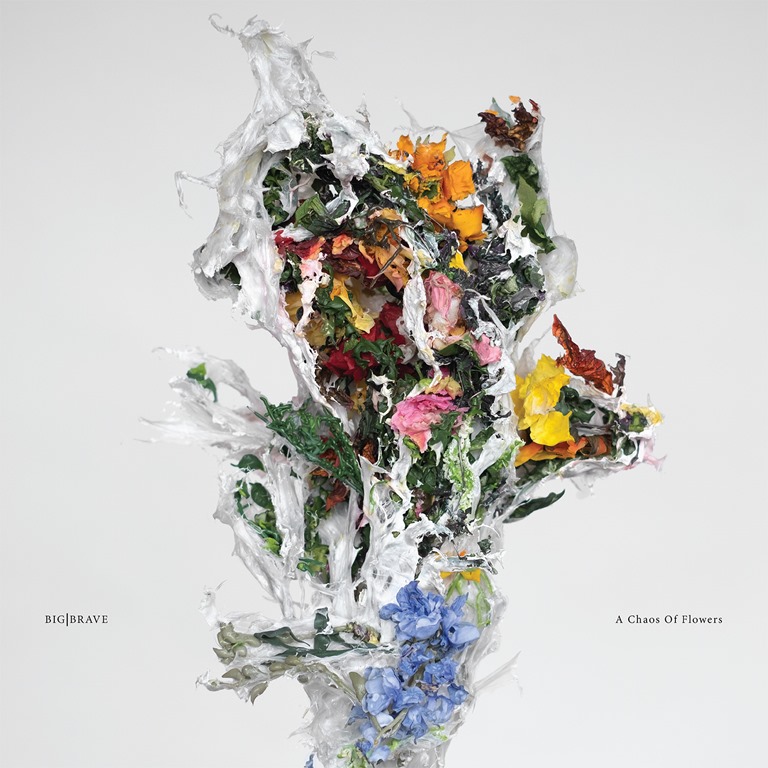
Coming a mere fourteen months after nature morte, and some substantial touring, how could they possibly sustain that kind of intensity? It seems improbable, but it’s happened. A Chaos Of Flowers is graceful, delicate, even folksy – but also eye-poppingly intense, cranium-splittingly loud, and utterly devastating.

The tracks released ahead of A Chaos Of Flowers hinted that this new album, beyond what seems human, would once again match its predecessor. ‘I Felt a Funeral’, which is also the album’s opening track, has strong folksy vibes… until the sonorous guitar tones enter. There are hints of late Earth about his, the way the resonant tones of pure sustain simply hang in the air. But dissonance builds, and there’s an awkwardness to this scratchy, imperfect beauty. The way Mathieu Ball’s guitar scratches and scrapes and builds to a blustering squall of dense, twisted noise is remarkable, building from nothing to an all-consuming howl. Yet at the same time, there’s restraint: it’s as if he’s pulling on a least to restrain this ferocious monster in his hands.

Currents – and volume – build. You’ve never heard guitar like this before. It brings the crushing weight of the drone of Sunn O))). And the thunderous relentless repetition of early Swans, but delivered with a breathy ethereal sparseness that’s difficult to place. And then there are the vocals. Not since first hearing Cranes in the early 90s have I heard a vocal so otherworldly.

The guitar feedback yearns heavy and hard in the final minutes of ‘not speaking of the ways’, a track which starts heavy and only grows in both weight and intensity. Robin Wattie’s voice is half adrift in a sea of reverb and drifting, almost drowning, in a tidal flow of guitar noise, for which you’d be hard-pressed to find a comparison. I’ve fried, struggled, failed. You can toss Sunn O))), Earth, MWWB around in the bag of references, but none really come especially close to conveying the experience of A Chaos Of Flowers.

The songs are shorter than on recent predecessors, and overall, the mood of A Chaos Of Flowers is different – dare I even say prettier than the last couple of albums. There’s a musicality and gentility about this album which marks something of a shift, and single ‘canon: in canon’ is the perfect evidence of this. One may say that ‘heavy’ is relative in terms of distortion and volume, but there is more to it than that. Many of the songs on A Chaos Of Flowers are delicate, graceful, sparse, with acoustic guitar and slow-twisting feedback dominating the sound of each track. There’s a levity, an accessibility, which is at the heart of every song here. Much of it isn’t overtly heavy… but this is an album which will crush your soul.

If A Chaos Of Flowers is intentionally less noisy than its predecessors, it’s no less big on impact. Raging, ragged chords nag away, until ‘chanson pour mon ombe (song for marie part iii)’ brings bleak, tones which cut to the core and explodes in to the most obliterative noise close to the end: this is the absolute definition of climactic finale.

There’s a rawness, a primitive, elemental quality to their music which has defined their previous albums, and this remains in A Chaos Of Flowers. You arrive at the end feeling weakened, short on breath, emotionally drained. I ask myself, how did I get here, so sapped-feeling? The answer lies in the force of this immense album. A Chaos Of Flowers is devastating in its power, and BIG|BRAVE reached a new summit – once again. The deeper and darker they go, the better they get.

AA

AA

641805

15th December 2023

Christopher Nosnibor

Glasgow Duo Empty Machines promise a blend of post punk, shoegaze, and indie synth rock, and ‘Velvet Sky’ is an expansive, atmospheric tune, layers of vocals floating in a swirl of textures synths and guitars submerged in effects. Reflective, contemplative, there are some bold dynamics here as they take things down to allow level before surging back. The blurry, saturated, shadowy but dazzlingly bright video perfectly encapsulates the mood here – one which is centred around a range of conflicting sensations and uncertain emotions. You feel a certain sense of bewilderment, as if being transported by invisible forces, both physically and psychologically.

It’s the vocals which carry the melody through a tidal wave of dense instrumentation, and with the drums low in the mix in comparison to this cinematic instrumental maelstrom, there’s a sense of volume, of sonic force to this dreamy but powerful single, as soft and smooth as velvet, but as dense as diamond.

AA

398690273_17873728037990162_7432350919056172319_n

Ipecac Recordings – 28th April 2023

Christopher Nosnibor

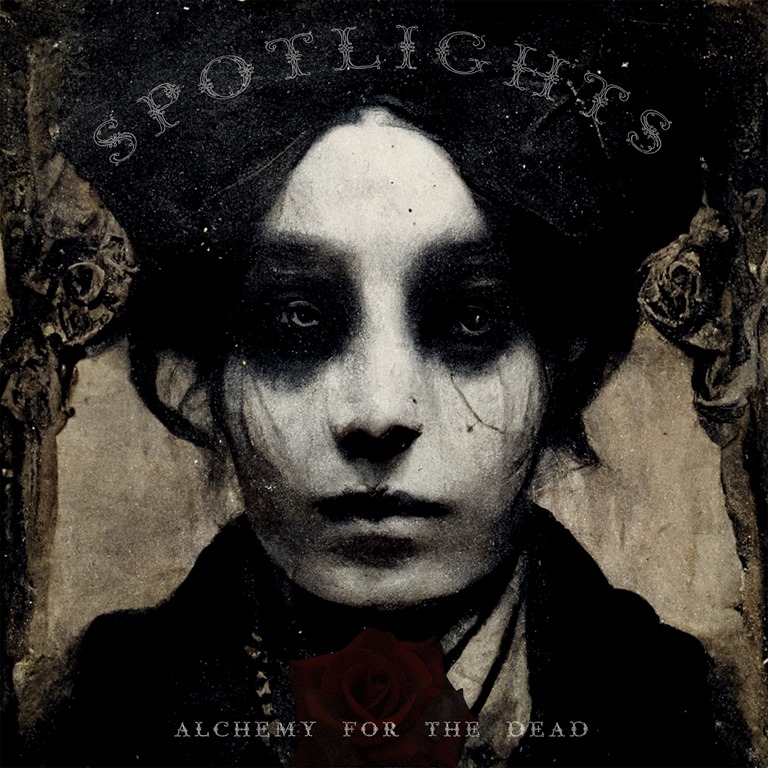
As their bio explains most succinctly, ‘Spotlights occupy the space between a push-and-pull of jarring metallic catharsis and sweeping distortion. Even as either side vies for supremacy, neither extreme ever completely tightens its grip, allowing waves of melodic vocals and expressive sonic sorcery to breathe in the middle. This deft balancing act has enabled the trio—husband-and-wife Mario Quintero [guitar, vocals, keys] and Sarah Quintero [bass, vocals] joined by Chris Enriquez [drums]—to carve a singular lane. Armed with an uncanny ability to wield darkness or light, the trio’s fourth full-length offering, Alchemy for the Dead [Ipecac Recordings], finds them exploring something we all face, yet few embrace…’

Expanding on this, Mario explains the album’s overarching theme, which the title alludes to: “One of the major parts of our lives, is the fact we’re all going to die,” he says “Most people are terrified of it, some people learn to look forward to it, and some see it as a way out of their misery. Various cultures view it differently. There isn’t necessarily a story to the album as a whole, but each song deals with the theme of death. It could be fantasy such as bringing a loved one back to life or darker moments like suicide and deep depression.”

It’s a fact that, at least in Western culture, death remains perhaps the last taboo, something of which even the dying tend not to talk about, not properly.

It was back in 2018 that I first encountered Spotlights: their cover of ‘Faith’ by The Cure from their Hanging by Faith EP was an instant grab. This was a band that really ‘got’ the atmospherics of the track and captured the essence of what, for many, myself included, remains as an untouchable trilogy of albums, 17 Seconds, Faith, and Pornography.

Alchemy For The Dead doesn’t sound like any Cure album specifically, but still takes cues in terms of weighty atmosphere. Following a gentle introduction that borders on dark synth pop, it’s not long before the blasting power chords crash in, thick and dark and heavy. And the thick, processed bass on ‘Sunset Burial’ blends with a rippling guitar that’s richly evocative and reminiscent of Oceansise at their best. But when they break into monolithic crescendos of distortion, I’m reminded more of the likes of Amenra, of BIG ¦ BRAVE.

There are some extravagant guitar breaks, but somehow, they’re as forgivable as the more processed prog passages, which in the hands of any other band would likely sound pretentious: Spotlights sound emotionally engaged and sincere without pomp or excessive theatricality: this isn’t something that’s easy to define, not least of all because it’s such a fine line when weighing up musical that’s so reliant on technical proficiency and very much ‘produced’. And the production is very much integral here: the arrangements require this level of separation and clarity. But this is where it’s important to distinguish between production and overproduction, and it’s testament to Mario’s skills at the desk that he’s realised the band’s vision so well. The bass really dominates the sound, which is so thick, rich, and textured, and also explores a broad dynamic range: the quiet passages are delicate, the loud ones as explosive as a detonation at a quarry.

Similarly while the songs tend to stretch beyond the five-minute mark, there’s nothing that feels indulgent or overlong here. ‘Repeat the Silence’ builds on a simple repeated sequence almost reminiscent of Swans’ compositions, but thunders into a bold, grungy chorus that’s more Soundgarden.

The album’s shortest song, the three-and-a-half-minute ‘Ballad in the Mirror’ is also the most overtly commercial, a straight-up quiet/loud grunge blast, and the riffage is colossal.

‘Crawling Towards the Light’ marries monster riffage with Joy Division-esque synths, and somewhere between Movement-era New Order and Smashing Pumpkins, but rendered distinctive by the propulsive drumming which drives the track which builds to a roaring climax.

The seven-minute title track is sparse and suffocating. It has a nostalgic quality that’s hard to define, and it’s perhaps something that’s only likely to punch the gut of nineties teens in this specific way, but it’s understated and emotive, and then the guitars crash in and it’s fucking immense and… well, what a way to conclude an album.

Alchemy For The Dead is a huge work, an album that draws its own parameters and digs new trenches around genre definitions before bulldozing them to the ground with riffs. Complex, detailed, and unique, Alchemy For The Dead is something special.

AA

SPOTLIGHTS_AFTD_LP FULL.png

Dret Skivor – 3rd March 2023

Christopher Nosnibor

Fern’s Deformed is appropriately titled: this some mangled shit. From the slow, deliberate, rolling grooves that boom and bow through snarled up noise, while against it, crisp, crunching beats thump and stutter, Fern keeps things interesting and innovative, but more than anything, keeps it uncomfortable.

Deformed sits within that bracket of dark ambient that’s deeply dark, but not entirely ambient, and doesn’t for a second let you settle into it, instead twisting and squirming awkwardly, refusing to solidify or confirm to any one fork of style.

‘Intro’, the minute-long splurge of wibbly dissonance set the scene nicely for the following twenty-five minutes of oddball electronica. The liner notes offer ‘Respect to Portishead, aphex twin, faster katt and Mindacid for inspiration (samples)’.

The majority of the album’s ten tracks are brief sonic snippets, most being well under three minutes in duration, and in many respects, Deformed feels more like a palette sampler than a fully realised work – although that is by no means a failing, as it gives the album an immediacy that further evolution would likely dilute.

It’s four tracks in that Deformed really starts to take (strange, twisted, unexpected and indefinable) shape: ‘Greyhats’, a live recording – it’s unclear if it’s live in the studio or soundboard, but there’s no crowd noise and it fades at the end – is aggressive, dark, and difficult.

Immediately after, ‘Heaven in my hands’ is a murky mangled mess of distortion and mid-range, drums overloaded and crackling in a grey blurry sonic haze, and ‘Give Your Soul Away’ is a skull-pounding beat-driven assault, and the samples pile in thick and fast. ‘Porthole’ is dense, robotic, repetitive, and while dance elements are a defining feature of the album’s style, this is by no means a dance album: it’s stark, it’s bleak, detached, and in places, unsettling.

Deformed is many things: easy, predictable, comfortable, are not among them.

AA

a0661217700_10

Gutter Prince Cabal – 16th February 2023

Christopher Nosnibor

There aren’t many guitar-based genres of music where one-man bands are particularly commonplace. Of course, I’m not talking about folk or acoustic-based music, but the kind of music where, on listening, you’d expect a full band. Industrial is something of an exception because early exponents like JG Thirlwell – aka Foetus – developed through the use of tape loops and studio experimentation, and the same is also true of later exponents like Nine Inch Nails, with Trent Reznor’s studio-based project evolving from being largely synthetic into a live proposition.

But black / death metal are genres unto themselves. One might joke that it’s because most of the people who make this kind of stuff have no mates or are too antisocial to form bands, although it may not be much of a joke. Either way, Melbourne-based Aaron Osborne is one of those one-man operations, handling all aspects of writing and playing to create the sound of several. And what a sound it is. If you want dark, dense, and sludgy, with bowel-loosening guttural vocals, then you’re in luck.

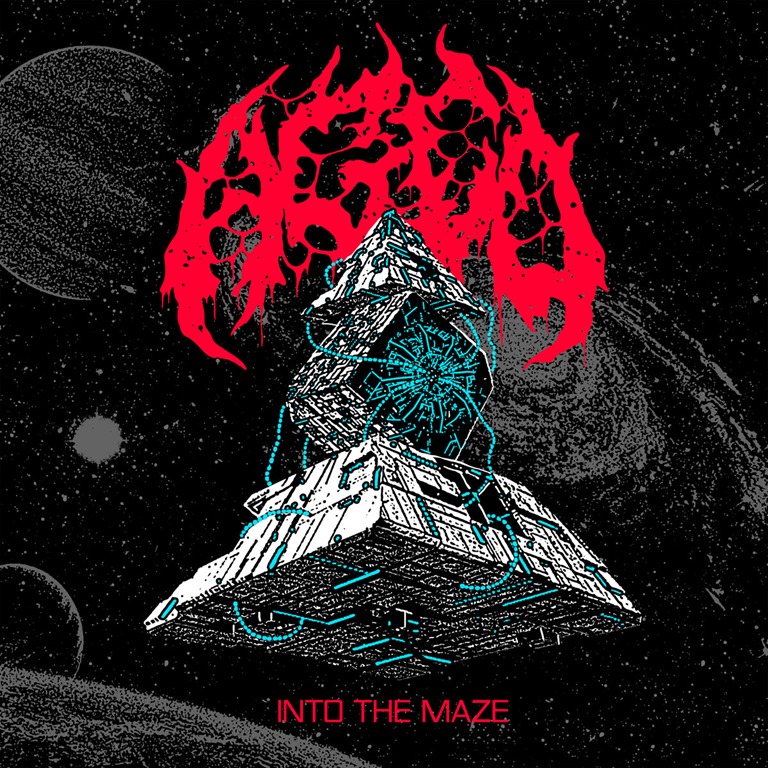
Into the Maze – a twenty-seven minute album – or mini-album – actually comprises two new songs plus four cuts previously released as the Collector EP.

You don’t listen to this stuff to be uplifted – but you do dive into it for escape, and Into the Maze brings that cathartic release.

The title track is monster slab of downtuned darkness. There are some guitar screeches which emerge from the relentless trudge that call to mind Fudge Tunnel, but this is denser, slower, doomier, and somehow less organic-feeling, like early Pitch Shifter but with live drums, and passing a nod to how they take ‘the swagger and groove of Entombed’s Wolverine Blues and infuse it with the tar-thick pull of doom’. But against Wolverine Blues, it’s half the pace and the lyrics are unintelligible grunts, so it’s very much an example of taking an influence and steering it in a different direction. And this is a good thing. The production is perfectly dingy and oppressive, and over the course of just short of half an hour it really grinds you down in just the way it should. In all, it’s pretty bloody brutal. I dig.

Oh, and that’s one hell of a logo.

AA

a3701776308_10

Warren Records – 25th November 2022

Christopher Nosnibor

While Leeds has a strong reputation and record for emerging noise-orientated rock bands, Hull is proving that it’s not far behind as a spawning ground for purveyors of noise-driven angst and anger.

As was the case in the 70s and 80s, social deprivation proves to be a powerful driver for the creation of art that channels frustration and the whole gamut of expression that comes from dark places, and from adversity. Of course, it’s always the North. Leeds spawned goth, Manchester Joy Division, Magazine, Slaughter and the Dogs, The Durutti Column. Sheffield, too, has a strong heritage of bands known for innovation born out of frustration, with Cabaret Voltaire being a strong starter for 10. Hull, of course, brought us Throbbing Gristle, arguably one of the most groundbreaking acts of the 70s and beyond.

Most punk bands, especially the Pistols, simply cranked out pub rock with a sneer and the guitars turned up. Throbbing Gristle went beyond any conventions of music to create a real soundtrack to alienation.

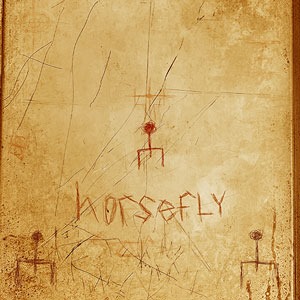
More recently, we’ve had The Holy Orders, Cannibal Animal, Low Hummer, Parasitic Twins, and many more. And now we have Bug Facer kicking out a disaffected din, and ‘Horsefly’ is one hell of a debut single, and clocking in at over six and a half minutes it’s a behemoth of a track.

The band say of ‘Horsefly’, ‘At its core the track is about struggle. It conjures images of being trapped or stuck in a box or something but we don’t want to give away too much! We try to write music that is evocative and suggestive, not being too direct with our lyrics and ideas as we’d much prefer our listeners to tell us what it is they hear and see as they listen to our tracks. Some people have said it’s like battling through and emerging from a storm, others say it’s like someone has angered the gods.’

The sense of struggle is conveyed keenly here: you feel the pain in your bones, in your muscles, nerves, and sinews. It pulls hard at the soul, at the same time as punching away at the guts with a methodical thud.

It’s a hefty, dirgy trudge that oozes anguish, and if the organic feel is rathe in the vein of Neurosis, the bands it’s closest to are Unsane and Kowloon Walled City. It’s bleak, grinding, stark and brutal. Its power derives not from distortion, or from pace, but from sheer density and crushing volume, and from raw power. It’s the kind of claustrophobic, pulverising heaviness that leaves you aching. This is serious. And Bug Facer are instantly my new favourite band.

Avalyn formed in late 2021 after long-time friends Andy Power (Guitar & Vocals) and Ben Croft (Lead Guitar) decided to start writing together due to them both being dissatisfied with their previous musical efforts. Soon joined by Cain Garcia (Drums) and Emily Turnbull (Bass & Vocals), the band appeared all over their local music scene in 2021, including playing their first gig supporting Junodream alongside Lime Garden at The Shipping Forecast in Liverpool, as well as going into Whitewood Recording Studio with Robert Whiteley to record their latest offering.

Influenced by the great punk powerhouses, Avalyn takes their cues from the likes of My Bloody Valentine, Slowdive and Lush. What emerges is the ferociously uplifting sound that can be heard on the group’s latest track; ‘When We Were Nothing’, out 24th March. Featuring mastering work from the Lead Singer & Guitarist of the seminal 90s Shoegazing band RIDE, Mark Gardener, the track melds brooding experimentalism, with an unshakeable punk sound. Thrashing guitars play under Power’s haunting vocals, as he sings about the euphoric uncertainty that comes with youth, and the always present, uncertain future.

“When We Were Nothing was the second song we ever wrote together as a band,” says Power. “Our guitarist Ben brought in the main riff and I could tell from the beginning it was going to be great, so I wrote a verse for it and then we wrote the lyrics together.  Everything really came to life once we brought it into the practice room with the addition of Cain’s drum part and Emily’s bass and vocal Recording with Rob Whiteley was a lot of fun as we felt like he was able to help give us the freedom to experiment with the sounds we wanted as well as being able to put all our ideas together into a cohesive mix. The mastering job from Mark Gardener was the final touch that has taken the song to another level and we’re excited to continue working with him going forward.”

Listen here:


AA

AValyn

Opa Loka Records – 5th March 2021

Christopher Nosnibor

Breath Mule is the third album for Dutch multi media artist Richard van Kruysdijk under the moniker Cut Worms, and after a gap of over three years, completes a trilogy along with Lumbar Fist (2016) and Cable Mounds (2017).

As the accompanying blurb outlines, ‘Cut Worms’ sound palette is firmly rooted in the lower frequencies’, detailing how ‘As the droney, cinematic tracks evolve, their slowly unravelling, gritty sounds evoke the audio equivalent of brutalist architecture: Concrete walls of sound that are as majestic as they are elementary, yet intrinsically detailed when examined with a magnifying glass.’

The majority of the tracks are long, and not a lot really happens, meaning that there is time given for each composition to breathe and explore the tones and textures in full detail. The low-booming opener, ‘Slug Sirup’ sounds like a ship’s horn sounding out over the miles through a dense and played back at half speed. First distant, it grows in volume, but little else happens for a very long time. And then, somehow, more than nine minutes has evaporated, and drifted into the slow-booming drone of ‘Come Lightly’. There isn’t much light about it: it’s dank and ominous.

There are crackling creaks enveloped in the dense, crawling fog of ‘Cinder Locks’. The sound is thick, heavy, immersive, and yes, it is ominous but at the same time, I find a certain comfort in such vast expanses of thunderous ambience. The more condensed the sound, the more it billows like smoke, the more impenetrable and more solid it becomes, the more it feels somehow like something that’s a source of a certain warmth and security. The same is true of the throbbing ‘Denmark Spiral’, but the thin, trilling wisps of Girly Totem’, while more overtly and quintessentially ‘ambient’ are somehow more difficult to settle in with – particularly in context.

The darkness really comes to the fore on the final track, the eleven-and-a-half-minute ‘Slashed Hostage’. The title provides a fair indication of its weight, and it begins with a low, slow, oscillating throbbing hum, one of those drones that nags at the senses like a far-off helicopter that you scan the sky for but can’t see. Again, it’s a slow-builder: the sound expands, louder, denser, but no different, and this is where it really starts to get into your head and burrow into your skull. It’s along this journey that the slow-moving drone expands to a different level of immersion, and when the swell tapers down, hushed vocals echo menacingly, too low in the mix to decipher the actual words, a poem by the enigmatic Italian composer Giacinto Scelsi (1905-1988), who wrote surrealist works in French. Because. That said, Scelsi is an interesting choice, as a composer who, according to his Wikipedia entry, ‘composed music based around only one pitch, altered in all manners through microtonal oscillations, harmonic allusions, and changes in timbre and dynamics, as paradigmatically exemplified in his Quattro pezzi su una nota sola (‘Four Pieces on a single note’, 1959)’.

On Breath Mule, Cut Worms offers more than a single note, but then again, there are no notes: only thick, swirling billows of sound and layers of drone on drone. It grips you, immerses you, hold you… and it’s not unpleasant, as long as you don’t struggle.

AA

CW-M013-digipack-3P_1CD-6-x-8mm-z-kieszonka V7