Posts Tagged ‘dark’

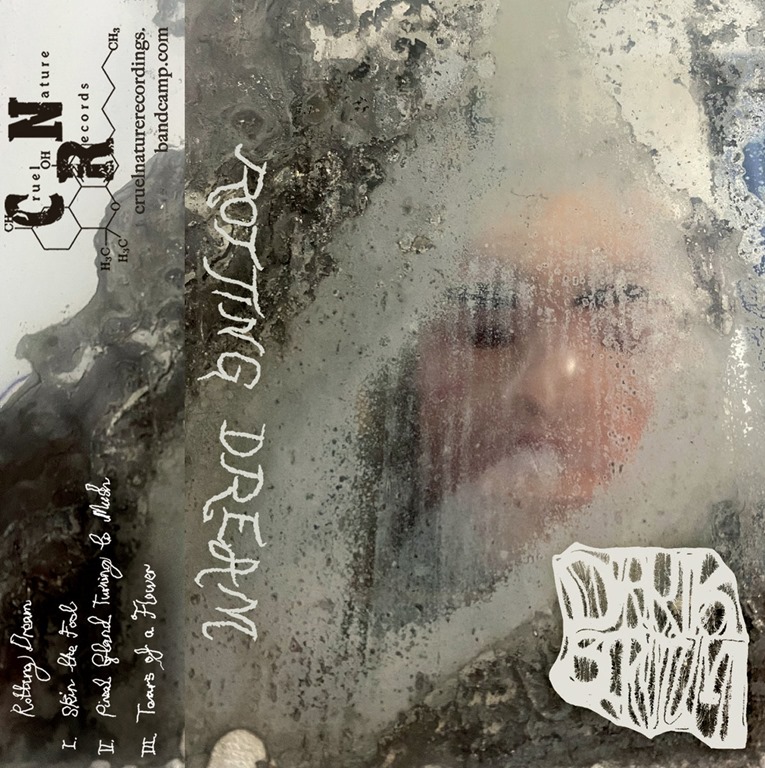
Dark Scrotuum – Rotting Dream

Cruel Nature – 27th June 2025

Christopher Nosnibor

As the label recently hailed in its midyear roundup, Newcastle-based cassette label Cruel Nature has put out some forty releases so far in 2025, which equates to one every fortnight. It’s no small achievement, particularly considering that not only are they essentially a one-man operation but they’re hardly mainstream in their output – and what’s more, that output is remarkably diverse. More often than not, niche labels adhere to a fairly narrow range, whether it’s black metal, indie, or experimental in nature: they know their audience, and cater to them, knowing they will shift inventory. Cruel Nature takes a different approach, which isn’t without risk, in that they release music they feel meets a standard based on quality rather than style, meaning that label collectors may not love everything – at least at first – but will be introduced to stuff they wouldn’t have otherwise listened to, and fans of given bands or styles will make discoveries by association.

And so we come to Rotting Dream by the wonderfully if somewhat crassly-named Dark Scrotuum. You know before you hit play that whether it’s black metal or power electronics, it’s probably going to be pretty nasty, right? Right. It’s pitched, quite succinctly, as ‘crushing dark ambient BM drone sludge noise’. BM could as readily be taken in the American sense – bowel movement – as black metal here. And believe it or not, that’s not a diss. Anyone who’s familiar with Aural Aggravation will be more than aware that heavy shit is our bag, and specifically my bag. And this is some heavy shit, bowel-trembling, uncomfortable, heavy shit.

The first of the three tracks, ‘Skin the Fool’, is seven and a half minutes of earth-shifting, stomach-churning dark ambience with a growling, grumbling industrial edge. It’s dark, and it’s heavy, a constant, heavyweight rumbling, the sound of destruction, of desolation, like slow-motion detonation. The first three minutes alone are utterly harrowing, and then, from nowhere, it goes nuclear, a churning blast of noise so dense it hurts, an extended billowing explosion that replicates the impact of Threads. Game over? Life over. Existence over.

Dark scrotuum? Tense and shrivelled scrotuum is the initial reaction to this brutally harsh work. ‘Pineal Gland Turning to Mush’ is ten minutes of tension, meaning the track is appropriately titled, barrelling into a relentless wall of harsh noise. It’s not quite HNW because there is texture and variation over its duration… but fuck. It’s abrasive, obliterative. I find myself sitting here, sweating, wide-eyed, uncomfortable. This is… intense, alright. It hurts.

And then, there is ‘Tears of a Flower’, the harshest heaviest, most explosive cut of the three. Toss Sunn O))), Prurient, Swans, and Vomir together and you’re about there. It seems that Dark Scrotuum have pulled together everything – and I mean everything – they can conceive to create the nastiest, most overloading wall of noise possible. ‘Tears of a Flower’ is a punishing, brutal sonic assault which offers no respite, only more pain, and more pain and more pain. And you feel it. There is not one fleeting moment of kindness, no respite. This is music to puke to as you feel your eardrums collapsing and your soul shrivelling. As for our dream…it’s over.

AA

a4040102512_10

The Helen Scarsdale Agency – 23rd May 2025

Christopher Nosnibor

The pitch alone is harrowing: ‘“Don’t be scared by death,” Alice Kundalini (aka She Spread Sorrow) calmly instructs at the beginning of her collaborative Grimorian Tapes with partner Luca Sigurtà. Her words slither from her lips with a subtle, sinister unease, compounded by the unsettling quality of her whisper. The fear of death, this most profound condition, has long been a subject of philosophical, spiritual, and existential inquiry. To fear death is undeniably human; to transcend that fear is often seen as reaching a higher plane of existence. At least, that’s the intention behind the rituals, the spells woven into the fabric of The Grimorian Tapes.”

I myself have spent a lot of time contemplating death, and the fear of death, especially of late. We are all scared of death, particularly in Western culture. When my wife was diagnosed wit stage 4 breast cancer, where it had spread to her bones, I was terrified, not only of losing her, but of waking up to find her dead in the bed beside me. What do you do in that situation? I did not want to see her dead, and she did not want me to see her dead. Thankfully, she made it to a hospice for her last day, but I lived for a year under the shadow of that ‘what if…?’

You might think that her passing brought peace, but it did not: instead, I have spent many mornings twitching and drenched in sweat lest I should die and leave our daughter an orphan, being thirteen. This is not a call for sympathy – simply as summary. It’s hard not to be scared by death, inevitable as it is.

For additional context, it’s worth delving into the details of the album’s inspiration, a large portion of which comes form The Black Pullet, ‘an 18th-century French grimoire filled with instructions for making talismans and magical artifacts’. We learn that ‘Kundalini weaves her own take on the book’s esoteric themes into the shadowy tape loops that comprise The Grimorian Tapes. The Black Pullet is a detailed guide into alchemy, divination, and occult practices, with a particular focus on harnessing hidden forces through the construction of specific objects imbued with magical power. Though Kundalini doesn’t practice these rituals per se, she finds a deep, poetic resonance with these ancient teachings. The allure isn’t in the performative aspect of these rituals but in the seductive power of its symbols and ideas, which speak to a long-forgotten language of metaphysical mystery. It’s this sense of transmutation, hidden knowledge, and occult wisdom that lends The Grimorian Tapes its dark, ritualistic intensity.’

And so it is that ‘grimoire’ introduces the album with a dark etherality, whispered vocals, the words indecipherable. Echoing amidst rumbles and a persistent drone which ebbs and flows. It’s compelling, and enticing, but at the same time, unsettling. It’s the fear of the unknown, of course: the esoteric and other-worldly and anything that speaks of a realm beyond one’s ken is always difficult to assimilate. This, in a nutshell, is the appeal of horror, because a lot of us find entertainment in being scared. It’s the same reason people go on rollercoasters. Being scared half to death reminds you that you’re alive. And The Grimorian Tapes is pretty scary, in the suspense and horror sense.

‘initiatory’ rumbles and hovers dark and murky, sonically entering the domains of Throbbing Gristle, and again, the whispered vocals are menacing, and reminiscent of Prurient’s Cocaine Death, while ‘the stairs’ brings a hint of disturbing playground, psychological derangement, the other ‘other side’ we’re all so afraid of due to a lack of comprehension. And the further this album progresses, the more uncomfortable and unsettling it becomes, the further it extends beyond the domains of the ordinary, the mainstream comprehension.

‘babele’ is a dank, muddy morass of sound over a slow thudding heartbeat rhythm, while ‘kirtan’ brings flickering, stuttering beats, while again leading the listener through hair-prickling terrain, with triffid-like stem-clattering and gloomy swirls and abstract vocals. ‘we worship you’ plunges deeper into a darker space, with sputtering electrostatic sparking, and gargled vocals, deep and robotic, growling, threatening and emanating from another place, another world, one beyond reach. ‘me and I’ churns like slow machinery, and is industrial in the primitive sense. Again, the way we have come to understand ‘industrial’ has evolved: Foetus is a far cry from Throbbing Gristle, and both are a world away from NIN and Ministry. But The Grimorian Tapes takes us right back to the origins of the genre.

This is one dark and difficult album, heavy and suffocating and uncomfortable from beginning to end. Two thumbs up. And now I need to lie down.

AA

a0844152259_10

Christopher Nosnibor

Last night, I spotted a post on Facebook from the Fulford Arms bearing the caption ‘hot day / sold out show = sweat dripping from the ceiling… f*cling awesome!’

And the gentrification of the grassroots venues we have left mean such occasions are a lot rarer than they used to be. And while for some punters it’s likely seen as a good thing, I personally do miss the sweaty mess aspect of packed-out pub venues, not because I necessarily enjoy being a sweaty mess, but because it was a part of the live experience, and you knew you’d been to a proper show if you came out absolutely drenched and having lost about 3lbs through perspiration.

And so it is that here we are at The Fulford Arms on the hottest day of the year so far. The thermometer in my back yard was showing 34°C earlier in the day. I found myself thinking ‘at least it can’t be as hot as The Mission at The Crescent, right? Or DZ Deathrays at the 50-capacity Woolpack in 2013… Surely?’ And it wasn’t. And not just in terms of temperature.

Cogas are a blackened death metal three-piece, with guitar, drums and vocals, plus face paint, chains, studs and random props. The seven-string guitar brings frenzied fretwork and some solid low end, and rapid fire kick drum action ensures the sound isn’t thin despite that lack of numbers. The singer looks really angry for the entirety of the set, and it works in terms of character, but it may be because of the amount of time he spends adjusting his mic stand. Towards the end of the set he wields an inverted cross of bones. Its relevance is unclear, but it’s an interesting visual.

DSC02351DSC02352

Cogas

Blasfeme have more and bigger spikes, more black face paint and more guitars: two plus a five-string bass. This combination ratchets up both the volume and density. They play hard and fast, the vocals are a demonic shriek. By a few songs in, half their makeup has disappeared, and with his office haircut the vocalist is transformed back to a more daytime look, but guitarist Vermin flails his hair furiously and they pound their way through a set of highly structured songs, predominantly culled from their latest album, delivered with a rare tightness, and there’s no denying their quality.

DSC02368DSC02378

Blasfeme

Thy Dying Light go darker still, with iron cross patches and black cymbals and shiny Spandex trews – plus a candelabra and a selection of horns and sheep skulls in front of the drum kit. the smoke seems to make the room even hotter, and by the end of the set, even the skulls looks like they’re sweating. The guitar/ drums duo – self-professed purveyors of “Cumbrian Black Metal” – deliver a set that’s raw and murky and true to the principles of black metal, seemingly have spent as long on their makeup as writing the songs. A big bearded guy in a Sunn O))) t-shirt emits a guttural growl between each song instead of applause.

DSC02388

Thy Dying Light

Burial bring beards and shaved heads, and t-shirts with cut-off sleeves. Their sound is as burly as they look, meaning that sonically they’re solid, but the fact their inter-song chat can be summarised as “how are you doing York, you soft wankers” and “fuck off you sexy cunts”, I’d have preferred more songs and less bantz. There seems to be a lot of in-jokes, which the faithful are in on, calling for them to get their tits out, but it rather falls flat for the casual observer.

DSC02421DSC02433

Burial

Perhaps the heat was a factor – certainly, the moshing was minimal and the crowd were keener to rush the bar and get air between the bands than go nuts during their sets – but something about the lineup simply failed to ignite on the night. None of the bands were duds, by any stretch, but there were no explosive cathartic peaks, making for a night that would sit in the ‘middling’ bracket overall. And that’s fine: four bands for a tenner means £2.50 a band, and it’s hard to begrudge that, and as a showcase of a breadth of metal, it delivered.

Panurus Productions – 2nd May 2025

Christopher Nosnibor

Northern noisemongers Belk are no strangers to the virtual pages of Aural Aggravation: I personally first caught them live as a duo back in 2021, when I remarked in my review that as fierce as they were, they might benefit from some bass. I could never have imagined just how much. These days, their sound is dominated by some juddering low-end that’s practically arsequake. It’s as if they thought ‘you want some bass, eh, bastard? Here’s some fookin’ bass. BOWWWWWWWMMMM’. They’ve certainly evolved over the last four years – but what that means, in real terms is that they’ve developed methods of making noise that’s even more nasty and gnarly and generally unkind to the eardrums. This is a good thing, and ‘Flayed’, the first of their two contributions to this split release is a beast. It has a definite and undeniable sense of swing to it, a swaggering groove that’s somewhat unexpected. But what is expected – and delivered – is a crashing riot of noise, a juddering wall of distortion, squalling, dirty guitars, drums blasting at a hundred miles an hour and guttural vocals half-submerged by the swirling chaos, with tempo changes galore and simply all hell happening at once inn explosive, brutal frenzy.

‘Cloak of Bile and Oil’ begins a little more gently – and for a moment I’m reminded of the intro to Fudge Tunnel’s ‘Hate Song’, which inevitably bursts into shards of incendiary sludge and squall – and sure enough, so does this, the extended intro giving the deluge of noise even more impact when it finally does arrive. They describe their style as ‘Blackened Leeds Hardcore’ and this must surely be a definitive example of what that means.

Casing are an unknown quantity, and their two contributions are brief – the longest piece is just over two minutes in duration. The sound they offer is certainly no less abrasive or disturbing. There’s nothing to indicate what the initialisms of the song titles actually mean, but the electronic excursion which is ‘L.U.A.N.L.B.’ begins with some rumbling dark ambience, soon rent with the wail of siren-like feedback, before a wall of harsh noise distortion swells like a tsunami and swallows everything. In contrast, ‘D.T.H.D.T.C.’ launches headlong into a gut-churning blast of manic grind, with a nauseating bass churn to rival that of Belk.

What it lacks in duration (the four tracks have a combined running time of less than eight minutes), this release more than makes up in devastating intensity. Mission accomplished.

AA

cover

Negative Gain Productions – 6th June 2025

Christopher Nosnibor

Just as the birds of prey from which they take their name are creatures of the night, so this Irish act – essentially one guy – who draw inspiration from the darker realms of postpunk, goth, and synth-based music are very much dwellers of the dark hours, as debut album Death Games attests, with titles such as ‘Perfect Nightmare’, ‘Tombs’, and ‘Send Me to My Grave’. The album’s themes are timeless and classic, offering ‘a haunting exploration of love, mortality, and the fragile nature of existence,’ while casting nods to touchstones such as Lebanon Hanover, Boy Harsher, and Black Marble.

Lead single ‘Give Me Your Stare’ opens the album in style with a disco beat and throbbing bass giving this bleak, echo-soaked song a dancefloor-friendly groove. The vocals are backed off but ring clear through a haze of reverb, offering a hint of The Cure’s Seventeen Seconds in terms of production values.

AA

The compositions on Death Games are pretty direct: there’s not a lot of detail or layers, and it’s the electronic beats and pulsating basslines which not only define the sound but drive the songs. The sonorous synths which twist and grind over the top of these predominantly serve to create atmosphere more than melody, although haunting, repetitive motifs are commonplace, and the vocals, too, being low in the mix and with a fairly processed feel, are more a part of the overall sound than the focal point.

‘Skin on Skin’ brings a wibbly, ghosty synth that sounds a bit like a theremin quivering over a minimalist backing of primitive drum machine and bass synth, and the likelihood is that they’re going for early Depeche Mode, but the end result is more like a gothed-up Sleaford Mods, although, by the same token, it’s not a million miles away from She Wants Revenge around the time of their electro-poppy debut, and that’s perhaps a kinder and more reasonable comparison. ‘Fevr 2’ brings an increased sense of urgency with skittering bleeps skating around the reverberating drums: it has both an 80s movie soundtrack vibe and a vintage goth disco feel, and despite its hectic percussion and busy bass, ‘Tombs’ conjures a haunting, requiem-like atmosphere.

The ‘death’ thematic may not always be literal, and as much concerned with the death of love and the ends of relationships, but the duality the theme offers serves OWLS well. There’s no denying that it’s both a stereotype and a cliché that an obsession with death is such a goth thing, and OWLS fulfil these unashamedly – but then, why should there be shame? Why is it only goth and some strains of metal which embrace life’s sole inevitability, and explore mortality and the finite nature of existence? Even now, after millennia, we aren’t only afraid of death, but, particularly in Western cultures, we’re afraid to think or talk about it. People passing in their eighties and nineties still elicits a response that it’s a tragedy or that they should have had more time, and I’ve seen it said of people departing in their sixties or even seventies that it’s ‘no age’. We seem to have a huge blind spot, a blanketing case of denial when it comes to death, as if it shouldn’t happen, that it’s an injustice, and that no-one deserves it. But nothing is forever, be it love or life, and while loss – any loss – is painful, it comes attached to inevitability, being a matter of when, not if.

The stark and sombre ‘Send Me to My Grave’ commences a trilogy of dark, downbeat, funereal songs, which grow progressively darker, more subdued, the vocals more swallowed by evermore cavernous reverb. Even when the beats kick in and the bass booms, things warp, degenerate, and seem to palpably decay and degrade. There’s a weight to it, a claustrophobic heaviness, and the kick drum thwocks away murkily as if muffled by earth and six feet under sods. ‘This Must be the End’ is brittle, delicate, the calm that comes with the acceptance of… of what? What comes after the end? It feels like the song, and the album, leave this question hanging with an ellipsis, a suspense mark. It seems fitting, since we simply don’t know. But it does very much leave the door ajar for OWLS’ follow up, and that is something to look forward to.

AA

AAlbum CoverA

Dret Skivor – 4th April 2025

Christopher Nosnibor

This latest release on Swedish microlabel devoted to the most underground of underground music, Dret Skivor, may be form an act we’ve not heard of before, but something about it has all the hallmarks of the eternally prolific Dave Procter all over it. The man behind Legion of Swine (noisy) and Fibonacci Drone Organ (droney) and myriad other projects and collaborations – some occasional, some one-off – has a distinctive North of England drollness and a penchant for pissing about making noise of all shades, after all.

Released on CD in a hand-painted edition of just two, the notes on the Bandcamp page for the release are typically minimal: ‘Is it dungeon synth? Is it just spooky music? Is there torture afoot?’ I would say I will be the judge of that, but dungeon synth is a genre I’m yet to fully get to grips with, although it does for all the world seem as if it’s a genre distinction that’s come to be applied to spooky music, and seems to have grown in both popularity and usage comparatively recently, despite its roots going back rather further.

The cover art doesn’t give much – anything away, and in fact, I might have hoped for something more… graphic. But perhaps less is more here. However, the titles of the two tracks –‘the shithouses’ shithouse’ and ‘the festering flesh of the neoliberal’ are classic Procter and could as easily be titles for poems by Dale Prudent, another of his alter-egos.

The first begins with a swelling thrum of what sounds like a chorus of voices, possibly some monastic indentation, layered and looped and multitracked to create a torturous cacophony. For the first twenty, thirty, forty seconds, you wait for a change to come, for something to happen. After a minute that expectation is diminishing, and by the three-minute mark it’s impossible to be certain if there really are keyboard stabs swirling in the mix in the midst of it all, or if your ears and mind are deceiving you and you’re losing the plot. For some reason, I’m reminded of the Paris catacombs – not because it’s actually creepy, but because, just as seeing rows and rows of bones stacked up for quite literally miles becomes both overwhelming and desensitising after a time, so hearing the same sound bubbling away for ten minutes is pretty much guaranteed to fuck with your head. Near the eight-minute mark, there are most definitely additional layers of buzzing drone and there are some tonal slips and slows, like listening to a tape that’s become stretched or is slipping on its spool, but by this time your brain’s already half-melted, and I find myself contemplating the fact that while visiting the catacombs on a sixth-form art trip, one of my fellow students accepted the challenge to lick a skull for eight Francs – which was about a quid at the time. I was less appalled by the fact it was a human skull than the fact the bones looked dusty and mossy, and had probably been touched by even more unwashed hands than the handle of the gents lavs at a busy gig venue.

And so we arrive at the twenty-two-minute ‘the festering flesh of the neoliberal’. It begins with a distant clattering percussion – like someone bashing a car bonnet with a broken fence post heard from a quarter of a mile away, but with a gauze of reverb, as if echoing from the other side of a valley – or, put another way, like listening to early Test Dept through your neighbour’s wall – while a pulsing, pulsating electronic beat, like a palpating heartbeat, thuds erratically beneath it. And that’s pretty much it. But there are leaps and lurches in volume, and the cumulative effect of this monotonous loop is brain-bending. There are gradual shifts, and seemingly from nowhere rises a will of croaks and groans which grow in intensity, and it may well be an auditory confusion, but regardless, the experience is unsettling. Twenty-two minutes is a long time to listen to a continuous rumbling babble that sounds like droning ululations and a barrage of didgeridoos all sustaining a note, simultaneously, for all time.

Is it dungeon synth? Probably not. Is it spooky? Not really. It is torturous? Without doubt. This is a tough listen, with dark babbling repetitions rendered more challenging by the cruelly long track durations. The torture afoot is right here.

AA

a2009823040_10

Gizeh Records – 4th April 2025

Christopher Nosnibor

Returning for their eighth album, A-Sun Amissa, purveyors of drone-centric ambience centred around founder Richard Knox pull back from the rather larger avant-rock sound of 2024’s Ruins Era to concentrate once more on ‘unsettling drones and claustrophobic atmospheres’. Knox is joined for the third successive release by Luke Bhatia and Claire Knox, indicating that this is a fairly stable lineup, and perhaps this has been a factor in the album’s exploratory, evolutionary approach.

The promise is that the record’s ‘washed out and ethereal sound drags electric guitar, clarinet, voice and piano through pillows of reverb and distortion to build heaving, desolate dronescapes. Moving through dense, oppressive passages of sound and diffusing into sections of gloomy, haunting restraint. We Are Not Our Dread is filled with majestic, textural detail. It envelops and, at times, smothers you before releasing just at the right moment, resolving in a billowing, melancholic, distorted reverie.’

The first thing that strikes me – as is often the case with any project centred around Knox – is the evocative nature of the title. Perhaps I’m feeling uncommonly sensitive right now, but this one in particular lands with an unexpected impact, and as much as the implication is one of positivity – no, we are not our dread, our dread does not define us or dictate our lives – there is equally the emphasis on the fact that we have that dread. And not you, or I, but us, together, collectively. And so it is that dread become the focus, that thing which looms large over not only the title or the album, but our lives. Why do we have this dread? It would not be an overstatement that the pandemic changed everything: the world that we knew lurched on its axis and no-one knew how to handle it. And since then, insanity has run free. 9/11 may have rattled the rhythm of life for a time, but not it seems that the entire world spent the pandemic years just waiting to wage war, and now nothing is safe or predictable – not your job, your home, your ability to post stuff online. You don’t need to be a prominent protestor or social agitator to attract the wrong kind of attention. The dread hangs over every moment now. We thought we had seen the worst when COVID swept the globe and lockdowns dominated our lives, and began to breathe a collective sight od relief when things began to retract, as we looked with optimism toward the ‘new normal’. But who ever anticipated this today as the new normal the future held?

We Are Not Our Dread consists of four fairly lengthy instrumental compositions, and ‘Electric Tremble’ arrives in a dense cloud of ominous noise which immediately builds tension, and if the rolling piano which drifts in shortly afterwards is gentle, even soothing, the undercurrents of rumbling discord and distant thunder which persist maintain a sense of discomfort which is impossible to ignore.

Ever since his early days with Glissando, melding post-rock with ambient tropes, Knox has had an ear for the unsettling, deftly manoeuvring elements of the soft and gentle with the spine-tingling. And while the eleven-minute ‘All The Sky Was Empty’ is a quintessential work of epic post-rock abstract ambience, rich in texture as it turns like a heavy cloud billowing and building but without an actual storm breaking, instead dispersing to offer breaking light and a sense of hope, the wandering clarinet brings a vaguely jazz element to the sound.

‘Sings Death or Petals’ arrives on trails of feedback and rumbling guitar noise, and is immediately darker, and those dark undercurrents continue with crackles and rumbles and elongated drones which persist beneath the ghostly, ethereal voices and reverb-heavy piano and picked guitar notes. At times, this bears the hallmarks of latter-day Earth, but at the same time there’s a less structured, less motif-oriented approach to the composition, which leaves much open space. I still can’t choose between death or petals here. It builds to a churning whorl, before the final track, ‘Our Hearts Bent As Crooked Lightning’ stirs from a rippling array of simmering noise and evolves into a colossus of rumbling drones, and, over the course of ten-and-a-half minutes, grows supple with softer waves of expansive synth which remind you to breathe again. For all the fuzz and broad swells of abstract, buzzing noise that’s equal parts gripping and soothing, the overall effect is sedative, and welcome.

We Are Not Our Dread leads the listener through some challenging moments, and as each listener experiences works differently, as I hear the final soaring strains of ‘Our Hearts Bent As Crooked Lightning’ this strikes me personally as dark and challenging. The intentions may be quite different, but this is undeniably a work which is sonically ambitious, spacious, resonant. Even as the tension lifts, the mood remains, like a dream you can’t shake, like the paranoia that persists even when you’ve dome nothing wrong.

That We Are Not Our Dread is true, and so is the fact that, to quote from Fight Club, you are ‘not your job. You’re not how much money you have in the bank. You’re not the car you drive. You’re not the contents of your wallet. You’re not your fucking khakis.’ And you are not your dread. It may at times possess you, but this, this is not it. This, however, is a great album.

AA

a1068739543_10

17th March 2025

Christopher Nosnibor

Deborah Fialkiewicz has been busy again, recording and releasing her latest offering in a compressed timeframe. Deborah Fialkiewicz is a low-key and predominantly ambient set, comprising twelve sparse, minimal works which rumble and eddy around the lower reaches of the conscious mind.

There are beats, but they’re way off in the background, as is the rest of everything. The restraint shown on ‘summer mantra’ is impressive: it’s the musical equivalent of holding your breath for five minutes. ‘the lief’ is rather more structured, centred around a descending motif which tinkles and chimes mellifluously, guiding the listener down a delicate path which leads to a murky morass of unsettling sonic experimental in the vein of Throbbing Gristle. The crackling static and muffled, impenetrable verbal mutterings of the ominous title track is exemplary, and it makes for uncomfortable listening. A hovering, quavering, UFO-drone hangs over words which are indecipherable, as if spoken from the other side of a thin wall – but their tone is menacing, and everything about this tense experience feels uncomfortable.

The circular, rippling waves of ‘star lady’ offer some respite, but it still arrives with strong hints of Throbbing Gristle circa Twenty Jazz Funk Greats and Chris and Cosey’s Trace, but also alludes to both Kraftwerk and Tangerine Dream. Thinks take a turn for the darker on the swarming drone of ‘Corpus’, which feels angry, abrasive, serrated edges buzzing attackingly, a thick rippling dominating like a helicopter directly overhead. In the present time, I can’t help but feel twitch and vaguely paranoid hearing this, even as it descends into a lurching, swampy nothing, because ‘bloodchild’ goes full churning assault, an echo-heavy wall of noise that cranks the oscillators this way and that, churning the guts and shredding the brain in a squall of resistor-driven frequency frenzy.

‘norther star’ is particularly mellow, as well as particularly tied to vintage beats and rippling repetitions, a work that’ simultaneously claustrophobic and intense. Synth notes hover and drift like mist before the next relentless, bubbling, groove. ‘widershin; is static, a locked-in ripping of a groove. And then there is the thirteen-minute ‘timeslip’, which marks an unexpected shift towards that domain of screaming electronic noise. The fact I found myself zooning out to the thirteen-minute monster mix of ambience and noise that is ‘timeslip’ is testament to the track’s immense, immersive expansions which massage and distract the mind.

Genetic Radio i.d delves deep into the electronica of the late 70s and early 80s, embracing the points of intersection between ambient and industrial, early Krautrock and BBC Radiophonic Workshop, while at times venturing into the domain of noisemongers like Prurient. It’s a harsh, heavy, extraneous incursion into the quietude of daily living, and it’s a sonically gripping and ultimately strong work which stretches in several direction simultaneously.

AA

AA

a1096582352_10

Cruel Nature Records – 28th March 2025

Christopher Nosnibor

Pound Land have evolved, expanded, metamorphosed, mutated, from two guys cranking out two-chord dirges, to a shifting lineup of musicians cranking out some wild freeform jazz over murky two-chord dirges. And now we learn that they’ve returned to their roots for this latest offering, their third of the year, no less. As they put it, ‘Can’t Stop sees founding Pound Land members Adam Stone and Nick Harris return back to the gratifying freedom and eccentricity of DIY recordings and lo-fi audio projects. Nine diverse tracks spread over half an hour, this short experimental collection nods to Pound Land’s absurdist ‘kitchen-sink punk’ past’.

Can’t stop? Or won’t stop? Not that they should, either way: Pound Land’s mission, it seems, is to proliferate their dingy bass-driven racket as far and wide as possible, and the world – as unspeakably shit as it is, especially right now – is in some small way better for it.

“Got my joggers on / got my flapjack / got my shaven head,” Stone mumbles laconically as if half asleep, over some trickling electronics at the start of the opening track, ‘Armed with Flapjack’. Then some dirty, trebly guitar clangs in and everything slides into a messy mesh that’s neither ambient nor rock, providing a seething, surging drone by way of a backdrop to the spoken word narrative, which is only partially audible, but seems to be a gloriously mundane meandering tale involving, essentially, leaving the house and going about ordinary business.… But it actually turns out to be more of an internal monologue of an anxietised mind. “I’m alright, I tell myself that, I’m gonna be ok, I can do this… bus, and train, take one thing at a time…” It’s really quite powerful in its way.

And staying with the mundane, ‘Watching TV’ is a spectacularly sloppy-sounding celebration of the mindrot pastime that starts out sounding almost sensitive and with a dash of country in the mix, but slides into soporific sludge, before the choppy ‘Lathkill’, which clocks in at just under two and a half minutes, shifts the tone again: it’s a classic Fall rip, or perhaps Pavements ripping The Fall, a sparse, lo-fi four-chord effort which just plugs away repetitively.

Things get really murky with the pulsating ‘Stuff’, where Stone’s meandering contemplations ring out through waves of reverb, and the whole thing feels – and sounds – very Throbbing Gristle. Dark, muffled, monotonous, it grinds and clatters away, a thick sonic soup, and it’s as primitive and unproduced as it gets. It’s not pleasant, but it works perfectly: it needs to be rough, raw, unfiltered. There’s simply no way this act is ever going to have commercial appeal, and that’s perfect: Pound Land are made for limited cassette releases and playing tiny venues to audiences who will be split roughly down the middle between absolutely loving them and wondering what the fuck they’ve stumbled upon. Pound Land really aren’t for everyone. They’re the anti-Coldplay. They’re for people who relish being challenged. ‘I Spy’ brings that challenge straight away, being different again, the rawest, scratchiest, scratchiest, most abrasive no-fi-punk you’ll hear all year.

Things get even more jarring and difficult towards the end of the album. ‘Janet’s Here’ should be a breezy interlude, announcing the arrival of a guest, but instead it’s tense because the delivery is straight-up demented, and ‘Affordable Luxury’ is a rabid rant, again reminiscent of Throbbing Gristle. It’s uncomfortable, the drawling vocal secondary to the warping drones and scratchy experimentalism. Stripped-back not-quite acoustic ‘EGG’ is a trick: again, it has hints of The Fall doing ‘sensitive’ – like ‘Time Enough at Last’, for example – and it’s delicate, but it’s also not.

And this is the thing. Can’t Stop is their most wide-ranging and accessible album to date. And yet… well, it’s not really accessible, for a start.

Can’t Stop is challenging in new ways, too. Working with so little, they’ve pushed the songwriting in divergent directions, making for an album that reaches in all different directions, while, of course, retaining that primal Pound Land core and purposefully simple, direct approach and aesthetic. I love it, but I expect many will hate it. And that’s the way it should be. It’s peak Pound Land.

AA

a3349026030_10

AUSTERE have unveiled the video clip ‘Time Awry’ as the first single taken from the black & dark metal duo’s forthcoming new album The Stillness of Dissolution. The band from Wollongong in New South Wales, Australia will release their fifth full-length on June 6, 2025.

AUSTERE comment: “The first single, ‘Time Awry’ was the second song written for The Stillness of Dissolution, our forthcoming new album”, guitarist, keyboard player, and vocalist Mitchell Keepin explains on behalf of the duo. “The first few songs written for the album tend to have a slightly more stripped back ‘rock’ sound than those written later, and that is on display here. Lyrically, it is presented from the viewpoint of a betrayed and solemn soul – a man with a heightened awareness of the inescapable running of time and seeking to accelerate that process.”

AA

a4531d68-c7d2-d7f6-3020-0498ed322db4