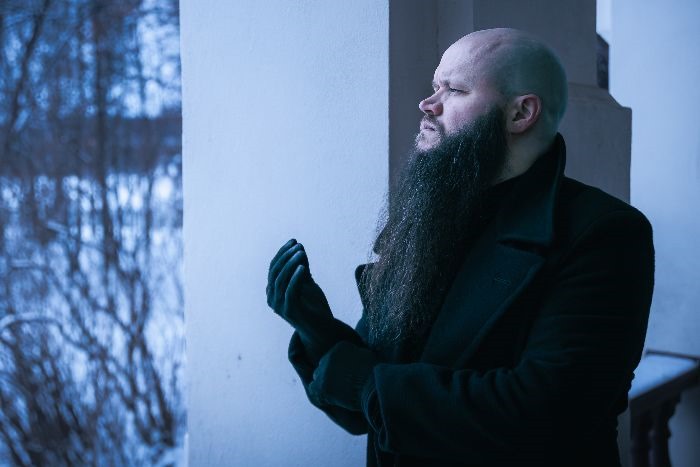
Finnish band, THE FAIR ATTEMPTS has just unveiled their latest single – the gothic rock-inspired, ‘Ghost Within’.
‘Ghost Within’ examines the internal monsters: negative self-talk, doubts, pride before collapse, and the subtle ways the human mind feeds on its own fear. The song portrays self-awareness as a mirror maze, where reflection offers no clear exit.
“This is a theme I’ve touched on in other songs because it’s something I struggle with. Ghosts may be coming to get you,” says frontman Timo Haakana, “but there’s one already inside you.”
Written during a year of deep introspection and creative pursuit, ‘Ghost Within’ depicts the emotional core off the forthcoming full-length album, Null Guide. It’s not about defeating your inner ghosts, but learning to live with them.
What do we know about In A House Of Heartbeats? Personally, nothing, and I can’t be alone in that, so will draw on the band’s bio to provide some necessary insight by way of an introduction: ‘Emerging from the shadows of Essex’s underground scene, instrumental trio In A House Of Heartbeats have been quietly sculpting soundtracks for euphoric nightmares since 2022. Their music, steeped in atmosphere and cinematic tension, walks the line between dream and dread, an ever-shifting blend of post-rock, doom, goth, and shoegaze, filtered through inspirations that reach far beyond the musical world.
‘From arthouse cinema and silent film to folklore, myth, and the murky corners of the subconscious, the band construct deeply absorbing sonic “journeys” rather than conventional songs. It’s a style that encourages deep listening: passages unfold with deliberate patience, building from whispered ambience to tectonic weight, always leading the listener somewhere unexpected.’
They pack pretty much every musical aspect of their broad range into the album’s first track, the behemoth that is ‘In a Perpetual State of Wonder’. A hiss yields to a drone before a colossal riff and soaring lead guitar crash in on a surge of powerfully atmospheric post-metal portent… and that’s just the first minute and a half. Spindly gothy guitars weave spidery webs over rolling tribal beats before the next round of the riff. Towards the end, the pace picks up, and drags the listener headlong into a thrumming tremolo-driven blast that’s like a black metal My Bloody Valentine. I went for a seven-mile walk this morning, and it took me just over two hours but it was nowhere near as mentally and physically intense or exhausting as this eleven-minute blizzard of guitars.
Next up, ‘Cambion’, which first surfaced back in December 2024, is altogether more sedate, at least initially, with a chiming, almost folk-infused prog-flavoured intro creating a calmness before the inevitable storm which pounds in with a sustained post-rock crescendo before things get heavier… and heavier. The level of detail, the attention to texture and the frequent twists and turns make this feel like an entire album compressed into a single – albeit lengthy – track. Along the way, chunky bass rips and guitars chime and soar, and I find myself thinking I must be into the next track, but no.
The sample-laden post-rock drift of ‘Parasomniac’ (that would be someone who suffers from the effects of ‘a category of sleep disorders that involve abnormal movements, behaviours, emotions, perceptions, and dreams that occur while falling asleep, sleeping, between sleep stages, or during arousal from sleep’ (according to Wikipedia)) is reminiscent of Maybeshewill, and provides a welcome interlude between the epics before ‘Oneiromancy for Beginners’ lands with the gutsy punch of Andsoiwatchyoufromafar – surely one of the most remarkable and potent riff-driven acts to have emerged from the early noughties post-rock scene. This is a band bursting with ideas and bursting with energy.
The final two pieces, in combination, form a whole, as the Shakespeare-referencing titles suggest: ‘Drift into Sleep…’ bleeds into ‘…Perchance to Dream’, with its title casting a reference to Hamlet, to forge a twelve-minute opus that begins with a ticking clock and a sample from a guided meditation recording which is almost a carbon copy of a recording used for Cognitive Behavioural Therapy (CBT). It’s likely uncomfortable for anyone who’s been through it, and I find myself squirming through the juxtaposition of soothing, flat vocals and churning noise, but suspect that’s part of the objective here. It’s disorientating and challenging, the second part conjuring atmospheric distortion and endless space with ambient tones and bold sonic washes, before slowly strolling towards an immaculate conclusion, defined by a smooth, swirling climax.
Divination of Dreams certainly delivers on the promise of ‘an ever-shifting blend of post-rock, doom, goth, and shoegaze, filtered through inspirations that reach far beyond the musical world’, and it would be impossible to deny that the end result more than achieves the ambition. Everything about Divination of Dreams is immense, from its ambition to its overwhelming listening experience. It simply covers so much ground – and does so with a rare confidence and finesse. It’s a rare beast, and a spectacular work.
As we approach winter and the solstice draws closer, Texas-based electronic composer Paris Music Corp. a.k.a. John Andrew Paris presents two new tracks – ‘Midnight Pad’ and ‘Sun Halos’ – that juxtapose light with dark, similar to how night turns to day and to night once again.
Nature and cycles are themes explored on his new Ecotone album as he takes us on an electronic odyssey that is both deeply personal and geographically-inspired. This record is rooted in the artist’s relocation to his childhood home in Brownsville, South Texas, just miles from the border and the coast. Paris wrote, recorded, mixed and mastered this at Tarantula Studios over the past two years.
“’Midnight Pad’ was another late-night writing excursion using some mind expansion influence. Another piece that started with my phone and ended up with hardware synths and drum machines in the studio one it was built. And ‘Sun Halos’? Creating a song just happens sometimes. Brian Eno always talked about his main theory in that “music just happens”. It’s really like a magic trick sometimes when what you turn out is an earworm of a piece that is memorable,” says John Andrew Paris.
Originally from Austin, John Andrew Paris has spent decades creating music and collaborating with artists, including Arthur Brown (The Crazy World of Arthur Brown, perhaps best known for his hit single ‘Fire’), as well as DJ Rev Kathy Russell, DJ Lucas Ray, Catastrophe Ballet, Le Reve, Life’s Eyes, Beast of Eden, OBOYO and Don Wigwam.
AA
AA
“The Ecotone album made sense to me because you have a transitional zone, where two different ecological communities or ecosystems meet and intermingle, often resulting in high biodiversity. I feel a lot closer to nature.. Some of my song titles reflect where I am. I actually lived in this area as a child and have come back to my roots,” says John Andrew Paris.
“A lot of these pieces were started on a phone app called Ableton Note. With this application you are able to scratch-pad a lot of cool ideas and then import them into you music workstation and finish them out. When I first moved to my new place I didn’t have a spacious studio setup and I wrote a lot just sitting up all hours of the night writing ideas on Ableton Note.”
Known for his cinematic and ethereal music, on this album, Paris Music Corp.’s music also shows its dark underbelly and futuristic imagination. Often with elements of 80’s darkwave and ambient soundscapes, his trademark sound includes heavily processed guitar and bass instruments locked into layered loops and further manipulated using software. Also employing live hand percussion, these dense soundscapes take the listener on a sonic journey to otherworldly places.
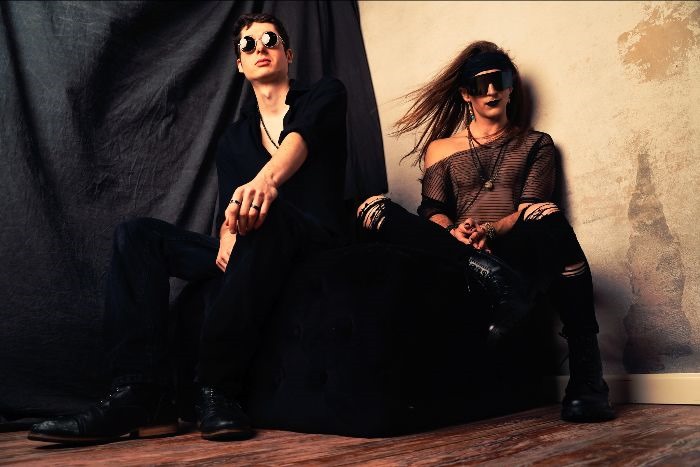
Seattle turbowave duo, DUAL ANALOG return with ‘Pale Visage,’ a new single and video that signals the dawn of their next era. With the video directed by Skye Wardenm, the clip and song explore transformation and self-recognition through a stark yet ultimately empowering lens.
“It wasn’t really a self-correction so much as it was a survival tactic,” says Chip Roberts of DUAL ANALOG. “We wanted the liberty to explore the expansive soundscapes that make us who we are.”
Reintroducing the world percussion, cinematic guitars, and progressive flourishes that defined DUAL ANALOG’s early sound, "Pale Visage" bridges bleak beauty with renewed color – both visually and sonically. It marks yet another glimpse of the band’s forthcoming 2026 album, Primal Grill, and is a bold declaration that all are welcome in the Temple of DUAL ANALOG.
AA
From the rain-soaked streets of Seattle’s Chinatown, DUAL ANALOG channels desire and distortion into a singular force—turbowave—a fusion of new wave, metal, industrial, and world rhythms. Formed in 2019 by vocalist-guitarist Chip Roberts and multi-instrumentalist Kurtis Skinner, the duo blends sleek futurism with raw emotion, crafting immersive performances where sound and atmosphere collide. Each ritual is a sensory experience—sweat, light, and pulse converging in devotion to rhythm and release. Their 2022 debut, Lust, Worship, and Desire unveiled a lush yet crushing sound—sexy, anthemic, and unapologetically heavy. 2024’s The Wheel descended into colder textures and brooding tones, anchored by extended-range guitars and nihilistic lyricism. Now shaping their third album, Primal Grill, DUAL ANALOG expands the boundaries of turbowave through a series of singles—’Kontrol’, ‘Sacred Sin’, ‘Save Me’, and the latest one, ‘Pale Visage’—each revealing a new facet of the band’s evolution between the sacred and the primal.
Bite the Boxer is unquestionably an unusual and intriguing name for a musical project: my mind immediately leaps to the infamous ‘bite fight’ between Mike Tyson and Evander Holyfield in 1997, where Tyson lost through disqualification after biting off a chunk of Holyfield’s ear in one of sport’s most shocking moments.
In combining an eclectic range of elements spanning industrial, alt-pop, trip-hop, and ambient lo-fi, there’s nothing about Matt Park’s music which indicates any connection to this moment in sporting history. The same is true of his objective to create music imbued with ‘he feeling of impending doom but with just a glimmer of hope’, which is inspired by ‘horror video games and dystopian, post-apocalyptic films’.
‘Venom Test’ is haunting – at first ambient, before bursting with an expansive, cinematic feel, then plunging into darker territory. Even without the aid of a beautifully-shot and remarkably stylish video, the rack leads the listener through an evocative sequence of sonic transitions. Although never harsh, the distant drums are weighty, powerful, and the overall experience feels like a juxtaposition of must and decay with rays of shining hope breaking through cloud. The listener feels as if they’re being pulled in opposite directions, the suspenseful end offering no conclusion, but instead, leaving a sense of emotional quandary, an uncertainty. ‘Venom Test’ creates a tension, and provides no closure or conclusion, only a sense of a door being left ajar. It’s a deftly woven piece, and one which feels very much like it belongs to a much larger project – which it does, being a taster (which doesn’t remotely have the flavour of bloodied ear, to the best of my knowledge) for the forthcoming album, Haunted Remains Pt.2. As a choice of single, it’s a good one, leaving us in suspense to hear it in the context it was intended.
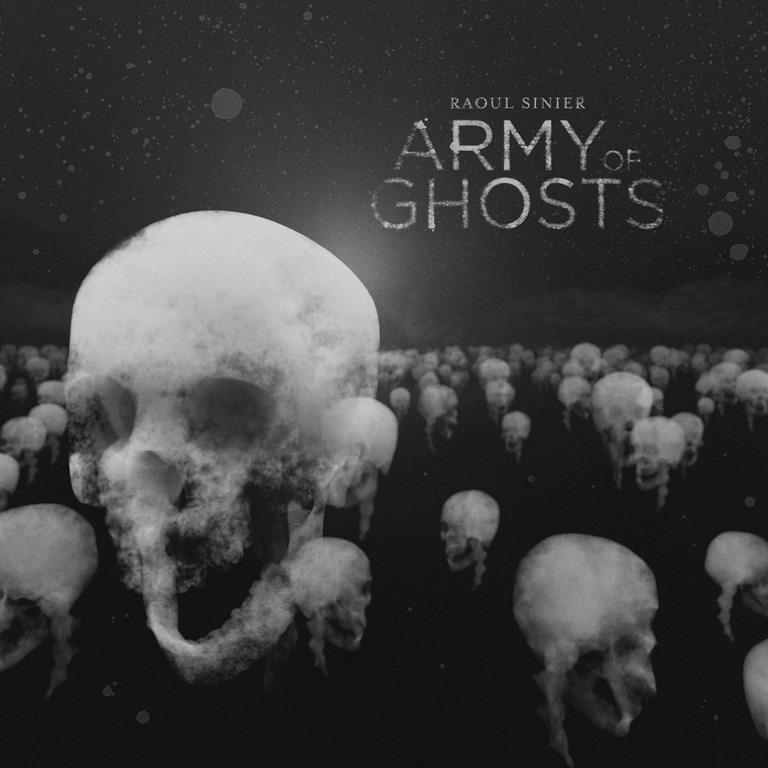
Raoul Sinier first caught my attention with the release of Guilty Cloaks, although he had already built a substantial catalogue of strange and surreal works in the preceding years, notably Brain Kitchen (2008) and Tremens Industry (2009). After Welcome to My Orphanage (2013) and Late Statues (2015), I rather lost track – something which is clearly to my detriment – and then he fell silent following Death, Love and Despair in 2018. Perhaps that title was a revelation beyond any of the contents or accompanying notes. It’s not anyone’s business, regardless.
What matters is that the arrival of Army of Ghosts is a welcome one, and one which is heralded in the accompanying press release with the fanfare that ‘Raoul Sinier is back — more hybrid and unpredictable than ever’. We go on to learn that ‘His new album is a bold fusion of everything that made electronic music iconic, layered with sample work straight out of hip-hop’s golden age. Add in overdriven guitars, throbbing bass, flashes of rock, prog, and funk, and you’ve got a sonic landscape that’s as explosive as it is unique. Floating above it all is Sinier’s signature ethereal voice, a haunting counterpoint to the beautiful chaos below.
Melancholic yet sharp, lyrical yet raw, his music walks the line between introspection and confrontation.’
The appeal of Sinier’s work is its inventiveness – although with Guilty Cloaks, I will admit that I was drawn by a certain post-punk vibe, too – and Army of Ghosts is certainly inventive.
The album’s first song, ‘Phony Tales’ switches between Phantom of the Opera theatrical verses and brutal industrial choruses worthy of Trent Reznor. It’s not just the surge of sound, but the crashing, metallic bin-lid snare that dominates the mix and completely spins your head. It may only last two minutes and ten seconds, but it’s intense.
Much of Army of Ghosts is intense, but in different ways. The drums are uncommonly dominant, and Sinier’s vocals often invite parallels with A-Ha’s Morten Harket, but crucially, said vocals are wrapped in a broad range of forms. ‘Brace Yourself’ offers a lethal cocktail of this, and that, and the other, led by some trip-hop drumming and proggy guitar work, before tapering out with a dark, sonorous bass. It’s that same insistent, baggy beat and Bauhaus-meets-metal explosion which shapes ‘Disperse’, a word which has enhanced implications and resonance of late.
In its eclecticism, Army of Ghosts comes up trumps. ‘Walking Through Walls’ offers springy post-punk energy in the vein of Bauhaus at their best, while the title track straddles post-punk and Nu-Metal, and then post-rock, with sludgy bursts of low-end distortion and…piano. Unexpectedly, it calls to mind the stylistic swathe of Bowie’s 1: Outside, an album which knows no borders.
Sinier knows how to spring surprises, and the wild intro to ‘Spectral Ocean’ is indeed wild, a furious flurry of violin, layered and awash in echo abruptly giving way to a low-slung thunderous bass groove that’s got goth stamped all over it and would have been perfectly at home on the new Rosetta Stone album – and that’s before we get to the brittle, picked guitar and sturdy mechanical drumming that pumps away relentlessly. After the widescreen expanse of the moody ‘Distant Wildlife’, which builds to a dark, slow-burning climax, driven by a dense, throbbing bass, the final track, ‘Neon Sign’ pairs things back and goes all out on the haunting atmosphere, with serrated guitars cutting through drifting synths and a contemplative vocal performance – before suddenly closing with a blast of drone metal straight off Earth 2.
The thing about Army of Ghosts is that it is both detailed and direct, sometimes simultaneously, but it is never predictable. The song titles do not offer a clear overarching theme, but the ghostly and paranormal hover in every shadowy corner of this theatrical and imaginative set of songs – a set that’s wildly varied, but consistent in its quality. Raoul Sinier is most definitely back, and this is very much a good thing.
The Hangnails have certainly evolved. Recent releases have been a very far cry from the raw garage blasts of their early works, starting out almost fifteen years as a full-throttle garage duo.
There was something of a fallow spell after the release of DOG in 2017, after which Martyn Fillingham and Steven Reid made an understated return, the dropping of the ‘…and the’ signifying their shift towards different territories.
‘Come On Outside’ may be their most different yet. Stripped back, mellow, atmospheric, and synthy, it boasts epic, cinematic qualities – and they still make sound that you’d think impossible for a two-piece.
The visuals for the video are pretty striking, too.
‘Darkest Day’ is the opening track from Rhys Marsh & Mandala’s new album, Until The End Of Time — a dark, expansive and cinematic journey that explores themes of loss and love, along with the notion that when you lose someone you love, you still love them until the end of time.
With songs ranging from ten to eighteen minutes in length, the album’s soundscape is largely dominated by majestic analogue synthesisers and led by Mandala’s trademark dynamics — ranging from whisper-quiet to wall-of-sound. Until The End Of Time will be available on all streaming and download platforms, alongside a strictly limited-edition CD, available exclusively from Burning Shed, on November 14.
Rhys Marsh has released eleven albums in the past — both solo, and as the singer-songwriter in bands — and this is the third Mandala album. It was decided to call this a Rhys Marsh & Mandala album, as thematically and stylistically it follows on from Marsh’s previous solo album, Towards The West, which was a direct refection on the loss of his Dad.
Formed in London in 1997, Mandala have toured the UK, Scandinavia and North America over the years, playing at iconic venues such as CBGB’s in NYC and The Marquee Club in London. Their blend of folk-noir, progressive rock, psychedelia — all wrapped in Marsh’s atmospheric and dynamic melodies — has garnered acclaim and airplay across multiple countries, with singles A-listed on Radio Caroline, and chart success on iTunes in the UK and Canada.
Critics have called Mandala’s sound “a kaleidoscope of prog, psychedelia, and folk”, and praised their “knife-edge atmospheres and Eastern-tinged melodies” (The Independent), with The Guardian describing their music as “folk-noir”, and Time Out highlighting their “melancholy laden melodies”.
Until The End Of Time is the kind of album that needs to be listened to from start to end. The songs are long, and the themes expand and unfold gradually. There are elements of post-rock with the long build-ups, progressive rock with the sweeping Mellotrons, and a deep sense of melancholy.
The album features spoken word in three languages: English, Norwegian and Welsh. Marsh says that this verse can sum up the overall feeling of the album:
Dark-electro artist, MARIE ANN HEDONIA has unveiled her new cinematic video, ‘Eve Had the Metallic Shine of Summer’.
The video concept was inspired by Ingmar Bergman’s film, Persona. Eve, our mannequin represents a toxic relationship. Eve is a person we pour our whole self into, a person who takes all of our energy, time, money, soul, and gives nothing back.
MARIE ANN HEDONIA’s collaborator, BLACK KITE, states, “This song is about the potency and allure of destructive, codependent relationships and how they require us to self-abandon. It speaks to both addiction and toxic relationships that masquerade as love or comfort, but are actually antithetical to both.” The ending is completely dependent on the viewer’s point of view: Do I go mad? Am I the bad guy? Am I free now?
The video was shot over a period of 13 to14 hours during one day of “guerrilla” style film making, all over Baltimore city and county. Director Alex Shaak was pivotal in creating the striking visuals seen throughout the video, bringing the concept to life. The weather was completely coincidental. The energy of the thunderstorm very much translates the powerful ending of the video.
I’ve been digging GSXT for a whole decade now and shouting about it whenever the opportunity arises. I’m not sure how many people have been paying attention, but anyone who hasn’t has been missing out. They took their timing building up to their debut album, released in 2022, with half a dozen EPs preceding it. ‘Cosmic’ is the first material since Admire, three years ago, and this new single continues their trajectory of extending their repertoire, taking the form of a slow-building expansive brooder.
A cinematic piece of post-punk desert rock, and with hints of recent releases by Earth ‘Cosmic’ tones down the snarling overdrive that’s the duo’s signature sound in favour of something more hypnotic, in the vein of ‘Sonores’. It suits them well, as it happens: Shelly X’s voice drifts and aches through the bass-led verses, floating in a growing swirl of guitars in the chorus before a straight-up rock guitar solo swoops in.
To describe ‘Cosmic’ as commercial would be rather misleading, because it’s certainly no sell-out. But it does mark a significant step. What’s more, it’s absolutely huge, and immediately accessible, making it the cut which has the broadest appeal yet. Maybe now they’ll listen up, eh?