Posts Tagged ‘Avant-garde’

Room40 – 30th June 2023

Christopher Nosnibor

There is no quick way to consider this album. And for many reasons – the first being that it needs to be heard in its entirety before being able to summarise and pass critical comment. The second being that after hearing it, one needs to drag themselves from the wreckage of their psyche and process an experience that is likely akin to a week being subjected to psychological experiments at the hands of the CIA under MK Ultra. Brace yourself…

As his bio points out, ‘Tony Buck is no stranger to the realm of durational performance and composition. As a part of Australian unit The Necks he has been central to defining a reductive, but rich sound language that equally interrogates timbre and time…[and] with Environmental Studies he moves even further into these longitudinal pursuits.’

Longitudinal is one word to describe this album. It’s a single, continuous piece, some two hours in duration, and while there are a couple of five-minute excerpts designed to give potential listeners an indication of what it’s like, it’s simply impossible to convey the experience in snippets. The snippets are lifted from the album’s lighter moments: that doesn’t mean they’re mellow, melodic, but the multi-layered clattering percussion that’s evocative of some kind of space-jungle and brief segment of avant-jazz feedback is nothing in the wider context. And – as I always say – context counts.

While chart music – geared toward snappy three-minute cuts which are 90% chorus – and the inclusion of streams when compiling charts, has effectively killed the album in the mainstream, further afield (and to be fair, you can’t get much further afield than this), the album is still very much a cherished format for both artists and listeners alike. In fact, it’s interesting to observe the rise of the really long album. I will often harp on about Swans releases from the last decade, but they’re not isolated. Frank Rothkkaramm released an album as a 24-hour CD box set – which couldn’t be much more different from Throbbing Gristle’s 24 hours box – as he explored sounds which helped with his tinnitus. Numerous doom, drone, and ambient albums in recent years have really pushed the parameters of an album thanks to digital releases not being subject to the same limitations of physical formats – or the same production costs. Is the medium the message? Perhaps, at least to an extent.

The recorded medium was always an issue: even going back to the height of the classical era, once recording became possible, the media limited what could be released, meaning to hear a full performance of, say, Handel’s Messiah, you had to be there, since even a recording which required a box-set album release required truncation. It also, of course, required the turning of records and the segmentation of the work.

In its day, Earth’s groundbreaking Earth 2 challenged the conventional notion the ‘the album’ – more even than any monster prog releases like Yes’ eighty-one minute Tales from Topographic Oceans and the two-hour plus, sprawling triple YesSongs. Because what differentiates these is the fact that Yes was a lot of noodling wank, while Earth did something different, with a specific desired effect intended, and its duration was in fact integral to its cumulative effect, namely that of a sonic blanket of suffocation. Anyway: the point is that Environmental Studies is an absolutely immense album, and it’s a work that needs to be heard as an album. You may find yourself drifting in and out, but it feels as if this is part of the experience: better to drift than experience in fragments.

The accompanying notes describe Environmental Studies as ‘An incredibly dense matrix of interwoven voices and layers, each occupying and exploiting a unique space within the fabric of the sound-environment, co-existing to slowly reveal themselves in multiple interconnected relationships.’

Immediately from the start, the listener is assailed by a deluge of discord and dissonance and streams of noise. It gradually drifts through an ever-evolving, eternally-shifting journey, where mellow jazz piano and slow-melting notes emerge and drip slowly over cascading cymbals and an infinite array of extraneous sounds which wash in and out. There are passages of supple, strummed acoustic guitar – which get harder and more challenging at times but also explore mellow passages –– and gurgling extraneous nose, straining, clattering. There are sections which so tense, straining and submerged by noise that as feedback twists and turns and groans and hums, that the enormity of Environmental Studies finally hits.

There are infinite layers of percussion rattling shakes and clangerous curiousness, with errant twangs and all kinds of shades of strange, with dingy distortion crashing in heavy amidst the a maelstrom of noise that sounds like a hundred pianos being thrown down a hundred flights of stairs at the same time while someone in the top floor flat blasts a Sunn O))) album at wall-cracking volume and there’s a fire broken out in the basement and it’s rapidly escalating upwards.

An hour in, we’re in sonic purgatory – and it’s absolutely magnificent. The polytonal percussion builds and builds; industrial, tribal, everything all at once, with sonorous drones and crushing distortion and noise and wailing feedback whistling and screaming all the while, it’s a relentless barrage of sound – but not noise, and that’s an important distinction here. There are noises, and they’re collaged into something immense, with the rattling of cages and furious beating of skins.

When it does simmer down, some time further in, we find ourselves in an alien landscape, that’s strangely spacey and tense before the next round of percussion barrels in. Environmental Studies is big on beats, but not all of the beats are big: insectoid skittering and scratchy flickers are as integral to the complex interweaving as the thunderous floor toms and reverberating timpanis, and everything melts together to weave a thick sonic tapestry.

While there is nothing about Environmental Studies which is overtly heavy in the conventional sense, to immerse yourself in the album is an exhausting experience, both physically and mentally. But if art doesn’t challenge, what is it for? It’s merely entertainment. This is not entertainment. But it is an incredible work of art.

AA

a1038790420_10

Christopher Nosnibor

‘I’m sorry, I’ve been busy’. We’ve probably all heard it: and most of us have probably spoken the phrase. I’m guilty, too, and hate myself for it. Everyone is fucking busy. Too busy to text, to open a message even, too busy to reply to emails, catch up with friends, too busy to fucking live. What is everyone so busy doing, and why is it that in a time when technology was supposed to make our lives easier, and in supposedly affluent western cultures, people are both fiscally porr and time-poor?

Naturally, I blame the current strain of capitalism: keep everyone too busy to live, to breathe, and too skint, and they’re not going to be protesting, they’re going to be too busy wondering where the next meal is coming from to fuck shit up. After everything, they’ve only got the juice to be ‘busy’ bingeing Netflix or the new season of The Mandalorian.

Admittedly, I have been genuinely busy parenting, publishing stuff, and writing a review a day while battling through an evermore overwhelming volume of submissions, but is that really a reason, or just an excuse? Right now, I’m not sorry either way. I keep myself to myself and I write when I can when I’m not doing laundry or cleaning or paying bills or feeding the cat

Gintas K is always busy, and he’s been having albums released at a ratee beyond that at which I can even download them, let alone listen and digest. And so it is that March and April have seen the release of three – yes, three – albums by the prodigious Lithuanian.

I must have been absolutely nuts to have set myself the task of reviewing all three together. The idea was to soak it all in with an evening of electronica, and report on what I expected to be an immersive experience. But knowing Gintas K’s work over the years, this was, in hindsight, an unlikely outcome. The headline here is that there is no overarching theme, there’ s no evolutionary trajectory, and nothing to really take hold of. But that in itself is K’s selling point: his work is exploratory, varied, sometimes playful, and often difficult.

Resonances, the first of these, ‘was recorded live, using computer, midi keyboard & controller on Autumn 2021’ and has been released by Sloow Tapes in an edition of 70 copies. It spins slow-swirling vortices around hovering hums and low-humming drones over the course of its ten, comparatively short (only a couple extend beyond four minutes), ponderous tracks. It’s perhaps one of his more varied works, both sonically and atmospherically – and Resonances really does explore atmospheres and cavernous swampy echoes.

Resonances

a1449704449_10

Fluxus +/- is a split collaborative release, which finds him working with Kommissar Hjuler Und Frau on a longform track, while a piece by Wolfgang Kindermann & PAAK occupies the other, and what we get here is just shy of eighteen minutes of really weird shit, bubbling swampy noise and loose collage layering of all sorts of snippets and a mish-mash of all kinds of everything that’s not easy to digest.

And then April saw the arrival of Sound & Spaces #2, which is perhaps more Gintas K’s standard fare of bubbling, foamy froth and stuttering, stammering glitch-heavy sonic mayhem. It stutters and scuffs, bleeps and wibbles, and at times sounds like the speakers are shredding, the cones torn and flapping in the blasts of random noise bursts, while at others… well, at times it’s a foaming froth and as others, it’s really not very much at all. The pieces run into one another to create a continuous stream of crackling distortion and bibbling trickles of tweeting and twittering, and while the effect is the most incomprehensible and difficult to digest, it’s by far the most quintessentially K. If it’s what I’d expected, then what this trio of releases demonstrates is that Gintas K continues to defy expectations and to produce work that’s different and diverse.

Sound & Spaces #2

a1377760751_10

Everest Records

Christopher Nosnibor

Guess it pays to learn to trust your sources: if I’d seen pics of these guys or simply seen mention of this release in passing, passing is precisely what I’d have done, without a second thought. It would have vert much been my loss.

A skim over the press release cause me to take pause as I read that ‘Two Dogs are Beat Keller on guitars and Joke Lanz on turntables and voice, both based in Berlin. An uncompromising union of two musical individualists who are shaking up the noise world.’

Shaking up the noise world, are they? In that case, I’m all ears to hear what these two Swiss musicians who ‘oscillate between perfect dissonance and intelligent harmony’, and who, ‘with their stripped-down instruments, Lanz and Keller create a unique language somewhere between pavement poetry and free improvisation.’ The pair both have impressive resumes, which even mention artists I’ve heard of.

‘Mom’s Birthday’ is the first track and lead single from their debut album, Songs from the Trash Can. It’s a short (sub-two-minute) glitched-out collage of whacky shit which finds Lanz half-speaking, but almost shouting, about the events which befell him on waking, namely his inability to find his toothbrush or toothpaste. But, here’s the real wince moment: he got drunk and forgot his mum’s birthday. Ah, shit. So he sings an off-key rendition of ‘Happy Birthday’ by way of a belated apology. As you do when you’re probably still drunk from the night before.

‘Mom’s Birthday’ is discordant and chaotic and sits very much at the experimental end of noise: it’s also very much of the lineage from early 80s tape-looping noisemaking – think Foetus’ Deaf!.

It’s a fitting companion to ‘In the Pub’, the quirky track that’s available to stream as a taster for the album, which, with tongues firmly in cheeks, pokes droll fun at English pub culture with an astuteness of observation that should shame most natives, and in just two minutes, they capture the reasons why I avoid town pubs and miss Europe, and why these guys are great.

AA

Two Dogs (uncredited photo)

Christopher Nosnibor

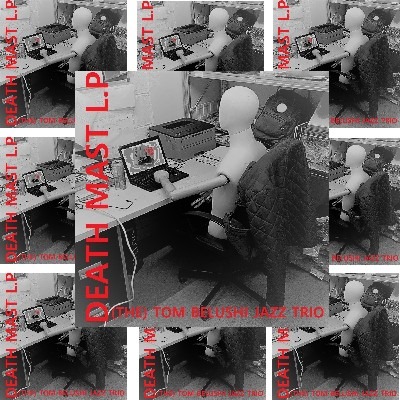
I get a lot of weird shit come my way. I guess it’s to be expected: I review a fair amount of weird shit and it just snowballs: weird shit finds me. And this is very much weird shit. Despite some serious deliberation, I can’t decide where the emphasis lies in that statement.

Details about the artist or the release are practically non-existent, but it doesn’t take too much digging to establish that the Tom Belushi Jazz Trio aren’t a trio and they don’t play jazz.

Having released an EP (also entitled Death Mast) and deleted it almost instantaneously, Tom Belushi Jazz Trio seem determined to render themselves as evasive frustratingly obscure as is conceivably possible. But this is clearly not simply a musical project, so much as an exercise in postmodernism that revels in ephemerality. With CD copies of this release being limited to single figures, I’m reminded of various crackers projects by Bill Drummond and The KLF, among others, whereby the objective seems to be to create an objet d’art that’s so scarce it’s beyond reach even before it’s released, essentially only existing in legend.

Slapping synths, gloopy stuttering beats, warping irregularities and groaning keys redefine the sound, along with snippets of robotic, autotuned vocals. Oriental motifs are dominant in this instrumental album’s ten exploratory tracks, which appear to be largely AI in origin. Because yes, it’s taking over the world. Think you can hide or linger on the peripheries now? You’re simply deluding yourself.

There are some nice sounds – and some naff ones – all balled together in an eclectic hotchpotch of ersatz electronic collaging. ‘Traitor’s Gate’ is a droning shanty that’s actually got human vocals; it’s woozy, disorientating in an uncanny sort of a way.

The titles are daft, absurdist, Dadaist or abstract, and littered with references, many of which are obscure – ‘Luke Haines. I Have Your Hat’; ‘No Mark Wynn’;(a particularly cheesy and overly synthetic slice of r ‘n’ b); ‘Stairwell Crooks Shutterstock Dust Jacket’ but ultimately seem to present as little true meaning as the music itself (and I can’t ever recall having experienced any dilemmas over purchasing avocados).

Death Mast is one of those albums that was probably more fun to produce thana it is to listen to. It does have considerable novelty value, and it does have lots of ideas, but few seem to be explored in any real depth or fully realised, and as such, the main idea seems to be the concept for the creative process – or should that be ‘creative’ process?- rather than the end product. But with the ideas and even the passages within the tracks being as fleeting and as ephemeral and impossible to locate as copies of the album itself, what are we really left with? Ultimately, Death Mast presents more questions than answers, a point of discussion more than a musical project. But, if there is one conclusion we can draw from this it’s that there is no need to worry that AI will bring about the end of music as we know it. At least, not this week. Welcome to the post-postmodern age.

AA

54d90880-c561-48af-aa9e-fda70c47391e_thumb_400

Plant-based metal avant-gardists BOTANIST have seeded the new track ‘Epidendrum Nocturnum’, which is named after a ‘nocturnal’ species of the orchid family (common to South Florida but also growing in the Caribbean and all the way down to Brasil), as the second single taken from their forthcoming album VIII: Selenotrope. The album is planted for blooming on May 19, 2023.

Listen here:

BOTANIST comment: “For VIII: Selenotrope, I wanted to limit myself to only dulcimers, drums, bass and voice”, mastermind Otrebor explains. “For the voice, I decided to have an album without any screams or harsh vocals whatsoever, and instead to rely on the whispers that speak to the listener as messages in a dreamlike state. As the album progresses, melodic choirs are increasingly introduced. These choirs, which have progressed in form and presence since I started Botanist, see their biggest role ever on VIII: Selenotrope. The song ‘Epidendrum Nocturnum’ is one of the album’s darker pieces. Its churning main section gives way to a cathartic landscape in which whispered elements underpin melodic choral paeans to flora that bloom in moonlight.”

tOnTnPbM

Botanist by Tony Thomas

Following the announcement of their forthcoming album Dødheimsgard return with their exceptional first single ‘Abyss Perihelion Transit’. The ten minutes plus track weaves a sombre tapestry incorporating elements of multiple sub genres in the world of Extreme Metal and thematically tackles ideas of epistemological dualism.

Regarding the single Vicotnik had the following to say:

“The whole album revolves subjectively around perception, experience, psychology, objective/subjective reality vs external pressure, tropes, taboos, the laws of motion/causality which influences one’s life. The subjective perception of reality vs the objective causal effects of reality and how they are bound interact. Epistemological dualism.”

Vicotnik continues:

“I guess mental health, or rather instead of health, let’s call it mental condition is a big topic on this record. Not as in a complaining way, or as a good or bad notion, but rather a subject’s study of his own psychology (en)during everything.

Like the ambiguity of Being. What is Being? Is it a meta-physical stratum of subjective emotionally fuelled notions or is Being just explaining a physical object that is, therefore being. Epistemologically I guess these lyrics dwell a lot on naïve realism vs representational realism. Cognitivism vs behaviourism, and then bringing it all to an artist context obviously. So, it is experiential renditioning, not solution driven.”

Accompanying the single is a video and single cover art from visionary artist Costin Chiorenau who brings the disparate and incredibly solemn existence of ‘Black Medium Current’s first single to life. Working together both the song and the video evolve over the course of the ten-minute run time to create something truly visionary both in a sonic and visual context. Costin elaborates on the video below:

“I’ve been following Dødheimsgard for 20 years now, and the genius of Vicotnik always captured my highest focus, being at the same time a huge inspiration, both musically and aesthetically. I always perceived Dødheimsgard being more as an artistic movement than a black metal band, another aspect which excites my creativity and I feel fulfilled that I could express all this passion through the ‘Abyss Perihelion Transit’ art video and single cover.”

He continues: “When I first heard it, I felt that void left behind by the desperation of the root-sense of old structures of perception. That void, which shakes the black matter foundation every time when manifestations tuned with and born in the past overleap the fresh sight of the present which fights hard to penetrate the dense walls of repetition. The main characters of this movie are the absence created by the vanishing old, the observer in search of a new fitting cloth of identity for its avatar and the desperate need of giving shape to the yet-not assimilated nor understood living new.

Secondary characters are different types of glitches in the matrix between self-imposed reality and the golden mean dream state, measuring systems for various types of space found between the layers of perception and the omnipresent shadow. These characters are interfering one with another in a multiverse of contrasts between defined and undefined, forming a brick-dust flavoured whole, at times exotic, at times smoked in bitter nihil. These characters are also the topics spoken but the energy of this song, by the voice of now and I consider the proper ones to be dissected through art.”

Watch the video here:

AA

thumbnail_2021-09-12 DØDSHEIMGAARD0819

Karlrecords – 10th March 2023

Christopher Nosnibor

When I started out reviewing, I always thought how cool it would be to get to hear new releases by acts I like in advance, and to opine on the latest releases by acts familiar to many. But I’ve come to realise that the real joy – and what I now see as my purpose – is to discover and share new and lesser-known artists. It is a gift which keeps on giving, for I hear so many people in my demographic moan about the lack of any decent new music. It’s simply not true: they’re just not looking in the right places (and their idea of ‘decent’ music tends to be rooted in their youth and coloured with nostalgia, which is sad really. Opening one’s ears and opening one’s mind is the key to keeping young. Or something). Of course, it’s always subjective, but there is a rare exhilaration and delight in – after all this time – hearing something that doesn’t sound like anything else.

And so here we have the debut EP from Sara Persico, which prefaces a full album in the pipeline. It doesn’t remind me of anything – but it does give me a rush, but also chills me to the bone.

It’s dark and it’s stark, and it’s challenging.

According to her bio, she was ‘born and raised in Naples, Berlin-based sound artist/vocalist Sara Persico cut her teeth experimenting on the fringes of Naples’ fiery underground experimental/noise scene, developing a technique that would integrate her voice with analogue electronics, field recordings, and samples.’

Fiery would be a fair description of the six tracks on Boundary, released on cassette. It’s big on bass and beats. Big big big. The percussion bashes at the cerebellum and kicks the cerebral cortex, while bass resonates through every fibre of the body. This dense and weighty stuff. It’s the elements of dance music slowed to a glacial crawl. Instead of making you want to move, it absolutely freezes you solid, tense, immobile. And as for Persico’s voice – it’s something else. She sounds tortured, trapped, and transcendental.

Stripping things back to a stammering, glitched drone on ‘Exit’, she switches between ethereal lilt to banshee howl, and the two are overlaid in a sonic collage that’s compelling and terrifying simultaneously. ‘Under the Raw Light’ is tense, aggressive, even, in its ferocious beats and Persico’s voice that sounds as if it’s coming from the other side, frenzied, tortured. In contrast, the closer, Umbilical’ is a disconcerting spoken word work pitched against a thudding heartbeat and muffled bass. It leaves you feeling… what? Detached, in some way.

Despite being built around familiar elements, Boundary doesn’t sound like anything else, and launches Sara Persico as a unique and exciting voice.

AA

KR107_front

PNL Records – 16th December 2022

Christopher Nosnibor

Nice… as you’d probably expect from this three-way collaboration, Time Sound Shape is a work of atmospheric instrumental experimentalism with some strong jazz leanings. That’s not smooth or mellow jazz, of course: more the weirdy, spaced-out non-musical kind of jazz. So not so much nice, as awkward, uncomfortable, challenging. This is not jazz of the cardigan and slippers variety, and you certainly wouldn’t play it at a dinner party, apart from perhaps at thee point when your remaining guests have overstayed their welcome and you want them to fuck off home.

Time Sound Shape is a single continuous piece with a running time of a full-length album, clocking in at precisely forty-nine minutes, and it’s a great example of intuitive improvisational collaborative work, and it sounds far better than the clunky text-based cover art suggests.

There are some dissonant, discordant, even outright difficult to digest crescendos, and moments of queasy chamber orchestral meanderings, as they tweet and toot together in a sort of droning solidarity. It begins gently enough, with some trilling woodwind courtesy of Frode Gjerstad who brings flute, and clarinet to the party as well as sax, but it doesn’t take long before things shift in numerous different directions.

There are moments that almost feel ‘continental’ in vibe, perhaps not least of all on account of Kalle Moberg’s accordion work. And all the while, Paal Nilssen-Love brings texture and atmosphere with his application of a wide selection of Paiste gongs, bringing doomy dolorous chimes and rolling thunder. At times, the crashing gongs are strong enough to vibrate the internal organs within the ribcage.

In many respects, Time Sound Shape delivers precisely what you would expect from these three musicians coming together, and yet at the same time, it brings more. It’s a richly textured work, that evolves as it progresses, and it never stays stull, and yet the changes are often subtle. Time drifts and bends as the sounds transition, changing shape. Let yourself be carried.

AA

PNL052_front

Unsounds Records – 1st November 2022

Christopher Nosnibor

Andy Moor has been nothing if not prolific over the course of his career, which is now well into its fourth decade, and his collaborations are truly multitudinous. He’s one of those musicians who clearly thrives on this approach to working – as comfortable contributing as steering his own path.

I’ve covered a fair few of his efforts over the last decade and a bit, both here and elsewhere – with my belated introduction in 2011 arriving via his appearance on Anne-James Chaton’s ‘Transfer /2: Princess in a Car’ single release.

Moor’s style is by no means accessible or easy, and is as distant from mainstream as is possible, but it’s highly distinctive, and this is unquestionably a significant part of his appeal, both to listeners and fellow musicians.

For this work, the accompanying notes explain how ‘Christine Abdnelnour and Andy Moor have explored the notion of hypnagogia or ‘unprotected sleep’ to drive their process for this improvised album, delving in their own experience and memories. Unprotected sleep is commonly defined as an altered state of consciousness that occurs beyond the proper or intended time of waking up, not sleeping in your own safe bed, or even sleeping without a blanket. Being slightly out of phase, one is vulnerable, fragile, but the mind is at the same time very fluid, ultra-associative with an extraordinary memory. In their music making Abdelnour (saxophone) and Moor (guitar) explore the possibilities of real and hallucination sounds and ranges that might come with deep dreaming.’

I had never known that this was a term before, but that it exists speaks on multiple levels, and on a personal level. Sleep is one of the most vital of human functions, but also the most neglected. I’m writing this at 11:30 at night after starting work at 6:30 this morning; five hours of sleep disturbed by lengthy anxiety dreams and broken by the occasional nocturnal anxiety attack is standard. I’m by no means alone in my difficult and often antagonistic and troubled relationship with sleep.

On Unprotected Sleep, Christine Abdelnour and Andy Moor soundtrack the traumas of troubled sleep magnificently. Moor’s scratchy guitar is both metronomic and agitatingly atonal, forging an aural representation of the head-nodding fatigue that so often sweeps over while challenged by needling thoughts that prick a way to wakefulness, or otherwise nag at the psyche

The heavy, grating drone of ‘80db is Loud if You’re Snoring’ ret with scraping guitars and squawks and scrapes if feedback before surging amongst the clattering of cans and escalating to a peak that will inevitably collapse. It drones and groans, and ultimately fades out.

On ‘Compartment 5’, the drone reaches an oppressive level, and it’s enriched by a blank, drony thrum. The density grows, as does the intensity, and it reminds me of the hours spent turning over and over, unable to find that right position, unable to get comfortable, and unable to that headspace conducive to settle to rest: instead, everything is an awkward, uncomfortable churn, accompanied by an unsettling sense off impending doom. The ‘Exchanging Oversize Chrome Objects’ brings a head-pounding crashing beat and uncomfortable churn that’s deeply unsettling, and there’s an uneasiness that permeates the album as a whole.

For many, the experience, if not necessarily the specific sounds, will resonate. Unprotected Sleep is a far from relaxing or soothing sonic experience, built on drones and dissonance, lurching atonal wandering guitar parts and inconsistent tempos that butt against low-key but uncomfortable saxophone drones and honks. Enjoyable is not the word, but compelling most certainly is.

AA

74U_front

Who are we? Where do we go? These are the kind of existential questions that have arisen for many of us during these last years and that have also been haunting DISILLUSION during the process of creating their fourth full-length Ayam. Without a chance to perform live and their personal lives also being affected by many restrictions the focus of the German avant-gardists shifted fully towards their band and the creation of new songs as well as recording. The effect is audible: Ayam sounds richer, even more multi-layered, and fully matured compared to the already highly praised previous releases. Yet the intricacies of their music are never just a means to an end, but more than anything all the complexity is subjugated to serve the inner feeling and cinematic aspect of each song itself. 

The thematic questions and multi-dimensional layers of the songs are also reflected in the album title Ayam. The word derives from Sanskrit and means "This One". Pronounced in English it sounds like "I am", while reading it backwards turns it into "Maya", which is neither an accident nor explained by the band that obviously likes to offer riddles.

While DISILLUSION stuck closer together, they were also searching their hearts whether it was time to change old habits and try out something new. This led to the excellent decision to leave the mix of the album to different ears than the bands’ for the first time. Their choice could not have been better as renowned producer Jens Bogren (OPETH, KATATONIA, MOONSPELL) once again worked his exciting magic and enhanced their already unique sound by shining a sonic spotlight to the most important aspects such as the vocals.    
Founded around singer and guitarist Andy Schmidt in the East Germany city of Zwickau in 1994, DISILLUSION pulled the rare trick of already becoming a staple in the field of avant-garde melodic death metal with the release of their full-length debut "Back to Times of Splendor" in 2004. The Germans have always been driven to seek new challenges and find new ways to evolve their music, which was exemplified by the following album "Gloria" that took radical musical steps in several directions at the same time. "Gloria" was far ahead of its time in terms of composition and sound, which becomes apparent when compared to GOJIRA’s masterpiece "Magma" for example that came out a decade later.

Despite their early success, DISILLUSION took a creative hiatus until suddenly returning in 2016 with the single "Alea" and a new line-up that had changed in several positions. Quite likely even to the band’s surprise, a large and loyal fan base had formed during the decade of their absence, which showed in sold out shows and a highly successful crowdfunding campaign to realise a new album, which the Germans repeated for Ayam.

19347941-3e6d-828c-f9c2-4dce26e5a3df

When The Liberation was released in 2019, critics described the album as a logical continuation of Back to Times of Splendor. Its songs reflected 15 years of additional experience in the musical development of Andy Schmidt. "The Liberation" turbo-charged all of DISILLUSION’s best qualities: the perfect interplay of massive metal with moments of pure euphoria and quiet introspection that create a sonic rollercoaster ride of passionate emotions.

With Ayam, DISILLUSION again sail among the stars to new stellar constellations of heavy sounds. While staying true to their general course, the German avant-garde pioneers also continue dropping anchor to explore new planets sparkling in space with a multitude of radiant sounds. "Ayam" offers exciting evolution rather than radical revolution, and DISILLUSION’s new musical forms and means are most beautiful and astonishing to behold. This album is a golden ticket to join the extraordinary journey of a life-time. Please feel free to check-in anytime you like!

AA

ea0d6bd8-521a-3bef-b268-2020303450d8