Interview by John Wisniewski
Intro by Christopher Nosnibor
Ordinarily, interviews on Aural Aggravation are run with titles which serve to encapsulate the contents in half a dozen words. This is an interview where that simply isn’t possible.
Since Nocturnal Emissions came into being in the late 70s, emerging from the experimental / industrial scene which evolved after Throbbing Gristle broke ground first tested by William Burroughs and Brion Gysin, they’ve existed in various forms, often as much known by reputation as by their actual work, which is nigh on impossible to pin down or pigeonhole. For most of their career, Nocturnal Emissions has been the solo vehicle of founder Nigel Ayers, who has come be a pivotal figure in the field of underground and experimental music – and beyond, working in a host of media including film and text, with a number of books since the turn of the millennium: The Bodmin Moor Zodiac (2007) is a characteristically quirky example of his wide-ranging interests which include psychogeography and occultism. Then again, any summary would be to omit so much as to misrepresent his divergent eclecticism. And then there are the countless collaborations… John Wisniewski was fortunate to pitch some questions to Nigel about his lengthy career, his influences, and current and future projects…
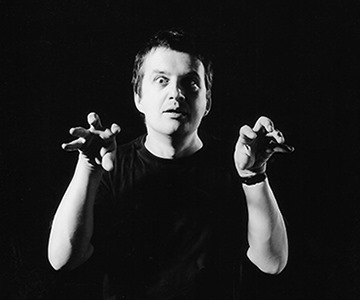
When did you start experimenting with sounds, Nigel?
I must have been aged 13 or so. Actually, I was experimenting with sounds in the form of soundtracks because had happened is my dad had this very old-fashioned format camera, it was called a Standard 8 camera, which was a kind of silent home movie film that preceded Super 8.
So, it was this kind of film that you could run twice through the camera, and it had large sprocket holes like 16mm, that was the difference between Standard 8 and Super 8 film. So, he’d bought this camera and he’d been using it to film his work in schools and as a youth club leader, but this camera was lying around. And when I was 13 or so, I was watching these experimental films on TV, and I’d been watching them in black and white, but there was things like the Magical Mystery Tour by The Beatles and then there’d be segments like “I am the Walrus”. These very early rock videos, were extremely surreal. And then there was a TV programme for kids called Vision On, there was sort of experimental animation on there. And then also there was Monty Python, where there was Terry Gilliam’s cut-out animation going on. There wasn’t the easy access to visual culture you get these days, but I had been exposed to and absorbed this kind of aesthetic and I was just looking at these ways of manipulating film. And I realised this camera, you could do stop-frame animation, you could also run multi-layers of film together.
Now, these techniques of layering and stop-framing and getting into individual segments of imagery are really what I used later when working with sound, because I was aware of how the context and meanings of images and sounds change through overlay, almost randomised factors, which could lead to an exploration of something which was intrinsic to the medium. Or intrinsic to memory, a memory of imagery and how imagery is imagined and restructured within our minds and within our culture. So these ideas, I was exploring film at a very early age, I mean, I’m talking like age 13 to 16. Meanwhile I was having a very conventional school education, really. This was not the sort of thing I could do at school.
I also acquired this reel-to-reel tape recorder, which was like another sort of cast-off that had been bought for some purpose, and it was an old-fashioned technology by then. Of course, it was this very solid mechanical thing with a manual sort of gear, that you could change to make the tape go backwards or forwards or rewind.
I think it had different speeds on it, I used this later on the raw material that went into the first Nocturnal Emissions records.
So yeah, I was exploring these sort of overlays of memory, I suppose. And I wasn’t really able to articulate that in words. Now as an adult, as an elderly adult, I can articulate this in a way I couldn’t do as a teenager.
But then I got onto a foundation course in art school after being thrown out of school, really. Excluded from school, really, it wasn’t an environment I fit in with very well.
So I went to do a foundation course in art and design, and the thing that I really warmed to was, they had this studio set up to do “light and sound”.
And in there they’d got, oh, I don’t know if modern people will understand this technology, but they had slide projectors, which could be synchronised to a reel-to-reel tape. And this reel-to-reel tape was a four-track TEAC tape recorder, routed to four speakers in this darkened room for a quadraphonic surround sound experience.
And they had a Revox in there, which is a two-track tape recorder. That’s something which you can, when you know the technique, do tape echo on. Wonderful machines.
And also I think I had the loan of a cassette recorder, I was recording incidental sound from the TV. I was recording children playing. I was recording dogs barking, and constructing this into sound collage.
We were making handmade slides, it was a sort of technique that was probably used by the Victorians in magic lantern shows. These are very high contrast slides, that I made anyway, and hand-coloured them with overhead projector markers and with coloured acetate. And I sort of made this scenario of, a sort of an alien civilisation, but it was really close-ups of the insides of a vintage and broken radio, with these parts of toys inside it. It was Bela Lugosi as Dracula and Boris Karloff as Frankenstein. These heads from Revel plastic kits that my brother had made years ago and then lost interest in, these parts of plastic toys. And I was constructing this sort of miniature city and then sort of overlaid in that city.
I had made these sort of, these non-functioning machines, but like science fiction devices,
A projection from the wartime era, rather than steampunk. Yes, that’s what it was. From the era of electronics, not the era of steam.
And I made this elaborate sort of titillation machine, which a friend of mine, she posed on it and as if she was pleasuring herself on this very strange sort of dynamo construction with loops of wires and coils and high voltage fuse boxes and transformers. And this was superimposed against these miniature sets.
I suppose it was like probably a DIY version of Fritz Lang’s Metropolis, but with this sort of different surreal sexual-mechanical angle that I gave it. So that was actually a quadraphonic sound installation that I did when I was 16, 17. So I sort of continued experimentally making films.
And so the sound that I worked on were to do with film installations and to do with, I suppose, visual art more than anything else. But all the time, I was DJing as well though, as at school, you know, I ran the school record club and I was at art school, I was DJing at events for the student union. I had very strong likes and dislikes in the way of music.
And also I knew some songs, which are dance songs, which would work. And I think very early on, I developed a very deep affection for reggae music. And that was going back to late sixties, early seventies anyway.
So yeah, so I was experimenting with sound ages 17 in art school anyway. So, but I didn’t have any equipment of my own, so to speak.
And so when I graduated and was out of that context, I started acquiring instruments. d I think the first thing I got was a cast off electric guitar and, a Watkins copycat echo, which I messed around with.
I found I used to cover up the erase head so you could get these endless loops building up on it and just gradually kept acquiring sort of sound manipulating equipment. And I bought a synthesizer in 1978. I bought the Korg MS-10 in Sheffield, you know, from the same shop that the Human League probably shopped in and ABC and Cabaret Voltaire shopped in.
And quite soon after buying this synthesizer, I was talking to Mal out of Cabaret Voltaire. I think it was at a Pop Group gig in Sheffield. And he invited me to use his studio, which was very good because I didn’t have access to that sort of thing, but I had some ideas that I was working on and not quite sure where to take them.
But then I got invited to London to stay with Caroline K. She was finishing a degree course and I’d met up with her and she’d seen that I got this synthesiser. And she wanted to install this sine wave, this sort of constant hum to be playing in this exhibition she’d done with some very austere black and white photographs of this house she was living in.
And the photographs all had different captions on which made you think different things about this location, was making it into the site of murders and various other fictional things for this exhibition. And with the sound, I think she was trying to give it a disturbing edge to it.
The place that she had photographed was actually quite a disturbing place and quite disturbing events happened there, but this was unrelated. This was probably what was at the back of her mind when she was thinking about this installation.
What did you hope to accomplish through your work with Nocturnal Emissions?
Well, what I wanted to accomplish was to get my inner visions out into the world somehow.
And at the time, it seemed the easiest way to do this was through the format of an experimental music group. Because I couldn’t see the experimental films I was doing being screened at any cinema, because they were too abstract, to fit in that context. And what was trying to do was like a live improvisation between multiple layers of projection, and multiple layers of sound.
That’s what Caroline and myself were aiming for, really. Caroline was always focused on soundtracks, and that’s reflected in her solo album, Now Wait for Last Year”, the track titles are named after Tarkovsky films, and it’s got a very strong John Carpenter influence going on there, as well as an Ennio Morricone influence, and as well as the radiophonic workshop influences that were going on.
What I want to accomplish through my work, though, was to get these inner visions, these inner sounds and visions out in the world, and to share them with the world, really. I just want to sort of bring things out, because I thought what was happening in the world of music in the early 80s didn’t exactly reflect my preoccupations.
I did want to get a political idea over, and a sort of an altered reality over, as well, because I think by deconstructing and restructuring reality, we get a better perspective of what’s going on, and we can see that other worlds are possible, and it’s possible to make the world into a kinder place, and a more compassionate place, and a friendlier place, and a more beautiful place than it is at the moment> That’s really what I wanted to get over in the music. I know the very early music was quite harsh. It continues to be quite harsh and abrasive occasionally, but I think that’s a way forming focus and dramatic tension within the work.
Tell us about forming the label “Sterile Records”. Who are some of the artists that you collaborated with?
I get the impression that when [people] form record labels, they have some sort of financial backing and they might also have some kind of business sense. That certainly wasn’t the case with me.
When we put our first Nocturnal Emissions records out, I was living rent-free because we were squatting. I had to do a lot of house maintenance to keep the place a bit habitable, but the housing and space costs were near zero, and I was in the middle of London, and so it was quite good for venues and things like that. I didn’t have transport.
I was working as a cleaner. Caroline was working as a library assistant, and we scraped together… What was it? Maybe it cost £1,000 to put out 500 records back then.
Whatever it was, we scraped it together, and I think we went into an overdraft to put together this first record. We didn’t have the equipment to do it on, really… We went to evening classes and used their equipment and borrowed instruments from friends and neighbours.
Vicki Aspinall out of the Raincoats was a neighbour, and I borrowed her electric violin. I don’t play it. I created sounds with it, on Tissue of Lies.
We hired a four-track and a two-track reel-to-reel to mix down onto for one weekend, we initially intended to make a single, but it worked out we could do an LP and give better value, and probably get more money back from doing an LP than we would do from doing a single. So that’s why our first record was an LP, Tissue of Lies.
Within months from doing Tissue of Lies, we’d actually made some money on it, and so we thought we’d do another record. The plan was just to carry on with what we were doing… after we’d done Tissue of Lies, our technical skills had improved, and we were able to do more, and we were getting. it to sound more like we wanted things to sound Our craft skills improved, so we wanted to do another record.
And then Maurizio Bianchi (M.B.) got in touch with me from Italy, and he wanted to pay me to put out a record on my label, but I didn’t have a label. I had just done one record, and I’d done a compilation cassette, which Maurizio had been on, about a year previously. I’d been in contact with Maurizio when we put out cassettes before Nocturnal Emissions, before we did any vinyl.
Maurizio wanted to put out 100 records, I was going to the pressing plant anyway, and it looked like I got enough money to add to make an edition of 250.
We could call this the start of a record label, I suppose, that with Fruiting Body, the second Nocturnal Emissions record. That’s how Sterile Records actually happened, really, what sort of started me made me open to the idea of it being a label.
But I mean, as a label, you know, people assume you’ve got money behind your venture, and you’ve got an office. But we didn’t even have any transport. A few hundred records would arrive at our house from a van.
But then getting them to the numerous record shops that we sold through in London, … I had this sort of shopping cart like old ladies have, you know, with wheels on it. And I’d go on the tube or on a bus and deliver boxes of records that way…. it was the most basic, crudest, cheapest DIY-est way you could operate a record label.
It was operating an absolute shoestring budget. but, you know, we sold a few thousand records this way, and it created quite a lot of interest and influence, I suppose, within that sort of very small, tight, obsessive community, which was the early industrial music world.
So we were gigging around London, and I think our first gig we actually played with anybody who was doing anything in a similar vein was with SPK. SPK asked us to play with them, and Brian Williams came along to it. He was a big fan of SPK’s and later joined SPK.
He was making his own experimental noises up in Wales, quite different to what he’s doing nowadays (nowadays he’s a Hollywood sound designer). His very early music sounded like train sound effects records, really, with this sort of ring-modulated vocal shouting over the top of them. But he sent me this demo cassette, so I said, ‘oh, let’s put this out’.
Let’s do a Lustmord cassette. And that did okay, I suppose. So then we did a Lustmord vinyl album, and I actually hired a studio for him to come down and record that.
And he invited… his friend from Wales who was called Nigel Dunster, and he also invited this other guy who was like a mutual friend correspondent, who was Geoff Rushton, who later changed his name to John Balance of Coil. He was involved in this first Lustmord album that we made, around the time he was involved in the preparations for Psychic TV.
And, yeah, I suppose…
Yeah, who’d we collaborate with? Well, quite a lot of people… you have to go and look at Discogs, and you’ll see who we put out on Sterile Records.
Yeah, we’re trying to develop something. I was going to do one of the first Portion Control records I was going to put out, but then they got a better deal with somebody else, and they got to do a tour with Depeche Mode.
So I didn’t do that one. And a band of Holy Joy was going to do a record with. I had that on a compilation.
Who else? Lustmord. Control Bleeding. And Nurse With Wound, but I rejected what they gave me. We were friendly with Bourbonese Qualk and collaborated with them on a few things. And helped one another out…… these were our friends who we hung out with, these old-school industrial people.
Who are the composers and recording artists who have influenced your work?
The big one would be, way, way back, the big one would be Captain Beefheart, and especially Trout Mask Replica.
That sort of field recording like a reconstruction of music. By this possibly crazy outsider artist, an incredible piece of post-blues music/ come field recording and it just conjured up a different, expressionistic, freeform natural world.
That was a big influence. Another big influence was the work of the BBC Radiophonic Workshop. I’m talking Delia Derbyshire and Daphne Oram.
There were quite a lot of women involved in this early electronic scene, and it seems they weren’t really credited at the time. They were quite important. The way they talked about putting sound together.
From loops and from music concrete. That’s the way it went in radio plays. Which they were doing soundtracks for.
And for TV work with things like Doctor Who. Some very strange children’s TV that was being made in the early 70s.
Ennio Morricone.
Just the beauty of those westerns. Those really operatic works. The good, the bad and the ugly. Beautiful, beautiful, beautiful.
I’ve got to say that almost all the music I’ve been exposed to has influenced the work. But I have to say very early on I was very black and white in my likes and dislikes. It was intense love or hatred, not by genre, but by individual pieces, I think that might have got in the way of some enjoyment sometimes.
Tell me about your work with digital sound assemblage.
I was talking about the way I constructed the films. In terms of overlay which changes the context of what lies beneath. The altering of speed and pitch and timbre. And time and space manipulation. Looping. And getting into the basic building blocks of sound. And. messing with it, Improvising with it. And editing it in such a way that it becomes something new that feels beneficial and healing.
And interesting and stimulating. That’s what I’ve done over the years. And nowadays I’m working digitally – largely. I’m out doing field recordings all the time. I use real instruments some of the time… I think with Digital sound you can do so much. And so.
I just like the way it’s gone actually. Because the way it’s been.
The access to. I’m not precious about technology, I’ve grown up. In an analogue world.
Of analogue tape. And analogue film. And analogue loops.
And I continue. To use some of that technology. Certainly the things you can do with analogue film which are impossible to do digitally.
Do you listen to genres such as rock or jazz music?
I don’t really listen to radio or streaming services, I tend to go to live music events as much as I can, and play CDs I’ve bought, rather than other people’s selections.
So these are some titles in a rack on my wall…
Bo Diddley. Donovan. Captain Beefheart.
Gavin Bryars. James Brown. David Bowie.
The Blind Boys of Alabama. Black Grape. Count Basie.
Asian Dub Foundation.
Johnny Cash.
The Bollywood Brass Band.
Sinead O’Connor.
Brian Eno Michael Nyman. Moondog. Thelonious Monk.
Andrew Lyles. Lead Belly. La Düsseldorf. The Unthanks
The Kinks. Daniel Johnston. The Human League.
Gil Scott Heron. Richie Havens. The Beatles.
The Fall. The Velvet Underground. Penguin Café Orchestra.
Nico. Lou Reed. Lou Reed’s solo work.
Lou Reed’s ambient work. Miles Davis. Bob Dylan.
Everything by Dylan. Wreckless Eric.
High Voltage. Flashpoint. 20th Century Experimental Electronic Sound.
The Bundu Boys. Gregorian Chants.
George Formby. The British Sixties. These kind of things.
Any future plans and projects, Nigel?
I’m preparing to do more live performances because involving more of a physical presence and more spoken word. I don’t want it to be an anonymous figure hiding behind a table while a film goes on in the background. It’s to do with spoken word and it’s to do with interaction and it’s quite pleasurable, dance orientated and dare we say quite funny what I do, I suppose.
And also, I’m trying to bring a bit of joy into this world. A joyful foundational industrial practice. And I’m also producing paintings.
I’m painting a lot on canvas and I’m writing and I’m keeping very creatively busy in these elder years. I hope to be performing all over the place, really. I’m putting out the vibe that I’m available for gigs anyway.
I’m available for live performances and I’m saying yes to a lot of things I probably wouldn’t do before. I’ve been performing in the UK which is very different to me because I very rarely played in the UK. So, yeah, I’m just making myself available and I’m saying yes to things, I’m writing, I’m doing spoken word performances and things like that if anybody’s interested in booking me for spoken word performances.
I’m writing. I’m keeping myself very busy.
You can keep up with Nigel’s busyness here.