Archive for the ‘Reviews’ Category

Aumeta Records – 7th November 2025

Christopher Nosnibor

The ever-accelerating pace of life, and the endless noise of not just the Internet, but absolutely everything, seems to have given rise to an increasing popularity in the sphere of ambient works. It can’t simply be my perception: post-pandemic, everything has got louder, busier, there’s more traffic, the driving is worse and more aggressive, there are people everywhere at all times of day, and even country paths and lanes are chocca with cyclists, runners, and dog walkers even at 2pm on a Wednesday afternoon. Never mind the fact that the entire world is at war, is flooded, is burning, rioting… fuck! Just make it all stop!

A Strange Loop may be Recur’s debut album, but the project’s lead, Tim Harrison, is by no means new to this, being a BIFA-winning composer, and for this excursion into analogue explorations, he’s joined by Richard Jones, the Ligeti Quartet, Jack Wyllie and the album was created using unique instruments crafted by Chase Coley. It’s not really ambient, not by a long way, and at times it’s quite dramatic, but it is immersive, in a way which leads the listener away from the turbulence of the everyday and into calmer waters, a sheltered cove where the tides are diminished, and there is respite, time and space to simply breathe slowly and regroup at distance from the noise, the constant disruption, the endless agitation and consternation. We simply don’t get anywhere hear enough time to breathe. When was the last time you properly relaxed your shoulders, filled your lungs to full inflation, and exhaled, slowly? When was the last time you truly felt ok?

The eight here pieces are slow, hazy-edged, abstract, immersive. Calming. ‘Oscillate’ delivers on its title, the volume surging and sliding unpredictably, creating a trick of the ear at times, with smooth, silken saxophone drifting in and out through delicate piano and washes of sound without any definite sound source. ‘Id Etude’ veers toward a chamber orchestra feel with picked strings and gliding notes.

It’s simultaneously focused and free: you very swiftly appreciate that this is a work where each composition is complex, detailed, the instrumentation varied, and the interplay between the instruments is both integral and remarkable. There are no fewer than thirteen players credited here, including four marimbas, two violins, two vibraphones, viola, cello, piano, and a host of more obscure instruments.

‘Nocturne’ brings the percussion to the fore to forge a hypnotic, beat-driven sway, before ‘Hieroglyph’ brings slow chimes, clumping trudging beats, and unsettling scrapes which evoke a mysterious, ominous sensation. This is Recur at their best: for all of the people playing here, they manage to create sparse, minimal, ominous, sombre works, pieces which are delicate, elegant, soft, supple, pieces which evolve, which shift gradually between places and moods, which make you feel… That’s it, really: they make you feel. From tension to emotion, from ease to unease, the scraping strings and swelling … ‘Iridescent’ is exemplary. It’s gentle. It surges and swells, there are moments of near-silence… and these moments are uplifting in a strange way, perhaps because moments of near-silence are so rare in all the babble.

Recur are unafraid of the silence, and, indeed, embrace it. We all need to embrace the silence.

AA

Recur – A Strange Loop  album cover 1000px

Magnetic Eye Records – 28th November 2028

Christopher Nosnibor

Magnetic Eye Records’ ‘redux’ series continues with another inspired choice in the form on Nine Inch Nails’ seminal release The Downward Spiral. The premise of the series is fairly straightforward – namely that a bunch of artists contribute versions of songs from a significant album to create a tribute rendition of said album from beginning to end. And then each release is accompanied by a ‘best of’ collection of covers of songs by the same band, where the contributors pick favourites ranging from greatest hits to obscure tracks lifted from the deeper territories of the catalogue. What’s impressive is that while many of the contributors to these releases tend to be relatively obscure, the standard of the interpretations tends to be high, which is testament to the curatorial skills of the guys at MER.

As a teen in the late 80s / early 90s, I was by no means alone in feeling like this was an exciting time for music, at a time of life when music comes to mean everything. Here in the UK, Pretty Hate Machine had created some minor ripples, and it was clear from ‘Head Like a Hole’ that Nine Inch Nails had something, even if that something did sound a bit like a harder-edged Depeche Mode. Landing just after my seventeenth birthday, The Broken EP was the most devastatingly brutal shock I had ever encountered. The thing is, it wasn’t metal – a lot of it wasn’t even guitars. And then, while the world was still recovering from that, Reznor delivered The Downward Spiral. It was – and in many ways, remains – the most fully realised, most expansive articulation of not only Nine Inch Nails, but of the human condition, in all its twisted, ugly complexity. It had everything, including vast emotional range.

The Downward Spiral landed at the perfect time for me, and as such, it’s an album I have a strong affection for now. Listening to this tribute version, it’s clear that the same is true of the artists who’ve contributed to it. That doesn’t mean that they’ve all delivered carbon-copy covers, and in many ways, it’s all the better for it. Kicking off the album, Black Tusk’s raging hardcore / thrash metal attack on ‘Mr Self Destruct’ is illustrative, in that it captures the nihilistic brutality of the original, and while it’s faithful to the structure, it’s very much about them channelling the raw emotion of the song in a way that they feel.

Grin’s take on ‘Heresy’ is dense and murky, dominated by a thick bass, and it’s solid. The chorus may not explode in a wall of rampant treble noise in the way the original does, but nothing could, so the fact they don’t even attempt to replicate it was a wise move. ‘March of the Pigs’ was one of the wildest single choices for a major-label release, and Sandrider’s version captures the song’s mania, while Daevar’s crawling sludge take on ‘Closer’ may lack the sleazoid groove of the original, but with the harmonic female vocals pitched against a wall of churning guitars, it’s still enough to bring on a bit of a sweat.

Author & Punisher – one of only a few of the acts I was familiar with in advance – present a stark, snarling rendition of ‘Reptile’. It’s an anguish-laden electro-industrial grind which captures the claustrophobic intensity of the original nicely, and credit to Between the Buried and Me for bringing more dark electronics and atmosphere to their rendition of ‘Hurt’ which is otherwise a pretty straight take – but what else is there to do? You can’t mess with perfection, and nor should you. The execution of the chorus is perhaps a bit emo, but it’s one of those songs that just hits so hard as long as you don’t try anything too radical. I don’t suppose Trent loses much sleep over the fact that the majority of people don’t even know that the Johnny Cash version was actually a cover.

a1197718638_10

The counterpart Best of set packs quality from beginning to end, too, with notable names including Thou and Evi Vine. The latter’s choice is interesting, being ‘This Isn’t The Place’, culled from the 2017 EP Add Violence, and it’s dark and atmospheric, woozy and somewhat unsettling, making for a perfect homage and well-placed reminder that as much as NIN are a ‘songs’ band, their catalogue is bursting with cinematic, atmospheric instrumental works. And this is where this ‘best of’ set comes into its own: while there are, almost by necessity, takes on ‘Head Like a Hole’ (here presented as a stark, rolling, post-metal piece by Blue Heron) and ‘Terrible Lie’ (Orbiter actually taking it poppier in a 90s alt-rock way), there’s a leaning towards post-Downward Spiral material, from ‘Every Day is Exactly the Same’ (a song I really felt in my early years of corporate drudge) by Chrome Ghost and ‘The Perfect Drug’ (a song that felt a bit flimsy to my ears at the time but one I’ve grown to appreciate) by Nonexistent Night. Bees Made Honey in the Vein Tree tackle ‘Over and Out’ from Bad Witch… Then there’s Thou’s savage version of ‘Suck’… woah.

What this showcases is not just how Nine Inch Nails have broken so much ground over the course of their career, and how significant a band they are for so many, but also how they have evolved over their time in existence. Trent Reznor is an artist who has often been imitated, but rarely matched, in terms of songwriting or production, switching his angle every time other show signs of catching up. The esteem in which he is held by fans and other artists is entirely justified.

Taken together, these two releases go a long way to reflect and represent just why Nine Inch Nails ae so revered. Credit is, of course, due to every contributor on both of these albums, and to the label for its curatorial work – but ultimately, it all serves as a reminder of just how essential Nine Inch Nails have been in the evolution of music over the last thirty-five years and more. This makes for a timely and fitting tribute to a truly pivotal band.

AA

a1767921004_10

17th October 2025

Christopher Nosnibor

…and still, the COVID pandemic continues to yield new offerings, even if some are repackaged, or otherwise documents of events which took place during that strange, strange time. Real live music events were, during those dark days, simply things of memory, which we could only dream of happening again – because, for a while which felt like an eternity, there was no end in sight. Live streaming events were as close as we got. I watched a few, participated in a handful, too, but like having beers on Zoom, as much as they went some way towards filling the gaping chasm that was social life, these things were countered by a certain pang of sadness and consternation, reminding us as they did of what we were being deprived of, highlighting the fact that there is truly no substitute for the experience of live music. I write this as a fairly ardent misanthrope who will sometimes go to quite exceptional lengths to avoid other people. But sharing a room with musicians and people who seek to become one with the sound and the experience is something altogether different. Unless it’s one of those gigs where casuals turn up and yack at one another in loud voices for the duration, of course. I find that this happens less in proportion to the obscurity – and / or extremity – of the music. The more difficult, the more abrasive, the further from the mainstream the artist, the cooler the audience. In this context, Orphax’s audience must be bordering on godlike.

Embraced Imperfections features ‘two live performances recorded during a live video streaming event during the early covid-19 pandemic’, originally released as Embraced Imperfections and Live in your living room, now, remastered, they come as a two-disc release. The title reflects the nature of the recordings – both performances were improvised ‘with various synths, organs, and effects’, and as such are inevitably imperfect. But… how would we know? Artists – musicians in particular – are commonly their own harshest critics. They kick themselves for the most minor flaws that simply no-one else on the planet would notice in a million lifetimes. But still, making peace with and embracing imperfections is a significant step.

The first disc – Embraced Imperfections I – offers forty-one minutes of slow-sweeping organ drone which subtly undulates and quivers, humming on, ebbing and flowing, but in the minutest of microtonal shifts. Above all, it’s a continuous sonic flow, and the shifts in its sounds and structure are made at an evolutionary pace. You don’t listen to music like this to be affected, to feel impact, but instead to be carried along, to feel it envelop you, to wash over you, to experience full immersion. It isn’t that nothing happens… so much as very little happens, and does so incredibly slowly. If listening requires patience, so does the making. It is not easy to hold a single note for long minutes at a time without feeling a certain pressure to ‘do’ something. As this performance evidences, Orphax possesses the Zen-like ability to resist any urge to increase the pace of movement – so much so that time itself seems to stall and sit in suspension here. Even the first fifteen minutes feels like a lifetime, and the secret to appreciating this is to stop listening and simply let it become the backdrop as you slow our breathing and allow yourself to relax. Remember what it is to relax?

The shorter Embraced Imperfections II, which clocks in at just over thirty-six minutes, is less overtly organ-driven and more constructed around an electronic hum, and it’s dark, claustrophobic. It also feels more low-key, and more ominous. It’s still another extended dronework, the sound of which is absolutely the immersive dronescape, the hovering hum that feels like nights drawing in and claustrophobic depression descending on the dense darkness. It’s a dense, scraping, soporific endless polytone that scratches and hums for what feels like all eternity. While far from accessible or easy listening, it does make for an immersive journey. And cat pics always win… embracing impurrfection.

AA

AA

a0536185753_10

Christopher Nosnibor

Bite the Boxer is unquestionably an unusual and intriguing name for a musical project: my mind immediately leaps to the infamous ‘bite fight’ between Mike Tyson and Evander Holyfield in 1997, where Tyson lost through disqualification after biting off a chunk of Holyfield’s ear in one of sport’s most shocking moments.

In combining an eclectic range of elements spanning industrial, alt-pop, trip-hop, and ambient lo-fi, there’s nothing about Matt Park’s music which indicates any connection to this moment in sporting history. The same is true of his objective to create music imbued with ‘he feeling of impending doom but with just a glimmer of hope’, which is inspired by ‘horror video games and dystopian, post-apocalyptic films’.

‘Venom Test’ is haunting – at first ambient, before bursting with an expansive, cinematic feel, then plunging into darker territory. Even without the aid of a beautifully-shot and remarkably stylish video, the rack leads the listener through an evocative sequence of sonic transitions. Although never harsh, the distant drums are weighty, powerful, and the overall experience feels like a juxtaposition of must and decay with rays of shining hope breaking through cloud. The listener feels as if they’re being pulled in opposite directions, the suspenseful end offering no conclusion, but instead, leaving a sense of emotional quandary, an uncertainty. ‘Venom Test’ creates a tension, and provides no closure or conclusion, only a sense of a door being left ajar. It’s a deftly woven piece, and one which feels very much like it belongs to a much larger project – which it does, being a taster (which doesn’t remotely have the flavour of bloodied ear, to the best of my knowledge) for the forthcoming album, Haunted Remains Pt.2. As a choice of single, it’s a good one, leaving us in suspense to hear it in the context it was intended.

AA

AA

92e42d4c-6d54-911b-d615-4a752d4ebad6

Blaggers Records – 2nd October 2025

Christopher Nosnibor

Continuing the thread of my review of the new Eville EP, which sees a young band push hard on the forward trajectory of a nu-metal revival, I find myself basking in the retro sound of ‘Anything,’, the latest offering from JW Paris, trashy indie / alternative trio from London. This isn’t some kind of nostalgia wank, whereby the 90s is largely misrepresented through the prism of Britpop (or grunge), but a cut that reminds us just how eclectic the 90s – particularly the first half of the decade – was. It was a melting pot of skewed guitar-led bands which were often lo-fi, ramshackle, bands who would grace the pages of Melody Maker but rarely play outside Camden, and the only way you’d ever hear any of their music would be by tuning in to John Peel, where they’d be wedged in between some weird dancy shit and the filthiest grindcore going, alongside something jangly on Sarah Records and something else entirely on Rugger Bugger records. And something by The Fall, of course.

‘Anything’, the lead track from their forthcoming EP, packs the essence of that period into just shy of three and a half energetic minutes. As much as it’s 90s indie / Britpop in its attitude, it’s the early Wonderstuff that comes through most strongly here. Before they became the beloved band of every cherry-red DM wearing sixth former, and way before the Gallagher brothers came onto the scene, Miles Hunt swaggered forth with colossal confidence, and songs that sizzled with snappy wordplay and hooks, and while I never really dug much after The Eight-Legged Groove Machine, they were exhilarating and fresh, and it’s this that JW Paris recreate here. The woo-ooh-wooooh backing vocals are a bit dandy Warhols, and there’s a lot going on, a lot of ideas and energy compressed into this neatly crafted nugget of a tune.

Bad Song Single (3000 x 3000 px) - 7

Christopher Nosnibor

When you’ve singlehandedly created a new subgenre, what better way than to cement the trail you’ve blazed with a release bearing its name? This is precisely what Eville had done here with the Brat Metal EP. For the uninitiated, their unique contribution to the musical landscape has been to give the slugging, concrete-slab guitar riffery of nu-metal a makeover, and by blending it with strong pop elements and delivering it all with a strong, empowering feminist message and truckloads of attitude, they’ve kicked the whole ‘sports metal’ ‘rock for jocks’ kind of thing in the nuts and made it something that’s culturally relevant here in 2025.

Maybe I need to unpack ‘relevant’ here. It’s a fact that in music, what goes around comes around, and there are always cycles of recycling, revivals and renaissances, waves and generations. But a nu-metal revival always seemed unlikely because it was so patently uncool, even at the time. But here we are: a new generation is discovering Limp Bizkit, who are back and riding a wave that combines nostalgia for those who were in their teens around the turn of the millennium, and the fact their kids are now teens who are educating themselves with their parents’… what, Spotify playlists now? But more significantly, women are still having to fight just as hard now as they ever did just to hold ground. Sexism, misogyny, and abuse are rife, and there are enablers everywhere.

Photo 29-07-2025, 23 08 31

This all makes Eville’s rapid ascent even more impressive, and something the world truly needs. It’s remarkable just how a flip can transform testosterone-led whiny shit into something truly powerful, and Eville have, over the course of a handful of single releases gone from being hopeful newcomers to Kerrang favourites performing Reading and Leeds with festival dates already on the calendar for 2026. There’s a very good reason for this: as I’ve been saying from their very inception, they’ve completely nailed their sound, are confident in their identity, and have killer tunes.

Brat Metal offers four more. None of the songs on here breach the three-minute mark, and all are thumping, riff-driven blasts bristling with hooks. ‘BR4T MBL’ powers in with a Prodigy / later Pitch Shifter vibe paired with sneering vocals which are autotuned to fuck for the verses, but then switch to a lung-busting guttural roar. Single cuts ‘No Pictures Please’ and ‘Accidents Happen’ bring real attack, sassy rap and stuttering beats colliding with force. In the former, ‘bitches’ takes on a different slant when delivered by a woman, and it feels like there’s a reclamation of sexist language happening here.

‘Bikini Top’ again brings the dense chug and squalling harmonics of Pitch Shifter, and at the same time offers the flippant lyrical simplicity of Wet Leg’s ‘Chaise Longue’ but it’s charged with the challenge to the male gaze, and it’s a lesson in how it’s possible to make music that’s heavy but accessible, to entertain while offering substance instead of mere fluff. Brat Metal shows that Eville can sustain the intensity and the quality over the duration of more than just standalone singles: it is packed solid, and their most focused document yet.

AA

BRAT-METAL-EVILLE-1-768x768

Christopher Nosnibor

Last time The Birthday Massacre played York, three years ago, it was at the 150-capacity Fulford Arms. It was sold out. This time around, they’re at the 350-capacity Crescent. They’ve sold that out, too. Despite having been around since just before the turn of the millennium, The Birthday Massacre are very much a band on the up. It’s an unusual trajectory: more often than not, acts explode early on, perhaps building over the course of the second and third album, or the first five years, and then plateau, having established their fanbase. It’s true that they’re a great live act, and that their latest long-player, Pathways, is a cracker, but something has clearly happened here that goes beyond the surface of these raw facts.

One thing that’s apparent is that there are people here for all of the acts – people who are keen, too: within five minutes of the doors opening, the front two rows are packed solid and people aren’t budging. From experience, this does seem to be something of a goth gig thing: the level of dedication and devotion is way up there. But the demographic is a broad mix, and it does seem that for all the hardcore fans, there are a lot of casuals in tonight. Quite how they’ve come by The Birthday Massacre is hard to tell, but given how crisp and poppy Pathways sounds in contrast to the full-throttle industrial drive of the live show, the chances are a fair few of them will be in for a shock.

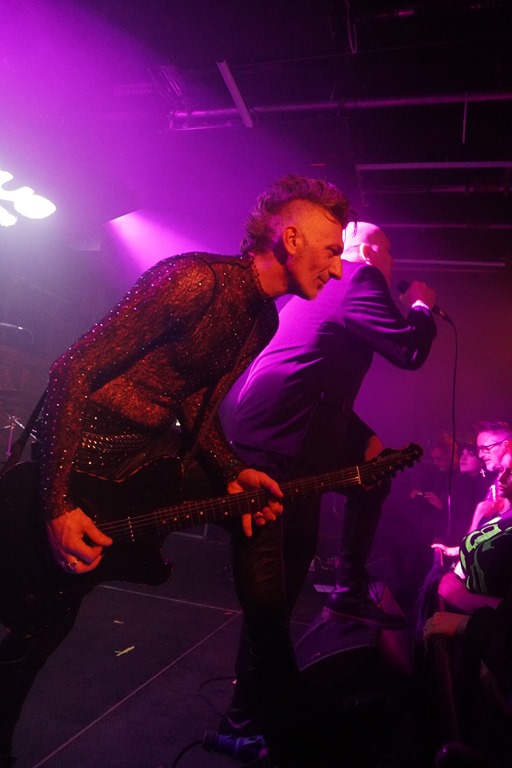
I’ve seen Ben Christo play many times… But this is my first time seeing Diamond Black. Although Diamond Black are his band, the heavy touring schedule of his dayjob work as lead guitarist with The Sisters of Mercy mean they don’t get out quite as much. They’re on ridiculously early – tickets and some event posting suggest it’s doors at 7:30 rather than the first band, but they play to a pretty packed house. I’m dubious about the platform centre stage which serves the purpose of providing ben a place to stand and throw poses, but he’s not particularly tall. More significantly, for all the 80-s rock stylings (think Mr Mister but with bigger guitars and thunderous bass) all the calls of ‘Hello York!’ and so on, it’s hard not to like them. Ben is clearly a straight-up nice guy and he loves doing what he does, and they’re big on positive messaging and facing up to mental health issues in an uplifting way. ‘Dark Anthems’ from the new EP is gothiest cut of the set, the verse’s guitar line worthy of the Sisters, before breaking into a chorus that’s pure anthemic pop. They’re likeable and fun, and sound great… what more do you need, really?

DSC04402DSC04418

Diamond Black

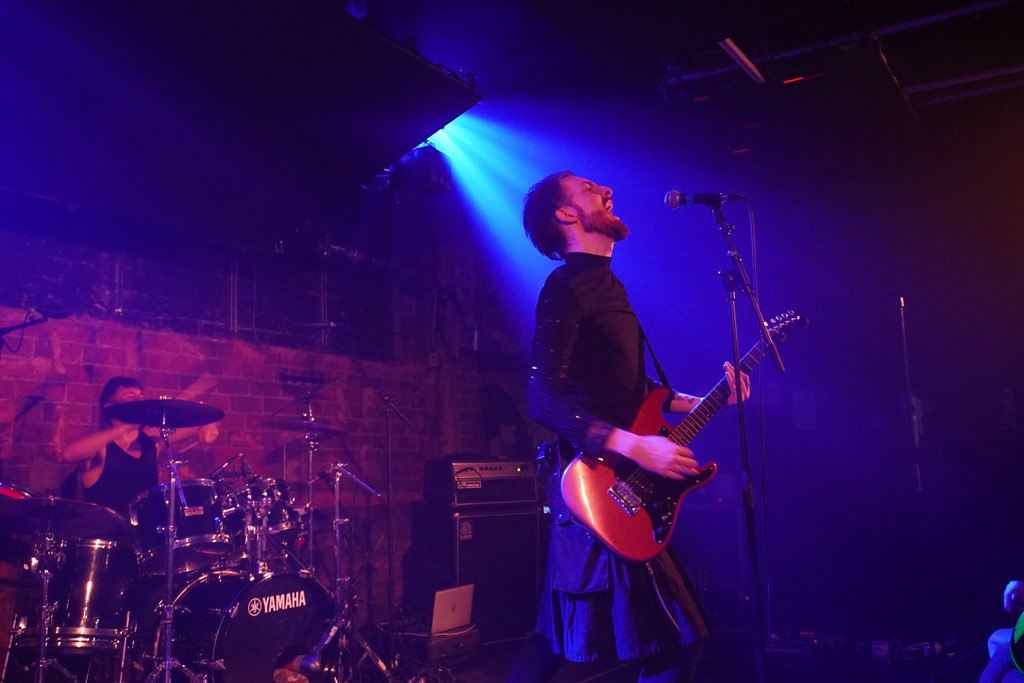
Lesbian Bed Death win for attention-grabbing name. They go all out on the stage set, too, with banners, mannequins, and a mic stand that’s composed of a strange animal skull atop a curved spine. In contrast with Diamond Black – and The Birthday Massacre – they’re darker, heavier, more metal, and they bring a more theatrical and punk style to the night. The name is a strong one, and works with a collective of predominantly female musicians… but it wasn’t always thus, and the band’s mastermind is the stumpy bearded guy in a Misfits T, and with a hat and a beer belly who goes by the name of Mr Peach. For reasons I’m unable to fully articulate, I’m always suspicious of men with beards trimmed so neatly at the neck. And having whipped out ‘the coolest’ guitar for the last song, it sounds like ass, and he switches back to his other guitar after just a few bars. But, objectively, with a set bursting with churning, slicing riffs, and gutsy, full-lunged vocals, their performance is solid quality and great entertainment.

DSC04440DSC04493

Lesbian Bed Death

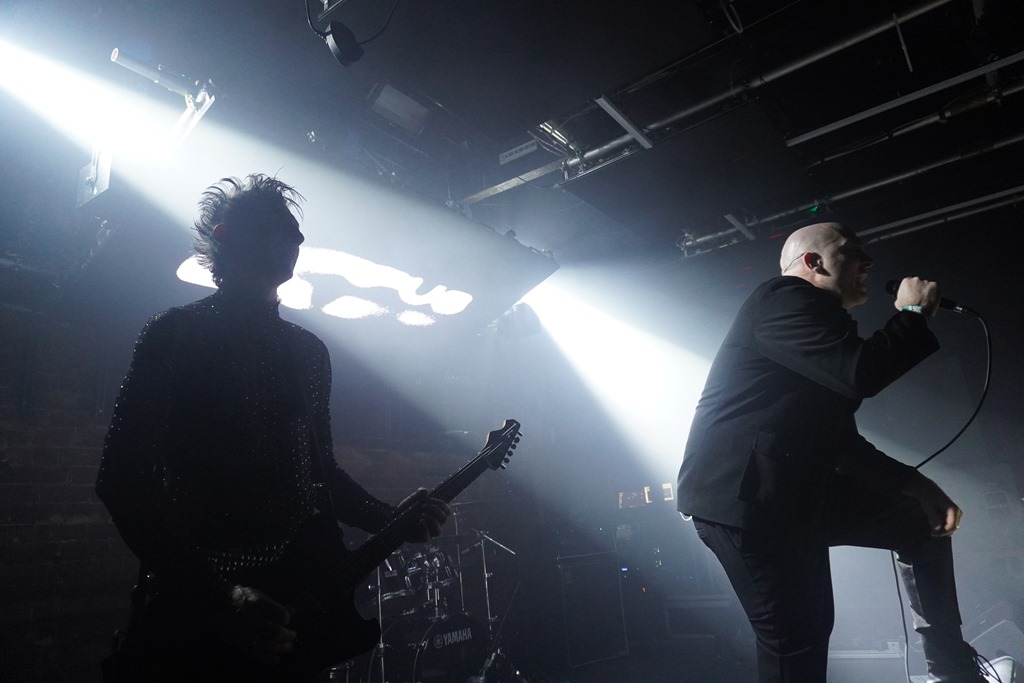
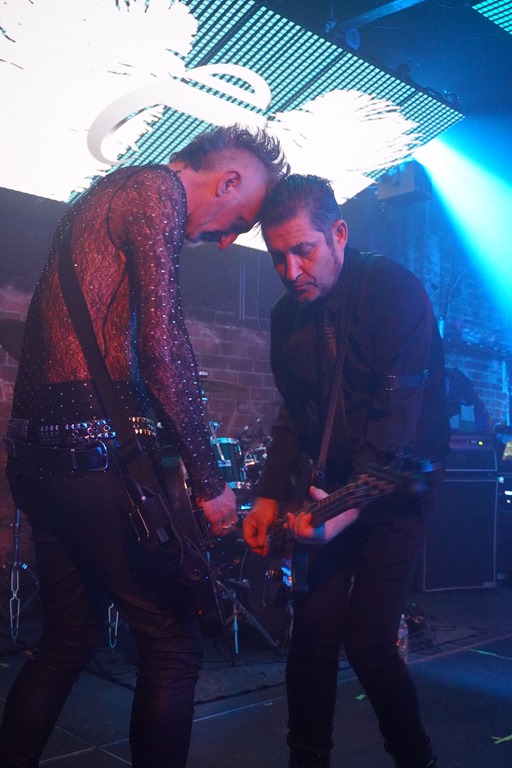
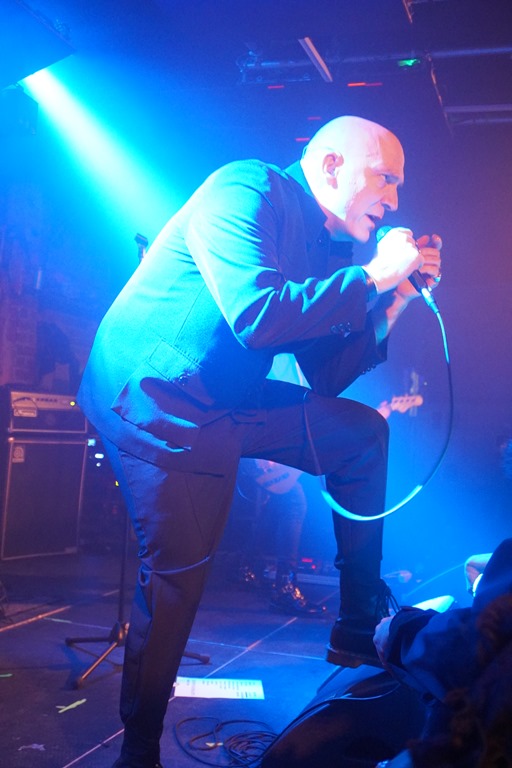
As for The Birthday Massacre… Woah. They sound phenomenal. Studio quality. But real at the same time. With six bodies packed on stage they need to be co-ordinated, and they are – tight beyond tight. If the energy was electric on their last visit, they’ve unlocked a whole new level of intensity now. Midway through the set, they’re all dripping, hair lank and stringy, but they don’t let up for a second. There are no ballads for a breather, and the audience feed off the band’s energy who feed off the crowd who feed off the band… you get the idea.

Sara ‘Chibi’ Taylor may be compact, but she’s one hell of a presence, but at the same time, a friendly one: she hands out water after fanning a distressed fan on the front row and beams throughout the set like she’s won the lottery. And it’s clear that it’s not just her who’s enjoying herself: the whole band radiates an aura of pleasure as they crank out a dense industrial chug. Sweeping synths fill out the sound, as Owen Mackinder lurches around his keyboards and wields his keytar with an infectious exuberance. Amidst the strobes, this is a band with bounce. They start a clap-along with ‘Destroyer’, and it’s a powerhouse blast from beginning to end.

DSC04604DSC04638

The Birthday Massacre

It’s true that in the scheme of things, and by the marks of the genre, The Birthday Massacre are something of a NIN-lite pop band, but they’ve created their niche and nail it, and what’s more, it’s clear they’re enjoying themselves as mush as we are. The drumming on ‘Crush’ is immense, and the song builds to a euphoric climax.

DSC04584

The Birthday Massacre

This time, they do play an encore, and keep the fans baying for more. But when did ‘one more song’ become a chant? If you want more, surely you really want MORE! (this doesn’t work so well at gigs by The Sister of Mercy, who never play anything on demand), but fortunately for us, The Birthday Massacre deliver not one, but three more songs. The reaction is incendiary and completely deserved. By the time they depart the stage, having dispatched twenty songs with explosive energy, it’s clear we’ve witnessed something special, a band at the very top of their game.

5th November 2025

Christopher Nosnibor

The early days of goth threw out a host of disparate elements, and there were some quite specific regional variations, too. While Leeds was a hotbed of the emerging scene, what was happening there was stark, bleak, with a certain industrial leaning, likely in part on account of its post-industrial wastelands and the kind of depravation which was rife in the late Seventies and Eighties, but was particularly prevalent in the North. It was quite different from what the more overtly punky Siouxsie and the Banshees were doing, and different again from the art-rock of Bauhaus. And it’s really their 1979 debut single –which was only partially representative of their oeuvre – which is largely responsible for the last forty-five years of the association of goth with bats and vampires and the like. Westenra do very neatly – and legitimately – tie these aspects together, hailing from Yorkshire (Whitby, to be precise) and with a name lifted from Bram Stoker’s Dracula, which famously sees the titular lead character land in Whitby, a place which will forever be synonymous with the macabre, the haunting, the gothic.

Announcing their arrival in 2019, Westenra are relatively new arrivals to a scene that’s creaking with acts who’ve been going for centuries (ok, decades), and in that time they’ve built quite a fanbase, particularly in and around their home county, with a steady flow of releases and an active touring schedule, including some high-profile shows playing alongside The Mission and Theatre of Hate. All of this is well-deserved, as they spin their own blend of – as they pitch it – ‘Goth, Alternative Rock & Metal.’

‘Burn Me Once’ does feel like a progression from their 2021 debut full-length, First Light. The production is fuller, bolder, and while the intro track (Monitus) is a densely atmospheric sample-soaked curtain-raiser, it’s only a primer. The band’s massive riff-slinging progress is nowhere more apparent than on the first song proper, ‘Ghosts in the Machine’. It’s got guts, and hints of the expansive vibes of Fields of the Nephilim’s ‘Psychonaut’, due in no small part to the sweeping synths and chunky, hypnotic bass groove, which explodes into a cyclone of bold metal-tinged riffery, against which Luciferia belts out dominant, full-lunged vocals which draw influence from Siousxie, but which are entirely her own style.

‘Sweet Poison Pill’ steps up the atmosphere and the tension, serving up a blend of vintage goth with a cutting metal edge and a dramatic theatricality, aided by layered vocal tracks. It’s bold, it’s epic. There’s a lot going on here: ‘Time’ opens with skittering electronic energy before crashing into a crunching metal Siouxsie-infused attack – and then there’s a whopping great guitar solo which erupts seemingly from nowhere. ‘For All To See’ is a big, bold, riff-led beast of a track that packs the density.

Westrenra sure know how to slide between modes and moods: Burn Me Once is epic in every sense. It’s an album which radiates immense power, and there isn’t a weak track here. Against a densely-woven musical backdrop, Luciferia delivers consistently strong vocals.

With this album, Westrenra deliver on all their promises, and then some, with a set of songs that’s brimming with energy and brooding introspection. And as much as they’re a goth band, Burn Me Once is an album that sees them pushing out in all directions far beyond genre limitations. Ultimately, Burn Me Once is a high-energy rock album with dark undercurrents which course relentlessly, and the quality of the songwriting is outstanding.

AA

a1821740368_10

15th August 2025

Christopher Nosnibor

In recent years, the field of doom has expanded in terms of range, and has, at the same time, become rather more populous. One suspects in part that because these are pretty fucking dark times, increasingly, people are turning to dark music to articulate their own challenges, and to navigate the world around them. One welcome development is the number of female-fronted doom bands with vocalists who bring not only powerful voices, but a strong emotional force to the heft of the instrumentation.

Amnesiak pitch themselves as ‘Alternative Doom Rock’ – a subtle but necessary distinction from the proliferation of doom metal, which is something rendered clearly on this, their debut album. Containing just seven tracks, the longest of which is just under five minutes in duration, and with a couple that clock in at under three, it’s a concise document – and that’s welcome, because unlike so many other releases in the genre, which can at times be indulgent and err towards the overlong, and leaving you feeling drained, Arkfiend leaves you hankering for more.

The instrumental intro track, ‘Deamoniacus’ is something of a trope nowadays when it comes to heavy music – and screamy post-hardcore – but here it works differently, with samples reverberating in torturous extreme stereo, the sounding of the muttering clamour of a fractured internal dialogue which crowds the mind with discomfort, paving the way for the slow, majestic ethereal grandeur of ‘Archfiend’, which blends sepulchral doom with soaring vocals which float to the skies. ‘Flamed In Solitude’ plunges into darker territory, with dingy guitars squirming queasily over loping percussion. Layered vocal harmonies contrast with the thick guitars and booming bass, and those vocals sit between doom and folk, elevating the song to unexpected heights.

The dynamics of each song is something special, and the stylistic interplay sets them apart from their peers. ‘Pillory Of Victory’ is theatrical, gothic, dramatic in a theatrical sense, but also in an intense real and immediate sense – and at two and a half minutes there’s a moment where the riff skews and things take a sinewy turn for the more discordant, before the riff returns, hard and heavy. And yeas, I’m one of those people who obsessively pinpoints the moment when a song switches, when it moves from ‘yes!’ to ‘woah, fucking yes!’ – and it all comes down to a second or so. I’ve digressed, but so have Amnesiak, until they come around to the churning riffery of ‘Bootlicker’, which is truly monumental. Everything comes together here, and this is track of the album. For all its dirty guitar grind and dark lumbering riffery, it’s majestic, epic, a song that fills you up and lifts you up with its power. The final track, ‘The Last Rattle’ is a perfect balance of light and dark, weight and melody, reflective and sad and uplifting in equal measure. The quality of the songwriting, and the attention to detail on display here is quite something.

Arkfiend places Amnesiak comfortably alongside Cold in Berlin and Cwfen – and that’s a strong recommendation.

AA

a4008843204_10