Archive for the ‘Reviews’ Category

16th June 2025

Christopher Nosnibor

Gintas K’s latest offering was recorded live, using computer, midi keyboard and controller in January 2025, and first released by Japanese label Static Disc in May.

It’s worth perhaps mentioning that ‘Breakcore’ is – and I shall shamefully quote from Wikipedia here – ‘is a style of electronic dance music that emerged from jungle, hardcore, and drum and bass in the mid-to-late 1990s. It is characterized by very complex and intricate breakbeats and a wide palette of sampling sources played at high tempos.’ In the main, not really my personal field of expertise, or particularly within the remit of Aural Aggravation.

But this is a Gintas K album, and the nine pieces are typical of his style, combining experimentalism and the application of software and midi / laptop setup, producing a range of glitchy, frothy, gurgly sounds which stop and start intermittently, unpredictably. His live and improvised works always come with a sense of unpredictability, of spontaneity, while bearing his distinctive sounds. One of the key focuses within K’s work is on detail, zooming in on microtonality, granularity. When I say it sounds ‘bubbly’ or ‘frothy’, I mean it’s the sound one might consider the equivalent of the visual experience of slowly swirling a latte or a pint of ale, or hyperfixating on the bubbles in a bath. This is not, however, the gentle swill and flow of currents, but a frenzied effervescence, like the reaction between bicarbonate of soda and vinegar. And look long enough and hard enough, and patterns begin to emerge.

Listening to the bubbling blitzkrieg of digital clicks, beeps, and fizzing of any work by Gintas K can be stimulating to the point of eye-popping discombobulation. It’s almost too much – and this is nevermore true than the experience that is Breakcore. There are beats present – but they’re composed not of beats in the conventional sense, being neither rhythmic nor percussive, either from an analogue source or a digital sampled source or emulation. These are flickers, pulses, rapidfire stutters, hard sounds which replicate the essence of a beat without being a beat, per se. For example, those of a certain age may recall the successive ‘pink-pink-pink’ chattering digital babble of dial-up. Few would necessarily consider those sounds beats in context, but… yes, they have a certain beat-like quality. And this is how the beats often emerge from the clicks and pops, moans and drones or another quintessential Gintas K demonstration of circuit meltdown as an artform.

I had never considered his work in a ‘dance’ context before, and still wouldn’t: one feels as if the title is perhaps a shade ironic. But the tempo is certainly high and the beats are complex and intimate, emerging as they do from the thrum of what sounds like a revving engine, the whirr of an old hard-drive, the click of a CD driver whirring into action. Every second of this release sounds like some kind of digital or mechanical malfunction, as tempos whirl and blur, drawl and slow. Scrunching, crunching, twanging, springing, stammering and stuck, it’s a relentless attack of wrong sounds. But emerging from all of it, there are erratic beats, like a succession of deliberately jarring jazz fills and simply wild judders.

It is relentless, and it’s complete overload. The nine tracks run for a total of twenty-nine minutes: its intensity is such that you feel as if your brain is starting to melt after the first ten. In short, Breakcore is truly wild, and it’s not remotely easy or accessible – but it absolutely encapsulates everything that defines what Gintas K’s does.

AA

AA

cover

Christopher Nosnibor

Last night, I spotted a post on Facebook from the Fulford Arms bearing the caption ‘hot day / sold out show = sweat dripping from the ceiling… f*cling awesome!’

And the gentrification of the grassroots venues we have left mean such occasions are a lot rarer than they used to be. And while for some punters it’s likely seen as a good thing, I personally do miss the sweaty mess aspect of packed-out pub venues, not because I necessarily enjoy being a sweaty mess, but because it was a part of the live experience, and you knew you’d been to a proper show if you came out absolutely drenched and having lost about 3lbs through perspiration.

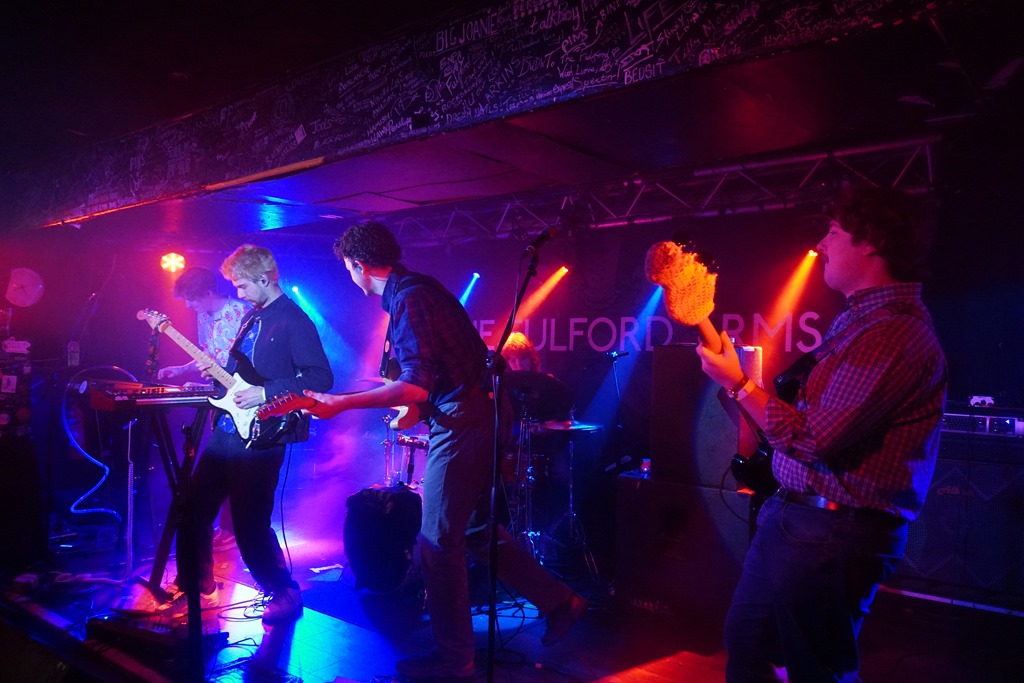
And so it is that here we are at The Fulford Arms on the hottest day of the year so far. The thermometer in my back yard was showing 34°C earlier in the day. I found myself thinking ‘at least it can’t be as hot as The Mission at The Crescent, right? Or DZ Deathrays at the 50-capacity Woolpack in 2013… Surely?’ And it wasn’t. And not just in terms of temperature.

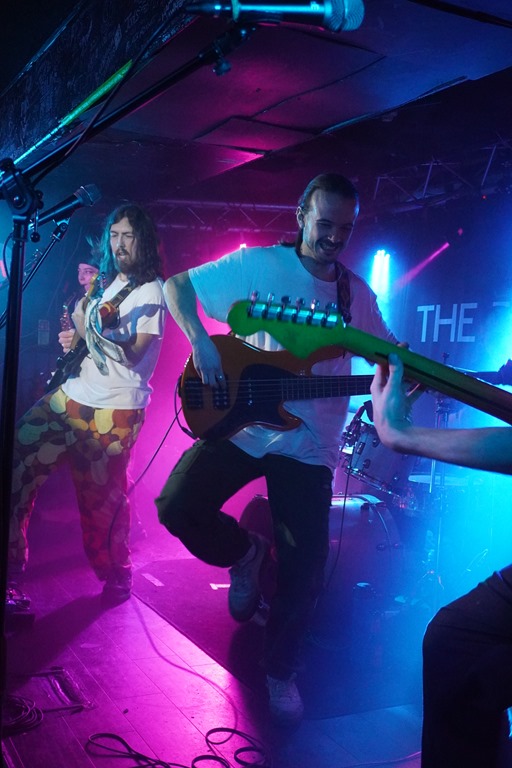
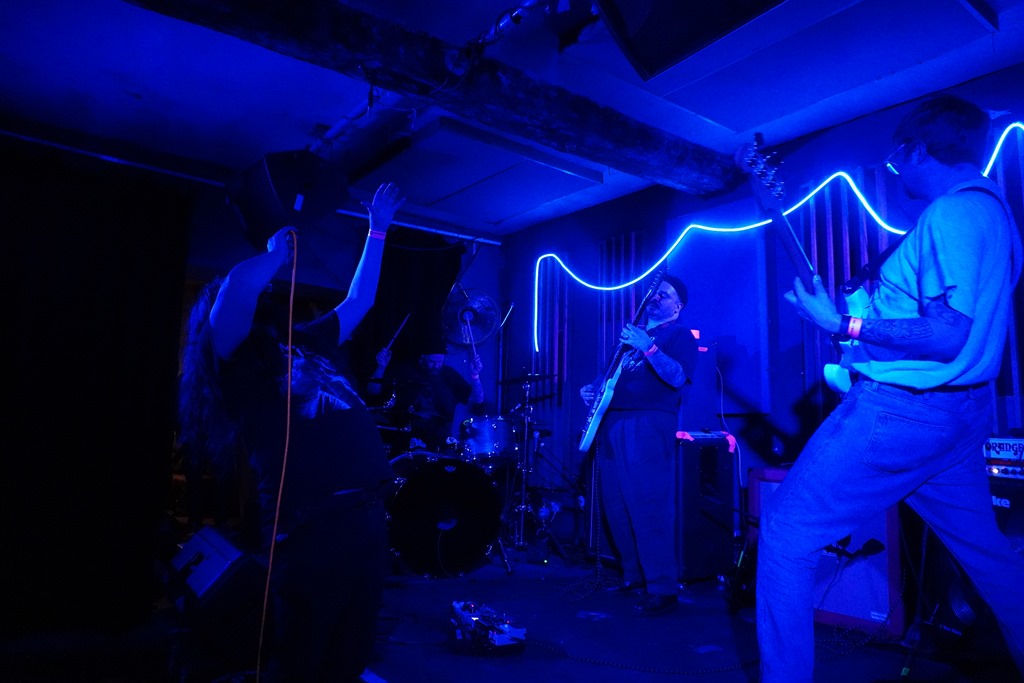
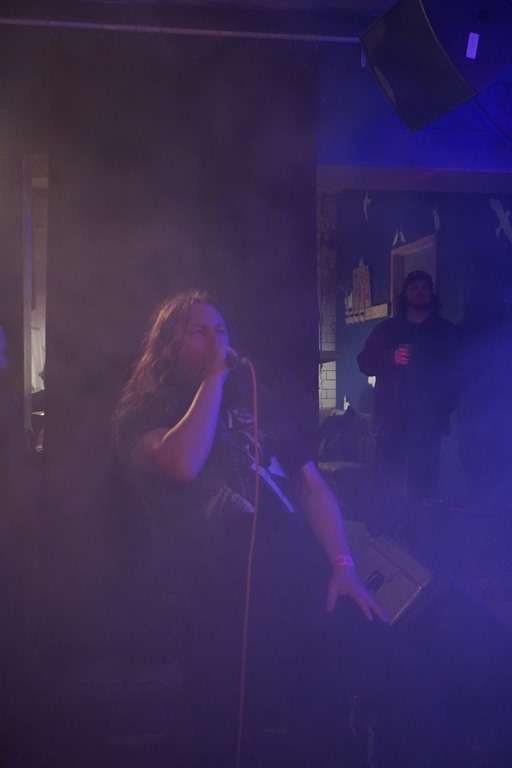
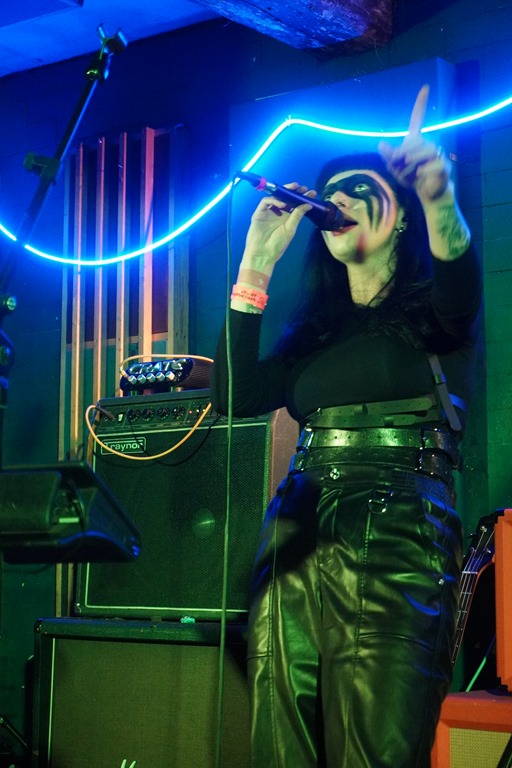
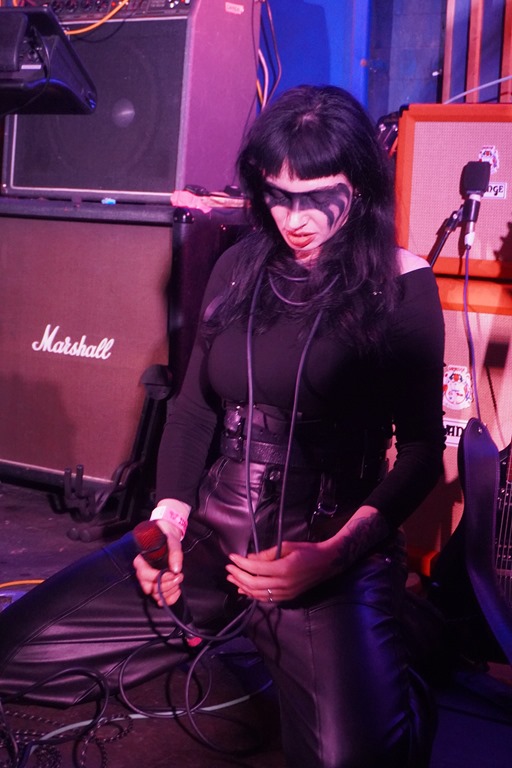
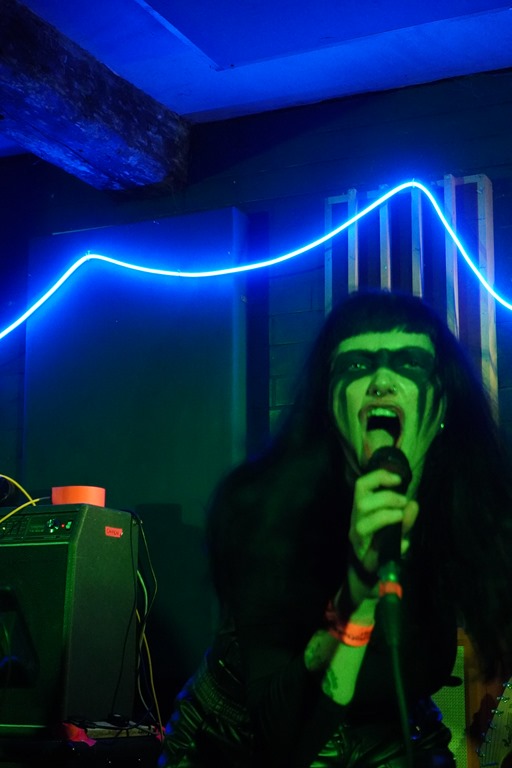
Cogas are a blackened death metal three-piece, with guitar, drums and vocals, plus face paint, chains, studs and random props. The seven-string guitar brings frenzied fretwork and some solid low end, and rapid fire kick drum action ensures the sound isn’t thin despite that lack of numbers. The singer looks really angry for the entirety of the set, and it works in terms of character, but it may be because of the amount of time he spends adjusting his mic stand. Towards the end of the set he wields an inverted cross of bones. Its relevance is unclear, but it’s an interesting visual.

DSC02351DSC02352

Cogas

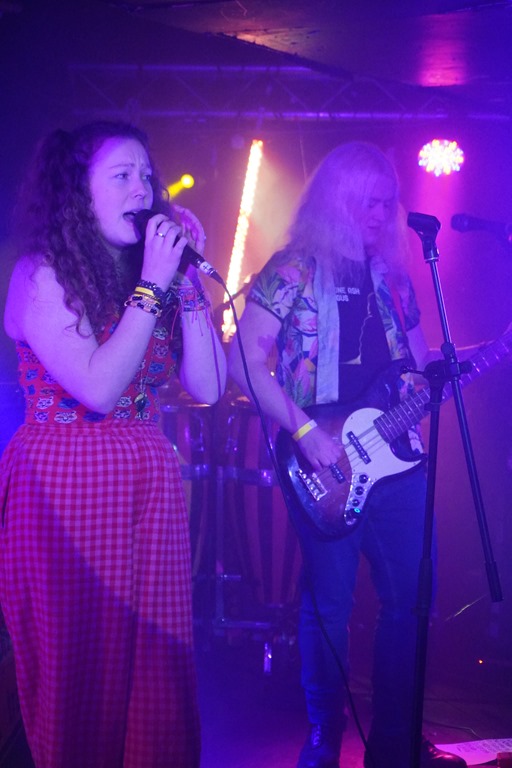
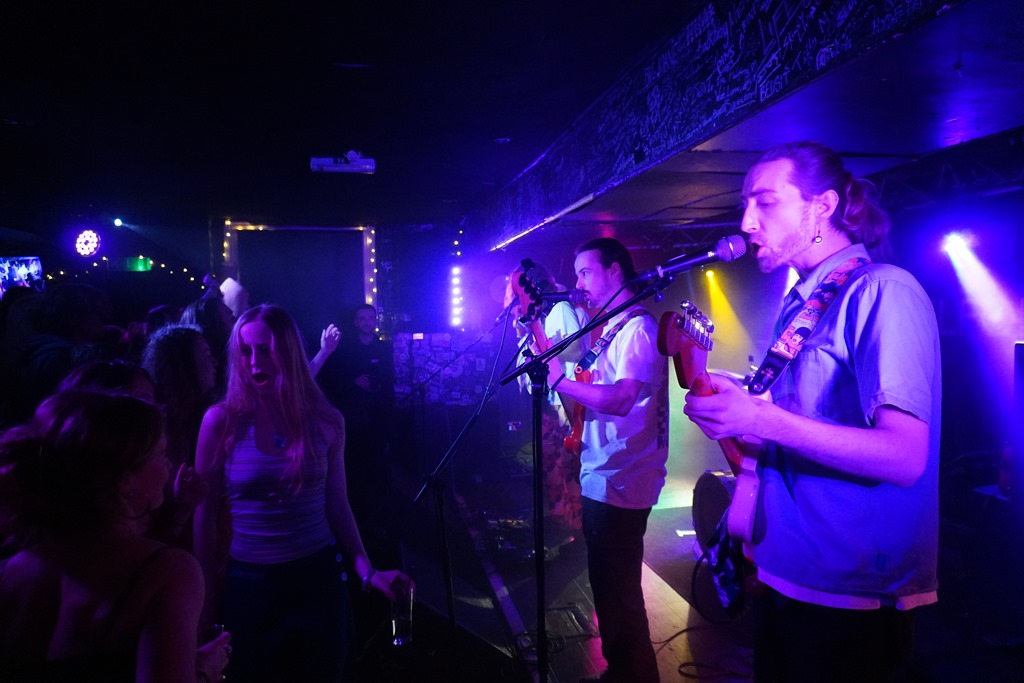
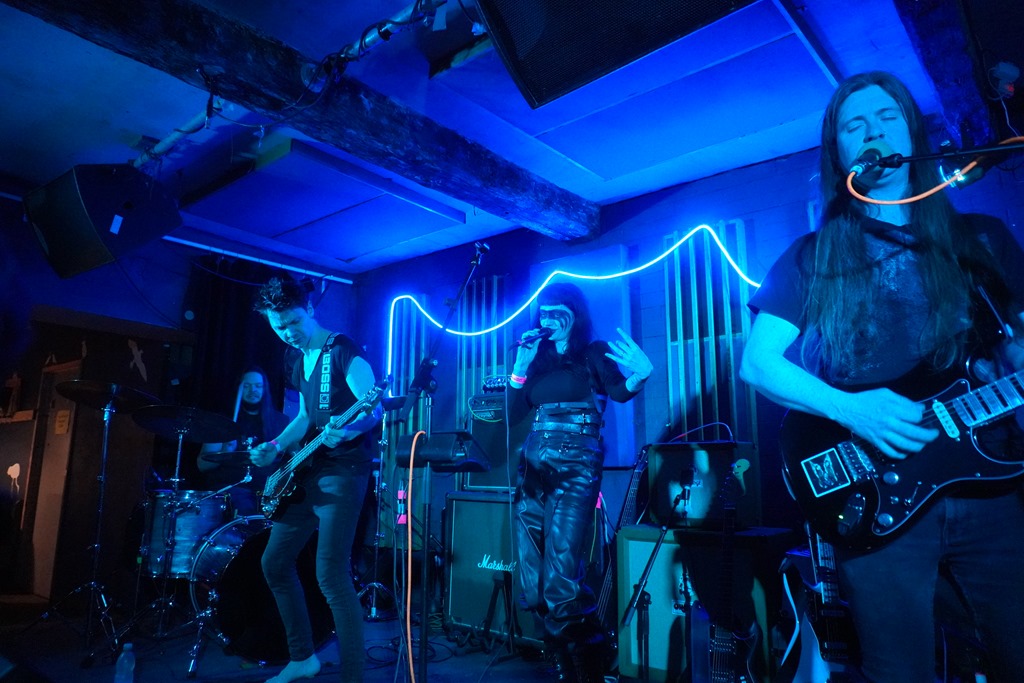
Blasfeme have more and bigger spikes, more black face paint and more guitars: two plus a five-string bass. This combination ratchets up both the volume and density. They play hard and fast, the vocals are a demonic shriek. By a few songs in, half their makeup has disappeared, and with his office haircut the vocalist is transformed back to a more daytime look, but guitarist Vermin flails his hair furiously and they pound their way through a set of highly structured songs, predominantly culled from their latest album, delivered with a rare tightness, and there’s no denying their quality.

DSC02368DSC02378

Blasfeme

Thy Dying Light go darker still, with iron cross patches and black cymbals and shiny Spandex trews – plus a candelabra and a selection of horns and sheep skulls in front of the drum kit. the smoke seems to make the room even hotter, and by the end of the set, even the skulls looks like they’re sweating. The guitar/ drums duo – self-professed purveyors of “Cumbrian Black Metal” – deliver a set that’s raw and murky and true to the principles of black metal, seemingly have spent as long on their makeup as writing the songs. A big bearded guy in a Sunn O))) t-shirt emits a guttural growl between each song instead of applause.

DSC02388

Thy Dying Light

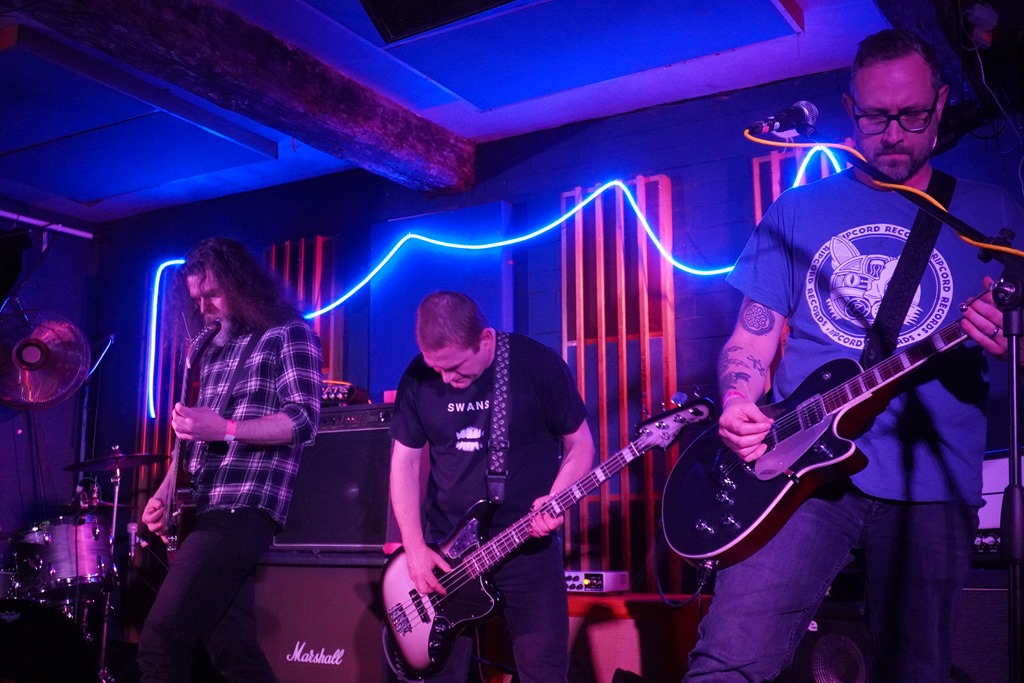
Burial bring beards and shaved heads, and t-shirts with cut-off sleeves. Their sound is as burly as they look, meaning that sonically they’re solid, but the fact their inter-song chat can be summarised as “how are you doing York, you soft wankers” and “fuck off you sexy cunts”, I’d have preferred more songs and less bantz. There seems to be a lot of in-jokes, which the faithful are in on, calling for them to get their tits out, but it rather falls flat for the casual observer.

DSC02421DSC02433

Burial

Perhaps the heat was a factor – certainly, the moshing was minimal and the crowd were keener to rush the bar and get air between the bands than go nuts during their sets – but something about the lineup simply failed to ignite on the night. None of the bands were duds, by any stretch, but there were no explosive cathartic peaks, making for a night that would sit in the ‘middling’ bracket overall. And that’s fine: four bands for a tenner means £2.50 a band, and it’s hard to begrudge that, and as a showcase of a breadth of metal, it delivered.

Panurus Productions – 20th June 2025

Christopher Nosnibor

You’d think that cassette labels would be not only niche, but few and far between, and in the main, they are, but Newcastle is home to not one, but two labels who provide a near-endless supply of releases to satiate the need for weird shit the world over, with Cruel Nature Records being one, and Panurus Productions being the other. The labels have a considerable amount in common, too, not least of all in that they both favour music that’s of a quality, rather than a style.

The latest Panurus release is a perfect case in point. The label’s previous offering, a split release from Belk and Casing was a raw blast of guitar overdrive. In contrast, the third album from M-G Dysfunction is of an altogether more experimental bent, leaning toward hip-hop and beat-driven electronics, but once again marking the close connection between the scenes in Leeds and Newcastle, both of which have become significant spawning grounds for the offbeat, the difficult, the wilfully obscure.

According to the blurb, ‘Mista Self-Isolation is the fullest realisation of the M-G Dysfunction project to date – a record of trepidation and humour, of lopsided passion and warped poetics. This album is about surveying the wreckage of monoculture and navigating the act of making music amidst a land-grab of rights, melodies and rhythms by people who never liked music in the first place. It’s about properly honest artistic expression – what “keeping it real” looks like, sounds like, feels like in 2024. It’s about getting some official beats and saying fly shit over them.’

That it’s quirky may be obvious, but it’s a necessary headline observation. On the one hand, it’s white rap, so there’s an awkwardness, but on the other, there’s some dirty experimental electronic noise layered over the beats, and this is an act that shared a stage with Benefits, a band who may have made their reputation by being angry, shouty, and noisy, but who aren’t without humour or an appreciation of nuance.

As tracks like ‘Roger Daltrey (Permanent Record)’ illustrate, M-G Dysfunction are multifaceted – something likely to leave many quite nonplussed. How can they do jokey, daft, a bit random and be serious at the same time? In truth, the answer is simple: because human beings are complex creatures, capable of a vast range of emotions and infinite ways of expressing them. It’s something we seem to have lost sight of in recent years, when everything has been boiled down to binaries, and everything is a conflict because the lines have been marked in such either / or terms. It’s no longer possible to be a woolly socialist: suggest that, I dunno, people on disability benefits are right to receive free prescriptions, and you’re labelled a left-wing extremist, a communist, and by the way, disabled people should get back into work or die. Something is severely fucking wrong with this picture.

Back in the early 90s, genre crossovers were all the rage, and the Judgement Night soundtrack was a real watershed moment that took the idea of rock / rap crossover, first witnessed in the mainstream when Run DMC and Aerosmith did ‘Walk This Way’ to the next level. At that time, it felt like a new future was emerging, and perhaps, even a future where boundaries and differences were dismantled. But here we are, and times are bleak.

But with Mista Self-Isolation – an album which is by no means an exercise in buoyant pop tunes – M-G Dysfunction show that in 2025, there is still scope to create something that speaks of what it is to be human.

The structured, beat-led songs are interspersed with self-reflective spoken word segments, spanning CBT meditation and contemplations on experiences and life in general. It is truly impossible to predict the twists and turns this album takes.

’50 Words for Blow’ comes on like a hip-hop-inspired barber’s shop quartet, while ‘John Wick’ is a critical memo, and the title track is abstract, minimal, dreamy but quietly intense. ‘Junglists Only’ is a perfectly executed pseudo-banger which knows it’s absurd and works because of it. The last song, ‘All that is Solid Melts into Deez Nuts’ evokes both humour and at the same time draws attention to M-G Dysfunction’s hip-hop credentials. If you know, you know, as cunts say, but for those who don’t, it’s a reference to Dr Dre’s ‘Deeez Nuuuts’ from The Chronic in 1992.

Postmodernism is alive and well after all, at least in some quarters, and it’s very well in the world of M-G Dysfunction. There is a lot going on on Mista Self-Isolation – and it’s all good.

AA

cover

Criminal Records – 20th June 2025

Christopher Nosnibor

If I didn’t know this was the new single by The Kut, I would never have guessed in a million years. ‘Sevens’ certainly sound different – very different… Beloved by Kerrang, Download veteran, with a debut album that reached number seven in the UK Rock Charts, The Kut is rock music. ‘Sevens’ however, is distinctly pop. Yes, really. But when you pick it apart, just how different really?

From their very inception, Princess Maha’s songs demonstrated a pop nouse, a knack for a hook, a nagging guitar line, a keen melody. It’s easy to overlook these components when it comes to many of the acts which have provided inspiration and comparison, the likes of Hole, Nirvana, Placebo. But all the raw energy in the world won’t translate to commercial success if there’s nothing that sticks in the mind. And so it is that all of these things are very much present on ‘Sevens’. Where it depart from previous offerings is not only that it’s sunny ad sultry, but the beats are backed off and everything is clean, smooth, the guitars are there but off in the background while a remarkably groovy bass flexes and bounces about in a way that’s not quite funky but certainly noddable. Landing in the middle of a heatwave and ahead of some festival appearances, it feels incredibly fitting. But, more to the point, if switched around to be recorded differently, with the guitars up in the mix and the vocals less compressed-sounding it would still be a solid rock tune. Done this way, it’s a solid pop tune with a post-punk flavour.

At heart it’s still The Kut, but with a new spin.

Ideologic Organ – 20th June 2025

Christopher Nosnibor

In his liner notes, Robert Barry suggests that ‘Brace for Impact might just be the first album of post-internet organ music’, and goes on to explain that ‘it is a record weaned on networked processes and algorithmic thinking, a suite of tracks which build their own systems then push them to the point of collapse. Lindwall is not a programmer, but he will wield whatever technology is ready to hand much as Chopin made use of the richer, fuller sound of an Erard piano. From the software subtly weirding the interior textures of ‘Swerve’ and ‘Piping’ to the juddering, kernel panic of ‘AFK’ and ‘À bruit secret’, these are works of music unthinkable without the ubiquitous experience of life lived online. Imparting that hypermodern aesthetic sensibility through the austere sound of a baroque organ only heightens the anachronistic sense of temporal disjuncture characteristic of days spent rabbit-holing through ever-multiplying stacks of browser windows. The vernacular of Web 2.0 is here re-transcribed in the ornate script of a medieval illuminated manuscript.’

As Barry also suggests, the organ has been undergoing something of a renaissance in recent years, and cites a number of significant organs which have been recently restored, including the grand organs at the cathedrals of St John the Divine and Notre-Dame (New York and Paris respectively, and, not so much closer to home but on my very doorstep, York Minster, which ‘heralded a “once-in-a-century” refurbishment of its own 5,000-plus pipe instrument’.

It marks something of a shift from an album I reviewed around maybe fifteen years ago, the details of which elude me now, which was recorded on a series of broken-down and dilapidated organs from around Europe which wheezed and groaned as if gasping out the last breaths from their collapsed lungs.

Brace for Impact is an altogether more vibrant work, although as much as it celebrates the organ and the instrument’s sonic magnitude, it also reaches far further into exploratory sonic territories over the course of these five compositions.

The title track features ‘a highly saturated and distorted electric guitar, performed by collaborator and SUNN O))) founding member, Stephen O’Malley’ – and ranges from tectonic crunches, machine-gun rattles and alienated whines rising from the kind of dissonant dronescape only O’Malley can conjure. And so we brace… and then we swerve. The collision fails to materialise during the ten-minute dark ambient swirl of the second track, spreading ominous overtones and watery, echo-heavy plips and plops. The muffled beats are akin to listening to a minimal techno set overlayed with a piece from the BBC Radiophonic Workshop, performed in the Blue John Cavern, and it shimmers accordingly, slipping into off-kilter fairground trilling in the final minutes.

The final diptych of compositions rally ventures out: both ‘AFK’ and ‘Piping’ extend beyond twelve minutes. The former brings jolting discord and drama, lurching stabs that manage to bring a crazed dance feel to the sound of the organ before swinging into a circus-type jive. It stands out as perhaps the most playful track on the album. There is a playfulness to ‘Piping’, too, but it feels more like it belongs to a film soundtrack or theatre performance, and it whirls and winds and spins and pirouettes it way to a pretty but perhaps confused conclusion.

Brace For Impact is very much a non-linear work, and one which stands, uncertain of where it’s going next. But is it unquestionably interesting, not to mention disorientating, and it’s a work which seems to bend time as well as notes. It’s an album to lose yourself in.

AA

SOMA062_3mmCover

9th May 2025 – Room40

Christopher Nosnibor

Souvenirs are unusual things, in that they’re intensely personal, and imbued with a resonance which is often difficult to articulate.

I will revisit an anecdote I relayed no so long ago: my dad gave me £15 spending money when I went on a Cub camp in Yorkshire when I was probably fourteen. We had a day trip to York, where I discovered an independent record shop, the now gone and sadly-missed Track Records. I blew most of my £15 on 12” singles by The Sisters of Mercy: Alice, Temple of Love, and The Reptile House EP. On returning home, my father was not happy: he’d given me the money for real souvenirs – fridge magnets, mugs, erasers… but the fact that I still have those records and tale to tell says these were the best souvenirs I could have ever purchased. Would I still have an I Heart York mug or a tea towel thirty years later?

But one thing that’s become apparent is that for fringe, niche, and unestablished acts like Sadie Powers, even when released by labels like Room40, physical releases are becoming less of a thing. It’s a sad reflection on the state of the world and how the arts in general are suffering. People don’t want to pay for stuff, or they can’t afford to pay for stuff, and the end result is the same.

Souvenir is a sad album, based on a premise which resonates on a personal level. I’ve written extensively of late on both the impact of the pandemic, and of losing my wife, and Souvenir is a work which explores grief, with a particular focus on the pandemic. Powers explains the album, its context, and its musical limitations and development in terms of instrumentation, in a fashion which warrants quotation in full:

‘Between 2020 and 2022, a significant number of friends and family passed away. Due to the pandemic, funerals became impossible to travel to or just didn’t happen. How does one grieve alone? What is that language? What is that movement? What do I do with my hands, with the muscle memory of care weaving phantom thread? What is the shape of the shelter one makes to bear this loss? If I’m not holding, will I sink to the bottom?

‘What is my last memory with them? Almost always, it is of embrace.

‘I’ve had a relationship with fretless bass for about 20 years. It’s an unforgiving instrument. It exposes everything. Like porcelain: elastic, pliable, detailed, expressive. Suggestive to subtle touches. It shows the hand of the player. I began recording improvisations with silence, thinking of those I’d lost, their embraces, those moments of stillness and when time folds in on itself, then cutting the tracks up processing and layering them, a sound collage. Programmable music box bells, sheet metal, cardboard box, and field recordings from the same spot on the back patio of my former home color the shape. Like a bird collecting items to create a nest of memory. Sounds drifting in and out like recollections, like ghosts. The practice became a life raft, or a grieving raft.

‘Is the souvenir the embrace? Souvenirs originated from pilgrimages in the Middle Ages, as a remembrance of a journey.’

The four compositions which make up Souvenirs are each approximately ten minutes in duration, and this would have made for a magnificent vinyl LP, particularly given the texture and detail of the works.

The first track, ‘Right After’ is exemplary: it begins so quietly as to be beyond range, before the crackle of a slow fade-in becomes discernible. And against this, and some rumbling dark ambience, there is the strolling fretless bass work. I can’t help but think – however fleetingly – of Duran Duran, not because it actually sounds like Duran Duran, but because that fretless bass has such a distinctive sound – thick, bulbous, rounded, warm.

‘Soft Materials: Permanent Rose’ is move overtly ambient, and ripples its way along in an understated fashion, and ‘Rabbit Hour, too, hovers and hums, clatters and clinks, plunging deeper into abstraction, drifting cloud-like and formless, hovering, while occasional scrapes and nails-down-a-blackboard feedback sounds cut through the soft waves.

‘Princess Moo Bear’ may sound soft, but the clanking chines are pitches against thick helicopter sounds and dark abstraction, before finally expanding and drifting to nothing.

Souvenir is not an easy or instant album. Quite the contrary is true. But it is detailed, layered, and has much going on.

AA

a0102366993_10

Human Worth – 11th July 2025

Why Patterns’ latest offering marks something of a shift from Regurgitorium, released back in 2022. I say ‘back’ in 2022 because it feels like a lifetime ago. Some of that is, admittedly, due to personal circumstance, but for most, 2022 was a very different time. We still weren’t all that long out of lockdown, for a start. We were still coming up for air, and finding our way – and likely crawling our way back to the office, while a lot of shops still had their Perspex screens in place. I remember in the checkout queue in Aldi just willing these weird cunts who had seemingly either forgotten the preceding year and a bit, or had lost all sense of how to engage, by looming and leaning over and pressing too close would fuck off. I revisit the context of the last album because it somehow managed to capture the mood in some obtuse way, and when I wrote ‘It’s fucked up. It’s deranged. It hurts,’ I could as easily have been referring to life itself at that point in time.

Screamers is different again. Or, if not so much, different, compressed, compacted, distilled, the intensity amplified by the concision of the tracks.

The crunchy, gnarly bass still dominates, and it’s snarling away and tearing strips straight out of the traps on the frenzied ‘After the Bullfight’. Clocking in at a mere minute and forty-seven seconds, it’s noise rock smooshed down to the tight parameters of grindcore, and with insane amounts of reverb, the stuttering, stammering vocal yelps from Doug Norton, the man behind the ‘Mouth Sounds’ owe an equal debt to Suicide and The Cramps, and this may be the spawning of industrial psychobilly as a new genre. Everything is overloading, the speakers are crackling with megawattage overload, and when ‘Clown in a Housefire’ blasts in, you actually begin to wonder if it’s supposed to sound like this of it your gear’s fucked.

One may cling in references to the Jesus Lizard and all the rest, but really, this sounds like a psychotic reimagining of early Blacklisters – specifically early because of THAT bass racket. But whereas Blacklisters were, and remain, quite song-orientated, at least structurally, Screamers sees Why Patterns take their template and smash the living fuck out of it by throwing it against a brick wall and stomping on it until there is nothing but splattered pulp. None of the songs – I mean, they’re not really songs, more demented blasts of discord played at three hundred miles an hour, all of the instruments playing at angles against and across, rather than with one another, the vocals the sound of a breakdown in real time. And listening to this as bombs and missiles are going off everywhere and no-one knows what is going on anywhere, I fin myself listening to this tumultuous mayhem and thinking ‘yep, they’ve done it again. This is the closest I’ve heard anyone articulate this moment.’ I mean, they don’t really ‘articulate’: as the title suggests, Screamers is a raw, primal scream. It’s a frenzied, lurching, gut-punching racket that rattles the bibs and kicks the balls, hard. Pleasant, it is not. Especially that grungy bass that churns the stomach.

There aren’t really any riffs: it’s just a relentless assault of jarring noise. ‘Nervous Laughter’ brings hints of the latest mclusky album, but does so with menace, malice, and a hint of the unhinged, and following on ‘Wind Up Chattering teeth’ is a minute and six seconds of rabid raving. It’s almost enough to make you want to puke.

Then there’s ‘Club Foot By Kasabian by Blacklisters’. It extends the joke of the original – since the Blacklisters song, ‘Club Foot By Kasabian’ wasn’t a cover, and had nothing to do with Kasabian, and so it is that ‘Club Foot By Kasabian by Blacklisters’ is a minute and a half of squalling, brawling, guitar-led abrasion. It’s somewhat reminiscent of Castrovalva in its deranged intensity, and frenzied, squawking disregard for decency. The title track is fifty-two seconds long. It’s rabid. It has to be heard to be comprehended.

The last track, ‘Buffoons and Barel Organs’ is both the longest and most structurally coherent. ‘Why do I cross the road? Why do I cross the road? Because I’m a fucking chicken!’ Norton hollers amidst a raging tempest of bass and drums.

Screamers is certainly appropriately titled. Every song is a brief but blistering assault. It’s full-on, and will melt your face, and as such, I wholeheartedly recommend it, unless you’re a wuss.

AA

AA

a3117811268_10

Christopher Nosnibor

When it comes to formats and the strategies for marketing new releases, it’s clear – particularly in hindsight – that the 90s was the peak period for milking fans with myriad formats, each featuring different mixes or edits, B-sides, and artwork. Now, I am by no means a nostalgia nut, but as a collector, part of me does miss this – particularly when most releases aren’t even available physically anymore, and some aren’t even downloadable. Adding a track your playlist is… nothing.

The latest offering from Glasgow’s wonky lo-fi maestros, Dragged Up, sees a different approach, at least, with an edited version of the A-side being released to streaming platforms but a full-length version available to download via Bandcamp, with the B-side being released a week later, followed by a physical release via the ever-innovative label Rare Vitamin.

You really need the full five-minute version of ‘Blake’s Tape’ to take it all in, to bask in the glory of the epic intro of churning feedback and rumbling discord which eventually gives way to a stomping, rambunctious indie tune which brings in elements of post-punk and folk, a collision of UK 80s and US 90s, and with the verses and choruses sounding like they belong to different songs, the dynamic is strong, switching as it does from nonchalance to pumping energy. And both are magnificently executed.

‘Clachan Dubh’ is a fast-paced, high-energy blast of fizzy guitars and blissfully loose interswitching vocals, and again it’s a collision of Pavement and The Fall plus all the scuzzy indue acts you’d read about in NME and Melody Maker in the early 90s. It’s less a case of them sounding like this band or that band, and more about the way they distil these various zetigeists and amalgamate them into a magnificent alt-rock hybrid which sounds like so much that’s gone before, and at the same time completely unique.

Oh, and they’ve got songs. Great songs. Get stuck in. And maybe go and see them on tour in a small venue in August, because after touring as the support for Steve Malkmus’ new band in the summer, there’s a fair chance they’ll be playing bigger places by this time next year.

AA

a3966480230_16a1631882881_16

Unsounds – 4th July 2025

Christopher Nosnibor

Oops. It seems I let things slide a bit. Just over two years ago, I provided coverage for the first ‘Handmade’ volume, and now, here we are, faced with the third instalment of a four-single series. And for those who mat be wondering, ‘A physical album of the collection will be released with volume 4’.

As the accompanying text outlines, ‘The Handmade series is an homage to craftsmanship through an exploration of the lexicons specific to traditional metiers. It unfolds over the course of 4 thematic volumes. With guest Yannis Kyriakides on electronics they create works where abstract notions mix with tangible ones by linking the arts of the hand with sound and poetry.’

Before we delve into the single’s two tracks, it’s worth relaying the contextual blurb, as it might as it might be to paraphrase, I always worry about missing something pivotal ad looking lame, so I prefer instead to lay it out as given: ‘Equipped with the “Method of Cutting and Assembling for Women’s Dresses, Children’s Clothes, Trousseau and Layette” by Mrs. G. Schérer, a work duly authorized and distributed in state normal schools and municipal schools at the end of the nineteenth century, Anne-James Chaton imagined a contemporary dance choreography in which « grand battement » and « pas chassé » were performed by following the instructions for the construction of a bodice with basques, a frock coat, a little boy’s jacket. Then he cuts, pleats and sews together a few letters of the alphabet – a, e, i, l, n, o, p, s, t, u – and writes a sentence that he borrows from the French poet Jean-Marie Gleize. In Tailles, the art of couture thus reveals its affinity with dance and literature.” Are you all on board?

Here, ‘The trio push the boundaries of traditional rock music incorporating spoken word, electronics with experimental angular guitar riffs to produce unconventional but infectious, beat driven music that embraces dissonance and distortion.’

And yes, a lot happens a mere nine and a bit minutes: ‘Pas De Danse’ for a start, being a dark stark whir and clank and chank and clatter of electronica which intimates an industrial edge. It’s the whipcrack of a vintage drum machine that provides the spine for ‘Pas de Danse’ – the sound of a Roland TR606 or thereabouts delivering a crisp, relentless snap that keeps metronomic time for a spoken word narrative, delivered in French, in a muttering monotone ., there are swipes of distortion and squalls of disruptive noise which interrupt this, intrude on the relentless swell of sound.

The five-minute ‘Ecrire un Phrase’ (that’s ‘write a sentence’ in translation) brings jagged drones shards odd angular noise – including shards of dissonant guitar reminiscent of Gang of Four. There’s something of a DAF vibe about this relentless, dissonant, drone attack.

Immediate it is not. Droney and difficult, it is. Just the way we like it.

Tailles 3

Cold Spring Records – 23rd June 2025

Christopher Nosnibor

It may be a heretical stance, particularly as a big fan of Throbbing Gristle, but Psychic TV never really did it for me. They felt a bit meandering, wanky folky, in the same way as a lot of David Tibet’s stuff does. This may be to my detriment, and I may be missing the joys and benefits of a huge catalogue, but… I can shrug it off, and I will live.

TG and seminal filmmaker Derek Jarman were kindred spirits, provocative, avant-garde, and testament of their reciprocal artistic respect is cemented in their 1980 collaboration, where TG soundtracked Jarman’s movie Under the Shadow of the Sun (with the soundtrack being released some four years later).

A Prayer For Derek Jarman was recorded later, on LP in 1985 by Temple Records and subsequently reissued as an extended CD version by Cold Spring in 1997. As the accompanying text explains, ‘Unavailable for almost three decades, this collection from the Cold Spring archive has been repackaged and remastered with new artwork. A documentation of the soundtrack work created by Psychic TV for the film-maker and artist Derek Jarman, it serves as a demonstration of why PTV were one of the most important groups in the underground scene of the 1980s and 1990s.’ The material on this disc was – as far as I can discern – last available in 2011 as part of the Themes six-CD box set, also released via Cold Spring, and this represents a solo release of disc two.

There’s no mistaking that both Jarman an PTV were important, although I would personally rank the former above the latter – that may be a rather subjective position to take, though, and there is no denying the immense shadow Genesis P Orridge would cast over the scene for many a year and perhaps an eternity.

The titular ‘Prayer For Derek’ is intended as an invocationary prayer and is based on Tibetan rituals; a collage of sounds including field recordings of the lulling waves running aground on the shingle beach opposite Jarman’s Prospect Cottage in Dungeness, Kent, home of some of the UK’s best preserved ‘sound mirrors’ – alongside bird song, crying babies and massed ritualised chants to aid the late director in his after-life journeys. It follows the seventeen-minute churning abstract noise whorl that is ‘The Loops Of Mystical Union’ – and which is, on balance, as good as any of Throbbing Gristle’s expansive dark noise works, and ‘Mylar Breeze (Parts 1 & 2) on which the promo for the album is predominantly pitched, and the ‘Mylar Breeze (Part 3)’. These compositions are piano-led and border on neoclassical. Dainty, charming, and musically eloquent, they certainly mark a departure from the work more commonly associated with Orridge or PTV, as well as evidencing the reasons why they are such a difficult act to pin down, or even distinguish the ‘good’ and ‘not so good’ works in their immense and wide-ranging – and variable – catalogue. With its echoed, looped vocal layers redolent of Gregorian chants, it’s not so hard to determine why ‘Mylar Breeze (Part 3)’ is not mentioned in the promo, although it’s entirely captivating.

As the accompanying text observes, ‘Other tracks feature elongated drones, washes of dissonance, melancholic guitar chime, evocative piano scoring, Burroughs cut-ups, gothic chants and snarling dogs.’ ‘Rites of Reversal’ marks a clear contrasts from the delicate piano-led compositions, diving in with some hard-edged grinding oscillations, which, again, lean more toward the kind of dark noise that was the TG trademark.

A Prayer For Derek Jarman is broad in scope and mood, and this is as appropriate is it is likely deliberate. It certainly presents the more experimental aspects of Psychic TV, and as varied as it is, the quality is also there.

AA

AA

a2838757322_10