Archive for the ‘Reviews’ Category

Christopher Nosnibor

Seeing the same band twice on the same tour – especially twice in the same week – may seem excessive to some. However, it’s not – and certainly wasn’t historically – unusual for fans to follow bands around the country, and even the continent. It’s something I’ve only done a couple or so times myself previously, at least that I can recall, and discounting the misfortune of having seen Sona Fariq around six times in three months supporting various bands in the early noughties. My first experience was seeing The Sisters of Mercy in Glasgow and Nottingham in the same week in 2000. The setlists may not have been radically different, if not identical, but the experiences could not have been more different. The Glasgow crowd was lively, and the band, visible through minimal smoke, were relaxed, and Andrew was chatty. A couple of nights later, in front of a static audience, the band were barely visible behind the wall of smoke and Eldritch didn’t speak a word all night. And so it was that I came to appreciate different locations, different crowds, etc., all have a bearing on the experience, and how two nights are never the same. I also decided to stand to the other side of the stage tonight, and being at the front that not only means a different view, but a different mix due to the proximity of the backline. We’ll come back to this shortly.

It’s perhaps less common to follow bands around now because the cost of tickets, accommodation and travel has skyrocketed way above the rate of inflation, and no-one hitch-hikes or sleeps on train stations anymore.

Anyway: some disclosure. Tonight is personal, I suppose. Having been offered press for the Leeds show before this one was announced, I jumped in, but on seeing a show a fifteen minutes’ walk from my house added to the itinerary, felt compelled to buy a ticket for the simple reason that I love the band, and – as they later remind us – their last visit to York was in 2011.

In the bar before doors, there’s a DJ spinning goth and post-punk tunes, and I get to hear ‘The Killing Moon’ over a PA for the second time in three days. And for the second time in three days, and the third time in as many months, I’m (pleasantly) surprised by the demographic: the first wave goth acts are no longer primarily the domain of those in their late forties or older. It could be that bands like support act Vision Video are proving to be something of a gateway – having discovered bands like The Violets and the whole early 80s scene pretty much the same way I did as a teen, they’re making music that’s influenced by those bands, with clear and accessible nods to The Cure and New Order, and finding an audience who are the age they were… etc. Anyway, it’s all to the good, and tonight’s audience is an enthusiastic one, and with youth on their side, they can dance and wave their arms without worrying about giving themselves a hernia.

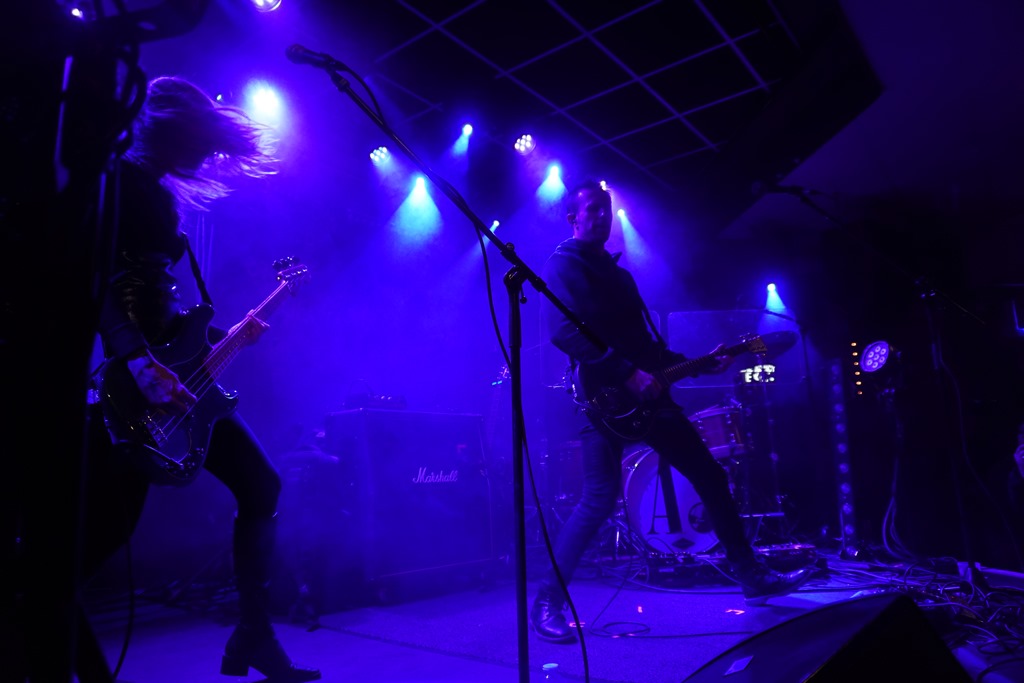
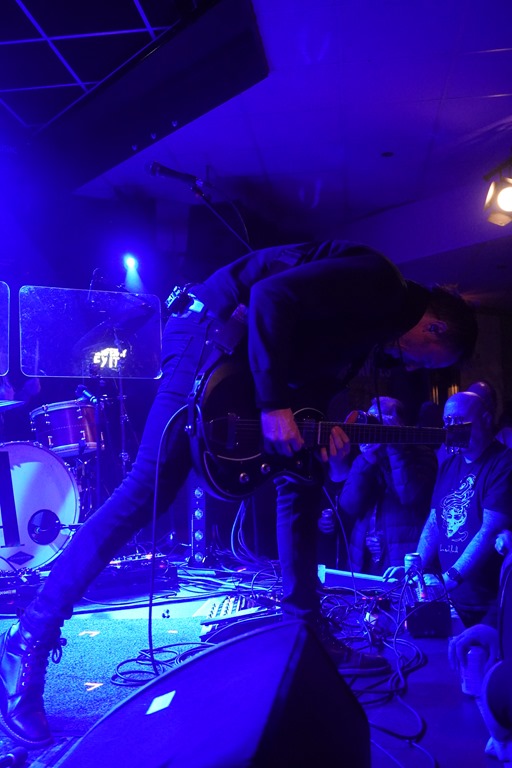
The Crescent is a smaller venue than The Warehouse, and when Vision Video arrive on stage, aspects such as lighting and PA variations are thrown into sharp relief: it’s darker, smokier, the minimal lighting is predominantly purple, and the thumping bass I enthused over in Leeds was significantly less present or impressive. In between songs, they offer similar chat, but it’s clearly not scripted, but notably a lot less chat in general. Vocalist / guitarist Dusty Gannon talks faster, seems less more hyped up, rushing to remind us that the current tour is the ‘Death to Fascism’ tour. Given the state of things over here in the last week or so, they should probably be careful about things like that. But more seriously, anyone with a platform needs to be calling this out right now. Because it’s through silence – and allowing ourselves to be silenced – that fascism spreads.

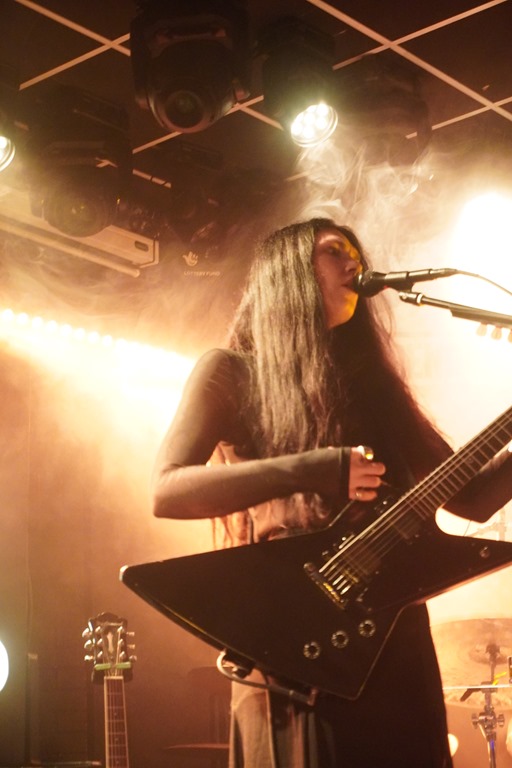
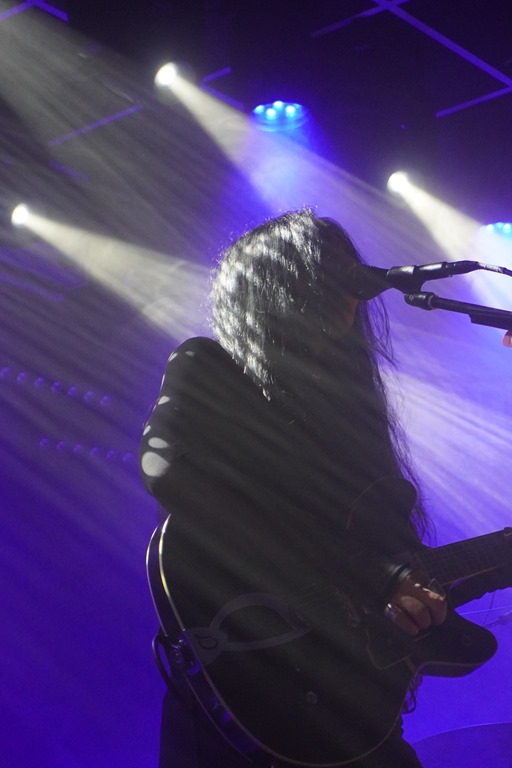
DSC02601DSC02588

Vision Video

Notably, the whoops in support of the band’s anti-fascist messaging are louder tonight. It’s a smaller crowd, but they dance harder, encouraging Dusty to find the confidence to leave the stage and be among the crowd during last song of the set, ‘In My Side’.

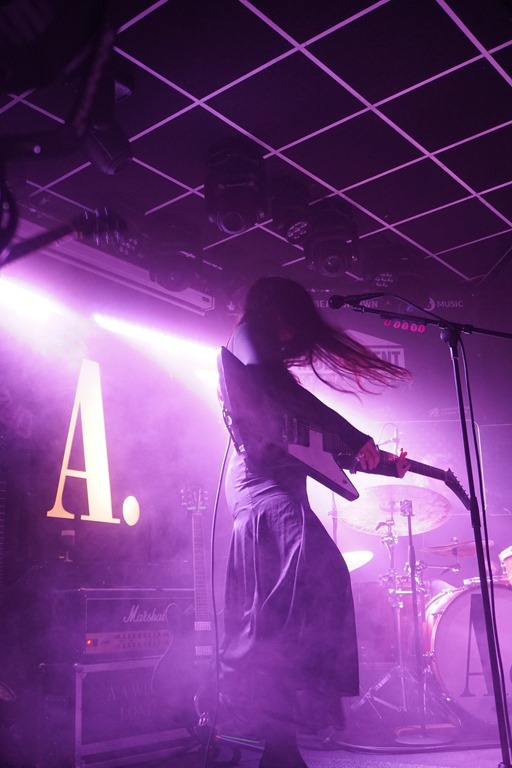
I arrived home buzzing and without having written a single note during the whole of The March Violets’ set. The setlist was the same as Leeds, the intros were similar… but it was anything but a carbon copy show. On the one hand, the sound wasn’t as crisp, but this wasn’t by any means a detraction, in that it replicated that sonic haze of yesteryear, and even the early recordings. Not having Tom Ashton’s amp at face-height perhaps gave me a better sense of balance, and Mat Thorpe’s vocal were both louder and clearer, which was a strong plus.

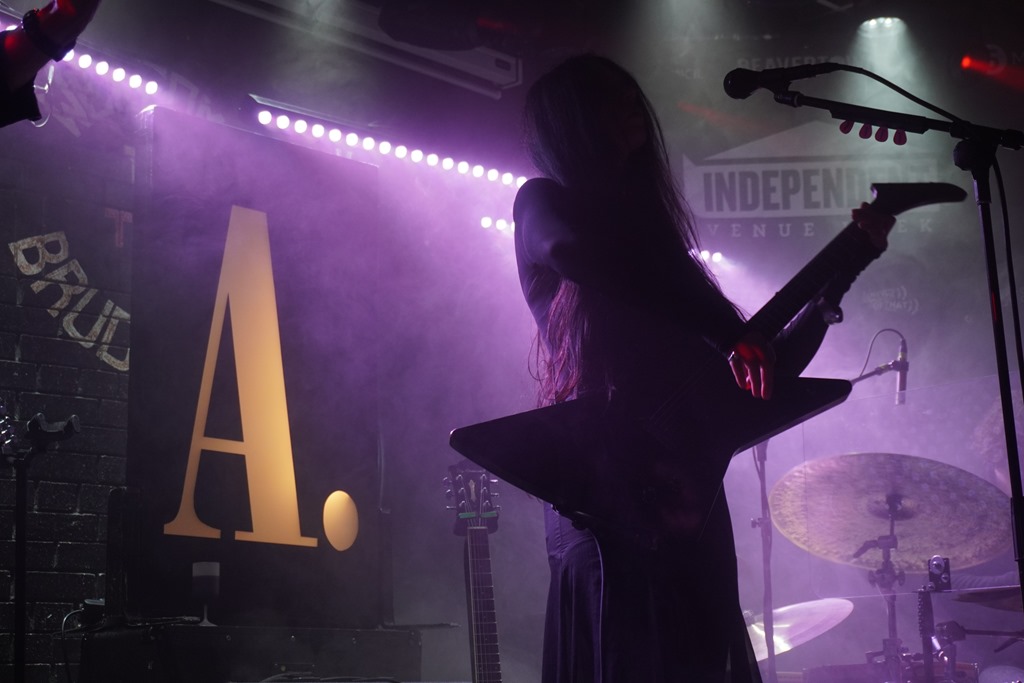
DSC02614DSC02626

The March Violets

Notably, while the front of the Leeds show was frequently disturbed by a number of ambulant photographers – the usual types, tall blokes in T-shirts and knee-length cargo shorts hauling cameras with massive lenses – there was no evidence of any press or lens-luggers tonight (I exclude myself from this category because while I do now use a ‘decent’ camera, I stick to a small lens and keep to my spot, to one side, for numerous reasons, but not least of all to remain as inconspicuous as possible and not to interfere with anyone else’s view). As a consequence, the audience were free to move about down the front, and the band seemed more relaxed, presenting a different energy. They were still clearly enjoying themselves – if anything, more so. Rosie spent the entire set bouncing around like a pea on a drum, and her energy is infectious and joyous.

DSC02661

The March Violets

Ordinarily, one would anticipate a more rapturous response at a hometown show: this has certainly been my experience with other Leeds acts through the years. But perhaps Leeds has been spoiled: it was only last year they played at The Old Woollen, while across the border, it’s been a lot longer – like more than a decade (Whitby appearances notwithstanding).

Tellingly, in Leeds, the claps and chants after the main set had been the somewhat irritating (and rather lacklustre) call for ‘one more song’ which has become a thing in recent years. Tonight, there is a relentless baying noise from a crowd who want as many songs as they can get (there were calls for ‘Bon Bon Babies’ and ‘Undertow’ during the set, and there was a fair bit of banterous to-and-fro with the audience). ‘Fodder’ was well-received, but the place positively erupted for ‘Snake Dance’. The band seem to respond to this, and really attack it, making for a blistering finale to an outstanding performance. If the rest of the tour is half as good, people are in for a treat.

Christopher Nosnibor

In terms of goth history, The Warehouse is pretty much ground zero. Synonymous in particular with The Sisters of Mercy in their early days, it was this milieu which also spawned The March Violets, making their return to the venue for the first time since 1983. I missed that one myself, having been seven at the time, but a fair few of the songs played that night are in tonight’s set list, too, and one suspects they probably sounded better this time around.

Early doors, there’s an almost 50/50 split of old goths and twenty-somethings, who really do seem to have embraced the original 80s dark punk look (as opposed to the ersatz emo stylings that passed as goth in the 90s). The Psychedelic Furs and Christian Death and Strawberry Switchblade are blasting over the PA as we wait for Vision Video, and I make myself comfortable with a pint of Weston’s Vintage at a reasonable £5.80 for a pint.

Vision Video have a long-established relationship with the Violets, with Tom Ashton having produced their first two albums. Stylistically, they’re at the rocky, post-punk end of the goth spectrum, who clearly take their cues more from ‘our’ brand of goth rather than the US ‘death rock’ scene (a mid-set cover of The Comsat Angels’ ‘You Move Me’ is illustrative).

DSC02498

Vision Video

A three-piece with guitar, synths and live drums, the sequenced bass is really solid and sounds… real, with proper low-end frequencies delivered at appropriate volume that make your nostrils vibrate. They’re over here from Athens, Georgia, with a message: they’re anti-fascist, anti-war, anti-capitalist, anti-Trump and anti-dickhead. And as guitarist / vocalist Dusty Gannon is a veteran and ex-firefighter, this is a message that’s delivered with sincerity from a place of experience, and a message which informs the songwriting as much as a vintage record collection. He speaks at length in between songs: none of is it preachy, but it is passionate, and the crowd warms to them (and judging by the clamour front centre, a fair few had warmed to them and learned the words in advance).

The March Violets take the stage as The Sisters’ ‘Marian’ comes on, and it’s a swift fade as they’re straight in with ‘Long Pig’, with a barrage of squalling guitars and stuttering beats. It’s immediately apparent that they’ve still got it, and pleasingly, they haven’t faffed about with the arrangements of the old songs, right down to the hyperactive drum machine programming which defined their early sound. ‘Crow Baby’, dispatched near the top of the set is still wild and sounds like nothing else.

Reminding us that they didn’t release their first album proper until after their post-millennium return, they give us ‘Made Glorious’, from their epic 2014 debut, followed by ‘Hammer the Last Nail’, lead single from recently-released follow-up Crocodile Promises.

DSC02543DSC02539

The March Violets

Playing ‘Grooving in Green’ and then ‘Steam’ replicates the running order of their 1982 single, and the interplay between the different elements comes through clearly: first, there’s that unique Leeds sound, with a thick, chunky bass welded to a thunderous drum machine, juxtaposed with a guitar style that draws at least a certain degree of influence from Gang of Four – scratchy, trebly, choppy, with some unconventional use of harmonics – and then there are the songs themselves, which are the product of distinct personalities. Bassist Mat Thorpe, who joined for the new album provides the more shouty male vocal counterpoint to Rosie Garland’s clean, theatrical enunciations, and as such, the essence (no, they don’t play that) of the old classics is retained. Meanwhile, ‘Kraken Awakes’ and ‘Crocodile Teeth’, lifted from the new album from new album sits comfortably alongside the older material.

The sound seems to get louder and brighter (and probably purpler) about halfway through the set, and they take things up a notch, Rosie confessing that they’re having a blast up there – although, truth be told, it’s pretty obvious: she’s in fine voice, and busting moves all over, and Tom spends half the set with a massive smile on his face. They know they’re sounding good, and they know we’re loving it, too.

DSC02556

The March Violets

Towards the end of the set, ‘Strangehead’ is particularly wild and wonderful. They encore with a blistering ‘Fodder’, and there is simply no way they could leave without giving us ‘Snake Dance’, which is one of the definitive anthems of goth – the Violets’ ‘Temple of Love’, if you will.

Tonight, we’ve seen a band on peak form, and proving that they’re a lot more than simply a heritage act, too. Long may they continue.

DSC02535

Saccharine Underground – 1st July 2025

Christopher Nosnibor

This one hell of a hybrid. Just when you think post-punk has been explored to the point at which it has been hollowed out, exhausted, and has only well-worn and instantly recognisable tropes to offer, along come Washington DC’s Zabus, purveyors of avant-garde post-punk with an EP which is something of a ‘best of’ with tracks from their two recent albums, Automatic Writhing (September 2024) and Floodplain Canticles (January 2025), plus a new track which paves the way for their next offering Whores of Holyrood (due in August).

With its immense, reverb-laden sound and expansive, drifting desert-like soundscape ‘Grafhysi Fyrir Alla’ makes four and a quarter minutes feel like a hypnotic span of double that duration. The shuffling bass and big, booming bass are pure dub. The guitar chimes and floats into the ether as everything swashes around in a huge echoic pool.

Of ‘Grafhysi Fyrir Alla’, lifted from last year’s Automatic Writhing, project founder and focal member Jeremy Moore says it’s about “the societal imposition of unobtainable standards of beauty, and our obsession with physical perfection at the expense of true happiness”. This is certainly not a case of style over substance, but a coming together of musical inventiveness with a level of intellect which is rare. “Psychopathologies like body dysmorphic disorder, at the extreme, can lead to a path of ruin, if most of your life is spent chasing a ghost—what you believe the world wants you to be. Death doesn’t discriminate. The end is always the same.”

This is some pretty heavy – and dark – philosophy on offer here, and it’s welcome: as much as there is much to be said for the benefits of the escapism music can offer, there’s equal solace to be found in art which articulates one’s own world view. And so it that that Zabus portray contemporary dystopia from a range of camera angles.

‘Orphalese’ is more uptempo and is decidedly cinematic with its broad-sweeping layers of synths driven by propulsive, rolling drums. There’s no verse / chorus structure, but instead a hypnotic expanse of sound, the aural equivalent of standing on a summit and looking out at a three-sixty horizon through a heat haze. It’s immersive, utterly absorbing, and transportative.

The first of the tracks lifted from Floodplain Canticles is the six-minute ‘Tearful Symmetries’, which is low and slow, Jeremy Moore’s reverb-drenched baritone croon approximating the late, great, Mark Lanegan against a dubby backdrop punctuated the clangs and scrapes of guitar drones and sculpted feedback. ‘This is the end….’ He reflects, but not with sadness or panic, but a sense of inevitability.

‘Golden-rot’ goes all out for the theatrically gothic experience: it’s as big on drama as it is on sound, as an insistent mechanised drum beat pounds away, cutting through a smog of murky guitar and thick, booming bass, and if I wasn’t already perspiring hard from the humidity and thirty-degree heat, this would make me sweat, with its tension and crackling energy.

And so we come to the title track, the first taste of Whores of Holyrood. It’s different again, although the cavernous reverb is a constant. This cut is a brooding piece that borders on country, once more evoking the spirit of Lanegan. It’s spacious, but its intensity brings an almost suffocating weight.

Shadow Genesis provides a perfect introduction to Zabus, and at the same time whets the appetite for what’s to come. And let me tell you, it’s something to get excited about.

Zabus - Shadow Genesis cover art

5th June 2025

Christopher Nosnibor

It may seem hard to believe, but there is music beyond Glastonbury at this time of year, and it may seem even harder to credit, but more than ten acts played the festival. And because right now, it seems there’s nothing but wall-to-wall debate over Bob Vylan’s performance, I feel more than ever that my job here is to focus my energy elsewhere. The only thing I will say on the matter is that it’s staggering just how vehement the criticism has been of the band in the media and by the government, when criticism of the perpetrators of genocide has been largely non-existent. The statement on the stage backdrop makes the point perfectly: “Free Palestine. The United Nations have called it a genocide. The BBC calls it a ‘conflict’.” And yet, I’ve observed countless couch warriors calling Bob Vylan ‘opportunists’ and ‘attention seekers’.

And this is where we land with ‘What You Made Me Do’, the new single by female-fronted grungy alt-rock four-piece Shallow Honey. Not because it’s a political song – it isn’t – but because it’s a song that comes from that breaking point where something just gives. Because normal dialogue simply has no effect. When the only way to get someone to listen is by going to an extreme.

I am screaming for attention

finding all the words

the words that can offend you.

Rai, Shallow Honey’s vocalist, describes the meaning behind the track: “WHAT YOU MADE ME DO is a track about when you have been calmly expressing your feelings and frustrations to someone over a long period of time, yet have not been heard. After a while of repeating yourself and trying to meet them where they’re at with nothing back – you will snap! Like holding a beach ball under water – you can only push it down for so long. It feels good to let go – but it’s also really scary and sobering”.

It’s indubitably relatable for most of us – and for those who it’s not relatable, it’s likely because you’re the one who’s given to endless stonewalling, the shit who will act surprised, dumbfounded, offended, and then suggest that this is an overreaction from someone who’s being sensitive or whatever.

‘What You Made Me Do’ is appropriately fiery, with driving guitars to the fore in what is a solid rock tune that would could have come from that early ‘90s golden age of grunge. But Rai’s vocals, while, strong, bring melody, with a tone reminiscent of Gwen Stefani, giving the song an instant accessibility – without diluting the power of the sentiment.

B-sides ‘Aim Low’ and ‘Start the Ride’ are both of a similar quality, with guts and a raw energy that’s completely compelling.

In short: this is good stuff. Dig it. More soon, please.

AA

AA

Shallow Honey - Artwork

Dark Scrotuum – Rotting Dream

Cruel Nature – 27th June 2025

Christopher Nosnibor

As the label recently hailed in its midyear roundup, Newcastle-based cassette label Cruel Nature has put out some forty releases so far in 2025, which equates to one every fortnight. It’s no small achievement, particularly considering that not only are they essentially a one-man operation but they’re hardly mainstream in their output – and what’s more, that output is remarkably diverse. More often than not, niche labels adhere to a fairly narrow range, whether it’s black metal, indie, or experimental in nature: they know their audience, and cater to them, knowing they will shift inventory. Cruel Nature takes a different approach, which isn’t without risk, in that they release music they feel meets a standard based on quality rather than style, meaning that label collectors may not love everything – at least at first – but will be introduced to stuff they wouldn’t have otherwise listened to, and fans of given bands or styles will make discoveries by association.

And so we come to Rotting Dream by the wonderfully if somewhat crassly-named Dark Scrotuum. You know before you hit play that whether it’s black metal or power electronics, it’s probably going to be pretty nasty, right? Right. It’s pitched, quite succinctly, as ‘crushing dark ambient BM drone sludge noise’. BM could as readily be taken in the American sense – bowel movement – as black metal here. And believe it or not, that’s not a diss. Anyone who’s familiar with Aural Aggravation will be more than aware that heavy shit is our bag, and specifically my bag. And this is some heavy shit, bowel-trembling, uncomfortable, heavy shit.

The first of the three tracks, ‘Skin the Fool’, is seven and a half minutes of earth-shifting, stomach-churning dark ambience with a growling, grumbling industrial edge. It’s dark, and it’s heavy, a constant, heavyweight rumbling, the sound of destruction, of desolation, like slow-motion detonation. The first three minutes alone are utterly harrowing, and then, from nowhere, it goes nuclear, a churning blast of noise so dense it hurts, an extended billowing explosion that replicates the impact of Threads. Game over? Life over. Existence over.

Dark scrotuum? Tense and shrivelled scrotuum is the initial reaction to this brutally harsh work. ‘Pineal Gland Turning to Mush’ is ten minutes of tension, meaning the track is appropriately titled, barrelling into a relentless wall of harsh noise. It’s not quite HNW because there is texture and variation over its duration… but fuck. It’s abrasive, obliterative. I find myself sitting here, sweating, wide-eyed, uncomfortable. This is… intense, alright. It hurts.

And then, there is ‘Tears of a Flower’, the harshest heaviest, most explosive cut of the three. Toss Sunn O))), Prurient, Swans, and Vomir together and you’re about there. It seems that Dark Scrotuum have pulled together everything – and I mean everything – they can conceive to create the nastiest, most overloading wall of noise possible. ‘Tears of a Flower’ is a punishing, brutal sonic assault which offers no respite, only more pain, and more pain and more pain. And you feel it. There is not one fleeting moment of kindness, no respite. This is music to puke to as you feel your eardrums collapsing and your soul shrivelling. As for our dream…it’s over.

AA

a4040102512_10

The Helen Scarsdale Agency – 23rd May 2025

Christopher Nosnibor

The pitch alone is harrowing: ‘“Don’t be scared by death,” Alice Kundalini (aka She Spread Sorrow) calmly instructs at the beginning of her collaborative Grimorian Tapes with partner Luca Sigurtà. Her words slither from her lips with a subtle, sinister unease, compounded by the unsettling quality of her whisper. The fear of death, this most profound condition, has long been a subject of philosophical, spiritual, and existential inquiry. To fear death is undeniably human; to transcend that fear is often seen as reaching a higher plane of existence. At least, that’s the intention behind the rituals, the spells woven into the fabric of The Grimorian Tapes.”

I myself have spent a lot of time contemplating death, and the fear of death, especially of late. We are all scared of death, particularly in Western culture. When my wife was diagnosed wit stage 4 breast cancer, where it had spread to her bones, I was terrified, not only of losing her, but of waking up to find her dead in the bed beside me. What do you do in that situation? I did not want to see her dead, and she did not want me to see her dead. Thankfully, she made it to a hospice for her last day, but I lived for a year under the shadow of that ‘what if…?’

You might think that her passing brought peace, but it did not: instead, I have spent many mornings twitching and drenched in sweat lest I should die and leave our daughter an orphan, being thirteen. This is not a call for sympathy – simply as summary. It’s hard not to be scared by death, inevitable as it is.

For additional context, it’s worth delving into the details of the album’s inspiration, a large portion of which comes form The Black Pullet, ‘an 18th-century French grimoire filled with instructions for making talismans and magical artifacts’. We learn that ‘Kundalini weaves her own take on the book’s esoteric themes into the shadowy tape loops that comprise The Grimorian Tapes. The Black Pullet is a detailed guide into alchemy, divination, and occult practices, with a particular focus on harnessing hidden forces through the construction of specific objects imbued with magical power. Though Kundalini doesn’t practice these rituals per se, she finds a deep, poetic resonance with these ancient teachings. The allure isn’t in the performative aspect of these rituals but in the seductive power of its symbols and ideas, which speak to a long-forgotten language of metaphysical mystery. It’s this sense of transmutation, hidden knowledge, and occult wisdom that lends The Grimorian Tapes its dark, ritualistic intensity.’

And so it is that ‘grimoire’ introduces the album with a dark etherality, whispered vocals, the words indecipherable. Echoing amidst rumbles and a persistent drone which ebbs and flows. It’s compelling, and enticing, but at the same time, unsettling. It’s the fear of the unknown, of course: the esoteric and other-worldly and anything that speaks of a realm beyond one’s ken is always difficult to assimilate. This, in a nutshell, is the appeal of horror, because a lot of us find entertainment in being scared. It’s the same reason people go on rollercoasters. Being scared half to death reminds you that you’re alive. And The Grimorian Tapes is pretty scary, in the suspense and horror sense.

‘initiatory’ rumbles and hovers dark and murky, sonically entering the domains of Throbbing Gristle, and again, the whispered vocals are menacing, and reminiscent of Prurient’s Cocaine Death, while ‘the stairs’ brings a hint of disturbing playground, psychological derangement, the other ‘other side’ we’re all so afraid of due to a lack of comprehension. And the further this album progresses, the more uncomfortable and unsettling it becomes, the further it extends beyond the domains of the ordinary, the mainstream comprehension.

‘babele’ is a dank, muddy morass of sound over a slow thudding heartbeat rhythm, while ‘kirtan’ brings flickering, stuttering beats, while again leading the listener through hair-prickling terrain, with triffid-like stem-clattering and gloomy swirls and abstract vocals. ‘we worship you’ plunges deeper into a darker space, with sputtering electrostatic sparking, and gargled vocals, deep and robotic, growling, threatening and emanating from another place, another world, one beyond reach. ‘me and I’ churns like slow machinery, and is industrial in the primitive sense. Again, the way we have come to understand ‘industrial’ has evolved: Foetus is a far cry from Throbbing Gristle, and both are a world away from NIN and Ministry. But The Grimorian Tapes takes us right back to the origins of the genre.

This is one dark and difficult album, heavy and suffocating and uncomfortable from beginning to end. Two thumbs up. And now I need to lie down.

AA

a0844152259_10

Sonic Pieces – 30th May 2025

Christopher Nosnibor

Five years is quite some time, and a lot has happened in the last five, that’s for certain. Although the fact so much has happened means that the last five years have been something of a void for many. And so it is that Reverie, recorded in October of 2024, sees Otto A Totland (piano) and Erik K Skodvin (guitar, cello, electronics, and processing) reunited in concert for the first time since 2019.

It’s pitched as ‘a follow up to 2014’s Recount, which saw two pieces of music created around their live-sets in different periods. This time, we are treated with a contemporary, raw live performance from October 2024 in Rabih Beaini’s studio, Morphine Raum in Berlin, during the 15th anniversary celebration of Sonic Pieces.’

The two longform pieces which make up Reverie were recorded live, and as if to prove the point, there’s the sound of a light cough just as the first piano note hits, then hangs in the air. They could have dubbed it out, I’m sure, but to have done so would be against the spirit of this work – spontaneous, improvised, in the moment. The recording is not only about capturing the music, but the moment itself.

The seventeen-minute ‘Rev’ is delicate, built primarily around Totland’s graceful, nuanced piano work, and considerable reverb, which may well be natural from the room, but however the sound is achieved, the sense of space is integral to the atmosphere. Skodvin’s contribution is magnificently understated: the slow scrapes of strings and subtle sonic details may seem secondary or additional because they’re not the focal point, but without them, the effect would be diminished by more than half. A great musician is not necessarily the one who dominates or demonstrates virtuosic talents, but the one who understands their contribution to the work as a whole, and appreciates that less is more. And so it is that elongated notes quiver and quail, wailing tones and sonorous drones swirl about and bring so much depth and texture, an as the piece progresses, the piano and extraneous incidentals achieve an equilibrium, and it’s utterly mesmerising.

‘Erie’ turns the tables, and it’s Skodvin’s strings which take the lead initially, before trepidatious piano creeps in. Trilling tones hang hauntingly like distant memories and displaced ghosts, and there’s a melancholia to this piece which is difficult to define, but lingers amidst the brooding lower notes. The slow piano is soft, and sad, while tremulous strings evoke a sense of something lost, somehow.

Without words, Reverie paints a picture, and hints that memories and reveries are inherently tinged with sadness. For even to recall a happy time is to remember a moment which has passed, and will be relived. However many times one may return to a particular place which is imbued with fond memories, however many times one may listen to that favourite song which carries such joyous connotations, that moment, that time will forever continue to recede into the past, never to be experienced again. The past is forever past, and will become further past with each day that goes by. Summers will never be as long, or as carefree as in childhood. The exhilaration of new experiences will never provide the same buzz, however hard you chase it. And with this realisation comes the slow fade, and a sense of acceptance. Bask in the reverie, and hold those times dear as the years slip away.

AA

ReveriePATTERN013 front

Photo: Alex Kozobolis

Christopher Nosnibor

What do you do as a touring band over here from the US with a night off in between stadium shows supporting Guns ‘n’ Roses? Night off to unwind, maybe do a spot of tourism, rest up ahead of the next one? If you’re Rival Sons, you squeeze in an extra headline date in a city that is absolutely nowhere on the way between Birmingham and London. I suppose travel logistics in terms of getting about the UK of rather different from what they’re used to at home, but still – between Villa Park and Wembley Stadium, at relatively short notice, they decided to swing by York.

Music is so often interconnected with memories, times, people, places, events: it provides the backdrop and the sound track to our lives. And so it is with Rival Sons. My late wife purchased a copy of head down, which received heavy rotation in the car. She liked her old-school rock. It may not be the standard Aural Aggravation material, but when I saw they were coming to York, I decided my daughter and I should go – not out of any great love for the band, but for her, in absentia. She was, no doubt, with us in spirit. And I always write a review, for posterity, for the record, if nothing else. I am aware that I will forget things, in time. This is a document.

The demographic is very much slanted towards the more senior end of the spectrum: as my daughter put it loads of old white dudes, but also lots of couples clearly 55 plus, all dressed in such a way that says they don’t go to many gigs each year, and when they do it’s this time of a venue. I’m acutely aware that I’m rapidly approaching this demographic, but I’m mindful of trying to avoid being one of the annoying ones.

The metal detectors tickets scanners and £8.25 pints are something of a culture shock to me, more accustomed than I am to attending shows and venues with capacities under 400 more often than not, and where I can just give my name on the door – or not, as happens when you go to places often enough over a number of years.

Support act Creeping Jean are from Brighton but wish they were from America fifty years ago. They’re solid and adhere to the 70s rock template, down to the haircuts and the guitarist’s flared white suit (no doubt sourced from frontman Olly Tooze’s vintage clothing shop) . They’re decent enough, apart from the irritating tambourine guy (he does some backing vocals and plays acoustic guitar on one or two songs, but his main purpose seems to be to bring energetic posing and some tambourine action) and the fact that while the clean bass sound was nice and dense, the distorted sound reduced it to a horrible scratchy buzz.

20250624_200832

Creeping Jean

From the off, it’s clear that Rival Sons are a cut above. The sound is loud and clear, and they have that essential swagger, which is justified when the musicianship is this good. Jay Buchanan struts on, barefooted, and they’re straight into ‘End of Forever’. And the band completely fill the stage with sound, and with presence. The hirsute Buchanan embodied the essence of Robert Plant, and Scott Holiday provides the perfect foil to his flamboyance with an equally dominant stage presence while wielding a multitude of guitars. He is a joy to watch, though, and his approach is innovative, playing with a host of effects and tunings that are anything but conventional. To describe him as the Tom Morello of blues rock may be a bit of a stretch, but you get the idea. He certainly pushes things out a way – and a fair way at that.

While most of the set is lifted from the two most recent albums, they always seem to ensure that all of the albums are represented during the course of a set. With ‘Keep on Swinging’ being the usual song taken from Head Down, I had next to no expectation of hearing what is by far my personal favourite track, ‘Manifold Destiny’ – but lo, they pulled it out around halfway through and played the full-ten-minute epic midsection.

Sure, the guitar solos are often overdone, over long, and indulgent (for context, they play for around an hour and forty-minutes, packing five songs back to back at the front end of the set and there’s no encore, but they still only play fifteen songs) and the vocal gymnastics are at times way over the top, but to complain of these things about a band so solidly cast in the Led Zeppelin mould would be to completely miss the point.

20250624_21590720250624_215913

Rival Sons

Towards the end, Jay thanks us not just for supporting their band and live music, but also rock music, and it’s an important distinction: this is rock music in the classic sense, and when it comes to classic rock they do everything which meets the essential criteria, and they do it well, and deliver it with panache. Rock music by nature is over the top, and if you’re going to go over the top, it’s best to go way over the top, with the flashiest longest guitar solos the most extravagant delivery, the most showmanship. Rival Sons recognise this and revel in it, and it’s impossible to deny their quality.

I reckon my wife would have enjoyed it. And rightly so. They play hard and put on a show, and will likely piss all over G’n’R at Wembley.

Mortality Tables – 20th June 2025

Christopher Nosnibor

Lunar Forms is Rupert lally’s second release on Milton Keynes label Mortality Tables, following his Interzones album, released in November last year, and forms part of the latest ongoing project by the label, dubbed The Impermanence Project (which so happened to feature a tense but lugubrious ambient work by some guy called Nosnibor a short while ago).

Sometimes, while I try to work through my review pile in a broadly systematic way, I have to reshuffle my priorities according to mood. And right now, my mood is jittery, jumpy, tense, unfocused, meaning that what I need is something fairly gentle, somewhat abstract, if not necessarily ambient. But also something which feels relevant, in some adjacent fashion. And so here we are: bombs are dropping and missiles are flying, and it’s maybe easy to dismiss it as taking place at a safe enough distance away…. But is any distance truly safe enough?

And so, it’s necessary to seek solace in distraction, solace in abstraction, something that offers layers and textures that draw you in, captivate the attention… but at the some time, offers something more to reflect on while listening to the glitches and echoes, woozy, skitty fragments of analogue pull my attention in different directions.

Impermanence… as polyartist and the innovator of the cut-up method, Brion Gysin said, ‘we’re all here to go’. And we are. We fear it, but it’s impossible to escape the inevitable. It’s not a question of if, but when.

Lunar Forms transitions between stuttering, glitching minimal techno and slowcore EDM, and more expensive, cinematic instrumental sounds which are overtly ambient. Electronic fuzzed and buzzes spark over swirling soundscapes, and at times we’re led into Tangerine Dream territory, while at others, we find ourselves adrift. The fact that, including bonus tracks, Lunar Forms features eighteen pieces, and has a running time of some seventy-four minutes, is significant. It’s a vast and expansive work, and one which is easy to get lost in, since the tracks are distinguished only numerically, ad those numerical titles are not tagged sequentially.

There is a lot of dark atmosphere, a lot of rumbling. There is much haunting reverb, considerable space, a great deal of bubbling, blipping, hovering. The deeper it plunges into spacious, cloud-like disturbance, the more immersive and simultaneously the more the power of this work increases. Breathe deep… and feel everything this represents. ‘313’ May be sparse, but it also edges its way into the space between dance music and the BBC Radiophonic Workshop, while ‘325’ pitches jittery microtonal beats against sonorous strong-like sound. It’s simultaneously tense and introverted, and outward-facing through cloud. The beats of ‘303’ are like the dripping of a tap amidst synthesizer drones and swirls. And it goes on. As such, Lunar Forms is more than varied: it straddles boundaries in a way which renders it almost impossible to place.

AA

cover

Distortion Productions – 20th June 2025

Christopher Nosnibor

Ahead of their new full-length album release, Haunted Hearts, slated for an autumn release, Metamorph have served up the Harlot EP, which offers their usual blend of glistening electropop with a dark gothy, witchy flavour, and promises to be ‘your summer soundtrack—sweat, stilettos, and seduction.’

Living in the north of England, the last thing I would have expected to be doing was writing this at what is, with any luck, the tail-end of a heatwave – but is does mean that while I’m short on the stilettos and seduction, I have more than enough sweat to make up for it. But it does remind me of the difference in where UK goth – particularly the early stuff – and US goth comes from in terms of its geography and broader environs. As the phrase goes, ‘it’s grim up north’. It rains a lot. It’s often cloudy, windy, and cold. Until recent years, if it went over 20ºC, even in the summer, it was hot, and you’d be forced to remove the leather jacket. These conditions, coupled with generally poor conditions of low wages, high unemployment, and social deprivation, meant that dark music articulated the experience of the world as is.

America has always had its own problems, of course, but summer has always been a bit different from on this side of the pond – inasmuch as the US tended to have summers. Anyway. ‘Harlot’ is classic Metamorph: uptempo. HI-NRG, somewhat sultry, gothy electropop, and concise, clocking in at a fraction over two and a half minutes. With pounding beats and a throbbing bass, it’s got that late 80s eurodisco / technogoth vibe, with a hint of KMFDM but popped up. In terms of singles, it delivers everything you’d want.

The five remixes are solid, in particular – and I’ve amazed myself in writing this – the dance mix, which really places the bass and the beats to the fore, and the expansive Allie Frost Remix is really quite special, adding a well-suited 80s spin to the sound, led by a dominant snare which is just perfect.

But my awkwardness with remix-led releases remains, and this EP gives us the same song, six times. It’s a good song, and some of the remixes are great, but… Bring on the album.

AA

229878