Archive for the ‘Reviews’ Category

Analogue Trash – 15th August 2025

Christopher Nosnibor

It’s been a busy spell for The Royal Ritual. You might say that David Lawrie is making up for lost time. With real-world activity off the cards during the pandemic, he assembled The Royal Ritual’s debut album, Martyrs, and followed up swiftly with the more sophisticated Pleasure Hides Your Needs last year, as well as an EP and some proper touring, which saw that sophistication taken to the stage in such a way that created a spellbinding live show and immense sound. Despite there only being two bodies on stage, two live guitars, a combination of programmed and live drumming, looped, not to mention ambitious visuals makes for a compelling performance. There’s no question that this this was a show that would be perfectly suited to a bigger stage, and landing a slot at Infest provided the opportunity for the band to truly come into their own. The live footage they’ve shared online confirms this, and the quality of the performance very much justifies this live album’s release, capturing as it does the full set with first-rate fidelity.

AA

It’s a masterfully structured set, which draws equally on the two albums, and begins with atmospheric organ leading into the slow-building ‘Vantage Point’, slow, brooding synths and a pulsating kick drum giving way to a barrage of beats and crunching, metallic industrial guitar. There’s no dead space between the songs: a tapering drone and snippets of samples maintain the atmosphere before ‘(nothing) On the Other Side’ thunders in on a thunderous percussive assault, and things only turn darker, heavier, more intense and more percussion-led on the claustrophobically intense ‘Pews in the Pandemic’. Lawrie gives it some guts in the vocal department, switching between menacing and wracked with anguish, and peaking at epic, emotive.

The processed-sounding guitars and synths have that KMFDM / Pig vibe and would be perfectly at home on a Wax Trax! release from the early 90s, but the colossal drumming sets it quite some way apart. Moreover, where The Royal Ritual really succeed here is in the way they preserve the sound – and the detail, and, importantly, the mechanical tightness – of the studio recordings, while the use of so many live instruments and, for wont of a better term, ‘moving parts’ means that this has the full energy and dynamics of the live setting, that edge, that bite. Naturally, this is felt more strongly when you’re actually in the room, in the moment, with the electricity of the proximity to the band, and in a room full of people, but this does a top-notch job of capturing it all through the medium of sound alone.

‘Martys’ is a full-blooded industrial-strength dark glam-tinged stomper, and ‘Modes of Violence’ takes things up a notch, combining solid hooks and gritty, hard-as-nails industrial guitars. It’s fitting, then, that ‘Coma’ closes the set with a more reflective feel, with expansive almost trance-like passages intersecting with electronic-led progressive segments. Lawrie’s soaring vocals are rich with emotion that’s almost spiritual as they ascend to the skies, before the set concludes with a glitching stutter, somewhere between a Morse Code SOS and teetering on a flatline, amidst a mutter of sampled dialogue and siren wails. It’s a bleak, almost apocalyptic, Bladerunner-esque finish. There is high theatre here, but there is also real human spirit, and an emotional range not always found in the sphere of electronic / industrial music, which can, at times, feel cold, clinical, detached.

The quality of the songs was already evident in their studio releases, but Live at Infest demonstrates that not only do the songs have further dimensions which only become apparent in a live setting, but that The Royal Ritual are a killer live act.

AA
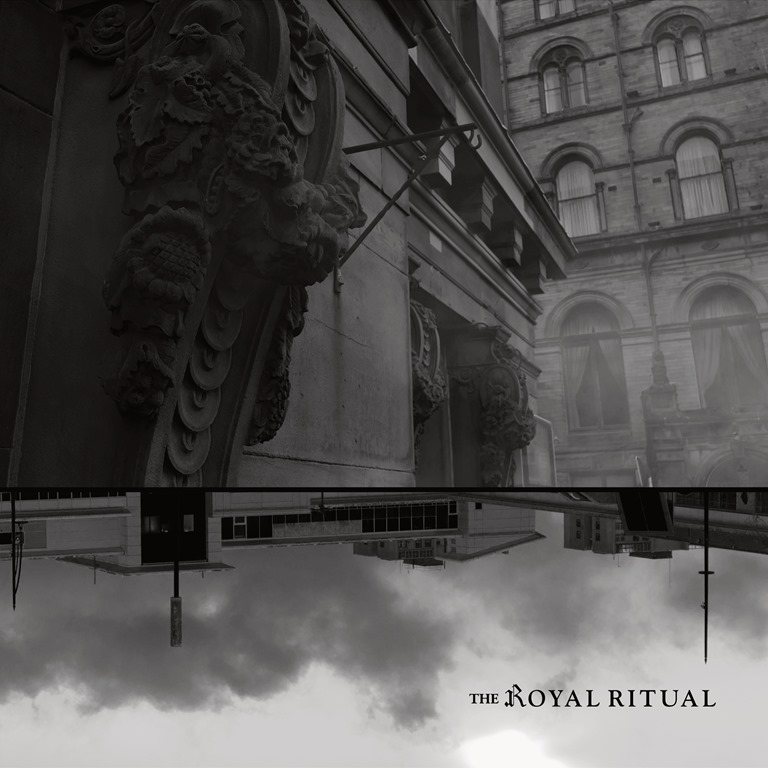
The Royal Ritual - Live at Infest (Digital Cover)

Prophecy Productions – 19th September 2025

Christopher Nosnibor

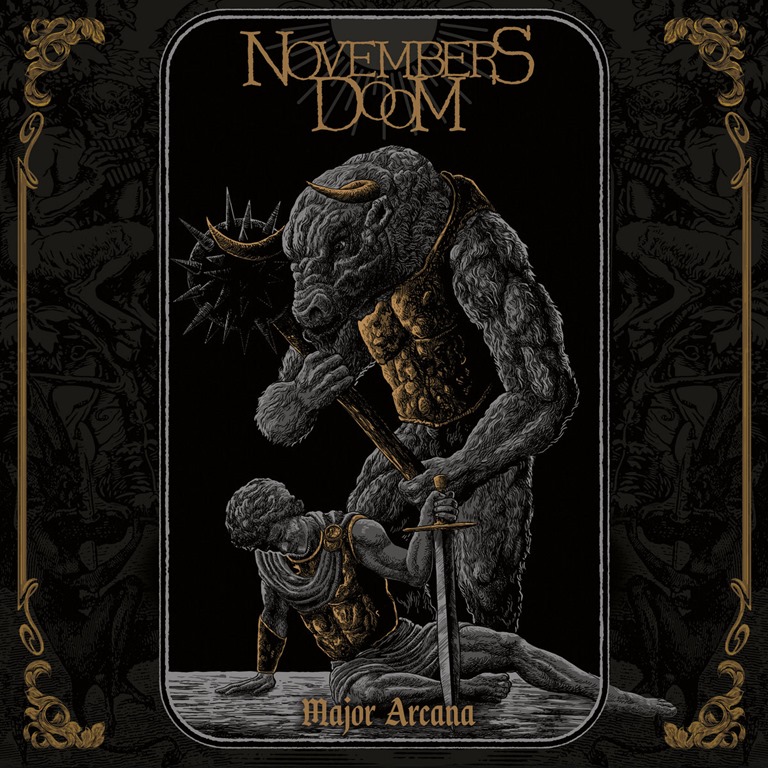
Founded in Chicago, by vocalist Paul Kuhr, Novembers Doom have been going since 1989, and have to date released a dozen albums, if we include their latest offering, Major Arcana, since their 1995 debut, Amid Its Hallowed Mirth.

According to their bio, having started out as exponents of ‘death doom’, they’ve come to formulate a genre unto themselves, ‘dark metal’, which blends their death metal and doom roots with progressive, folk, and classic rock influences. Sometimes, I think I should probably avoid reading bios before listening to releases, because this stylistic summation is somewhat offputting to my sensibilities. I also think bands should check their punctuation – particularly apostrophes – when declaring their name, but I’m a pedant.

As the album’s title suggests, the theme – or concept, such as it may be – revolves around the tarot deck, which originated in the middle ages and has inextricable ties to occultism and mysticism. The major arcana (greater secrets) are twenty-two cards which feature in the 78-card deck used by occultists and esotericists.

‘June’ is not one of them, but this atmospheric piano-pled intro-piece is a well-considered composition which blends neoclassical instrumentation, underpinned with a sense of foreboding, and menacing vocals, makes for a suitable appetiser. The songs are not all specifically focused on a specific card, but instead explore their meanings and more.

These are some long songs, extending past the five-minute mark and well beyond, and the scale of the ambition – both conceptually and musically – is clear. The sound is cinematic in scale, the production is clean and expansive, the drumming switching from double-pedal thunder to more standard four-four beats adding emphasis to a solid guitar sound.

It turns out that the bio is fairly accurate. Sometimes, they hit a crunching metal groove that’s burning with churning distortion and snarking guttural vocals, as on ‘Ravenous’, a powerful blast of infinite blackness. These moments are charred gold.

But as songs like the title track and ‘Mercy’ find the band easing into more melodic territory, emanating progressive, and in places, vaguely folk vibes. On the latter, they cross towards Black Album-era Metallica – by which I mean the mellowness of ‘Nothing Else Matters’, and such serious emotive efforts feel somehow wanting. In the main, they’re better when you can’t make out the lyrics, but more than that, it’s not easy take the overly bombastic, overwrought thing delivered with a straight face entirely seriously.

AA

‘The Dance’ brings a magnificent chugging riff that just goes on and on, relentlessly, and it’s satisfying and solid. But the vocals, gritty but tuneful, feel like a bit of a letdown in contrast. Perhaps it’s the context, which makes melodic tracks sound simply weak in contrast to the might of the full force they demonstrate elsewhere. Perhaps it’s just my personal preference. I can handle diversity and range across an album, but there’s a sense that Novembers Doom are simply striving to cover too many bases here, or otherwise show a lack of focus. Either way, as bold and ambitious and well-played as it is, and despite the thematic framework, Major Arcana isn’t particularly cohesive, switching styles hither and thither without really pulling things together. The eight-minute ‘Bleed Static’ is a standout by virtue of its sustained menacing atmosphere, and while it’s as guilty of the Metallica-isms and folk appropriations as other tracks, it’s realised in a way that feels more committed, and there’s a mid-point crescendo that lands nicely and everything falls into place… and I suppose it’s against this benchmark that other tracks fall short.

I doubt existing fans will be deterred by any of this, but, objectively, Major Arcana isn’t bad, but it is patchy, an album that’s mired in metal cliché and fails to scale the heights of its ambition.

AA

a4251308479_10

Dimple Discs – 22nd August 2025

Christopher Nosnibor

Weird shit is welcome here at Aural Aggravation. It was a part of the ethos of my starting this site back in 2015. Yes, it’s been that long since I decided that I wanted to strike out alone with a view to creating a platform devoted essentially to stuff that appealed to me and exploring them with more long-form, discursive essay-type writing. This of course completely went against the grain of where most media, in particular music media, is at now, and this has only become more pronounced over the last decade, in which time attention spans have largely been reduced to circa 120 characters or simply .GIFs and memes. But – presumably because my focus is on rather niche music which doesn’t always receive a wealth of coverage, rather than because of my propensity for divergence into the personal or the political – Aural Aggravation now attracts a respectable readership. I don’t feel any desire to celebrate 10 years of doing this: to do so would really be to celebrate a decade in a lifetime of stubbornness, a compulsion to write, and a musical obsession which I choose to inflict upon the world, but I do suppose, on reflection, that the rarity of the format, occasionally touching on theory, but – hopefully –without too much hypotactic wankery.

And so we arrive at XiX by Kev Hopper, who despite fourteen solo albums, and despite co-founding electronic act Ticklish in the late ‘90s, and was composer/bassist with Prescott in the 2010s, and working as a visual artist by the medium of painting for a good number of years, is still probably best known for being the bassist in Stump between 1983 and 1988. Despite only releasing one album proper, their output of singles and EPs was solid, they were all over the music press at the time, and they were championed by John Peel. This potted history throws into sharp relief just how times – and the face of the music industry, particularly outside the mainstream – have changed.

Hopper’s second album on Dimple Discs is a collection of quirky, whimsical electronic experiments. Skittery, light, and lively, there’s a playfulness which defines the pieces, even when sliding into low-end notes and minor chords. ‘Vector Prodder’ plunks and plonks, twangs and reverberates, and slides into spooky but fun territory, and in some respects it’s got 1960s Addams Family vibes. ‘Gruntian Forbes’ twists and spins strangeness into a sunny calypso groove, and this, in many ways, encapsulates Hoppers’ approach to composition on the twelve tracks on offer here – namely taking a comfortable form, and rendering it uncomfortable by warping, twisting, and distorting it in some way or another, tossing in some ethereal haze and a bucketload of l’aissez-faire oddball elements. And why not?

XiX fully embraces the spirit of experimentalism – the idea of simply trying things out and seeing what happens, and not even being hugely concerned if it’s only half-successful. That isn’t to say there are any semi-successes or borderline failures on XiX: what I’m driving at is the spirit of creative freedom which pervades. When cut free of the constraints of commercial concerns, when liberated from self-censorship, and simply creating for the sake of creating, for the joy that experimentation and making sound can bring, a work takes on a level of buoyancy. XiX is the sound of creative freedom. ‘Devils’ may be dolorous, with hints of Tom Waits, but ‘Lance The Prawn’ is an exercise in gurling synth and ridiculously OTT vocal processing (half-burying absurd couplets like ‘lance the prawn / on the lawn’) amidst bleeps and wiffles and space-age throbs and pulsations.

It’s sci-fi in its influences, but it’s Douglas Adams on the serious scale. While I’m no fan of Adams myself – I find the humour simply too cheesy, but worse than that, I find the fans of his works, who insist on referencing him relentlessly beyond irritating, I would like to think that this scaling works in context. The album’s material is not irritating or nerdy, but it is, at times, overtly strange, and nowhere more so than on ‘Brand Street Psychodrama’. It may be but a brief interlude, but it’s all the disorientation. ‘Window Seat’ brings all the chimes and gentle brass, evoking that mythological bygone age crossed with intimations of ‘made in China’, in the brittle 80s plastic sense.

Having just written about Eamon the Destroyer’s new release, it seems that this belongs in the same field, but represents an altogether different face of the experimental dice.

And this is a good thing, in that we are able to wander through very different corridors while stroking our chins and pondering the work emerging from the field of ‘experimental music’. Towards the end, there’s an urgency that builds to XiX. Or perhaps it’s just my anxiety rising as midnight draws closer.

Either way, this is a supple work, which ventures across a range of styles and forms, with the chiming, tinkling nine-minute closer, ‘The Cucurella Problem’, with its whimsical , warping lead lines and tentative, wandering bass being truly exemplary. It bends the brain, but slowly, gently, softly, and it’s kinda nice.

AA

a0361012740_10

Bearsuit Records – 5th September 2025

Christopher Nosnibor

The thing with Eamon the Destroyer is that you never know what you’re going to get. The Maker’s Quit is different again from We’ll Be Piranhas, which in turn was quite unlike Small Blue Car (which remains a personal favourite, even if it does make me feel impossibly heavy on the inside). If We’ll be Piranhas marked a step forward in terms of experimentalism and optimism, The Maker’s Quit sees a greater emphasis on songwriting and structure – but don’t for a second think it’s in any way straightforward, and that the experimentalism has taken a back seat – it’s still very much a copilot here, and with the accent on the mentalism.

Here, the title track commences what is an incredibly varied set with a song that has the theatricality of Alex Harvey crossed with 1990s Leonard Cohen, before ‘Silverback’ confounds all expectation by bringing some shuffling funk-infused jazziness. In contrast to the fairly minimal arrangements common to previous ETD releases, this is pretty busy, then is settles into a mellow groove that’s almost loungey – bar the mid-section, which is rent with a protracted burst of extraneous sound. It’s almost as if he purposefully weaves around the line between genius and self-sabotage simply to tests us as listeners. There are some nice, light, poppy moments on here, and – albeit fleetingly – some captivating grooves. But it wouldn’t be Eamon the Destroyer without a huge helping of straight-up weird shit mashups, and The Maker’s Quit brings the lot, from frenzied jazz and post-grunge, wonky vaudeville waltzes and whistling, via electropop and slices of pan-culturally inspired melody.

More often than not, the verses and choruses are so contrasting as to seem to have been spliced from different songs – that’s when there are verses and choruses. ‘Three Wheels’ is a veritable patchwork, which compresses segments of what sounds like half a dozen songs into five minutes as it spins from grandiose heavy country dirgery by way of an intro, which even hints vaguely at recent Swans, before swerving into Europop with a hint of Sparks, through a off-kilter but gentle soundscaping that slides into laid-back salsa before winding up with a segment of jaunty indie rock. But rather than feel like an identity crisis, the effect is more that of a multi-faceted artist showing all his facets simultaneously. It’s hard to keep up, but one can only imagine what it must be like to live in his head.

The lyrics are equally fragmented, between stream of conscious and cut-ups, producing a Burroughsian, dream-like quality. This snippet from ‘The Maker’s Quit’ exemplary: ‘Saturn kid – spins and reels – in a city / Little Feet – lost in a wave – out to sea / A grandmother – nods – to a space in the crowd / Cap gun assassin – emerges – from a conjurers cloud…’ Beyond oceans and waves, it’s impossible to pin down any notion of themes or meanings. The images float up and fade out instantaneously.

‘The Ocean’ begins dramatically, a swelling, surging drone that halts abruptly, yielding to one of the most typically Eamon the Destroyer passages – lo-fi folktronica with a low croon reminiscent of Mark Lanegan, which slowly tilts its face upwards from scuffed boot-tips towards the sun…. and then all mayhem happens in a brief but explosive interlude, and your head’s suddenly spinning because wherethehellhasthiscomefrom? It’s this wild unpredictability and unapologetic perversity which is – strange to say – a substantial part of the appeal of Eamon the Destroyer.

When Eamon the Destroyer goes downtempo, as on the mournful, string-soaked introductory segment of ‘Captive’, you can actually feel your heart growing heavier by the bar, but then it twists onto some semi-ambient avant-jazz, and the sensation transitions to bewilderment.

The final track, ‘The Buffalo Sings’, is a twelve-minute behemoth is s slow, surging lo-fi electronic exploration. Face the strange? It embraces it, hard, then absorbs it by ghostly osmosis. If ever a song was less country, less ‘Buffalo’… maybe some of the western themed electrogoth songs by James Ray and the Performance are on a par on that score, but this wanders into a sonic desert without even a hat for protection from the punishing sun, and slowly, everything melts in the heat. Circuits bend and warp, and the weirdness rises like a heat haze… and it’s wonderful to be immersed in a work which celebrates creative freedom with no sense of constraint or obligation.

On reflection, with Eamon the Destroyer, you know exactly what you’re going to get: visionary hybridity, moments of aching sadness and fractured beauty, shards of melancholic memory , unbridled inventiveness and fevered creativity, and music like nothing anyone else is making. In a world where meaning seems to have all but evaporated and it’s increasingly difficult to make sense of any of it, The Maker’s Quit feels like a fitting soundtrack. It exists purely in its own space, and it’s the perfect space to escape to in these most dismal of times.

AA

Eamon-TD-3_Cover

Christopher Nosnibor

It’s good to be back at Wharf Chambers. Personal circumstances have meant that the trip to Leeds has been largely beyond me, but stepping into the place felt like coming home. It’s unassuming, some may even basic, but it’s got a unique – and accommodating – vibe. There aren’t many small independent venues that can keep going by sticking to a programme of leftfield live music, or being explicit in a keen leaning towards inclusivity for LGBTQIA+ and anyone else who stands outside the fence of the normies, but Leeds is a big enough, and diverse enough, city for a place like this to not only survive, but thrive. It’s kinda quirky, a bit shabby chic, and it works: the beers – local – are cheap, the sound in the venue space is good, and it’s all cool, and tonight’s advertised lineup is a cracker. Diverse, but solid quality of an international reach.

Before we come to that, it’s a strange and rare occurrence to arrive at a venue to discover that there is an additional, unadvertised, band on the bill, and even more so when the band in question has effectively gatecrashed the event without prior arrangement with the promoter, but by dint of deception. But the first band on tonight have done just that. Perhaps it’s the only way they can get gigs. Because they sure do suck, and it was obvious that they’d never have been booked for this lineup in a million years. I head back to the bar after a couple of songs, having heard enough. When they’re done, promoter and sound man (in both senses), Theo takes the mic to explain that he hadn’t booked them and that they didn’t espouse the experimental ethos of the acts Heinous Whining exists to promote. The band did not respond well to this, validating the opinion a number of us had already formed, and they fucked off in a huff. Dicks.

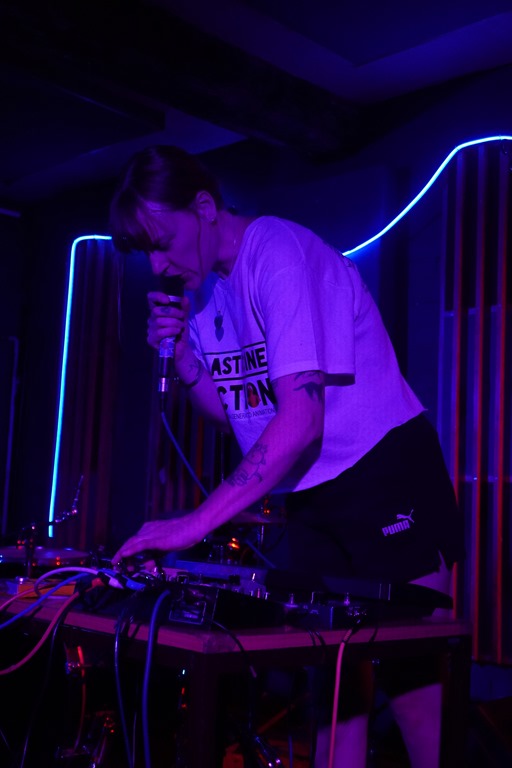
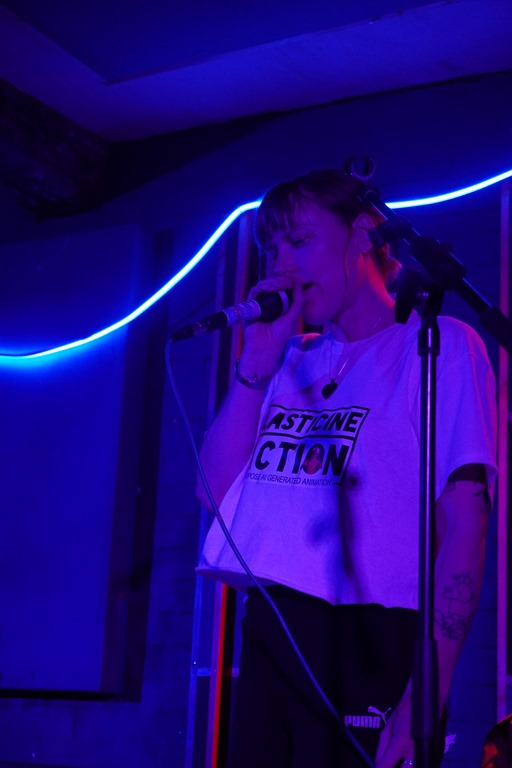
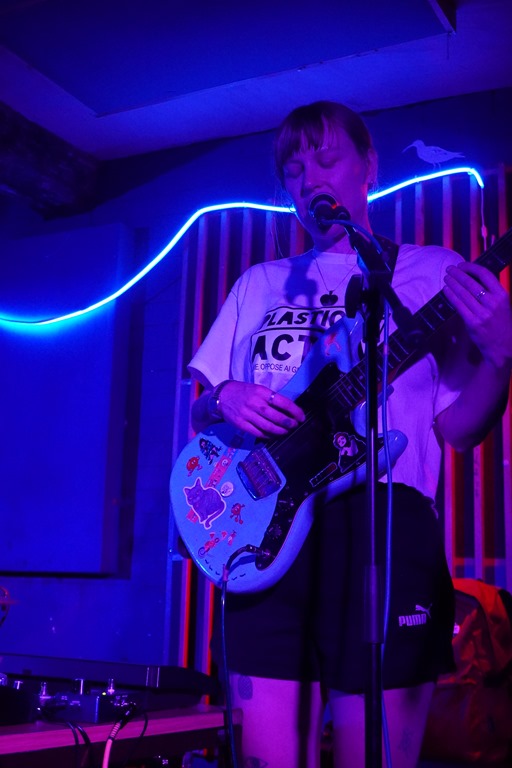
Thankfully, normality – of the kind we’re here for – resumed with the arrival of Sour Faced Lil, the solo project of Hilary from Cowtown. Her set starts – somewhat incongruously – with a quirky electropop cover of Bright Eyes. I just about manage not to cry. Then she swerves into swooshing space rock noise galore, and she explores the weird and wibbly, and it’s everything you’d expect from a Heinous Whining night. Live drums, looped, live guitar, and warped, undulating synths create a cacophony of sound in layers. The performance is a little tentative in places, but the audience is behind her all the way. There’s something quite enthralling about seeing a solo artist juggling myriad musical elements and instruments, knowing what a balancing act, how much effort it is to remember everything and keep the flow, and the fact she manages it is impressive.

DSC03057DSC03064DSC03070

Sour Face Lil

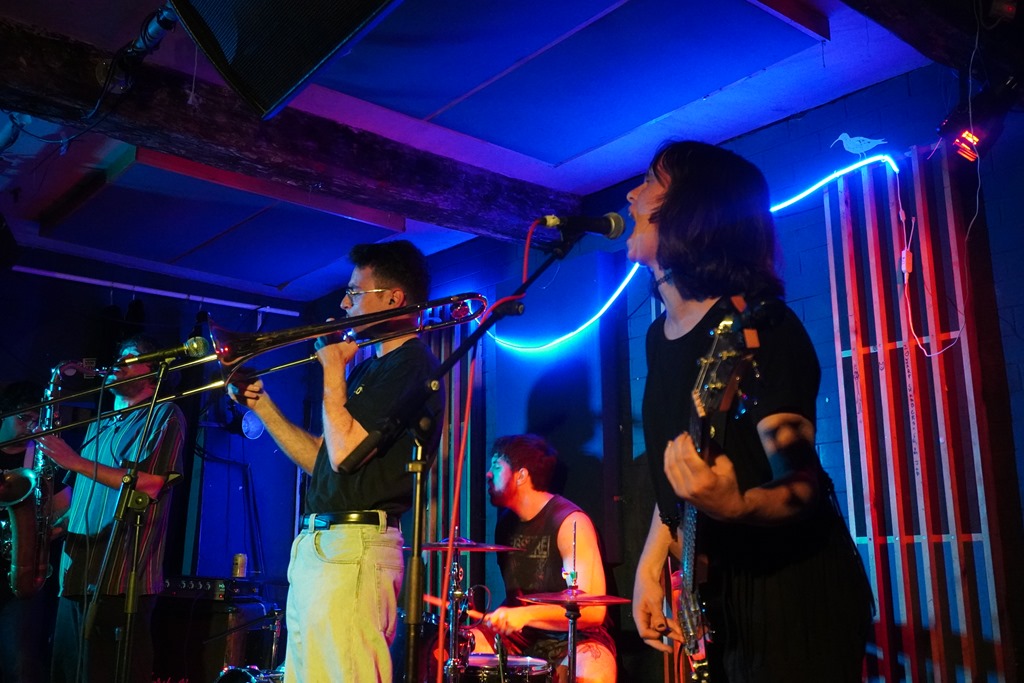
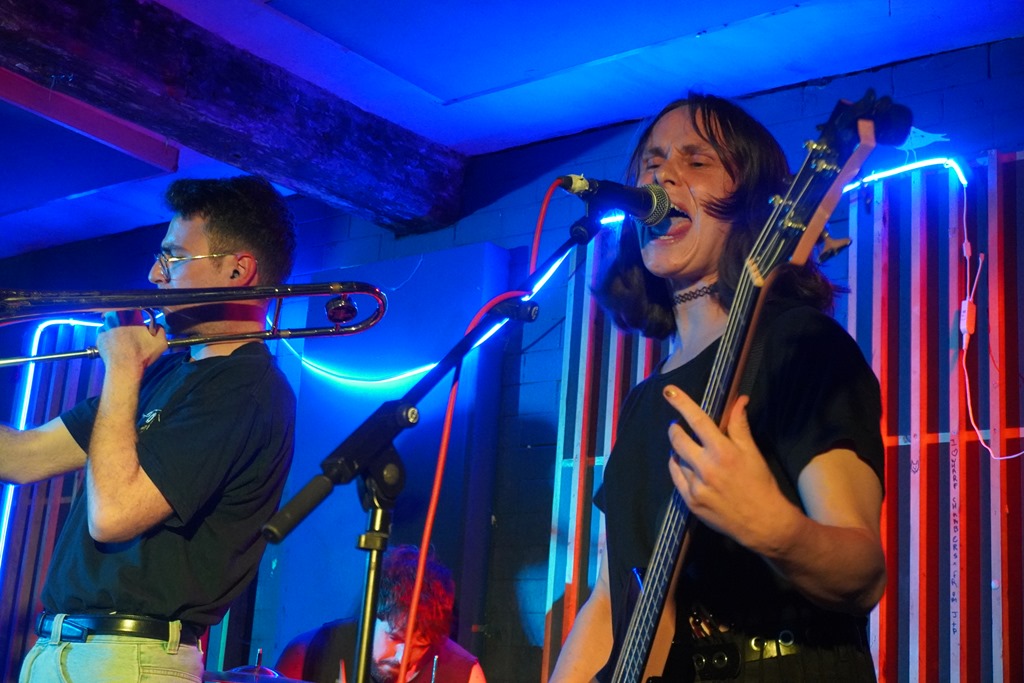
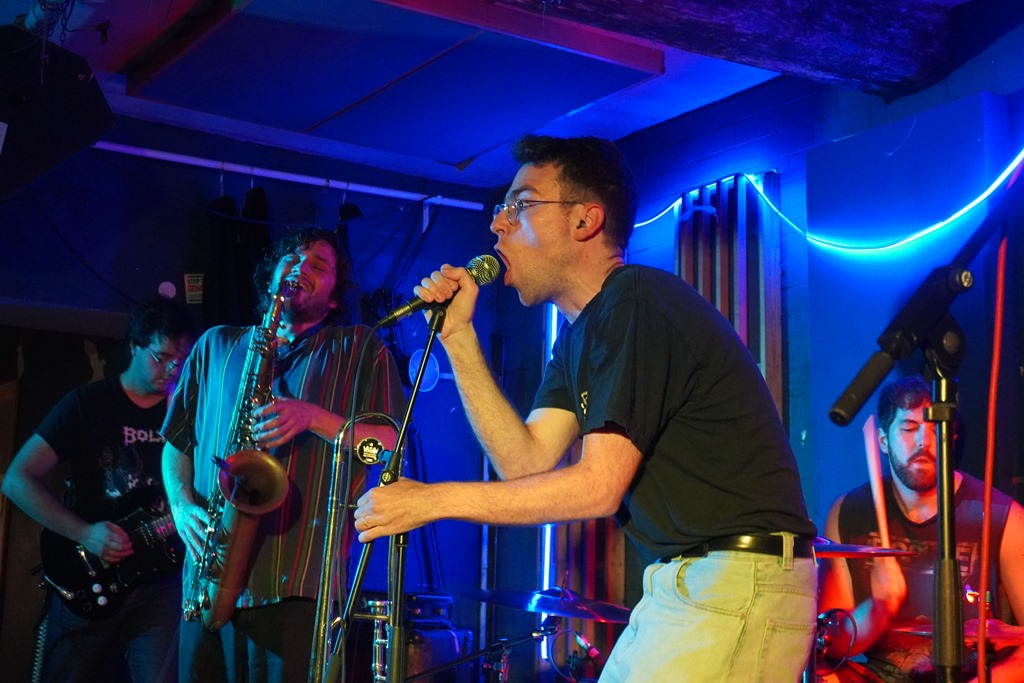
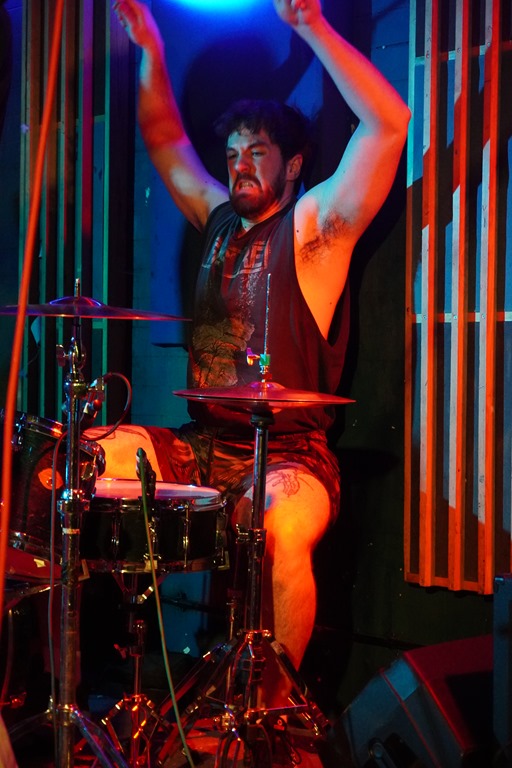
Also impressive are Lo Egin, but for quite different reasons. I feel I owe Lo Egin an apology, as it happens. When I reviewed their split release with Beige Palace a little while ago, I misspelled their name as Lo Elgin, more than once (although I managed to get it right when covering Volumancer in 2013) Hammering out reviews on a daily basis means I slip up sometimes. It’s not great, and I do try, to do better but… I did really rate that release, though, and I’ll admit that they were as much a draw for me as the headliners. And the fact is, they were worth the entry fee alone. On paper, they’re perhaps not the easiest sell, bring atmospheric post rock in the vein of early Her Name is Calla, with brass – sax and trombone – crossed with elements of doom – with the addition of screaming black metal vocals. They do epic. They do crescendos. They also do ultra-slow drumming, something I am invariably transfixed by having first become fixated during my first time seeing Earth live. The drummer raised his arms to fill extension above his head, before smashing down with explosive force.

DSC03079DSC03084DSC03092DSC03105

Lo Egin

Dolorous droning horns create a heavy atmosphere. Then, out of nowhere, from the delicately woven sonic tapestry they’ve been weaving, things turn Sunn O))) and the skinny baggy jeans wearing trombone guy who looks like a young Steve Albini delivers cavernous doomy vocals as he contorts and the mic stand and then all hell breaks loose. When they go heavy, they go heavy – and I mean HEAVY, the drummer smashing every beat so it hits like a nuclear bomb. To arrive with high hopes for a band, and to still be absolutely blown away is a truly wonderful experience, and one that stays with you.

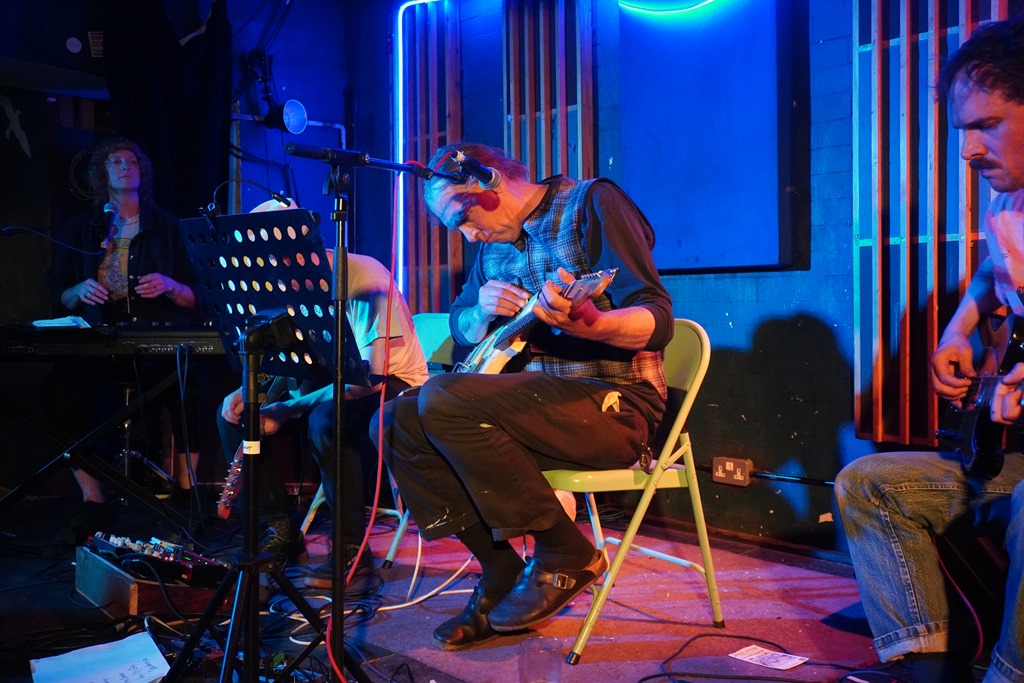
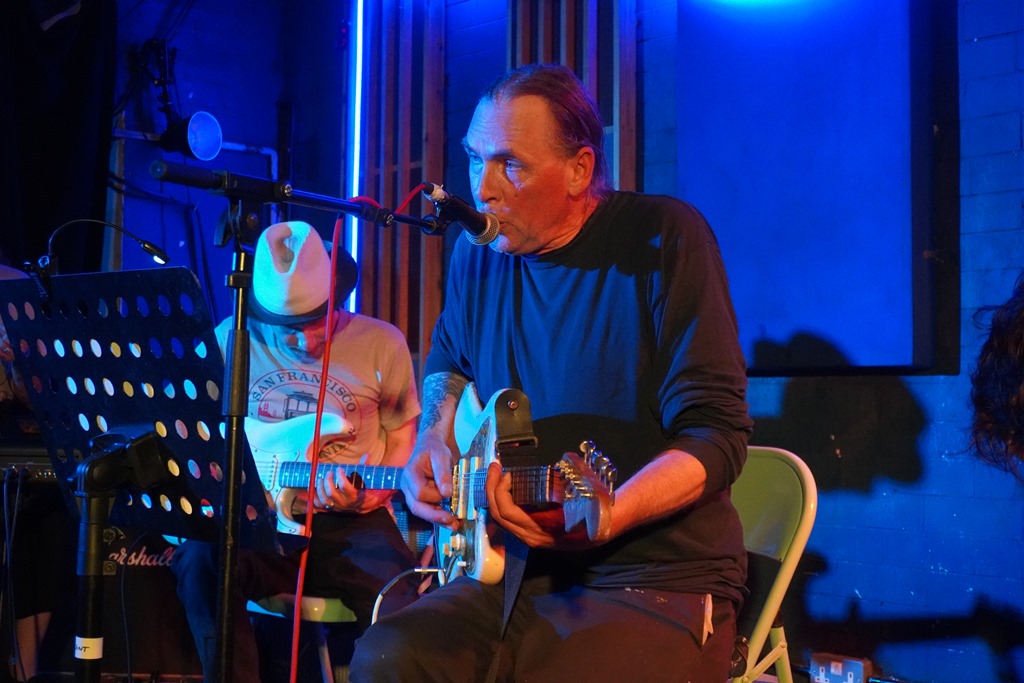
I feel I should perhaps take this opportunity to apologise to Jackie-O Motherfucker, too: in my review of Bloom, I described them as a country band. And while there are without question country elements, they’re really not a country band. They’re not really a psychedelic band, either, or any other one thing. Instead, they’re a hypnotic hybrid, and they’re deceptively loud considering how mellow everything is. What they do is simple in many respects, but in terms of genre, it’s rather more complicated, not readily pigeonholed. I’d clocked them about the venue beforehand, and they seemed like really chilled folks, and while they’re not exactly chatty during their performance, it’s apparent that they’re humble, and simply really chuffed to be playing here. The room is pretty full, too. Tom Greenwood looks like he’s just taken some time out from doing some decorating to play. He’s got paint on his trousers, and is as unassuming as they come.

DSC03109DSC03130DSC03137

Jackie-O Motherfuker

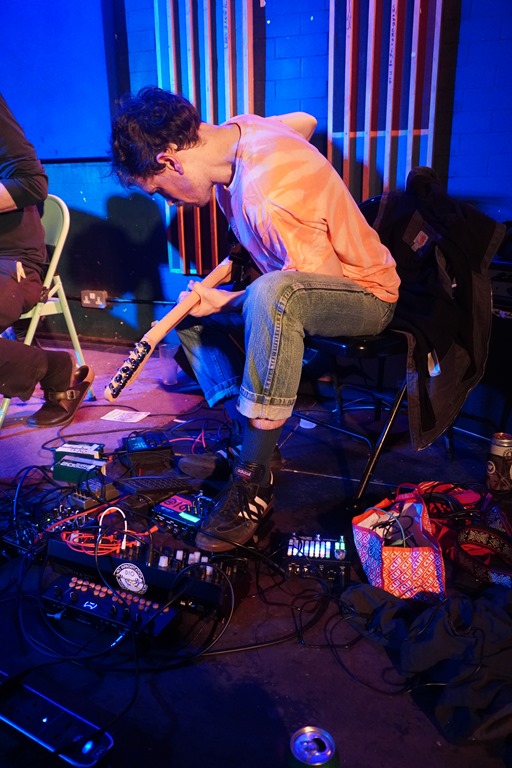
The current lineup consists of three guitars, synth, and some electronic stuff including subtle percussion. No bass, no drums. There are, however, many pedals and much pedal fiddling throughout the set, as they sculpt a wall of reverb and feedback and a whole lot more from this hefty – but ultimately portable – setup.

The resultant sound is detailed, but at the same time a hazy blur. Picked notes – and much of the sound is clean, with next to no distortion, but with all the reverb – bounce off one another here and there, creating ever greater cathedrals of sound. I find myself utterly transfixed. Their hour-and-a-bit long set features just seven songs, and they are completely immersive. There’s no real action to speak of, just an ever-growing shimmer which envelops your entire being. In some respects, their extended instrumental passages invite comparisons to the current incarnations of Swans, only without the evangelically charismatic stage presence or crescendos. In other words, they conjure atmosphere over some extended timeframes, but keep things simmering on a low burner, without any volcanic eruptions. The end result is a performance which is hypnotic, gripping because of, rather than in spite of the absence of drama. Low-key, but loud: absolute gold.

Ideologic Organ – 5th September 2025

Christopher Nosnibor

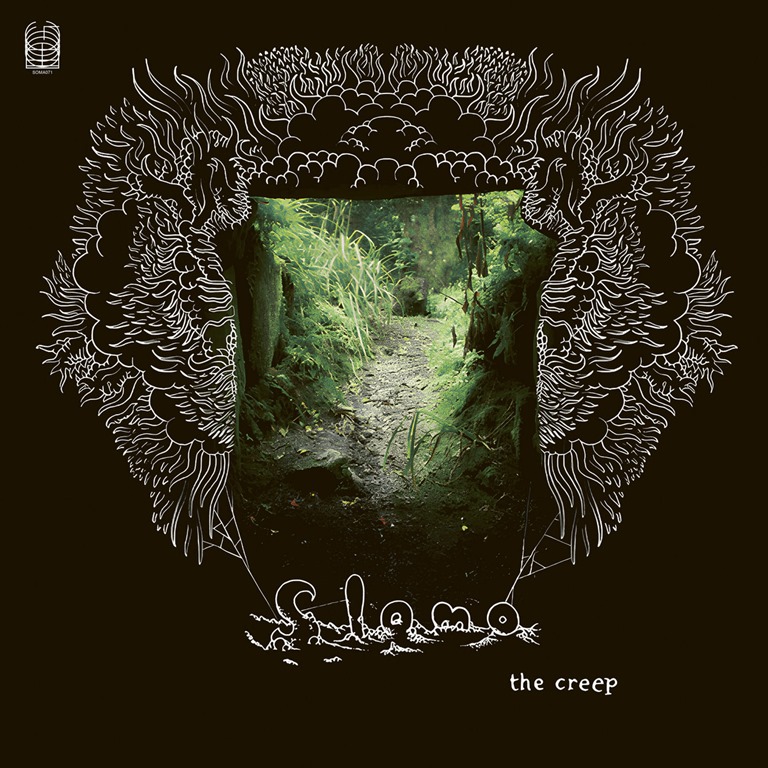
Umberto Eco is one of the many authors I feel I should have read, and hope that one day I will get around to reading. Social media has of late showered me with posts and reposts with a quite from Eco about owning more books than you will ever read – something I never much relate to. I only have so many hours in the day, and reading – since I insist on engaging with books rather than passively absorbing audio books while participating in other activities – is one of those pastimes which is time-intensive. I find music-listening to be comparable. As much as I enjoy listening to music while I’m cooking or participating in other activities, I like to give music full attention, especially new music. And it’s in this context that I often find I purchase music – like books, albeit to a lesser extent – at a faster rate than I can consume it. And this is why it’s taken me until the twentieth anniversary release of Slomo’s The Creep to catch up with this cult classic which brings together sludge / doom and vintage industrial influence.

The album’s context, too, is worth providing here, and so, I shall quote at length rather than paraphrase – not because I’m lazy in my writing, but because I fear making omissions, and feel that liner notes or press releases articulate in a way which better represent the artist.

Just one week after the passing of COIL’s Jhonn Balance in late 2004, the 61-minutes of "The Creep" manifested in a Sheffield suburb. Not yet a band and only captured due to happenstance, this first music of Slomo flowed forth without any consideration of it even being "a piece", let alone a release, though it didn’t take long for the participants (Chris "Holy" McGrail and Howard Marsden) to realise they’d captured something of distinct colour on account of how often they were listening to it.

Initially dubbed "The Ballad of Jhonn & Sleazy", the pair soon instead ascribed the music to Boleigh Fogou; a prehistoric underground chamber on the Land’s End peninsula that both had recently visited and been affected by. "The Creep" took its name from the peculiar side chamber assumed to be if ritual function, having no apparent practical use. This ponderous music chimed perfectly with the fogou; an apparently stolid place that teems with life once you become attuned to its frequency.

Fitting in perfectly alongside other massive single-track albums such as Sleep’s "Dopesmoker", COIL’s ‘Queens of the Circulating Library’, Cope’s "Odin", and Boris’ "Flood", "The Creep" secured a limited release on Cope’s Fuck Off & Di CD-R label in 2005 that quickly sold out via supportive outlets such as Southern Lord, Aquarius Records and Stephen O’Malley’s Ideologic Organ – then operating merely as a blog and micro-store.

And now, Ideologic Organ present a twentieth-anniversary vinyl edition. No doubt there will be plenty of people who are happy about this: after all, it’s never been released on vinyl, and I expect the tonal qualities of vinyl are ideal for a work where there is so much texture, so much richness of tone. The slow, resonant, reverberating bass during the quiet intro deserves deep grooves and decent speakers.

One downside of where the industry is now – and there are, as most of us are aware, many – is that the days of a promo copy of a slab of vinyl are essentially over (unless you’re writing for a major national or international publication), meaning I’m here with some decent enough speakers, but basing my opinion of the mastering and overall sonic experience based on an MP3 version. And as the low notes crawl, quivering, from those decent enough speakers, the rooms seems to darken and the atmosphere grows thicker, heavier.

Not a lot really happens during the first fifteen minutes, but the effect is profound, in that it resonates throughout the body. There is movement, but it occurs at a tectonic pace, and by stealth, rumbling around the far reaches of internal organs. For anyone who has read The Anatomy of Melancholy, Robert Burton’s seventeenth-century analysis of depression which explores the effects of the various humours on both mind and body. And The Creep slowly pulls on the gut and the intestinal tract in the most shuddering, lugubrious ways. At times it’s barely there, but shudders and shivers uncomfortably low on the psychic register. Others… there are low peaks among the troughs, but this is an album that registers more on a subliminal level and certainly low in the guts.

Where I raised the point of the vinyl release likely being popular with many fans, the counterpoint to this is the disruption to the continuity that the format creates. Listening to the MP3 version, there’s a fractional pause at just over thirty-two and a half minutes. It feels like a minor stutter, given that there is a long, low, undulating bass boom that fans out like a ship’s horn or subaquatic signals – but imagine having to get up and flip the record at this critical point before things begin to build. I’m perhaps being picky, but this feels like an unwarranted disruption.

The second half is even lower and slower than the first: twenty-nine minutes of bleak, rumbling abstraction. It’s the perfect amalgamation of drone, experimental, and dark ambient. And The Creep is dark. Whisps of feedback trail around and waft over hovering bass tines which simply roll and reverberate. Time stalls. Everything hangs in suspension: even your mind, and your digestion, hang, suspended, paused. Your breath… your mind. You stop thinking and simply float in this, this sound. Immersive is an understatement. It’s all-consuming, and you can easily lose yourself – completely – in this slow, slow, heavy drone.

20 years on, it’s clear that this is a work which is timeless. Niche, but timeless, in the same way that Earth 2 and Sleep’s Dopesmoker are more than just heavy droning noise. It’s no means an easy listen, but I’d still point to it as an essential one.

AA

a3748639222_10

ROOM40 – 9th August 2025

Christopher Nosnibor

It’s been some time since I’ve sat down to listen to a work created using prepared piano. It’s been even longer since I spent time with Erik Griswold’s work. Perhaps the two are related, as Griswold’s accompanying notes recount how it’s been a while for him, too:

Under the house again, just me and my very old piano. Have we got anything more to say to each other? Will some new toys spice things up a bit? The creative process seems to swing like a (Foucoult’s?) pendulum, always returning to the same spot again and again, eventually. When I last made short form prepared piano pieces in 2015 (Pain Avoidance Machine) I was “feeling stifled by the negativity of the Australian political discourse, the narcissistic excess of social media, and facing a long summer of migraine-inducing heat.” If only I had known how far we had to go.

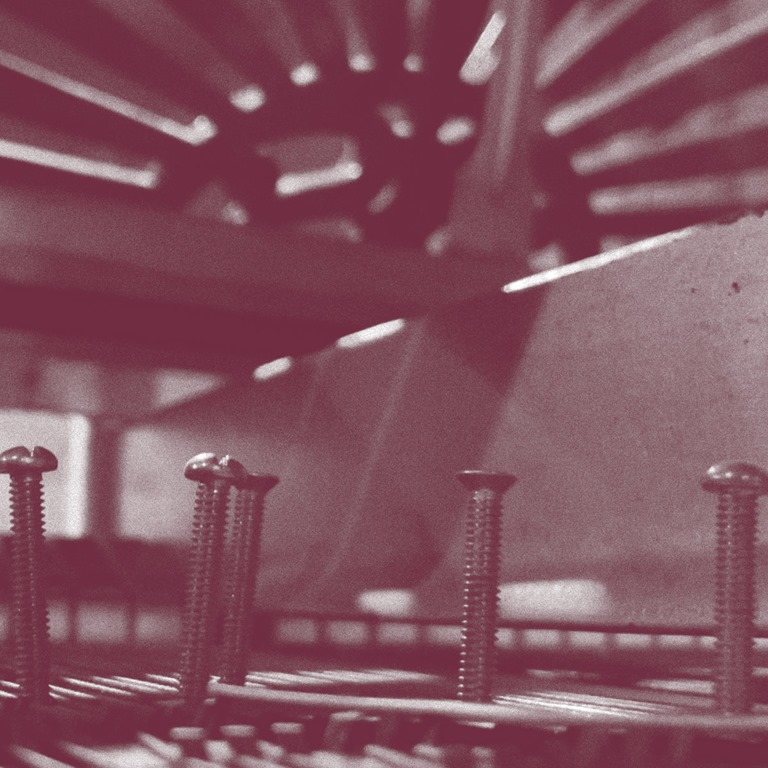
To the sounds of my 1885 Lipp and Sohn, prepared with brass bolts, strips of paper and rubber, I’ve added an analogue synthesizer, extending the exploration into the electronic. The tactile quality of both instruments is central to my approach, with small inconsistencies of sound, attack, decay, filtering all foregrounded. It’s a very intimate setting with just two C414 microphones at close distance to capture the granular details of sonic materials. The addition of “frames,” “windows,” and “sonic mirrors” produce a ritualistic aura hovering above and around the music.

I take a moment to reflect on reading this, before I can even bring myself to listen, reflecting on the title. Putting things off is… well, it’s a way of dealing, but it’s not really coping, is it? Not that Griswold hasn’t been making music: he’s maintained a steady flow of releases over the last few years, even during the COVID years – but to return to the piano is a significant step.

The title track raises the curtain here, and at times the tinkling tones are achingly beautiful, graceful, delicate, the most magnificent invocations of neoclassical perfection – albeit alternating with plinking, plonkling randomness which flips between low-end thunder and what, to the untrained ear or anyone unfamiliar with the instrumentation, sounds like clumsy stumbling.

‘Wild West’ isn’t a twanging country tune, and says nothing of the wiki-wiki-wah-wah we know, but a rolling piano piece with the prepared element adding a taut, almost electronic-sounding aspect – like the plucking of an egg-slicer – but also abstract, and strangely evocative. Meanwhile, the gentle, somewhat vague, and perhaps rather progressive-leaning ‘Ghost in the Middle’ radiates a hypnotic beauty.

The album’s mid-section takes on a dreamy, drifting, hazy quality, floating from here to there, with scratches and scrapes, forward and backward providing texture to these ponderous sonic expanses.

‘Uncertainty’ again balances neoclassical magnificence with angular irregularities and some jarring alternative tuning which continues into the trickling ‘Poly cascade’, a stack that’s subtle and in some way grounding.

‘Colours of Summer’ lands as a surprise and completely rips out those roots in an instant, being a throbbing techno track which completely goes against the grain of the album. In complete contrast, ‘Ghost of Ravel’ returns to classical territories, and is nothing short of beautiful, although as the album inches towards its close – the atmospheric bubbler that is ‘X-Mode’ which calls to mind the Krautrock bubbling of Tangerine Dream, and, more contemporaneously perhaps Pye Corner Audio’, find ourselves floating, drifting, unsure of where we are. Next Level Avoidance is full of surprises, and is in essence representative of the prepared piano, in that it’s unpredictable, unstable. Dim the lights, breathe and feel the flow.

AA

a0361562758_10

Magnetic Eye Records – 22nd August 2025

Everything gets an anniversary reissue now, doesn’t it? And however much you love a band or an album, the constant cycle of repackaged reissues with bonus this, that or the other, a new remastering starts to feel like a cynical drain. Not that such exploitation is anything new: the late 80s and early 90s with infinite formats of single releases whereby fans felt compelled to purchase multiple versions to obtain all the tracks and mixes in order to attain a higher chart position – when these things actually counted – were shocking for it. But back then, 7” and cassette singles cost 99p, a CD single wasn’t much more, and a 12” was maybe £3.50. But the point was that you got different stuff on different formats, and being a completist didn’t require a second job. Now, you’re looking at £30 for a splatter vinyl remaster with maybe one bonus track of an album you’ve already got five copies on, but you buy if for that track and for the sake of the collection… and being reminded that an album is now ten, twenty, twenty-five years old is like a body blow as you realise how quickly your life is passing by. On a personal note, I’m feeling this most acutely as I find myself on the cusp of fifty. How the hell have I been here half a century? And this means that anything that happened twenty-five years ago – at the turn of the millennium – was a quarter of a century ago. Remember how the entire civilised world was shitting itself over the so-called ‘Millennium bug’? It felt like the apocalypse was imminent at the time. How, it feels like a picnic.

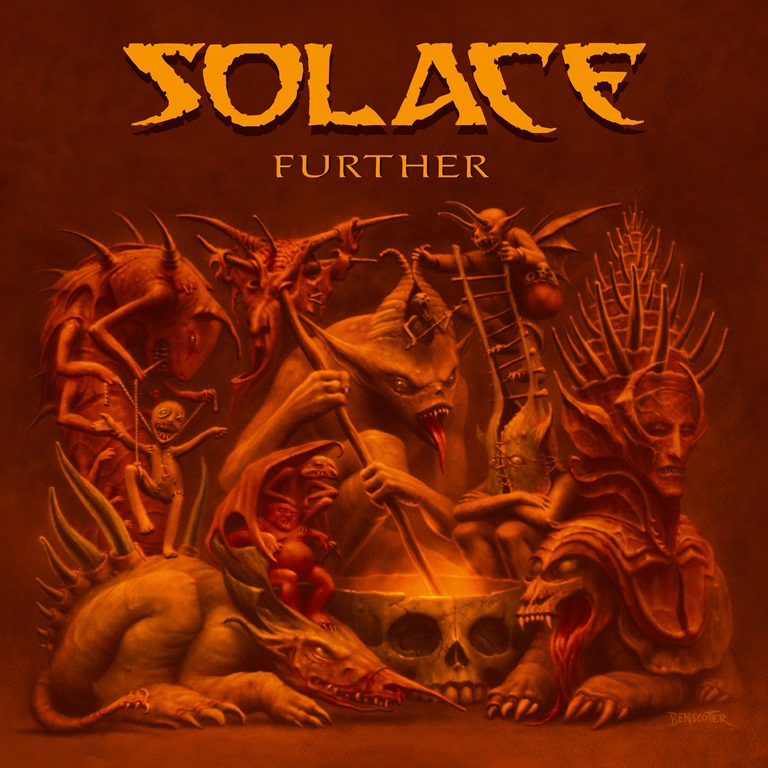
But there are positives. Sometimes, a new edition can bring an album to the attention of a new generation of fans, and / or provide long-term fans with something special which serves to expand on the legacy of the release. This is likely the case with Further, an album which bypassed me, but won New Jersey stoner metal act Solace critical acclaim and fans, and there’s a poignancy about this re-release, too, as founder and vocalist Jason died in January of this year (the reissue was already in the pipeline before his departure), making for a fitting tribute and summation of his and the band’s legacy, remastered and expanded to include three previously unreleased tracks, and the original EP version of ‘Heavy Birth / 2 Fisted’.

Now, as this is my first exposure, if you’re already familiar with the album, this review will likely not be of much use to you: I’m in no position to comment on how the 2025 remaster compares to the original, or how the track sequencing – which follows that of the 2005 reissue, down to the 11-minute cut of ‘Heavy Birth / 2 Fisted’, with the additional material appended to the ten-track version.

For those unfamiliar, this is a solid slab of heavy metal that takes plenty of cues from Black Sabbath, straight from the off with the rifferola of ‘Man Dog’. The lead guitar work is busy, atop riffs which are thick and heavy, while the rhythm section is dense: the drums feel loud despite being fairly low in the mix, giving the impression of extreme volume on the part of the guitars while the bass slides like sludge at the bottom end of the sonic spectrum.

Jason’s vocals tend to manifest as bombastic and Ozzy-like, but there are moments, as on ‘Black Unholy Ground’ where he channels some palpable aggression, just before an epic solo breaks loose. There are no shortage of epic solos to be found here. The slower eight-and-a-half-minute ‘Followed’ exploits the classic quiet / loud dynamic and goes for the atmospheric slow-building intro, but when it gets going, by the mid-point it packs the filthy heft and rage of Fudge Tunnel. It’s a ball-busting blast of anguish which races to a pulverising conclusion with a blown-out cyclical riff. ‘Hungry Mother’ goes mellow – a brief acoustic interlude with some psychedelic hues – before the behemoth that is ‘Angels Dreaming’, a nine-minute monster that is peak stoner metal. Like ‘Followed’, ‘Heavy Birth’ draws as much on 90s underground noise as much as vintage heavy metal, and packs a massive punch.

The musical landscape of recent years is another world from that of 2000, and it’s important to bear this in mind, not because Further has aged badly, but because it sounds so contemporary. While stoner metal wasn’t a completely novel concept at the time of release – Melvins had been doing it since forever already, of course, and Queens of the Stone Age would unleash breakthrough major label debut Rated R in June 2000, it certainly isn’t the sound of the time, when nu-metal was the dominant style the world of guitar music, and after grunge fell to indie, big riffs were largely out in favour of guitars that sounded like slabs of concrete and vocals which switched between rap and emoting.

Further is heavy, gritty, unashamedly drawing on grunge (which with acts like Tad had taken cues from 70s metal in the first place), and hearing it now, it feels like an album that’s more at home in 2025 than it would have been in 2000. But this also demonstrates just how, while fashions come and go, quality music always holds up at any time – and this is quality. The bonus tracks – including the obligatory live cut in the form of ‘Funk #49 (Live in Tokyo ’98)’- are all worthy additions of a standard which is equal to the album itself.

AA

038620

Rocket Recordings – 22nd August 2025

Christopher Nosnibor

While you wouldn’t exactly call Rún a supergroup, they certainly represent a coming together of disparate artists of no insignificant pedigree, as their biography attests:

Rún comprise firstly Tara Baoth Mooney – sometime Jim Henson voice artist, with a longstanding background in everything from folk and choral music to experimental film-making. Diarmuid MacDiarmada – Nurse With Wound co-conspirator and brother of Lankum’s Cormac, brings with him the experience of avant-garde collaborations with a plethora of artists stretching back over thirty years. Drummer, sound designer and engineer Rian Trench, meanwhile, has worked on everything from the psychedelic IDM of Solar Bears to auto-generative experiments to orchestral arrangements, and owns the studio – The Meadow on Ireland’s East Coast – in which the album was made.

It’s a delicate folksome vocal which floats in on the first composition, ‘Paidir Poball (Pupil)’over what initially sounds like a mechanical wheeze of a bellows, or some form, of life support. The juxtaposition between something so earthy, so human, and something so very much not is compelling, and quite powerful, in a way which isn’t immediately easy to unravel. But a couple of minutes in, a thick, droning guitar – reminiscent of Earth 2, with that thick, sludgy distortion and trebly metal edge – winds its way int the mix and immediately, the mood and the direction changes. And then, on top, choral, almost monastic layers of vocal build and rise upwards to the heavens through the grit and grind and howls of feedback before eventually there is percussion. The drums – thick, thudding, low in the mix, feel as if they’re lagging, foundering in the tide or struggling against a head-facing current.

‘Your Death My Body’ strips things back primarily to percussion, but turns up the intensity with the vocals, which hit a wild intensity which borders on rabid. But with this, and some bleepy computer incursions and a grumbling but groovy bass which makes allusions to Jah Wobble, this album becomes increasingly difficult to place, or to pigeonhole. It’s a sad fact that nowadays, not only will they throw you in jail if you say you’re English, these days (I’m safe as I’m ashamed to pronounce my Englishness, even – or perhaps especially – in Scotland) – but aligning oneself to a genre can be a minefield, too.

The eight-minute ‘Terror Moon’ is a dark morass and a muti-layered, bass-heavy mindfuck that explodes into blistering, shredding electronic overload in the first minute before thumping percussion and the filthiest, fuzziest bass drive in and punch straight in the gut, propelling a psychotic, psychedelic weird-out with tripping space-rock synths and strains of feedback and infinite echo, which leaves you feeling dazed, dizzy. Terror? Yes, just a bit: it’s huge, it’s warped, and a tiny bit overwhelming in its weight and witchiness.

But this is nothing compared to the final track, the ultimate finale, the thirteen-and-a-half minute behemoth that is ‘Caoineadh’. Arriving as it does after a pair of punchy cuts – ‘Such is the Kingdom’ is murky, atmospheric, leaning toward experimental / spoken word, but a mere three an as half minutes on duration, and ‘Strike It’, which is perhaps the album’s most direct composition, evoking Swans circa ’86 but on speed, the grind coming with pace –it takes the album in a whole new trajectory. Gentle, even tentative at first, with nothing but a wandering bassline, it has a slow-burning drone-rock vibe to it as first. But then, the vocals – oh, the vocals! Tara Baoth Mooney brings a lilting folk feel against a slow, droning backdrop, which eventually gives way to a slow, expensive prog-pop mellowness, opening new horizons in every way. And every direction. It ends in a rippling wave of distortion.

This is essentially Rún in a nutshell: they have no confines, no limits, and to touch them is to embark on a journey. And what a journey this is.

AA

a1829277806_10

13th August 2025

Christopher Nosnibor

Re:O’s ninth single is a song of frustration, of dissatisfaction, about giving everything and receiving underwhelming returns. It’s a song about life’s struggles. And it takes the form of musical hybridity taken to another level. And when it comes to taking things far out, Japan has a long history of it. Only Japan could have given us Merzbow and Masonna, Mono and Melt-Banana, Shonen Knife and Baby Metal – acts which couldn’t be more different, or more wildly inventive. J-Pop may not be my bag, but on reading that Re:O take ‘the best of Japanese alternative music and combin[e] western metal and rock… Re:O has been described by fans as “Japancore” a mix of Metalcore, industrial metal, J-Pop, Darkpop, cyberpunk inspired symphonic layers with high energy and heavy guitar.” It’s a tantalising combination on which I’m immediately sold.

Hybridity in the arts emerged from the avant-garde, before becoming one of the defining features of postmodernity: the second half of the twentieth century can be seen as a veritable melting-pot, as creatives grappled with the notion that everything truly original had already been done, and so the only way to create something new was to plunder that which had gone before and twist it, smash it, reformulate it, alchemise new permutations. If the zeal – not to mention any sense of irony or knowingness – of such an approach to creativity seems to have been largely drained in the first quarter of the twenty-first century, Re:O prove that there’s life in art still after all.

With ‘Crimson Desire’ they pack more ideas into three and a half minutes than seems humanly feasible, starting out with snarling synths, meaty beats, and churning bass – a combination of technoiundustrial and nu-metal – before brain-shredding, overloaded industrial guitar chords blast in over Rio Suyama’s blistering vocal. And it blossoms into an epic chorus that’s an instant hook but still powered by a weighty instrumental backing. The mid-section is simply eye-popping, with hints of progressive metal in the mix.

The only other act doing anything remotely comparable right now is Eville, who have totally mastered the art of ball-busting nu-metal riffery paired with powerfully melodic choruses rendered all the more potent for strong female vocals, but Re:O bring something different again, ad quite unique to the party. It’s all in the delivery, of course, but they have succeeded in creating a sound that is theirs, and theirs alone. No two ways about it, they’re prime for Academy size venues, and given a fair wind, they could – and deserve to be – there this time next year.

AA

AA

a0408141558_10