Archive for the ‘Albums’ Category

Christopher Nosnibor

The trouble with receiving more shit than you could ever listen to in a week on a daily basis means you lose track now only of what you’ve got, but also where much of it came from. The positive spin is that life becomes a constantly-rolling conveyor-belt of surprises, some of which are pleasant.

What’s pleasant is a matter of taste, of course, meaning not everyone in my position would be enthused on stumbling on the dark, industrial-strength electronica of Kojoohar × Ködzid Goo – less a collaboration than a collision of Ukranian Andrei Kojoohar (who produces industrial / power electronics as Kadaitcha, and synthpop / triphop / downtempo under the Fogscape moniker), and Ködzid Goo from Russia, who specialises in bleak darkwave.

It’s no criticism to say that Дотла represents the sum of its parts. ‘Сулема’ (trans:‘Sulema / (Mercury Chloride)’ sets the tone with churning atmospherics paving the way for a thudding industrial rhythm and shivering electronica. It’s low-tempo, intense and claustrophobic. There’s no space to get comfortable here: there’s barely space to breathe. Its as dark as the black on charcoal cover from beginning to end.

There are dark hip-hop elements buried deep in the songs, too, and the hybridity contributes to the otherworldly distancing that defines the sound.

Whether or not the lyrics lose anything in translation, I couldn’t comment, but there’s something fascinating about their viscerality and potent images, with the opening lines of the final track, ‘Полынь’ (trans: ‘Polyn’ / Wormwood’ being fairly typical:

Eye slits plastered with phlegm completely,

eyelashes sealed with wax tightly

All the humanity has a single mind,

and now it starts getting distracted

Wrapped in food plastic film deceitfully,

it rots in its semiconsciousness

Drowning unhelpfully in swampy lakes,

trudging scarcely through powder dunes

The same song closes off with the equally dark lines:

Dust settled on our senile scalped heads

Successively having turned into powder

We all were born at the wrong time in vain

Blossomed in the wrong place all over

Delivered in a blank monotone, devoid of emotional and humanity, it sits well with the stark, mechanoid instrumentation that thumps and grinds low-end bass throbs welded to dead-hearted beats, overlaid with icy synths.

Hard, stark, cold and dystopian in every sense, this release offers no comfort and no breaks, no hooks and no easy inroads. It’s a difficult and singular work that reminds us that we’re all on the outside, all alone, and all doomed.

AA

cover

Sige Records – 1st November 2019

Mellow… melodic. Mammifer’s The Brilliant Tabernacle is, well, is the title suggests, brilliant. And yet its brilliance is largely hard to define. It’s an album that drifts by almost inconsequentially, and not just on first or second listen.

‘All that is Beautiful’ introduces the album with a rolling drum beat and lilting piano that provides the accompaniment to faith Coloccia’s airy, ethereal vocal. But somewhere along the way, currents of noise build, and by the final bars, the music itself has been drowned in swelling swirl of feedback. You’re left agape, wondering ‘how did this happen’? It’s a slow and delicate swell, and it characterises the subtlety that pervades The Brilliant Tabernacle.

The album as a whole is a lot more delicate, with rolling piano and little else backing the most magnificently absorbing singing. And it’s so soft, easy, it drifts and lulls the listener. While a long way off being ambient, instead drawing on elements of folk, indie and retro pop to forge mellifluous magic. The Brilliant Tabernacle is calm and calming, and encourages a state of mental relaxation. ‘River of Light’ weaves rippling waves of sonic intangibles, while woodwind and piano ebb and flow in and out and hover in the space between post-rock and shoegaze.

Yet, in places, darker currents run below the surface, and with the complex, urgent, flickering rhythms there are hints of latter-day Swans in evidence. The ten-minute ‘Hymn of Eros’ is a vast expanse of semi-ambience, while ‘To Be Seen’ is pure 60s psychedelic folk, both musically and lyrically.

There is something both vintage and timeless about The Brilliant Tabernacle. There is also a sense of incredible equilibrium, and a cosmic hue radiates like a halo from every note: The Brilliant Tabernacle is otherworldly, but also somehow earthy in a paganistic, celebratory sense. Truly special.

AA

Mamiffer – The Brilliant Tabernacle

AdderStone Records – 4th October 2019

James Wells

Originally released in November 2018, Jo Quail’s Exsolve has been re-released, remastered, as a double vinyl effort on her own, newly-founded, AdderStone Records. It’s been expanded to include a new fourth track, ‘Reya Pavan’.

If a mere eleven months feels like an uncommonly short span of time, consider the fact that the original release wasn’t available on vinyl, and also the year Jo has had. With support slots with Mono and Emma Ruth Rundle, her profile has very much been on the up, and her performances have been consistently spellbinding.

Quail’s appeal was always likely to be subject to slow diffusion. While we’ve become accustomed to post-rock and experimental music, a solo cellist who conjures sound like a full rock band is essentially unique. Moreover, she’s more a purveyor of prog than neoclassical, and this really doesn’t sit readily with contemporary trends, however accommodating and broad-minded and receptive audiences are.

Christopher Nosnibor frothed effusively about the album on this very site a year ago and all of that still stands: this is a stunning album, and the depth and range of the sound is incredible. It has grace, it has power, it has impact, and it has blistering solos that sound like guitars. I’d challenge anyone to sit and listen to this without any forewarning and consider for a second this is the work of one person, or a solo cello album.

The new, additional composition, ‘Reya Pavan’ is the most overtly orchestral track on the album, and it oozes sadness rom the heart, while underpinned by a sonorous rhythmic throb that adds a very different dimension.

It’s not really a re-valuation as such, or a reissue, but a timely reboot, and Jo Quail is a singular and innovative artist who deserves the attention.

AA

Jo Quail - Exsolve reissue

Ipecac Recordings – 1st November 2019

You could look at this from two different angles: one – some people never grow up. Two – some people never sell out. Cunts’ eponymous debut is the product of both simultaneously. The ‘snarling LA-based punk band’ features guitarist Michael Crain (Dead Cross/Retox) and singer Matt Cronk (Qui), with drummer Kevin Avery (Retox/Planet B), bass player Keith Hendriksen (Virginia Reed) and guitar player Sterling Riley (Hepa.Titus).

So they all have other projects, and so the fact Cunts will never achieve radio play or mainstream attention simply by virtue of being Cunts isn’t an issue. Then again, their other projects won’t achieve major-league success and radio play either, despite not being graced with a media-blackout moniker, meaning that none of them has anything to lose or gain here. So yeah, fuck it: Cunts are keeping it real and keeping it antagonistic, and forget being cynical, they’re doing this for the right reasons: they’ve got the rage. Rage used to be for the young, descending into the impotent bitterness of the cliché grumpy old man. But times have changed. Older, wiser, more furious and better equipped to articulate that rage, Cunts represent the new generation of over-40s who, rather than mellowing and settling into midlife, have all the anger and need to vent or suffer an aneurysm. These are the worst of times, and we live in a divided world.

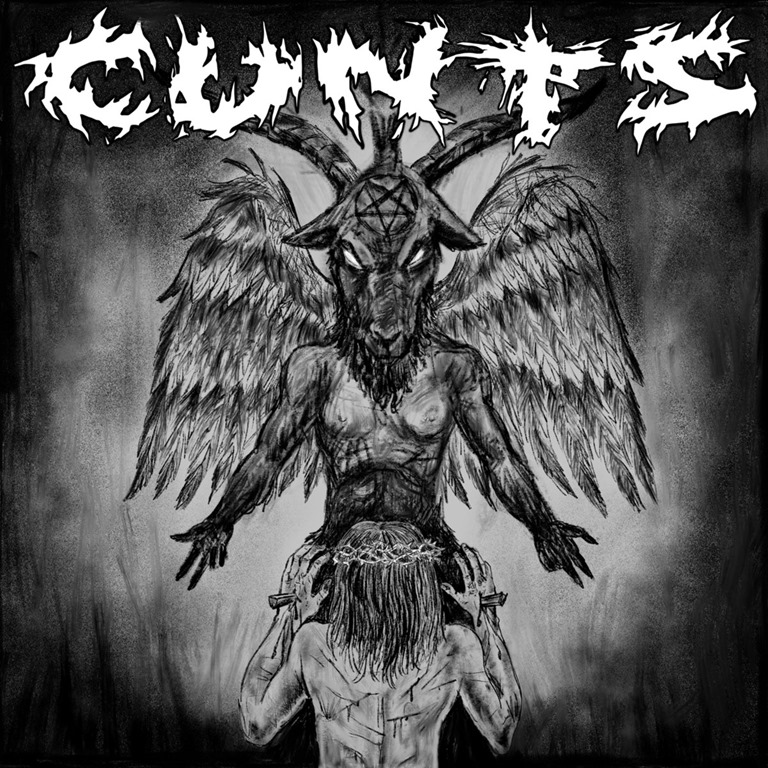
This is proper old-school gnarly US hardcore punk shit, played at a hundred miles an hour, and if song titles like ‘Ass to Grind’ and ‘He’s a Lady’ carry distinctly un-PC connotations, the lyrics reveal the band as being on the right side of consideration for difference. They’re not afraid to venture into Unsane gore territory, but shock tactics aren’t entirely without merit in a desensitized society. There’s noting subtle about an of this, least of all the over art.

‘Goin’ Out West’ gets a bit Ministry, but with glammy / goth overtones to its thudding stomp, while a number of the frenzied thrashabouts, like ‘Fail at Failure’, clocking in at 1’46”, and the 1’ 26” ‘Seagulls’ bear hints of Dead Kennedys, while ‘For the Greater Good’ lunges messily into Unsane territory, and there are a fair few tracks that clock in well under three minutes, with the longest song on the album being just 4’08” and no other songs being much over three-and-a-half minutes.

Cunts is fiery, shouty, fast and furious with the emphasis on the furious. Primally raw and brutally uncompromising, it’s harsh but vital, and punk at its best.

You could look at this from two different angles: one – some people never grow up. Two – some people never sell out. Cunts’ eponymous debut is the product of both simultaneously. The ‘snarling LA-based punk band’ features guitarist Michael Crain (Dead Cross/Retox) and singer Matt Cronk (Qui), with drummer Kevin Avery (Retox/Planet B), bass player Keith Hendriksen (Virginia Reed) and guitar player Sterling Riley (Hepa.Titus).

So they all have other projects, and so the fact Cunts will never achieve radio play or mainstream attention simply by virtue of being Cunts isn’t an issue. Then again, their other projects won’t achieve major-league success and radio play either, despite not being graced with a media-blackout moniker, meaning that none of them has anything to lose or gain here. So yeah, fuck it: Cunts are keeping it real and keeping it antagonistic, and forget being cynical, they’re doing this for the right reasons: they’ve got the rage. Rage used to be for the young, descending into the impotent bitterness of the cliché grumpy old man. But times have changed. Older, wiser, more furious and better equipped to articulate that rage, Cunts represent the new generation of over-40s who, rather than mellowing and settling into midlife, have all the anger and need to vent or suffer an aneurysm. These are the worst of times, and we live in a divided world.

This is proper old-school gnarly US hardcore punk shit, played at a hundred miles an hour, and if song titles like ‘Ass to Grind’ and ‘He’s a Lady’ carry distinctly un-PC connotations, the lyrics reveal the band as being on the right side of consideration for difference. They’re not afraid to venture into Unsane gore territory, but shock tactics aren’t entirely without merit in a desensitized society. There’s noting subtle about an of this, least of all the over art.

‘Goin’ Out West’ gets a bit Ministry, but with glammy / goth overtones to its thudding stomp, while a number of the frenzied thrashabouts, like ‘Fail at Failure’, clocking in at 1’46”, and the 1’ 26” ‘Seagulls’ bear hints of Dead Kennedys, while ‘For the Greater Good’ lunges messily into Unsane territory, and there are a fair few tracks that clock in well under three minutes, with the longest song on the album being just 4’08” and no other songs being much over three-and-a-half minutes.

Cunts is fiery, shouty, fast and furious with the emphasis on the furious. Primally raw and brutally uncompromising, it’s harsh but vital, and punk at its best.

AAA

Cunts

Southern Lord – 25th October 2019

Christopher Nosnibor

The appearance of a new Sunn O))) album just six months after Life Metal represents a significant upsurge in their usually steady output. But then, as much as it is a standalone document, Pyroclasts exists in many ways as a companion and counterpart to Life Metal, which in the slow-moving scheme of Sunn O))) represented a seismic shift on a par with Monoliths and Dimensions in that it brought a new focus. The question posed by Life Metal centred around what precisely could Steve Albini bring to Sunn O)))’s eternal drone guitar noise. In the event, his ‘stick the mics in front of the amps at a precise distance and angle and let the tape roll’ approach brought new sonic dimensions (but no monoliths) to the fore, giving the band a new and unexpected richness of sound. It’s this clarity and depth that also defines Pyroclasts recorded during the same sessions.

An element of ritual is integral to much of Sunn O)))’s work, and while this is perhaps nowhere more evident than in their live performances, the very nature of the music, the image, and the titling of their albums alludes to a certain type of repetitive organisation and (pseudo)spiritual convention. The origins of Pyroclasts is rooted in that ritualism, as is explained in the press release:

‘The Pyroclasts album is the result of a daily practice which was regularly performed each morning, or evening during the two week Life Metal sessions at Electrical Audio during July 2018, when all of the days musical participants would gather and work through a 12 minute improvised modal drone at the start and or end of the day’s work. The piece performed was timed with a stopwatch and tracked to two inch tape, it was an exercise and a chance to dig into a deep opening or closing of the days session in a deep musical way with all of the participants. To connect/reconnect, liberate the creative mind a bit and greet each other and the space through the practice of sound immersion.’

And so the four pieces on Pyroclasts last between 10’54” and 11’04”, and being aware of the time constraints imposed by the players, the endings make sense: the first track, ‘Frost’, is close to what sounds like a natural ending as the drone hum hangs, but fades uncommonly fast when ordinarily they’d let the note hang for an eternity. Likewise the last of the four, ‘Ascensions’, which starts higher, faster, more aggressively than is usual for Sunn O))), and ends abruptly as though the tape was simply stopped dead – which it probably was.

Given the band’s maximalist tendencies and a propensity for sprawling sludgescapes spanning fifteen to twenty minutes this discipline and concision offers a new insight into their methods. Four tracks and a running time of circa forty minutes is tight for Sunn O))), and it works remarkably well.

Pyroclasts is exploratory and experimental in context of Sunn O))), and in revealing new facets while at the same time mining the same seam the band have explored since their inception, it’s an interesting and highly necessary document of their evolution and practises. Moreover, it’s another booming slab of texture-heavy droning doom and absolutely classic Sunn O))).

AA

700829

Gizeh Records – 25th October 2019

Christopher Nosnibor

Although having contributed to various projects and collectives, including a number of independent soundtracks that have appeared through Gizeh, it’s been a while since Christine Ott last released anything as a primary artist. Nanook of the North, a collaboration with Torsten Böttcher, who brings hang drum, kalimba, and didgeridoo to Ott’s diverse array of instruments.

Nanook of the North is another soundtrack to a film which ‘tells the daily life of the Eskimo family living in Hudson Bay. Fights for life, constant shifts, fishing, seal hunting… The spectator shares the life of the family of the far north’.

As a release, this has been a long time in coming, having been first commissioned in 2013 by La Rochelle International Film Festival.

From the first strike of percussion, which sends a low, rippling hum on which eerie atmospherics build in layers like thick mist, the pair conjure highly evocative soundscapes. Pairing piano with non-western instrumentation makes for some fascinating and utterly compelling combinations, with unusual melodies taking shape along the way. Whereas many soundtracks place the compositional emphasis on atmospherics and vague structures, Nanook of the North stands out for its tendency toward keenly co-ordinated structures and definite tunes brimming with chiming melodies.

There are moments of brooding, shade that contrasts with the unexpected levels of light that fill this album, and ‘Walrus Hunting’ balances drama and playfulness through the incorporation of jazz tropes. Elsewhere. ‘Winter’s Coming’ conveys the ominous sense of darkening days and a creeping chill, while ‘Et le blizzard’ is surprisingly calm and soothing as opposed to the tempest one would reasonably expect. But then, the silence of a blizzard can be a strangely tranquil experience.

The range on Nanook of the North is impressive: it’s expressive and conveys such an array of moods and spaces, while at the same time retaining a compositional and instrumental coherence. And while the places these pieces speak of are bone-breakingly cold, the listening experience is most heart-warming.

AA

GZH93DP-Digital-Sleeve

Buh Records – 20th September 2019

Christopher Nosnibor

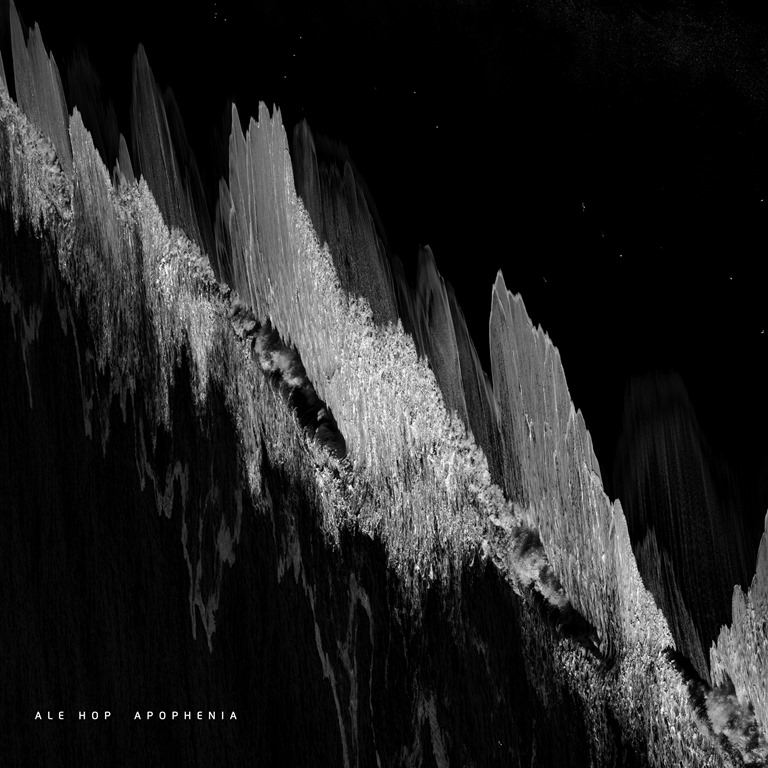
Apophenia: the tendency to perceive connections and meaningfulness in random noise, e.g., clouds resembling animals or human faces. Ale Hop’s Apophenia, which we learn ‘suggests possible and reimagined South American geographies’, contains an abundance of random noise. Ale Hop, we find, isn’t a band as such, but ‘a Berlin-based artist, researcher, and experimental instrumentist (sic) from Peru. She composes electronic music, by blending strains of noise, pop, avant-garde, ambient and a complex repertoire of extended techniques for electric guitar and real-time sampling devices which she uses as her sound vocabulary to craft a performance of astonishing physical intensity, saturated of layers of distortion and stunning atmospheres’.

And on the strength of this outing, she grasps atmosphere in a major way. These pieces are hefty, deep, and often dark, not to mention challenging. Ale Hop doesn’t do easy accessibility, and that’s a good thing. This is one of those releases I’m proud to say is about art. I can’t truly fathom it, and certainly can’t justify it.

The press release pitches ‘atomized field recordings and sound samples. recollected from video archives from her homeland, Peru, the composer interweaves unknown territories, by mimicking mountains and oceans, but also grey skies and violent cities, with droning and shrieking textures of electric guitars mixed with spoken chatters and sizzles’.

Somnambulant drones and ethereal elongated notes which hover and hum dominate the album’s eight compositions. There are no easy inroads here. In fact, there are no inroads at all.

‘Side Effects’ is an odd piece of spoken word with extraneous noise, and the mix oddly pitches background sounds to the fore to disorientating effect. It’s only three-and-a-half minutes long, but it’s three-and-a-half minutes of warping drones and static hiss and crackling.

There’s dark turbulence on ‘Lima’, which plunges the listener into subterranean spaces of disquiet and discomfort, while ‘Onomatopoeia’ appropriately brings a gloopy, swampy soup of sound, and the title track – a succession of scraping shards of electronic feedback.

And what does it all mean? That I fail to sense ‘South American geographies’ doesn’t mean they’re not present in every moment, but reminds us that artistic intention and the artist’s spheres of reference and influence often differ from those of the audience, who can only truly receive art from their own solipsistic vantage point. As such, dissemination and reception rarely correspond, and this is never more apparent than when considering the experimental and the avant-garde, where theoretical context counts for nought to much of the audience.

The sign of artistic success in this context is not whether or not the audience grasp the context or intention but whether they connect with the work – on any level – despite a lack of a priori knowledge.

Apophenia is a challenging listen, but is an album that holds up and ‘works’ when removed from its context. It’s all about atmosphere, and the universal language of sound.

BR127_front

Panurus Productions – 18th October 2019

Christopher Nosnibor

WHELM
verb
past tense: whelmed; past participle: whelmed
engulf, submerge, or bury.
"a swimmer whelmed in a raging storm"
well up or flow.
"the brook whelmed up from its source"

It’s funny: I’d never really considered the true meaning of ‘whelmed’, and I’ve simply used it as a blank space between under- and over- and in some vague and misguided attempt to be amusing on occasions. But the definition provides the preface to the accompanying text for this split release featuring two spectacularly abstruse purveyors of gnarly noise, the latter of the two acts featuring Panurus head honcho (and indeed solo honcho) James Watts with grunts and growls.

The moment I clapped eyes on the name Bodies on Everest it lodged in my brain s one of the best band names going. There are thought to be currently around 200 unrecovered bodies on the world’s highest mountain, and it doesn’t take much searching of the Internets to find a library of images of frozen corpses. As such, the name isn’t only gruesome but highly visual in its connotations. And it’s also incredibly fitting:

Talk about a mammoth build… BoE’s first track, ‘My Mother in the Mountains Affects My Gym Coat at Work’ is a sprawling twenty-minute behemoth that starts gently, atmospherically, musically, with a strolling bass and takes its time to swell into the blistering, raging racket it winds up as, first growing in volume before ultimately being buried beneath the most agonising deluge of extraneous noise. And it’s a glorious tsunami of noise that they bring, with the vocals – and there aren’t many – howled, anguished – buried in the wall of noise as screaming feedback howls over the thunderous bass – it’s around twelve minutes in that I realise that said bassline has maybe only two notes – that grows evermore agitated. And in the end it all collapses into a churning squall of feedback and contact hum.

‘Can Ghosts See Dogs’ brings muffled samples of dialogue into the mix before bringing the gnarly noise centres around a low-slung bass churning out a repetitive groove, over which there’s some psychotic yelling, and‘(Yes)’ follows a similar format, but places the emphasis on loping rums, at least until the bowel-shaking bass loop slithers in at half speed and the percussion recedes.

Th fifteen-minute ‘Kicking my Landlord’ Head In’ goes punky postpunk grind groove while at the same time not exactly deviating from the formula, and it’s every bit as brutal as the title suggests, calling to mind Head of David’s HODICA racketfest.

Lump hammer aren’t a band who provide calm or contrast, serving up five tumultuous compositions built on gut-churning noise. Where do you take such a brutal, squalling grind of bass and drums paired with roaring vocal that veers between growling guttural and howling demonic throat-ruining screams? There’s no answer, really. Lump Hammer are also appropriately named, delivering a brutal bludgeoning in lieu of anything tuneful. The bass dominates the sludge mess, and it is a mess, an overloaded deluge of distortion from which it’s difficult to decipher, well, anything much.

‘Pigfish’ is the first, and clocks in at under three squalling minutes, before they settle into the six- or seven-minute zone. Each track is a lumbering sludgefest, tortured and torturous. Yes, it is all unintelligible raw-throated howling against a backdrop of rumbling bass, crashing rum and discordant guitars. And that’s everything that’ ace about it.

‘Tired’ pairs things back a looong way, trudging through a sparse space while he crawling ‘Manual Labour’ pounds away at a crawl that lands between early Swans and early Godflesh, with a dash of early Pitchshifer thrown in. It’s heavy, for sure.

Closer ‘FFS’ stretches the underlying formula out for almost eighteen minutes. Amidst the bass / guitar sludge that sounds like the grind and scrape of earthworks and some vocals where there are almost decipherable words. Almost. It’s a truly purgatorial noise and fifteen minutes feels like forever at 35 BPM.

This is dingy, dirgy, heavy, and utterly punishing. As such it may be a perverse pleasure, but a pleasure nonetheless.

AA

cover

Nefarious Industries – 1st November 2019

The one thing that’s been consistent about experimental noise-rock duo Cinema Cinema across their previous releases has been their capacity to confound expectation. Their freeform approach to rock has always made them hard to place in a fixed sense, although Sonic Youth and Live Skull are reasonable references against which to pitch their guitar-driven racket that’s been given to stray into expansive space rock workouts.

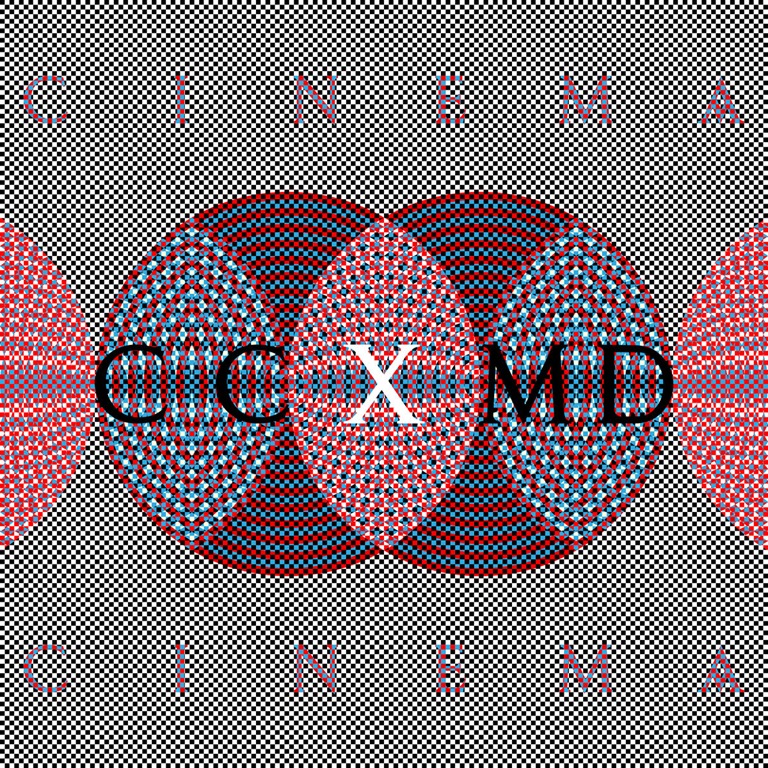
Each release has ventured into different stylistic territory, at least at points, and while 2017’s Man Bites Dog did bring some sax into the mix, they’ve predominantly maintained a no-wave rock focus – until now. With CCXMD they cut the cord that holds any ties to the conventions of rock to go all-out on the freeform, and this time it’s jazz. Not even jazz-rock, but a weirdy, off-the-wall, jazz oddity with swirling ambient currents. CCXMD is a genuine ‘wtf?’ release.

Where are the guitars? And words? There are practically no vocals, and the vocals there are, are mangled and so low in the mix they’re barely audible. There are guitars, but they’re practically absent on the first two tracks – short, semi-ambient fragments – and when they do finally appear on the third track, ‘Colours’, it’s more the sound of tuning up, accompanied by pan-pipes and with stuttering percussion that lollops and rolls and crashes chaotically without ever taking form. You’re on the edge of your seat waiting for something – you don’t even really know what – but you don’t get it. It’s hard to tell what you actually do get.

‘Cyclops’ threatens to settle into a rock-riff groove before veering into all kinds of chaos with parping sax trills and every shade of jazz mania mewling like demented cats here there and everywhere, and the album’s thirteen-minute centrepiece, ‘Ode to a Gowanus Flower’ is an exercise on patience-testing as they wander through evocations of Eastern mystery. It’s difficult to listen to because it’s difficult to place and even more difficult to settle in with. This isn’t because it’s a departure, this is simply by virtue of the fact that this is a challenging album it its own right. It’s deranged, messy, unpredictable, incoherent and all the jazz. But it’s ambitious, interesting, and sees Cinema Cinema really test both themselves and their fans. And that’s a good thing: remaining static is tantamount to being dead. And moreover, any band that finds its niche and sticks to it consigns itself to a trajectory of diminishing returns.

Cinema Cinema are following their creative urges and aren’t dictated by any perception of fan demands or dictates: they do what they do because they’re driven to do it, and certainly not because of any label or trend. And this is why Cinema Cinema are such an essential band, and why they’ll endure. They don’t give a fuck about what you’re into. They do their own thing. And that is art.

AA

Cinema Cinama

Front & Follow – 15th November 2019

Christopher Nosnibor

Front and Follow is a label that’s carved a special niche in the cassette release corner of the industry, and has, for those in the know, become a trademark of quality. But sustaining such consistency – or even anything – as a one-man operation is hard work, and often with little reward. As such, while I was sad to learn they’re taking a break, they’re signing off with an incredibly strong release, courtesy of Ekoplekz, who is also embarking on an indefinite break.

The album’s pitched as ‘drawing parallels between present day Britain and that of the turn of the 80s, Ekoplekz looks back to that era’s industrial and post-punk soundtrack for inspiration,’ and the press release continues: ‘In a land increasingly brutalized by austerity and divided by nationalism, the tensions that informed some of the post-punk era’s most important works (Red Mecca, Unknown Pleasures, Metal Box) haunt this collection of bleak postcards from the present’. The present is indeed bleak, unless, of course, you perhaps run a hedge fund with billions backing a no-deal Brexit or you’re a major corporation invested in climate change denial or pharmaceuticals. But then, if you’re in that bracket, you’re probably on your private jet grabbing bitches by the pussy and going gammon about these smelly hippy protestors or somesuch. For the rest of us these ae dark times that require a dark soundtrack, and as I’ve said elsewhere, it’s no surprise that we’re experiencing a different kind of 80s revival at the moment. Brutal and divided pretty much sum up both UK and US politics and cultures , as well as further afield. Who actually feels safe on the street? Who actually feels safe as a career artist? Who isn’t remotely concerned, doesn’t feel concerned, panicked, anxietised? We don’t need Duran Duran replicas like The Bravery, and even Editors and Interpol’s take on post-punk feels lightweight in the face of the crises that define the current – and so Ekoplekz plunge deep back to the late 70s source to dredge real darkness and despondency here, and in doing so, In Search of the Third Mantra soundtracks the present – bleak as it is.

With In Search of the Third Mantra, Ekoplekz sets his spheres of reference out early, with ‘High Rise Dub’ carrying Ballardian connotations and ‘K-Punk’ taking its title from the seminal blog of the early noughties by the late Mark Fisher, to whom the album is dedicated. This, then, without wanting to sound elitist, is no mindless replication of an array of retro tropes, but a considered assimilation of myriad sources, distilled into something wilfully challenging. We would expect nothing less of K Craig, filmmaker and front man of currently-resting Last Harbour. This is quite a departure, but works in context: while we don’t get brooding vocals and arch-gothic sonic structures, there’s a brooding nihilism that rumbles at the core of In Search of the Third Mantra in the same way it lurks so many albums of the period, and a lot has to be credited to the production.

It’s got grooves and danceable beats, but it’s also possessed of a dehumanised detachment, a sense of distancing and dislocation: you’re in the zone and in the space where you’re feeling the distance, the disfunction. The fact that this doesn’t fit, the fact that you don’t fit.

The spartan electronica of the former, with its dubby bass and rhythm that shuffles and clatters conjures a sense of alienation and otherness, while the latter brings things down a notch darker, laser bleeps and eerie vaporous notes hover ominously. ‘Do the Meinhof’ goes full motoric, channelling the insistent industrial grooves of DAF and Cabaret Voltaire into a tense death disco pounder laced with icy synths.

The sonic touchstones are all very much in evidence as the listener is led through a haunting desert of sound, dark, murky, menacing. ‘Accept Nothing’ has hints of The Cure’s Carnage Visors soundtrack, and the atmosphere which permeates all ten compositions is unforgiving and inhospitable.

There’s a degree of linearity to the album’s sequencing, and each track feels sparser, less defined, and with this progression there comes an increasing sense of collapse, of emptiness, and while sonically, the pieces are spacious, the atmosphere is evermore paranoid. One feels as though familiar structures are falling away, disintegrating. By the time we arrive at ‘Heart Addict (In Make Up)’, there’s little left beyond an almost subliminal, stunted dub bass that twitches anxiously alongside a barely perceptible beat, and we’re left, alone, disorientated, and teetering on the precipice just inches from the void.

AA

Ekoplekz_cover