Archive for May, 2022

2nd May 2022

Christopher Nosnibor

‘Bitch 16’ is the debut single from French darkwave project Distance H. It was recorded in collaboration with Ophelia from Saigon Blue Rain, one of a number of female vocalists to feature on Distance H’s forthcoming EP, Intimacy.

It’s a deft slice of dark pop with both atmosphere and edge, not to mention hints of Garbage. And while not without hooks – it has plenty – it’s the atmosphere that stays with you, at least after the first listen, and it’s the vibe you want to revisit and which makes you hit repeat – and that urge to hit repeat is strong.

Propelled by an old-school drum machine sound, there are some retro drum fills that sound just a shade clunky against the austere, smooth-surfaced synths, but there’s a compelling urgency, and a certain sass about ‘Bitch 16’ as Ophelia’s vocals glide and soar – and yes, perhaps it’s something about the translation, as the band summarise that ‘Bitch 16’ is ‘in some ways opposed to Sweet 16 and its form of happy, carefree transition. When sweetness gives way to brutality; when detachment gives way to obsession, when desire gives way to disgust’.

These are strong emotions, and Distance H have distilled them into a taut four and a half minutes, making for a strong debut.

AA

073130

Acclaimed Nordic Dark Folk artist Sowulo reveals the second single and lyric video ‘Stearcost ealra’, from the upcoming new studio album Wurdiz, set for release on September 9th through By Norse Music.

‘Stearcost Ealra’ is a powerful song about fate and destiny, and how both notions are the strongest of all.

Faber Horbach comments: ‘Do not fight, do not resist your destiny, if you withstand that what already is, you will suffer a lot in your lifetime. Observe how your mind fools you to believe that you have a choice to go against the will of destiny, but that you know the truth deep down in your heart. This ‘knowing’, this inner voice, can be experienced as a feeling realization. Let it guide you, let fate come to pass.’

About the album: “Wurdiz”, the proto-germanic word for destiny, is all about the dance between fate and free will and with these songs, Sowulo’s founder and multi-instrumentalist Faber Horbach intentionally connects to fate and let it incite him to become a weaver of his own destiny.

The album is about fate as the unfolding turning of events and the journey of becoming aware of one’s own threads within the tapestry of life. As the twelve songs unfold, the replicas of historical instruments in combination with modern-day instruments and production techniques confer to “Wurdiz” a powerful and cinematic sound that takes you on a journey within. While the carnyx, lyre, nyckelharpa, Irish bouzouki, Celtic harp, and blow horns create echoes from the distant past; throat singing, spoken incantations and powerful vocals tell the stories on a deep emotional level, accompanied by bombastic percussion and strings.

Watch the video for ‘Stearcost Ealra’ here:

AA

Sowulo

We love mental shit, and this is some mental shit.

Avant group Hifiklub has shared a new track, ‘Weird Five,’ featuring the legendary Iggor Cavalera (MixHell, Cavalera Conspiracy, Pet Brick, co-founder of Sepultura). The song is a part of the French trio’s audio-visual collaboration, ScorpKlub I & II Original Soundtracks, with the Montreal animator James Kerr (Scorpion Dagger). The double-sided record — which features Alain Johannes (Queens of the Stone Age, Them Crooked Vultures, Eleven) in addition to Iggor Cavalera —will be out digitally as well as on different colored vinyl on 27 May 2022 via Electric Valley Records.

Hifiklub bassist Régis Laugier on ‘Weird Five’: “1 Day as A Lion, 2Pac, Spacemen 3, Gang of 4, Electric 6, L7… Something was missing. What about the “Weird 5”? Let us know what’s your favorite band with numbers in their names. In the meantime, here is the first track of Hifiklub’s collaboration with Iggor Cavalera, from ScorpKlub I & II. 18 more videos to come!”

Check ‘Weird Five’ here:

AA

535cc99c-7f17-6a48-2551-42978da69a81

Electric Valley Records – 24th June 2022

Christopher Nosnibor

In my recent review of the new album from St Michael front, I commented on German humour – in a positive way, I should add. So it was with a certain relief that I noted that BongBongBeerWizards hail from Dortmund. Don’t get me wrong, it’s a shit name for a band irrespective of where they’re from. I genuinely thought that Doom/Drone/Sludge Metal had run its course in terms of daft names and gone over the border some time ago, and that Mammoth Weed Wizard Bastard (now MWWB, presumably because they realised the name was daft rather than that they believed it was an obstacle to commercial success) had had the final word in name-generator style absurdity. And they ought to have. But then these buggers turn up with an even stupider name. But at least we can reasonably assume they know it’s a fucking stupid name and are pissing themselves over it.

BBBW may well be hampering their potential audience reach – I’ll admit, I did think twice about bothering to listen – but that would have very much been my loss, because Amprire is an instant classic as a storming example of the genre. With just three tracks and a running time of almost fifty minutes, it’s Sunn O))), it’s Earth, it’s Sleep and it’s Bong in a tectonic collision – more of a slow melt than anything likely to cause earthquakes and mudslides. That said, there are tempo changes galore on the twenty-three minute ‘Choirs & Masses’, a megalithic beast that’s got the lot: heavily reverbed vocals and choral ceremonials that echo from cavernous depths of despair while the guitars churn and growl all around, thick with dripping distortion. At times it’s a raging thrust of riffery, at others it’s a gut-churning crawl, or an ominous organ note that hovers indefinitely, and there are many changes to hold the attention over its epic duration.

‘Unison’ raises an even denser, thicker guitar-driven tempest that’s so thick and sludgy it’s suffocating, and when the vocals are absent, churns into full-on Sunn O))) territory with the gnarly guitar obliteration.

It’s hard to really say that there’s a real arc or progression on an album like this: it may be more of a case of will or projection, but I suppose whether it’s real or an illusion, the end result is the same from a listening perspective, and the perception is that things become more focused and ultimately heavier and denser over the duration of the album. And as an album, Ampire is a beast: epic, ambitious, and for the most part, the changes are well-timed if not always smooth – some of the transitions feel a little bit like stopping one riff and starting another – but it hangs together overall, and it maintains and even increases the weight right to the crushing end. Overall, it’s an admirably solid album. Still an awful band name, though.

AA

a1363458322_10

Fabrique Records – 29th April 2022

Christopher Nosnibor

On her latest project, Jana Irmert shrinks the focus of her thoughts and her music on the microcosmic – although that certainly doesn’t extend to the microtonal. What Happens At Night is an intensely-focused work that places the lens onto textures and tones, and an examination of the relationship between the physical and the cerebral. You may call it a celebration of overthinking, but ‘philosophical’ feels a more appropriate term for her musical meditation on life and death – specifically death and beyond, the part of the life journey no-one has ever reported on and will, one assumes, be forever unknown and unknowable.

The liner notes set out the granular nature of the album’s composition: ‘Like layers of sediment, sounds are being pushed up from underneath, floating away or sinking back to the bottom. At the core of the album lies a question: What will be left of us? While Earth melts, we go on. But eventually, there will be a point in the future where all that will be left of humanity is a thin layer of rock. While this may seem like a deeply gloomy prospect, it also carries a great deal of comfort: the reminder that we are only a small particle in a vast system so big that we can never fully grasp’.

This is the limitation we all live with: the inability to comprehend life without us, what it would be like to not exist. Much of it’s ego, but perhaps it’s also a preprogramed limitation. Everything is dust, and once we pass, ashes to ashes, dust to dust, we become desert, and nothing changes: the world goes on… and on. And that’s a disheartening prospect; for the majority, our legacy won’t extend beyond our lifetimes, and the world at large is unaware of our existence while we’re here, let alone likely to experience any ripples in our wake. But even the world will be finite, ultimately. It will be swallowed by the sun in supernova. But none of us will be here to report on it by then.

What Happens At Night is dark and stark, and with just four tracks and a running time of less than half an hour, it’s perhaps technically only an EP, but feels like an album in every respect.

There’s a dolorous chime of a bell and a shrieking anguish of tortured spirits trailing like comets fading through the sky at the start of the album’s first piece, ‘Particles’, and everything simply floats and drifts. It’s ambient in the conventional sense: it’s background, you don’t really pay close attention while it’s playing, but it does subtly slant the mood.

‘Ashes’ is but a drifting fragment between the megalithic pieces on either side: it’s barely three minutes in duration. If ‘Dust is the Rust of Time’ is sparse it’s also dense, and a sedated heartbeat pulses uncomfortably throughout, amidst shuddering, gasping breaths of panic. You feel the anxiety at the passing of time; what have you achieved, and what will be your legacy? How will you be remembered in a world without you? It’s a tense, dense, gloomy sound, and you come to realise you are nothing, you’re simply here to go, and one day you will be but dust. Deal with it. And yet… It’s not a question of there being something more beyond, as such. And yet… ‘Stratum’ closes, and it’s the splash of waves and the quiet roar of a buffeting wind and the slow sound of the dust settling as incrementally, life returns to earth in slow, sedimentary layers, and each layer fossilises a period in time for all eternity. You may be dust, you may be forgotten, but in some form, are eternal in the earth.

Irmert articulates nothing specifically or directly here, but instead, What Happens At Night provides a sonic backdrop which invites contemplation.

AA

FAB097_front

Coming from the playfully intangible modular synth and multi-instrumental collective The Utopia Strong, is ‘Castalia’, a new taster of the voyage to come from their second full length International Treasure (Rocket Recordings, 10th June).

Here, the band share their thoughts on the second single and album closer:

"Castalia was one of the first tunes we started for International Treasure, it felt so optimistic and forgiving which was such a tonic during the somber period in which the album was recorded. Castalia initially felt at odds with the rest of the album which generally has a much bleaker, melancholic tone – to our ears at least – but by putting it in as the last tune it somehow makes sense of everything that went before.

Kavus continues, "It has this end of the night kind of feeling, it put us in mind of Orbital’s Belfast or Ashra’s Sunrain. Steve and I thought it would sound perfect as the last tune we’d play in a DJ set, in fact initially I wanted to call it ‘Last Song Of The Night’ but thankfully Mike wasn’t having any of it! The vocal at the end once again comes from Katharine Blake who sang on the last piece of our debut album, Moonchild. We liked the conceptual continuity of that but also, along with the use of acoustic instruments, the way it humanises the track too.

"Mike Bourne, who created the video, has been a friend before we were even a band. It was he who inspired Steve to take up the modular synthesiser in the first place. We loved his work anyway and he’d created an astonishing video for The Holy Family, another Rocket band Mike York and I are involved with, so we were very keen to work with him. He’d specifically asked to do the video for Castalia and knowing his work we gave him a free hand. I think the end results absolutely crystallise the vibe and atmosphere of the piece, we couldn’t be happier."

Watch the video for ‘Castalia’ here:

AA

US2

Photo credit: David Ryder Prangley

Season Of Mist – 6th May 2022

Christopher Nosnibor

Sometimes, in this line of work, an album will land – or however else you prefer to phrase it – and you know it will likely mean almost infinitely more to you than pretty much anyone you’ll see or speak to or who’s likely to read the review. As a reviewer, you pretty much live for opportunities like this, to cover bands you’re not only a huge fan of, but have been since you properly started discovering music, and also reading the music press (something that sadly no longer exists, at least here in the UK, which once had a rich range of reportage and critique, thanks to Melody Maker, Sounds, and last one standing, NME. Sure, they had their failings, but like The Word, Snub TV, and The White Room on TV, and John Peel, Janice Long, and even Zane Lowe on Radio 1, they were key for providing exposure to ‘alternative’ music and breaking new acts.

It was via Melody Maker and Mick Mercer’s Gothic Rock Black Book that I first encountered Christian Death, and purchased Sex and Drugs and Jesus Christ on its release in 1988. This in turn not only led me to excavate their back catalogue and purchase each new release, but to catch them live a couple of times. They’re a band I’ve not so much returned to, but never really left, despite not always keeping up to date with new releases.

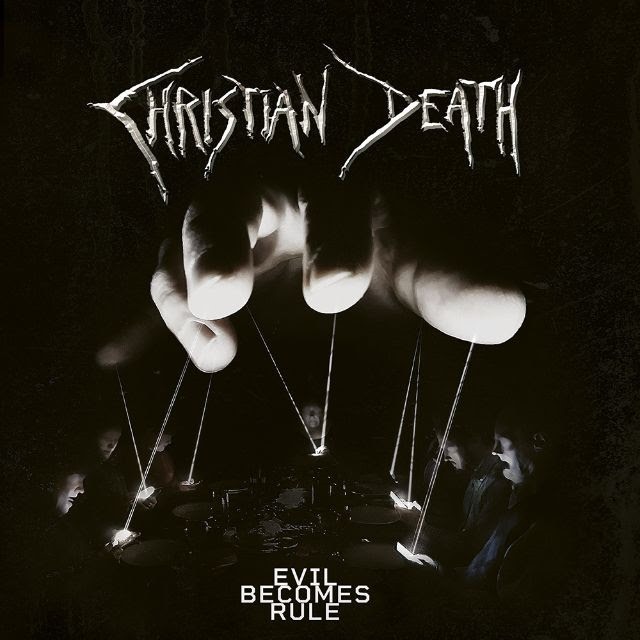
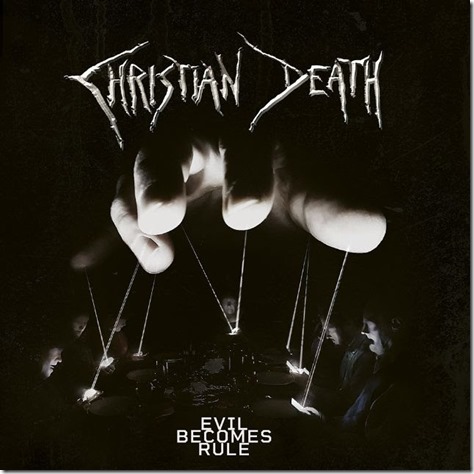
But here we are: it’s the spring of 2022 and after a significant gap since The Root Of All Evilution, Christian Death return with Evil Becomes Rule, which Valor says is, essentially, a sequel, explaining, “Both Evil Becomes Rule and The Root Of All Evilution are pretty much the story of evil. These songs are generally about “The Evil Within Society,” not necessarily stemming from a demon, or a devil, or a God. Instead, it’s about something concerning the evil within mankind… Evil Becomes Rule is a continuation of this theme. We’re going from the present time into the future. When we started writing this album, we anticipated an event like the pandemic; a disastrous event occurring on the earth. So now we’re asking the question, “maybe this is just the beginning of it?”

Evil – and its opposite – is a familiar theme for Christian Death: The simultaneously released All The Love / All the Hate albums explored these diametric standpoints, and essentially aligned hate with evil, taking this idea of the evil within man to its logical end with songs like ‘Nazi Killer’ and ‘The Final Solution’. As such, perhaps the lineage of exploration can be traced a fair bit further back in the band’s career than the last album.

Evil Becomes Rule is quintessential Christian Death, but as is always the case, it’s different from anything before. It’s heavy in places, a shade less metal than things were around the turn of the millennium (Sexy Death God, for example, felt a bit too metal and a shade underproduced), and they seem to have hit something of a sweet spot in terms of balance this time around.

Opening the album, ‘The Alpha and the Omega’ is sparse, but tense, claustrophobic, and initially finds Valor in his best Bowie mode – crooning, stealthy – and this, is the shape of the verses – which contrast with the explosive choruses, there things get dark and, I have to say it, high gothic. ‘New Messiah’ has a quite different vibe, and is almost swingy, smoochy, but does again exploit the quiet verse and big chorus dynamic, and faintly echoing in the dark recesses, there’s the ‘I feel like my heart is being touched by Christ’ sample from Altered States that also appeared on ‘Mors Voluntaria’ from Insanus, Ultio, Prodito, Misericordiaque. It’s still fucking eerie.

Maitri takes the lead vocal on the urgent thrashabout of ‘Elegant Sleeping’, which harks back to their earlier works more than any other on the album, before ‘Blood Moon’ crashes in and already feels like a familiar friend. It’s as strong as any of the singles they put out during their late 80s commercial peak, as represented by ‘Church of No Return’, ‘Zero Sex’ and ‘What’s the Verdict’, and the production is smoother, too, and it very much works in its favour. ‘Abraxas We Are’ is a heavy rock epic which is equally single-worthy, and features some blistering lead guitar work, and they find their rock stride even more solidly with ‘The Warning’ – bursting into a rabid, ragged, industrial stomp about killing sprees in the chorus, and it kicks arse abundantly.

The songwriting – and attention to dynamics – are very much to the fore on Evil Becomes Rule, and the switch to pastoral chamber music in the intro to ‘Beautiful’ brings a nice contrast – the song effortlessly swings into stonking post-punk and is quite uplifting. The album concludes with the suitably dramatic two-part ‘Who Am I’, that combines Spanish guitar and a surging crescendo.

Evil Becomes Rule is by no means their most biting or intense work, and it doesn’t have the raw impact of Sex and Drugs, but instead harks back to the dramatic style of Atrocities, and it works well. It is, perhaps, their most rounded and well-realised release yet, as well as their most consistent. Oh, and yes – we are indeed ruled by evil. These are dark times, where we really need Christian Death and voices of dissent.

AA
166908

Two albums in and London’s Grave Lines, purveyors of ‘heavy gloom’ have already carved a unique niche in the myriad spheres of heavy music. Their first album Welcome To Nothing set the tone for their distinct take on doom metal, which was broadened even further with album two Fed Into The Nihilist Engine. An epic feast of hard ‘n’ heavy riffs coupled with brooding sadness interspersed with thoughtful transcendent moments of introspection.

Never a band to rely solely on trotting out those ‘doom metal’ tropes, the band began to weave in gothic and experimental elements into their music, to delve deeper into the dark shadows of the psyche.

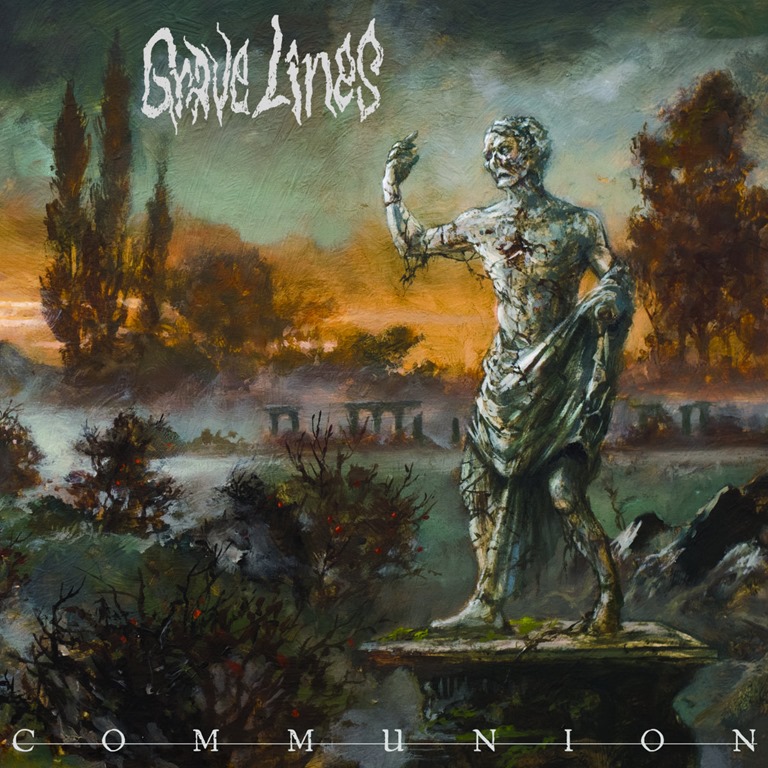
Now with their third album Communion Grave Lines continue their exploration into the ugliness of the human condition, at the same time becoming a band that truly defies any pigeonhole.

Continuing to hone and evolve their collective vision and aided by the masterful production of Andy Hawkins at The Nave Studios, Communion sees Grave Lines creep further into the various corners of their sound.

In a nutshell Communion is a violent descent of bile-soaked intensity spiralling between filth laden swagger, and fragile mournful lament. The album delves into the internal aloneness of existence and the failings of the human connection.

Owing as much to Bauhaus and Killing Joke as it does to Black Sabbath or Neurosis, there are moments of gut wrenching doomed up heaviness and bellowing noise rock, contrasting with ambient gothic passages and a thoughtful melancholy, to a create a powerful new chapter in their ceaseless journey through the gloom. Listen to first single ‘Carcini’ now:

AA

a4278953279_10

Neurot Recordings – 6th May 2022

Christopher Nosnibor

There’s something about Neurot: as a label, it certainly has a distinct ‘house style’, and if it does seem to be predominantly in the vein of Neurosis, then Ufomammut’s latest offering, Fenice,  is simultaneously definitive and a departure, in that it’s clearly metal in persuasion, and given to long, slow, and expansive workouts, with the majority of the album’s six pieces running (well) past the seven-minute mark. It’s delicately-paced, too: it’s not all a crawl, but the crescendos land a fair way apart and the build-ups are long and deliberate.

Opener ‘Duat’ is an absolute monster, clocking in past ten and a half minutes, and beginning with ominous dark ambience and slow to a crawl electronics, before a surging techno bass grind cuts through and pulses away. It’s three and a half minutes before the guitars pile in, and when they do, everything comes together to forge a piledriving industrial blast: for a moment, I’m reminded of Nine Inch Nails’ ‘March of the Pigs’, but then things switch again with a tempo change, slowing to a lumbering thud. It builds from there, and the final minute hits that sweet spot of pulverizing riffery that is pure joy. Ufomammut may be a ‘doom’ band by designation, but this is some of the most dynamic progressive metal you’ll hear.

Having set the bar so high so early, the challenge is, can they sustain it? ‘Kepherer’ is a dank, semi-ambient interlude that provides some much-needed breathing space. ‘Psychostasia’ starts off gently, but again, builds into a really slugger, the riff hard and repetitive, the vocals half-buried amidst overdrive and reverb, and it’s so, so exhilarating.

It takes an eternity of a slow, nagging cyclical motif, rich in chorus and reverb, before ‘Metamprphoenix’ breaks, and segues immediately into the throbbing behemoth that is ‘Pyramind’, where things do, finally, hit all-out doom grind with the heaviest, most crushing power chords. The bass goes so low that it practically burrows underground, while the guitars soar skyward. Closer ‘Empyros’ is the album’s shortest track, and it’s three minutes of punishing guitars that pick up precisely where ‘Pyramind’ leaves off and just drives and drives and drives, churning, hard, heavy.

If you’re seeking instant gratification, Fenice isn’t the album you want, but that doesn’t mean that it by any means feels drawn-out or like there’s much waiting involved: despite the lengthy songs, and the slow-builds, the textures and atmospheres are remarkable. I have a friend who loves his slow-burning metal and math-rock, but hates Amenra because he finds them insufferably tedious. Personally, I’m a fan, but I get the impatience, and it is largely around this kind of slow, earthy metal where time stalls and aeons pass between events, and the builds take several lifetimes to come to any kind of fruition – but this most certainly isn’t an issue for Ufomammut on Fenice. The compositions twist and turn and continue to not only hold the attention but to tug at the senses, keeping the listener on edge, poised, tense, expectant. And they always deliver on those expectations.

There is a clear and definitely trajectory here, too, building over the last three pieces to a point where the riffs are dominant – megalithic grinds that hit hard. Fenice makes you feel a broad range of things: boredom or disappointment aren’t among them. It does require some work, but it’s amply rewarded.

AA

465952

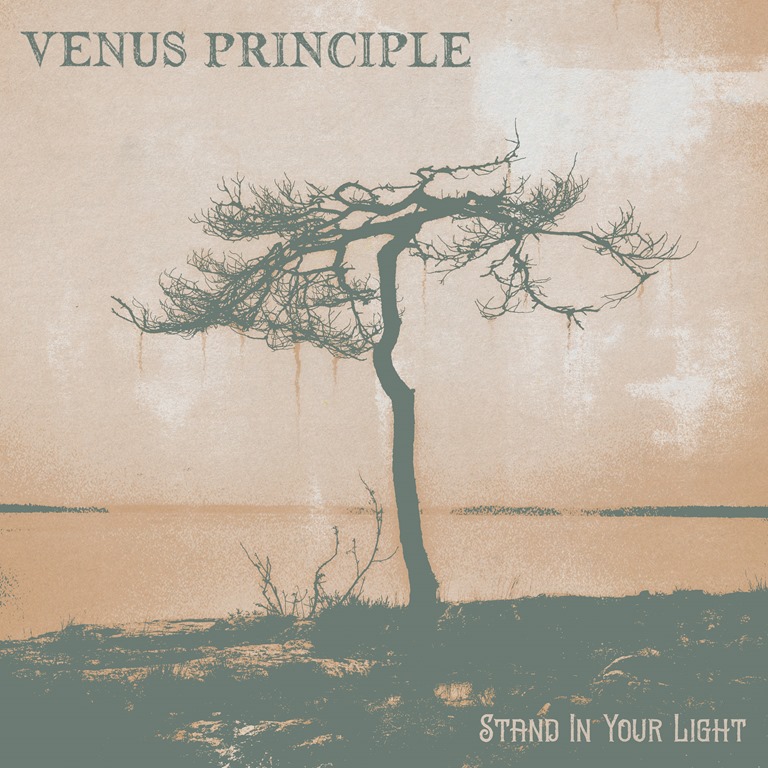
Venus Principle are premiering the melancholic and powerful new track ‘Drag Nets’ as the final single taken from the dark psychedelic rocker’s debut full-length Stand in Your Light, which has been scheduled for release on May 27.

‘Drag Nets’ makes subtle use of a wide range of instrumentation from sax to mellotron vibes and Mini Moog, and the stunning vocal chemistry between Daisy Chapman and Daniel Änghede comes into play again as well.

The band comment: “After the initial recording sessions for Stand in Your Light were postponed, we had a chance to write a few more songs”, guitarist Jonas Stålhammar tells. “The last one written was ‘Drag Nets’. It turned out to be by far the heaviest track on the album. ‘Drag Nets’ represents the waste and rejects of man. You can trawl the sea for food and treasure, but humankind will always carelessly discard all unwanted matter only for it to be rediscovered as flotsam and jetsam. The idea of adding saxophone was a last minute thought in the studio when I reached the conclusion that we had too many guitar solos on the album already. Our amazing guest on the saxophone, August Eriksson, copied my guitar solo note for note and then added some improvised sprinkles.”

Listen to ‘Drag Nets’ here:

AA

Venus_Principle_000_album_cover_Stand_in_Your_Light