Posts Tagged ‘references’

Cruel Nature Records – 3st1 July 2026

Christopher Nosnibor

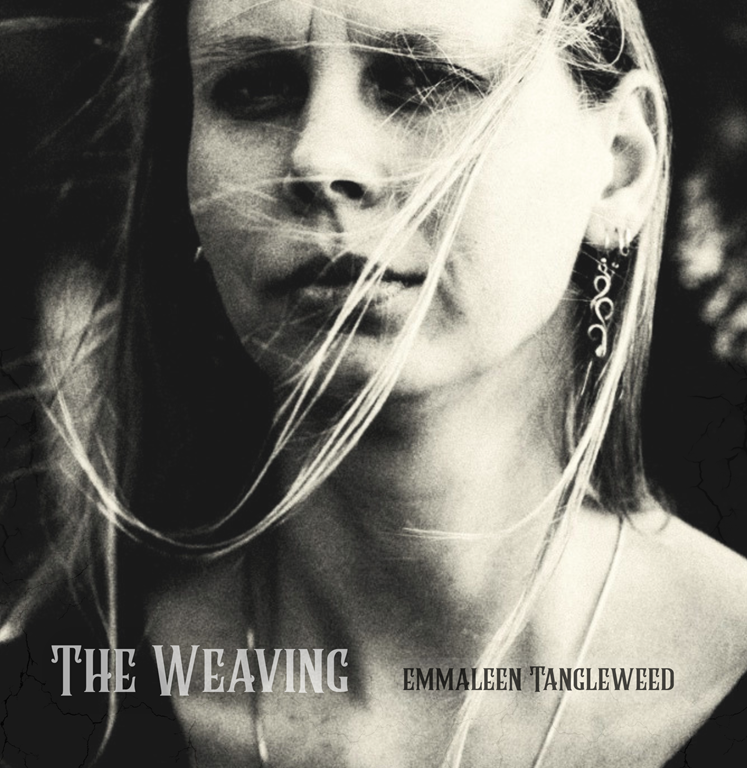
“This album is kind of a collage of all the books I was reading and my impressions of the general emotions swimming in the collective experience, as well as personal stories I’ve picked up along the way.” So says Emmaleen Tangleweed of her new album, The Weaving, which was recorded in September 2025 ‘in a log cabin in Swartvlei (“black lake”), Western Cape, South Africa’. The liner notes describe it as ‘a collection of gothic folk and blues ballads tinged with hypnotic magic realism’.

The first song, ‘The Hours’ is likely, then, to be a direct reference to Michael Cunningham’s 1998 Pulitzer-winning novel – which in turn was inspired by Virginia Woolf’s 1925 novel Mrs Dalloway. It’s a wonderfully earthy slice of dark, primitive blues, rendered all the more potent by the rich patina of Tangleweed’s voice. In the recent Six of the Best feature for Aural Aggravation, she cited Black Pudding by Mark Lanegan and Duke Garwood as an influence, citing ‘an archetypal timelessness’, and this is what very much comes through here, perhaps with a hint of PJ Harvey in the mix, too. There’s nothing complex – or even innovative – about it, but blues isn’t about complexity or innovation, it’s about feeling, about soul. And this is something The Weaving brings in spades.

‘Silent Killer’ could be a hundred years old, but it could also be an outtake from Rid of Me. Emmaleen sings from her gut, and with guts, too, and plays with a perfect feel for the swing required to bring the songs to life. There’s a bit of fuzz on the low strings which gives a vintage, analogue feel to the production. This is also true of the sepia-toned ‘Strangeling Angel’, which very much replicates the feel of those early twentieth century blues legends and those altogether more obscure.

The introduction of cello on ‘Blind Faith’ is done subtly, but adds depth to the otherwise sparse arrangement, and for the most part, everything hangs on her voice and acoustic guitar. Perhaps because of this, there’s a palpable intimacy and immediacy about The Weaving, capturing as it does the sensation of being in a small room as the songs are performed live. ‘Never Ending History’ is almost a crawl, and she drawls the lyrics low and slow, and something strange happens with time as it slips back. one can almost envisage grainy black and white photographs accompanying it.

Most of the songs are in the five-minute region and she fills the space with a rare tension. ‘Ask the Dust’ is another song which makes a direct reference, this time to John Fante’s 1939 novel set in The Great Depression, and shit, it’s bleak. ‘Is there anyone out there’ she asks against images of ‘the burnt out rust’ and a monotonous, repetitive riff reminiscent of Michael Gira at his most lugubrious. It’s here that is becomes most apparent that it’s possible to be heavy without distortion or volume, and that weight comes from the heart. You can hear her fingers hitting the strings on ‘Ask the Dust’, in a way that has the same feel as striking dry earth with a pick. It’s not entertainment, but labour, and The Weaving finds Tangleweed dredging deep. There’s no showing on the doll where this music touches: it’s somewhere deep inside, subconscious, subliminal. And herein lies its power – it’s something that’s affecting on an almost cellular or biological level, resonating with experiences of past lives or something. You feel it in a way that’s impossible to explain. But feel it, you do.

AA
cover

COP International – 31st December 2024

Christopher Nosnibor

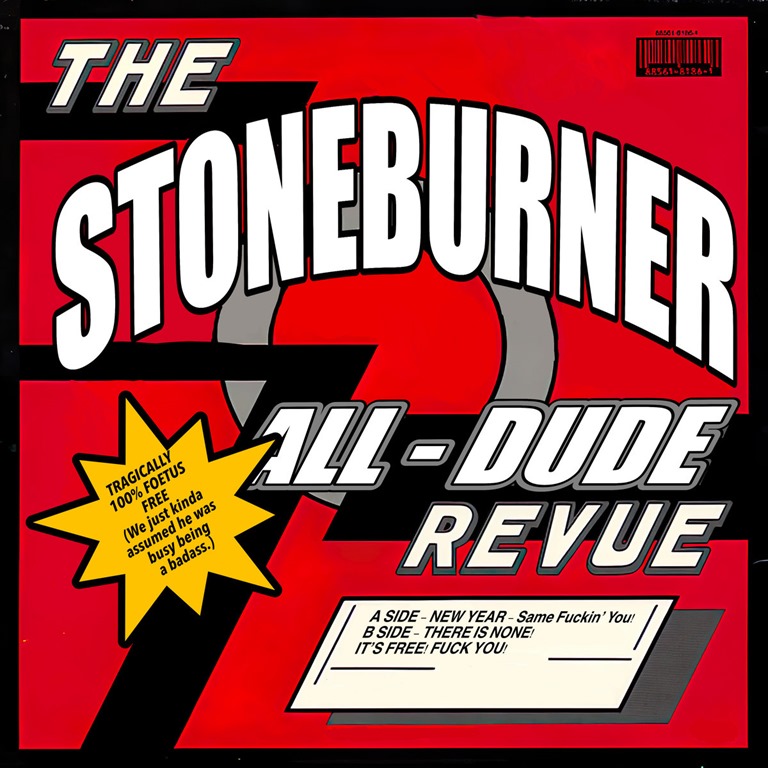
The adage that you should never judge a book by its cover is a nonsense, and certainly doesn’t apply to records. I was instantly drawn to Stoneburner’s ‘New Year Same Fuckin You’ for its referencing – by which I mean almost direct lifting – of the artwork for the Foetus All Nude Review ‘Bedrock’ 12”, one of JG Thirlwell’s first forays into the ‘big band’ swing sound back in 1987.

It transpires they’ve got form: previous releases ape the fourth Foetus album, Nail, as well as Big Black’s Atomizer, and no doubt other releases reference things I’m unfamiliar with, as it’s impossible to know everything within another’s sphere of reference, and Stoneburner have released a hell of a lot in a comparatively short time. But I always maintain there’s more honour in being up-front in acknowledging one’s influences than trying to hide them, and have all the admiration for Stoneburner for their unashamed referencing. By now, we all know – or should know – that there’s nothing news, so better to front up and embrace the fact instead of feebly proclaiming artistic innovation.

The solo project of Steven Archer, best known for his work with the electronic rock band Ego Likeness, as well has is abstract electronica project ::Hopeful Machines::, he’s one of those creatives who simply gushes new material.

For ‘New Year Same Fuckin You’, Archer has enlisted Rodney Anonymous, Matt Fanale, and Mark Alan Miller, and it’s something of a departure from the majority of the Stoneburner catalogue, which, while very much given to industrial leanings, also place considerable emphasis on atmosphere and drama (in the way JG Thirlwell and Raymond Watts do, setting Foetus and PIG apart from the majority of the field). There’s no such subtlety here: ‘New Year Same Fuckin You’ is a balls-out blaster.

The track is pitched as ‘a rallying cry for a time when so many feel defeated and powerless. A time when giving up seems easier. But when I think of those who marched across the bridge in Selma, knowing full well what was waiting for them; when I think of the women who sacrificed everything for their autonomy; when I think of every brave soul who stood tall against oppression, I know this: we owe it to them to rise again.’

It’s a strong sentiment delivered at a time when mood and energy feels like it’s at an all-time low. It’s hard to recall a festive season that’s felt less festive, and celebrating extravagantly with gifts and feasts has felt quite wrong while the world is at war and hyperconsumption continues to drive climate change. What are we actually celebrating here? The idea that we’re ‘doing it for the kids’ rings rather hollow when you know that every overpriced piece plastic of tat stuffed in a stocking is another nail in the coffin of the future they’ll inherit.

And this brings us to the gimmick of New Year’s resolutions. How many last past the first fortnight of any given new year? Mostly people seem to resolve to get fitter, and take out gym memberships with good but misguided intent. Gym conglomerates rub their hands as they make half the year’s profits in a week or so, knowing that the regulars won’t be complaining of overcrowding again come February. Most goals set are as pointless as they are unattainable., but how many set themselves the target of being less of a cunt in the coming year, eh? Eh? Yeah – New Year Same Fuckin You.

This is a full-throttle raging technonidustrial banger, and curiously, as much as it’s in the vein of KMFDM and the entirety of the Wax Trax! catalogue with its pounding, hard-edged disco beat and snarling synths and mangled vocals, I can’t help but be reminded of ‘It’s Grim Up North’ by the JAMMs.

As an anti-trend anthem, with it’s ‘Fuck you! Fuck you! Fuck you!’ refrain, ‘New Year Same Fuckin You’ is the perfect counterpoint to all of the motivational guff that circulates all year round but becomes particularly prevalent at this time of year as every agency going advertises to appeal to your shame – shame for your indulgence, your weight gain, your slacking, your failure to move forward in your life goals – in an attempt to take your money and convince you that spending with them will make your life better. Yes, fuck you! Get a grip. You want your life better? Start by taking control of your own direction, instead of paying for apps and influencers and life coaches to tell you what you already know. Need reminding that this is the true way forward? Listen to this on repeat for an hour daily.

AA

a1200904832_10

7th October 2023

Christopher Nosnibor

West Midlands post-punk trio , The Glass House Museum, comprising Joe and Jon Cummings (both vocals and guitar) and Lee Meadows (programming and bass), have been releasing music since 2017, but ‘The Committee’ is their first new material since the mini-album Artifacts in 2020.

It begins with some dark atmospheric grumbling, some gloomy bell chimes and squawks, presumably the menacing cries of the vultures mentioned in the song’s chorus, and also featured on the cover art. And, naturally, the collective noun for vultures is a committee. Despite this literal referencing and representation, it’s apparent that the song’s meaning is truly somewhat rather more figurative: ‘Tread careful, stranger,’ is the caution which starts the song’s lyrics.

With the sequenced rhythm section, they hold the solid core groove tight, giving it that quintessential goth vibe.

Over the years, I’ve witnessed many detractors – and even fans – ask why bands like The Sisters of Mercy don’t get a drummer. There are numerous reasons why they don’t, won’t, and never would, but the main one is that the drum machine is a defining feature of the sound of that particular strain of post punk which came out of Leeds in the early 80s. That hard, relentless beat, paired with a bass that followed it, bam-bam-bam-bam, overlayed with guitars, edged with a metallic clang and shrouded in chorus and reverb created a perfect tension that isn’t really like anything else – and this is why it’s provided the blueprint for so many bands over the last forty years.

But to dismiss it as being ‘derivative’ would be to miss the point: this is about heritage and lineage, and also there’s a certain degree of knowingness to making references that are, in some ways, I suppose, tribal in their function. If you know, you know, and you’re one of ‘us’. And so it is that the lettering on the cover is lifted from Siousxie and the Banshees’ A Kiss in the Dreamhouse, offers another referential insight into the band’s stylistic touchstones. The devil really is in the details.

The vocals aren’t of the spiky punkier aspect of post-punk, eschewing the edgy styles of Siouxsie and Skeletal Family’s Anne-Marie Hurst and if anything, are more in the vein of Julianne Reagan in her rockier moments.

But the most significant thing here is that the ingredients are well-blended and folded in together around a decent tune with some sharp energy and a solid chorus, and none of it feels formulaic or ripped off. In short, ‘The Committee’ is in the ‘classic’ style, but with a strong identity of its own.

AA

533356