Cruel Nature Records – 3st1 July 2026
Christopher Nosnibor
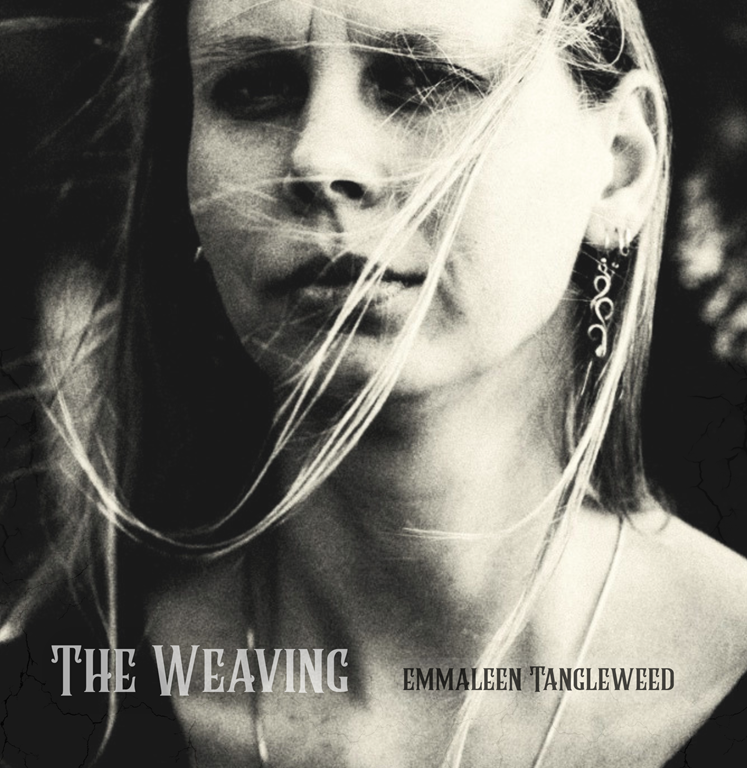
“This album is kind of a collage of all the books I was reading and my impressions of the general emotions swimming in the collective experience, as well as personal stories I’ve picked up along the way.” So says Emmaleen Tangleweed of her new album, The Weaving, which was recorded in September 2025 ‘in a log cabin in Swartvlei (“black lake”), Western Cape, South Africa’. The liner notes describe it as ‘a collection of gothic folk and blues ballads tinged with hypnotic magic realism’.
The first song, ‘The Hours’ is likely, then, to be a direct reference to Michael Cunningham’s 1998 Pulitzer-winning novel – which in turn was inspired by Virginia Woolf’s 1925 novel Mrs Dalloway. It’s a wonderfully earthy slice of dark, primitive blues, rendered all the more potent by the rich patina of Tangleweed’s voice. In the recent Six of the Best feature for Aural Aggravation, she cited Black Pudding by Mark Lanegan and Duke Garwood as an influence, citing ‘an archetypal timelessness’, and this is what very much comes through here, perhaps with a hint of PJ Harvey in the mix, too. There’s nothing complex – or even innovative – about it, but blues isn’t about complexity or innovation, it’s about feeling, about soul. And this is something The Weaving brings in spades.
‘Silent Killer’ could be a hundred years old, but it could also be an outtake from Rid of Me. Emmaleen sings from her gut, and with guts, too, and plays with a perfect feel for the swing required to bring the songs to life. There’s a bit of fuzz on the low strings which gives a vintage, analogue feel to the production. This is also true of the sepia-toned ‘Strangeling Angel’, which very much replicates the feel of those early twentieth century blues legends and those altogether more obscure.
The introduction of cello on ‘Blind Faith’ is done subtly, but adds depth to the otherwise sparse arrangement, and for the most part, everything hangs on her voice and acoustic guitar. Perhaps because of this, there’s a palpable intimacy and immediacy about The Weaving, capturing as it does the sensation of being in a small room as the songs are performed live. ‘Never Ending History’ is almost a crawl, and she drawls the lyrics low and slow, and something strange happens with time as it slips back. one can almost envisage grainy black and white photographs accompanying it.
Most of the songs are in the five-minute region and she fills the space with a rare tension. ‘Ask the Dust’ is another song which makes a direct reference, this time to John Fante’s 1939 novel set in The Great Depression, and shit, it’s bleak. ‘Is there anyone out there’ she asks against images of ‘the burnt out rust’ and a monotonous, repetitive riff reminiscent of Michael Gira at his most lugubrious. It’s here that is becomes most apparent that it’s possible to be heavy without distortion or volume, and that weight comes from the heart. You can hear her fingers hitting the strings on ‘Ask the Dust’, in a way that has the same feel as striking dry earth with a pick. It’s not entertainment, but labour, and The Weaving finds Tangleweed dredging deep. There’s no showing on the doll where this music touches: it’s somewhere deep inside, subconscious, subliminal. And herein lies its power – it’s something that’s affecting on an almost cellular or biological level, resonating with experiences of past lives or something. You feel it in a way that’s impossible to explain. But feel it, you do.
AA