Posts Tagged ‘Postmodern’

Cruel Nature Records – 12th September 2025

Christopher Nosnibor

Postmodernism, emerging primarily as a product of post-war America was defined by hybridity, the demolition of parameters and distinctions between different cultures, genres, and was, in many respects, tied to the accelerating pace of technological development, in particular the globalisation of communications and beyond. But postmodernism also not only recognised, but celebrated, the fact that originality has finite scope, and that anything ‘new’ will by necessity involve the reconfiguration of that which has gone before. Shakespeare had all the ground to break in terms of the advent of modern literature, and one might say the same of Elvis and The Beatles with the advent of rock ‘n’ roll and pop respectively. The reason the 80s were such a watershed was because technology revolutionised the potentials for music-making, and while this saw a huge refraction in terms of creative directions, from industrial to electropop, one could reasonably argue that the next leap in music after 1985 came with house and techno.

Post-millennium, it feels like there is no dominant culture, no defining movement, underground or overground: the mainstream is dominated by a handful of proficient but in many ways unremarkable pop acts, and notably, it’s largely solo artists rather than bands, and while there are bands who pack out stadiums, they tend to be of the heritage variety. At the other end of the spectrum, the underground is fragmented to the point of particles. There are some pros about this, in that there is most certainly something for everyone, but the major con is that unlike, say, in the mid- to late-noughties, when post-rock was all the rage, there’s no sense of zeitgeist or unity, and right now, that’s something we could really do with.

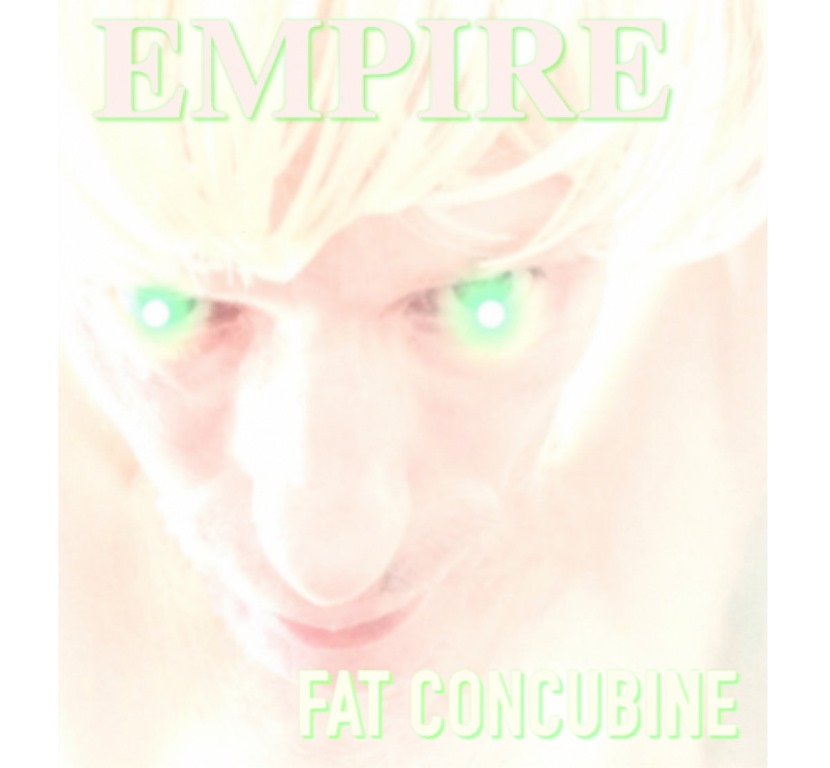
Fat Concubine are most certainly not representative of any kind of zeitgeist movement. With a name that’s not entirely PC, the London acts describe themselves as purveyors of ‘unhinged dance music’, and Empire is their debut EP, following a brace of singles. The second of those singles, ‘for Whom the Fools toll’ (with its irregular capitalisation, which is a bit jarring), is featured here, along with four previously unreleased tracks. This is a positive in my view: so many bands release four, five, or six tracks as singles, and then put them together as an EP release, which feels somewhat redundant, apart from when there’s a physical release.

And so it is, in the spirit of wild hybridisation, that they’re not kidding when they say their thing is ‘unhinged dance music’, or as quoted elsewhere, ‘unhinged no wave ravers’. ‘Feeding off the dogs’ pounds in melding angular post-punk in the vein of Alien Sex Fiend with thumping hardcore techno beats, and it’s not pretty – although it is pretty intense. The snare drum in their first thirty seconds of ‘for Whom the Fools toll’ takes the top of your head off, and the rest of the ‘tune’… well, tune is a stretch. It’s brash, sneering punk, but with hyperactive drum machines tripping over one another and a stack of synthesized horns blaring Eastern-influenced motifs.

There are hints of late 80s Ministry about ‘When we kick Their front door’, another synth horn-led tune that begins as a flap and a flutter before a kick drum that’s hard enough to smash your ribs thuds in and pumps away with relentless force. If the notes didn’t mention that it was a perversion of ‘These Boots We’re Made for Walking’, I’d have probably never guessed. As the song evolves, layers and details emerge, and the vibe is very much reverby post-punk, but with an industrial slant, and a hint of Chris and Cosey and a dash of The Prodigy. If this sounds like a somewhat confused, clutching-at-straws attempt to summarise a wild hotch-potch of stuff, to an extent, it is. But equally, it’s not so much a matter of straw-clutching as summing up a head-spinning sonic assault.

‘tiny pills’ is a brief and brutal blast of beat-driven abrasion, with a bowel-shaking bass and deranged euphoric vocals which pave the way for a finale that calls to mind, tangentially, at least, Cabaret Voltaire’s ‘Nag Nag Nag’.

The version of ‘O so peaceful’ was recorded live, and builds to an abstract chanting drone work. It offers a change of angle, but is no less attacking, its percussion-heavy distorted, shouting racket reminiscent of Test Department and even Throbbing Gristle, particularly in the last minute or so, and you can feel the volume of the performance, too. This is some brutal shit.

Empire is pretty nasty, regardless of which angle you approach it from. It’s clearly meant to be, too. Harsh, heavy, abrasive, messed-up… these are the selling points for this release. And maybe having your head mashed isn’t such a bad thing if you’re wanting to break out of your comfort zone and really feel alive.

AA

a1581875889_10

13th August 2025

Christopher Nosnibor

Re:O’s ninth single is a song of frustration, of dissatisfaction, about giving everything and receiving underwhelming returns. It’s a song about life’s struggles. And it takes the form of musical hybridity taken to another level. And when it comes to taking things far out, Japan has a long history of it. Only Japan could have given us Merzbow and Masonna, Mono and Melt-Banana, Shonen Knife and Baby Metal – acts which couldn’t be more different, or more wildly inventive. J-Pop may not be my bag, but on reading that Re:O take ‘the best of Japanese alternative music and combin[e] western metal and rock… Re:O has been described by fans as “Japancore” a mix of Metalcore, industrial metal, J-Pop, Darkpop, cyberpunk inspired symphonic layers with high energy and heavy guitar.” It’s a tantalising combination on which I’m immediately sold.

Hybridity in the arts emerged from the avant-garde, before becoming one of the defining features of postmodernity: the second half of the twentieth century can be seen as a veritable melting-pot, as creatives grappled with the notion that everything truly original had already been done, and so the only way to create something new was to plunder that which had gone before and twist it, smash it, reformulate it, alchemise new permutations. If the zeal – not to mention any sense of irony or knowingness – of such an approach to creativity seems to have been largely drained in the first quarter of the twenty-first century, Re:O prove that there’s life in art still after all.

With ‘Crimson Desire’ they pack more ideas into three and a half minutes than seems humanly feasible, starting out with snarling synths, meaty beats, and churning bass – a combination of technoiundustrial and nu-metal – before brain-shredding, overloaded industrial guitar chords blast in over Rio Suyama’s blistering vocal. And it blossoms into an epic chorus that’s an instant hook but still powered by a weighty instrumental backing. The mid-section is simply eye-popping, with hints of progressive metal in the mix.

The only other act doing anything remotely comparable right now is Eville, who have totally mastered the art of ball-busting nu-metal riffery paired with powerfully melodic choruses rendered all the more potent for strong female vocals, but Re:O bring something different again, ad quite unique to the party. It’s all in the delivery, of course, but they have succeeded in creating a sound that is theirs, and theirs alone. No two ways about it, they’re prime for Academy size venues, and given a fair wind, they could – and deserve to be – there this time next year.

AA

AA

a0408141558_10

Crónica – 1st July 2025

Christopher Nosnibor

Only yesterday, I expended considerable contemplation – and verbiage – on the matter of press releases, and the level of detail they contain nowadays compared to the old A4 1-sheet – which sometimes contained just a few lines under the heading and the logo. It’s wasn’t really a complaint, as much as an observation, although there is, sometimes at least, a sense that most of the reviewer’s job has been done for them in advance.

However, there are other ways in which the detailed press release can prove to be a double-edged sword, and this is one of them. And so it is that I’m plunging into unknown territory with this release. Not in that I haven’t spent many hours immersed in ambient recordings, and not that I’m unaccustomed to postmodernism, in theory and its application, how it applies to the world as we experience it. But sometimes, a work is so inspired and invested in something specific, specialised, and conceptually-focused that it feels like I’m not fully qualified to approach it, much less critique it.

Before I do dive in, this is the context. Are you sitting comfortably?

At the end of the 1990s, Hakim Bey wrote a book about the then-emerging possibility of the virtual. With the lucidity for which he is known, he recognized at the time that the virtual was nothing more than a new avenue for the expansion of capitalism. He introduced the concept of temporary autonomous zones as a kind of Foucauldian heterotopia — spaces that existed only for as long as they could evade capture. Today’s reality reflects a radical intensification of what Bey was referring to in the 1990s. Temporalities have changed completely. We are now almost overwhelmed by an incessant pursuit of instantaneity, accompanied by the mounting impatience it inevitably breeds.

The temporalities of sound, therefore, are naturally different too.

Time must be disobeyed.

The sounds of our autonomous zones aim to be the opposite of what technology offers us today: fascination and dazzle through excess — more buttons, more effects, louder… AI. These are bare sounds, defiantly rejecting the paraphernalia that surrounds them. They are simple yet perhaps carry the greatest complexity of all: turning their backs on spectacle and presenting themselves as they are: unmasked.

This work is the outcome of a series of studio sessions recorded during the summer and autumn of 2024. We followed an exploratory approach grounded in clearly defined premises and a pre-conceived compositional outline shaped by three key notions that are central to us: repetition, silence, and duration.

There is no post-production manipulation. What you hear is what was played. Inactual by conviction, this represents an utterly contemporary mode of being. These are sounds that seek to endure as a resistant, autonomous possibility — even if only fleetingly. Suspended between silences. Those marvelous, singular, sounds that Cage taught us to hear. They are there to last for as long as they can.

The title Horizons of Suspended Zones is inspired by a book from Hakin Bey.

I find that I’m sitting rather less comfortably now than I was a few minutes ago. I’ve never read a word by Hakim Bay. I’m aware of him and his work, but have never got as far as investigating. Therefore, I’m deficient. And so, in my head-swimming uncertainty, bewilderment and state of flaking confidence, I arrive at this fifty-five minute articulation of time-challenging theory/practice feeling weak, overwhelmed. Where do I even begin? Can I relate it to my own lived experience?

I struggle, because it doesn’t communicate that postmodern overlapping and disruption of the time / space continuum in a way that I can relate. For me, cut-ups and collage works convey how I experience life: the eternal babble of chatter and time experienced in terms of simultaneity rather than in linear terms.

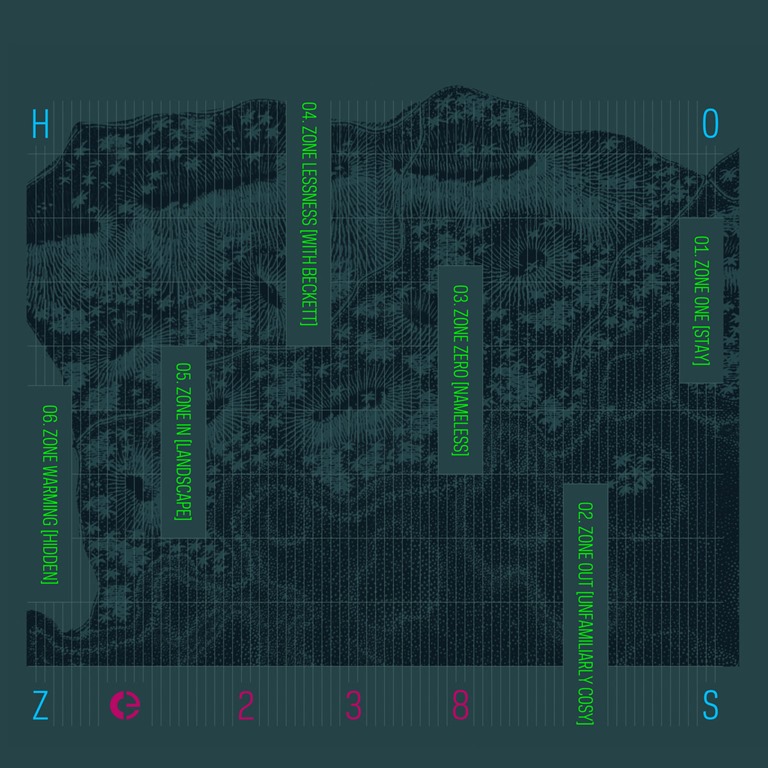
‘Zone One [stay]’ is a drifting, abstract, ethereal ambient work, and while over ten and a half minutes in duration, the time simply evaporates. It drifts into ‘Zone Out [unfamiliarly cosy]’, which is appropriately titled, and I find that I do as instructed, as the slow chimes and resonant tones hover in the air like bated breath. There’s a sense of suspense, that something will happen… but of course, it doesn’t.

For all of the detail around the concept, there’s very little around the construction by comparison. But perhaps a bell chime is simply a bell chime and an echo simply an echo. But those echoes matter. I find myself wading through the echoes of time, how it passes, how we lose time. How did we get to August? How did we – my friends and I – get so old? How, how, how is the world so utterly fucked up right now?

Each extended abstraction turns into the next, and so ‘Zone Zero [nameless]’ arrives unushered, unannounced, and unnoticed. There are whispers, the sound of the wind through rushes, and there’s something dark in the atmosphere. It’s only on returning to this after some time to reflect that I come to note the squared brackets in the titles. It’s an unusual application of this punctuation, which is more commonly found in academic work, and which I assume isn’t accidental – but why?

Anyone who’s read Beckett will know how painful and challenging, and, above all, how his work can be, and so ‘Zone Lessness [with Beckett]’ certainly reflects the emptiness of many of Becket’s works – the sprawling nothing where there are no events, no… nothing, and how life itself bypasses us as we wait. Life, indeed, it what happens while we’re making plans. It has a painful habit of passing us by. Life is not the Instagram shots or ‘making memories’ moments. It’s the trip to the supermarket, it’s endlessly checking your bank balance, it’s the dayjob and the cooking and washing up. It’s the dead moments that count for nothing. Those moments occupy the majority of time. And on this track, a low laser drone slowly undulates throughout, and over time, fades in and out, along with incidentals which allude to lighter shades, and ultimately, the nine minutes it occupies simply slip away.

‘Zone In [landscape]’ is sparse but dense, moody and atmospheric in its rumbling minimalism, and the last cut, ‘Zone Warming [hidden]’ chimes and echoes, bells ringing out into endless silence, without response, before tapering contrails of sound slowly and subtly weave their ways in and out. There are spells of silence, and the silence casts spells, and the spells float upwards in suspension.

Perhaps an appreciation of the context and theoretical framing of Horizons of Suspended Zones is advantageous, but it remains accessible as an abstract ambient work without that deeper comprehension. And it still feels as if there’s a sadness which permeates the entirety of the album. It’s by no means heavy, but it does have an emotional weight that drags the listener in, and then drags the listener down. And then leaves them… simply nowhere. Caught with their thoughts, and nowhere to take them.

AA

AA

a4170718585_10

Mille Plateaux – 22nd March 2024

Christopher Nosnibor

What’s often fascinating to me as someone who writes about music quite extensively, is to observe the avenues other writers explore, particularly when engaging with music that’s ambient, obscure, or otherwise difficult to take a hold of and to pin down. This fascination is amplified when the music, either by its inherent nature, or by virtue of explanatory words from the artist, has a foundations in a theoretical or conceptual context.

Achim Szepanski has been tasked with a challenge when it comes to the notes to accompany

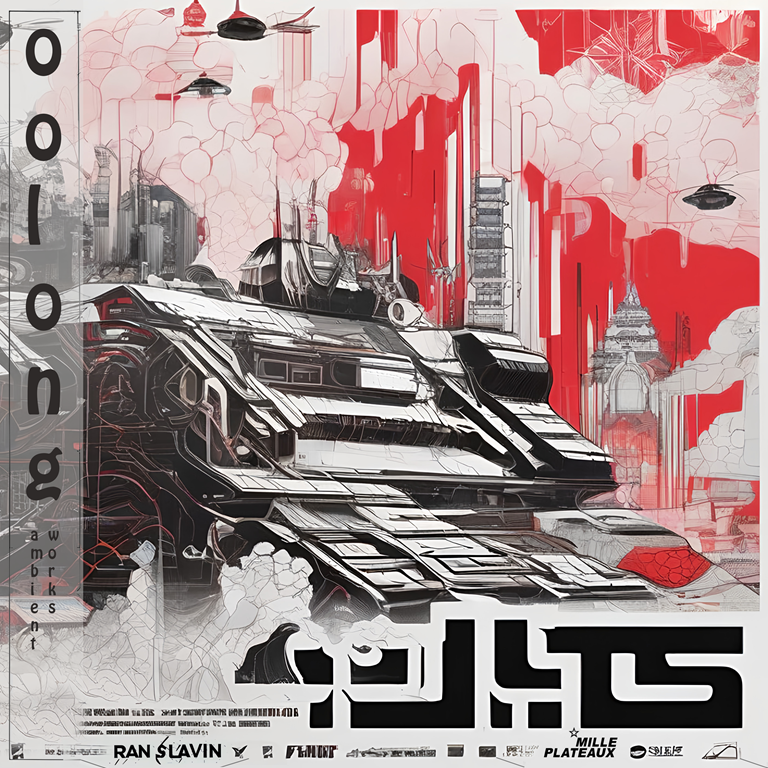
Oolong: Ambient Works, which is the 17th studio album from multi disciplinary artist Ran Slavin, which is pitched as ‘a 74 min drone-ambient-minimal-symphonic infused LP that takes after various teas in the far east.’ To heighten the experience, each track is accompanied by ‘a slow and atmospheric visual journey shot by RS in East Asia and the total can be experienced in total and joined as an immersive 74 minute journey.’

Szepanski helpfully explains the layered meanings in the translations of the word ‘oolong’, and expounds the complex interconnections of tea and dragons through a filter of Felix Guattari (which isn’t entirely surprising, given the label releasing it). He grapples with ‘the minimalist concept of tea architecture’ and the way in which ‘Not only the centripetal, but also the centrifugal orientation of the sound is imaginary.’

While the visuals clearly form an integral pat of the project overall, I shall preserve my focus exclusively on the audio release, and in advance of this draw the distinction between audio created to provide a soundtrack, and visuals created to accompany an audio work, because while Szepanski discusses at length the relationship between the visuals and the tea path and the simultaneous limitations placed on the work by the visuals and their capacity to enhance the experience, Oolong: Ambient Works is an audio release or an ambient persuasion, as the title suggests.

The seventy-four minutes is divided into eight individual pieces, with titles such as ‘Grand Jasmin’ and ‘Assam Jungle; as well as others which are less overtly tea-derived, like the first composition, ‘Time Regained’. It’s fifteen minutes of slow-simmering ambience, the levels of which fluctuate and catch, the glitches rupturing the smooth surface of the soft sonic fabric.

Szepanski makes an important point when he writes ‘It is impossible to know exactly what the individual sounds signify. Sometimes it might be the intention to hear the sounds of nature. But it’s not a question of identifying its source and its effect.’ And so we come to what is, for me, the crux of the ambient listening experience, whereby the source of the sounds is far less significant than what the listener hears. Not even what I hear as a listener, although I can only speak and interpret for myself, and the beauty of this experience is that however much Slavin strives to imbue this work with meaning, it cannot be imposed. Slow pulses bring a rhythmic element to this otherwise abstract piece, which is deeply calming, but occasional warps jolt the listener from their state of tranquillity like a prod.

‘Butterfly of Ninh Binh’ flits by with crackles and scratches by way of disturbance, and the introduction of static and ersatz surface noise to recordings is a curious one, as something which only became a feature with the advent off digital audio. Those who have come to vinyl since the renaissance are less likely to relate, since vinyl is now a plush commodity and not something people leavy lying around or use as a coaster or whatever as was commonplace in the sixties, seventies, eighties. But such interference is integral here: Slavin’s approach to ambience on Oolong is subtly different, and introduces just enough dissonance and discomfort for it to be not entirely comfortable.

The ten-minute ‘Ruby Ceylan’ is soft and ripping repetitive and hypnotic, but something – perhaps the abstract moans, perhaps something else – is just off.

Iroh, in Avatar: The Last Airbender, is a keen advocate of the calming properties of Jasmine tea, and I get a far stronger Jasmine connection from this – the original animates series, that is – than from ‘Grand Jasmin’ here – the album’s shortest track is subtle and soothing, but also marks a change of texture with a thumping beat which echoes away hard and fast beneath its slow-swelling outer layers.

‘Himalayan Flower’ unfurls slowly and with pronounced percussion, before the ten-minute ‘Summer Monsoon’ brings the album’s conclusion. A slow, mesmeric, soporific cloud of ambience passing by, with occasional clangs and abstract interruptions which echo through the drift, this is a real; eyelid-drooper which suggests it’s time to sleep, or time for a coffee.

AA

MP69_front

Arriving more than three decades after his first solo album and almost 20 years since his groundbreaking group Telex delivered their final message, Belgian electro-pop musician Michel Moers is finally making a comeback with As Is, his brand new album. To celebrate its imminent release, the synth man has invited iconic vocalist Claudia Brücken from the similarly revitalised Propaganda (now xPropaganda) to guest on its first single, ‘Microwaves’. A 50% electro-pop, 50% new wave anthem, it will delight fans of Ladytron as well as Telex classics such as ‘Moskow Discow’.

“Claudia has a great voice that you recognise from the very first note,” says Moers. “I was thrilled to get the opportunity to work with her and was determined to place her vocal upfront in this song.”

Check ‘Microwaves’ here:

AA

Michel Moers will release As Is in mid-April. Coming 33 years after his solo debut, Fishing Le Kiss, the long-awaited record features ten tracks that showcase Moers’ wisdom and artistic reflection as he offers a blend of thoughtful, electronic music infused with surrealism in his own unique style. It includes contributions from xPropaganda singer Claudia Brücken, who adds her distinctive Teutonic touch to ‘Microwaves’, plus Moers’ compatriot DAAN (Daan Stuyven), whose deep, expressive voice is utilised to full effect on ‘Back To Then’.

Containing songs that have been developed over several years, the album has an intimate, diary-like quality, reminiscent in part of the compositions of Erik Satie. With highlights that include the stridently uptempo ‘Potentially (Love-Hate)’ and ‘Pixels’, plus the lyrically unsettling ‘New Friend’, the album actually opens with an updated version of ‘Les Gens Sont Affligeants’ (People Are Disappointing) from Moers’ debut. It resonates more than ever in today’s individualistic society.

As Is represents a triumphant return for Moers, blending past influences with contemporary sounds and themes, and stands as a testament to his enduring creativity and adaptability in a continually evolving music landscape.

Moers has spent the last three decades working as an architect and photographer while continuing to make music. Involved in the remastering of the Telex back catalogue that was reissued to great acclaim on Mute Records in 2023, this also served to reinvigorate his skills and contributed to the creation of As Is. Belgium’s first electronic band, Telex were influential pioneers, appearing on Top Of The Pops in 1979 and representing their nation at the Eurovision Song Contest in 1980.

ff3a0909a1752b34921296440990af1eb6900c49

Corvo Records – 15th October 2023

Christopher Nosnibor

As the saying goes, when life gives you lemons, make lemonade. In the spirit of this optimism, we have the cynical manoeuvring of disaster capitalism – but we also have 60 Seconds Each. Yes, to spin the adage, we have ‘when there’s a massive fuck-up, collaborate to release a compilation album.’

As the accompanying notes explain, ‘This LP was born out of a data leak: In 2022, the opening of the position of Professor for Sound Art at a German Art Academy attracted the applications of a broad, international panorama of sound artists. After the position was filled, the email rejection to all other applicants was sent by mistake by the university with an open distribution list (cc).

‘Kristof Georgen, one of the applicants used this mishap to develop a concept for a collective sound art project, inviting the artists included in the open cc to send a 60-second sound piece.

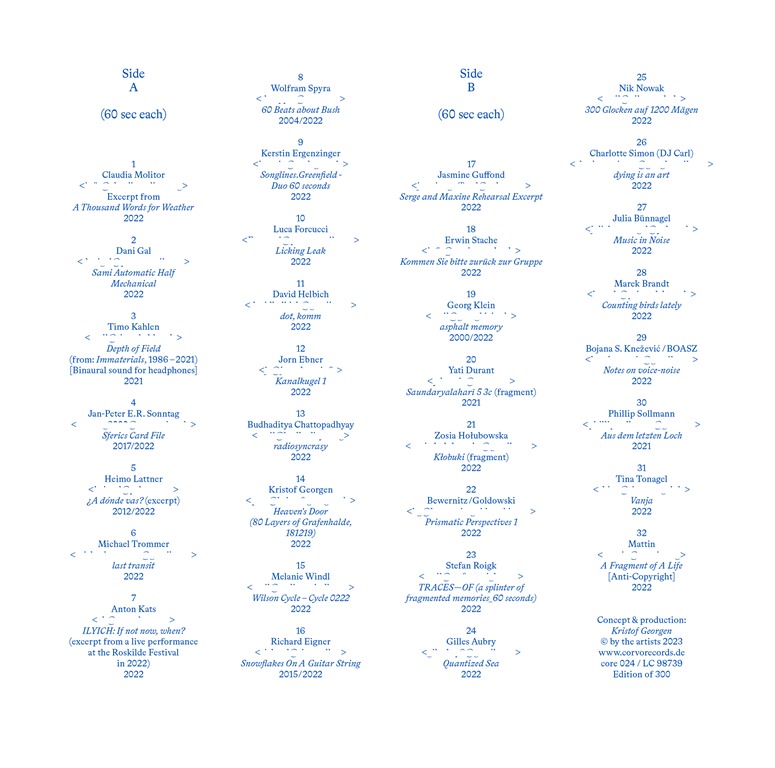
‘A group of 32 artist who were prepared to understand a record as a group work, followed the invitation – the result is 60 Seconds Each. The fragmentation of many music scenes during the pandemic, which still lingers today, is countered here with an artistic statement. This heterarchical approach transformed the application competition into an artistic cooperation which ultimately became a very diverse compilation, a one of a kind „Salon des Refusés“ of sound art. The time limitation of an LP and the restricting concept of 60 seconds stands as an antithesis to the unmanageable and boundless characteristic of the data leak.

This reduction to the essential determines also the visual concept of the release. Fragments of redacted email addresses of the participating artists, forming a cloud of unreadable data which merges into the background of the cover art are an essential part of the design. The 60-second grid also structures the vinyl groove into a strict visual pattern, which can be read as small chunks of each participating artist’s work.’

The visual aspects of the album are almost worth the purchase alone, with the back cover and each artist’s notes which accompany their piece in the hefty booklet presented as redacted emails, prefaced by a concept-heavy but accessibly-written essay by art, design and music researcher, curator and DJ, Prof. Dr. Holger Lund, who asks:

‘Can sound art be funny and ring 300 bells on 1200 stomachs? Can it be macrocosmic and reflect time, living beings and the future? Can it be micro-cosmic and dedicated to the sound of snowflakes or the beeps of e-scooters? Can it be prophetic and deal with dying instruments? Can it sonify non-sonic things like light, shadow and air? Can it turn techno beats “inside out”, that is left-field? And can it build a specific atmosphere and dramaturgy in the miniature format of 60 seconds? It can do all that – and much more, as the present record project 60 Seconds Each shows.’

With thirty-two tracks – some full compositions, some fragments, others either simply sketches or field recordings – packed back-to-back and lasting just over half an hour per side, the individual pieces become a part of the whole, a jigsaw or sound-collage more readily experienced as the sum of the parts, instead of broken down. The brevity of each piece also makes it rather difficult to really unpack specific merits on the individual works, because out of context, we’re presented with simply a snippet of sampled dialogue, some electronic bleeps, a burst of noise, a gurgling drain, some plan weird manipulated vocal stuff, engines, birdsong, distortion and, well, you name it. Many of the pieces would simply serve as interludes on any other album, but here we have an hour of incidentals and interludes, or otherwise of sample snippets where you may skip pr otherwise choose to listen to the whole track… But rather than being frustrating, this sonic patchwork quilt is so much more than the sum of its parts, and the segments coming at you at such pace is dizzying.

Veering wildly between the playful and the hyperserious, and those which it’s difficult to determine, intermingled with the abstract, hefty beats banging hard between moments of soothing ambience, the experience is one of overload – information overload. But information is currency in this age of digital insanity. We’ve gone beyond the relentless blizzard of information and communication, to an existence dictated by algorithms and three-second video clips, attention spans so stunted so as to even find a hundred and forty characters excessive; tl; dnr – thinking not good. Even our anger at the state of the world is abridged to the point that it’s articulated in GIFs and memes, and we don’t even know why we think what we think, because we’ve been deprived of the time and the capacity to analyse and weigh up our responses. Religion is no longer the opium of the people: 24-7 online media has usurped it, combined with an epidemic of addition to prescription painkillers which means that opium is in fact the opium of the people (prescription painkillers are now considered more addictive than heroin, and their use is certainly more widespread). Anyone in a fucked-up state would probably do well to avoid this release. But I digress.

Despite tighter regulations around data handling, breaches are increasingly commonplace because the pace and pressure of work environments force human error. Whoever hit ‘cc all’ made a mistake with consequences, and while responsible, the ultimate responsibility lies with the system, a system where academic institutions are business operations and everything ultimately comes down to the bottom line.

It’s quite remarkable that this bunch of rejects – sorry, group of academics – came together to contribute to this project instead of pursuing the institution for compensation.

In much the same way as the tape experiments with cut-ups and inching, and drop-ins conducted by William Burroughs and Brion Gysin in the late fifties and early sixties sound to create an experience which was closer to perception, so 60 Seconds Each presents an auditory experience analogous to flicking through TV channels while scrolling X or Facebook as you’re being bombarded by messages on WhatsApp when you’re actually supposed to be working. Yes, 60 Seconds Each is as close to everything all at once as is conceivably possible, and it makes for a truly mind-blowing hour, after which a period of silence with eyes closed is strongly recommended.

AA

core024_front

AA

core024_rear

ZOHARUM – 17th October 2023

Christopher Nosnibor

It wasn’t so long ago that I’d arrive home from work and struggle to open the door for the pile of jiffy bags which had cascaded through the letterbox while I was out, and that I’d regularly receive vinyl for review in the mail. The pandemic and the spiralling coast of everything really kicked that into touch. The sheer volume was quite overwhelming at times, but I do miss it, and the occasional delivery of a physical copy of a release reminds me why.

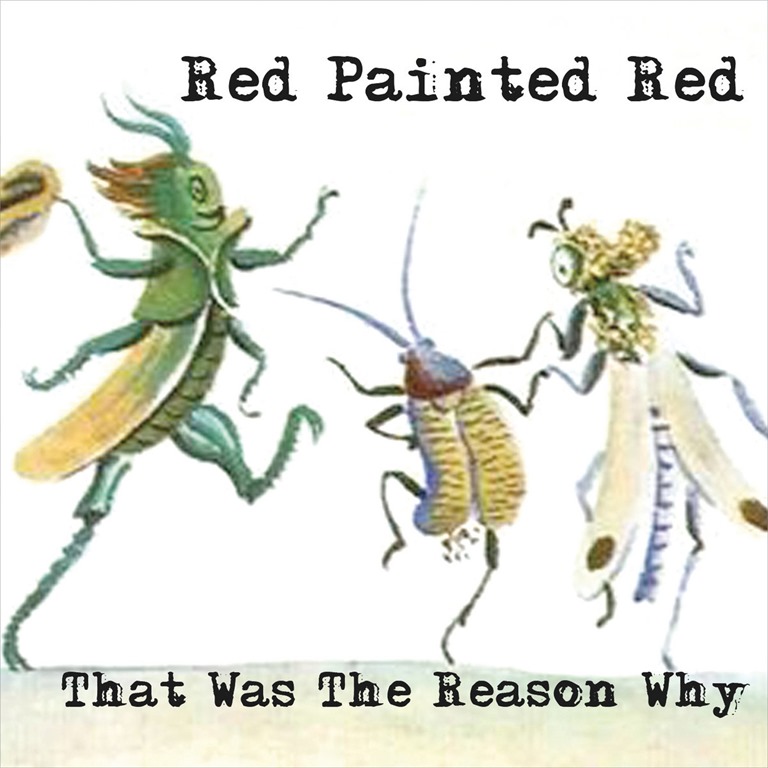
My copy of That Was the Reason Why was accompanied by a stack of wonderful postcards for a start: a strange array of scenes printed on thick card with a matte finish they’re fantastic. And so is the CD’s tri-fold packaging, which includes the full album lyrics, which I read through as I’m listening to the album. Yeah, yeah, I’m old – at least according so some people. But yes, I grew up with physical media and am comfortable with that as I read the contents of the truly beautiful sleeve. This is what people who don’t do, and have never done, physical media are missing out on. The fact is that music is, or at least is at its best, a multi-sensory, inter-dimensional experience. I took this for granted when I was younger. I’d go to record shops in town and but records and tapes, and later CDs, and spend hours looking at the artwork and pouring over the lyric sheets.

Starting with beeping keytones and with an ominous keyboard score, ‘Human Condition’ is dark and dense and builds a palpable tension as the glacial robotic vocals enunciate the stark declarations of ‘Self-mutilator. Mother. Arsonist. Materialist. Abuser. Assassin. Scientist. Charmer. Harmer. Narcissist. Artist. Redeemer. Explorer of the fauna’ on a loop that becomes more chilling with each cycle. Creepy is the word, and the bass and drums build as the track progresses, along with the extraneous noise that sits behind the nagging motif.

‘Astronauts’ cuts a sound collage which overlays a strolling, bass-led groove that’s almost proggy, and over that, Yew spins semi-narrative lyrics with cool detachment.

That Was the Reason Why is an unusual blend of experimentalism, cut-ups, collaging, and trippiness, which incorporates elements of a range of genres but belongs to none. The synthiness of the sultry ‘Come to Me’ is almost Vangellis-like, while ‘Knife’ is sparse, atmospheric electronica that’s oddly reminiscent of Kate Bush, at least in Yew’s delivery, and it’s magnificently melodic and dreamy in a melancholic sort of a way, and ‘Silence’ brings discord, abrasion and snarling zombie backing vocals tearing through a hybrid post-punk drone that sounds like a collision between The Doors and Toyah. ‘Dances’ is altogether weightier, and brings hints of Swans circa Children of God. But for all of its diversity and divergence, there is a strong homogeneity to the album as a whole, and it works well.

Samples of narrative and dialogue, and snippets of all sorts come together to conjure a disorientating reflection of the world and somewhere beyond – sometimes exterior, sometimes interior, bringing inner space and outer space into the same frame. Breathy, ethereal, yet tense and claustrophobic, That Was the Reason Why is a dialogue of inner turmoil, an exploration of liminal spaces, and an unstintingly intriguing and unusual work.

AA

a2407616562_10

German post–modern ensemble ZAHN have today shared a lyric video for instrumental track ‘ZEHN’. Yes, you read that right.

“The video to our new song ‘ZEHN’ is a poem for instrumental music enthusiasts. A silent movie. A song for the deaf. Nina Walser (Friends Of Gas) is singing you a ditty but you won’t be able to hear it. Just read along and listen and it all will make perfect sense.” – ZAHN

It’s a proper headfuck, and proper good too, and you can watch it here:

AA

0vqCv_A8

Christopher Nosnibor

I get a lot of weird shit come my way. I guess it’s to be expected: I review a fair amount of weird shit and it just snowballs: weird shit finds me. And this is very much weird shit. Despite some serious deliberation, I can’t decide where the emphasis lies in that statement.

Details about the artist or the release are practically non-existent, but it doesn’t take too much digging to establish that the Tom Belushi Jazz Trio aren’t a trio and they don’t play jazz.

Having released an EP (also entitled Death Mast) and deleted it almost instantaneously, Tom Belushi Jazz Trio seem determined to render themselves as evasive frustratingly obscure as is conceivably possible. But this is clearly not simply a musical project, so much as an exercise in postmodernism that revels in ephemerality. With CD copies of this release being limited to single figures, I’m reminded of various crackers projects by Bill Drummond and The KLF, among others, whereby the objective seems to be to create an objet d’art that’s so scarce it’s beyond reach even before it’s released, essentially only existing in legend.

Slapping synths, gloopy stuttering beats, warping irregularities and groaning keys redefine the sound, along with snippets of robotic, autotuned vocals. Oriental motifs are dominant in this instrumental album’s ten exploratory tracks, which appear to be largely AI in origin. Because yes, it’s taking over the world. Think you can hide or linger on the peripheries now? You’re simply deluding yourself.

There are some nice sounds – and some naff ones – all balled together in an eclectic hotchpotch of ersatz electronic collaging. ‘Traitor’s Gate’ is a droning shanty that’s actually got human vocals; it’s woozy, disorientating in an uncanny sort of a way.

The titles are daft, absurdist, Dadaist or abstract, and littered with references, many of which are obscure – ‘Luke Haines. I Have Your Hat’; ‘No Mark Wynn’;(a particularly cheesy and overly synthetic slice of r ‘n’ b); ‘Stairwell Crooks Shutterstock Dust Jacket’ but ultimately seem to present as little true meaning as the music itself (and I can’t ever recall having experienced any dilemmas over purchasing avocados).

Death Mast is one of those albums that was probably more fun to produce thana it is to listen to. It does have considerable novelty value, and it does have lots of ideas, but few seem to be explored in any real depth or fully realised, and as such, the main idea seems to be the concept for the creative process – or should that be ‘creative’ process?- rather than the end product. But with the ideas and even the passages within the tracks being as fleeting and as ephemeral and impossible to locate as copies of the album itself, what are we really left with? Ultimately, Death Mast presents more questions than answers, a point of discussion more than a musical project. But, if there is one conclusion we can draw from this it’s that there is no need to worry that AI will bring about the end of music as we know it. At least, not this week. Welcome to the post-postmodern age.

AA

54d90880-c561-48af-aa9e-fda70c47391e_thumb_400

Bearsuit Records – 31st August 2022

Christopher Nosnibor

I may have mentioned it before, but I always get a buzz when I see a jiffy marked with an Edinburgh post stamp land on my doormat mat and I realise it’s the latest offering from Bearsuit records. Because while whatever music it contains is assured to be leftfield and at least a six on the weirdness spectrum, I never really know what to expect. That lack of predictability is genuinely exciting. Labels – especially micro labels which cater to a super-niche audience tend to very much know their market, and while that’s clearly true of Bearsuit, they’re willing to test their base’s boundaries in ways many others don’t dare.

Andrei Rikichi’s Caged Birds Think Flying is a Sickness is most definitely an album that belongs on Bearsuit. It doesn’t know what it is, because it’s everything all at once: glitchy beats, bubbling electronica, frothy screeds of analogue extranea, mangled samples and twisted loops and all kinds of noise. As the majority of the pieces – all instrumental – are less than a couple of minutes long, none of them has time to settle or present any sense of a structure: these are fragmentary experimental pieces that conjure fleeting images and flashbacks, real or imagined.

‘They Don’t See the Maelstrom’ is a blast of orchestral bombast and fucked-up fractured noise that calls to mind JG Thirlwell’s more cinematic works, and the same is true of the bombastic ‘This is Where it Started’, a riot of rumbling thunder and eye-poppingly audacious orchestral strikes. Its counterpart and companion piece, ‘This is Where it Ends’ which closes the album is expensive and cinematic, and also strange in its operatic leanings – whether or not it’s a human voice is simply a manipulation is immaterial at a time when AI—generated art is quite simply all over, and you begin to wonder just how possible is it to distinguish reality from that which has been generated, created artificially.

Meanwhile ‘At Home I Hammer Ceramic Golfing Dogs’ is overtly strange, a kind of proto-industrial collage piece. ‘What Happened to Whitey Wallace’ is a brief blast of churning cement-mixer noise that churns at both the gut and the cerebellum. Listening, you feel dazed, and disorientated, unsettled in the stomach and bewildered in the brain. There is simply so much going on, keeping up to speed with it all is difficult. That’s no criticism: the audience should never dictate the art, and it’s not for the artist to dumb things down to the listeners’ pace, but for the listener to catch up, absorb, and assimilate.

‘Player Name: The Syracuse Apostle’ slings together some ominous atmospherics, a swampy dance beat and some off-kilter eastern vibes for maximum bewilderment, and you wonder what this record will throw at you next.

In many respects, it feels like a contemporary take on the audio cut-up experiments conducted by William Burroughs and Brion Gysin in the late 50s and early 60s, and the titles only seem to further correspond with this apparent assimilation of thee random. I suppose in an extension of that embracing of extranea, the album also continues the work of those early adopters of sampling and tape looping from that incredibly fertile and exciting period from the late 70s to the mid-80s as exemplified by the work of Throbbing Gristle, Cabaret Voltaire, Test Dept, Foetus. These artists broke boundaries with the realisation that all sound is material, and that music is in the ear of the beholder. This strain of postmodernism / avant-gardism also follows the thread of Surrealism, where we’re tasked with facing the strange and reconciling the outer strange with the far stranger within. Caged Birds Think Flying is a Sickness is an album of ideas, a pulsating riot of different concepts and, by design in its inspiration of different groups and ideas, it becomes something for the listener to unravel, to interpret, to project meaning upon.

Caged Birds Think Flying is a Sickness leaves you feeling addled and in a spin. It’s uncanny because it’s familiar, but it isn’t, as the different elements and layers intersect. It’s the sonic representation of the way in which life and perception differ as they collide.

AA

a3019257531_10