Posts Tagged ‘Noise’

Room40 – RM4163 – 3rd December 2021

Christopher Nosnibor

Field recordings are rarely something one would consider ‘contemporary’, although if you think about it, they invariably capture a moment in time in some way or another, be it the morning of the dawn chorus or the grind of machinery which is firmly post-industrialisation; the sounds committed to tape all document history in sound.

Ian Wellman’s latest release is quite specific in its focus on present times. It is almost impossible to avoid the pandemic; it has, after all, affected all of our lives, and in myriad ways. As the accompanying text states, ‘If this past couple of years has taught us anything, it is that to hold someone closely is not something we may take for granted. The bonds of friends and of family are tenuous, as tenuous as the world that we find ourselves in.’ While most attention has understandably been given to the vulnerable, the bereaved, and the sufferers of long covid, there have been long—terms and slow-evolving effects on everyone. And this is what Wellman soundtracks with subtlety and care here.

The parenthetical ‘(Police Helicopter Activity Increased – Jul 2020)’ is brief, but it’s impactful. On the one hand, it’s a simple snippet of the sound of rotors; on the other, it’s the kind of conglomeration of low-flying helicopter buzz that makes you duck and look up and feel paranoid: police helicopters hovering or circling overhead always do, right?

The final moments of ‘It Crept into Our Deepest Thoughts’ bursts into shards on abrasive noise in the final moments. It’s on ‘The Toll on Our Daily Lives’ that Wellman really encapsulates the struggle. The first four minutes are dislocated ambience, which reflects the general sense of detachment and distance, but the last minute is dominated by a rising tide of noise, a surging swell. And it speaks because it really is the sound of swelling tension and anguish. The reality is that living through this is not something that belongs to a ‘model’, there is no fix by means of re-engagement. This resonates because it speaks to and of the building anxiety, and it builds because maintaining that level of alertness, that level of fear, actually has a cumulative effect in real terms, and we’re simply not designed to process life in the now. There is nothing normal about this, old or new, and ‘The Toll on Our Daily Lives’ encapsulates this perfectly, both in its title and the sonic smog that ambulates broodingly, again growing in density and becoming more oppressive and heavy and harsh as it progresses. You feel not only the weight, but the tension. It’s real, it’s palpable, and it’s a direct reflection of life as lived.

The interludes, too, are so very visual and evocative: a cock crows and what sounds like rainfall and passing cars crackle and splash on ‘(Ash Falling on Power Lines – Sept 2020)’ (the ash of wild fires burning), and there’s a post-apocalyptic feel to ‘(Wind Against Decaying Bus – Jan 2021)’, and they all combine to create what the blurb describes as ‘a devolving diary of unsteady moments and the assurance of change as the one constant in our collective times’.

‘As The Beast Swallowed Us Whole’ veers between ominous rumbling and near-ambience and surging, cracking textured distortion that borders on noise, and there is nothing comforting about this album. Even the final track, the optimistically-titled ‘The Light at the End’ is woozy and disorientating, and evaporates into a crackle of static that ends abruptly, and feels more like the light being snuffed out. You want to be wrong… but life… it’s a killer. Swear all you like, but whether or not it’s going to be okay remains to be seen.

AA
a0173304686_10

Wharf Chambers, Leeds, 3rd December 2021

This is a show I’d been revved for for quite some time: on their last visit to this venue, back in 2017, noise veterans Part Chimp blew me away with the sheer quality of their performance, as well as their sheer volume, prompting me to ruminate on how ‘they radiate noise from every orifice and every pore’ and how ‘the guitars serrate your skull and the bass vibrates your solar plexus and every riff is as heavy as a small planet and the drums as hard as basalt.’ Experiences like that are rare, but also addictive: as a gig—goer, you want every show to replicate that level of thrill, that mind-blowing intensity, and it’s a dragon you’ll chase and chase but rarely capture. There’s also a thing about seeing a band for the first time, when you don’t know really what to expect, and then whatever your expectations may have been, they’re confounded tenfold. Second, third, fourth time around, it’s unlikely you’ll feel that same sock in the face.

Anticipation for the evening stepped up a few notches on disclosure of the support act, Objections, being ‘a pair of Bilge Pump’s and a Beards’. ‘Formed in 2007, dispatched in 2018’, the latter splattered their way onto the scene with their sound defined by the explosively angular racket of their debut album ‘Brick by Boulder’, and during their existence, proved to be a stunning live proposition. Meanwhile, the former, revitalised in 2019 after almost a decade’s silence had been reaffirming their status as Leeds legends prior to the pandemic halting their live activity.

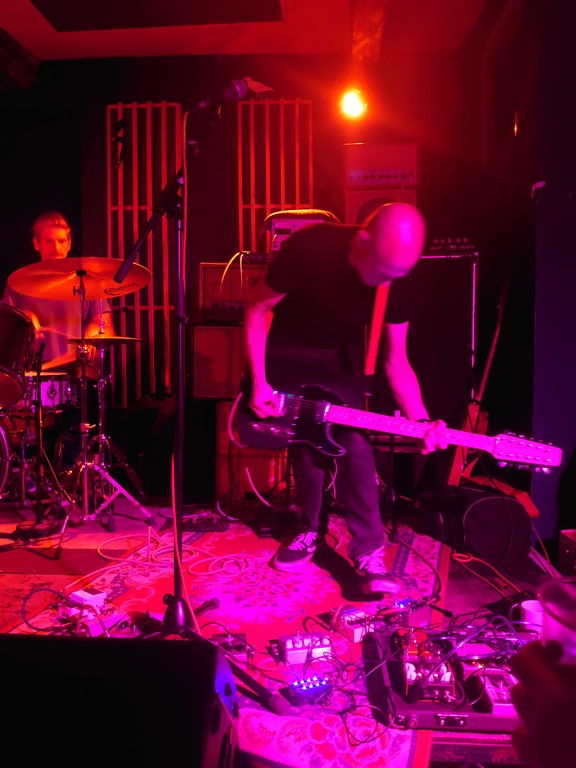
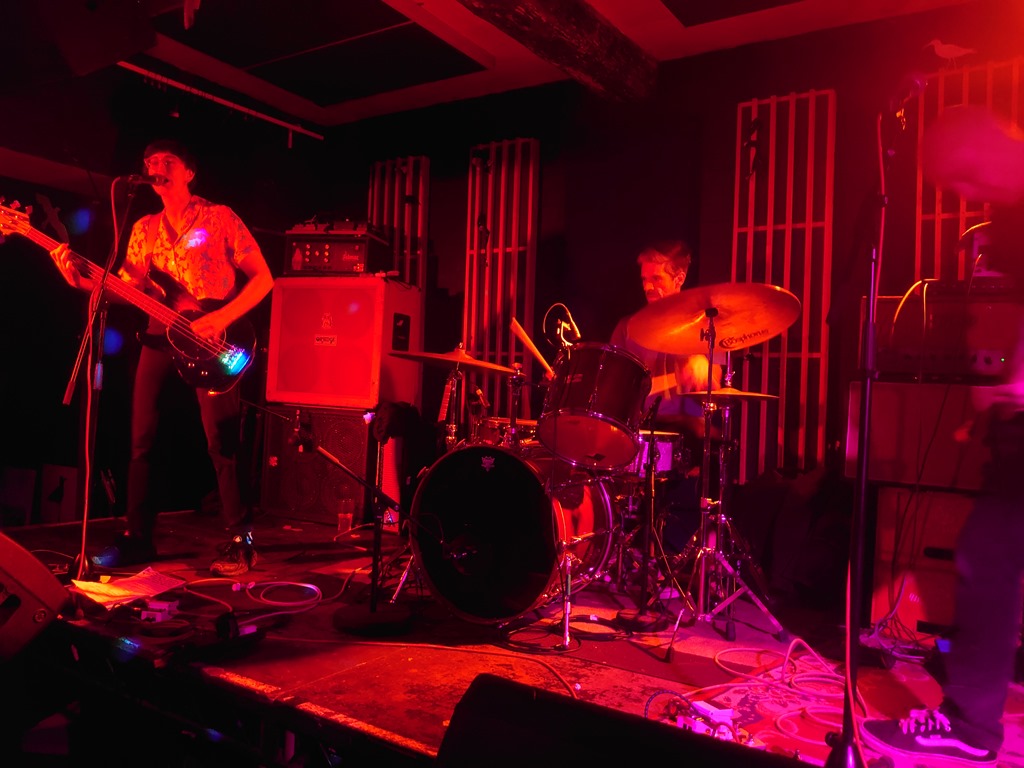
Objections is Bilge Pump’s Joe O’Sullivan and Neil Turpin with ex-Beards’ Claire Adams. Claire covers bass and vocals, while Joe’s weapon of choice is a 12-string, which brings some real depth and density to their brand of sinewy post punk. It’s goth meets math rock, and at the same time combines the best of both Bilge Pump and Beards. The guitar provides texture and tone rather than tune, sculpting shapes, and watching O’Sullivan is always a joy, not to mention exhausting: the man is a relentless blur of energy (and impossible to [photograph without better kit than mine), and plays every chord with his entire body, leaping, lurching, and perspiring heavily every whichway. Adams’ bass is stop/start, lumbering, and the choppy, angular songs with their variable time signatures are held together with precision percussion from Turpin. Oftentimes, a relentless repetitive rhythm grinds a backdrop to peeling shards of guitar splinters, and chunk funk bass drives a collision between Shellac and Gang of Four, leading towards an ultimate space rock finale. They are stunning, and the place is busy, and the reception they receive is well deserved: this is one of those occasions where you could leave immediately after the support and feel that you’ve easily had your money’s worth.

DSC_1127DSC_1123

Objections

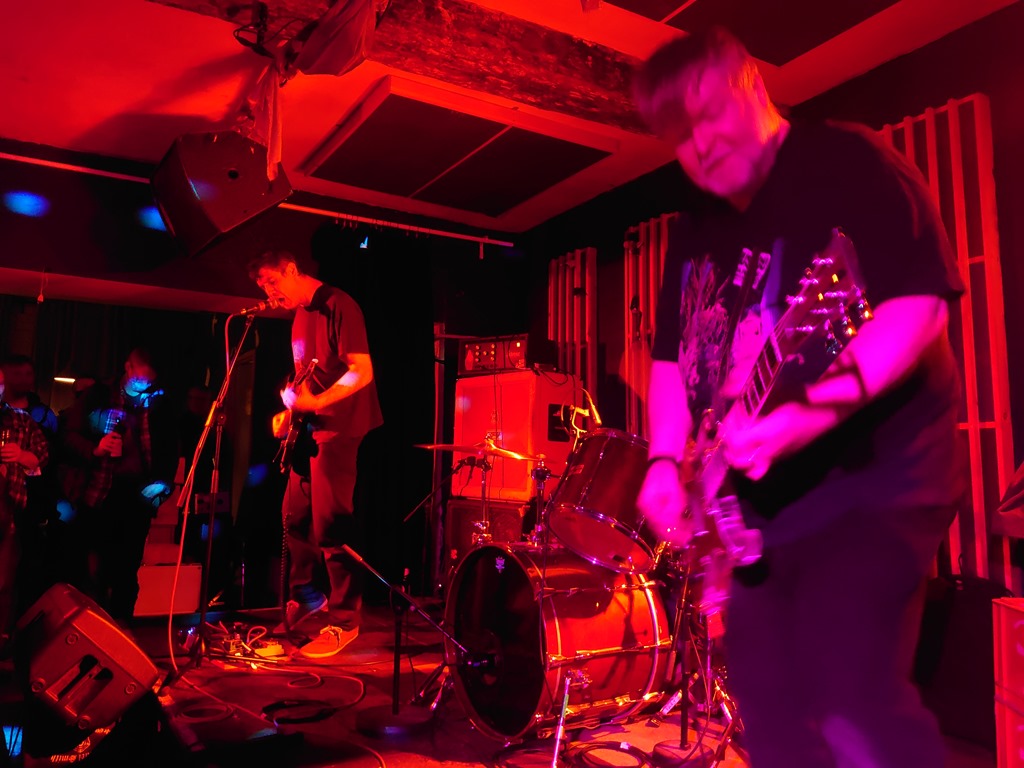
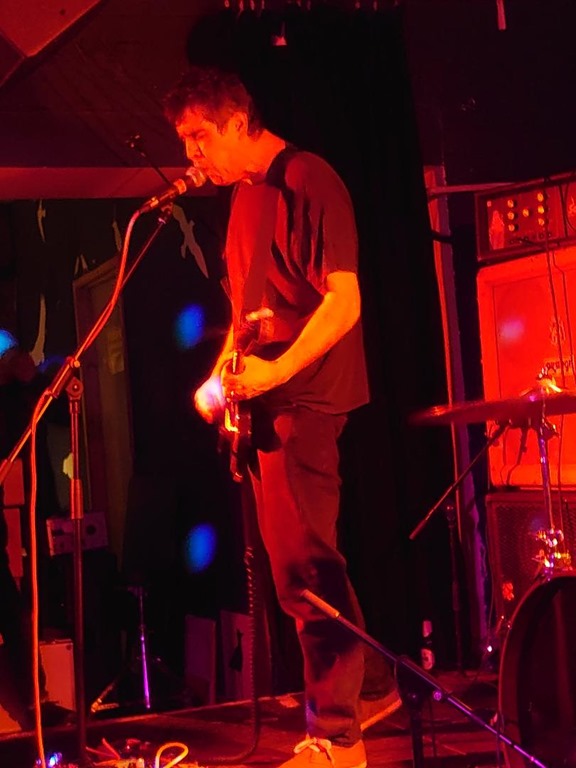
But then, it’s Part Chimp headlining, promoting their latest album, Drool, their sixth proper in their twenty-year career and the follow-up to 2018’s Cheap Thriller, and it’s the final track from this album that they power into a blistering set that’s a massive barrelling noise of relentless riffery from the off. They’re out as a three-piece sans bass tonight, but make enough racket for infinite members, with enough downtuning to cover the low end. And when I say that they’re loud, I mean they’re seriously fucking loud. Standing front row stage right I’m overwhelmed by the speaker shredding backline of Iain Hinchliffe’s guitar but it’s magical – obliterative, immersive, cathartic.

At this point in their career, they’re no longer young, and they’re not overtly cool, with their beanstalk singer and somewhat squat and unsvelte guitarist, but it’s the music that matters and makes them the coolest guys around: they make the best fucking noise, and may have just released their best album, which occupies half the set and reveals its range magnificently. Battering away at a couple of chords blended with all the distortion and feedback, the vocals buried in echo, and there’s a sample that runs between the songs throughout set in a fashion that’s reminiscent of the loop that runs through Rudimentary Peni’s Pope Adrian 37th Psychristiatric. With guitars like bulldozers blasting out rifferama ear-bleeding volume – did I mention that the volume’s up to twelve or thirteen?

DSC_1143pc...

Part Chimp

There are occasional hints of Hawkwind happening, but overloaded with distortion and howling feedback at a thousand decibels and there’s some bad trip psychedelia slow and hypnotic in the mix. But Once again, it very quickly becomes a haze, and it’s impossible to do anything but yield to the wall of sound and enjoy. Live music fans live for moments like this, and it’s clear that everyone in the room was in the same space. If there is a heaven, it has to be this.

Nim Brut – 19th November 2021

Christopher Nosnibor

The hardest battles are those against yourself: they’re perpetually self-defeating and at the same time impossible to win. A duelling duality creates the core dynamic of Rejection Ops. The Leeds-based duo’s bio describes them as ‘a drummer and bass-and-electronics player who sound like each is trying to outdo the other at driving audiences from the room’, presenting a scene of duality and conflict, and this document of that internal tension was captured in its rawest form, namely self-recorded on a Zoom recorder during May 2021, so no engineering panache or highly-detailed production values here, no layering, multitracking, or overdubs. And it’s a mangled, gnarly mess of noise from beginning to end. It’ sets your teeth on edge, it makes your organs vibrate. It makes you feel tense, and grind your teeth. And these are the reasons to love it, because it has impact. It’s not some comfortable background work, and it’s not even songs that drift into your ears and lodge softly but with longevity. Rejection Ops vs. Rejection Ops is pre-emptive revenge for something you may do, and it’s going to punish you hard for it.

The first track, ‘Agendas Vary’ is a squall of feedback and overloading noise pitched against a tempest of thunderous drumming, and it does that free jazz thing of sounding like the climactic finale of an epic set without there having been the epic set preceding it. As such, it’s seven minutes of ear-bleeding, cranium-crushing chaos that doesn’t go anywhere, but then isn’t intending to.

‘Atomic Basketry’, the album’s longest track at almost eight minutes in duration, ratchets up the noise and almost buries the percussion beneath a blistering squall of screaming noise, a tidal wave of treble, a deluge of distortion. Blistering electronic noise, a bowel-shredding harsh noise wall splatters against arrhythmic clattering.

Thereafter, the form shifts away from expansive and exploratory towards brief blasts of mangled abrasion, every one faster and harder and wilder and more off the wall. Guitars thrashed hard splinter in a mesh of treble while the drums pop like bubblewrap. ‘Heeding Tartan’ is particularly abrasive, two-and-a-half minutes of metal-scraping, crunching, white hot molten noise, and ‘Raging Ninepin’ rages hard, so hard it blisters and peels and pulverises the grey matter to the point of near liquefication. The drums ricochet hard and fast like machine gun fire through ‘Rat Pie’, which snarls and crackles hard, but it’s all just a prep for the sonic blitzkrieg of the final cut, ‘Soon Learned’. Even sooner remember earplugs would be the advice, because this absolutely fucking hurts. Again, it’s three and a half minutes of everything all at once, only here, it’s the head-shredding crescendo climax it sounds like, rather than just some avant jazz end without a start.

By the time it’s over, you feel battered, bruised, drained, but also buzzed and exhilarated. The purpose of art is not to entertain, but to challenge, to arouse the senses. Rejection Ops certainly challenge – not only the listener, but themselves and one another, to create a stupendously intense experience.

AA

a3422423491_10

A Place To Bury Strangers announce the release of their sixth album See Through You on 4th February 2022. It’s not just a return to form for the band, but also a return to their fiercely independent, DIY roots on their own label, Dedstrange.

Outpacing even their own firmly blazed path of audio annihilation, this 13-track album repeatedly delivers the massive walls of chaos and noise that A Place To Bury Strangers are renowned for. It’s an explosive journey that explores the listener’s limits of mind-bending madness, while simultaneously offering the catchiest batch of songs in the band’s discography. It’s a nod to the art school ethos of the band’s origins, while forging a new and clear direction forward.

The first single ‘Let’s See Each Other’ is an intimate and disarming love song from a forgotten future. Syncopated memories and deconstructed fantasies of lovers lost in a city that doesn’t know their names. The accompanying video, directed by David Pelletier, features the band destroying the song while imploring people to reunite.

Watch the video here:

AA

5tqs_APTBSPhotobyEbruYildiz650

Photo by Ebru Yildiz

I know, I know, poor form, etc., etc. But hey, it’s not every day this kind of thing happens.

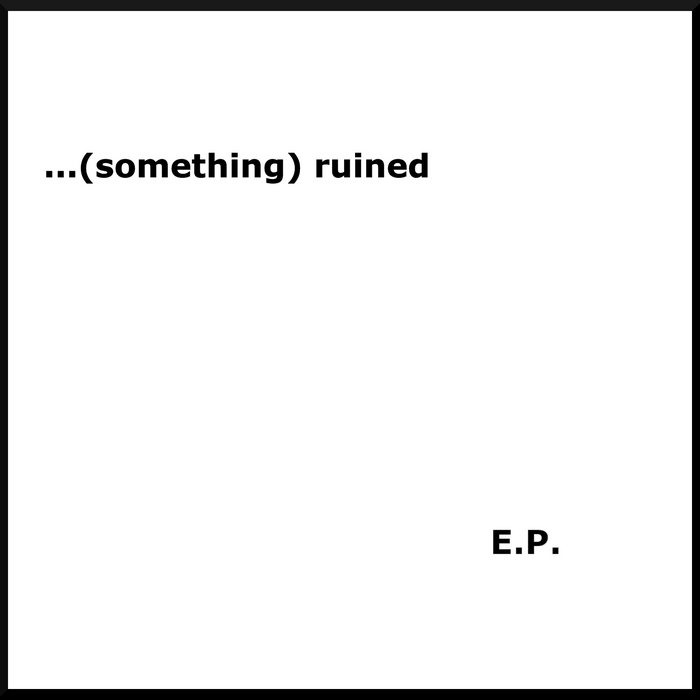
…(something) ruined coalesced by happy accident as a live proposition. Like so many bands, lockdown hit our progress and development hard. The ‘white noise and shouting’ worked because of a combination of factors all in the moment – extreme volume, intuition, adrenaline, the consumption of alcohol. Replicating the vibe without those factors proved to be a challenge – but, when offered the platform of the FEAST online streaming events organised by the Nim Brut label during lockdown, it felt like an opportunity to develop a new way of working and to refine that sound in a more controlled setting. Trial and error led to the creation of noise first, vocals second, and over the course of several months, thing evolved, and …(something) ruined became something more, with not only a more defined sound, but a thematic focus lyrically.

E.P. is a cohesive document, but also a document of an evolution, and the tracks are presented in the chronology in which they were created, each first aired at a FEAST event.

‘Life Is Too Short’: small frustrations simmer and boil over when presented with the stark reality that you could die tomorrow and you’ve squandered the last 10 years your waking hours being nice and pandering to utter cunts.

‘On Mute’: anthem for remote workers around the globe as we’ve watched cretins babble away merrily on video calls while no-one can hear a single word – although, frustrating as it is, it’s usually better than hearing their words.

‘Harder, Not Smarter’: another corporate classic. Time and again management promote smart working, time-saving, and economy. But for all the words, there’s only whip-cracking ultimately.

‘On Brand’: brand isn’t just slogans and advertising. It’s an ethos. You don’t just work for a company, you are the company, a walking promotion. Live the brand.

AA

a0772507179_16

Neurot Recordings / Gilead Media – 8th October 2021

Christopher Nosnibor

Less is more. This is something that few bands appreciate or understand half as well as Kowloon Walled City. And less doesn’t have to mean less intense: if anything, it’s a major factor in the ‘more’ element of the equation. Instead of hitting the listener with hard volume, relentless drumming, and gnarly distortion, Kowloon Walled City distil emotional pain into something simple and direct, and in doing so achieve optimal impact.

Their last album’s crushing weight derived not from its pace or even its volume, but its sense of space. Instead of filling the air with big noise, each chord crashed down hard and rang out into silence. In that space, Singer/guitarist Scott Evans’ vocals conducted pure anguish and blank nihilism. No throaty metal stylisation or posturing, just a kind of shouting – a shout of pain, of psychological torture – the torture of existence.

It’s the space between the sound that they’ve explored in the evolution of their fourth album, Piecework – their first output in six years. Make no mistake: Piecework is fucking heavy. It packs some utterly gut-punching, seismic riffs that drive hard, and when they hit, they’re utterly pummelling. But it’s the bleakness, and the blankness, that’s most affecting, that really hits the hardest. In the first instance, it’s simply so raw, so unprocessed. With the vocals clean and up-front, it’s the humanity that’s at the fore.

Not that there was any fat on Grievances, but with Piecework they pare it right down to the bone, and then scrape away a little more. Whereas most of the songs of its predecessor sat around the five or even six-minute-plus mark, Piecework packs seven songs into around half an hour. In cutting back so hard, the effect if heightened as the grey walls close in tighter, faster, more likely to bring a crushing end. The effect is cumulative, and there are no clear standouts on Piecework, only a sustained slug driven by a low, lumbering bass. It’s a bass that really churns the gut, and it has a physical force.

The production captures this dark, dense force perfectly, conveying a sound that feels live, that feels real. Wish you were there? Hell yes: we all need a bit of fortune, and Piecework is both beautiful and harsh. When they bring it down to nothing but a single note hanging in the ear, I’m reminded of latter-day Earth, and it’s clear that space and time matter.

As the press notes tell us, ‘Evans was dealing with the loss of his father during the writing of the album. He found strength in the women in his life, especially his maternal grandmother, who worked at a shirt factory in Kentucky for 40 years while raising five kids. The album name (and title track) is a nod to her line of work—and her quiet resilience.’ The lyrics are at once abstract and packed with images. There are no specifics, only scenes, and they’re bleak ones, of claustrophobic confined spaces, of deathbeds.

And it’s no criticism that this feels like an album of graft: the rhythm section ploughs on, and on, relentlessly, as if their duty is pure graft, digging, digging, digging. In the same way that early Swans was the sound of punishment, so Piecework is a soundtrack to the brutal reality of production-line capitalism.

The album’s predominantly slow pace is not the sound of rapid mechanisation, but of soul-sapping drudgery, the crushing weight of negative progress. There is no respite, no detours to bathe in moments of human kindness, the idea that for everything, there are glimmers of light and optimism. No, Piecework is an album with no let-up, in the way that Unsane are unrepentant, unremittingly grey in their outlook and execution. It hammers and bludgeons away at the senses and prods hard at the frayed nerve endings, the space and dead air speaking to the emptiness that hits us when the noise stops. Life is short and life is cruel, and Piecework is the perfectly merciless reminder of that.

065653

Cruel Nature Records – 24th September 2021

Christopher Nosnibor

The lights that burn brightest tend to be the ones that burn briefest, and it’s something of a conflicting pull on the gut that surrounds reflections on this. The idea that acts who quit and artists who died leaving a small but impactful legacy are somehow unfulfilled and that we’ve been deprived of whatever they may have done is counterbalanced by the contention that perhaps curtailing a career at its peak or even still in its ascendency is the best way, and fans will be forever divided on this topic.

What if Ian Curtis had lived, and Joy Division had mutated into New Order? They would have been just another band whose longevity overshadowed that early career, another Manic Street Preachers. Simple Minds should have called it a day in about ’84, and Kasabian’s early promise was spent after just one album.

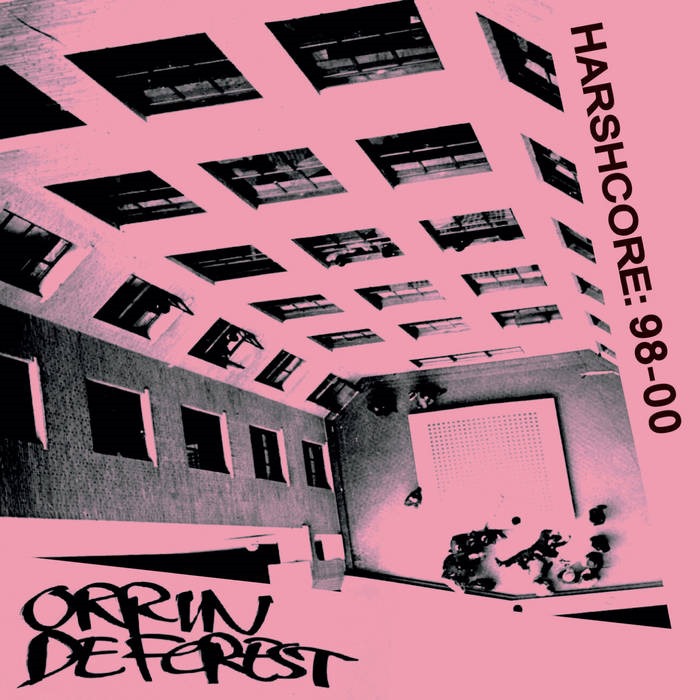
ODF never lasted long enough to really break out of the locality of Gateshead. As the liner notes to this retrospective observe, they ‘blasted onto the North East’s harshcore scene in 1998 and were gone in a flash three years later; their 2001 split album with Newcastle’s Jazzfinger the only remaining recorded output’. Everything leans toward the attainment of immortal cult status here, and the changes are infinitely more people have heard of the band, or otherwise heard them posthumously than ever did during that brief but explosive career.

This limited cassette, Harshcore 98-00, documents two live shows, both recorded in Gatehead, with the first seven tracks recorded June 2000 at the Floating Cup, Gateshead, and tracks 8-14 recorded June 1998 at the Soundroom, Route 26 Centre, Gateshead.

It’s pretty fucking brutal. Most of the songs in both sets are around the two-minute mark, and it’s as abrasive as hell. The vocals! Rob Woodcock (Marzuraan; Tide Of Iron; Fret!; Platemaker et al) sounds like a zombie from The Walking Dead on amphetamines, snarling and rasping with the most ravaged-sounding voicebox. There’s a lot going on here: ‘Calisthenics’ brings all kinds of jazz and math elements alongside the full-on, balls-out wild thrasher, and the fifty-five second ‘Aggressive Lowbrow’ brings everything all at once in a racket that suits the title.

Despite the close proximity of the sets, there’s a clear evolution here, so it’s a little frustrating that they’re presented in reverse chronology on the release. The ’98 set is less evolved, less detailed, less jazz, less multi-faceted, and more of its time – brimming with samples and songs that are little short of whirling explosions of whiplash-inducing racket, with ‘O.D.F. Will Kick Your Lame Ass Motherfucker!’ being exemplary, but also marking the band’s first forays into different terrains, with hints of swagger emerging amongst the frenzied racket. It’s gnarly, it’s intense, and it’s fucking punishing. And it really makes you wish you had been there.

AA

a1380330890_16

Dret Skivor – DRET 009 – 3rd September, 2021

Christopher Nosnibor

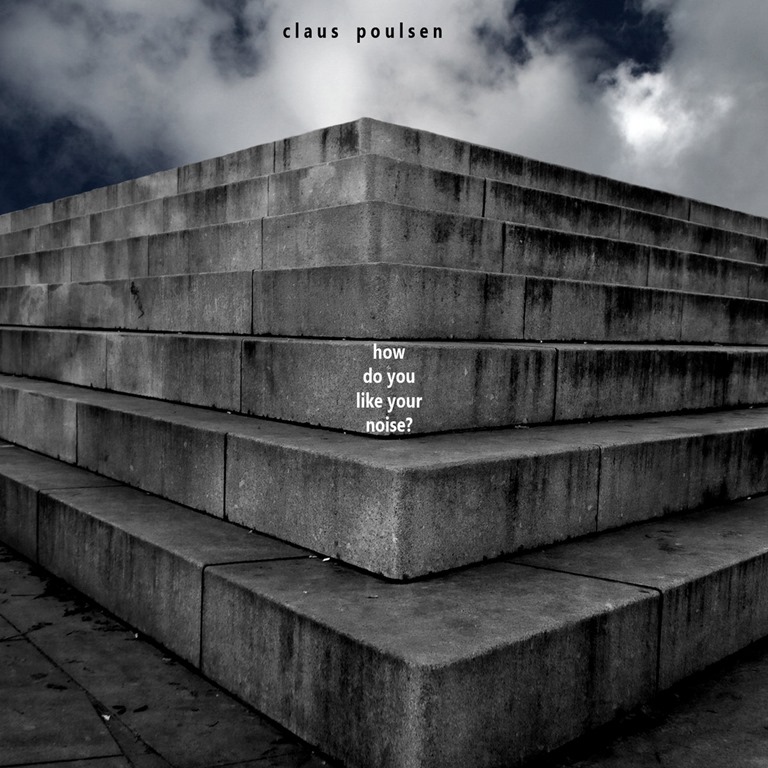
On the face of it, it’s a straightforward question. But chewing on it a little longer than is probably advisable, like a lump of gristle you can’t quite find an opportune moment to spit out discreetly at a family meal, it presents a range of different potential inflections, from the casual ‘how do you like your noise?’ delivered with the same intonation as ‘how do you like your steak / coffee / eggs?’ through to the rather more personal but interrogative ‘how do you like your noise?’

So while listening to the ten pieces on this short release, available digitally and as a C20 cassette, I gave this some consideration. It wasn’t necessary, but then, not a lot is, beyond the basic functions of eating, drinking, breathing, and sleeping. Then again, art has existed longer than civilisation, and perhaps it’s not so wild to think that giving an outlet to one’s thoughts and feelings which transcend verbalisation is also necessary in the most fundamental sense. Perhaps we need art to live. This act of consideration in itself made me realise that a lot of noise is something that’s possible to think alongside listening to. It isn’t that it’s necessarily undemanding: it’s often far from it. It’s just that noise has the capacity to free the mind in ways that more structured genres, and modes of music more geared towards beats and lyrics can often pull the brain waves into their structures instead of encouraging that certain mental drift. Of course, ‘noise’ can be subject to a host of interpretations, sometimes with an interchangeability with ‘sound’. Specifically, here, though, I’m talking about noise.

And ultimately, I can only conclude that I do like my noise harsh. For some reason, noise that makes me grit my teeth and chew the inside of my mouth while I’m listening is the noise that meets the needs of my inner workings. It excites me and sets me on edge. I suppose it’s because ultimately, when it comes to this shade of noise, all you can do is submit to it, and it’s a cathartic release to allow the sound to draw the stress from the mind and body.

How do you like your noise? is pitched as ‘a bunch of noises recorded live 2020 and gems from the archives’, and while it’s not always clear which represents which, there’s no shortage of nasty abrasion on offer here, and it’s clear that Pulsen ‘get’s noise – by which I mean, he has a handle on the effects of varying textures and frequencies, and how shifts between different ranges can trigger both physical and cerebral responses. The grating ‘metal massage’ and squalling electronic blitzkrieg of ‘urbanoise’ are exemplary of the kind of circuit-melting experimentation that many will find painful and torturous, and be grateful for their merciful brevity.

There’s range here: ‘dead man’ is a sparse and spacious guitar piece that borders on post rock, while ‘ringu’ does some glitchy warpy bendy note electronics tricks and teeters on the brink of some kind of electrojazz odyssey. There’s also some whimsical faffery, clattering and clanking around that’s more throwaway interlude than composition, with sub-minute snippets like ‘still haven’t found what i was looking for’.

And so, I changed my mind: I like my noise varied. On this release, Poulsen shows the full spectrum of his versatility, and the range of his noise. I like my noise, and I like this a lot.

AA

a3069066462_10

Cruel Nature Records – 27th August 2021

Christopher Nosnibor

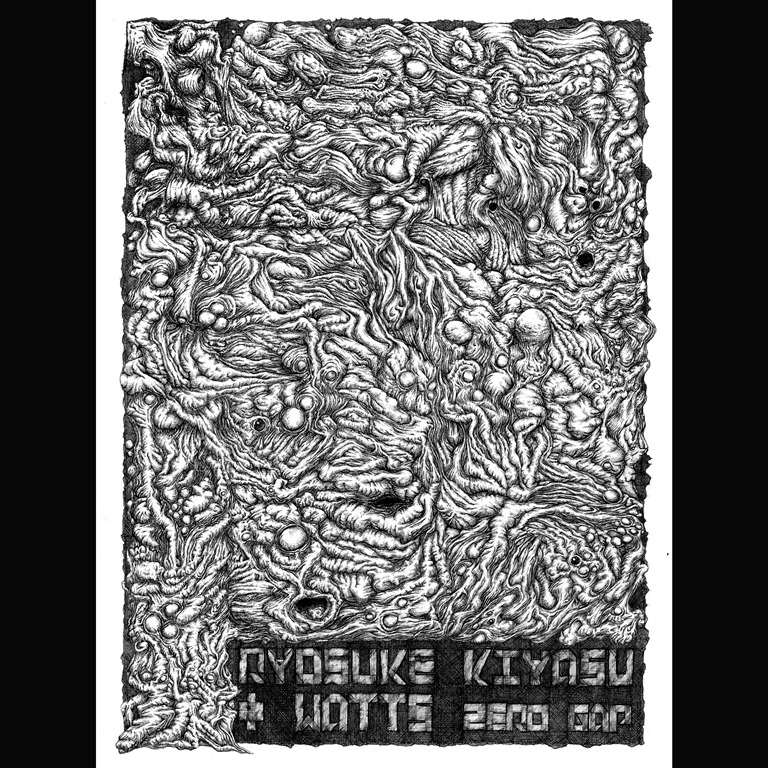
Zero Gap is a truly international collaboration between Ryosuke Kiyasu (SETE STAR SEPT, Fushitsusha, Shrimp, etc, aka ‘the Japanese guy with a snare drum’ and WATTS (Lump Hammer, Plague Rider, Lovely Wife, aka that beardy growly bloke) that proves that location is a state of mind. Recorded oceans and continents apart, there is zero gap between the two artists as they hammer out half an hour of sonic abrasion, created, as the accompanying notes explain, ‘entirely from one snare and one delay drenched throat’.

If on the surface the snare drum seems to have only limited potential, then Kiyasu doesn’t exactly disprove that, in that it sounds like snare drum throughout. But the guy finds every conceivable way of rendering that snare sound, from rapidfire hits and rolls and crashes through clattering blasts and builds, and the still finds ways beyond conception to conjure yet more dynamic range from the simplest of instruments.

Against this clattering, clanking, thunderous barrage of percussion, Watts delivers a vocal performance that quite simply doesn’t sound like a vocal performance for the majority of the time. From a whispering moan like a distant solar wind, to a gurgling drain to a chthonic babble, he’s got immense range. It might not quite be Mike Patton’s Adult Themes for Voice, but it’s still impressive – and I mean eye-poppingly wide-ranging and weird. Best of all, Watts grasps when less is more, at times uttering little more than barely audible grunts and burps at long intervals. Snarling and snapping like a zombie in The Walking Dead, one moment, to barking like a rabid dog the next, Watts is wildly unpredictable, and often quite simply doesn’t sound human. Perhaps he isn’t. At times unsettling, unnerving, others plein scary, he snarls, growl and gargles his way through the creation of some quite strange soundscapes.

Everything works well in context, too: at times, Kiyasu pulls back on the battery of beats to taper down to some barely-there hints of sound, and the two not only are incredibly egalitarian in the distribution of the prominence of their contributions, but they seems to intuitively grasp the need for ebbs and flows, crescendos and decrescendos, making Zero Gap a work that feels like a journey, and even if it’s a journey without a clear end point, it’s a journey punctuated by events and variations.

Zero Gap isn’t abstract as such, but it does, most definitely stretch the boundaries of music. It is ultra-niche, but in the global village it’s the kind of thing that has the potential for significant cult reach. The pair deserve it: Zero Gap is far out in the best way. Crazy, inventive, innovative, not giving a fuck for convention, it’s an album that carves its own niche.

Captured as a single track spanning thirty-two minutes, it’s unusually a release that works best digitally (and dare I even say it, it, could make a nice CD), but then this is an unusual release. My advice? Dive into the dark stuff.

AA

cover

Human Worth – 17th September 2021

Christopher Nosnibor

Sometimes, a record hits you before it’s even got going. Perhaps it’s the way sound connects beyond the rational, striking a chord in the soul on a subconscious level that’s almost impossible to pinpoint, let alone articulate. We All Do Wrong is one such record.

From the first bar, the chord struck is a brittle clang that intimates something sharp-edged and to be mindful of. Meandering brass isn’t the most obvious thing to enter the mix next, but then for all of their hardcore / noise credentials, there’s nothing obvious about the material on this release from X’ed Out, featuring members of Silent Front and Working Men’s Club (the hardcore one, not the shit indie one). And then the guitars blast in and everything explodes. It’s only the first track, and already I’m dazed and dizzy, feeling as though I’d been beaten around the head with a crowbar outside a jazz club – because how else do you explain such a brutal battering while brass bursts all around?

Turns out this is just the gentle introduction to the full-throttle mania that ensues. ‘The 5 Headed Boy’ is a jolting, jarring mess, a blurring whirl of hardcore, math-rock and weird craziness, like Black Flag, Shellac, and Truman’s Water in a blender. I can’t remember if it was NME or MM (probably the latter) who described Truman’s Water’s deconstructed math-rock with their jolting, jerky, off-centre riffs as being ‘the real Pavement’, but it made sense at the time, as Pavement were hailed as inventing slackerist lo-fi with skewed riffs, while TW were way more slanted (if not necessarily enchanted) in their manic approach to similar materials. I digress, but I suppose this is informative to the context of what X’ed out sound like, with stop/start rhythms, changes in tempo and direction at the most unexpected of moment

Sometimes, this job is really tough. You’re exposed to new music quite literally all the time, your inbox bursting with more than you can ever even listen to or even aspire to listen to – in my case, twenty or more albums a day is a minimum average. Have you ever listened to twenty albums in a day? Let along listened to and written about them? I’d love to, of course, and knowing it’s simply not humanly possible, I’ve contemplated the possibility of having music injected directly into your brain, so you have it stored, heard and assessed, without the labour.

Of course it’s a ridiculous concept: you listen to music to feel the energy and emotion, to bask in the experience, not to simply ‘know’ it, and albums like this remind me why. You feel this with a blistering, blinding intensity.

Everything is louder and faster and more angular than everything else. When they play slower, it gets sludgier and gnarlier, as on the synapse-blasting ‘Fouling the Nest’ and ‘Self Healer’. On the former, it’s a bowel-quivering bass that dominates, while on the latter, from seemingly out of nowhere, there’s a long, slow, expansive instrumental section over which melodic vocals drift, and you momentarily forget where you are – namely in the middle of a sonic riot, with bottles, brick and Molotov cocktails being slung in all direction. What happened? Were you temporarily hypnotised? Possibly. I believe it’s called being ‘in the moment’, and this of course is one of the most wonderful things about music, in that it can transport you, can make you forget. A rolling piano chimes out and it’s grand, and almost soothing, and then the drums hammer harder.. and then it’s gone.

The epic ten-minute final track, ‘The Noble Rot’ is different again – expansive, emotive, it sounds very much Oceansize in styling, at least until the trumpet marks its arrival. With so much in the blender, it’s so, so hard to categorise or pigeonhole We All Do Wrong, although alongside the aforementioned comparisons, Terminal Cheesecake and Bilge Pump are probably worth mentioning: if these bands means anything to you, then you need X’ed Out in your life. If they don’t, then you still need X’ed Out in your life, as well as to expand your education.

What’s more, being released on Human Worth, a label where the clue is in the name, 10% of the proceeds from the release is being donated to charities, on this occasion Breast Cancer UK. It’s all good.

AA

a1642734540_10