Posts Tagged ‘Industrial’

24th May 2024

Christopher Nosnibor

Welcome… to The Royal Ritual! I simply felt the urge to open with that. It felt necessary, if only to me. But if you can’t please yourself…

In my case it’s something of a belated welcome, having been aware of the act and its founder, David Lawrie for quite some time, but having only recently come around to the actual music, with my introduction being their recent show in York. There’s something to be said for hearing a band live first, without knowing the songs, rather than the other way around: if they can grab you in that twenty minutes or half an hour, when you’re not necessarily primed to absorb songs and details, then there’s a strong chance they’ve won a fan, provided the recordings are up to scratch.

Where The Royal Ritual really stand out live is with the use of live guitar, which brings the benefit of not only an immediacy and human aspect to the predominantly digital music, but an additional body on stage, which creates not only a visual balance but a greater sense of movement.

Recorded, these elements are less essential, and the songs here are clearly the product of extreme focus and a meticulous attention to detail. When I wrote in my review of the York show that The Royal Ritual sound ‘produced’, I observed that ‘their approach to production owes more to the methods of Trent Reznor as pioneered in the early 90s on Broken and The Downward Spiral, balancing gritty live guitars with synths and fucked-up distortion and harnessing their tempestuousness in a way that creates a balanced yet abrasive sound.’ And so it is on record, also.

Pleasure Hides Your Needs is The Royal Ritual’s second full-length release, following MARTYRS in 2022. A lot has happened, and much has changed since then, and the project, born in lockdown, has evolved significantly – as have many of us. Life is different now: that’s a fact.

We learn that ‘Pleasure Hides Your Needs sees David contemplate his own life and experiences, adopting a distinctive, more personal tone than the expansive and outgoing approach of MARTYRS: “Pleasure Hides Your Needs is much more introspective when compared to the social and political commentary of MARTYRS,” says David. “For me, it is about the closing of three distinct chapters of my life. Finding the common threads through each of those chapters in order to represent them sonically, and in a consistent way, was a really interesting challenge – if at times quite emotionally exhausting.”

Life is exhausting, in every way, but there’s a tense energy to Pleasure Hides Your Needs. It builds from the instrumental intro piece, ‘Shadow Self’, where crashing waves erupt from soft ripples, dark rumbles and inaudible muttering contrast with chimes, before ‘Vantage Point’ opens a broad sonic vista paired with a solid kick drum beat. Just as it’s leaning into the proggier end of alternative rock, a gritty guitar kicks in and the mood immediately turns darker.

‘Fifteen 14’ lands as an unexpectedly pop tune, with a solid chorus, which softens the arrival of the album’s nine-and-a-half-minute centrepiece, ‘Sinner Gambler Fugitive’, which really does run the gamut for range, a sonic and emotional rollercoaster. It’s ‘Modes of Violence; that goes full industrial, with a metallic smash of a snare and snarling bass providing the backdrop or Lawrie’s wrought vocal as he wrestles with a veritable tempest of emotion, before he hollows himself on the bleak, minimal title track.

The album as a whole is more geared toward tension than release, always simmering but rarely bursting the floodgates. Muted isn’t the word: it’s more a case of clenching tightly to maintain a grip of control for fear of what may erupt otherwise.

Pleasure Hides Your Needs is dark and exploratory, but still eminently listenable. As The Royal Ritual evolves its sounds and expands its horizons, there remains much potential to explore myriad paths in the future, and recent touring will likely serve to open new avenues of exploration.

AA

a0879761406_10

Metropolis Records – 27th September 2024

Christopher Nosnibor

Hot on the sweaty trotters of Red Room, released in May, the Lord of Lard, Raymond Watts has managed to mine fresh truffles for a whole new EP ahead of embarking on an extensive tour of the US, which so happens to take its name from the first track on said EP, ‘Heroin for the Damned’. The fact that this isn’t a set of remixes

The title alone is glorious, and you can almost feel the relish with which Watts conjured up the phrase, wicked, perverse, dark, and equally ostentatious and grand, evoking an image within the realms of The Last Supper but with an S&M slant as the participants dine on an orgy of gore… or something. When it comes to relishing the richness of language and delighting in deliciously devilish wordplay and alliteration, sifting through PIG’s catalogue for titles and lyrics (there’s a suitably extravagant book containing all of them just out) provides abundant evidence that Watts really gets kicks from it.

It’s also clear he is absolutely loving the whole self-styled industrial rock-god posturing, hamming it up in leather and mesh, and simply the whole music-making thing, perhaps more than at any point in his career. Instead of being awkward about self-promotion, he’s fully embracing its absurdity, and in a genre that’s largely dominated by serious, angry people, PIG stand out as being rather less po-faced, and altogether more fun than your average industrial act. I’m not sure I’ve seen Al Jourgensen or Trent Reznor posting pics on Facebook hugging their pooches.

That doesn’t mean that the music is any less serious. Watts and his various collaborators really know how to bring a crunching riff and a stonking beat, and, occasionally, having taken early cues from the legendary JG Thirlwell, spin in some bombastic strings and grand orchestral strikes. And Feast of Agony is dark, heavy, intense, and marks a strong return to the more experimental 90s work following a pursuit of an altogether glammier sound of late.

‘Heroin for the Damned’ – the opium of the people for the 21st Century, perhaps – starts low, slow, and sinister, Watts’ vocal a croak amidst a dank electronic swamp before a steady riff, laden with grit, grinds in, rubbing hard against a lowdown pulsating synth groove. It’s a bit NIN circa The Downward Spiral, but equally it’s quintessentially 90s PIG, and lands a monster chorus that combines the raging roar of Sinsation and the grainy grooves of Praise the Lard with gushing gospel grandeur – something that really dominates the final track, the Jim Davies remix of ‘Baptise, Bless, Bleed.’ Piano and bold orchestral sweeps meld with stark synths and crunching guitars on ‘Fallout’, before Watts comes on like Bowie on the slow-paced anthemic ‘Comedown’, while the verses of ‘Hand of Mercy’ owe more to Prince.

It’s a PIG release and therefore it’s a pure [serial killer] thriller, alright – but even within the now-expansive catalogue, Feast of Agony is a strong entry.

AA

a2658647365_10

Christopher Nosnibor

It was in my early teens that I discovered goth, and Mick Mercer’s Gothic Rock Black Book was something of an early bible for me. Mercer has built a career on being a huge authority on the genre, and things in the post-punk sphere. So the fact that the latest release from History of Guns – a ‘maverick’ industrial act from Hertfordshire leads with a quote from Mercer, describing them as “by far, the most inventive UK band to have got their hands caught in the Industrial threshing machine,” is quite a strong sell. The strongest sell, of course, are the wares themselves, and highlighting just how unfettered by convention History of Guns are is the fact that Drug Castle isn’t just another video single, another lyric video, another ‘vizualizer’ (thank fuck). No, this is, they explain, ‘a short film for one of the more experimental parts of their latest album, Half Light, in which they take their instruments to the beach, and experiment with different audio and emotional frequencies, in an effort to contact beings from another world.’

If this sounds utterly deranged, the context counts for a lot, and to provide this, I shall quote at length:

‘Drug Castle was the nickname given to a facility in England where they used to conduct experimental, often unethical psychological procedures during the 60s and 70s. No one’s quite sure of its exact location, other than it was near the sea, and some of the sessions happened out on the beach. Different psychologists and psychiatrists could effectively book it out, and then take patients or unwitting volunteers down there for however long, and do whatever they liked. There are stories from people who received really helpful, life-changing treatment there, but it’s probably more famous for the awful horror stories and reports of extreme abuse and deaths. Apparently, there was very liberal use of experimental drugs and techniques, hence the nickname. One of the experimental treatments was called Frequency Therapy which involved using sonic frequencies to match or harmonise with emotional frequencies, which would cause a third frequency to be created which caused some quite profound healing and bizarre experiences. One survivor of a group of a group reported making contact with alien creatures.’

Sourcing information about ‘Drug Castle’ is virtually impossible, but then, that’s hardly surprising given the nature of the operation. We know that the CIA’s operation MK Ultra ran from 1953 well into the 1970s – but there’s also a lot we don’t know. This is how conspiracy theories are born – though the known existence of government conspiracies. While most of the documents relating to MK Ultra were destroyed, those which survived and were declassified, despite heavy redactions, contained staggering and truly terrifying revelations.

‘Staggering and truly terrifying’ happen to be fitting descriptors for this dark, challenging audiovisual excursion. Scaping, droning, groaning, tectonic-plate-shifting heavy industrial churns and grinding metallic noise and dissonance provide the sonic backdrop to a menacing spoken-word piece. The vocals layer upon on another and the experience grows increasingly uncomfortable. Strings swirl and build, but what may, done differently, be a soothing experience, creates nothing but tension.

The guys looks like they’re participating on some ritual as they sit, cross-legged, on a beach. That beach becomes the location of a washed-up emptiness further on, and then transition to acoustic-led neofolk-tinged darkness in the later parts of thee tune a dramatically alters the trajectory of this work. The pleasantry of the surroundings transition to unsettling territory.

It’s quite apparent that History of Guns have gone way, way deep into their excavations in shaping dark domains of Drug Castle. Dark and uncomfortable, this is remarkable art.

You can see it all here:

AA

AA

0036723499_10

Buzzhowl Records – 27th September 2024

Christopher Nosnibor

Once again, following the release of a four-way split showcasing local talent a few months ago, Stoke proves the be the spawning ground of more off-kilter noisy noise, this time from no-wave duo Don’t Try with their second EP. As an additional point of note, and also something of a recommendation / hype point, the EP’s artwork is courtesy of Dan Holloway, of USA Nails/Eurosuite/Dead Arms fame, who worked with the band previously on their 2018 single ‘JWAFJ’. To accompany the release, Dan has also realised a video in his own inimitable style.

Like ‘JWAFJ’, their first EP, Elvis Is Dead was released in 2018, meaning it’s been a full six years since they last released anything, suggesting that on the output stakes at least, they’ve been living up to the band’s name.

Lead track ‘my grazed knee’ with its gritty yet poppy synths and urgent, determined beats isn’t actually a million miles from the sound of The Eurosuite. It reminds us of the proximity of new wave to punk, and the reasons why new wave and post-punk are essentially interchangeable terms. And while punk did, undoubtedly, spawn some great tunes (I’d perhaps contend less great bands, in that many punk acts, with a few notable exceptions like The Ruts and Adverts, produced only one or two outstanding or even memorable sings, and were unable to deliver the entirety of a solid album, let alone a career), it was post-punk where things got interesting, after things had evolved from three-chord stomps. If punk was predominantly pissed-off, railing against boredom and just off the rails, what followed explored a greater emotional range, and was more articulate, both musically and lyrically. For all its rebellion and antagonism toward conventions and norms, punk very quickly established its own conventions and norms: post-punk broke down those definitions to explore in myriad different directions, fragmenting and evolving into countless new genres.

It’s been a long time since the advent of both punk and new wave now, and in theory, any contemporary exponent of either is liable to tie themselves to certain tropes. But contemporary punk bands, more often than not, seem to be so limited in their scope, whereas many current acts who align themselves with post punk / new wave offer a broader range – even the ones who have been lazily lumped into the bracket of Joy Division imitators. I mention this as I discovered both Interpol and Editors because they were constantly being compared to Joy Division, and while I came to like both bands very much, my first reaction was dismay laced with disappointment over how unlike Joy Division either act sounded.

And so, circuitously, we arrive back with Don’t Try. ‘my grazed knee,’ as I was starting to say before I embarked on my obligatory and epic detour, is a fuzzy, low-fi keyboard-driven cut that boasts a monstrous throbber of a grindy synth bass groove that lands between Suicide and Cabaret Voltaire’s ‘Nag Nag Nag.’ But it’s a lot harder, harsher, noiser, more aggressive, more antagonised. Punkier? I suppose it’s representative of the point at which that nascent industrial sound began to evolve, but there’s also a manic hardcore edge to it, which is more apparent on the harsh assault of ‘climax in the imax’. Here, everything is ratcheted up in its volume and intensity, there’s a clattering metallic snare sound that crashes like a bin lid through the song’s duration, and about two-thirds in, it sounds like someone’s started up a drill and it all suddenly goes slower and heavier and you start to feel like things are getting dark and tense. This is very much a positive, in case you’re wondering.

There’s a clear trajectory to this EP, a sonic evolution which moved forward with each track, and things turn full-on industrial on the third track, ‘ritual’, which manifests are a monstrous, relentless rhythmic pounding reminiscent of mid-80s SWANS and the heavy grind of Godflesh. The crazed, anguished vocals are howled, yelped, drawled, hinting at the manic howl of the Jesus Lizard (and so, equally, Blacklisters). After hitting what feels like a locked groove around the mid-point, everything explodes and the track – and EP – climaxes in a slamming wall of ear-blasting noise. None of it’s pretty. All of it’s good.

AA

AA

a1753193572_10

Metropolis Records – 23rd August 2024

Christopher Nosnibor

Even at their commercial peak, PIG releases weren’t all that easy to come by, at least here in the UK, despite some of them being on big labels with big distribution. PIG – the project of London-born Raymond Watts – is an act which can legitimately claim to be big in Japan while largely unknown at home.

My own first encounter was seeing them support Nine Inch Nails on The Downward Spiral Tour in Wolverhampton in 1994. I was in the middle of my A-level exams, but no way was I going to miss NIN. I didn’t even know who the support were, but witnessing the heavy grind of PIG, with pigs’ heads on poles at the sides of the stage, as their lanky singer writhed his way through a gritty set was an absolute revelation. The set’s opening song stuck with me, but it was some years before I would actually source a copy of Red Raw and Sore, on this new site called eBay. The debut album, A Poke in the Eye…. With a Sharp Stick and the ‘Sick City’ 12” were fairly easy to find at record fairs around 1994, as Wax Trax! vinyl was available in abundance, and often cheaply, too, but anything else? Pretty much impossible to find. And so it was that PIG felt like a near-mythical act, and despite having played these big shows with NIN, still no-one was really aware of them.

Sinsation was released first in Japan in 1995, and a year later in the US, and on learning of its existence, I got my local record shop to order it in, but had to wait literally months for it to arrive on import. Oh, but it was worth the wait. It delivered all of the theatrical pomp that defined A Stroll in the Pork, but cranked up the dirty industrial guitars and found Raymond Watts in top form with his extravagant wordplay. In short, it reset the bar, not just for PIG, but for what ‘industrial’ music could be. This wasn’t just hard and heavy, but also playful, witty, intelligent, and still dark, seething.

The cover alone is striking. Watts’ image is a standard feature on all PIG releases, but whereas more often than not he is depicted looking buff or brooding, the sickly green hue is unsettling – and slamming in with a series of orchestral strikes and a low, grumbling bass before hitting full-on industrial anthem mode on the first track, the six-minute ‘Serial Killer Thriller’ (the chorus of which provides the album’s title), it’s immediately apparent that Sinsation is something special (and not something sad…).

Admittedly, despite this being an album I’ve played to death over the last thirty years, apart from a few tracks being a few seconds different in their duration, I can’t discern any huge differences between this remastered version and the original: there are, perhaps, more details revealed in the mix, but then, the production on the original was impressive, and again, I’ll come back to that word, ‘detail’. There’s a lot happening; samples, snippets of bits and bobs, strings, multi-layered vocals… A touring member of Foetus early in his career, with JG Thirlwell involved in the early singles and debut album, Watts clearly learned much from Thirlwell, as well as his early involvement with KMFDM. Sinsation felt like the point at which he brought these two aspects together in perfect balance while simultaneously realising his own unique sonic vision. The result was a set of hefty, driving songs, exploding with ideas and noise, and so many layers, so much going off all over the place. It was bold, audacious, and while it’s easy enough to say that it’s a bit Foetus, a bit KMFDM, it goers so far beyond these points that comparisons are a diminishment of Watt’s achievements here.

Sinsation is certainly the first PIG album to showcase the full range of styles and compositional aspects Watts has in his locker, and as such, represents something of a creative peak.

While nominal single ‘Painiac’ (an early version of which was the lead track on a Japanese-only EP, and a video for which got a few spins on MTV on the album’s release) is a throbbing industrial beast of a tune, ‘Golgotha’ is a dark, semi-ambient interlude which sits between the driving snarl of ‘Hamstring on the Highway’ and the swaggering industrial-strength glam-tinged gospel-infused dark pop of ‘The Sick’, which would provide the blueprint for the PIG renaissance which started with The Gospel in 2016. ‘Analgesia’ is a magnificently atmospheric piano-led instrumental which incorporates elements of ambient and electronica and extraneous noise ‘Volcano’ is serpentine and sleazy, with some audacious orchestral work in the mid-section which take the bombast of Foetus’ Nail to another level, while ‘Hot Hole’ drives hard and heavy with pulsating electronics colliding with hefty chugging guitars and ferocious beats.

For the many who likely missed this the first time, this re-release provides the opportunity to make acquaintance with one of the definitive PIG albums, and for those already familiar, it’s a timely reminder of the incredible journey that has been PIG’s career to date, while offering the first chance to get it on vinyl. Almost thirty years on from its first release, Sinsation still sounds phenomenal – insanely ambitious, utterly deranged, and in a league of its own, quite unlike anything else before or since, even within the PIG catalogue.

AA

a2059987689_10

Following hot on the heels of his new album ‘Red Room’ (released in May 2024), industrial rock mainstay Raymond Watts aka PIG has today reissued a fully remastered version of his seminal mid-‘90s album ‘Sinsation’ via

Following hot on the heels of his new album ‘Red Room’ (released in May 2024), industrial rock mainstay Raymond Watts aka PIG has today reissued a fully remastered version of his seminal mid-‘90s album ‘Sinsation’ via Metropolis Records (CD, digital) and Armalyte Industries (deluxe 2xLP vinyl). Out of print for almost three decades, it makes a timely reappearance just ahead of a North American tour.

‘Sinsation’ was originally released in 1995 on Nothing Records, the label established by Nine Inch Nails kingpin Trent Reznor, and not long after PIG had opened for NIN at a number of shows. Nothing was an influential and commercially successful label with a cult underground following that also issued records by Marilyn Manson, Squarepusher, Autechre, Meat Beat Manifesto, Pop Will Eat Itself, Einstürzende Neubauten and Plaid, as well as NIN themselves.

(CD, digital) and Armalyte Industries (deluxe 2xLP vinyl). Out of print for almost three decades, it makes a timely reappearance just ahead of a North American tour.

‘Sinsation’ was originally released in 1995 on Nothing Records, the label established by Nine Inch Nails kingpin Trent Reznor, and not long after PIG had opened for NIN at a number of shows. Nothing was an influential and commercially successful label with a cult underground following that also issued records by Marilyn Manson, Squarepusher, Autechre, Meat Beat Manifesto, Pop Will Eat Itself, Einstürzende Neubauten and Plaid, as well as NIN themselves.

Check the video here…. Album review to follow….

AA

9af61b6130ce938e2fa6f1d2fbf2db35b6784588

Bill Leeb is the Vancouver-based musician and mastermind behind electro-industrial scene mainstays Front Line Assembly and ambient-pop duo Delerium, as well as a key member of recording projects that include Noise Unit, Intermix and Cyberaktif.

Model Kollapse marks the first solo venture by this sonic chameleon and creative trailblazer since the mid-80s days of Front Line Assembly, when Leeb began making recordings in his bedroom and released them on limited edition cassette format. Almost four decades on, his new album was recorded and produced in Vancouver, Toronto and Los Angeles with assistance from production duo Dream Bullet and long-term recording cohort Rhys Fulber, plus regular mixing engineer Greg Reely.

The song ‘Demons’ has been released today as the second single from the album, with Leeb stating that the EBM styled track is a comment on “how much darkness and evil exist in the world, some of it created via technology that is here to stay, and how we have to carefully navigate our way through it all on a day-to-day basis.”

‘Demons’ follows the introductory single ‘Terror Forms’, featuring Shannon Hemmett of the group ACTORS, who are also based in Leeb’s home city.

Watch the video here:

AA

a4b332826fb57004f015b07c9799a9237b0fe591

BILL LEEB | 2024 photo by Bobby Talamine

British singer, songwriter, producer and prog pioneer Tim Bowness has shared his stunning new single ‘Idiots At Large’. The third single to be released from his forthcoming album Powder Dry (out 13thSeptember on Kscope), ‘Idiots At Large’ presents an intriguing combination of delicate atmospherics and dynamic explosions to tell the story of someone drifting away from their previously safe home life and mainstream views.

Mixed by Bowness’s partner in no-man, Steven Wilson, the new single is accompanied by a vibrant, atmospheric visualiser created by Matt Vickerstaff.

Check it here:

Tim Bowness says, ‘The song is partly about eco-apocalypse and partly about someone becoming detached from their family and friends as a result of their increasingly strong beliefs (beliefs reinforced by digging deeper down the internet rabbit hole). This isn’t a commentary on the rights or wrongs of anything, it’s an observation about how idealism can alter the course of a life.’

Featuring 16 pieces over its restless 40-minute duration, Tim Bowness’s eighth studio album Powder Dry represents a new beginning on a new label.

A collection of acute contrasts, the album is a vibrantly accessible and wildly experimental genre-blurring assault, embracing Industrial Rock, Electro Pop, singer-songwriter directness, haunted carnival soundscapes and more.

Entirely produced, performed and written by Bowness (a first), Powder Dry was mixed (in stereo and Surround Sound) by Bowness’s partner in no-man (and The Album Years podcast), Steven Wilson, who also acted as Bowness’s sounding board during the mixing process.

AA

Tim Bowness

HAUJOBB reveal the new video single ‘Opposition’, which is featuring guest vocals by the outstanding Emese Árvai-Illés from the Hungarian pop noire duo BLACK NAIL CABARET. The track is taken from the Electro-Industrial act’s forthcoming new album The Machine in the Ghost. The German duo’s tenth full-length has been slated for release on September 20, 2024.

HAUJOBB comment: “Adding guest vocals towards the end of the song was basically the idea of a Saturday afternoon”, programmer Dejan Samardzic explains on behalf of the duo. “Emese is such a reliable artist, she delivered her impressive vocals within 24 hours. Maybe she sensed the urgency this had for me. I could hardly wait to add that new element to the arrangement as it brought a strong organic feel to it.”

Emese Árvai-Illés adds: “Dejan had some wordless singing in mind, like the side vocals of the Eurythmics’ classic ‘Sweet Dreams’, and he asked me to just improvise”, the Hungarian singer reveals. “I recorded a couple of takes and did some random Adlibs at the end. That gave me somewhat of a Massive Attack ‘Unfinished Sympathy’ feel, but in a more industrial way.”

Watch the video here:

AA

ebbc9731-d7a0-5959-8077-6263beb0d048

Christopher Nosnibor

Being restricted to live shows within walking distance of one’s house really does change one’s perspective and selections. As much as it also significantly limits my options, I’m fortunate to have no fewer than three venues within this range, and spotting that The Royal Ritual – a band I’ve long been aware of but have never witnessed live – were playing at one of them provided more than enough of a poke to get out.

It’s not exactly heaving. That is to say, come 8:15, it’s still pretty quiet, even for a Wednesday night. But then, I noticed that York was conspicuously quiet all day today: driving almost empty roads to a near-dead Tesco was as welcome as it was strange earlier in the day. The first week of the school summer holidays, and it seems everyone has buggered off – apart from the tourists clogging the town centre, which was far from quiet in the afternoon. But tourists tend not to seek out relatively unknown alternative bands playing a mile or two out of town. They should. Live music is as integral to a city’s nightlife as its pubs and bars and so on. I once ditched a conference dinner in favour of a gig when visiting Stirling, having clocked that maybeshewill were playing, and in the process, discovered And So I Watch You from Afar, who absolutely blew me away, plus I got to explore a new venue. It was a memorable event, and one which has stuck with me. It’s unlikely the alternative would have had quite the same impact – and while I’ll never know, as someone who’s uncomfortable dining with strangers and making small talk, I’m as comfortable with my choice now as then.

Comfortable isn’t really my default, and caving crawled out of my bunker, this is an evening I’m quite content to hide in a dark corner with a pint and observe.

Material Goods are a last-minute replacement for Dramalove. It’s a solid, blank name which suits the duo’s style, which comprises some heavy, complex synth work paired with live percussion – and quite outstanding live percussion at that. The processed vocals are a bit muffled, but overall, the sound is dark and dense and the drums really cut through it with energy and force. Essentially, their palette is 90s alt rock, a bit NIN but with a vague dash of nu metal, and a bit Filter, too. Multitasking and a vast amount of gear affords the singer limited scope for movement on stage, but the sound has a really good, strong energy, despite the songs being pretty downtempo and downbeat.

IMG_20240724_200808IMG_20240724_200818

Material Goods

With Material Goods overrunning and Neon Fields also possessing an immense amount of flash-looking tech which needed setting up, we’re fifteen minutes behind time when they take to the stage. Sonically, they’re astonishing. Playing a hundred-and-twenty-five-capacity pub venue, they sound like half a million quid’s worth of gear in an arena. And the songs match it. They sound like they look: black clad, tattoo bands, neatly-trimmed beards, big, soaring emotional outpourings… And completely lacking in soul. Christ, this guy’s level of emotional trauma is enough to raise the blood pressure to induce a heart attack. Wracked with anguish and all of the pain of the lovelorn, the love-torn… And yet it’s all articulated so blandly, everything is so slick, and so one-level. The theatre soon wears thin, and I start to forget I’m listening to it while I’m listening to it. It doesn’t help that there’s a group of four people bang in front of me gabbing on and pricking around, pulling faces, play-fighting, the guys trying to impress the birds by demonstrating their strength by lifting one another up… they get shushed by a fan but even the absence of their distraction doesn’t really improve the experience. There’s some earnest, meaningful falsetto, and the penultimate song had some cliché tribal drumming, and they wrapped up their bombastic set ten minutes after the headliner was due on.

IMG_20240724_21083420240724_210849

Neon Fields

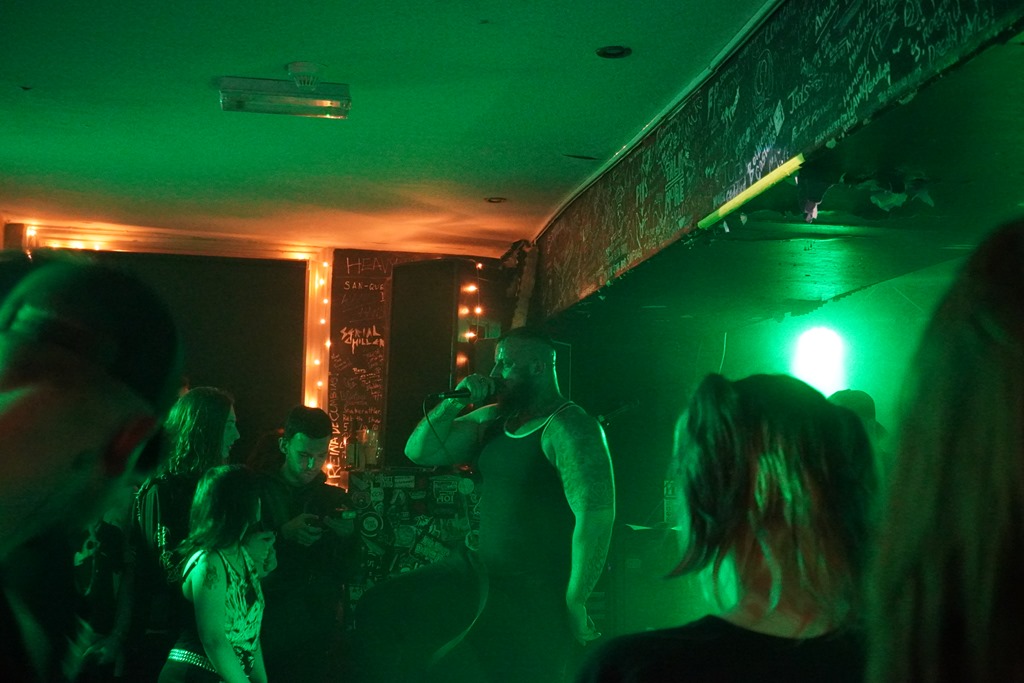
The Royal Ritual are also a duo who have an extremely ‘produced’ sound. But their approach to production owes more to the methods of Trent Reznor as pioneered in the early 90s on Broken and The Downward Spiral, balancing gritty live guitars with synths and fucked-up distortion and harnessing their tempestuousness in a way that creates a balanced yet abrasive sound. David Lawrie plays live electronic drum pads in addition to the sequenced beats, adding dynamics and live energy to proceedings, and flitting between the drum pads, synths, and mic stand, he’s incredibly busy throughout the set. But something about Lawrie’s delivery highlights everything that was absent on Neon Fields, and just carries so much more weight: the whole package brings a rush of adrenaline propelled by that emotional heft and solid force.

Objectively, the feel is very Stabbing Westward, and goes hard NIN at times in its combination of guitar, synths, and sequenced and live electronic drums. The Royal Ritual are strong on dynamics and atmosphere, and Lawrie is an intense and compelling performer.

IMG_20240724_22045120240724_22154320240724_220550

The Royal Ritual

He does break out of the moody persona to thank other bands and plug merch, but what do you do? In the current climate, bands sadly need to plug the stall. The fact that David steps out of broody tortured soul for two minutes of affable chap may seem hard to reconcile, but then, this perhaps speaks more of the human condition than remaining ‘in character’; people are complex and conflicted, multifaceted and inconsistent. And this is what truly lies as the heart of tonight’s performance by The Royal Ritual. Digging deep into the complexities of the psyche, there’s something about the duo’s performance that gouges into the flesh and demands contemplation.