Posts Tagged ‘Expansive’

Bearsuit Records – 30th April 2025

Christopher Nosnibor

It’s been a couple years since we last heard new material from Harold Nono, enigmatic purveyor of weirdy electronica, and platformed by the go-to label for weirdy folky worldy electronica, Bearsuit Records. And Faro is suitably strange, and, well, Bearsuity.

It doesn’t start out so: ‘Raukar’ is primarily sedate, piano-led, sedate, strolling, and overall, feels quite calming, despite jangles and scrapes of dissonance whispering away in the background. As the ambience trickles its way into balmy abstraction, we feel a sense of discomfort, and while the expansive ‘Sketch for Faro’ is soothing, expansive, cinematic, and feels like it could easily be an excerpt from Jurassic Park or another sweeping passage from a big-budget family-friendly movie, there are undercurrents which are subtle but nevertheless discernible which add an element of ‘otherness’ to it, particularly the abstract, almost choral vocal which rises near the end.

An EP consisting of only four tracks, Faro is a brief document, but Nono brings together many elements within this succinct work. Besides, it’s not all about length, right? Faro is sonically rich, imaginative, and ambitious in scope and scale. It feels expansive, transporting the listener over huge landscapes of trees and hills and field and planes, and you kinda feel carried away on it all in a largely pleasant way, despite the niggles of tension which creep in. And during ‘The Hour of The Wolf’ everything begins to explode and expand like some kind of galactic simulation, and suddenly, from nowhere, there are beats are blasts of distortion and everything somehow crumbles, and as silence falls, you find yourself standing, dazed, amidst rubble and ruins wondering what just happened.

While many of the elements common to Nono’s work are present here, Faro does seem like something of a development, expending in the direction of 2023’s ‘Sketch for Strings’ and moving further from the more disjointed, collagey compositional forms of earlier works. It’s less overtly jarring, less conspicuously weird, but don’t for a second think that Nono has gone normal on us – because Faro is subtle in the way it unsettles, and the last couple of minutes completely rupture the atmosphere forged gently and carefully over the rest of the EP. And this is why it’s both classic Nono and quintessential Bearsuit – because whatever your expectations, it is certain to confound them.

AA

a0171664628_10

20th March 2025

Christopher Nosnibor

And finally, following the single release of ‘The Reflecting Skin’, Mercury’s Antennae deliver their first album in seven years, in the form of Among the Black Trees, the release date set to mark the Spring Equinox. It’s a nice detail which feels pertinent. This last winter has felt particularly grim: not necessary especially cold or even seasonal by historical or conventional standards – but dark, unpleasant, and relentlessly grim – and that’s without even contemplating global events. The Spring Equinox is a specific point of celebration, even elation, perhaps, at which the long, dark nights begin to recede, buds and shoots begin to appear, leaves unfurl, and the first flowers bring colour. The renewal, rebirth, and even a bubbling sense of optimism is palpable, and reminds us that whatever atrocities mankind commit upon the planet and one another, nature has a resilience which transcends all of it.

They describe the album’s nine tracks as ‘existential tales [which] inhabit a ghostly realm of reflection, rebirth and reconciliation, overlaying dense bass, swirling ghostly guitars, and atmospheric electronics, all melding with lustrous and soaring vocal melodies’.

It begins with the glacial synth-led six-minute ‘A Sunless Winter Night’, and it conveys that through the medium of sound as the layers of vocals sweep and soar. It’s vaguely reminiscent of Ultraviolet-era All About Eve, and its slow beats are absorbing and compelling as they clip through the swirling sonic backdrop.

It’s a heavily chorused, reverbed, and otherwise processed guitar which chimes and flutters its way through ‘The Moon Viewing Garden’, a song which is truly beautiful, but also aches with a beautiful sadness, while the six-and-a-half-minute ‘Whispered Among Flowers’ presses the downtempo, atmospheric vibe, with soft washes of chiming, reverb-hazed guitar and wispy synths shaping and shading everything delicately – although it’s the thudding classic goth bass groove that really pins everything together.

As much as the early goth sound emerged from a range of sources, spanning Siouxsie and the Banshees to Bauhaus, and not forgetting The Cure, it’s fair to say that Craig Adam’s bass style and Wayne Hussey’s twelve-string picking on The Sisters of Mercy’s debut album set a definitive template. Among the Black Trees is by no means derivative, but the lineage is evident.

This brings us to the lead single, ‘The Reflecting Skin’: it’s certainly a high mark of the album, but also perfectly representative of its boldly atmospheric intent, and the way it blends the melancholy and the uplifting, perfectly articulating the complexities of emotional and mood-driven highs and lows and the swings that come with what one may describe as ‘seasonal variations’.

While the instrumental ‘PERMIAN’ provides a solid-sounding interlude, ‘As I Lay Hidden (Deer Island)’ offers something quite different, a swashing, dark, Cocteau-Twins influenced slice of dream-pop which also brings with it a folksy twist, and the result is – I’ll say it – epic. And that’s perhaps the ultimate summary of Among the Black Trees as a whole.

As much as many of the songs feel introspective, their expansive nature feel very much outward-looking, as if scanning the horizon for hope, for optimism. It’s something we need to cling to. It can’t all be bad, after all.

To suggest that Among the Black Trees offers light at the end of the tunnel would be misleading. There is no end to the tunnel right now. But Among the Black Trees is a magnificent work, one which is abrim with subtle emotional depth and sound which is truly immense – yes, epic – in scope. It’s an ambitious and expansive album, which offers so much – and delivers on all of it. For the large part, it’s a work that’s understated, but it is, in its own way, quite spectacular.

AA

Mercury_s Antennae promo shot v4

Prophecy Productions

Christopher Nosnibor

Ahead of the release if their seventh full-length album, A Pathway to the Moon, Unreqvited, the Canadian blackgaze solo-project of 鬼 (Ghost), has unveiled a new lyric visualiser for ‘Void Essence / Frozen Tears’. While it’s a timely taster for the album it’s also a reminder that singles are something of a rarity nowadays. I can’t help but feel that this is a significant loss. Perhaps not so much for acts like Unreqvited, whose singles are unlikely to garner radio play or drive the same kind of album-buying traction singles would in the 80s or 90s. The Internet has certainly changed our habits when it comes to music consumption, and while one may reasonably argue that the old industry model was a massive con on so many levels, we not longer appreciate the single as we once did. Singles were an art, and not only the kind pitched to radio play, and not only the standalone release which bridged spaces between albums and perhaps indicated a transition for an artist.

While it’s true that singles far too long for radio have been around since living memory (The Orb’s ‘Little Fluffy Clouds’ and ‘Psychonaut’ by Fields of the Nephilim spring to mind, but let’s not forget the songs radio made exceptions for, like ‘Bohemian Rhapsody’ and ‘American Pie’), it’s really only with the advent of the digital stream that ten-minute singles have become commonplace. It is, of course, much easier when terrestrial radio play isn’t on the cards, and fitting a track onto a side of vinyl isn’t something which requires consideration either.

If the demise of the single as we used to know it has one positive, it’s that artists are no longer constrained or limited by these boundaries. You want to release a single track that’s three hours long with no interruptions? No problem. No physical release and probably no audience, but no problem. Anyway. ‘Void Essence / Frozen’ is a single released as a lyric video, as seems to be popular right now. It may not be especial popular with me, but that’s neither here nor there.

According to the press release, ‘UNREQVITED explain: “The final advance track, ‘Void Essence / Frozen’ reveals the causatum of its antecedent, traversing vehemently into the undistinguished”, mastermind 鬼 comments. “Obstreperous yet endowed in euphony, it emblematizes a juncture in the greater odyssey by which it subsists. Redolent of prior opera, it is an ardent offering to the fervent disciple.”’ ‘Explain’ may be a rather generous overstatement, but it’s a bold counteractive stance against the perpetual dumbing down and overt aversion to anything which could feasibly construed as art in mainstream culture in recent years.

Clocking in at nine minutes, ‘Void Essence / Frozen Tears’ is but a brief interlude following ‘The Antimatter’. It’s also something of a contrast to its full-blooded raging guitar assault, with a graceful, chiming guitar. It takes a while for the rapid kick-drumming to hit and propel the guitar, by now soaring high, into the stratosphere.

There is so much detail, so much texture subtly woven into the fabric of this epic, epic composition, and then, around the mid-point, the vocals finally arrive. The screaming anguish is almost submerged in the mix… and then, suddenly, we’re adrift in space, airless. An ambient calm descends for a time, paving the way for the ultimate theatrical climax.

The album is now set for release on February 7, 2025.

AA

af19ac22-d776-a893-33f9-469695aca701

Regenerative Productions – 7th June 2024

Christopher Nosnibor

The last couple of years – and 2024 in particular – has seen a huge upturn in acta reconvening after lengthy breaks. Anticipation for the Autumn drop of the first album from the Jesus Lizard in over two decades is immense, but then only this week I wrote – extremely favourably – on the new album by The March Violets, released eleven years on from its predecessor, and From Fire I Save The Flame by Three Second Kiss – twelve years down the line from their last album. They all have their reasons for pausing, and for the timing being now, but as much as its perhaps coincidental, it makes for exciting times for fans who had little to no expectation of ever hearing new material. And what’s more, and perhaps most remarkable, is that these albums have been proving to be GOOD – not some damp squib, reheated soufflé reunions which sully their catalogues and make you wish they hadn’t bothered (in the way Bauhaus’ Go Away White was such a monumental let-down).

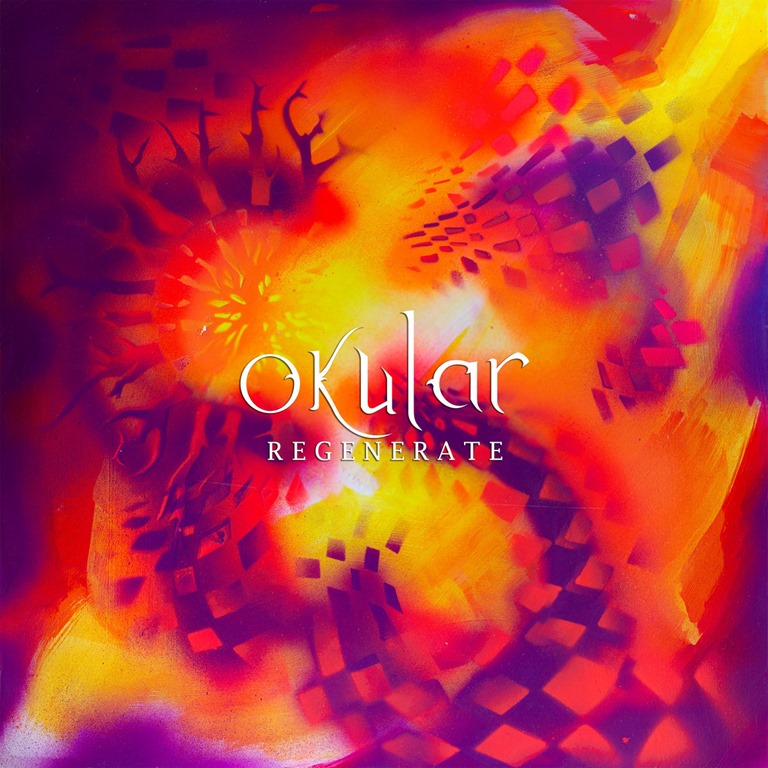
And so here we have Norwegian death-metal outfit Okular with their first full-length release in eleven years since their 2013 second album Sexforce.

I will confess to being unfamiliar with their previous work, which means I’m unqualified to comment on how the aptly-titled Regenerate stands in comparison. But I do feel able to consider Regenerate on its own merits.

Blasting in with ‘Back to Myself and Beyond’ the sound is dirty, murky, dingy as fuck, snarling, gnarled vocals spewing venom and gargled gasoline over churning guitars, from which emerge the occasional squealy note before flicking into a quickly-woven blanket or fretwork wizardry. Underneath it all, the bass and drums thump and thud away at a hundred miles an hour, muffled, muddy, and manic.

The two-and-a-half-minute title track follows this five-minute titan, and it’s a fast-and-furious fretfest, on which the vocals switch between menacing growl, strangled rasp, and raw deep-throated demonic howl.

All of the requisite tropes are in place: a hefty percussive barrage and super-fast fingerwork provide the backdrop to ugly, bowels-of-hell vocals, with some rapid drops and sudden breakdowns, and when it comes to genres, missing these elements is case for disappointment. That said, there is still scope for invention, and ‘A New Path’ brings what its title proffers, opening with a soft acoustic almost country-tinged grunge intro, before doom-laden power chords crash in, an unstoppable chuggernaut – and the two elements play off one another to forge a really interesting dynamic.

The album’s shortest track, ‘Debauchery’ surprises again, with another almost folky acoustic flavour to start, before simmering up to a boil to deliver what it promises in the shape of some spectacular soloing, preceding the album’s longest track, the six-and-a-half-minute epic what is ‘Another Dimension of Mind’. It’s a delicate, lilting, layered acoustic segment – which is really quite technical and borders on a blend of folk and neoclassical – which plays out on the album’s closer, ‘Elevate’, and it’s really quite nice. Of course, everything blasts in at double the standard intensity for the final minute, and it’s positively incendiary, a ground-scorching flame-thrower assault that hits like a tsunami before an abrupt and unexpected end.

Regenerate is a smart album. By its nature, technical prowess and musicianship is portrayed almost extravagantly, but, as is the law, it’s contrasted with the dirtiest, hardest, fastest riffs. But Regenerate offers so much more – more texture, more stylistic diversity, more range, a really ambitious approach to songwriting that goes beyond the confines of genre.

AA

a2807309953_10

29th December 2023

Christopher Nosnibor

Alright, I’ll get the moment of amusement about the fact that US stoner / prog / space rock / psychedelic indie trio We Are Space Horses have a member named Kevin Vanderhoof out of the way before getting down to business – the business of getting to grips with this expansive seven-track EP, which sees the band really explore texture and detail across its duration. I make no apologia for my flippancy, since first and foremost, I’m here to offer a detailed and serious critique, and a small amount of levity is no bad thing.

The first track, ‘To Let Go… Absolutely’ is representative, beginning with a screed of noise which backs off to leave us with a simple acoustic guitar and wafting falsetto vocal. The vibe is very much 70s prog, accentuated by some bold guitar breaks over the song’s six-and-a-half-minute duration. It’s not so much leaning on this artist or that, so much as assimilating the broader oeuvre.

Bass and drum-led ‘Haunt’ mines some blued-based seems with some gutsy Led Zep-inspired riffology delivered with some serious swagger. The contemporary production values and overall gritty heft places it alongside the likes of Rival Sons. Now, on a personal level, I’m in two minds about the latest heavy blues revival and in particular about Rival Sons, and this comes from the perspective of someone who spent their early teens almost exclusively at pub gigs watching blues acts, electric and acoustic, and seeing countless blues artists in York around 2005, not least of all because every other pub was host to live acoustic blues at that time. And I learned you can have too much of a good thing.

We Are Space Horses are unquestionably a good thing, and that’s a fact, and best of all, when they transcend beyond the blues template to wander exploratory space, as they do on the meandering but beefy ‘God is a Ghost’ they’re hugely exciting.

If ‘Ketoacidosis’ is a bit standard alt-rock and is the sound of black-shirt wearing beard-sporting clean progressive metal, it is at least well-executed: there can be absolutely no doubting these guys’ musical competence or their capacity for dynamic structures, and the songs across the album as a whole are imbued with palpable emotional sincerity. ‘Stale Skies’ thunders in with an intro that’s pure Joy Division before pairing off towards something starker, sparser, more 80s AOR, but stretching its way boldly into more contemporary prog. Clean chords strike off in different directions as the bass rolls and strolls, moves and grooves before lunging in with some chunky distortion.

The vogue for epic last tracks may have become somewhat predictable of late, but I really can’t complain. Way back in the 80s, even, the killer epic longer last song by way of a closer became, for me, the mark of an album that was special. And of course, slower: from Duran Duran’s ‘The Chauffeur’ to The Sisters of Mercy’s ‘Some Kind of Stranger’, the extended, emotion-tugging closer emerged as a thing and over time, it’s become more pronounced, although I won’t suggest more indulgent – bands have simply created space to extend beyond their limits to deliver spectacular album finishes. And this is a spectacular finish to a spectacular album.

Apologia is bold, varied, and ambitious, and finds the band taking risks. More often than not, they pull them off, too, making for an album that’s bold, confident, and exciting.

AA

AA

a0967635177_10

New Heavy Sounds – 26th January 2024

Christopher Nosnibor

It begins with a yawning, wailing drone, before thunderous bass, drums, and a rolling piano crash in tempestuously. But if you think this is just another heavy doom-leaning record with a dash of theatre, the arrival of Amber Gardner’s vocals changes everything. She brings an antagonistic, nihilistic punk vibe at first, but then, as the song transitions into a grand, sweeping expanse, reveals a softer side. And so it is that ‘White Noise’, the album’s eight-and-a-half-minute opener is a real shape-shifter, sliding back and forth between crushing weight and spellbinding atmosphere. But when it goes heavy, it’s utterly pulverising, and the sustained crescendo which occupies the last three minutes is gut-wrenching, annihilative, a rare exhibit of raw, chest-tightening emotional heft combining with the most punishingly brutal instrumentation, which leaves the listener feeling wracked, drained, ruined.

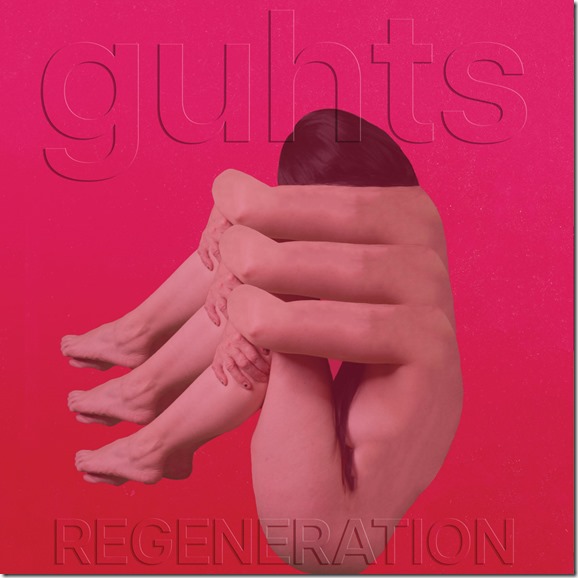
It may sound strange, but it’s often more difficult to write about albums which really hit you, which have the most impact. To scrabble for an analogy, it’s like being kicked in the chest and left lying breathless on the ground then being asked to describe the experience while still barely able to draw oxygen. It’s like… like… It leaves you stunned, numb, dazed, and at a loss. Regeneration is one such album. It’s all well and good clutching and comparisons and scratching for similes, but no words can really come close to articulating the spectrum of sensations which engulf your very being when faced with something so intense, so close to overwhelming. Yes, it’s dancing about architecture. What you want to do, more than anything, is to forcibly sit people down and say “listen to this! No, really, listen! Feel that!”

New York-based GUHTS (pronounced ‘guts’) declare themselves to be an ‘avant-garde post-metal project, delivering larger than life sounds through, deeply emotional music’. It’s the emotional aspect that hits harder than the punishing power chords, but it’s the combination of the two which really is the killer here.

The album’s seven tracks are incredibly ambitious in scope and scale, and in terms of balancing emotional depth and sheer brutal force. For the most part, the compositions extend beyond the five-minute mark, but are confined to under eight, and are effectively doom/goth epyllia – expansive, dense, cinematic. The prominence of piano – particularly notable on the slower, intensely wrought and dynamically varied ‘The Mirror’. One of those songs which sustains a surging sensation from the very beginning, it’s truly worthy of the ‘epic’ descriptor.

‘Till Death’ has hints of Cranes about it in Amber’s ethereal vocal delivery, but it’s paired with megalithic guitars of absolutely crushing weight, while the shortest song on the album, ‘Handless Maiden’ is monstrous in its unyielding heaviness. Gardner brings another surprise with her rabid howl, which is utterly petrifying.

There isn’t a weak track here, nor a single second that doesn’t feel utterly vital and doesn’t crackle with intensity, and Regeneration is an immense and powerful album. ‘Generate’ rolls into graceful shoegaze territory, with rolling drums and chiming guitars which wash and ripple mesmerically, gradually building to a sonic tsunami.

There’s something inevitable and completely perfect about the way it all leads the way to the ten-minute ‘The Wounded Healer’, which comes as a truly monumental finale. And what a finale! It begins delicately, ringing xylophone or glockenspiel chiming out mellow tones, before a grinding low-end grinds in and from here, the build is slow and inexorable. Gardner traverses the sonic space, shifting mood and tone in a flicker. The guitar twists and spins, tense and serpentine against the ever-swelling wall of booming bass and by only halfway through, you’re drowning, the air pressed form your lungs… and then… then… Christ. Gardner is possessed, and the guitars pulverise and you feel your skull beginning to compress. Finally, around the seven-minute mark, there is levity. Clawing for aa comparison, I arrive at Amenra, although it’s less than half the story of a song, and an album, which is utterly peerless and completely beyond spheres of comparison.

Regeneration is special, hard-hitting, unique. Really. Listen! Feel that!

AA
a3406377299_10

Crazysane Records – 24th Nov 2023

Christopher Nosnibor

The press release describes Zahn as a ‘German post–modern noise rock ensemble’, while their bandcamp bio offers ‘A bold escape from your daily life through technicolor transmissions of post–rock, krautrock, dark jazz, noise–rock, post–punk and electronic music. Influenced by the likes of TRANS AM, THE JESUS LIZARD, METZ, THE MELVINS and TORTOISE’, adding that ‘Adria is a compelling soundtrack to a 1980’s anti–utopian road movie!’

As a prospect, it’s head-spinning, sounding like an everything-all-at-once hybrid, and the actuality isn’t much different. There are plenty of driving grooves, largely propelled by solid bass and insistent drumming, but there are also some angular riffs and big splashes of noise.

The first track, ‘Zebra,’ boasts a bulbous bass with some big low-end and some easy, noodly synths which wibble and wander agreeably and mellifluously… and then towards the end it builds and distorts and things get altogether more twisted and less pleasant. And this is a feature characteristic of the compositions on show here. They don’t mash everything into every second simultaneously, and there’s none of that jazz / Beefheart kind of stuff that sounds like each band member is playing a different tune in a different key and time signature all at the same time. There are times where that kind of avant-gardism most definitely has its place, and works, but this isn’t what Zahn are doing here. In keeping with the road movie concept, the pieces are constructed around transition.

The ten-minute ‘Schmuck’ is a magnificent example of their ability to do mellow, with clean sounds and even a tinge of a country twang, it swings along breezily and evokes sunshine and expansive vistas. Then, near the seven-minute mark, the bass steps up to a crunching grind and things get a whole lot noisier, from where it builds into a big, driven riff which crackles with energy. ‘Yuccatan 3E’ is another colossus of a cut, running to almost nine and a half minutes and manages to take it time in pushing outwards and working a single passage for a fair while, but equally packs in at least three or four songs’ worth of ideas.

The changes feel organic, and sometimes emerge gradually, and at others there will be a sudden and unexpected swerve, and there’s so much happening that the absence of vocals barely registers.

Because the mood, tone, and tempo differs so radically between songs – and between sections – Adria very much does feel like a journey, through space and time. ‘Apricot’ is a sparse synth work with crispy vintage drum machine snare cutting through quavering analogue synth sounds – then, without changing the instrumentation or the simple repetitive motif, it goes massive. A post-rock Depeche Mode chronically undersells it, but it’s as close as I can get, at least off the top of my head. The final minute is an extravagant climax, and truly magnificent.

The majority of the album’s eleven tracks run past five minutes, with the majority sitting more around the seven-minute mark, but the eleven-and-a-half-minute ‘Faser’ is the album’s megalithic centrepiece. It blasts hard with a fuzzy, scuzzy repetitive riff cycle with stoner rock tendencies, and it’s dynamic and exhilarating. Dropping down to bubbling synths in the breakdown around six minutes in, the threat of a re-emergence of the heavy lingers suspensefully. When it does land, it does so with a vengeance, before transitioning once more into something altogether different again, skittering its way into Krautrock territory.

The power blast of ‘Tabak’ hits square between the eyes and feels unexpected however expected it actually is. These guys are absolute masters of the unpredictable and varied structure, and conjure some highly evocative and atmospheric passages, and while the playing is technical, it’s not technical for its own sake: there’s nothing showy or extravagant, and the focus is very much on the compositions, the structures, and the impact. ‘Amaranth’ piledrives a full-on doom riff, slogging away at it for what feel like an eternity. It’s a heavy trudge, and really hits the spot – again, when you least expect it.

Adria straddles many, many genres, and does so in a way that’s incredibly imaginative. The key to its success is its execution, which balances precision with passion.

AA

a0822649105_10

Testimony Records – 8th September 2023

Christopher Nosnibor

‘We are living in troubled times and it is hardly surprising that this is reflected in any form of art including music. On Mazzaroth, Sodomisery have spun a dark lyrical yarn about mental illness in society, religion, and the struggle of the individual, which is running like a red thread through their sophomore full-length. The Swedish melodic death four-piece are underlining their loosely conceptual approach with a remarkable musical evolution’, says the bio which accompanies this album.

There’s no misery like Sodomisery. At least, that’s what I’ve heard. For reasons I haven’t explored, while society has progressed – and I do mean this broadly and generally, being most aware of the fact that homosexuality and many things more widely accepted remain not only illegal but subject to severe punishments in a large number of countries – the word ‘sodomy’ carries brutal connotations which continue to hold currency in the circles of the

blackest of metal and industrial and power electronics. It’s true that Whitehouse’s Erector (with its blatantly unsubtle ‘cock’ cover) was released in 1981 and things have moved on a bit since then, but how much? Many of these bands are, as far as I can discern, less concerned with contemporary perceptions of anal penetration, whereby in permissive western society, it’s generally accepted regardless of sex or sexuality, and in pornography, it’s more or less considered essential, and more preoccupied with the harsh, perverse connotations of the writings of The Marquis de Sade – one of the few writers whose work still has the capacity to truly shock. And in this context, sodomy connotes the worst of sexual tortures, the infliction of pain, a statement of the ultimate power dynamics. It all seems appropriate given the band’s objectives.

This album had an interesting evolution, too: ‘When all the new tracks were written and pre-produced, SODOMISERY decided to create two versions of the album. One mix included keyboards and orchestration, while the other version had no such additions. After an extensive period of deliberation and many listening sessions, the Swedes decided that the new dimension and cinematic feeling added by the keyboards was exactly what their songs needed.’

Without hearing the two versions side by side, I’m in no position to comment, but the fact of the matter is that the keyboards certainly have not transformed this into some twiddly prog-rock effort: instead said keyboards are low in the mix but serve to fill out the sound with elongated droning tones against the relentless, thunderous fury of frantic fretwork and double-pedal drumwork that’s faster than the eye or ear can process.

There are some moments of such tunefulness that one has to take pause and breathe for a moment. We’re not just talking clean vocals or tuneful; there are moments, albeit brief, of outright pop sandwiched between the furious rage and overloading distortion. But rather than diminish the album’s power, I find myself respecting the band all the more. To have a softer breakdown in a song is one thing: to be so unashamedly clean and crisp and tuneful is bold.

‘Delusion’ balances all of the various elements nicely, coming together to forge a blasting yet grand and graceful dirty monster of a track which even packs in a heroic guitar solo near the end. Juvenile snickering ensues here with ‘A Storm Without Wind’, and I know it’s not funny and the delivery is entirely serious. Not least of all the lung-ripping bass that prefaces the throat-ripping vocals which snarl over guitars which alternate between old samples and snippets stolen from the present.

It feels scary, like being left alone on a platform and staring into the abyss. Any minute and it could retreat, and leave you falling into the void, and on the evidence here, you’d incinerate in seconds. Ultimately, we’re all scared. Mazzaroth is a worthy soundtrack to that fear.

AA

406169