Posts Tagged ‘electronic’

22nd November 2025

Christopher Nosnibor

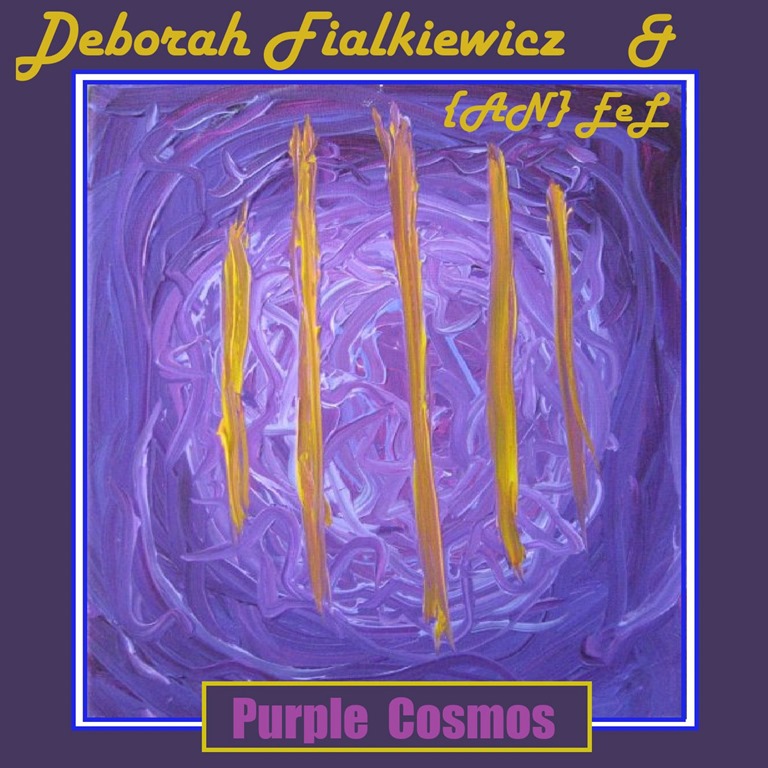
The second collaborative release of the year by Deborah Fialkiewicz & {AN} EeL (aka Neal D. Redke) lands amidst a blizzard of output from two musicians who are both insanely prolific – by which I mean prolific on a scale which isn’t far off Merzbow or Kenji Siratori: they each release more frequently than the average person has time to listen to it. I don’t in any way consider myself to be an average person – and we’ll not go there – but writing about music means that having something play in the background while I do other stuff, like changing the cat litter or whatever, isn’t always something I fancy, and certainly isn’t my way of hearing a release for the first time. Ok, so this is not how, say, my daughter, who’s fourteen, or her generation, or even some of my peers take in new music, but my formative experience of new music involved sitting down and setting a new album to spin and giving to my undivided attention for its entire duration. Sometimes twice in succession, or more on a weekend.

Attention, in 2025, is, it would seem, in short supply. And yet, flying in the face of this, albums with long tracks seem to be becoming increasingly more common. Perhaps it’s a sign of artistic rebellion. Perhaps it’s that artists feel a need to reclaim the focus and concentration associated with longer works. Whatever the reason, it’s welcome, and Purple Cosmos contains three compositions spanning a solid half an hour.

This is a thoughtful, delicate trilogy of compositions, which build from hush to tumultuous tempests of sound incorporating powerful space rock and progressive elements within their protracted ambient forms.

‘The Floating Monk’ is centred primarily around a thick, earthy drone that has the texture of soil, and it’s enmeshed with dark layers of serrated tones and thunderous rumblings. It’s dark and it’s dense, and it’s uncomfortable. The rest of the album doesn’t offer much by way of light relief.

Yes, the title track strays more toward bleepy electronic experimentalism –a different kind of space rock, if you will – and the final track combines wailing synth overload with some persistent beats… but first and foremost this is an unashamedly experimental work.

Purple Cosmos is a work which reflects a rare attention to detail, and it possesses a certain persuasive relentless in its marrying of dark noise, analogue undulations, and insistent beats. There’s more than a hint of Throbbing Gristle about it, and perhaps a dash of Factory Floor. It gets inside your head, and at the same time enwraps your entire being with its otherworldliness. It sure is a far-out groove.

AA

a2147012585_10

Christopher Nosnibor

Benefits exploded onto the scene not long after lockdown – and I mean exploded, an atomic detonation of rage. The essence of the setup was pretty simple: angry sociopolitical spoken word delivered with blistering vitriol, backed by a blinding wall of noise. The result could reasonably be described as something in between Whitehouse and Sleaford Mods, but the fact is that from day one, Benefits created their own niche. The live shows were jaw-dropping, and the debut album, Nails captured that raw energy with a rare precision.

The arrival of second album, Constant Noise marked a necessary departure – sonically mellower, far more beat-orientated, a lot less shouty, angry-sounding. My first impression was that it was decent, more produced, but still packed some sting in the lyrics., and will be hard to top in terms of the number of mentions of dogshit in albums of the 2020s. But it’s a fair reflection of post-lockdown Britain: dogs have proliferated exponentially, and concordantly so has the volume of dogshit – and, just as bad, bags of dogshit tied and dropped, piled next to or on top of bins, and hung in trees. What kind of twat does that? A selfish one is the only answer. But as for the album, I kinda let it sit for a while. But over time, with more – and more – listens, the album’s depths reveal themselves. Constant Noise is every bit as angry as Nails, and if anything, the more moderate, tempered delivery hits harder. It just takes a little bit longer to reveal its depths and quality. But how would this translate live, especially now they’ve been stripped back to the founding duo of Kingsley Hall and Robbie Major?

DSC05075

Benefits

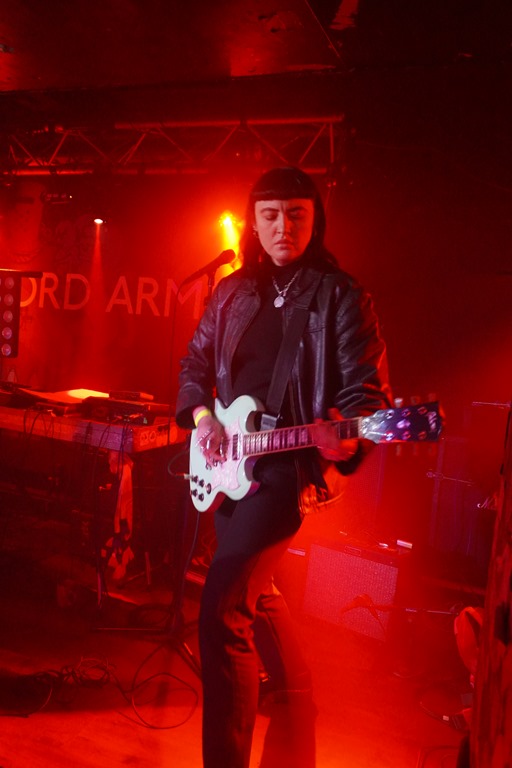
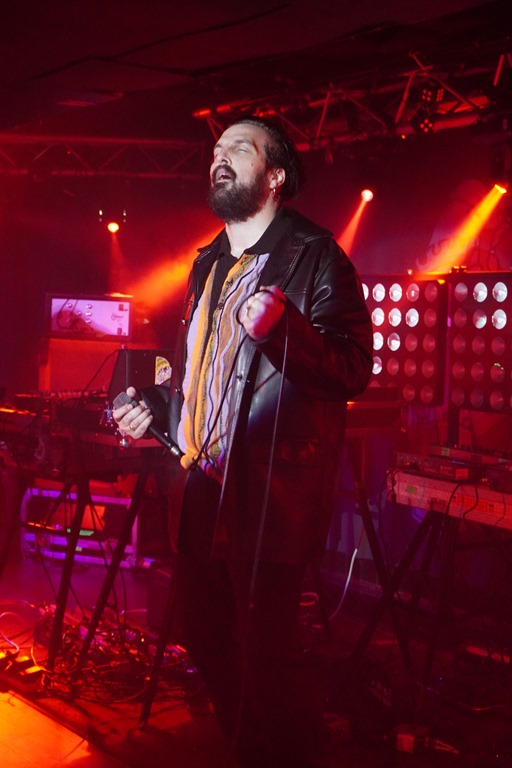
Before we would get to find out, there was the equally intriguing support. The Eighties Matchbox B-Line Disaster are one of those acts who may have only attained cult status during their time together, but it’s one which has expanded since their demise. They were always a band destined to implode, as was apparent when I witnessed a particularly fractious gig here in York circa 2007. But this was always a band which had derangement and volatility wired into their makeup. Guy McKnight formed DSM IV in 2018, and they’re an altogether different proposition, trading in gothy electro with some tidy guitar textures woven into the fabric of the songs, and Guy seems altogether more settled. It’s all relative, of course, and he ventures into the crowd on numerous occasions, and at one point around the middle of the set, tosses mic stand over, drops the mic and busts some tai chi moves. It’s a solid set, both compelling and entertaining, and they’ve got some tunes, too.

DSC04943DSC04962DSC05008

The DSM IV

Benefits don’t really have a great many tunes in the conventional sense. Choruses and hooks aren’t the primary focus of their compositions. Hall’s words range from reflective and ponderous to outright roaring rage, the backing spanning sprawling barrages of obliterative noise to quite chilled dance grooves. But at this volume, and when delivered with this much passion, there’s nothing chilled about this live show.

Here, I find myself returning to the topic of seeing an act you’ve seen before and been blown away by, and going to see them again in the hope of replicating that first time – only it’s a weak hope, because the first time has the element of surprise which is unlikely to be repeated. Yes, a band may be consistently awesome, but that first bombshell experience, that initial high… very few bands have the capacity to have that impact more than once. Benefits, however, hit even harder on this outing than any before.

DSC05025DSC05084

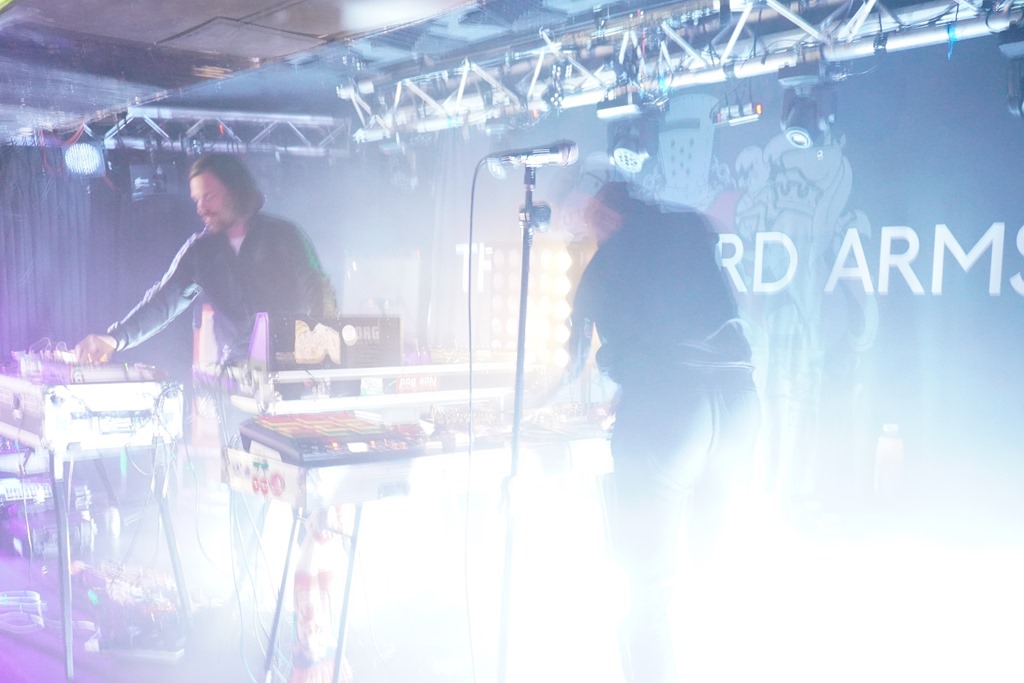
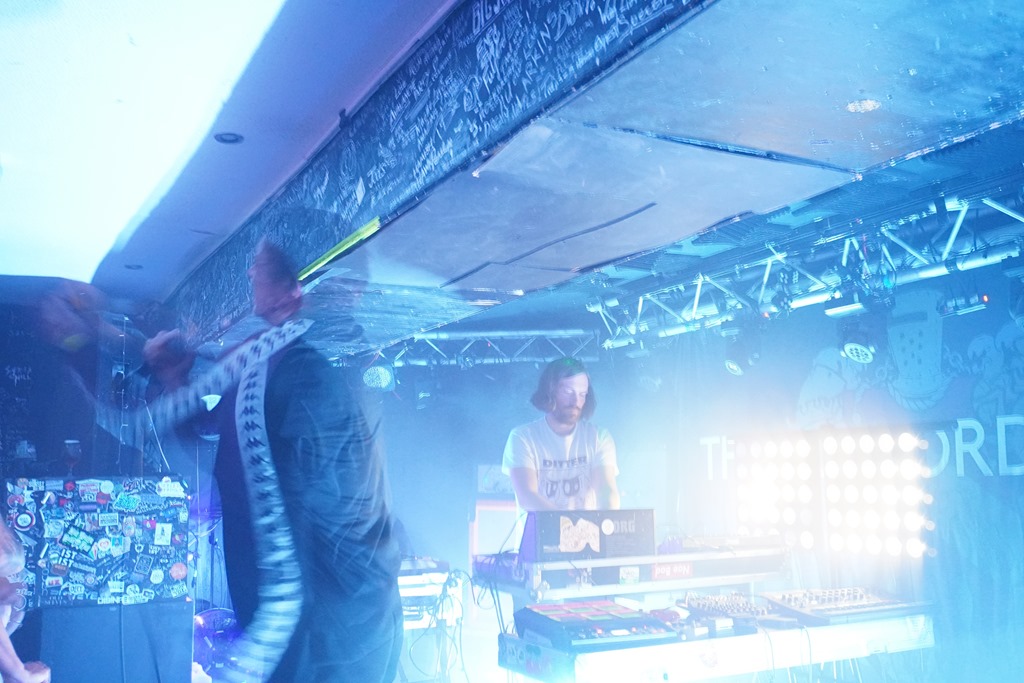
Benefits

There was word online that their current tour was as brutal as any they’d ever done. Having seen them three times previously, and never with the same lineup, it seemed like that claim might be a bit of a stretch, particularly without a live drummer. But synthetic beats have a way of bludgeoning and cracking in a way that live drums don’t always, and when paired with gut-churning low-frequencies and ear-bleeding top-end noise, the sonic impact of what blasts from the PA is positively immolating.

DSC05085

Benefits

Kingsley gets most of the chat out of the way at the start, with a bit at the end: in between, they power through a relentless set uninterrupted. And relentless it is, and not just sonically: with the sole lighting consisting of blinding white strobes for the entire duration of the hour-and-twenty-minute set, the stark, uncompromising nature of the music and lyrics is amplified. They put every ounce of energy into the show, Hall positively streaming with perspiration by a third of the way through. And we feel the passion; the whole room is buzzing and aglow with a sense of unity through a shared experience of catharsis. These are shit times. Dark times, bleak and scary times, domestically and globally. Benefits capture the zeitgeist, and rail against those who will one day be proven to have stood on the wrong side of history – the right-wing, flag-shagging, pro-Brexit, racist, xenophobic, hatemongering, exploitative, manipulative capitalist shits and their supporters and enablers – articulating thoughts and feelings with a unique precision and an intensity which is positively nuclear. The experience is nothing short of mind-blowing.

New Heavy Sounds – 7th November 2025

Christopher Nosnibor

Cold in Berlin have come a long way over the course of fifteen years and now – after a six-year wait – five albums. Give Me Walls was sharp, defined by an angular post-punk sound which crackled with nihilistic fury. You wouldn’t exactly say they’ve mellowed over time, but they’ve become heavier, darker, and have evolved the ways in which they articulate themselves, musically, and lyrically.

January 2024 saw the release of the EP The Body is the Wound, which introduced the thematics of a new and significant project, and indicated where they were heading, and came with references to an album to follow later in the year. The year came and went, and here we are, at the dark end of 2025. But as lead single ‘Hangman’s Daughter’ and follow-up ‘The Stranger’ foreshadowed, Wounds was worth the wait. Perfection takes time, and that’s what Cold in Berlin have delivered here.

But more than that, this is an album which wrestles with difficult stuff. As the band explain, “Wounds is a series of songs about the different ways people live with and process ‘the wounds’ of their lives… A strange celebration of that formative pain we have all experienced in some way. The loss and joy of survival – the celebration of finding others like us, the gift of knowing life comes after fire.” For all the noise of how we need to talk more about mental health, the fact of the matter is that it’s really just that. There is still real stigmatisation surrounding the subject in real terms, with reactions to attempts at open dialogue tending to range from diminishment, to dismissal, to awkwardness and paralysis before moving on with an embarrassed cough. And yes, I’ve learned this from painful experience. Raise the subject of mental health, anxiety, and dealing with bereavement while adjusting to life as a single parent with a teenage daughter… it’s amazing how many people go quiet, how many friends seemingly vaporize. The simple fact is that the majority of people are afraid to touch on dark topics, to venture to dark places. They can’t handle it, and so… these are my personal wounds, and why this album reaches parts other albums don’t get close to.

It’s ‘Hangman’s Daughter’ that raises the curtain on the dark drama which will infold over the course of nine songs. The big riffery that’s become their signature – and nowhere more apparent on predecessor, 2019’s Rituals of Surrender – is very much present, but there’s a lot happening here, in terms of detail and dynamics and arrangement, with pulsating electronics which owe considerably more to Krautrock than glacial gothy / post punk traditions prominent in the mix, and some thunderous drumming (which does belong more to the post-punk lineage) and some spindly lead guitar work that’s classic trad goth – and at the same time, the song’s imagery leans more toward folk-horror. It’s a potent mix which sets the tone – and standard – for a phenomenally powerful album.

Piling straight in hard and rather faster, ’12 Crosses’ is another showcase of stylistic eclecticism: the tense, cyclical guitar straddles post-punk and noise rock, and creates a claustrophobic, airless atmosphere – then, seemingly from nowhere, there’s brass, which, in context, introduces something of a post-rock feel, which is a sharp contrast with the spiky, Siouxsie-like stylings of the song’s second half. It’s fierce, but there’s more than straight attack.

A mere two songs and ten minutes in, and I find myself reeling by just how much they’ve packed in, in terms of range and depth, and the attention to detail is superlative.

‘Messiah Crawling’ provides… not respite as such, but some headspace to be carried along by a thick, doomy, Sabbathesque riff. ‘They Reign’ marks a change of pace, bringing down the tempo and volume, leading by a more narrative lyrical form. After a slow-build, rolling drums and swathes of synth conjure a cinematic sonic expanse which is transportative. It makes you feel, on a spiritual, perhaps even primal level. Landing mid-album, ‘The Stranger’ is rather sparser and it’s the synths which take the lead on this shimmering prog-pop cut, which grows and twists as it progresses towards a surging climax. Final song, ‘Wicked Wounds’ is nagging, and somehow antagonistic and more overtly punk in its delivery

Throughout, Maya’s vocals are powerful, commanding, but equally, rich and emotive. Not only has she never sounded better, but never more suited to the music her vocals are paired with, running the gamut of emotions from anguish and torment to reflective and vulnerable.

With Wounds, Cold in Berlin have stepped up to another level – and in every aspect. It didn’t seem possible they could keep getting better… but here, they’ve surpassed expectations, and once again exploded beyond the walls of genre to deliver an album which is something else.

AA

Wounds_Cover_3000x3000

As we approach winter and the solstice draws closer, Texas-based electronic composer Paris Music Corp. a.k.a. John Andrew Paris presents two new tracks – ‘Midnight Pad’ and ‘Sun Halos’ – that juxtapose light with dark, similar to how night turns to day and to night once again.

Nature and cycles are themes explored on his new Ecotone album as he takes us on an electronic odyssey that is both deeply personal and geographically-inspired. This record is rooted in the artist’s relocation to his childhood home in Brownsville, South Texas, just miles from the border and the coast. Paris wrote, recorded, mixed and mastered this at Tarantula Studios over the past two years.

“’Midnight Pad’ was another late-night writing excursion using some mind expansion influence. Another piece that started with my phone and ended up with hardware synths and drum machines in the studio one it was built. And ‘Sun Halos’? Creating a song just happens sometimes. Brian Eno always talked about his main theory in that “music just happens”. It’s really like a magic trick sometimes when what you turn out is an earworm of a piece that is memorable,” says John Andrew Paris.

Originally from Austin, John Andrew Paris has spent decades creating music and collaborating with artists, including Arthur Brown (The Crazy World of Arthur Brown, perhaps best known for his hit single ‘Fire’), as well as DJ Rev Kathy Russell, DJ Lucas Ray, Catastrophe Ballet, Le Reve, Life’s Eyes, Beast of Eden, OBOYO and Don Wigwam.

AA

AA

“The Ecotone album made sense to me because you have a transitional zone, where two different ecological communities or ecosystems meet and intermingle, often resulting in high biodiversity. I feel a lot closer to nature.. Some of my song titles reflect where I am. I actually lived in this area as a child and have come back to my roots,” says John Andrew Paris.

“A lot of these pieces were started on a phone app called Ableton Note. With this application you are able to scratch-pad a lot of cool ideas and then import them into you music workstation and finish them out. When I first moved to my new place I didn’t have a spacious studio setup and I wrote a lot just sitting up all hours of the night writing ideas on Ableton Note.”

Known for his cinematic and ethereal music, on this album, Paris Music Corp.’s music also shows its dark underbelly and futuristic imagination. Often with elements of 80’s darkwave and ambient soundscapes, his trademark sound includes heavily processed guitar and bass instruments locked into layered loops and further manipulated using software. Also employing live hand percussion, these dense soundscapes take the listener on a sonic journey to otherworldly places.

AA

Paris Music

UK electronic outfit Scissorgun announce their album Scream If You Wanna Go Faster, out November 21 via Dimple Discs. Mixing urban electronica with fuzz and wah guitar, these trailblazers present a solid collection of songs, dances and abstract soundscapes. A must-have for Factory Records collectors, the vinyl includes seven tracks, while the digital and CD versions include three bonus tracks. Ahead of its release, they present the tracks ‘Gone Rogue’ and ‘Bad As Bingo’.

Formed in Manchester in August 2016, Scissorgun is an electronic trio comprised of Dave Clarkson (synths, rhythms, tapes, percussion), Alan Hempsall (vocals, treated guitar, samples, loops) and Adrian Ball (light show and projections). Carriers of Factory Records’ legacy.

“We always operate on instinct and improvisation is the key starting point. Some ideas become structured songs, but others remain as first recorded, with the music finding us and not vice versa. The title is a soft attempt at social comment, intended to be inferred rather than overt,” says Dave Clarkson.

Their musical scope is varied – pastoral dreams one minute and, the next, crashing swathes of noise chased down with a dub twist.

“The idea for ’Gone Rogue’ started with a busy electro bass line and, as soon as we found a good quote from a conspiracy theorist on social media, the whole thing seemed to turn into a polemic against turning your back on humanity in revulsion. We dwell on the impact of the fight for our attention on the individual and the damage done. All the while, the driving beat is pushing us on with heavy cowbells and pulsing bass. We’ll all feel better if we dance,” says Dave Clarkson.

Alan Hempsall adds, “As for ‘Bad as Bingo’, we were both overjoyed when this came out of the mincing machine. We’d been looking for something with a go-go beat to it, so this was perfect. The words flowed automatically as the best ones always do. Broad brush observations of a situation gone bad coupled with a mawkish sentimentality for what’s lost. The glitching and grinding bass line and barking dogs take on a life of their own. Suddenly it all makes sense and the initial spark revolts into structure and form.”

Alan and Dave first met in 2007 when Dave’s band, Triclops, were supporting Biting Tongues at Islington Mill in Salford. Alan was in the audience and was so taken with Triclops’s performance that he wandered over to show appreciation and a friendship was struck up, bonding over a mutual weakness for early industrial, rock and modern jazz. After nine years of gig-hopping and hanging out, the timing was suddenly right for them to organise some jam sessions to see what came out.

It so happens that both of their bands were on hiatus at the time. While Dave Clarkson was in Triclops from 2000 to 2015, he was in White Cube prior to that. He since boasts an extensive catalogue of solo works.

As for Alan Hempsall, he was the vocalist for Crispy Ambulance, who was on Factory Records from 1980 to 1982, before spending five years in the mid ‘80’s playing percussion in a Brazilian Samba band. Hempsall also famously appeared on stage with Joy Division in April 1980, standing in for Ian Curtis at a show in Bury that descended into a riot.

“As with any album, we operate on instinct. Improvisation is the key starting point. At this moment, anything can and generally does come out. The bizarre accidents and serendipity that occur during this process are the parts we keep. Those moments that feel like you’re merely the vessel that the music is transmitted through,” says Alan Hempsell.

Dave Clarkson adds, “Some ideas gradually emerge into structured songs whilst others have the fortitude to remain in their original form to some extent or another. Yet no conscious decision is made. We are not in control. It is the music that finds the musicians. As the body of work is growing and developing, it seems to take on its own identity, something else we appear to have little influence on. So, there is an element of Praxis at work here, we’ll do it because we want to and think up the reasons why later.”

AA

Scissorgun

Christopher Nosnibor

Bite the Boxer is unquestionably an unusual and intriguing name for a musical project: my mind immediately leaps to the infamous ‘bite fight’ between Mike Tyson and Evander Holyfield in 1997, where Tyson lost through disqualification after biting off a chunk of Holyfield’s ear in one of sport’s most shocking moments.

In combining an eclectic range of elements spanning industrial, alt-pop, trip-hop, and ambient lo-fi, there’s nothing about Matt Park’s music which indicates any connection to this moment in sporting history. The same is true of his objective to create music imbued with ‘he feeling of impending doom but with just a glimmer of hope’, which is inspired by ‘horror video games and dystopian, post-apocalyptic films’.

‘Venom Test’ is haunting – at first ambient, before bursting with an expansive, cinematic feel, then plunging into darker territory. Even without the aid of a beautifully-shot and remarkably stylish video, the rack leads the listener through an evocative sequence of sonic transitions. Although never harsh, the distant drums are weighty, powerful, and the overall experience feels like a juxtaposition of must and decay with rays of shining hope breaking through cloud. The listener feels as if they’re being pulled in opposite directions, the suspenseful end offering no conclusion, but instead, leaving a sense of emotional quandary, an uncertainty. ‘Venom Test’ creates a tension, and provides no closure or conclusion, only a sense of a door being left ajar. It’s a deftly woven piece, and one which feels very much like it belongs to a much larger project – which it does, being a taster (which doesn’t remotely have the flavour of bloodied ear, to the best of my knowledge) for the forthcoming album, Haunted Remains Pt.2. As a choice of single, it’s a good one, leaving us in suspense to hear it in the context it was intended.

AA

AA

92e42d4c-6d54-911b-d615-4a752d4ebad6

House of Halifax – 3rd October 2025

Christopher Nosnibor

Content’s career to date – such as it is – has certainly not followed a conventional trajectory, or even one designed to gain a following. It’s not the shifting lineups (that’s hardly unusual) but the fact the direction of their output is completely unpredictable. Their debut EP, We Keep Improving, released five years ago, was a riotous DIY racket, which I described as ‘a gnarly mess of electronics, popping beats and a disorientating sonic swirl’. Released in an edition of seventeen physical copies, it has all the ingredients required to become a near-mythical underground work.

So of course, with a different lineup, they followed this with an album which recreated the entirety of Yes Please! by Happy Mondays – an album which was roundly pilloried, and saw one of the weekly music papers review lead with the headline ‘No Thanks!’. It was the Mondays’ Shark Sandwich moment.

Amazingly, their second album is another cover of an album in its entirely, this time the 2018 Geezer by Leeds grindcore legends Ona Snop, who recently called it a day. I can’t think of anything further removed from, the slack, bloated funk of Yes Please! But this is Content, the vehicle of Benbow and – currently – Richard Knight. And this is absolutely guaranteed not to bring them world domination, or even more than a handful of fans. I don’t think they’re fussed about that, though.

Given that Ona Snop’s approach to powerviolence / grind was never entirely straightforward, or serious, Content’s irreverent approach to ‘reimagining’ the album, which blends industrial, techno, ambient, electropop, ‘retains some of the humour included in Ona Snop’s original work’, they say. Indeed it does. It certainly doesn’t contain much else, although that shouldn’t be construed as a criticism. The ‘reimagined’ tag gives them licence to pretty much do whatever the hell they please, and that’s precisely what they do.

And so it is that the first track, ‘In Pieces’, is transformed from forty-nine seconds of thrashing, splashing aural vomit, into a three-and-a-half-minute technoindustrial workout with a funk groove, coming on with the strut and snarl of Revolting Cocks circa Linger Fickin’ Good. It’s grimy and sleazy and fuck – and it’s as ace as it is audacious. It sets the tone for a wild ride: ‘Total Both’ brings bump and grind and flamboyance in spades, like Rammstein covering The Rocky Horror Show – or perhaps the other way around. Either way, it’s camp and crazy.

It’s all going on here: ‘More Important Than Christ’ starts out with wibbly 80s wizardry before going hyper electropop, landing somewhere between The Associates and The Teardrop Explodes in the process. There’s wonky electronica, spoken word, bleeps and horns… ‘Mustard Farm’ seemingly draws from Depeche Mode, Devo, and Man 2 Man in equal measure, while ‘Respect’ goes lounge, and there’s a hint of early Foetus in the warped disco blast of ‘Rotisserie Geezer’, before ‘Cement Head’ goes a bit Tom Waits.

How all this actually works, it’s hard to pinpoint. That each track is well executed – in that it’s apparent what they’re aiming for, and they achieve – helps, but the hectic, drum machine-propelled arrangements are dizzying, and so far removed from the source material at times it feels beyond tenuous. While the original ‘CD / DVD’ opens with a sample, Content rework it as a cut-up collage of glitched-up, mangled samples, harking back to the old-school Industrial roots demonstrated on the EP, with a debt to Throbbing Gristle and Cabaret Voltaire, and in turn, William Burrroughs. ‘Ona Snop F.C.’ is a super-slick autotuned workout that’s equal parts Prince, Har Mar Superstar, and overprocessed R’n’B. Horrible as it is, the knowing levels of cringiness are something to respect. Then, seemingly from nowhere, ‘Hot Soup’ goes all Mike Oldfield and ambient.

While the original album has a running time of less than twenty-five minutes, pulling the songs out and stretching things apart in every direction means that this reimagining runs for closer to an hour, and it never ceases to confound with its weirdness, or its willingness to embrace the cheesy. It’s almost impossible to judge Geezer Reimagined by conventional benchmarks or assess its merits by the standards one would ordinarily apply, because it simply doesn’t conform, and exists in its own sphere of strangeness. And whether or not you dig it – and I do – it’s impossible to deny that it’s imaginative in its interpretations.

AA

Content - Geezer Reimagined (House Of Halifax, 2025) (Front Cover)

Dependent Records – 3rd October 2025

Christopher Nosnibor

I’ve always favoured words over numbers – meaning, maths was never my strong point, and my qualifications strongly favour the arts. But it doesn’t take a maths genius to deduce that there are some serious numerical gymnastics taking place when conjuring the equation for this release. That Octagram extends the love of the number 8 which is clear from the band’s name to a concept, whereby the album features 8 songs with a playing-time of 8 minutes is logical, but when they try to spin it that ‘when the 8 just turns by a little in the context of the German electro industrial project’s sixth album, it becomes the symbol for infinity’, I’m lost. How does infinity fit in, and how does it all sit with being their sixth album, something which really screws up the whole thematic.

The tracks aren’t all exactly eight minutes in duration, but in the eight-minute span, ranging from 8:11 to 8:58, so it doesn’t feel as if the limitations / constraints of the project are so rigid as to inhibit the creative freedom necessary to explore and interrogate the themes flexibly.

We’ve already aired single cuts ‘New Eden’ and ‘Oathbreaker’ here at Aural Aggravation, and it’s fair to say they’re representative of this expansive, ambitious effort. It’s electronic industrial, with expansive, ambient trance elements woven in, as well as sampled snippets of dialogue. It’s perhaps worth noting that the vocal samples consist mainly of recitations quoting the last words of persons that were about to receive the death sentence. It’s all there on the sweeping, cinematic, dark electronic dance opener, ‘The Unborn’. In terms of texture and production, it’s absolutely meticulous, but a bit predictable and of a form. Three minutes or so in, the tone and tempo changes, the atmosphere darkens and the beats get harder, and the gritty, distorted vocals finally arrive and while it’s still quintessential technoindustrial / dark electro, the switch makes the song work in terms of structure and dynamics. And this seems to the strength to which FÏX8:SËD8 play to on Octagram, blending the trancey ambient dance elements with the driving hard-edged aspects of the genre.

Skinny Puppy are an obvious touchstone, to which they themselves draw attention, they seem to have assimilated the entirety of the Wax Trax! catalogue, while pulling from all aspects of cybergoth, and even Tubular Bells to forge a hypnotic hybrid of techno, electronica, dance, and industrial, taking a number of cues from Ministry’s Twitch. It’s true that I often return to the same sources: Wax Trax!, KMFDM, Skinny Puppy, 80s Ministry… but I feel I should stress that this isn’t entirely a reflection of my limited sphere of reference, but the two inches of ivory on which so much of the electronic industrial scene carves its tales of angst. The use of samples does feel rather cliché, the way the beats build behind fuzzy synths which ebb and slow, the minor-key one-finger synth riffs… And that’s fine: you know what you’re going to get. But at least with Octagram, FÏX8:SËD8 push that envelope a bit.

If ‘New Eden’ represents the more accessible side of all this, ‘Blisters’ goes in hard. ‘Tyrants’, too, brings a heavy Industrial throb with a dominant percussion, led by a powerful bin-lid smash of a snare sound. With the distorted vocals low in the mix, it’s tense, it’s intense, it’s claustrophobic. Taking its title from one of my favourite phrases from Milton, ‘Darkness Visible’ brings an interlude of cinematic serenity, at least initially, before locking into another dark pulsing groove. The darkness has rarely been more visible.

‘An Unquiet Mind’ makes for a slow-simmering, brooding finale, cinematic, atmospheric, expansive, as synth layers and beats build, rising from a montage of samples to stretch out an almost post-apocalyptic landscape. It feels like the end… and it is.

The best electronic industrial has an intensely inward focus, and makes you feel tense, restricted, somehow, and as much as it draws on obvious influences, with its taut, claustrophobic feel and dense production, Octagram sits – shuffling, twitching, crackling with anxiety – with the best electronic industrial.

AA

a1712199305_10

Cruel Nature Records – 12th September 2025

Christopher Nosnibor

Postmodernism, emerging primarily as a product of post-war America was defined by hybridity, the demolition of parameters and distinctions between different cultures, genres, and was, in many respects, tied to the accelerating pace of technological development, in particular the globalisation of communications and beyond. But postmodernism also not only recognised, but celebrated, the fact that originality has finite scope, and that anything ‘new’ will by necessity involve the reconfiguration of that which has gone before. Shakespeare had all the ground to break in terms of the advent of modern literature, and one might say the same of Elvis and The Beatles with the advent of rock ‘n’ roll and pop respectively. The reason the 80s were such a watershed was because technology revolutionised the potentials for music-making, and while this saw a huge refraction in terms of creative directions, from industrial to electropop, one could reasonably argue that the next leap in music after 1985 came with house and techno.

Post-millennium, it feels like there is no dominant culture, no defining movement, underground or overground: the mainstream is dominated by a handful of proficient but in many ways unremarkable pop acts, and notably, it’s largely solo artists rather than bands, and while there are bands who pack out stadiums, they tend to be of the heritage variety. At the other end of the spectrum, the underground is fragmented to the point of particles. There are some pros about this, in that there is most certainly something for everyone, but the major con is that unlike, say, in the mid- to late-noughties, when post-rock was all the rage, there’s no sense of zeitgeist or unity, and right now, that’s something we could really do with.

Fat Concubine are most certainly not representative of any kind of zeitgeist movement. With a name that’s not entirely PC, the London acts describe themselves as purveyors of ‘unhinged dance music’, and Empire is their debut EP, following a brace of singles. The second of those singles, ‘for Whom the Fools toll’ (with its irregular capitalisation, which is a bit jarring), is featured here, along with four previously unreleased tracks. This is a positive in my view: so many bands release four, five, or six tracks as singles, and then put them together as an EP release, which feels somewhat redundant, apart from when there’s a physical release.

And so it is, in the spirit of wild hybridisation, that they’re not kidding when they say their thing is ‘unhinged dance music’, or as quoted elsewhere, ‘unhinged no wave ravers’. ‘Feeding off the dogs’ pounds in melding angular post-punk in the vein of Alien Sex Fiend with thumping hardcore techno beats, and it’s not pretty – although it is pretty intense. The snare drum in their first thirty seconds of ‘for Whom the Fools toll’ takes the top of your head off, and the rest of the ‘tune’… well, tune is a stretch. It’s brash, sneering punk, but with hyperactive drum machines tripping over one another and a stack of synthesized horns blaring Eastern-influenced motifs.

There are hints of late 80s Ministry about ‘When we kick Their front door’, another synth horn-led tune that begins as a flap and a flutter before a kick drum that’s hard enough to smash your ribs thuds in and pumps away with relentless force. If the notes didn’t mention that it was a perversion of ‘These Boots We’re Made for Walking’, I’d have probably never guessed. As the song evolves, layers and details emerge, and the vibe is very much reverby post-punk, but with an industrial slant, and a hint of Chris and Cosey and a dash of The Prodigy. If this sounds like a somewhat confused, clutching-at-straws attempt to summarise a wild hotch-potch of stuff, to an extent, it is. But equally, it’s not so much a matter of straw-clutching as summing up a head-spinning sonic assault.

‘tiny pills’ is a brief and brutal blast of beat-driven abrasion, with a bowel-shaking bass and deranged euphoric vocals which pave the way for a finale that calls to mind, tangentially, at least, Cabaret Voltaire’s ‘Nag Nag Nag’.

The version of ‘O so peaceful’ was recorded live, and builds to an abstract chanting drone work. It offers a change of angle, but is no less attacking, its percussion-heavy distorted, shouting racket reminiscent of Test Department and even Throbbing Gristle, particularly in the last minute or so, and you can feel the volume of the performance, too. This is some brutal shit.

Empire is pretty nasty, regardless of which angle you approach it from. It’s clearly meant to be, too. Harsh, heavy, abrasive, messed-up… these are the selling points for this release. And maybe having your head mashed isn’t such a bad thing if you’re wanting to break out of your comfort zone and really feel alive.

AA

a1581875889_10

British artist J. Blacker, mastermind of ESA, has released a powerful music video for ‘Golden House’. The song is taken from the artist’s new album Sounds for Your Happiness, released on July 5th via Negative Gain Productions.

The new single and music video for ‘Golden House’ is an erotically charged, Roman tragedy inspired slab of pumping dancefloor power. Featuring Jo Hysteria from Massenhysterie on vocals, the video for ‘Golden House’ is a cynical POV on the infamous Roman rulers; Nero & Caligula (played by Jo Hysteria and Jamie Blacker respectively). As we witness their hedonistic and power hungry daily affairs (which include a servants wrestling match and body builders performance) before accompanying Nero and Caligula as they travel into modern times and seek to satisfy their hunger for pleasure.

AA

Inspired heavily by the pomp of the 1979 film Caligula, the video features competition winning body builders Jeannie Ellam and Vikki Varley alongside Jenova Rain and Stephan Sutor as the video Finale’s Insurgents, looking to swipe the ‘throne’ from the naive and arrogant Nero & Caligula.

The context that inspired this piece is the realisation that even after 1548 years since the demise of the infamous Roman Empire, the elected powers in place will still conduct themselves in the same way..and that abuse of power pays no real attention to time periods.

The single for this club edit of the track and music video is available from today (July 18). Whilst the original version of this track (which includes a historic re-telling of these two Emperors by Konstantia Buhalis) is featured on ESA’s album Sounds for Your Happiness, released on July 5th.

Sounds for Your Happiness is yet another milestone in the creative universe of ESA. Striking and thought provoking visuals, enormous electronics and powerful messages is always expected from an ESA release..Sounds for Your Happiness does not disappoint with any of these ingredients.

With this album, J Blacker paints ESA as a sinister technology company, with the musical structures from the album, utilised to create an emotional response from its listeners, which is transferred as energy to run the simulation we all live in. Its a nod to shows and films such as Severance and Soylent Green.

Musically, Sounds for Your Happiness is a bleak and furious slab of electronic meat. A journey of EBM / Industrial / Black Metal / Dark Ambient / Power Noise / Punk / Techno and Goa, the album is as ambitious as it is exhilarating and genres merge seamlessly into an energetic free-fall of sonic chaos.

Get plugged in and let the happiness wash over you.

GOLDEN HOUSE VIDEO PROMO PIC (1080 x 1920 px) - 1