Posts Tagged ‘Dance’

Long Trax Productions – 31st January 2024

Christopher Nosnibor

The brief liner notes are almost as perplexing as the cover art and the rest of Will Long’s Bandcamp page. I mean, you might think that the title is the key here. While clocking in around the eleven-minute mark, these compositions, as much as they’re far from short, well, I’ve certainly heard many longer trax, with many albums featuring a single twenty-minute piece on each side. But of course, it’s a pun. Sort of. Regardless, spreading these four tracks across four sides of vinyl feels somewhat indulgent, although I won’t go quite as far as to say exploitative, despite the temptation.

Will Long has to date created an extensive catalogue of work, both with Celer, since 2004, and as a solo artist – and when I say ‘extensive’, I mean extensive, with Celer having released around a hundred albums (if you include collaborations and compilations), and his solo output is equally overwhelming in volume. The Long Trax releases have arrived sporadically between other releases, and are broadly connected, in stylistic terms. As Long puts it, ‘round 4 of the Long Trax series [is] the pivotal moment of truth. Four new deep cuts spread across 4 sides of vinyl in dual sleeves, and spun onto disc. An all-analog, hardware machine affair, full of glacial pads and icy stabs, rhythm composure (composer) sequences, round booming basslines, and narrators from beyond. It’s the real thing, still chugging along.’

Less than a minute into ‘One in the Future’, I’m feeling late 90s chilled techno vibes, and I’m dragged back to a handful of club experiences where I fucking hated the music and I hated the posers.

I’ll admit, I’ve always had something of a fraught relationship with dance music and its culture. I suppose I’ve generally leaned towards rock, but have found spaces in my head and heart for some dance and adjacent, loving the KLF from the start, and so much of the electronic music from the late 70s and early 80s. Chris and Cosey’s Trance is a straight-up dance album, and I dig it not just because it’s a Throbbing Gristle-related release. But, as I discovered when visiting a club in Brighton on visiting friends in the late 90s, some stuff, I just struggle to connect with. And this is it. To add to my story, I attended an Optimo night in Glasgow in 2004 to see Whitehouse. It was a strange event, in that most were there for the downtempo dance, which was halted for three quarters of an hour while William Bennet and Philip Best cranked out the most punishing, ear-shredding set to the sheer horror of the majority, before smooth beats returned, to their relief. My experience was inverse to the majority. Whitehouse did not go down well: the end of their set did. As the relentless bouncing beats returned, I was happy to leave, as were my whistling, devastated ears.

‘One in the Future’ is the longest eleven minutes of nondescript sonic wallpaper I have had the pain to endure in over a decade. It’s the monotony that hurts. It’s soulless, tedious, and nothing happens. And this is a fair summary of the album as a whole. To my ear, to my mind, to my insides, it feels so devoid of… anything that I can connect to. The samples blare, the squelchy synths blip and bloop and pulsate over tedious beats and maybe I need different drugs or a different brain, but this is relentlessly tedious, monotonous and crushingly dull. Get me out of here!

AA

名称未設定のアートワーク

26th November 2024

Christopher Nosnibor

Deborah Fialkiewicz has been keeping busy – as usual. Composer of contemporary classical, ambient, and dark noise works both as a solo artist and in various collaborative permutations and guises, she’s back with a new BLOOM release in collaboration with Daniel James Dolby. And it’s a Christmas single.

I’ve never been rabid about Christmas, and the last three years have seen a succession of difficult Christmases for me personally. In December 2021, my wife was diagnosed with stage 4 breast cancer. We weren’t even sure if she would be home for Christmas. She was, but was incredibly weak after three weeks in hospital, and that she was able to sit at the table for Christmas dinner felt like a miracle. We were in shock, and she was clearly unwell. Having made substantial improvements in rebuilding her strength through 2022, she deteriorated with the onset of winter, and again was weak and struggling over Christmas. It still doesn’t seem real that she only had another three weeks. And so Christmas 2023 was the first with just me and my daughter, aged twelve. We made the best of it, but it wasn’t the same. I detail this not for sympathy, but purely for context. It means that while around this time of year it becomes nigh on impossible to avoid festive fervour, with adverts depicting happy couples and radiant nuclear families, all the usual Christmas tunes and an inbox busting with new ones clamouring for coverage, and Facebook friends and work colleagues are dizzy with excitement over getting their decorations up, sorting secret Santa and planning social activities, I’m not feeling much enthusiasm, concerned primarily with getting through it and hoping distant relatives don’t think I’m rude or twatty for not sending cards out for the second year in succession.

When writing about music, I am often – and perhaps increasingly – aware that how we engage with it, how it affects us, is intensely personal and involves multitudinous factors. Sometimes, it’s something as arbitrary as the mood we’re in when we hear a song that will determine our response. And the chances are – and I’m no doubt not alone in this – hearing chirpy tunes when I’m down isn’t going to cheer me up, it’s going to really piss me off, or set me off. It’s impossible to predict. To be safe, I tend to try to avoid Christmas songs, which involves avoiding TV and radio – which is surprisingly easy if you spend large chunks of your time in a small room reviewing obscure music – avoiding shops – manageable – tacky pubs – easy – and ignore review requests for Christmas singles.

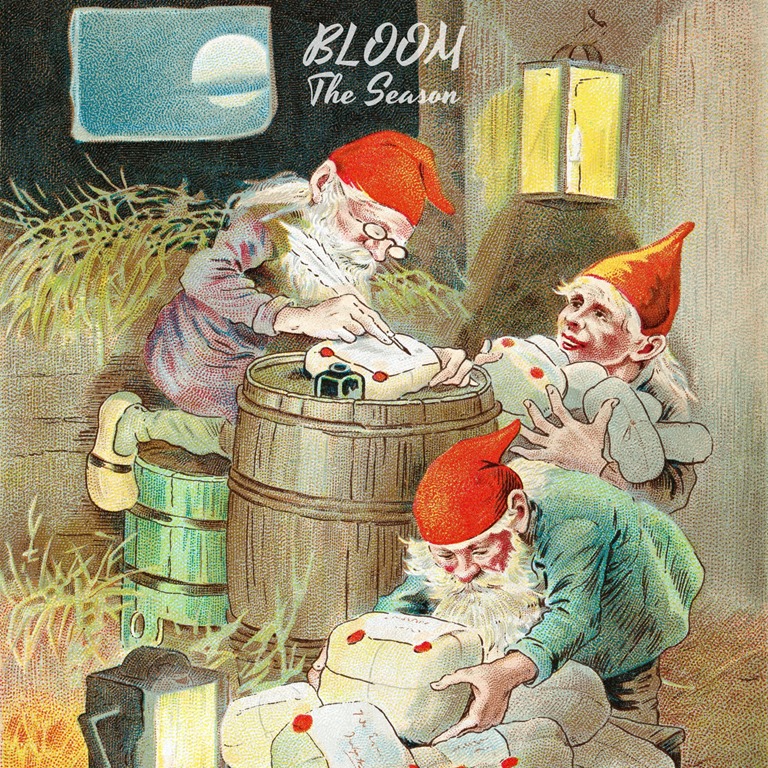
But there is always space for an exception, and Bloom’s ‘The Season’ is it. Deborah may have been posting pics on Facebook of the ‘festive mouse’ in the studio to mark this release, but said mouse is looking over a piece of kit called ‘Psychosis Lab’ made by Resonance Circuits. The cuddly cartoon cover art for this release is misleading, and for that, I am grateful.

It’s five minutes of deep, hefty beats melded to a throbbing industrial synth bass. Atop this thumping dance-orientated rhythm section, there are synths which bring a dark 80s synthpop vibe. In combination, the feel is in the vein of a dance remix of Depeche Mode circa ‘85 or ’86, around the point they began making the transition from bouncy pop toward altogether darker territories. It’s repetitive, hypnotic, pulsating, big on energy. But there are eerie whispers which drift through it all, distant wails like spirits rising from their graves. These haunting echoes are more evocative of Halloween than Christmas – and this is a significant part of the appeal. It’s a curious combination of ethereal mists and hefty, driving dance groove, which is simultaneously uplifting, tense, and enigmatic. It is not schmaltzy, cheesy, twee, or saccharine. It’s the season, alright. The season to be weird, to be unconventional, to accept those darker moods and remember that they will pass. It’s a Christmas anthem for those who aren’t feeling festive. And I will most certainly drink to that.

AA

a3458409831_10

Mortality Tables – 1st November 2024

Christopher Nosnibor

Spoken word is hard. I know. I’ve done it. I’ve been terrible at it. I’ve witnessed countless others be terrible at it, too. Spoken word is even harder as a prose writer. It’s just so difficult to hold an audience’s attention. This is why spoken word events seem to favour poetry: whether they rhyme or not, poems tend to focus on rhythm and to be brief, rarely longer than aa couple of minutes. And a lot of poets manage to memorise their pieces for performance, and poets who ‘read’ tend to be looked down upon in certain circles. It’s rather harder to memorise and recite a three-page slab of prose, and face buries in pages makes performing and engaging altogether harder. But worst of all, people simply don’t seem to possess the attention span.

Reading prose is hard. A segment of a story may not really work outside if its intended context, and a short story that only takes three minutes to read isn’t going to have much substance.

There’s a huge disconnect here: people listen to audiobooks but struggle with spoken word or anything that isn’t a renowned author or a celebrity voicing an accessible, pot-driven narrative.

William Burroughs told Philippe Mikriammos in an interview in 1984 that ‘many poets are simply lazy prose writers.’ He qualified this by explaining, ‘I can take a page of descriptive prose and break it into lines, as I’ve done in Exterminator!, and then you’ve got a poem.’

It’s true.

Chop your sentences down to phrases.

Cut your phrases down,

Down to their component parts,

Capitalise each line

– unless you’re e e cummings –

And lo,

You have a poem.

Burroughs had the advantage of recording his spoken word pieces and performing segments from his books in the 60s, 70s, 80s, when the medium was still comparatively fresh, and people had attention spans greater than goldfish, and had the additional benefits of a remarkable flair for reading and a truly unique voice. Here in the 2020s, it can be hard to attract – and maintain – any kind of attention with an audience. As I say, I know: I’ve done it, and I’ve been terrible at it. I’ve also been alright at it. I’ve driven people from the room, and considered it an achievement, because it’s infinitely better to have an impact of that nature than for audience members to fall asleep, or worse, forget the performance. The challenge for any spoken-word performer, be it in a live setting or in a studio, is how to grab, and maintain, the attention of any audience.

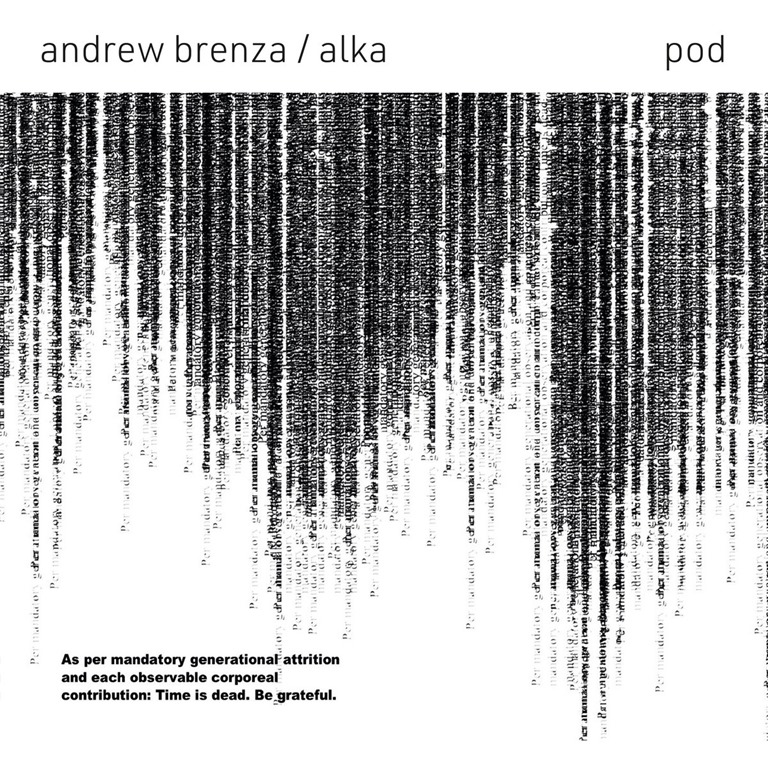
Here, Andrew Brenza reads from his book pod (ghosTTruth, 2023) with accompaniment from sound artist and electronic instrument restorer alka (Vince Clarke’s VeryRecords). Instrumental augmentation is the most obvious and immediate way of grabbing the attention. It transforms a spoken word work into a multimedia project, for a start, and moreover, the moment ‘music’ is involved, a whole new audience – which likely has no interest in spoken word – opens up.

His voice processed with a metallic flanged edge and epic reverb, and against an ominous organ droning ambient hum, Brenza becomes commanding, not to mention eerie in his delivery. This is the fine line all spoken word performers must tread, of course, but here it is felt acutely: The delivery can often overrun the work; style overtakes concept and content.

I find myself drawn into the delivery of pod – the sounds, the delivery. But engrossed in these, the content slips to become secondary, in a way. But perhaps that’s ok. ‘Intermission Meander’ provides a bleapsome interlude, and the narrative segments are vignettes, segmented scenes which are centred around image and concept rather than linear narrative, events, or characters. In this context, this release works. It is not an audiobook, but an audio accompaniment to a book. It’s difficult to absorb, but a successful project.

AA

a0689313884_10

Benefits blast in ahead of another substantial UK / EU tour with the release of the first new material since their debut album, Nails.

‘Land of the Tyrants’ features additional vocals by Zera Tønin of Arch Femmesis.

It may be more overtly dancey than previous outings, hitting an almost trance groove, perhaps even a bit KLF, and the rage is more simmering than roaring in in terms of delivery, but lyrically… as explosive as ever, ‘Land of the Tyrants’ tells it like it is. The video is more overtly produced, but it’s dark and stark. It’s grim up north, right?

Tour dates:

05/10 HUDDERSFIELD Parish

06/10 LANCASTER Kanteena

07/10 GLASGOW The Hug and Pint

08/10 EDINBURGH Wee Red Bar

09/10 ABERDEEN Tunnels

10/10 STIRLING Tolbooth

11/10 MIDDLESBROUGH Play Brew

12/10 LIVERPOOL The Shipping Forecast

13/10 PRESTON The Ferret

17/10 ROTTERDAM Left of the Dial Festival

18/10 UTRECHT ACU

19/10 ROTTERDAM Left of the Dial Festival

20/10 OSTEND Cafe de Zwerver

22/10 SOUTHAMPTON The Joiners 23/10 BRIGHTON Hope and Ruin

24/10 MARGATE Where Else

25/10 LONDON The George Tavern

26/10 NEWPORT Le Pub

AA

Benefits@2000x1270-696x442

Pic: Tom White

26th January 2024

Christopher Nosnibor

Polevaulter haven’t come from nowhere but have, it seems, evolved – or devolved – from a regular band with guitars and a regular drummer, to a brutal drum-machine driven duo, a model which has landed them some high-profile support slots and attention in their own right. Debuting – at least in this incarnation – with ‘HILTSCTW’ (That’s ‘How I Learnt To Stop Chewing The Wasp And Face The Bulldog’) in February 2020, they’ve put out a couple of EPs on tape and CD, both of which have sold out, as well as a couple of digital singles, ahead of this, their debut album, which they performed live for eight hours straight and streamed it on YouTube as a fundraiser for Palestine the other week. It might not have had the intensity of one of their half-hour support sets, but it set out their position politically and as people, suggesting that as much as they’re about impact, they’re also about endurance.

With the exception of the last couple of singles, none of the songs on Hang Wave have been previously released. Hang Wave, then, is no sweeping up of their catalogue to date, but an album proper, and a work which is focused on where they’re at now, not where they were.

It’s a thudding pulsing bass drum bear that drives ‘Mia Goth Made Me Do It’, the first of the album’s ten tracks. It’s tense, and it’s dark: the bass is low-slung and bulbous, but the vocals are subject to really high-treble EQ and some crisp, dry reverb which gives them a harsh edge. This is no gentle introduction: they’re straight in and at the jugular. A mangled, confrontational industrial / goth assault, it makes for a challenging, confrontational opening to an album that’s stark and uncompromising.

Single ‘Trend’ packs snappy (and in places somewhat bizarre) lyrics, with lines like ‘Don’t tell me to put my vase away’ and ‘I do a line off a horses dick’, and stuttering beats, a monstrous bastard of a bass noise and some woozy discordant notes that bend and melt in the incendiary heat of the fire of the vocal ferocity. ‘Pissed in the Baths’, just unveiled as a final taster of the album is another murky morass of dingy post-punk, and as likely to deter more prospective listeners than it will attract. You get the impression that Polevaulter couldn’t care less, and that they’re not doing this to garner popularity, to get played on the radio, for accolades or to get rich or famous – which is a good job: in articulating alienation and also simply venturing, without restraint, down the deepest, darkest, and most obscure tunnels against a backdrop of the most unrefined, angular noise, Polevaulter have pretty much guaranteed they will achieve none of these things. Of course, in repelling the majority, they’re appealing to an extremely devoted minority of people who actively enjoy music that hurts, physically and mentally.

It’s hard to make out what the fuck they’re ranting and raving about most of the time, but the delivery – half spoken word, half hollering – is strong and is a message in itself. Because anger is an energy, and shouting into the abyss is the most exultant catharsis. Polevaulter deliver that catharsis in the bluntest, starkest of manners, and the production accentuates it all.

‘Industry Plant Based’ seems to be a swipe at more than one contemporary issue, and it’s fair to say it’s hard to imagine an act further from The Last Dinner Party.

There are no tunes to speak of on Hang Wave, and choruses are in short supply, too. Perhaps the most obvious and valid points of comparison are Benefits and Sleaford Mods – but whereas the latter bring hooks and groove, Polevaulter present nothing but bleak trudging, and while the former are focused on the channelling of rage with passion and a politically-charged message of unity, Polevaulter bring us blank nihilism delivered with a twist of crushing desolation. There are dance elements in the mix, but the mix is a cement mixer churning away a blend of grit and napalm, and this is nowhere more strongly evidenced than on single cut ‘Violently Ill’, a song so wrecked as to twist your intestines, while the air-raid siren howl of ‘GabWorld’ is chilling and unsettling.

The album winds up in a twitching, glitching, explosive mess in the form of the snarking, sparking, meltdown that is ‘any%WR’.

Hang Wave is harsh. There are no mellow moments, or softer interludes. There is nothing remotely pretty or pleasant about it, either. Outside, a storm rages – the second in as many days, and the tenth since October. The river just a few hundred yards away has burst its banks again. The sound of other people’s recycling rattles past my front door as it bowls down the street, and it’s a potent reminder of the reality and the palpable effects of climate change. It looks very much like we’re on the brink of WW3 s the UK and US dig deeper into their commitment to fire missiles into Yemen; Gaza is all but decimated; Trump looks like he’ll running for president once again, and no-one seems particularly concerned because they’re fretting about how they’ll pay the rent and the next energy bill. It’s a sick, sick world. All of it mounts up and compounds and you feel ill. With Hang Wave, Polevaulter do absolutely nothing to lift the mood or make you feel better, but Hang Wave is the perfectly bleak, nihilistic to these utterly fucked-up times.

AA

HWsleeve

12th December 2023

Christopher Nosnibor

German electro duo ALTR∞ seem like a pretty chipper pair, pronouncing the arrival of their second EP with the theatrical, Shakespeare-referencing proclamation ‘The world is not a stage, it’s a dancefloor: welcome to the Cosmic dancefloor of Eternity!’

They go on to explain how the ‘INFINITE’ EP is a celebration of the complexity and the beauty of life and the connection that binds us all! The broad spectrum of music influences, woven into the EP’s music tapestry, symbolises the infinite flow of ideas and references that shape and drive the Collective Consciousness. We hope that these songs will make you feel free: dancing and releasing all worries and troubles! We wanted to try new things, while exploring a more dancefloor-oriented sound, while still sticking to our own style. The energy was there and the rest just happened as usual – immersing in the magic of the studio and channelling our feelings!’

The EP’s four tracks span just over eighteen minutes, and while they are certainly very rhythmically-orientated, in terms of commercial dance, they’re not what anyone would call bangin’ dance choonz – not even your dad or your grandad. Sonically, Infinite sits somewhere in the middle ground between the minimal techno favoured by Gilles Peterson on his 6 Music show, and the kind of stuff I find modular synth fanatics noodling out at the Electronic Music Open Mic nights we have around the country.

‘I Saw the Future’ is, ironically, a squelchy analogue workout that’s decidedly retro, and the sparse vocals are more 90s dance track dub remix than avant-garde futurism. The vocal snippets add layers or mystique and esotericism, ‘Hurricane’ brings more urgent beats, clattering hand drums rattling over a thudding bass drum and pulsating groove, with weaving synths conjuring an expansive and trace-like atmosphere. The last track, ‘Infinite Mind’ pulses away in an inwardly-focused way.

This isn’t music that will send you wild or dance yourself into a frenzy, but will instead likely catapult you into inner space, and inspect your own psychological circuitry – in a most pleasant way. It kinda sounds like the cover looks.

AA

a0263571887_10

26th June 2023

Christopher Nosnibor

‘Industrial’ is a definition that’s shifted significantly over the years. The shift seems to have come some time in the late eighties or early nineties, when the likes of Ministry and Pitch Shifter were breaking into a much more mass-market audience: the former smashed MTV with the singles from Psalm 69, with even Beavis and Butthead getting down to ‘NWO’ and proclaiming ‘even the old dude is cool’ in reference to William Burroughs’ appearance in the video to ‘Just One Fix’. It seems hard to reconcile the enormity of that album with the face of music in the media now, but the early 90s really were something. You’ll read endlessly about how Nirvana smashed open the doors and so on, and perhaps to an extent that’s true, but they were simply a part of the zeitgeist in an era when MTV focused on ‘M’, and you would find bands like Soundgarden and Butthole Surfers and Rage Against the Machine being played alongside ‘Sabotage’ by The Beastie Boys, and it didn’t seem incongruous with all the mediocre pap because, well, that was what people were listening to. I even picked up a Therapy? live bootleg CD in a record shop while on holiday in Venice in the summer of ’94. I was excited, but it didn’t seem particularly strange at the time. Pitchshifter, meanwhile, had named their debut album Industrial, and it was fucking heavy, but it wasn’t until they changed their sound and rode the wave of sports metal around the turn of the millennium that they got popular, doubtless aided by their intersection with The Prodigy.

But because of the bracketing of these bands as ‘industrial’ in the 90s, the original characteristics of what had previously been deemed ‘industrial’ became buried, and forgotten. It’s hard to really find a connection between Ministry and the likes of Throbbing Gristle and Cabaret Voltaire (at least musically: they all loved Burroughs, but Jourgensen’s fascination was more about the junkie guru legend, whereas TG and The Cabs were into exploring ways of applying the cut-ups and Burroughs’ tape experiments of the late 50s and early 60s to music.

Binary Order sit firmly in the bracket of contemporary industrial, or what many refer to as Industrial Metal, and with this release they really show their influences and wear them with pride.

Now, I do get somewhat twitchy when the running order of a review stream or download differs from the Bandcamp stream or whatever, because the flow of a release is important – at least to me, and I tend to consider the overall flow of a release in my appraisal of its success.

So we’re going with the Bandcamp sequence here, which kicks off with lead single and title track, ‘Thrown Away’, a cover of the song by the oft-maligned nineties nu-metal act Papa Roach, who, remarkably, are still going and releasing albums at a steady rate. Are people really still buying this shit? Rap Metal was surely one of the worst things to have happened to music… but here it is. They blast off the four-track EP with a chunky riff-dense rendition of ‘Thrown Away’, and with that out the way, be can finally turn to the rest of the EP.

The remaining three tracks are remixes of songs from their debut album, Songs from the Deep, released in November of last year. The ‘Bleeding Mix’ of ‘Parasite’ is a gut-churning gurgle of stuttering electronica, that starts with a pumping, shuddering beat and a quivering synth groove which provides a stark backdrop to the raw vocals… but then it gets a bit ravey and autotune and straddles the uncomfortable intersection between dancefloor and sonic assault.

The Arcadmix Remix of ‘A Good Death’ is altogether more atmospheric and moody, and works well, largely because it’s neither overtly dancey nor Industrial / Nu-Metal. The six-and-a-half-minute ‘Irreversible Mix’ of ‘Hands of Time’ manifests as a long, oppressive, darkly ambient drone that’s a real departure from the rest of the EP.

The diversity is the key strength of this release, paired with the fact that it shows a band wanting to push their limits and aren’t especially precious about how their material is reshaped or adhering rigidly too their chosen genre.

AA

812429

7th July 2023

Christopher Nosnibor

A year after unveiling ‘The Nature of Light’ with the promise of a debut album in September 2022, Celestial North’s Otherworld is finally with us. With the title track and ‘Yarrow’ having also built a level of anticipation, it’s left like an album that’s been a long time coming.

Some things simply cannot be rushed, and Otherworld is appropriately-titled, as Celestial North creates songs which sound as if transported from another world, and another time. A she says of the album’s evolution, “I imagined that I was time-traveling through different and exciting worlds. Wandering through the ancient, sacred stone circles at Machrie Moor and then jumping straight into an underground rave in the forest.” And on Otherworld, she transports the listener on these journeys alongside her.

The album opens with the sweeping dreampop of ‘Are You Free’, which begins as a spoken word piece with misty synths, her Scottish accent strong and honest, before piano ripples in and she slides with grace and elegance into her lilting singing voice. It’s a question phrased as a statement, and I suppose it serves to remind us that whatever society’s constraints, we can, to an extent, choose our freedoms.

And yet, for all this ethereality and otherness, Otherworld has a deep-seated earthiness or sense of nature flowing through it. I don’t mean it feels like Celestial North is connected to nature: she is nature, and channels it through her ever molecule.

Raised in Scotland and now residing in Cumbria, Celestial North channels her natural surroundings and their rich, ancient history and heritage. Many artists have promotional photos shot by standing stones and in stone circles, but she describes her music as ‘pagan euphoria’, and listening to Otherworld, you feel that this isn’t image or posturing: these are the spaces where she belongs, and draws the energy from these places. Some – many – will likely dismiss the notion, but many of these locations do possess a unique and indescribable power that goes beyond mere awe. Castlerigg, near Keswick, is one which surprises me every time I visit; yet I have also felt something, like a crackle of electricity, on stumbling upon a minor circle, only half-intact, while in Scotland; the landscape was barren, and gorse had grown beside it, but the full circle was marked by a ring of nettles and a chill ran over me. These are the sensations which emanate from Otherworld.

Her piano-led rendition of REM’s ‘Nightswimming’ is a magnificently-realised slice of quintessentially dreamy indie. Ordinarily, I’d question placing a cover as the third track on an album, but context counts: this featured on a lauded and band-backed charity compilation released by God is in the TV – but moreover, it just works. ‘Olympic Skies’ is breezy, wistful, easy, airy, with a lilting melody that brings folk and dreamy indie into perfect alignment.

The aforementioned title track packs pitter-batter rhythms and sweeping synths and soaring backing vocals which wrap themselves around a fragile, yet confident-sounding lead vocal as it floats on air, before the more overtly 80s electro-sounding ‘Restless Spirit’, another paean to freedom, this time driven by a thumping dance beat. Her voice is unique and complex: it’s quiet, reserved, breathy, with hints of Suzanne Vega and The Corrs, but also Cranes’ Allison Shaw but also Maggie Riley on ‘Moonlight Shadow’. It makes for compelling listening, especially on songs like ‘The Stitch’, which convey powerful, wild-outdoors Celtic pagan vibes – but again, in an understated fashion. ‘Yarrow’ plays the album out with a rolling piano-based post-rock piece that’s sedate and soothing. Otherworld avoids the bombastic clichés which tend to mar much so-called pagan folk or electronic folk: many acts overdo the gothic leanings, and go for bold (melo)drama, which feels contrived and emotionally empty, simply because it’s trying too hard.

For Celestial North, it all comes naturally, and the dancier elements feel comfortable because one doesn’t get a sense of the artist trying to be simultaneously ‘hip’ and ‘deep’; this is simply her music, her style. Otherworld demonstrates that ‘powerful’ doesn’t have to be heavy or hard, and that ‘light’ doesn’t have to mean lightweight or flimsy. It’s accessible, but complex, deep but not dark or difficult. Sit back and let it carry you.

AA

856085

Mille Plateaux – 19th May 2023

Christopher Nosnibor

Fase Montuno is the twenty-seventh release by Cristian Vogel. Yes, the twenty-seventh. Depending on which version you get, this one has seven or eight tracks, all reliant on old synth and drum machine sounds, giving it very much a late 70s / early 80s vibe,

As the accompanying notes detail, ‘This highly personal release is a visionary take on the futuristic potential of Latin American electronica, and promises to be a thrilling journey through Vogel’s musical imagination, every track infused with his signature creativity and energy.

Vogel has lingered on the fringes of dance music for the entirety off his career, and Fase Montuno goes very much all out on accentuating the dance elements of the pieces. That doesn’t mean that Fase Montuno is a chart-dance album, not at all. But with its Larin American influences, it’s very much music you can dance to, if you’re that way inclined – and if you’re not, well, it has groove, and that’s something anyone can get into.

The title track is a busy, bleepy six-minute chiptune that builds layers and energy as it progresses. Things get glitchier and gloopier on ‘Temples in the Sky’ with some busy polyrhythms which flicker over pulsing beats and swathes of swashing synths. It’s sparse, but at the same time there is much happening, sometimes incidentally, sometimes simultaneously.

Always, the beats are dominant, even when pitched subtly. ‘Labyrinth and Warrior’ mines a specific seam of techno I find quite oppressive despite its spaciousness, whereby the repetitions are tightly looped and I find myself feeling as if I’m trapped in a nagging glitch of just a second or two and physically can’t move. Ironic, perhaps, that certain dance music should, instead of moving me, render me utterly paralysed and almost suffocating with claustrophobic panic. But there it is. For those reasons, I find this and uncomfortable experience, and difficult to enjoy.

And so it is that the nagging grooves of Fase Montuno lead nowhere other than inside, burrowing into themselves and clanking away hermetically: there is nothing beyond this is and of itself, and while many find release and escape in this form of music, for me, it’s like being zipped up in a bag where I’m unable to move my limbs and then thrown into a darkened room – worse than sensory deprivation, it’s like the drip-drip-drip of water torture.

I can’t blame Cristian Vogel for my extreme and quite irrational reaction to his music: it’s meticulously crafted, and the frequencies, the mix, are magnificent, and evidence – as if more evidence were needed – Vogel’s enduring appeal in his field.

AA

MP60_front

21st April 2023

Christopher Nosnibor

You know you’re onto something when you get banned from a platform, and so it is that the promo for ‘Heavy Heart’ got canned from VIMEO, usually one of the more forgiving platforms, and you have you ask ‘why?’ It features clips of various failed British Prime Ministers – notably Theresa May’s infamous grooves and various right-wing twats like Farage and Fox and Yaxley-Lennon (Tommy Robinson my arse), pontificating and being pelted with milkshake: nothing untoward, just news footage. So what’s the issue? Perhaps the platform took issue with the featuring of the visage of that out-and-out fash Suella Braverman. But more likely it was starving families juxtaposed with Churchill, toting a machine gun while smoking a cigar, because fuck me, that exposé of the dark side of British politics is hard to swallow for some. No-one wants to contemplate the possibility that Churchill was a twat – an aristocratic political defector and an imperialist – which makes Johnson’s idolisation make deeper sense.

Nishant Joshi’s words which accompany this release are a grim indictment on ‘Great’ Britain in 2023 – the nation which chose to leave the EU (albeit by a slim margin, and that’s something that can’t be stressed enough) on the basis of an ‘advisory’ referendum in 2016. Because ‘the will of the people’? Half the country didn’t even bother to vote because it was a non-issue for them, and only a slender majority of those who did made it happen. But it’s that slender majority who were the most vocal.

He says ‘I was faced with racial slurs when I was younger, but nobody has uttered a racial epithet to my face for many years. But, I know the racists who existed in the 90s are still alive and well. They didn’t die out all of a sudden, and neither did their ideas. So, the point of this song is that everyone acknowledges that racists exist. But nobody will ever admit to being racist – so where did they all go? My answer is that they all wear disguises: as politicians, right-wing journalists, and talking heads for shady think-tanks. The brazen racism has retreated into the shadows, and subtle racism has taken over.’

Will Self said it best when he said ‘Not all Brexiters are racists, but almost all racists will be voting for Brexit’. And that sad fact is, we live in not only a divided society, but, post-Brexit, a more overtly racist society. The referendum outcome has emboldened people to espouse their racist views, with racially-motivated attacks not just affecting blacks and Asians, but also Eastern Europeanss, notably Poles, etc.

Fuck’s sake. We’re a mess. Who do we think has been picking out strawberries and delivering our coffee in Starbucks and Costa thee last decade? The people shunting stacked-up trolleys for click and collect and home deliveries from the supermarket? Large fries?

In Britain, capitalism itself is institutionally racist in a century-long hangover from the empire.

‘Heavy Heart’ kicks straight in with a buzzing, fuzzing, gritty bass and kicking drums that yell urgency. And yes, this is urgent, and it and locks into a throbbing groove that really grabs you hard, a magnificently poised dance / punk hybrid. Just as punk gave voice to a generation frustrated and marginalised, so, sadly, what goes around comes around, and once again, it’s music which is a powerful medium for channelling that frustration. We need change, and it’s voices like Joshi’s which give us hope. And in the meantime, Kill, The Icon! give us a unifying energy, and exhilarating tunes.

AA

FuOhnDPXoAM8A8f