Posts Tagged ‘Album Review’

Clonmell Jazz Social – 13th February 2026

Christopher Nosnibor

1984 has never felt more relevant. In the early chapters, Winston is shown rewriting history, in the form of news articles – something which has become a defining feature of the Trump Administration of late. The quotation ‘The Party told you to ignore the evidence of your eyes and ears. It was their final, most essential command’ has been all over social media in recent weeks. Because we live in a time when a woman in her car calmly saying ‘I’m not mad’, or a medic shielding a woman from assault, can be murdered by the state, the event filmed and broadcast from many angles, and reported as being ‘domestic terrorists’. When news reportage becomes outlandish fiction, there’s a problem of unspeakable proportion. And so it’s become the objective of the media wings of governments – those of America, if Israel, of ours here in England – to preserve fictions and mask facts for their own propagandist, gaslighting ends.

Harry Christelis – whose latest offering features Christos Stylianides (trumpet/effects), Andrea Di Biase (bass/synth) and Dave Storey (drums) – is not seeking to propagate propaganda here, but simply to explore sonic territories, with a album of ‘post-jazz, ambient and folk-inflected improv’, which ‘captures a deep collective instinct – reflective, spontaneous, and richly atmospheric…’ Christelis explains that “in the creative process — as in life — there is never true certainty, never a ‘right way.’ These are simply fictions we hold onto. This realisation inspired the title Preserving Fictions: a reminder to stay present with whatever comes, grateful for each lesson, knowing that something new may be just around the corner, waiting to turn that on its head.”

The album launches with the longest track, the nine-minute ‘Blues of the Birds’, which is, at heart, an ebb-and-flow ambient composition… but then there’s clattering percussion and waves and wisps flittering skywards, before, around the mid-point, it settles into a smooth, strolling, settled feel. Nice. And all that.

The spontaneous nature of the way this album was created is perhaps one of the reasons behind the broad spectrum of the pieces which it comprises, and it’s worth noting that Miles Davis and Talk Talk are cited as central influences, in that they become more apparent once you’re aware of this fact, which roots what is, on first hearing, a nebulous, meandering work. Not that it isn’t nebulous or meandering, or that these are bad things, but there is a solid contextual framework in which these pieces sit.

The title of ‘A Sense of Parrot’ is laced with absurdity, but the sonic actuality is a composition which drifts serenely, underpinned by a strolling bass and some nicely loose-wristed percussion, while ‘Wood Dalling’ (named after the Norfolk village in which it was

composed) has something of a post-rock feel, a sepia-tinted nostalgia augmented with gentle woodwind. The percussion-led ‘Djembe’ is fundamentally self-explanatory, and one of the album’s most explicitly jazz pieces.

‘How old are you?’ is a phrase I’ve often used to disparage people – usually in the workplace – over petty or otherwise juvenile or irritating behaviour. Christelis’ piece by the same title doesn’t convey anywhere near the same sense of frustration at human behaviour, but with bowed low notes scraping beneath ambient undulations, while chirps and chatters of wildlife are just audible in the background behind ringing guitar notes and vast reverberations.

The compositions on Preserving Fictions are sedate, and take their time in unfurling, and it’s a welcome alternative to much of the wilder, more frenetic jazz-leaning releases which have come my way of late. It’s not that I dislike them – far from it – but in stressful times, something gentler and somewhat transportive is most welcome. Preserving Fictions fits the bill nicely.

AA

Press pic 2

Dret Skivor – 6th February 2026

Christopher Nosnibor

Of Dave Procter’s myriad musical projects, Legion of Swine may not be his most endearing, but it’s certainly his most enduring – a vehicle for noise, often at the harsher end of the spectrum – with a highly political angle, and usually involving some form of porcine pun.

One of the orange fascist’s recent outbursts not only created a stir in the media, but gifted LoS with a title for this latest blast of angry noise. The notes which accompany the release make it clear where his thoughts are right now:

‘Who knows how many times that massive arsehole has his name printed in those files? Will we ever see them un-redacted before he threatens to invade everywhere/nowhere/nuke the planet/shit his pants/get bruised from too much handshaking and other bollocks? The soundtrack to the end of the world? Who knows. Enjoy it while we still can.’

To articulate quite how all of this feels in words is difficult. There’s certainly much anger, but also fear and confusion. Lately, the news has been such that had it been pitched as a plot for a movie, it would have been laughed out the door for being so ridiculously far-fetched. As such, there’s an air of unreality to it all. Is this shit all really happening? At once? And this is why everything is so bewildering. It’s not just the Epstein shit – which is even wilder than the wildest conspiracy theories about global elites – but it’s ICE, it’s bombing Venezuela and kidnapping the president, it’s plotting to turn Gaza into a holiday resort, it’s angling to take Greenland, it’s the rewriting of history, it’s the renaming of things, and the endless stream of outright lies and truly insane ramblings.

“quiet piggy!” is twenty-five and a half minutes of obliterative harsh noise, a relentless sonic blizzard, a solid wall that batters every sense, tearing from the speakers with a force that’s positively physical. It’s like standing in a hurricane, or besides a jet engine. The best way to appreciate this is at high volume, to let the ferocious blast immerse your very being. The effect is, seemingly counterintuitively, quite soothing. Like running a marathon or climbing a mountain, it take the focus away from all of the shit swirling around in the ether and crowding the mind, affording mental relaxation, while blasting away the stress and agitation – at least until you realise that it probably sounds remarkably similar to the detonation of a nuclear bomb.

AA

a1695291494_10

Dragon’s Eye Recordings – 23rd January 2026

Christopher Nosnibor

The facetious part of me reads the title of this as being a greeting to a pane of glass. I should probably get my coat after such a shameful revelation, but never mind. I’m here with my ears for this complex and detailed release, and will share the standard biographical info to provide much-needed context here:

Evening, window is the debut full-length album by Helsinki-based sound artist and ambient composer miska lamberg. Working with intricate field recordings that gather the overlooked moments of daily life – rainfall, distant traffic, animal calls – lamberg threads these textures into compositions that ache with personal memory. On Evening, window, the familiar becomes spectral: fragments of sound blur into melody and mood, capturing the stark melancholy of Nordic winters and the soft violence of remembering.’

The album features some long pieces: four of the six compositions are over eight minutes in duration, and this allows the pieces the appropriate and necessary time to build.

It begins with a metallic clattering. Heavy rain on a tin roof? Perhaps. Then there is a rumble – possibly thunder – but chattering abstract voices and soft, gentle synths drift in a cinematic spatiality and an organ swell gradually comes to dominate as it drifts… Evening, window is a sonic diary of sorts, a compilation of recordings captured in everyday settings as she goes about her life. The nine-minute opener, ‘Half-memories absorb us’ is both immersive and transportative, provoking contemplation. In some respects, the title does more than speak for itself, and also speaks of the way our minds work. And how do our minds work, exactly? Erratically, unpredictably, leaping from one place to another. And we’re thinking one thing while looking at another.

From a certain perspective, Evening, window can be seen to operate within the same field as William Burroughs’ cut-ups, and in particular the tape experiments he made with Iain Sommerville, although the collaging of field recordings and various layers of sound aren’t nearly as extreme here, blending the field recordings and decontextualised samples with carefully-crafted layers of ambience, which maked for a rather more listenable experience. Different objectives through similar intentions, one might say.

There are some haunting, unsettling motifs which cycle through Evening, window: ‘Seeing only faces turned away’ is dark, and listening to the ghostly swathes of ambience which hang dark and heavy is uncomfortable, a repetitive chord sequence conjuring, if not outright fear, then a sense of tremulous trepidation and unease. While Evening, window is a work of lightness and air, it’s also a work of slow, dense weight.

There are children’s’ voices. There are supple strings. At times, the atmosphere is soothing, sedative, but more often than not, there are undercurrents of tension, befitting of a dystopian thriller. Some may consider this to be something of a disconnect from the concept of presenting, or representing, fragments from the everyday life of the artist. But life is strange; the world is strange, and scary.

‘I remember the day the world lost color’ is bleak, barren, conveying the murky gloom of a blanket of fog, while ‘Its monotony is unrelenting’ is the drudgery of life – at least some periods of it – summarised in four words. Anyone who has endured a crap job will likely be able to relate to the sense that life is slipping by while days evaporate trudging through eternal sameness and feeling a sense of helplessness and a loss of identity, a distancing from the self. The sound is muffled, and very little happens over the course of eight minutes of crafted stultification during which the chord sequence of ‘Seeing only faces turned away’ is reprised, only slower, more vague, somehow tireder-sounding. It’s the soundtrack to hauling your living corpse through another dead, empty day – and another, and another, and another.

Evening, window isn’t depressing as such, but it is not light or breezy, and the mood is low and melancholy. It’s a slow, gradually unfurling work which drags heavy on the heart, an album which radiates reflection and low mood. It’s a dose of stark and sad realism, and an album which speaks so far beyond words.

AA

a0509711029_10

Christopher Nosnibor

Ashley Reaks is an artist who has very clear creative cycles, releasing, as standard, an album a year, and sometimes two, which make the fallow periods more conspicuous. This is not one of those fallow spells: Nature Reversed arrives just four (dark, cold, wet, gusty, wintery and generally depressing) months after At Night the World Belongs to Me, released at the end of September last year. And it marks something of a shift, and even ventures into the realms of what one might consider a ‘concept album’.

Reaks describes the album as ‘a stark, hallucinatory journey through the Yorkshire Dales and the inherited wounds of a father–son lineage. Mixing messed-up jazz fragments with rural, almost medieval folk textures, the album follows a narrator who must invert his own nature to survive the authoritarian “Old King” and then claw his way back to himself through wildness, shame, desire, and the raw, cyclical violence of the natural world.’ That’s a lot to unpack. If it was the plot for a novel, it would be a twisty-turny work, rich in allusion and haunting imagery – but likely jazz-free. But to compress all of this into nine songs and forty-five minutes… Ambitious would be one word for it.

The album’s first piece, ‘I Don’t Like The Old King’ does very much explore the expansive fields of folk, but through a proggy filter, performed with synths, and underpinned by a strolling bass – somewhat reminiscent of the Bauhaus song ‘Part of the Third Part’, at least at the start – and a beat that both shuffles and swings. It’s the bass that defines ‘We Forage in the Gutters’, going full Jah Wobble in its dubbiness. But at the same time, there’s a sparseness, an introspection which is different here. The elements we’ve come to expect from Reaks are all present and correct, but Nature Reversed takes those elements to another place, and it feels like the freneticism has been turned down in favour of a more focused approach.

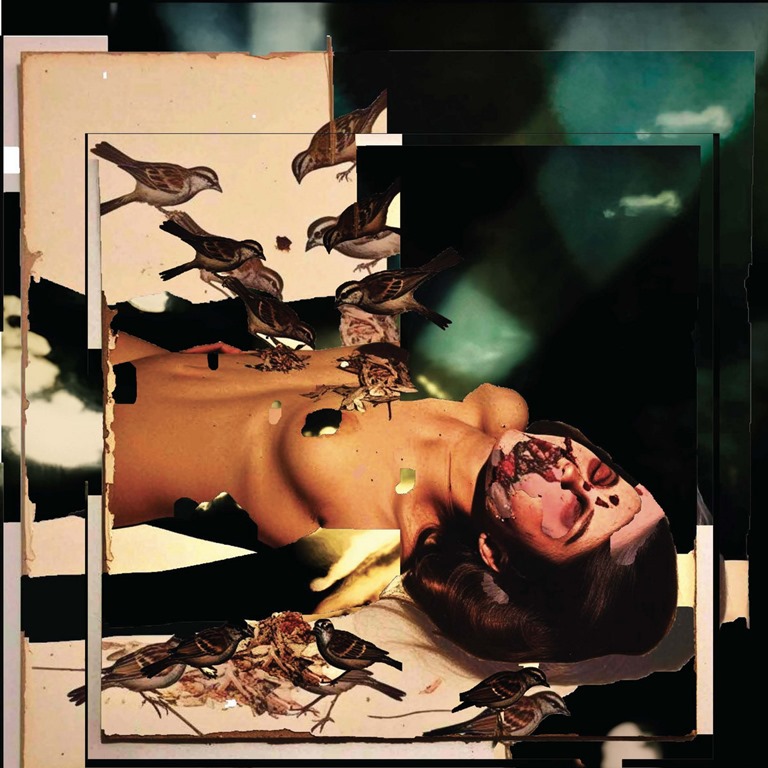
As with everything Reaks releases, Nature Reversed is interesting… by which I mean it’s a collage of weirdness that draws together a host of disparate elements. Just as Reaks’ artworks are crazy collages, so his music is relentlessly unpredictable. ‘The Desire to Seduce Euphoria’ is perfectly representative: it brings together some moody, melancholic postpunk, with chiming, reverby guitar… there are some processed vocals and there’s some jazz in the mix… I say ‘some’, but the mid-section is a massive blast of horns, before it careens into a heavy prog synth workout What the fuck IS this? This is no criticism: Reaks relentlessly challenges the borders, and does his own thing.

AA

Nature Reversed gives us all of the conventional Reaks elementsbut the wild jazz is dialled back significantly. He describes it as ‘cut-up jazz, awkward Eastern folk, medieval motifs, old ghosts, and new life pushing through ancient stone walls — music about inheritance, rebellion, and what survives when you break things wide open’, and so it’s no surprise that William Burroughs features in the list of inspirations, ‘ranging from ‘nature poet’ John Clare and William Burroughs to Rip Rig + Panic, Talk Talk, PJ Harvey, Robert Wyatt and Captain Beefheart, Nature Reversed fuses literature, music, and visual art into a chaotic, lyrical, and intimate landscape. Ultimately, it’s a meditation on survival, rebellion, and renewal — the feral life that surges when you break open your origins.’

As is always the case with Reaks’ work, Nature Reversed is a huge intertext, and it would be reasonable to describe him as a classic postmodernist, celebrating and revelling in multitudinous sources, plundering his influences and inspirations openly and emphatically. This feels more restrained, more contemplative, and lyrically there’s a proliferation of images drawn from nature – but then again, there’s no shortage of sharp-edged, darker stuff, as on ‘Picking on the Meat Membranes’, and ‘Swan in a Womb’ brings together post-punk grooving bass, sprawling jazz, glittering prog synths and vocal processing – and this is point of definition for Nature Reversed, really. It’s everything, all at once, but at a sedate pace. Don’t be fooled by the gentler, more introspective sound: Reaks stull pushes experimentalism to the absolute limits, and Nature Reversed is the singular sound of creative freedom.

AA

AA

a0782818268_10

Twilight Music – 28th November 2025

Christopher Nosnibor

I’d apologise for being a little late to this one, but given that Corpus Delicti took some thirty years to reconvene for this, their fourth studio album, I think I can be forgiven. Formed in 1992, they kicked out three albums in quick succession establishing themselves as leading exponents the goth renaissance, or the next wave of goth (which wave is which… is a subject of debate, but that’s perhaps a topic for another time), before departing a short while after the release of Obsessions in 1995. During their time away, they’ve had more compilations released than they had albums, and it seems their popularity has grown significantly during their absence.

Their planned reunion in 2020 was scuppered by the pandemic, but they finally reemerged as a live entity in the spring of 2022 and now, finally – finally – they deliver Liminal. And if you’re into that later goth stuff – from Rosetta Stone to all things Nightbreed – it does everything you’d want it to.

From the outset, Liminal is dark and brooding, with fractal guitars and infinite reverb: ‘Crash’ brings the stark post-punk dynamics of X-Mal Deutschland paired with the soaring theatricality of The Associates, and it’s a work of high drama which evokes Bauhaus at their best. That’s by no means to suggest that it’s derivative, but it’s clear they know their heritage.

They also know how to bring kineticism and range, and how to sequence an album to best effect. ‘Room 36’ comes on like an industrial reimagining of Soft Cell, landing like She Wants Revenge cranked up to eleven, with lasers and guitars set to stun. ‘It All Belongs to You’ channels Bowie, but again via SWR and The Associates – at least vocally: instrumentally, there’s layered synth work and swirling shoegaze guitar all over. But for all the dark, Liminal is a work of magnificently-crafted pop.

‘Under his eye’ is an obvious reference to The Handmaid’s Tale, a book the which has become more resonant in recent times than could have ever been foreseen at the time of its writing and publication in 1985. Led by a rolling piano and augmented with sweeping strings, there’s drama galore. Between the driving guitar buzz and snaking bassline of the super-urgent ‘Chaos’ propelled by lolloping drums, and ‘Fate’, which brings an atmospheric shoegaze aspect to some trad goth stylings, there’s a lot going on here – and they pack in some really sharp hooks and strong choruses.

As an example of modern goth, Liminal brings so much of what’s missing from many recent releases in the same field – broad in range, big on energy, this is how it’s done.

Corpus Delicti are on tour in the UK in February, performing Edinburgh (19th), Newcastle (20th), Leeds (21st), Birmingham (22nd), Portsmouth (24th), Bristol (27th), and London (28th), with dates in Mainland Europe in April. Full details and tickets are available HERE.

AA

Band image - pic Loreleï J ade

Photo: Lorelei Jade

The Helen Scarsdale Agency – 30th January 2026

Christopher Nosnibor

Cindytalk has been going almost literally forever, at least in terms of the life cycle of bands. A brief scan of my own archives reveals that the last time I wrote of Cindytalk was way back in 2013, covering A Life is Everywhere, released on the esteemed experimental label Editions Mego. The musical vehicle of Scottish musician Cinder, with an ever-shifting supporting cast, Cindytalk has been in a constant flux and perpetual evolution since the project’s formation in the early 80s – emerging from the post-punk scene and exploring every direction since, a career defined, as they put it, ‘by a continued process of disintegration and regeneration’. This is the very essence of the avant-garde, which was built on a manifesto that said that its function was to destroy the old to build the new. And implicit within that concept is the need to destroy its own creations in order to progress. Cindytalk has very much espoused that ethos over the course of the last forty years or more, with a career defined by perpetual reinvention.

Described in the press blurbage as ‘a labyrinthine opus, one that returns to the themes of the sacred and profane that have rippled through all of Cindytalk’s recordings’, Sunset And Forever opens with the eighteen-minute exploration which could reasonably be described as a (dark) ambient work. And it is dark. Spectral voices and spirits haunt every second of this unsettling drone-led work.

‘Labyrinthine opus’ is a fair description for an album which begins with a sprawling eighteen-and-a-half-minute ambient monolith, where falling objects cascade in caverns of reverb before slowly undulating drones gradually grow and turn. At times dense, at other more nebulous, around the mid-point, the scraping trickle of ‘embers of last leaves’ turns into a darker place, and is ruptured with percussive crashes and unpredictable extranea, while haunting voiced fade in and out through the swelling churn of abstract noise. This first piece, alone, feels like an album.

With seven tracks and a running time of around sixty-mine minutes, Sunset And Forever takes it time in exploring sonic contrasts, with graceful sweeps of watercolour synth washes underlaid with scratches and hisses and harder, uneven textures, the sonic equivalent of cobblestones underneath a velvet rug – or somesuch. Put another way, the soft and gentle is rendered uncomfortable by something altogether less soft or comfortable beneath, and hidden beneath a pleasant surface, and those hidden elements are reason to tread cautiously or risk twisting an ankle. It’s almost as if each track contains two compositions overlaid, a kind of collage or a palimpsest of a gentle ambient work and an altogether less gentle noise construction.

On ‘tower of the sun’, the dissonance and angularity rises to the fore to make for a skin-crawling ten minutes, while ‘my sister the wind’ screeches and scrapes, shards of drilling treble buffeted along by a train-track rumble.

The sound – and the meaning – of Sunset And Forever is forever just beyond grasp. For as much as the sounds and textures rub against one another and create discomfort, as a whole, it’s vague, indirect, hazy. It concludes open-ended, with questions unanswered and leaves a sense of uncertainty.

AA

AA

HMS078 front

Testimony Records – 13th February 2026

Christopher Nosnibor

When I first started Aural Aggravation – kinda by stealth, with no fanfare – back in October 2015, with a review of Philip Jecks’ Cardinal, it was with a view to using the platform to break away from more conventional and comparatively short-form reviews to indulge in more personal, reflective, essay-type analysis. But with a bursting inbox and a desire to provide coverage to as many acts as possible, sometimes it’s not always appropriate to spend hours and column inches pondering the context and the content through a framework that sits between reception theory and gonzo journalism. More to the point, there simply aren’t enough hours.

Slaughterday is an old-school death metal duo, and Dread Emperor is their sixth album. They promise ‘crushing doom-ridden ultra-heavy parts to calculated outbreaks of utter brutality,’ and cite as lyrical inspirations ‘H. P. Lovecraft and other masters of horror’. They go on to add, ‘while sinister things crawl and creep through the duo’s timeless brutality, they have always portrayed them with a sinister flair of their own. These days, the band has repurposed those monstrous creatures as metaphorical ciphers for relevant contemporary topics’.

Titles such as ‘Rapture of Rot’, ‘Necrocide’, ‘Obliteration Crusade’ and ‘Astral Carnage’ speak for themselves, and the ‘crushing’ ‘doomy’ aspects they focus on in their pitch are very much to the fore: ‘Enthroned’ lifts the curtain with some slow, heavyweight riffery, and paves the way for the rabid attack of ‘Obliteration Crusade’.

That bands which blast out frenetic guitar mayhem at a thousand miles an hour with impenetrable growls and howls by way of vocals go to lengths to sell the merits of the lyrical content is something which is a source of vague amusement – I mean, as if you could make out a single word by ear. But it’s beside the point, really: as I’ve touched on before, it’s about the conveyance of sentiment, the implication of meaning.

On Dread Emperor, Slaughterday leap and lurch from bowel-bursting heavyweight sludge-trudge to flamboyant pirouettes on the frets. As they say themselves, they ‘deliver everything that they excel in, which is also precisely what their fans want from the duo’: as such, it’s no criticism to say that Dread Emperor ticks genre boxes, because it’s mission accomplished for the band. And it’s hard to argue otherwise. Dread Emperor delivers riff after riff, drives hard, brings the heavy and snarls, growls and spits its way with gut-churning malevolence from beginning to end.

AA

AA

a1341187244_10

Cruel Nature Records – 21st December 2025

Christopher Nosnibor

I fucking hate winter. And I fucking hate capitalism. These two statements are, in some ways, at least connected. Believe it or not, while the life of a serf is broadly associated with an existence synonymous with slavery, under feudalism, serfs were homed, and – harvests permitting – lived from the land they tended in exchange for providing some of their yield to their lord. As such, it was a system based on reciprocity. During the winter, when there was no work to be done, the serfs would rest, and without books or any of the mod cons we take for granted, would tend to live their lives around daylight hours. Even in Medieval times, a period in history commonly associated with barbarism and a comparatively primitive society, the landed gentry recognised that the people they owned were among their most valuable assets.

Under capitalism, the workforce has become expendable. There’s always another sucker, someone more desperate, who will work longer hours for less money to pay for their rented accommodation. For all the progress we’ve witnessed in giving workers rights in recent years, conditions remain pretty shit.

Since the industrial revolution and the ever-accelerating development of technology, capitalism has sought to squeeze every possible hour of labour from the workforce. Ill? Have a Lemsip and crack on, pussy.

My hatred of winter, then, is largely because of the demands of capitalism. It’s dark when I wake for work, it’s dark before the end of the working day. Many who work in offices or shops will be stuck indoors for the entire – brief – duration of daylight hours (if it actually gets light) and this simply isn’t healthy. I feel sluggish, lack motivation, and suffer from some crushing low moods, often wishing I could simply hibernate.

So arriving at Winter by Beckton Alps2 – the final part in the series of ambient concept albums released throughout 2025, imagining Stone Age people reacting to the changing seasons – I feel in some ways that little imagination is required. Technologically, we live in a different world. As beings… we have evolved… but only so much.

AA

a0783332579_10

Crónica – 20th January 2026

Christopher Nosnibor

As time passes, our tastes change. For some, they narrow and become more cemented, more deeply entrenched. There’s a broad acceptance that people become more conservative as they grow older – which may explain why, with our ageing population, we – that’s the western world – has become more in favour of conservative values, such as low tax and a belief that the past was a golden age in which hard work was rewarded, and of course, music was better. There is certainly more than a grain of truth in the boomer stereotype. And as a Gen X-er, I’ve observed people I grew up with, and /or have known for many years become set in their ways and their listening habits, locked in the 90s in their musical tastes, and becoming increasingly churlish about the youth of today and the like.

I consider myself fortunate to be surrounded by friends and acquaintances, both in real life and in the virtual world, who are deeply invested in new music. The fact I get sent new music of all kinds from around the globe is only half of the story, as it would be so easy to sweep vast swathes of it aside to listen to, and review, nothing but goth, contemporary iterations of post-punk and new wave, grunge, and reissues. In fact, I could devote my entire listening time and run a website dedicated to nothing but reissues and still be incredibly busy. It would probably garner a huge readership, too. But no: I am constantly encouraged to listen to new music, and the fact of the matter is that I thrive on it, and never fail to get a buzz from new discoveries. As such, since I began this journey as a music writer, my horizons have broadened beyond a range I would have ever imagined.

A measure of this is that my first encounter with the music of Rutger Zuydervelt, back in 2014, was marked by a most unimpressed four-star review, in which I said that Stay Tuned was ‘a bit of a drag’. While I don’t feel particularly inspired to revisit it now alongside my writing of this review, I feel I would likely have been more receptive to its longform minimalism now.

Spelonk is not quite as long in form – three compositions spanning a total of forty-two minutes, and sees Zuydervelt taking some time out from his dayjob to indulge in the act of creating for pleasure – or, perhaps, more accurately, creating out of the need to experience freedom, to feel that metaphorical – and perhaps literal – sigh of release.

As he explains, ‘Most of the music I make nowadays is commissioned for film, dance, or other projects. And I love it — it’s the best job in the world! — but sometimes I have to pull myself away from it, and make something purely for myself. My 2004 release Omval was one of these works, as is now Spelonk. These projects are always made in short bursts; once I start creating, things fall into place quickly, as if the ideas were (unknowingly) already there and just needed to get out of my system.

The three tracks that comprise Spelonk (simply titled I, II, III) are built with “hardware jams” that I recorded with my live setup. It’s all quite hands-on, with effects pedals, an oscillator, and electronic gadgets. The magic happens when combining different recordings, layering them, and hearing what happens. Listening is always a favorite moment in the process, with a welcome element of surprise. I guess it’s all about creating alien landscapes — alien also to me too — that are exciting to explore.’

‘Alien landscapes’ is a fair description of these sparse works, constructed with layers of ominous drone. On ‘Spelonk II’, there are chittering sounds which scratch like guitar string scraping against a fret, or perhaps a ragged bow dragging against a worn string, but by the same token, untranslatable voices come to mind. The drones are eerie, ethereal, and hang low like mist or dry ice: it’s not nor merely an example of dark ambient work – there is very much a 70s sci-fi feel to it, hints of BBC Radiophonic Workshop emerge between every surge and crackle as slow pulsations reverberate among the unsettling abstraction. Over the course of the track’s eighteen minutes, there is movement, evolution, and just past the midpoint, there is a shift, where trilling organ-like notes and digital bleeps emerge, evoking recordings from space travel, and, as rippling laser sounds begin to burst forth, vintage sci-fi movies and 70s TV.

There are moments of near silence as ‘Spelonk II’ drifts into ‘Spelonk III’, also eighteen minutes in duration. Here, clanks and bleeps bubble and bounce and echo erratically, unpredictably, over a backdrop of low hums and reverberations. The low-end vibrates subtly but perceptibly, and while the experience is not one which instils tension, the cave-like digital drips and sense of space, as well as darkness, is not relaxing. You find yourself looking around, wondering what’s around the corner, what’s in the shadows. And while there’s no grand reveal, no jump fright here, the second half of ‘Spelonk III’ grows increasingly murky and increasingly squelchy and unsettling.

Over the album’s duration, Spelonk grows in depth and darkness, becoming increasingly dark, strange, and unsettling. Rutger Zuydervelt makes a lot out of very little, to subtle but strong effect.

AA

Crónica 245 front