Archive for the ‘Singles and EPs’ Category

31st December 2020

London-based alt-rock quartet Ben Wood & The Bad Ideas have certainly been keeping busy, and ‘Soho’, released on new years’ eve, is their twelfth – and understandably final – single release of 2020.

There have seen various debates as to the sagacity of releasing a single a month over an album with attendant singles, not least of all around the logistics of promotion (with many suggesting it’s easier to promote an ‘event’ like an album release and building up said release and marketing it with singles rather than the singles being the event in themselves, but 2020 has undoubtedly seen a shift in how music is consumed.

Attentions spans are different and while everyone needs something to look forward, the future always seems to be a distant horizon: in this context, a monthly delivery and a more frequent level of engagement feels ‘right’ somehow, fostering a much-needed sense of community and sustained contact.

With Wood and co inviting comparisons from across a broad range of touchstones spanning The Gaslight Anthem and Arctic Monkeys to Elvis Costello & The Attractions and The Associates, ‘Soho’ is a quintessential indie tune with jangling guitars pinned to a tight rhythm section. It’s not just a Smiths meets Wedding Present throwback stylistically, but a song that captures the essence of classic indie rock tunes of yesteryear, merging boy-meets-girl with kitchen sink drama while throwing in appreciative references to Marianne Faithful. It does very much call to mind the time when Morrissey was someone who wrote relatable songs, before he became quite explicitly an embarrassing racist bellend who rendered is entire back-catalogue unlistenable. More than we hate it when our friends become successful, we hate it when our heroes reveal themselves to be vile, obnoxious pricks.

Ben shows no such indications, thankfully, and ‘Soho’ is an accessible, melodic slice of clean indie pop. It’s accompanied by a video that sees Ben wandering the streets of London, and seeing them bereft of people is strange, unreal almost. There is traffic, busses and bicycles, but benches are empty and the Eye is static.

This, of course, is the world in which we find ourselves, and in counterpointing a song which very much centres around the ordinary, the everyday, with the extraordinary times of the now, Ben Wood presents a striking statement that’s very much a summary of 2020.

AA

Ben Wood _ The Bad Ideas - Soho Cover

Epidemic Records – 25th December 2020

Christopher Nosnibor

The timing couldn’t really be much better for an Italian hardcore act going by the name of Locked In, and it’s not much of a challenge to deduce the inspiration for their return to making music after a seven-year break.

According to their bio, ‘Locked In were quite active between 2007 and 2013 and played Italy and Europe extensively before coming to a full stop. Locked In were quite active between 2007 and 2013 and played Italy and Europe extensively before coming to a full stop.’

Or perhaps it was more of a semi-colon, since this digital five-tracker is scheduled to be followed by another EP some time next year. The prospect of ‘next year’ reminds me that while 2020 has oftentimes felt apocalyptic, like the end of days, the end of time, like a full stop on life, it is, and will be, ultimately, no more than a pause or semi-colon in the grand scheme of things. Meanwhile, there’s plenty to be enraged about, and while the lyrics may be entirely indecipherable, there’s nothing like some fast and furious hardcore punk to purge any pent-up fury and to channel any conflicting, confusing or otherwise unplaced emotions.

With the five tracks on offer here each sitting around the three-minute mark, the whole set is dispatched in around fifteen minutes, and it’s pretty primitive and raw: the guitars are played hard and fast, and while the playing of all the instruments is tight enough, the lack of production and definition on said guitars means they’re blurry enough to mask any blurriness; likewise the drumming give precedence to pace over precision, and that’s all exactly as it should be.

‘Coz I Can’ is essentially a statement of intent by way of an opener: in the face of growing state controls, surveillance, and restrictions that extend far beyond virus control on the part of many governments, we need some ‘fuck you’ punk attitude right now, and it seems Locked In are one a band willing to bring it, and do it in the time-honoured fashion of shouting it loud and cranking everything up to eleven. And yes, the faster the better. The adage that you should live every moment like it could be your last is one that very much applies to hardcore in general, and these guys run with it here, cramming in seven missed years of anger into an explosive package. The title says it all, really: they may be dead tomorrow, but they’re not dead yet and are going to make the absolute fucking most of it.

Lead single ‘Dying City’ is likely self-explanatory on the basis of the title, and likely encapsulates the experience of living in Italy at the peak of the pandemic. Here, our perception of Italy has been coloured by a combination of alarming statistics and footage of people singing from their balconies, presenting a narrative of a nation gripped by a sweeping pandemic but ultimately coming together as a community, an ultimately heartwarming and uplifting representation of unity and human warmth. Over here, in England, if only we could be like Italy, as our government praise our grit and community spirit and our NHS heroes… and so we evoke the spirit of wartime community and support as the nation takes to the street to clap ad band pots and pans to say thank you to our national treasures… and we know it’s all bollocks. This isn’t the war, this isn’t the black death, and this is a nation divided, between people who don’t give a shit and would climb over one another and batter one another with crutches to grab the last packet of pasta in the supermarket. This is the reality, and Locked in deliver the soundtrack.

There’s a moment about twenty seconds from the end of ‘No Faith’ where the bass booms and threatens to engulf everything else in the mix: it’s an incredible moment, a proper sonic punch in the guts of the kind that only comes through chance and a lack of time and polish. No pretence, no pissing about: this is the real deal, and one hell of a Christmas present.

AA

copertina def 300dpi  - Copia

Dret Skivor – 21st December 2020

Christopher Nosnibor

Initially, this review was to open with the line ‘Dave Procter, the man with more musical projects than the devil has names, has been rather quiet of late’ – but the northern noisemonger doesn’t really do quiet, and doesn’t really do fallow periods either. Procter’s full-time relocation to Sweden from Leeds may mean, sadly, that some of the acts he’s involved with – most obviously The Wharf Street Galaxy Band – are on hiatus, but wherever he goes, he makes noise – quite literally, as demonstrated by his ‘noise walks’. Not that ‘hiatus’ really means anything with lockdown putting paid to so much musical activity anyway. It’s a shame, because Dave’s myriad projects tend to be geared to a live setting – improvised, visceral, and loud. On a personal level, I miss his presence on the scene: a man as comfortable in a pig’s head and lab coat as a red boiler suit, it’s his understanding and acceptance of niche I value almost as much as the noise he makes: no audience? No problem. And so with live performances largely off the table, Proctor’s started out establishing his space in Sweden with the set-up of a new label, Dret Skivor, and this early-doors sampler EP gives a taste of what we can expect – which is, for anyone with a priori knowledge – what you’d expect, namely experimental, and noisy.

On offer here are just four acts with a track apiece, but then, as an EP – which would actually work nicely as a 12” with a different running order – it does the job of showcasing exactly what Dret Skivor is about.

Fern’s ‘Low Pressure Wave’ is minimal lo-fi electro, an erratic pulsation and low-thrumming oscillating drone vibrating against one another to build a headache-inducing tension, fading into a simmering wave with scratchy interference. Claus Poulsen brings the noise and then some, with ‘Machines 2 and 4’yelding an absolutely face-melting five minutes of screeding distortion and treble abrasion worthy of Merzbow. It’s a squall of punishing feedback and overload. IJIN also trades in big, abrasive noise, but ‘OH the JOY’ (which I can’t help but read as sarcasm) takes the form of stop/start slabs of noise, with greater emphasis on lower and mid-ranges – although there’s a gum-curling blast f metallic treble that churns relentlessly throughout somewhere lower in the mix. But this track occupies a different territory from the others being showcased here, being a sixteen-minute behemoth that evolves through a series of transitions – yet for the largest part sustains an undulating, howling sustain that drones in an animalistic anguish against a shifting backdrop. It occasionally tapers ad re-emerges, swelling to a thick, nuclear wind of noise that blasts hard against a grinding sonic earthwork of deep, granular noise.

In contrast, Zherbin’s ‘piece for a router, a tape loop and a plastic bag’ feels a little lightweight, disposable, even. But it’s all relative, and in its own context it’s a grainy bit of noise that digs into the cranium with some surprisingly sharp claws.

More Dret, please!

AA

a2509852270_10

Secret Warehouse Of Sound Records – 15th December 2020

Christopher Nosnibor

Here we are at the fading fag-end of the shittiets year in living memory and yet as energy levels and any prospect of salvaging anything of real merit fades faster than that of a satisfactory deal on Brexit, some are keeping those flickering flames of optimism alive. With venues having been closed since March, the odd socially-distanced all-seated show notwithstanding, live music has been largely off the table in 2020, leaving not so much a gap as a gaping chasm in the lives of many, and not only gigging musicians and venues and the staff who work in those venues in their various capacities.

Music is more than music: music is community, music is a place of retreat, of escape, music is personal freedom. But music is also… music, an outlet for its makers and a conduit for its fans, and Muca & La Marquise are determined to wring the very last drop of accomplishment from this bleak year with their fourth single of the year in the shape of ‘Devil’s Dance’.

An acoustic homage to long summer days spent lounging under the gaze of an unrelenting sun, it feels like a real misfit in what feels like the darkest week of the darkest month of the darkest year, but maybe that was the plan – to break through the deep-set mopology and lift the spirits with something bright, buoyant, and above all, summery – think Bobby McFerrin, think Macy Gray, think Paolo Nutini’s ‘New Shoes’, think laid-back soulful jazz-flavoured mellowness. Think maybe about not thinking for a bit and giving your brain a rest. I know it’s not aggro. It’s time for a night off. With a large whisky and some candles lit, this one’s working for me.

AA

Devil_s Dance Artwork

MC/free iOS app Langham Research Centre LRC001

7th December 2020

Christopher Nosnibor

My last encounter with Langham Research Centre was 2017’s Tape Works Vol 1, an experimental set that evoked the spirit of William Burroughs while also being littered with references to JG Ballard which inevitably piqued my interest. However, on the arrival of Quanta / Signal / Noise, I discover that both a remix of Tape Works Vol 1 as well as Tics and Ampersands and the spectacularly mundane yet dauntingly postmodern-sounding Gateshead Multi-storey Car Park, both released in 2018 had bypassed me.

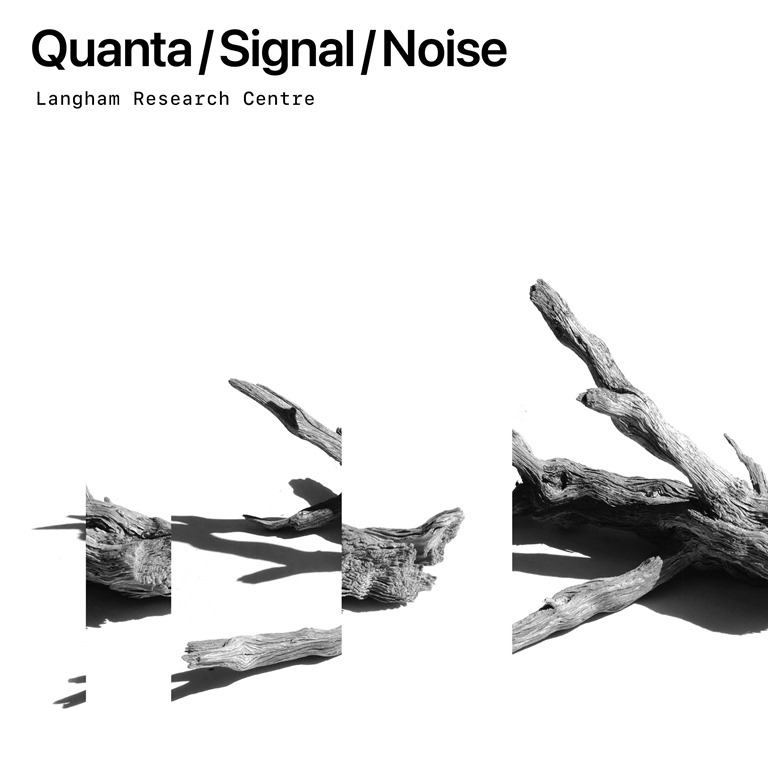
Quanta / Signal / Noise, a work in four parts seems to offer a fair – and welcome – point at which to reconvene with Langham Research Centre. the press release forewarns of ‘a shift away from the conventional building blocks of music: notes and harmony and rhythms that are mapped onto a grid of steady pulse. Instead, the focus is on a fascination with sound itself; with its unfolding textures, shapes, energies and dynamics’. So far, so much standard avant-garde / experimental fare.

The release contains four tracks, in the form of versions 1 to 4 of ‘Quanta / Signal / Noise’, each of which has a duration of four minutes and thirty-four seconds, two of which were composed by Iain Chambers, and two of which were composed by Robert Worby. ‘Version’ is a misnomer: none of the pieces bear any real resemblance to one another, ranging from heavy discordant clunks and thunks to fizzing circuitry and erratic bleepery, with woozy atmospherics, warped chatter of multiple simultaneous conversations and deep, dark, ominous undercurrents. Explosions shattering plate glass windows behind real-time running documentaries collide simultaneously with birdsong and erratic levels of volume. It’s an interesting sonic collage, but, one might say, largely of its type.

But there’s more to this than immediately meets the ear, as in addition to the standard audio release, there’s an iOS app, ‘Langham Research Centre variPlay: Quanta / Signal / Noise’, produced and developed in collaboration with London College of Music at the University of West London, which presents an interactive version of the release. The pitch is that it may be thought of as ‘experimental cinema for the ear or maybe a tool for dynamic sound painting [which] follows in the musical tradition established by composers, specifically in the middle of the 20th century, when sound recording became widely available… In the app version, by playing with these sonic materials, imaginary auditory landscapes may be created. Sonic narratives, with expressive moods, unfold before the ears and mobile, fluid sound canvases can be brushed and sketched and collaged.’

Such interactivity may not be wholly new, but still, to break the third wall in such a way becomes rare, and inviting the audience to become the artist radically alters the dynamic of the relationship not only between the artist and audience, but also audience and material. The material ceases to be something the audience ‘receives’, but instead repositions the audience as part of the art ad its creation. That breaking down of boundaries utterly transforms the experience of reception. It is quite possible that the concept is more exciting than the reality, but then, playing about with sound can be great fun. Unfortunately, the app only appears to be available for Apple / iPhone users, so I’m unable to confirm or comment either way.

The app version stands in extreme contrast to the physical release, on cassette, a format that was on the brink of obsolescence over twenty years ago, and yet is still going, albeit with a microniche market. The chances are half the interaction with the format involves a hexagonal pencil or a Bic biro.

Nevertheless, it’s an intriguing exercise to witness the evolution of interactive art that strives to question and to redefine the role or artist and audience, as well as the notion of the ‘finished’ or definitive artefact, making this more than just something to listen to, even if only conceptually and for a certain portion of the audience.

AA

LRC001_front

Mamka Records – 3rd December 2020

Christopher Nosnibor

Just when things threaten to be getting a bit safe and predictable, with many musical artists having found ways of working around Covid restrictions to record remotely, release digitally and promote by means of performing on line or otherwise streaming shows, the ever-restless Maja Osojnik manages to do something truly different and innovative.

The third release on her recently-established Mamka Records is far, far more than just another digital single, and it’s not just about the music, either: it’s about both art and artefact, and forms the very fabric – literally – of an exhibition as well.

With Matija Schellander, Osojnik is Rdeča Raketa, and for this project, they’ve teamed up with author Natascha Gangl and evolved a genre unto themselves, in the form of the ‘sound comic’ (or beautifully evocative ‘Klangcomic’ in German). The concept – whereby, as with comics, ‘where words and images merge into one another, here it is the spoken word and sound which blend together.’ As such, this is a graphic novel in audio form, a juxtaposition of word and sound that conjures an alternative space in between, a cut-up collage of sorts.

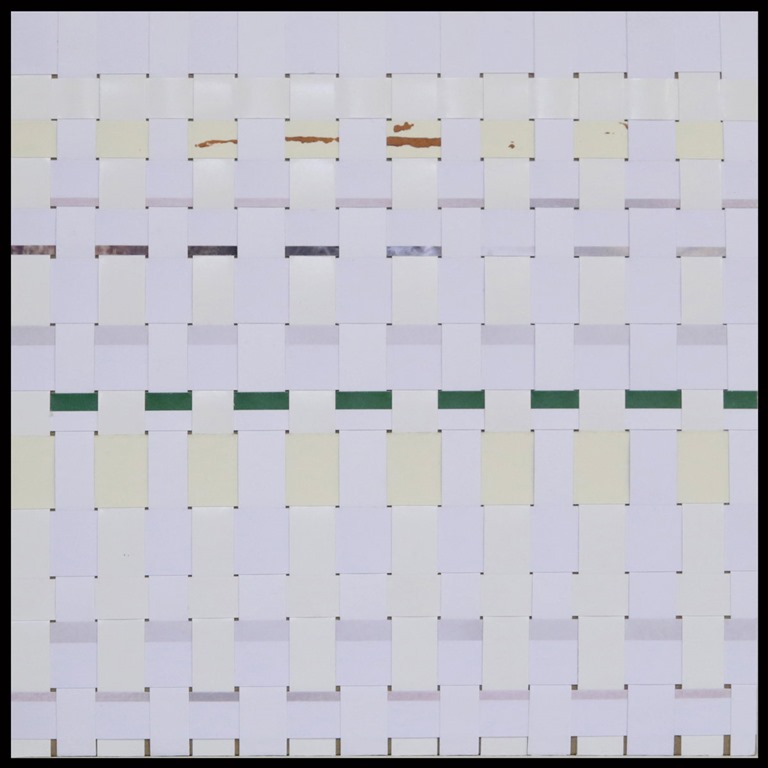
But first, the artefact: as the liner notes explain, ‘Each individual record is its own uniquely woven and hand-printed specimen. Woven from the randomly selected strips of paper, cutting remnants from the other works’. Consciously or otherwise, this links the project into the lineage of cut-up forms that feeds through from Tristan Tzara to Kenji Siratori, although perhaps most obviously via William Burroughs. The assimilation and recycling of pre-exiting material taps into the subconscious on a level that’s difficult to explain, conjuring a strange sense of deja-vu, whereby the ghosts of those remnants and scraps of other works forge a subliminal nexus of intertextual references, reminding us of the things we know, but don’t know that we know (to paraphrase Burroughs).

‘Superandome’ very much exists within this territory of the simultaneously familiar and unfamiliar, a murky electronic collage – not really a tune or a song but a shifting soundscape – but an immersive experience. Woozy, tremorous synthy wibbles oscillate and ripple and churn, while a mutter of voices gradually rises in volume and pitch until it reaches a helium-filled cacophony or babble. As with any collage, interpretation is as much about rezeptionsästhetik – essentially what the individual brings to the work as its specific meaning as bestowed upon a work by its creator. And as such, I find myself increasingly on edge, the swelling conglomeration of chatter evoking the anxiety of overcrowding and agoraphobia.

‘Super Random Me’- which is exactly the same 4:28 duration as ‘Superandome’ – is a yet more extreme collage as fragments of voices are overlaid and cut in / out over ominous rumbles, eerie drones, and random tweets. Again, it’s disorientating, bewildering – and yet equally, an encapsulation of the experience of life as lives, a clamour of voices and random sounds all at once.

Both tracks are reworked and edited from a previous work, and so such, are recycled cut-ups that in turn form a self-referential intertext which also challenge the concept of a work of art ever being ‘finished’ or a fixed definite article.

As for the art, in lieu of a conventional single launch, the record was set to be presented as a picture (built out of 110 of the 160 singles) and a video on 17th of December as an Exhibition in the Gallery Kluckyland in Vienna, and the exhibition is scheduled to run until the 3rd of January 2021 – and while at present it can only be viewed from outside, ‘Superandome / Super Random Me’ stands as a remarkable accomplishment that shows once again that it’s the artists of the avant-garde who innovate the hardest. In the year of the lockdown, we need art even more than ever.

AA

a2731630175_10

11th of December 2020

Christopher Nosnibor

Lifted from their Codependency D.S.T. EP, ‘The Causeway’ for no obvious or specific reason evokes the experience of reading Lee Rourke’s debut novel, Vulgar Things, which is set on Canvey Island in Essex. It may be in the Thames estuary, but it’s not connected to the mainland by a causeway – at least not since 1931. Although inspired by the street on which a pub in London frontman Ted Joyce stumbled upon and had been about to frequent before discovering it was boarded up due to COVID restrictions, ‘The Causeway’ in some way reminds us of the ways in which we’re all cut off and isolated, and how we’re all subject to – and dictated to – by the ebbs and flows not just of tides, or time, but of life, and of moods, ours and those of others.

The lyrics are a stream of consciousness unfolding, the tune is a colossal hybrid of indie, alt-rock, post-punk and funk. The fat, strolling bass is the focal point and bounces a groove that owes a debt to The Cure in their poppier moments (and coupled with the buoyant lead line in the bridge, if they weren’t listening to ‘Hot, Hot, Hot!!!’ around the time of writing, then it only goes to prove that influence is transmitted through the ether and spreads like a rhizome in the subconscious) before cutting hard left into a driving chorus that’s got indie anthem stamped all over it.

AA

DST part ii EP Artwork

Bad Paintings – 16th December 2020

Christopher Nosnibor

It’s perhaps fitting that elkyn should wrap up the year with a Christmas single. Bleak as the year has been for so many, it’s been an interesting and evolutionary year for the shy and retiring Leeds-based artist, 22-year-old songwriter and multi-instrumentalist Joseph Donnelly.

2019 saw Donelley tour the UK with 60’s LA legends LOVE featuring Johnny Echols, as well as playing shows with Katie Malco, Rozi Plain, S.T. Manville, Molly Linen and Mark Peters. 2020 put a halt on touring, and pushed him back into quiet retreat, and it seems that creatively, it’s proven remarkably beneficial.

Transitioning from elk to elkyn following the release of his debut ‘beech’ EP, and after a spell of silence, he returned with a slew of new material that’s as breathtakingly delicate and understated as you could conceive, beginning with a beech remixes ep and the single ‘if only it was alright now’.

How does covering a Coldplay track sit in the scheme of things? After all, they do epitomise the mainstream preference for the blandest, most diluted, tepid, fare going, the musical equivalent of instant decaff.

With chiming bells and dulcimers and soft washes of synth, this rendition certainly sounds and feels like a Christmas single, but with softly picked acoustic guitar and Donelley’s quite distinctive vocals that are imbued with a sunny 60s pop vibe, it doesn’t feet like Coldplay either. With a bold drum rolling in like thunder and a cinematic production, it’s well executed and makes for a fitting bookend to an outstanding year for elkyn.

11th December 2020 – PNKSLM Recordings

Christopher Nosnibor

Trapped in a box, a loop of ever-diminishing life, it’s not difficult to comprehend why amidst the confusion, the sadness, the frustration, and anxiety, and general bewilderment, nostalgia should grow its presence. Your life sucks, and it probably always has, but it’s easier to cast a hue of fondness over the past than to accept that if the present’s bad, the future is worse. It’s a natural part of the ageing process, too, of course: kids get younger and the music and fashions get worse by the year.

Katja Nielsen, singer and bassist with Swedish punk act Arre! Arre! had been suffering from bipolar disorder a decade before diagnosis. With the outbreak of a global pandemic, band activity curtailed: she found that writing songs helped her process, and so She/Beast was born, with ‘In the Depths of Misery’ being the first of a brace of EP, both of which derive their titles from quotes from Vincent Van Gogh, another bipolar artist.

The liner notes recount how the songs were ‘written and arranged entirely in Nielsen’s living room’ and ‘mark a dramatic departure from the furious pace of Arre! Arre!’s output, instead evincing a lo-fi, pop-rock sound’.

How it translates is as all the dark side of the 80s distilled into a neat package: it’s very much bass-driven, propelled by a drum machine that thumps away mechanically, with economical programming – no fancy fills or extravagant cymbal work – and laced with stark synths. Throw The Cure, X-Mal Deutschland, Skeletal Family, and all the fringe artists from that 1979-83 period who ventured into the darker realms of post-punk, into a blender and you’ve got the sharply piquant flavour of She/Beast.

It’s poppy, but it’s heavy on shade. ‘I don’t know what to do with myself’, she sings lost and aimless on ‘The Sadness Will Last Forever’. The bubbling ‘Born to Fight’ is exemplary of the way Nielsen brings everything together. A looping buoyant synth line that would have sat comfortably on an early Depeche Mode single is welded to a thudding four-four Craig Adams style bassline that dominates the rhythm section, while Nielsen spins a message of self-affirmation in a dreamy style, her voice compressed and floating in reverb.

The loping drums of closer ‘A Fragile State of Mind’ are murky in the mix, but the snare cuts through in the way that’s characteristic of that 80s sound. It’s so, so evocative that it carries almost as much weight and impact as the tune and the lyrical content combined – meaning that in context, this short, five-song EP speaks and resonates on levels far beyond its constituent parts.

AA

a3365911352_10

1st January 2021

Christopher Nosnibor

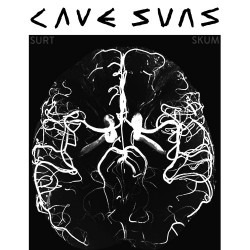
‘Surt Skum’ is a sweet Swedish treat and translates to ‘sour foam’ – at least according to the missive that accompanies the latest release from psych rockers Cave Suns and their missive from Tier 3 Newcastle, who report that they ‘entered their lysergic bubble of a practice room, to escape the impending mask strewn, gig parched landscape of the North East’.

Emerging from a series of improvisations, this EP offers some solid – if ragged – grooves and a fuckload of energy – not to mention some wild wah-wah action.

The title track kicks things off in a suitably raw but dynamic style: propelled by motoric drumming and a throbbing, repetitive bass that provides the backdrop to a sprawling, wah-laden lead, it’s a dense rush of heavy kraut-infused psych played rough ‘n’ ready, and this sounds lie a one-take live in the studio affair, and the up-front drum thump that clatters and crashes through ‘Sleep Never Rusts’ isn’t so much underproduced as unproduced – but the sounds very like Joy Division’s ‘Dead Souls’, and the nagging bassline isn’t the only factor in this epic builder.

Six-and-a-half-minute finale ‘Sloop John Dee’ brings goth-tinged Celtic guitars as if played by Hendrix to a heavy stoner riff that’s welded – albeit loosely – to a stomping tribal beat that’s pure new wave.

It all adds up to a pretty intense experience, and a cracking release.