Archive for the ‘Albums’ Category

By Norse Music – 6 September 2016

Christopher Nosnibor

It was reading Naomi Kline’s Doppelganger recently that I truly came to appreciate the way in which western colonialism has annihilated indigenous cultures. I have no real defence for my ignorance, although it’s most apparent that the version of history we receive from virtually any source you care to name is slanted, skewed, almost to the point of revisionary fabrication. The fact that so many countless indigenous cultures have been erased or so diminished so as to be rendered invisible has become normalised and recounted as a process of ‘civilisation’ or ‘improvement’ renders the wider world oblivious to the brutality of fact.

And so it was that reading the text which accompanies Mari Boine’s latest release struck me with a heightened impact, and it’s worth quoting for context:

‘Like so many people impacted by colonisation which we see throughout the world today and throughout history, the Sámi people of Norway (Sweden, Finland and Russia), have been oppressed and deprived of their distinct indigenous culture and language since the 17th century. Mari’s music aims to convey a sense of oppression and frustration, anger and sorrow, which stems from this history. On Alva specifically, a Northern Sámi word which translates to energy, determination or willpower, Mari’s compelling use of traditional joik singing bores through layers of history, imploring the Sámi people to

‘Bring out, breathe out the stories

that ask to be told

With your light feet

trespass the border of time’

This release, we learn, sees Mari Boine ‘blending ancient traditions and resonating with a message of respect for the earth. Alva is not just an album – it’s a journey into the very soul of Sámi heritage, brought to life by one of the world’s most compelling and visionary artists.’

And indeed it is. The thirteen songs on Alva which translates as ‘willpower’ – possess a palpable sense of spirit, of – for wont of better words as I fumble around in a weak effort to articulate – heritage, culture. Even where it’s not possible to comprehend the words themselves, the music, and Mari’s voice speak, and do so on an instinctive, human level.

You see, colonialism – and our capitalist society – was / is based on division, a narrative of ‘us’ and ‘them’, with an othering of indigenous peoples as being lesser. The fact the world as is – particularly in the last few years, and particularly on social media, which has increasingly become a cesspit of division and self-centredness – means a lot of us have lost sight of the fact that fundamentally, we have more in common than we have separations, and division is another instrument of control exercised by those who strive to hold power in this capitalist society. When society tells us that the only way becomes dog-eat-dog (and migrant-eat-dog, and cat, becomes a topic in a presidential debate), it’s apparent just how fucked-up things have got, and how far we’ve come from living in harmony with symbiosis with the planet.

Alva doesn’t evoke ‘simpler’ times by any stretch. In fact, I suspect what may prove unexpected for many is just how timeless – and at the same time, contemporary – Alva sounds. ‘Dánsso fal mu váhkaran’ manages to infuse an airy, folksy song with a tinge of funk and a buoyant, almost Eurovision groove, while ‘Várjaliviĉĉet min vuolláneames brings bold, ceremonial beats, and ‘Anárjoh’ gáttis’ is expansive and atmospheric, and again, percussion-driven. But there’s an air of fluidity, of naturalness, of something at once earthy and above the earth which lingers around the delicately-poised melodies.

Alva is graceful, life-affirming, meditative, transportative, and magical.

AA

MariBoine_Alva_Front-9903cf014505143c

Dret Skivor – 6th September 2024

Christopher Nosnibor

Traditions are important: they’re grounding, they give us a sense of comfort and safety in their familiarity. In times of tumult, of confusion, during difficult times, they offer a raft to cling to in a sea of unrest. I’m not referring solely or specifically to old traditions, either, especially not the ones where Christianity has usurped pagan tradition, only for these traditions to in turn be usurped by the mechanisms of corporate capitalism. Christmas is the kind of tradition that should be tossed on the fire. What we need is to establish new traditions, traditions which are personal and meaningful – anniversary gigs or meet-ups, for example.

On a personal level myself, since one of the last holidays we made as a family saw us meet my late wife’s step-mum on Lindisfarne on August bank holiday week, and we had been due to stay there in accommodation with a view of the castle, we instead scattered some of her ashes with that view of the castle, and visit the spot around the same time each year before going to the pub we lunched in on that last visit. On the one hand it’s sad, but in such a magnificent and historically-rich location (we got married in Northumberland, and had Lindisfarne fruit wines obligingly delivered directly to the venue across the causeway), this new tradition of ours feels right, and in many ways positive.

The same is true – albeit in a different way, of course – of the traditional reconvening of the pairing of Procter and Poulsen. Something was written about it once, I seem to recall. Two friends, who see one another infrequently, but always make some noise together, and release the results, at some point or another. This is the kind of tradition which possesses real meaning, a symbol of connection. In a way, whatever music the session yields is irrelevant: this is about ritual, and interpersonal resonance.

As the title suggests, this is their eighth collaborative release, and contains two longform tracks, each occupying a full side of a C40 cassette, this time released in a limited edition of six.

There’s no way you’d describe the devastating soundtrack to nuclear annihilation that is ‘A’ as ambient: distorted, mangled vocals crackle out from the howling wails of feedback torn from shredded circuitry in a heavy gale which carries pure devastation. Once that raging storm dissipates, we’re still left with the sonic equivalent of a nuclear winter, the sounds drifting over shattered remains, fragments of things which existed before. Glitching beats fizz out in crackling walls of noise and fizzing distortion. Bleeps and wibbles pop and buzz and there are moments where it’s possible to catch a short breath. Sometimes it’s almost dubby, but it’s always a desert. It’s always desolate. The atmosphere is always thick, uninhabitable.

‘B’ is dronier, buzzier, more overtly electronic – but more like a giant bee hovering in suspension – sedate, bur trapped. As the track progresses – at least in terms of duration – it seems to degenerate, forms disintegrating, fracturing, crumbling, degrading. It’s not done elegantly, aesthetically, but presents as a greyening mess of murk and twisted wires, indistinct moans and Triffid-like clicks and clacks. It’s oppressive, and feels like crawling through the soundtrack to being a survivor of the apocalypse in a bleak 80s dystopian series.

Nothing is comfortable. Nothing is right. Tension and darkness are all around: every inch of this experience is eerie, uncomfortable. You don’t want to be here – but there is no escape. This is sheer horror, without words.

The shuffle into some sort of 80s industrial experimentation with a scratching guitar and stammering heartbeat percussion which soon slips into fibrillation, which comes to pass close to the end, only renders the experience all the stranger, before birdsong and groans hint that perhaps, this is it – you’re here, you’re dead. Perhaps we are all dead already, and life is an illusion. Perhaps this would be for the best.

AA

a3358540954_10

Tidal Wave Records – 6th September 2024

Christopher Nosnibor

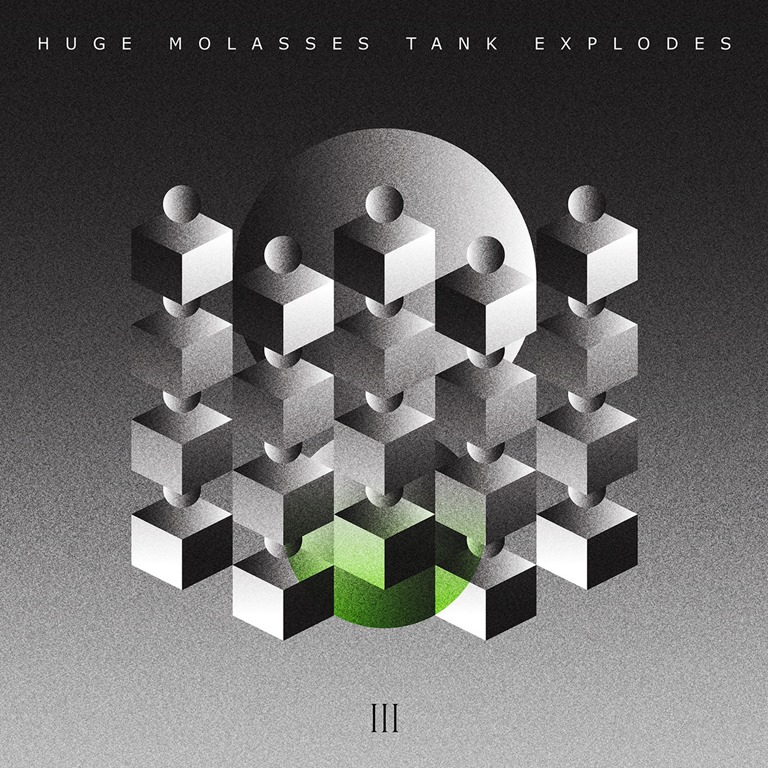
Advance single cuts ‘Indeterminate’ and ‘Distant Glows’ whetted the appetite for III, the latest long-player from the cumbersomely-monikered purveyors of swirling psychedelic rock with a propensity for motorik rhythms. And the album does not disappoint.

Sure, there’s an element of formula here: sprawling psychedelic rock may have its roots in the 60s, but the 90s revival really cemented the form, and since then, it’s just kept on coming in wave after wave: it’s never really been totally on trend, but it’s never been out of favour, either. But when done well, it’s utterly enthralling, and Huge Molasses Tank know exactly what they’re doing here.

After a short, shimmering keyboard-led intro, first single ‘Bow of Gold’ wafts in like a heat haze, a steady, trickling melt of tone and texture – mellow, bleached-out hues ripple as the guitars bend and drift, bleeding into the mid-paced flow of the cloudlike ‘Tenuous Form’, where I’m reminded of Nowhere-era Ride, but also – perhaps less well-known but no less worthwhile – The Early Years. Time simply floats into a passing drift, and in your mind’s eye you see vintage photographs and movie clips, the oversaturated colours glaring and the details, the faces and forms blurred. Five minutes, six minutes, as you become immersed within the hypnotic flow of each song, time and reality evaporate in a sonic haze. It’s beautiful. Compelling and calming in equal measure, you start to feel your limbs loosen.

I’ve no great insights or exploratory reflections to posit here, no theories or musings: I simply find that music of this ilk hits a certain spot. You can sit back and let it unwind, and unwind with it. The original 60s sound may have been revived in the 90s, but since then it’s been a cyclical return to the space in between these as the past is filtered through endless contemporary filters and refractions, and receded further into the distance.

‘Indeterminate’ brings the synths to the fore and is more assertive and overtly Krautrock in its stylings, but still possesses that essential depth and dynamic which drives the more guitar driven songs – among which the penultimate track, ‘The Fall’, stands out with some solid riffery in the wake of the more dreamy, drifting, less overtly structured lower-paces ‘Eerie Light’. Yes, here they bring to energy and some pace, highlighting the album’s range. But for that range, III is a coherent work which pulls together the corners of all things psychedelic, and its quality is consistent – and it sure is a groove.

AA

a0971484828_10

APF Records – 30th August 2024

Christopher Nosnibor

Perhaps it’s because I listen to and write about a pretty broad range of music, perhaps it’s something else entirely, but sometimes, I just get buzzed by the prospect of some monster riffage. And that’s what’s promised here with WALL’s debut, Brick by Brick.

Their press write-up got me in half a sentence, describing them as ‘An instrumental 2-piece heavy fucking riff machine, built brick by brick & riff by riff by twin brothers and Desert Storm members Ryan & Elliot Cole’ and the news that ‘debut album Brick by Brick is overflowing with unashamed Iommi-worshipping, instrumental, sludge/doom metal.’

There’s some flamboyant fretwork which adds detail – and a hint of extravagance – to the tunes, but in the main, they keep things tight, with pounding percussion and pulverising, full-weight riffery dominating the album from beginning to end.

Some may balk at the absence of vocals, and listening to the big, overdriven guitar heft of the album’s thirteen tracks, most of which pish their way past four minutes, which makes for quite a long album, I did occasionally thing that some throat-ripping larynx work would be of benefit. But then, how many great albums, even great bands, have disappointed with the vocals, for whatever reason? The number of times weak vocals have let down a strong instrumental sound for me is beyond my counting, so on balance, they’re wise to stick with the instrumental duo setup instead of risk diminishing the material.

The band – and album – are appropriately-named. This is just short of an hour’s worth of relentless riffery, and it’s solid. Like, well, a wall, and heavy, like, er, bricks. These may not sound like revelatory statements, but the point is that so many bands promise the world and barely deliver more than few pebbles. WALL hammer our hard riffs, back-to-back.

‘Legion’ is almost buoyant and the intro at least offers a picked guitar line that sits with the turn of the millennium metal sound before big, thick power chords crash in, evoking the spirit of the 70s and then some. ‘Avalanche’ brings with it some busy fingerwork, something which veers toward excess on ‘The Tusk’, but is kept in check for much of the album, thankfully.

There’s not really anything that’s new on Brick by Brick, but this kind of consistent riffology is comforting in a way, and moreover, they don’t disappoint.

There are some nice, atmospheric and pleasantly musical passages to be found along the way, and they clearly understand the power of the dynamic as well as of volume. When they take things down, it reels you in, before slamming on all the pedals and blasting you away with big, big chords. A few tracks feel a bit like filler, but then again, they provide some contrast, which is never a bad thing when an album is very much centred around one specific thing, namely headbanging instrumental riffs.

There are a couple of covers, and one night question the necessity of their inclusion, particularly closing with a Black Sabbath cover (‘Electric Funeral’): the may have been wiser to cut it on the penultimate track, the massive slugger that is ‘Filthy Doner Kebabs on a Gut Full of Lager’, but maybe they just don’t know when they’ve had enough, eh? But for that, this definitely feels like an eight out of ten in terms of delivering what it sets out to.

AA

a1461439387_10

Petroglyph Music – 25th August 2024

Christopher Nisnibor

Deborah Fialkiewicz, who I first encountered performing as one half of her noisy dark ambient duo SPORE, is one busy and highly prolific creator, who not only manages to whip musical work spanning contemporary classical to ambience from out of the air at a remarkable pace, but clearly thrives on collaboration. This latest one, with German sound sculptor Wilfried Hanrath, is a further example of the way in which the coming together of artists with slightly different background and musical bents can make for unexpected – and brilliant – results.

As the accompanying notes explain, ‘the album starts with Deborah’s wonderful piece ‘Love’ and ends with Wilfried’s interpretation of it – ‘Love in other words’… The eight tracks in-between are based on noisy, dark ambient drones Deborah provided. Wilfried, inspired by a short trip to the sea, added to these by playing his synthesizer in the beautiful seaside resort. The result is a melange that combines the influences that both bring into this project to something larger than its components.’

Having recently returned from a week by the sea – on the Cornish coast – I can certainly vouch for the replenishing, refreshing, and inspirational qualities of the sea. Living inland and in climes which are perpetually humid and polluted, one immediately notices the difference in air quality when in the presence of a sea breeze.

As collaborations go, this is a particularly interesting one, not only musically as of and in itself, but it’s difficult to separate out what each of the contributors has brought here.

Fialkiewicz’ opening composition is gentle, combining tweaks, tweets, and twitters over the picked strings of a chamber orchestra of sorts, and a billowing wind which fills the background. It’s simultaneously sedate and mournful, and ends feeling unresolved.

Fialkiewicz’ capacity for conjuring dark drones is well-documented, primarily with her work as one half of Spore, but just how much manipulation they’ve been subjected to at the hand of Hanrath – which should really be an album title for a future collaborative / remix work of his – is impossible to determine. This is how collaborations should be, really: the aim should be to achieve a blend, to, and to conjure something which is neither one party nor the other. LOVE fits this criteria: it’s not about who does what, specifically, but the overall listening experience being something different, which is neither one artist or the other, but what they create in combination.

Following ‘Love’, ‘Oneness’ marks a complete shift in every way: it’s a bubbling quickfire electro piece that pretty much brings Kraftwerk together with Gershon Kingsley’s ‘Popcorn’. This numerical sequence of pieces, which runs from ‘Oneness’ to ‘Eigthness’ is an evolutionary, exploratory series, the majority of which are an expansive seven or eight minutes in duration and really mine a deep seam of bubbling, squelchy electronica which becomes increasingly engrossed in the quite granular details of the interplay and interaction between tone and texture, but without venturing fully into the dots-in-front-of-the-eyes details of the truly microtonal.

Slow winds and wide washes define the soundscapes offered here, and I suspect these are the foundations Fialkiewicz provided before Hanrath began to add his spin to them, with stabbing strikes and all kinds of digressions and generally unpredictable incidents which change both the course and the mood of the pieces.

‘Threeness’ is a particularly layered piece, ominous and brooding at first and subsequently, but interrupted by wibbling bleeps, a hint of an R2D2 seeking escape from the haunting confines of the track’s opening. Nothing is quite as it seems, and nothing feels quite right here.

‘Fourness’ is a torturous mess of oscillating drones and groans pitched against a mangled sampled vocal loop, and as one of the album’s darkest and most uncomfortable pieces, it’s very much in the vein of Throbbing Gristle. But suddenly, emerging from the frothing tempest of noise emerges a piano which brings tranquillity to provide balance. And this is where LOVE exceeds. There is a lot going on, and it’s an album which really revels in its contrasts and its manifold depths. This means that overall, and in context, LOVE is a standout work which conforms to no set parameters, doesn’t really sit anywhere, not least of all within the realms of expectation.

AA

a0291842123_10

27th August 2024

Christopher Nisnibor

Just read that bio, and reflect for a moment:

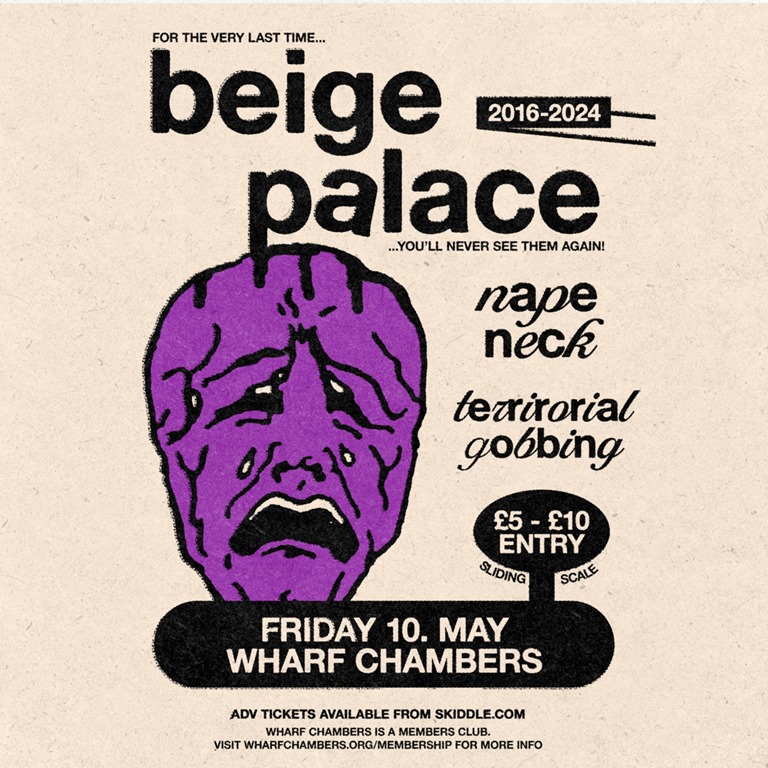
Beige Palace was a band from 2016 to 2024. During that time we released two albums, an EP, a split 7" and some other miscellaneous bits. We toured the UK a bunch, we managed to play shows in France and Belgium, and we opened for some of our favourite bands like Shellac, Mclusky and Dawn of Midi. It has been lovely!

These are no small achievements. But for all of them, Leeds’ leading exponents of low-key lo-fi have been humble and kept it DIY throughout their eight-year career. Fans inevitably feel a sense of loss at the demise of any band, but as someone who was present at their first ever show and having followed their progress through the years, this feels like a particularly sad moment. It shouldn’t: the members have moved on to become Solderer, with the addition of Theo Gowans, a Leeds luminary, gig promoter, purveyor of mad noise as Territorial Gobbing, and one-time member of Thank, another of Freddy Vinehill-Cliffe’s vehicles, and of course, they’ve all received coverage here along the way.

So we shouldn’t feel sad. Instead, we should celebrate the achievements of a band who seemingly set out with no ambitions other than to make music for themselves. But still… I was in attendance at their first show, and as I documented at the time, and as I’ve mentioned in subsequent reviews, they were ace. Unassuming, a shade awkward, perhaps, but warm, human, and appealing in the way they presented their set of sparse, minimal tunes, Young Marble Giants were my first-choice reference point.

How YMG, a band whose album was released on Rough Trade and who have been the subject of a number of articles, not to mention being referenced and covered by the likes of Hole, remain obscure, I will never comprehend. But no matter: Beige Palace picked up their baton and, er, hid it under the settee.

In contrast to the wildly flamboyant dayglo-sporting Thank, Beige Palace were always the introspective, introverted musical counterpart who hung back, heads down as they looked at their shoes. Beige Palace’s successes happened almost in spite of the band themselves. That’s no criticism. They were a great live band, and they released some great music, too. I’m reminded of one of the other great DIY Leeds – via Bradford – bands, That Fucking Tank, who bookended their career with recordings of their first and last shows. Without the documents, the events would be but myths and legends.

This looks like being the first of two retrospective releases, and as a recording of their last live show – which neatly bookends my experience of the band, having attended their first – makes my case about the quality of their performances.

LIVE For The Very Last Time (2016-2024) presents a career-spanning set, with opener ‘Mum, Tell Him’, ‘Dr Thingy’, and ‘Illegal Backflip’ representing their 2019 debut album, Leg, and a fair few cuts from Making Sounds for Andy packing out a varied set, which culminates in single ‘Waterloo Sublet’.

But there are a handful of unreleased songs here, too: like Thank, Beige Palace were always focused on the next project, the next release, and as the very naming of ‘Waterloo Sublet’ illustrates, irreverence was their thing. ‘Local Sandwich’ is a perfect illustration of their quirky irreverence, as Vinehill-Cliffe rants about, yes, a local sandwich shop.

LIVE For The Very Last Time (2016-2024) captures everything that was great about this trio. Awkward, honest, slightly disconnected between-song chat is integral to the experience, and there’s plenty of that – including comments on someone’s wind – on this warts-and-all, as-it-happened recording, captured in Leeds in the intimate but awesome grassroots venue, Wharf Chambers, where the sound is always good – and loud – the audiences are friendly, and the beer is cheap.

There are no overdubs, there’s no polish or pretence, and LIVE For The Very Last Time (2016-2024) is all the better for the fact. The mix isn’t always balanced – the vocals are half-buried and times and the guitars are way loud at times, but what you get is a feel for being in the room.

The music is gloriously wonky, skewed, angular math-rock with some valiant forays into noise. The vocals and guitar both veer wide of melody; it’s the lumbering, loping, rhythm section that keeps everything together: without them, it would be a complete disaster. But this is how some bands work, and Beight Palace always sounded like a band on the brink of falling apart, in the same way Trumans Water always sounded like they may or may not make it to the end of the song as they jerk and jolt their way through waves of chaos.

‘Update Hello Blue Bag Black Bag’ which lands mid-set making its debut and final appearance is unexpectedly evocative, and the eleven-and-a-half-minute ‘Dinner Practice’, also unreleased, hints at the trajectory they might have taken on their next album.

Beige Palace were never going to be huge: they were cut out for cult fandom, and comfortable with that, being one of those bands who made music for fun first and foremost. It’s the sense of fun that come across here. Even in the most downtempo songs, what comes across is that they’re enjoying playing. They will be missed, but we look forward to their next incarnation.

AA

a3696456151_10

ENCI Records

Christopher Nosnibor

It’s taken me a while to get around to this one. It happens, and happens often: I’m simply overwhelmed by the sheer quantity of new – and exciting – releases that land with me on a daily basis. Of all the things to be overwhelmed by (and I will confess that I often find myself overwhelmed by many other things, too, from parenting challenges to DIY, budgeting and the prospect of driving to the supermarket), I do realise that I’m extremely fortunate. But there’s a specific reason I’ve selected this album to post a review of today. Why today? For those who live in a vacuum – and at this moment, I truly envy you – today is the day Oasis announced their reunion and a fourteen-date UK tour. ‘The news the world has been waiting for’, people frothed on FaceBook. Fuck me: judging by the reaction and the blanket press coverage, you’d think world peace and a handout of million quid for every person on the planet had just been announced simultaneously. But no. Just a couple of gobshites have decided that for a few hundred million quid they can bare to be in one another’s presence for a bit. It’s not even looking like it’s the full or original band reuniting.

For many, Oasis were, and remain, the best band on the planet in the whole of history. For anyone with ears, they were purveyors of lumpen, lifeless, plodding, derivative pub rock. A great many of the people who are going absolutely fucking apeshit at the news are broadly in my demographic, who were in their twenties in the nineties, and who, on hitting thirty, found their cultural clock stalled, and they’ve spent the last twenty years or so bemoaning the fact that there’s no been any decent new music since the 90s and how they miss Chris Evans and TFI Friday.

Just as age tends to have a correspondence with increasing political conservatism, so the same is true of musical tastes. It’s why parents of every generation gripe about the music their kids listen to and dismiss it as being shite, without appreciating that they’re not supposed to like or even understand it, because they’re not the target audience. Do I get K-Pop? No, no more than Skibidi Toilet makes any sense or provides any amusement to me. It would be weird if I was down with the kids at the age of 48, and my daughter would likely find me even more embarrassing if I was than being the dinosaur she perceives me as. BUT – and it’s a massive but, a but so massive Sir Mix-A-Lot would die for, that doesn’t mean that there’s no new music of interest any more.

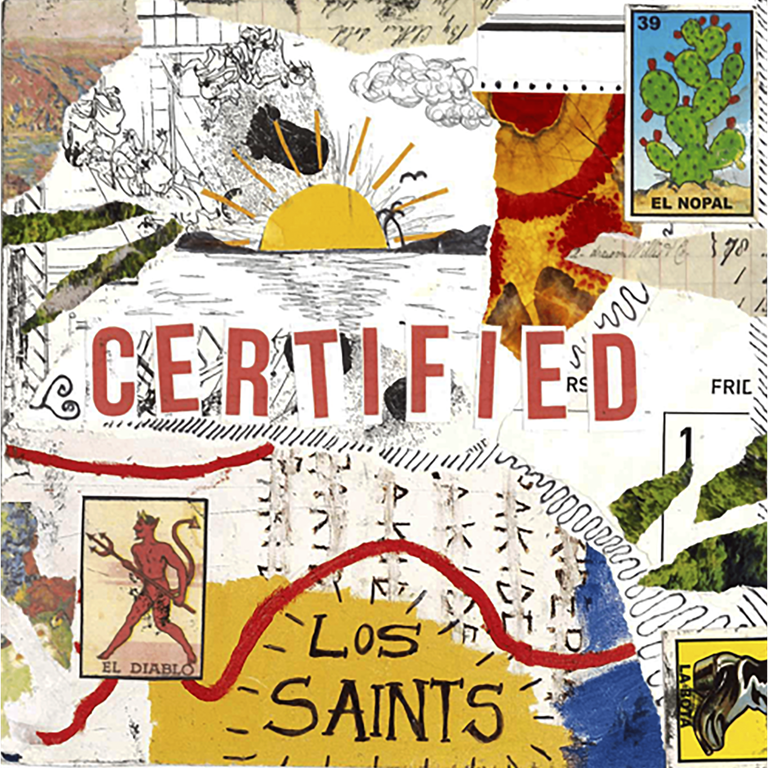
Certified, the debut album by San Diego-based Los Saints, is a perfect illustration of this fact. They describe themselves as an alternative rock band. Various other sources, in their coverage, have referred to them as showcasing a ‘bold indie rock sound’, ‘indie’, and even ‘Chula Vista’s version of Cage the Elephant’, alongside numerous comparisons to The Strokes. I’m not a fan of either The Strokes or Cage the Elephant, but that’s beside the point: both of these acts have produced music far more exciting than anything Oasis mustered during their career spent serving up half-baked bollocks and right now, in the present, amidst the endless wanking over the announcement that after fifteen years a couple of overrated has-beens are going to reheat their tedious, tepid stodge in the name of nostalgia and the interest of payola, we have Los Saints giving us Certified.

There are rib-rattling basslines aplenty, which give the songs – which tend to be on the shorter side, with only a couple of the album’s ten tracks running over three and a half minutes – a really beefy sound and a certain dynamism, an urgency (the likes of which you’ll hardly ever find in an Oasis song). Lead single ‘Faded’, which kick-starts the album with a lively two-minute stomp not only gets things off to a cracking start, but sets the tone, too – dreamy, slightly fuzzy, psychedelic vocals and mellow guitars contrast with the stonking rhythm section, and if anything, ‘Where We Goin’, which follows it is even better, and then again, the punky, poppy, melodic guitar driven indie of ‘Hard’, which lands perfectly between Asylums and Pixies. Even if the rest of the album was shit, after this opening run, you wouldn’t grumble. But no, they keep on delivering joyous tunes with the grungy pop nouse of DZ Deathrays crossed with the driving tones of Darklands era Jesus and Mary Chain and a dash of A Place to Bury Strangers. The title track pairs a nagging guitar with another chunky-as-anything bass before blasting into a breezy but sturdy chorus, and there simply isn’t a dud here.

The production isn’t overly polished, giving the album a live-sounding energy, and this only enhances its appeal, because you feel the band are really in the music, feeling the playing of the songs. Yes, some of the touchstones may be from some mythical golden era – as identified by people of a certain age – but Los Saints show that they can write songs – rather than rip them off – and deliver them with a contagious vibrance.

Bollocks to nostalgia: Certified is proof that not only is there some great new music around, but that a lot of stuff that’s held up as being ‘classic’ is objectively underwhelming and its status is tied to a period in time – and popularity is no measure of anything other than popularity itself – or, more probably, good marketing.

AA

Certified_-_Album_Cover_Resized

Metropolis Records – 23rd August 2024

Christopher Nosnibor

Even at their commercial peak, PIG releases weren’t all that easy to come by, at least here in the UK, despite some of them being on big labels with big distribution. PIG – the project of London-born Raymond Watts – is an act which can legitimately claim to be big in Japan while largely unknown at home.

My own first encounter was seeing them support Nine Inch Nails on The Downward Spiral Tour in Wolverhampton in 1994. I was in the middle of my A-level exams, but no way was I going to miss NIN. I didn’t even know who the support were, but witnessing the heavy grind of PIG, with pigs’ heads on poles at the sides of the stage, as their lanky singer writhed his way through a gritty set was an absolute revelation. The set’s opening song stuck with me, but it was some years before I would actually source a copy of Red Raw and Sore, on this new site called eBay. The debut album, A Poke in the Eye…. With a Sharp Stick and the ‘Sick City’ 12” were fairly easy to find at record fairs around 1994, as Wax Trax! vinyl was available in abundance, and often cheaply, too, but anything else? Pretty much impossible to find. And so it was that PIG felt like a near-mythical act, and despite having played these big shows with NIN, still no-one was really aware of them.

Sinsation was released first in Japan in 1995, and a year later in the US, and on learning of its existence, I got my local record shop to order it in, but had to wait literally months for it to arrive on import. Oh, but it was worth the wait. It delivered all of the theatrical pomp that defined A Stroll in the Pork, but cranked up the dirty industrial guitars and found Raymond Watts in top form with his extravagant wordplay. In short, it reset the bar, not just for PIG, but for what ‘industrial’ music could be. This wasn’t just hard and heavy, but also playful, witty, intelligent, and still dark, seething.

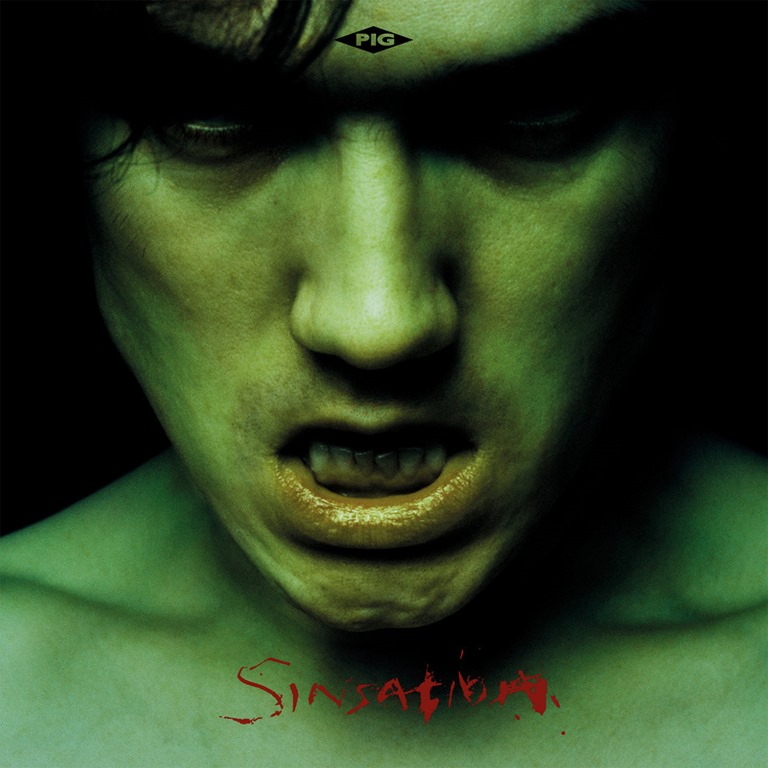
The cover alone is striking. Watts’ image is a standard feature on all PIG releases, but whereas more often than not he is depicted looking buff or brooding, the sickly green hue is unsettling – and slamming in with a series of orchestral strikes and a low, grumbling bass before hitting full-on industrial anthem mode on the first track, the six-minute ‘Serial Killer Thriller’ (the chorus of which provides the album’s title), it’s immediately apparent that Sinsation is something special (and not something sad…).

Admittedly, despite this being an album I’ve played to death over the last thirty years, apart from a few tracks being a few seconds different in their duration, I can’t discern any huge differences between this remastered version and the original: there are, perhaps, more details revealed in the mix, but then, the production on the original was impressive, and again, I’ll come back to that word, ‘detail’. There’s a lot happening; samples, snippets of bits and bobs, strings, multi-layered vocals… A touring member of Foetus early in his career, with JG Thirlwell involved in the early singles and debut album, Watts clearly learned much from Thirlwell, as well as his early involvement with KMFDM. Sinsation felt like the point at which he brought these two aspects together in perfect balance while simultaneously realising his own unique sonic vision. The result was a set of hefty, driving songs, exploding with ideas and noise, and so many layers, so much going off all over the place. It was bold, audacious, and while it’s easy enough to say that it’s a bit Foetus, a bit KMFDM, it goers so far beyond these points that comparisons are a diminishment of Watt’s achievements here.

Sinsation is certainly the first PIG album to showcase the full range of styles and compositional aspects Watts has in his locker, and as such, represents something of a creative peak.

While nominal single ‘Painiac’ (an early version of which was the lead track on a Japanese-only EP, and a video for which got a few spins on MTV on the album’s release) is a throbbing industrial beast of a tune, ‘Golgotha’ is a dark, semi-ambient interlude which sits between the driving snarl of ‘Hamstring on the Highway’ and the swaggering industrial-strength glam-tinged gospel-infused dark pop of ‘The Sick’, which would provide the blueprint for the PIG renaissance which started with The Gospel in 2016. ‘Analgesia’ is a magnificently atmospheric piano-led instrumental which incorporates elements of ambient and electronica and extraneous noise ‘Volcano’ is serpentine and sleazy, with some audacious orchestral work in the mid-section which take the bombast of Foetus’ Nail to another level, while ‘Hot Hole’ drives hard and heavy with pulsating electronics colliding with hefty chugging guitars and ferocious beats.

For the many who likely missed this the first time, this re-release provides the opportunity to make acquaintance with one of the definitive PIG albums, and for those already familiar, it’s a timely reminder of the incredible journey that has been PIG’s career to date, while offering the first chance to get it on vinyl. Almost thirty years on from its first release, Sinsation still sounds phenomenal – insanely ambitious, utterly deranged, and in a league of its own, quite unlike anything else before or since, even within the PIG catalogue.

AA

a2059987689_10

Room40 – 6th September 2024

Christopher Nosnibor

For an album that’s based solely on the sounds of the guitar, Dust Resonance sounds distinctly unlike a guitar album. As the title, Dust Resonance, suggests, this is a work of extended, drifting drones, a set that’s predominantly ambient in nature.

But as Norman Westberg’s recent solo releases – also released on ROOM40 – have demonstrated, it is quite possible to take the guitar into this territory, and to create expansive, subterranean drones with just six strings and some distortion pedals, and perhaps some reverb thrown in.

As Zimoun himself explains, he was interested in the guitar as a sound source for some time and have explored it on previous editions including Guitar Studies I-III. “On this work,” he says, “I’ve experimented with different methods and materials, specifically a Magnatone tube amplifier from the 1960s, and various speaker membranes covered with dust, soil, or small stones. The friction of these materials on the vibrating speaker membranes produced slight distortions and irregularities in the sounds, alongside the warm tube tones of the vintage amp.”

As such, the dust is rather more literal than metaphorical here, but the title and the substance of the sound presents a work that functions on multiple levels, with the connotations of dust settling as time elapses and the idea of dust and drones hazing together working alongside the physical interference of organic material with the mechanics of the recording process.

Zimoun’s approach, then, like Westberg’s, is similarly simple and sparse, but at the same time, adds an edge of experimentalism which is quite unique. The addition of materials to create friction and alter the texture of his guitar may take its cues from the ‘prepared piano’ pioneered by John Cage and taken forward as a career choice by Reinhold Friedl. I can’t think of so many examples of the guitar being twisted and mangled in such a way, or an artist taking such an organic, earthy approach to breaking down the fundamentals of the sound of their instrument of choice. It does, however, create the context for an album which features nine dronescapes which creep into one another to forge a continuous hum, scratching, scraping, quite literal earthworks. The thought of earthworks draws me to a place where I find myself reflecting on hut circles, tumuli, and the landscape of the iron age, something I was fascinated by in my early teens and have once again become drawn to having resumed, after a lengthy period, walking moorlands and studying the details of OS maps. And so it’s purple-hued heather-covered moors and outdoor expanses which occupy my mind as I listen to this, a work which evokes similarly vast and barren spaces.

The album contains nine numbered pieces, which hover low and heavy and segue into one another to create one single, monolithic work, and one of immense density. The colossal ‘DR Part 2’, which grinds on for almost nine minutes is exemplary.

I recently wrote on the experience of listening to the instrumental ambient release Ambient Short Stories by Bistro Boy, which slotted firmly into the ‘background’ ambient slot: soft, gentle, undemanding. This is most definitely not background: the dense, buzzing tones and uncomfortable frequencies of Dust Resonance place it firmly in the foreground. It’s impossible to settle back and let this drift over as you yawn and slowly relax into a space of tranquillity. Dust Resonance makes you squirm, sends tension down your spine. Throughout, there is a sense of unease, discomfort, of wrong, which rumbles in the guts.

Dust Resonance is a work which, beneath its smooth surface ambience, is grinding, rough-hewn, slow, and dragging, with billows of cloud accompanying the low-level churn. Something about this, paired with the slow-building spin, starts to feel a shade disorienting. You might sleep, but you may not sleep comfortably.

AA

a0068423991_10

Möller Records – 9th September 2024

Ambient Short Stories is the tenth album by Frosti Jonsson, who records as Bistro Boy. As selected monikers go, this isn’t one of the best in terms of what it connotes, at least for me. While I accept that there’s an element of personal perception involved here, there’s little escaping the fact that there’s a strong whiff of middle-class superiority in the mix here, a late-nineties / turn of the millennium snobbery with a hint of contemporaneous IKEA-tinged cool.

Cut back to 1997, my then girlfriend and I bought our first flat, a cardboardy newbuild with magnolia walls and magnolia carpets, which we stuffed with pine units and furnished the dining part of the open-plan kitchen-dining space with a trendy bistro-style circular table and chairs. On the other side of the same room, we’d sit on the IKEA sofa and watch Friends. I’ve actually got no beef with Friends, but fuck me, talk about cliché. We actually thought we were cool, and our friends did, too.

Ambient Short Stories contains eleven instrumental – and as the title suggests – ambient works, which are pleasant, mellow, easy on the ear. Fair enough. The compositions aren’t the sort of thing you’d actually hear in a bistro, or any other social setting for that matter, although the style is very much background when it comes to the level of attention the album demands. From amidst the generally gentle drifts and rippling waves pipe up some unexpected incidental bits and bobs, and these interjections – whether they’re woodwind or some dominant lead synth or something else – feel a bit out of place, a fraction loud in the mix, a bit wrong, and also a bit dated, a bit post-Tubular Bells 80s / 90s New Age.

Ambient Short Stories isn’t bad, by any stretch: in fact, as a gentle ambient work, it brings almost exactly what you’d probably want: it’s slow, supple, soothing, spacious, and quite soporific, to the point that it almost feels like AI has conjured the perfect balance of light and dark. It isn’t particularly gripping, but I don’t think it’s intended to be, instead sowing seeds of ponderousness.

AA

Ambient Short Stories - Ambient Short Stories - Bistro Boy