Archive for the ‘Albums’ Category

Cruel Nature Records – 21st February 2025

Christopher Nosnibor

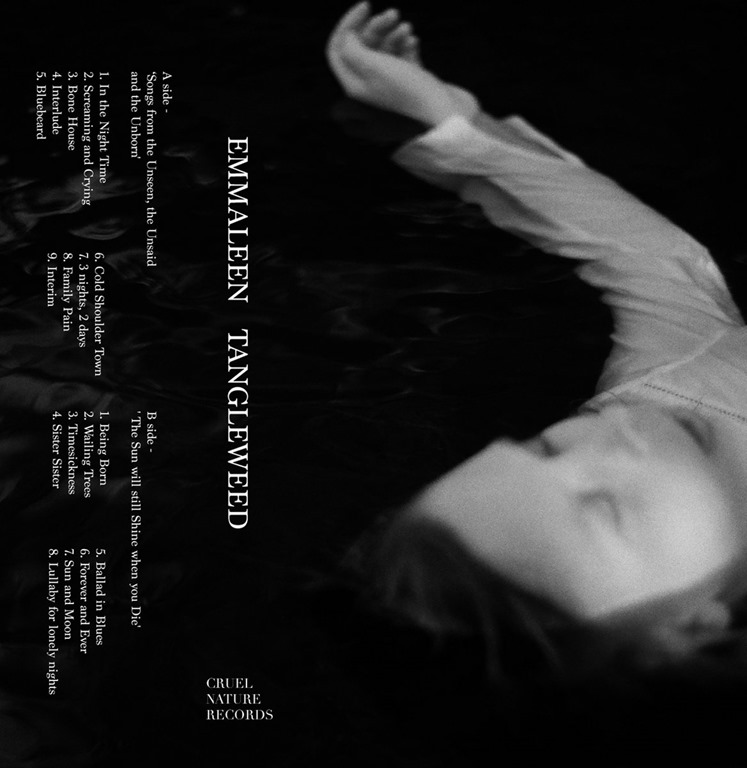
Sometimes, I find myself reading – and returning to – the write-up for an album and thinking ‘Yes: I’m going to like this… but perhaps not tonight. I don’t know if I’m ready or in the mood’. This immense release, which finds two previously-released album reissued as a single package consisting of seventeen pieces, by Namibian-born Emmaleen Tangleweed is one such example. Listening to new music daily doesn’t mean that writing about it is always easy, and sometimes, I find myself feeling daunted by the prospect, and asking myself ‘how could I do this justice?’

Here’s the preface, which accompanies the release on Bandcamp:

Emmaleen Tangleweed’s music is more accurately described as a channeling than a song. Summoning stories of lost souls too tortured to let go, she cries and yearns as they no longer can, and yet, a silver thread of faith binds them. Themes of death, relationship and lingering hope imbue the listener with an eerie feeling of communion, of conversing with souls who have crossed the great divide.

Painting a visionary picture for the listener the stories contain hidden characters and everyday dramas played out in a time capsule of song giving the words weight in the earthly as much as in the ethereal they are delicately plucked from.

There’s also the fact that I feel obliged to listen to a release the whole way through, uninterrupted, so as to experience it as intended, not as people dipping in and out and skipping through playlists do, meaning that two albums back-to-back is quite a commitment. Anyway.

Songs From the Unseen, The Unsaid And The Unborn (Tracks 1 – 8, 10) was originally self-released in November 2022, while The Sun Will Still Shine When You Die (Tracks 11 – 17) was again self-released in October the following year.

Listening to these simple yet hypnotic folk songs of Songs From the Unseen, The Unsaid And The Unborn, I find myself wondering if Tangleweed is really her name, in the same way I muse whenever I see someone wearing a coat from Jack Wolfskin. It would certainly be convenient if it was, because it’s a perfect match for the sparse but swampy blues of songs like ‘Screaming and Crying’ and ‘Bluebeard’. I also find myself thinking of early PJ Harvey – not because she was in any way blues, but because there’s something in the feel, the fact that it’s folk but not folk, blues but not blues, but not indie either. ‘3 Nights And 2 Days’, one of the shorter songs, is light in delivery, heavy in lyric, but the skipping, picked notes and easy groove are a joy.

Tangleweed’s voice is rich in timbre: not low but it has depths which imbue it with a gravity which in turn adds substance to the songs. And these are not short songs: Tangleweed spins out narratives over slow and steady acoustic strums running for five minutes at a time. But the time floats by.

The songs on The Sun Will Still Shine When You Die feel more considered, and are perhaps a few shades darker. Certainly, the seven-minute ‘Being Born’ is low, slow, epic in scope, and there are two songs – ‘Forever and Ever’ and ‘Lullaby for Lonely Nights’ – which stretch past eight minutes. The former balances a Leonard Cohen vibe with a more Beat-influenced spoken word approach. ‘Nice’ might not be quite the word, but it’s nicely done.

The arrangements – such as they are – are simple, the playing raw, immediate: it’s very like listening to the songs being played in a dimly-lit pub, with a room capacity of thirty, sitting on low stools around sticky circular tables with low chatter bubbling around as people go to the bar and pass observations. I have fond memories of many a night in pubs listening to some outstanding blues artists in my formative years, and I would say that my appreciation of live music really stems from these experiences. But it’s not solely for this reason that this release appeals: there’s something which resonates on a deeper level when it comes to heartfelt blues. It may be due to its timelessness. Wherever you go, whenever you go there, the blues is the blues, and it speaks to the soul. Tangleweed plays with honesty and without pretence, and the result is magic.

AA

a1995837137_10

Dret Skivor – 7th February 2025

Christopher Nosnibor

I do like an album with a story. With Korset i Röjden by D L F, we get half a story, but one which builds a sense of mystique, enigma, a sort of allusion to local folklore, set out in the notes which accompany the release:

‘There’s a place in the forest, in the shape of a cross, where nothing grows. No one knows how it got there, or why.

60°33’48.6"N 12°39’15.6"E

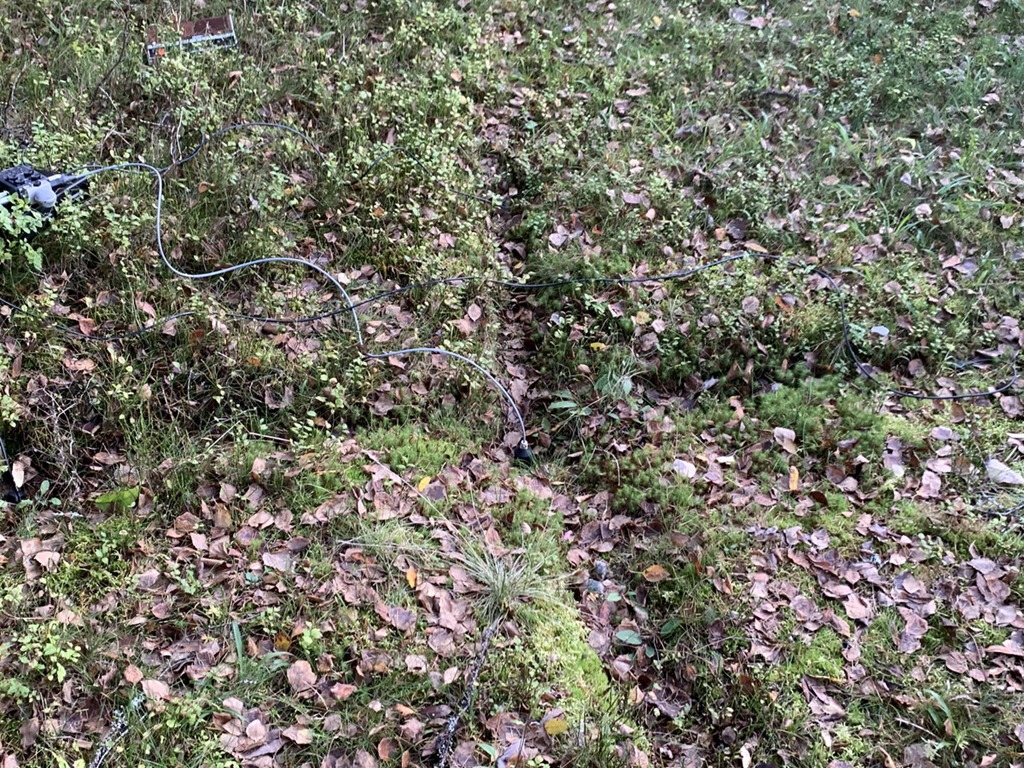
The two recordings on Korset i Röjden capture sounds and vibrations in and around the cross. A geophone, a few contact mics, an H6, a smartphone, and a broken cassette recorder. Track two, ‘Den onda ska pressas ur’, features samples from a 1963 television documentary, an old Finnish lullaby, and taped interviews with locals from the 1990s.’

This has got it all: mythology, mystery, co-ordinates – a map, in other words – and the kit, the foundations for a sonic retake of The Blair Witch Project, perhaps. There is a strong sense of there being something hat isn’t right. Granted, I get that from simply breathing the air, from turning on the news – but this is quietly unsettling. Very quietly, in places: the first two minutes or so of ‘Korset’ are almost the sound of silence. Turn it up, and there is the sound of air, a soft breeze, perhaps, some kind of background noise. Insects? Footsteps? The rustle of leaves? Perhaps, but just as nothing grows in that unexplained cross marked in the forest, so it seems there is little sound. No birdsong, no… nothing. Has anyone ever run a metal detector over the sight? Considered digging?

I mention digging with caution. There is a wood close to where I live, a portion of which has been decimated in the last three years or so by dirt bikers who have turned the space into a track with jumps and ditches. It’s clearly not just the work of a couple of kids with spades: these are proper earthworks, excavations, the likes of which have involved adults turning up with mini-diggers. I once witnessed a woman challenging a family who had turned up with motorbikes who were revving around and scaring pedestrians and dog-walkers being met with aggressive verbal abuse. My email reporting the matter was of no consequence. Rather like this narrative detour.

‘Det onda ska pressas ur’ offers another ten minutes of haunting dark ambience – unsettling, disorientating. It rumbles and echoes around infinite subterranean corridors, leading to who knows where? There are sounds – possibly the pushing through undergrowth, possibly almost anything else. Wraiths whisper through the clicks and crackles, hums and pops… is that breathing or simply the breeze?

Korset i Röjden tells us nothing, other than that the world is a dark and unpredictable place. It’s a dark and unpredictable album. But it hints that we should fear, and fear the worst. There are dark forces all around, and while the insanity of the world right now is more than reason to take cover, it’s worth remembering that there are other things a play.

AA

a2167462165_10

33.3 Music Collective – 5th February 2025

Christopher Nosnibor

It doesn’t seem like five minutes since Beauty in Chaos emerged with their debut album, and here, in the blink of an eye, we are looking at a twenty-nine track ‘reimagined’ version of the fourth album from this ever-expanding collective, curated by Michael Ciravolo (formerly of Human Drama and Gene Loves Jezebel. I’m not even going to start on the roll-call of personnel who have featured on these releases: I’d still be going by the time I’d finished listening to all twenty-nine tracks.

It’s certainly quite an expansion on the original eight songs which made up Dancing with Angels, which notably featured Wayne Hussey and Ashton Nyte among its guest vocalists. There is, as one might anticipate, an abundance of remixes – no fewer than five versions of ‘Holy Ground’, for example, and four of ‘Hollow’. Some are better than others, some are pretty radical, others less so, with the standard examples of slapping a big beat and some effects tossed into the mix with variable results, but Combichrist and Bellwether Syndicate are noteworthy for their contributions.

The ’almost acoustic version’ of ‘Made of Rain’ stands out not only by virtue of not being a remix, but also being a really good take on the song. But the selling point here are the songs which didn’t appear on the original album, which appear right at the very end of the monumental track-listing.

Their take on T-Rex’s ‘Children of the Revolution’ harks back to the early 90s when Al Jurgensen was arguably at his peak and dropping leftfield covers of ‘Lay Lady Lay’ and ‘Da Ya Think I’m Sexy?’, accompanied as it is by a video which finds the band performing behind a mesh fence, as Ministry did while touring Psalm 69 (as much for their safety as for effect). It also calls to mind the club scene in The Hunger where Bauhaus play ‘Bela Lugosi’s Dead’, and I don’t doubt that this is also intentional: Bauhaus – and Bowie – can both be heard waving influence through Beauty in Chaos’ songs. “The revolution will be televised”, Al announces through a loudhailer, and well, if you’ve seen any news in the last fortnight, you’ll know this to be a fact. However, the issue isn’t that anyone’s being fooled here, but that no-one seems willing or able to stop it: just as the world watched on as Israel perpetuated genocide on the Palestinians in Gaza, so it gawps, motionless, as Trump and Musk undertake a coup, and not just making a grab for absolute control over the United States, but world domination. It’s absolutely fucking terrifying – unlike this recording. It’s a solid enough cover, but perhaps lacks the bite and heft it deserves, being more straight-up than cranked-up.

‘Open Your Eyes’, originally by Lords of the New Church, also feels apposite – indeed, lyrically, it’s never been more relevant, and while this cover, again, is almost entirely faithful to the original and is accompanied by a video clearly shot during the same session as ‘Children of the Revolution’, it hits home to wrap up the album in fine style.

AA

AA

Atomic Disc 4 Panel Wallet 2 Pocket

Metropolis Records – 17th January 2025

Christopher Nosnibor

The arrival of So Lonely in Heaven marks the twenty-fifth anniversary of the existence of The Legendary Pink Dots. And it’s a concept album. Edward Ka-Spel sets it out as follows: ‘Way way back in the early days I used to say a lot about ‘The Terminal Kaleidoscope’, a concept comparing the fragile planet we live on to a drowning human being with life flashing before his or her eyes, the images constantly accelerating. It’s 2024, a little over two decades since the turn of this unbearably turbulent century and the concept appears to have become an unlikely soap opera where we are the cast.’

It’s their second post-pandemic album, and it’s weighted with a sense of impending doom and biblical destruction spun in a suitably grand fashion whereby prog meets avant-garde and electronica.

It can be a bit of a gamble opening an album with a long song – the risk being losing the listener before things have even got going. But it’s a calculated risk, on an album where most of the songs are pretty long.

Some of it’s Ka-Spel’s tone and enunciation, but the title track which is that first long song, carries hints of an electronic reimagining of Suede, circa Dog Man Star. That is to say it also sounds a bit Bowie, and a bit Kraftwek, and with some weirdly bits of glitchy noise and reverby piano, it has echoes of Outside.

Thereafter, there are big sounds and big moods and big concepts in abundance, and it’s by no means an easy album to pigeonhole. Space and environmental issues are woven through the twelve tracks, which, as I fumble for a context, evoke equally the whimsical hippy trippiness of Gong and the inventiveness of The Young Gods. ‘Choose Premium : First Prize’ delves into tense electro territory, and presents a rather harder edge than the preceding songs, and it’s here we really begin to feel the sense of the ‘machine’ which is a central focus of the album’s thematic content:

The machine is everything we are. It sees everything, hears everything, knows everything and feeds, speeds, drinks us down, spits us out – we lost control of it at the instant of its conception. You may cough, curse and die, but the machine will resurrect you without the flaws, at your peak, smiling from a screen, bidding someone in a lonely room to join you. It’s an invitation from Heaven, where anyone can be anything they want to be, but it’s a Nation of One. You’ll be everything we are. You’ll be a shadow of yourself. You’ll repeat yourself – endlessly. You’ll be desperate for some kind of explanation. You’ll be lonely. So very lonely…

This is nowhere more apparent than on the sparse, acoustic-guitar centred neofolk bleakness of ‘Wired High : Too Far To Fall’, which swells and soars and expands to immense proportions, as well as plunging to dark, sonorous depths over the course of its seven minutes. Elsewhere, ‘How Many Fingers In the Fog’ has a more post-punk feel to it, but still spun with a proggy haze, and there’s a lingering wistful melancholy which clings to it.

That there are whimsical, light-hearted moments of plinky-plonky keys and segments of So Lonely in Heaven sound more like wide-eyed stargazing in pure awe shouldn’t trick you into thinking this isn’t a serious album. The medium is the message, and entertainment is a diversion, a distraction, the ultimate lie that it’s ok to sit, sedated, and forget the world. The shit that’s gone down in America is the absolute proof of this: while everyone has been entertained by the circus, a coup has been taking place. This isn’t hyperbole, and this isn’t simply some scuffle in a small third-world republic. Meanwhile, people, especially here in the UK, are largely preoccupied with the current season of Love Island or whatever instead of trembling in fear for the future.

For all the buoyancy and quite enjoyable moments – ‘Blood Money : Transitional’ offers a quite accessible, easy groove beneath its darker surface – ‘business is business’, Ka-Spel sneers over a quite Depeche Mode-like accompaniment.

So Lonely in Heaven is varied, and sometimes sounds as if belongs to another era – but at the same time, it’s unexpectedly and shockingly relevant and now, and is well worth your time – whatever time you have left.

AA

867980

Long Trax Productions – 31st January 2024

Christopher Nosnibor

The brief liner notes are almost as perplexing as the cover art and the rest of Will Long’s Bandcamp page. I mean, you might think that the title is the key here. While clocking in around the eleven-minute mark, these compositions, as much as they’re far from short, well, I’ve certainly heard many longer trax, with many albums featuring a single twenty-minute piece on each side. But of course, it’s a pun. Sort of. Regardless, spreading these four tracks across four sides of vinyl feels somewhat indulgent, although I won’t go quite as far as to say exploitative, despite the temptation.

Will Long has to date created an extensive catalogue of work, both with Celer, since 2004, and as a solo artist – and when I say ‘extensive’, I mean extensive, with Celer having released around a hundred albums (if you include collaborations and compilations), and his solo output is equally overwhelming in volume. The Long Trax releases have arrived sporadically between other releases, and are broadly connected, in stylistic terms. As Long puts it, ‘round 4 of the Long Trax series [is] the pivotal moment of truth. Four new deep cuts spread across 4 sides of vinyl in dual sleeves, and spun onto disc. An all-analog, hardware machine affair, full of glacial pads and icy stabs, rhythm composure (composer) sequences, round booming basslines, and narrators from beyond. It’s the real thing, still chugging along.’

Less than a minute into ‘One in the Future’, I’m feeling late 90s chilled techno vibes, and I’m dragged back to a handful of club experiences where I fucking hated the music and I hated the posers.

I’ll admit, I’ve always had something of a fraught relationship with dance music and its culture. I suppose I’ve generally leaned towards rock, but have found spaces in my head and heart for some dance and adjacent, loving the KLF from the start, and so much of the electronic music from the late 70s and early 80s. Chris and Cosey’s Trance is a straight-up dance album, and I dig it not just because it’s a Throbbing Gristle-related release. But, as I discovered when visiting a club in Brighton on visiting friends in the late 90s, some stuff, I just struggle to connect with. And this is it. To add to my story, I attended an Optimo night in Glasgow in 2004 to see Whitehouse. It was a strange event, in that most were there for the downtempo dance, which was halted for three quarters of an hour while William Bennet and Philip Best cranked out the most punishing, ear-shredding set to the sheer horror of the majority, before smooth beats returned, to their relief. My experience was inverse to the majority. Whitehouse did not go down well: the end of their set did. As the relentless bouncing beats returned, I was happy to leave, as were my whistling, devastated ears.

‘One in the Future’ is the longest eleven minutes of nondescript sonic wallpaper I have had the pain to endure in over a decade. It’s the monotony that hurts. It’s soulless, tedious, and nothing happens. And this is a fair summary of the album as a whole. To my ear, to my mind, to my insides, it feels so devoid of… anything that I can connect to. The samples blare, the squelchy synths blip and bloop and pulsate over tedious beats and maybe I need different drugs or a different brain, but this is relentlessly tedious, monotonous and crushingly dull. Get me out of here!

AA

名称未設定のアートワーク

Hallow Ground – 7th February 2025

Christopher Nosnibor

If it’s got Norman Westberg on it, I’m in. The longtime Swans guitarist is – and I’m not ashamed to say it – something of a hero of mine in the league of guitar players. The discipline he displayed churning out sometimes just a couple of chord at a crawling BPM is beyond admirable, and those releases, particularly from Cop to Children of God were entirely reliant on punishing guitar monotony, and while his post-Swans solo works have been of a significantly more ambient persuasion, his brilliance as a musician still lies in his adherence to a ‘less is more’ approach, playing to achieve sonic effect rather than to showcase himself or his musicianship. There’s something refreshingly egoless about this.

The context of this release is that ‘Night Keeper is a collaborative album by New York City-based artist Aaron Landsman and former Swans guitarist Norman Westberg that is based on the former’s eponymous play. Westberg recorded it together with performer Jehan O. Young for the Swiss Hallow Ground label, with Landsman serving as the record’s producer. The original piece was first performed in the Spring of 2023 at The Chocolate Factory Theater in Queens and filled the stark industrial space with spoken text, choreography, projections, and music in dim light and, occasionally, complete darkness. Westberg and Young afterwards brought it to the studio to record it as a two-part album in whose course his textural sounds, based on loops and samples, set the stage for her soothing, sonorous vocal performance.’

In a sense, then, it’s a soundtrack album of sorts, and it’s also a spoken-word album.

The accompanying notes explain that ‘Night Keeper is a performance inspired by sleeplessness and the wanderings of the human mind at night—about time and memory… The initial spark for Night Keeper was a run of almost sleepless nights in different neighbourhoods of a city that is perpetually insomniac. Instead of trying to force himself to go back to sleep by any means necessary, Landsman started writing down his thoughts.’

I first experienced insomnia at the age of five while staying at my grandparents’. As the time wore on, I grew increasingly scared, and convinced that if I fell asleep I wouldn’t wake up in the morning. Bordering on hysterical, I went downstairs to see my parents, who told me not to be ridiculous and to go back to bed. I cried myself to sleep that night, But I did wake up.

In my mid-teens, I came to embrace the insomnia, spending my nights watching television and videos, drawing, writing, making music, and later, dwelling in internet chatrooms and talking shit till the small hours while writing a novel and downloading stuff from Napster and Soulseek, before perhaps embracing it a little too hard in my mid-twenties, reaching petrifying levels of paranoia and experiencing hallucinations, before collapsing and being off work for six weeks.

I recount this, because the spaced-out, dreamy, disjointed stream-of-consciousness un-narrative of Night Keeper feels uncomfortably familiar. The way the internal monologue flows on, and on… and sometimes spills out to external monologue without realising. The soundscapes forged by Westberg as a backdrop to this is abstract, unsettling. At the end of the first part, there’s a glitching loop, which starts with a thud. It’s an uncomfortable rhythm, akin to water torture and replicates, to some extent, that heightened sensitivity and self-reflectiveness which interrupts the flow of the monologue: what is that? Am I going mad? Oh my god, I’m going mad. What is it? Make it stop… And then, it does, and the silence feels strange.

‘I still can’t sleep. Am I sleepy?’ the narrator asks as one point, after picking through an alertness to a range of sounds. There are people out there, and not everyone is asleep. Sleep’s for wimps, and you can get so much more done if you sleep less, even if that’s starting a fight club. The narrator counts the hours – not with close attention, but suddenly, it’s gone form 2:15 to 4:15. ‘How did it get so late? When is it time to give up?’ are questions which resonate. It’s no longer a late night, it’s no longer tomorrow, it’s almost time to get up for work again. It’s not worth going to bed. Might as well get a couple of chores done and arrive a bit early at work in the hope of an early finish. As if.

In the main, the musical backdrop is supremely subtle: occasionally, ripples of chiming guitar ripple across the murky surface of the dark, misty drones. Sometimes, there are some stuttering crunches, thick scrapes, and they change the dynamic, create seismic shudders which break through the low, slow, undulations. It’s the perfect soundtrack: sympathetic, subtle, nuanced, detailed, textured, dynamic, and understated. You find yourself drifting in and out of the words, and drifting in and out of the backdrop, too – and this is the most fitting experience, in that it’s the most accurate representation of the insomniac life. If you’ve ever not slept for a prolonged spell, Night Keeper will feel familiar. If you’ve had the good fortune to habitually enjoy the luxury of quality sleep, then Night Keeper may provide some education and insight into the torment of what it’s like, you lucky bastard.

HG2407_Outer Sleeve_643x328.indd

Inedible Records – 14th February 2025

Christopher Nosnibor

This album seems to have had a long build-up, as well as being some time in the coming. After all, it’s been six tears since Stairgazing, which yielded the instant perennial classic, ‘Advent Beard’. Glam stomper ‘Mirror Shoes’, the first new material after Stairgazing, arrived in September 2023. Since then, we’ve had a couple more singles, in the form of ‘Idiot’ and ‘Triage’,

The title track provides the album’s opening gambit, and it’s an uptempo, upbeat affair. ‘Things are getting better all the time / You have to crush some grapes to make the wine’, Edible sings encouragingly in the first chorus – and it’s a chorus that’s irrefutably catchy, and this is an unashamedly accessible classic rock tune, with a dash of punk energy to push it along. And when I say ‘classic rock’, my first reaction to the guitar in the opening bars was ‘Summer of ‘69’. The fact I appear to have two copies of Reckless on vinyl, while my wife had a copy on CD for the car says this is not a criticism.

Listening to The Optometrist is rather like going round to someone’s house for some beers and they keep remembering songs from their collection that they simply have to play, making for an eclectic playlist spanning a host of genres and decades: the aforementioned glam monster that is ‘Mirror Shoes’ blams along with a stonking beat propelling a big, fizzy guitar and brings hooks galore, while ‘Idiot’ sounds like Nathan Barley for the 2020s yapping over a rhythm that’s got a strong Adam and the Ants vibe, where The Glitter Band glam meets punk, courtesy of former Kingmaker skin slapper, John Andrew.

Despite having the hallmarks of a sad anthem, ‘Cancelled’ is a snappy post-breakup song that reflects on a relationship that was doomed from the start, while ‘Better than Oasis’ is a factually accurate title for this Beatles-esque indie-pop love song which takes a run through ‘classic’ bands and makes nods to their styles, too. Sure, the ‘Queen’ segment may be a bit novelty, but it works in context.

The CD artwork notably splits the tracks into Side A and Side B, corresponding with the vinyl, and it’s clear that despite its constant style-hopping, The Optometrist is structured as an album in the classic style, with both sides culminating in a big, long statement song: for side A, it’s the eight-minute ‘Cat Piss,’ while side B winds up with the immense, nine-minute ‘The Big Reveal’. The former is a piano-led downer while spirals into Muse-like arena-prog territory about three minutes in that seems to offer something of a companion piece to ‘Cancelled’, while the latter slides into a far darker space.

Elsewhere, ‘Dog Dirt’ – thematically connected to ‘Cat Piss’ by more than just the title – is a quintessential indie cut with fire in its belly, and third single ‘Triage’ takes a slower, more reflective turn.

For all its range, The Optometrist works as an album, thanks to some savvy sequencing, which brings the changes in mood and pace at exactly the right points. Above all, the quality of the songwriting is right there throughout.

AA

a0492446347_10

Bearsuit Records – 31st January 2025

Christopher Nosnibor

It’s been a while since we’ve heard form Bearsuit Records, and from Eamon The Destroyer, too, with Harold Nono’s The Death of Barra slipping out quietly in October, and the last ETD release being the Alternate Piranhas EP last April. Ok, so it’s not so long in the scheme of things, but in recent months, while the world has spun into new realms of insanity, the wonderful wibbly weirdness this label specialises in has been sorely missed.

As the factual, functional title suggests, this release features tracks recorded for radio sessions, recorded for In-Tune (BCfm 93.2 FM), broadcast in September of 2024, and Majjem Radio, broadcast at the tail end of the year. And if another release with no new material seems like overkill, since the last ETD was a set of remixes from second album We’ll Be Piranhas, which came out in October 2023, then it’s pleasing to be able to report that, no, while this may well be something of a stop-gap release, it’s a worthy addition to the catalogue. It not only provides some insight into what one may call the ‘promo cycle’ of an album, particularly for a DIY act, but also casts a different light on the songs, being stripped-back acoustic guitar-based renditions of the songs – which are a 50/50 split of choice cuts from We’ll Be Piranhas and its predecessor, A Small Blue Car.

The original versions may be sparse and lo-fi in their production, but that production, and the prominence of droning, wheezing synths is what really defines them. That’s not to detract from the songwriting or performance at all, but the downtempo, downcast mood is heightened significantly by the execution, and that thick, hazy sound is integral to that.

However, hearing these songs played straight, as it were, is something of a revelation. The parts are essentially unchanged, but apart from a bit of reverb, and some vocal layering, these takes are more live-sounding, as could be performed by one man with a guitar and a pedalboard or synth with a few loops.

A far shorter rendition of ‘Underscoring the Blues’ still packs in the magnificent oddness that encapsulates everything that’s special about both Eamon and the whole Bearsuit aesthetic, suddenly spinning off from a sparse picked folksy guitar into a fantastical fairground of whirling, waltzing organ.

I’ve written previously that Eamon The Destroyer’s songs have a certain quality which casts a long, bleak shadow of lugubriousness over the soul, and how the effect is, for me, at least, similar to listening to Leonard Cohen’s Songs of Love and Hate. It’s an outstanding album, but it’s dark in a way which goes beyond the crushing lyrics of ‘Avalanche’, ‘Dress Rehearsal Rag’, and ‘Famous Blue Raincoat’. What I’m trying to articulate here is that there’s a special place for sad songs, songs which have a mood-altering effect, and this is Eamon The Destroyer’s strength. The lyrics are largely abstract and often difficult to decipher, but the feel is inescapable.

The ‘Avalanche’ on here, which first appeared on A Small Blue Car isn’t a cover of the Leonard Cohen song, but the stark atmosphere hits just as hard. It’s all about the minor chords, and the monotone croon. ETD adds layers of extraneous noise way down in the mix which adds tension to an already tense soundtrack.

Not because it sounds in any way similar, but ‘The Choirmaster’ calls to mind Chris Rea’s ‘On the Beach’ with its wistful tones and twisted hints of flamenco, and wraps the release with a vibe that’s almost uptempo, despite the heavy undercurrents of melancholy.

It’s the end of one of the longest, darkest, bleakest Januaries in living memory: we’ve been battered by storms, by global politics, by relentlessly traumatic news of war, of.. of… you name it. If you’re looking for a lift, steer clear of Eamon the Destroyer. But The Radio Sessions is nevertheless essential listening, showcasing the quality of the songwriting which lies beneath that fuzzing haze and reverb, and remember: it’s ok not to be ok.

AA

a4026067221_10

Futura Resistenza – 27th January 2025

Christopher Nosnibor

Some years ago (like about seventeen years ago), when I embarked on my reviewing journey proper, I was introduced to whacky experimental work and the world of microtonality. It was an absolute revelation. Just as, growing up in the 80s and raised on the Top 40 singles and Now That’s What I Call Music, discovering goth, alternative, John Peel, and Melody Maker completely changed my head, so did entering this new world. Onje thing that completely spun me was the way in which some artists extrapolated and academicized some pretty stupid or mundane stuff. This is a reasonable example. To quote: ‘Flipperen takes the randomness of pinball and turns it into music. Using recordings from old pinball machines, the music mixes chaos and structure, reflecting the Fluxus spirit of play and chance. It’s a wild ride through sound, where things don’t always make sense–but that’s the fun of it.’

Flipperen began as a lockdown / COVID project, of course. As they detail, ‘During the quiet and strange Covid days, Suzana Lașcu, Robert Kroos, and Reinier van Houdt began a recording project based on the soundbites of pinball machines. They visited the empty Dutch Pinball Museum in Rotterdam and captured field recordings of machines from the 1960s to the 1990s. From these, they selected 28 samples to serve as thematic starting points for what they called ‘game pieces,’ recorded in two sessions at Sonology Studios in The Hague. The recordings were then shaped into sound collages using cut-up techniques and probabilistic processes.’

These processes mean that the end product is a very long way removed from the actual sounds of metal balls pinging and rolling about inside a glass-covered case. Instead, landing between Brion Gysin and John Cage, we get a collection of weird and woozy fragmentary pieces – compositions would be something of a stretch – ranging from awkward ambience to crashing and banging that sounds like a prepared piano fitted with lump hammers. There’s playful, whimsical sighing and trilling, psychedelic trippery and some fairly straight jazz-flavoured piano in the mix. There’s Clangers-like whistling and clattering and clanking, pops and thuds, explosive industrial noise and frenzied country. There are moments which sound like someone grunting through a comb with greaseproof paper, others which sound like the strumming of an egg-slicer, others still which create the impression of a piano being dropped down a flight of stairs.

The final cut features twenty-six tracks, the majority of which are around a couple of minutes long, or even significantly shorter. But there are a couple which run to around six and a half minutes of uncoordinated chaos, and it’s a lot to take in.

The appeal from a sonic and experimental perspective is that ‘Pinball is a game that combines control and randomness—each action leads to an unpredictable result, and the outcome is always uncertain’, and as such, the patterns which provide the material for these pieces are erratic, unpredictable, and ultimately, not really patterns at all. And so it is that Flipperen shunts forwards and backwards, crackles and pops with zany snippets of this, that, and everything, conjuring a wild collage of disparate elements and all kinds of discord.

As much as pinball machines lie at the heart of Flipperen, it’s really a wide-ranging collage work with randomness at its heart. It’s fun, it’s fascinating, it’s brain-bending – and one might say it’s a work of Flipperen genius – but you definitely have to be in the mood for something quite this far out.

AA

a2489366009_10

Cruel Nature Records – 21st February 2025

Christopher Nosnibor

Cruel Nature are delivering a slew of releases on 21st February – an overwhelming volume, in fact. We’ll be coming to a fair few of them in the coming weeks, but first up, is the second album from Lanark / Reading based sludgy shoegaze project Chaos Emeralds, Passed Away, which comes in a hard-on-the-eye dayglo green cover which is catchy and kinda corny in equal measure.

According to the bio, ‘Chaos Emeralds is Formerly the solo project of Charlie Butler (Cody Noon, Neutraliser, Mothertrucker) with releases on strictly no capital letters, Les Disques Rabat-Joie and Trepenation Records, Chaos Emeralds has now expanded to a duo with Sean Hewson (Monster Movie, Head Drop, This) joining on lyrics and vocals.

Passed Away combines the lo-fi slowcore, shoegaze and doomy post-rock sounds of the previous Chaos Emeralds releases with a more song-focused approach to create a set of scuzzy emo gems.’

For some reason, despite ‘sludgy shoegaze’ and ‘lo-fi slowcore, shoegaze and doomy post-rock’ featuring in the above description, I didn’t quite expect the Pavement gone Psychedelic vibes of the title track which raises the curtain on the album. A primitive drum machine clip-clops away, struggling to be heard above a tsunami of feedback and waves of distortion on ‘Count Me Out’, which adopts the kind of approach to production as Psychocandy – quite deft, breezy and ultimately melodic pop tunes almost completely buried in a blistering wall of noise.

‘Juggler’ brings a wistful tone – somewhere between Ride and Dinosaur Jr – amidst ever-swelling cathedrals of sound, a soaring lead guitar line tremulously quivers atop a dense billow of thick, overdriven chords which buck and crash all about. The way the elements play off one another, simultaneously combining and contrasting, is key to both the sound and the appeal. It’s one of those scenarios where you find yourself thinking ‘I’ve heard things which are similar, but this is just a bit different’, and while you’re still trying to decide if it actually works or not, you find yourself digging it precisely because of the way it’s both familiar and different.

The vocals, low in the mix, feel almost secondary to the fuzzed-out wall of guitar, but their soft melancholy tones, sometimes doused in reverb, add a further minor-key emotional element to the overall sound, especially on the aching ‘Matter’.

When they do lift the feet off the pedals, as on ‘Welcome Home’, the result is charmingly mellow indie with a lo-fi sonic haze about it – and a well-placed change in tone and tempo, paving the way for the epic finale that is ‘In Our Times’, a low-tempo slow-burner which evolves from face to the ground miserabilism into something quite, quite magnificent, Hewson’s near-monotone vocals buffeted in a storm of swirling guitars as the drum machine clacks away metronomically toward an apocalyptic finish.

AA

a4117384026_16