Archive for August, 2025

8th August 2025

Christopher Nosnibor

The seventh single released by the Papillon de Nuit project / collective / ensemble centred around Stephen Kennedy is perhaps the most ambitious yet. It’s clear that Kennedy, who has for a number of years, operated as a live music promoter under the guise of The Velvet Sheep, is an irrepressible creative, a restless spirit never content to do or be any one thing. In Papillon de Nuit, he’s songwriter, arranger, vocalist and multi-instrumentalist, bringing to this track vocals, found-sounds, additional percussion, additional piano. And here, in just three and a half minutes, he and his collaborators have produced a song which is many things at once. They’ve also got Steve Whitfield, known for his work with The Cure and The Mission (admittedly, some of my least favourite works by The Mission, but that’s more a matter of material than production) in as producer again.

Being drawn to certain names because of songs is, I suppose, only natural: favourite songs create images and associations which in some way we use to orientate ourselves within the world, internally. And there’s no doubt that Charlotte, like Alice, is a name with special resonance to those with musical tastes which lean towards the gothier domains. That Robert Smith’s inspiration for ‘Charlotte Sometimes’ was inspired by Penelope Farmer’s haunting 1969 novel of the same title was reason enough for me to track down and read a copy of the book, and in context, the doubling / overlapping of the vocals can be seen to represent the parallel / interchangeable lives of the lead character.

‘Frozen Charlotte’ is also a work of a historical persuasion, described as ‘a dark Victorian morality tale about the folly of vanity.’ And it is, indeed, dark. It arrives with a sharp squeal of feedback and the crunch of feet on gravel, before a low but springy – classic goth – and ultimately stealthy bass strolls in and completely shapes the song’s framework. Rolling drums – a minimal, Mo Tucker style, which adds to the stark, brooding atmosphere. The addition of cello and piano builds things further ahead of the arrival of the vocals. It is all about the intro and the build here, but Kennedy gives a magnificent performance. It’s not the overdone booming baritone goth cliché, but a rich, soulful delivery which imbues the lyrics with meaning, in what I can perhaps best describe as a ‘literary’ sense. What I mean by this that while studying English literature at university, some lecturers had the ability to get you completely hooked in a writer because the way they delivered the quotations had impact: they felt the words, and could convey them in a way that opened your eyes to the fact the word on the page contained so much more depth when orated with passion.

The chorus here is understated, the emphasis very much on the dark atmosphere, although the vocal melody does still provide a clear and vital hook, and the ultimate result is alchemical.

AA

AA

Frozen Charlotte artwork

KEYS return with Acid Communism, their boldest and most expansive record to date – a rich and unfiltered document of collective creativity, sonic exploration, and philosophical curiosity. Released by Libertino Records on Friday 18th July, the album draws inspiration from the late cultural theorist Mark Fisher, whose unfinished work left a lasting impression on the band.

“We were captivated by the poetry of those two words,” Matthew Evans (KEYS – vocalist and songwriter) explains. ACID COMMUNISM isn’t just a title – it’s a guiding principle. ACID symbolises creative play and experimentation, while COMMUNISM speaks to the strength found in (comm)unity. In a time when the internet often amplifies individualism and leans into certain ideologies, the band wanted to celebrate togetherness and collective expression.

While Acid Communism isn’t overtly political, it does pulse with a quiet sense of purpose – to resist isolation, to reconnect with others, and to celebrate the kind of shared, DIY spirit that binds bands, friends, and scenes together. It’s about building something together, rather than standing apart.

The band took a hybrid approach to recording. Much of the album started life on 8-track tape before being moved into Logic, capturing a blend of home-recorded warmth with digital precision. Musically, it draws from the live, freewheeling energy of JERRY GARCIA and the lo-fi intimacy of their lockdown-era album HOMESCHOOLING. The result is a sound that’s raw yet refined, unpolished but deeply intentional.

Across its twelve tracks, Acid Communism flows through a variety of textures – from sun-scorched psych-pop and angular guitar riffs to gentle, piano-led introspection and atmospheric washes. It’s a record that favours connection over perfection, instinct over polish.

The recently released double A-side ‘Your Shoes’ / ‘The Greatest Joke of All’ coincides with the announcement of Acid Communism, offering a glimpse into the album’s contrasting emotional tones’

Hear ‘Your Shoes’ here:

AA

2tk78npl9tbH

Alternative pop artist Celeste Corsano has unveiled the video for her latest single ‘Stuck’, the third in a trilogy of singles the Pennsylvania-based artist has released this year, following ‘Nightbird’ and ‘Sunlight Gazing’. With hues of Kate Bush and Tori Amos, Corsano is the latest artist to join the talented roster of blossoming Montclair, NJ-based indie label Magic Door Record Label.

This song features famed guitarist James Mastro (The Bongos, Mott the Hoople, Ian Hunter, Patti Smith, John Cale), drummer Ray Ketchem (Guided by Voices, Elk City, Gramercy Arms, Luna, Crash Harmony) and keyboardist-bassist David Nagler (Nova Social, Joan Baez, Aaron Neville, Rosanne Cash, Yo La Tengo).

A tender composition that explores being caught in the inescapable grip of an emotional impasse, Corsano masterfully conveys the struggle of a mind wrestling with an unyielding heart, creating an intimate space where raw emotion takes center-stage. The animated video reflects this perfectly through the journey of a ball cutting loose from his existing reality and his loss of direction to find a new path.

“I’m really excited to have a video for this song – the first video created for my music. This artist, known as Brother JT, is an incredible musician, artist and animator. So happy to share it with everyone. It’s fantastic and gives me goosebumps. Lots of humor and wisdom here and very well thought-out,” says Celeste Corsano. “’Stuck’ is a “little” song with a big meaning.  The lyrics come from a tender place that needed simplicity and not a big vocal sound.  Actually, any time I tried to sing it any differently, the vocals still came out simplistic and childlike."

A gentle but potent counterpoint to the noisy world we live in, Corsano forfeits flashy gestures in favor of the quiet sacred space, offering an raw peek into the most fragile parts of our hearts. With a simple unassuming style, there’s a disarming honesty in her work that feels deeply personal, yet speaks to something we all feel. Revealing a vulnerability that is both deeply personal and strikingly relatable, her sparse, almost childlike vocals amplify its impact.

Corsano’s music blends poetic lyricism with adventurous arrangements, unexpected rhythms and a distinct emotional range — from ethereal and moody to playful and bold. With a natural use of mixed meters and layered vocal timbres, her fearless approach to storytelling conveys a deeper truth.

AA

Corsanooo

Continuing with their nature-inspired theme, ‘Cwlwm Cariad’ refers to a type of moth, the ‘True Lover’s Knot’ in English. This is the second in a run of singles by singer-songwriters Eve Goodman and SERA from their upcoming collaborative album, Natur, due for release in the Autumn of 2025. It follows their first single ‘Blodyn Gwyllt’ which was released in July.

Where Blodyn Gwyllt was a celebration of freedom and the summer, Cwlwm Cariad is quite different. There are no guitars and percussion here, only one piano and 2 live voices almost until the end. It is delicate and it sings of the peril often tied up in the complexities of love and relationships, the passion, the self-destruction and flying too close to the flame. The delicate moth and the human heart connected in this way.

The track was recorded on an upright piano and the duo’s voices weave together in harmony once again.  Recorded at Wild End Studio near Llanrwst, North Wales, with co-producer Colin Bass. (member of Camel and also producer of the Tincian album from 9 Bach which won ‘Best Album’ at the BBC Radio 2 Folk Award in 2015)

The single is out on 15th August. Watch the video here.

AA

h-k_SGoIMrPy

28th July 2025

Christopher Nosnibor

Beauty, as they say, is in the eye of the beholder. Certainly, it requires a fairly specific subjective standpoint to hear the beauty in a bleeping rush of effervescent electronic froth, but there is something in it – and yes, it is intense – to the extend that it’s like a fizzing chemical reaction, like vinegar and bicarbonate of soda, exploding in your brain. And it’s quite a high.

Intense Beauty finds Gintas Kraptavičius (Gintas K) in his most common setting, with the album being fully improvised, ‘recorded live, using computer, midi keyboard & controller’. Recorded in June 2025 of this year, by the power of the Internet and micro-labels, it was released as a limited cassette on Tokyo-based label Static Disc just weeks later on 10th July, before also becoming available on Gintas’ own Bandcamp page.

As is common to many of Gintas K’s works recorded in this manner and with this – seemingly unique setup, there’s something playful, even joyful and uplifting about the sound. It is chaotic, but it’s also carefree, and it’s not remotely dark or heavy: there’s nothing harsh or abrasive to be heard here. ‘intense’ is skittery and skittish, off-key electric piano thumps and stomps erratically, glitching in and out throughout, while cellular sounds fly around all over like plankton in a storm before gradually slowing, tinkling and flitting at a more sedate pace until grinding to a halt.

‘harmony’ isn’t particularly harmonious, instead merging static and drone with groaning whirrs before yielding to discordant bent notes playing across one another. One thing that is a constant throughout Intense Beauty is a sense of movement. There isn’t a moment is stillness, as sounds and ideas flit from one place to another with no discernible flow, and th9is is nowhere more apparent than on the shifting sonic collage of ‘gal bet’. It’s hyperactive, and should be exhausting, but the sheer energy is contagious and uplifting.

Watching the accompanying video of Gintas recording for the album is illuminating, particularly the vigour with which he plays, simultaneously striking keys on the keyboard with hands, wrists, forearm, seemingly at random, but with remarkable speed and dexterity, while cranking knobs hard and fast: the camera and table shake under his frenetic kinetic activity. K isn’t one of those who creates sound simply by pushing buttons here and there: this is a full-body physical performance. This, too, is an example of intensity, and the artist pours it into the act of artistic creation.

There are a lot of experimental electronic artists around, but no-one else sounds quite like Gintas K.

AA

AA

a3925363230_10

Dret Skivor – 1st August 2025

Christopher Nosnibor

Having debated the merits – or otherwise – of the extensive, expansive, hyperdetailed press release, and having felt a certain trepidation when tackling a work rooted deeply in weighty postmodern theory beyond the peripheries of my personal field of – perhaps rather specialist – expertise, I find myself on altogether more confident footing here. The latest release on Dret Skivor, a Swedish label devoted primarily to drone, noise, (darker) ambient, and general weird shit, offers up two longform tracks, each corresponding with a side of a C30 cassette, accompanied by precisely zero information, beyond the fact that it was ‘Mastered by Dave Procter at Svinig Studio, Skoghall.’ Hell, it doesn’t even have any capital letters.

I’m at ease with this. When it comes to abstract / instrumental / experimental works, I don’t need to know who the musician or musicians are, what gear they’re using, and unless there’s something quite specific which inspired or motivated the work on a theoretical or personal level, I generally prefer to allow the music to speak for itself, and for my mind to do the work of interpreting how the sounds affect me.

The tracks are, in fact, both exactly 14:27 in duration – which is oddly precise. It’s the only thing which does seem to be precise, but not odd, about the compositions – such as they are, with ‘my crustacean brother’ manifesting as a huge, churning wall of full-spectrum noise. It’s the mod-range that fills the space and fills your ears and your head as it barrels from the speakers, a dense, relentless rumble like a mangled engine – but there’s low end that hits around the gut and enough treble to add an extra level of pain. Sometimes, it sounds as if there may be fucked-up vocals gnarled up in the machine, distorted, fractured, and buried in the mix – but it’s as likely that it’s my ears deceiving me as my brain tries to subconsciously find form in the formless. If you mic’ed up a tractor engine and then ran the recording through half a dozen distortion pedals, it would likely sound like this. The sound feels mechanical, analogue: rather than harsh in the way pure digital often is, this is the sound of moving parts, or rusted metal flapping as it slowly disintegrates. Around eleven minutes in, it seems to gain in volume and intensity, but this again could be an auditory hallucination. Yes, this is how methods of torture involving sonic elements, the likes of which were trialled as part of MK Ultra, work. It’s not sensory deprivation, but complete sensory overload. When it stops, the silence feels wrong.

‘gås!’ is a fraction less dense, favouring treble a little more, and also containing more detail, or at least more clarity, which allows the detail to be heard. There is a distinct throb which creates a rhythm – one which glitches and stutters as it snarls and roars. It’s harsh, pure, brutal sonic punishment, taking the Merzbow template and… replicating it perfectly, not just sonically, but in the spirit of inflicting damage, both physical and psychological, on the listener, knowing that the whole thing is insane, beyond excessive, testing the patience as well as the stamina over the course of almost a quarter of an hour. It’s nasty, and I love it. You (probably) won’t like it, sugar…

AA

a0540901673_10

Crónica – 1st July 2025

Christopher Nosnibor

Only yesterday, I expended considerable contemplation – and verbiage – on the matter of press releases, and the level of detail they contain nowadays compared to the old A4 1-sheet – which sometimes contained just a few lines under the heading and the logo. It’s wasn’t really a complaint, as much as an observation, although there is, sometimes at least, a sense that most of the reviewer’s job has been done for them in advance.

However, there are other ways in which the detailed press release can prove to be a double-edged sword, and this is one of them. And so it is that I’m plunging into unknown territory with this release. Not in that I haven’t spent many hours immersed in ambient recordings, and not that I’m unaccustomed to postmodernism, in theory and its application, how it applies to the world as we experience it. But sometimes, a work is so inspired and invested in something specific, specialised, and conceptually-focused that it feels like I’m not fully qualified to approach it, much less critique it.

Before I do dive in, this is the context. Are you sitting comfortably?

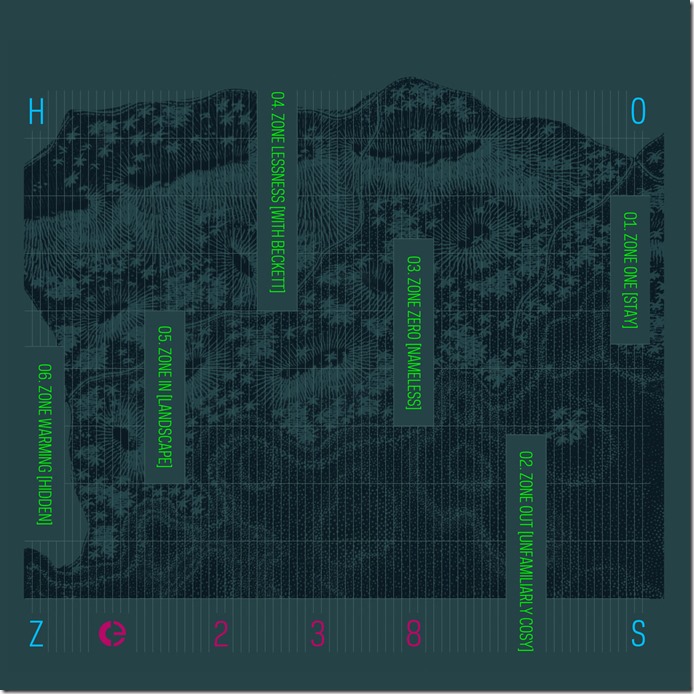
At the end of the 1990s, Hakim Bey wrote a book about the then-emerging possibility of the virtual. With the lucidity for which he is known, he recognized at the time that the virtual was nothing more than a new avenue for the expansion of capitalism. He introduced the concept of temporary autonomous zones as a kind of Foucauldian heterotopia — spaces that existed only for as long as they could evade capture. Today’s reality reflects a radical intensification of what Bey was referring to in the 1990s. Temporalities have changed completely. We are now almost overwhelmed by an incessant pursuit of instantaneity, accompanied by the mounting impatience it inevitably breeds.

The temporalities of sound, therefore, are naturally different too.

Time must be disobeyed.

The sounds of our autonomous zones aim to be the opposite of what technology offers us today: fascination and dazzle through excess — more buttons, more effects, louder… AI. These are bare sounds, defiantly rejecting the paraphernalia that surrounds them. They are simple yet perhaps carry the greatest complexity of all: turning their backs on spectacle and presenting themselves as they are: unmasked.

This work is the outcome of a series of studio sessions recorded during the summer and autumn of 2024. We followed an exploratory approach grounded in clearly defined premises and a pre-conceived compositional outline shaped by three key notions that are central to us: repetition, silence, and duration.

There is no post-production manipulation. What you hear is what was played. Inactual by conviction, this represents an utterly contemporary mode of being. These are sounds that seek to endure as a resistant, autonomous possibility — even if only fleetingly. Suspended between silences. Those marvelous, singular, sounds that Cage taught us to hear. They are there to last for as long as they can.

The title Horizons of Suspended Zones is inspired by a book from Hakin Bey.

I find that I’m sitting rather less comfortably now than I was a few minutes ago. I’ve never read a word by Hakim Bay. I’m aware of him and his work, but have never got as far as investigating. Therefore, I’m deficient. And so, in my head-swimming uncertainty, bewilderment and state of flaking confidence, I arrive at this fifty-five minute articulation of time-challenging theory/practice feeling weak, overwhelmed. Where do I even begin? Can I relate it to my own lived experience?

I struggle, because it doesn’t communicate that postmodern overlapping and disruption of the time / space continuum in a way that I can relate. For me, cut-ups and collage works convey how I experience life: the eternal babble of chatter and time experienced in terms of simultaneity rather than in linear terms.

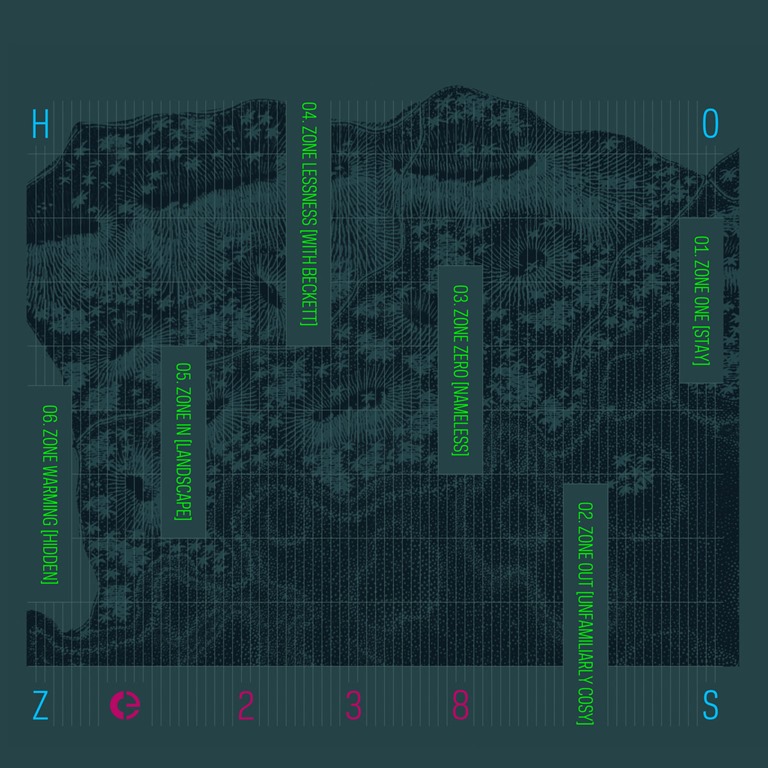
‘Zone One [stay]’ is a drifting, abstract, ethereal ambient work, and while over ten and a half minutes in duration, the time simply evaporates. It drifts into ‘Zone Out [unfamiliarly cosy]’, which is appropriately titled, and I find that I do as instructed, as the slow chimes and resonant tones hover in the air like bated breath. There’s a sense of suspense, that something will happen… but of course, it doesn’t.

For all of the detail around the concept, there’s very little around the construction by comparison. But perhaps a bell chime is simply a bell chime and an echo simply an echo. But those echoes matter. I find myself wading through the echoes of time, how it passes, how we lose time. How did we get to August? How did we – my friends and I – get so old? How, how, how is the world so utterly fucked up right now?

Each extended abstraction turns into the next, and so ‘Zone Zero [nameless]’ arrives unushered, unannounced, and unnoticed. There are whispers, the sound of the wind through rushes, and there’s something dark in the atmosphere. It’s only on returning to this after some time to reflect that I come to note the squared brackets in the titles. It’s an unusual application of this punctuation, which is more commonly found in academic work, and which I assume isn’t accidental – but why?

Anyone who’s read Beckett will know how painful and challenging, and, above all, how his work can be, and so ‘Zone Lessness [with Beckett]’ certainly reflects the emptiness of many of Becket’s works – the sprawling nothing where there are no events, no… nothing, and how life itself bypasses us as we wait. Life, indeed, it what happens while we’re making plans. It has a painful habit of passing us by. Life is not the Instagram shots or ‘making memories’ moments. It’s the trip to the supermarket, it’s endlessly checking your bank balance, it’s the dayjob and the cooking and washing up. It’s the dead moments that count for nothing. Those moments occupy the majority of time. And on this track, a low laser drone slowly undulates throughout, and over time, fades in and out, along with incidentals which allude to lighter shades, and ultimately, the nine minutes it occupies simply slip away.

‘Zone In [landscape]’ is sparse but dense, moody and atmospheric in its rumbling minimalism, and the last cut, ‘Zone Warming [hidden]’ chimes and echoes, bells ringing out into endless silence, without response, before tapering contrails of sound slowly and subtly weave their ways in and out. There are spells of silence, and the silence casts spells, and the spells float upwards in suspension.

Perhaps an appreciation of the context and theoretical framing of Horizons of Suspended Zones is advantageous, but it remains accessible as an abstract ambient work without that deeper comprehension. And it still feels as if there’s a sadness which permeates the entirety of the album. It’s by no means heavy, but it does have an emotional weight that drags the listener in, and then drags the listener down. And then leaves them… simply nowhere. Caught with their thoughts, and nowhere to take them.

AA

AA
a4170718585_10

US dark-pop duo Magic Wands have released a double single today (1st August) that couples the brand new song ‘Across The Water’ with a remix by Stargods of their ‘Hide’ single issued exactly a year ago. The latter is accompanied by a new video that can be seen here:

AA

They describe ‘Across The Water’ as “setting the tone for a sonic journey through time, transporting us to a 16th-century French European landscape and evoking the essence of a bygone era. Its repetition invites interpretation, allowing listeners to weave their own narrative and connect with the music on a deeper level.”

‘Across The Water’ is the opening track on a brand new album by the duo entitled Cascades, which is set for release on 24th October via Metropolis Records. It also includes the original single version of ‘Hide’, plus the previously issued ‘Armour’ and ‘Moonshadow’. The album will be promoted with an appearance at the Substance 2025 festival in Los Angeles on 7th November, with further shows to be arranged.

AA

c221a95108828c1659ddda2ea3ebf8b9e03358d3

1st August 2025

Christopher Nosnibor

The other day, while riffling through my record collection, I found a few LPs and 12” I had quite forgotten owning, including a promo copy of ‘Chance’ by Red Lorry Yellow Lorry. Stapled to the plain black die-cut cover of this white-label record with the title hand-written in biro, is a press release which simply reads ‘I know this is what you’ve all been waiting for….. Yep. The new Red Lorry Yellow Lorry single It’s called “Chance” and as usual it’s on Red Rhino Records. It’s very good’ and is signed ‘Yours condescendingly’.

You just don’t get press releases like that any more – especially not typed in all block caps and photocopied.

I appreciate the effort that goes into a good press release, and a solid band bio, because it does help me as a reviewer get a sense of context, of what a band’s about, what an album’s about. But the counterpoint to that is that there’s so much detail being spoon-fed, there’s less room for creative interpretation. The fact of the music industry has changed radically since the 80s and 90s, the days of the weekly inkies, the time before the Internet.

There simply was no way of ‘doing research’. And writers had tight deadlines. And so they just riffed to fill the column inches. Facts were hazy, critiques were often based on first impressions and knocked out in an hour after an extended liquid lunch. Names, dates, titles weren’t always accurate. And fans scoffed at the errors – and still do when clippings are posted online – but that was the nature of the beast.

Now, misspell the name of the bassist or give the wrong year for their debut EP, or somesuch and PRs, labels, and bands are onto you straight away asking for corrections. In a competitive market – I often report that on average, I receive around fifty submissions a day – simply getting coverage is a massive feat. This is certainly not to say that those times past were better – simply different, and I simply navigate my way to this release via this route to demonstrate the ways in which things have changed in the years since I started out writing about music in the 90s. It’s also altogether rarer now to find negative reviews, and while a part of this is due to the overwhelming amount of music being released meaning that reviewers are generally more inclined to spend what time they have promoting music they like, there’s also a certain element of fear of there being a social media pile-on, or having their supply of gratis music cut off. But artists and their labels and PR really need to accept that they’re not going to please all the people all the time, and sometimes, it’s necessary to call out an act with dodgy politics or whatever, or to simply call a turd a turd.

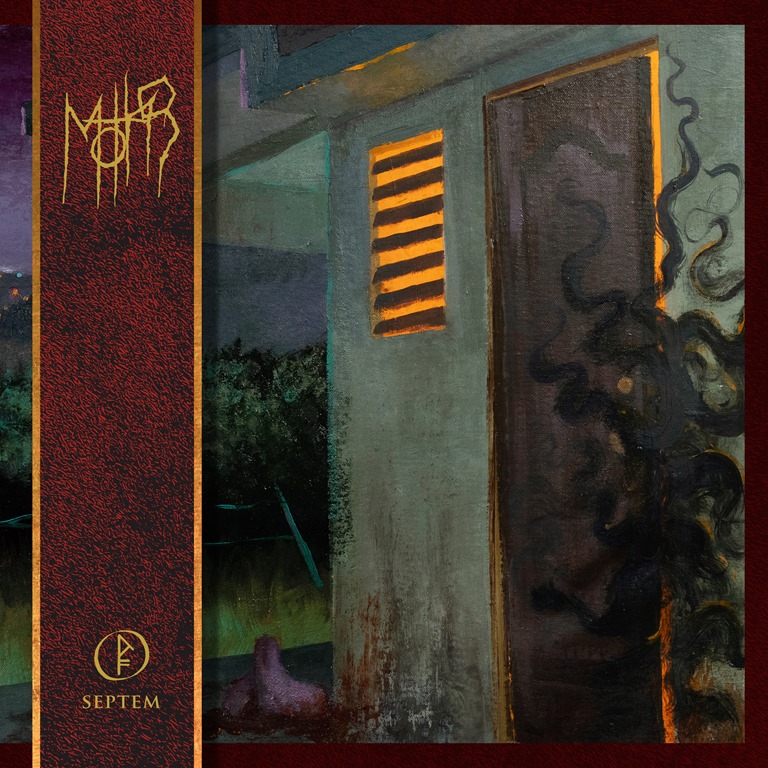
Anyway. Before I’ve even hit play, I’ve learned that this release by MOTHS is ‘a visceral journey through the Seven Deadly Sins, with each track embodying a facet of indulgence, obsession, and self-destruction — from the corrosive jealousy of “Envy” to the insatiable hunger of “Gluttony” and the rage of “Wrath”. The album plunges listeners into a dark, immersive experience where desire spirals into chaos’, and that ‘Diving deeper into heavier territory, MOTHS fuse elements of death and black metal with their signature blend of progressive, psychedelic, doom, and stoner metal, crafting a sound that’s both aggressive and atmospheric. With every step forward, MOTHS continues to explore new sounds and challenge genre boundaries, proving that music has no limits when driven by passion and innovation.’

I feel as if my work is already done. I can pour myself a large vodka and kick back, right? Well, I could. But that’s not my style. At least not the kicking back part. Large vodka in hand, I brace myself for the sonic onslaught… to be faced with some tinkering banjo or acoustic guitar giving country licks that are pure blues / Americana. And it gets jazzier and groovier as it goes on. What the fuck is this?

‘Sloth’ slides into ‘Envy’, a slippery, sultry alt-rock cut where the vocals are bathed in reverb, and the lo-fi production belies the fact that this is a vaguely jazzed-up take on grungy emo, at times coming on like Paramore recorded on a 90s cassette four-track. The haziness of the recording is actually something of a positive, but these are songs which require a slicker, fuller production. As a consequence, these takes sound more like demos than final versions.

The murky rawness works better on ‘Greed’, which brings rabid, raw-throated, growling black metal elements to the vaguely gothic metal compositions. It segues into ‘Pride’ which goes full-throttle skin-peeling abrasion before suddenly going commercial rock with fancy licks at the midpoint. I like ZZ Top, as it happens. I just wasn’t expecting a riff from Eliminator here.

‘Pride’ does take things full heavy, a prime slice of sludgy doom, and ‘Lust’ is, without question, a slugging slab of doominess, with some fancy fretwork thrown in on top. There’s certainly a lot going on here, and most of it works. MOTHS certainly bring some megalithic riffs and a lot of fire to an album that may be unpredictable in places, but is, overall, solid and with no shortfall of gutsy, guitar-driven heft.

AA

MOTHS - cover